
4 PATROLLING 4 1 Kinds of patrolling i


- Slides: 58
4 PATROLLING 4. 1 Kinds of patrolling i. e. Key men’s daily patrol, Gang 1 patrol, Monsoon Patrolling, security, Patrolling, Stationary Watchman at vulnerable points, Weather warnings, Single and double frequency patrolling,
Necessity of patrolling • Condition of Permanent Way–– • Each JE/SSE(P. Way) shall be responsible for the condition of the permanent way under his charge.
Necessity of patrolling … • Maintenance of Line –– • Each JE/SSE(P. Way) shall – • (i) See that his length of line in his charge are efficiently maintained, and • (ii) Promptly report to the SSE/P. Way(in-charge) all accidents to, or defects in the way, which he considers likely to interfere with the safe running of trains, at the same time taking such action as may be necessary to prevent accidents.
Necessity of patrolling … Keeping of material–– • Each JE/SSE(P. Way) shall see to the security of all rails, chairs, sleepers, and other material in his charge, and ensure that such of the said articles as are not actually in use are properly stacked clear of the line so as not to interfere with the safe running of trains.
Necessity of patrolling … Inspection of Permanent Way–– • Every portion of the permanent way shall be inspected daily on foot by some railway servant appointed in this behalf by special instructions: • Provided that the interval between such inspections may, under approved special instructions, be increased to once in two days in the case of lines with light and infrequent traffic.
Necessity of patrolling … Inspection of Permanent Way–– • All bridges and works including signals, signal wires, interlocking gear, points and crossings, overhead equipment and any other equipment affecting the safety and working of all trains shall be inspected regularly in accordance with special instructions. • In addition to the daily/regular inspection, whenever any portion of a railway is likely to be endangered by abnormal conditions such as heavy rains, breaches, floods, storms and civil disturbances etc. , the line shall be patrolled in accordance with special instructions.
Necessity of patrolling … • When a railway servant deputed to patrol the line notices any condition likely to affect the safety of trains or otherwise apprehends danger, he shall take action in accordance with special instructions prescribed for the purpose to protect the obstruction on line and thereafter inform the nearest Station Master by the most expeditious means.
Necessity of patrolling … • Patrolling of line is an intensive inspection by foot, of the line that is arranged in addition to the daily inspection being carried out by the Keyman of the gang. • This is necessary to safeguard running of trains from any danger likely to be encountered due to any unsafe conditions that would be developed in the track or bridges, natural or otherwise.
Necessity of patrolling … • Occasions when line patrolling is necessary : • Patrolling of railway line is resorted to under the following circumstances. • In the event of sudden storm or hurricane during day or night; • Gang patrol during abnormal rainfall or storm.
Necessity of patrolling … • Occasions when line patrolling is necessary : • Monsoon Patrolling. • Hot/Cold weather patrolling for long welded rails/continuous welded rails • Watchmen at vulnerable locations • Security patrolling during civil disturbances and special occasions.
Types of patrolling (a) Keyman’s daily patrol. (b) Gang patrol during abnormal rainfall or storm. (c) Night patrolling during monsoon. (d) Hot/cold weather patrolling for LWR/CWR (e) Watchmen at vulnerable locations. (f) Security patrolling during civil disturbances and special occasions for movement of VIP specials.
Keyman’s Daily Patrol – v Every portion of the permanent way shall be inspected daily on foot by the key man of the beat in which the portion of the track falls. v Provided that, the interval between such inspections may, under special instructions, issued by Chief Engineer be increased to once in two days in the case of specified section of lines with light and infrequent traffic. v The Keyman shall preferably be provided with a GPS tracking device, to monitor his movements so as to ensure effective patrolling.
Gang Patrol during Abnormal Rainfall or Storm – v In the event of abnormal rainfall or storm during day or night, the Gang Mate should, on his own initiative, organize patrolling over the length affected, independently of other patrolling, if any, being done. v This patrol should, in case of heavy rainfall, confine its inspection to known points of danger, such as cutting or culverts likely to scour, banks affected by tanks likely to breach and bridge approaches. v In case of high winds, the Patrolman should inspect the length of track likely to be fouled by falling of tree etc.
Monsoon Patrolling v During the monsoon, certain section of the railway line, as may be specified, shall be patrolled to detect damage by flood, such as breaches, settlements, slips and scours and immediate action be taken to protect trains, when so warranted.
Commencement and Termination – v The sections, which are normally to be patrolled during monsoon will be identified and notified by the DEN. v For every such section, the DEN shall prescribe the period of year, when normal monsoon patrolling is to be done.
Commencement and Termination … v Patrolling should be started on these notified sections on the dates specified. v If the local conditions warrant, the JE/SSE(P. Way) of the section concerned may introduce or continue night patrolling outside the stipulated dates, duly advising all concerned.
Hot Weather Patrolling for LWR/CWR– v Period for hot weather patrolling shall be laid down by the Chief Track Engineer for each section and patrol charts prepared where necessary. v Patrolling shall be organised by JE/SSE (P. Way) accordingly. v In addition, the JE/SSE (P. Way) and the Gang Mate shall be vigilant during summer and on hot days.
Hot Weather Patrolling for LWR/CWR … v Patrolling will be introduced, when the rail temperature rises above: (i) td + 25° C on PSC sleeper track with sleeper density 1540 nos. Per km and above. (ii) td + 20° C on PSC sleeper track with sleeper density less than 1540 nos. Per km
Hot Weather Patrolling for LWR/CWR … v Patrol beat for Hot weather patrolling will be as follows: (i) On single line or where only one road in a double line section is having LWR/CWR- One patrolman for 2 km. (ii) On double line section when LWR/CWR exist on both roads One patrolman for 1 km length of UP and DN road. v The beats of each hot weather patrolman will thus be restricted to 2 km.
Hot Weather Patrolling for LWR/CWR … v (iii) Changes in beat length and man power deployment as given above, if found necessary, may be decided by the Sr. DEN (Co) of the division depending on prevailing local conditions, frequency of train service, weather conditions etc. , v The hot weather patrolman should always carry the following equipment: HS Flags - Red 2 Nos. Staff for Flags - 1 No. Detonators - 10 Nos. Canne-a-boule fitted with rubber ball – 1 No.
Hot Weather Patrolling for LWR/CWR … Hot Weather Patrolman : v He shall patrol the track during the hottest part of the day, to look for prominent kinks, incipient buckles or tendency towards buckling. v He shall protect the track at the site of the prominent kinks, incipient or actual buckles and report the same to nearest Station Master and JE/SSE/P. Way immediately. v The patrolman shall preferably be provided with a GPS tracking device, to monitor his movements so as to ensure effective patrolling.
Hot Weather Patrolling for LWR/CWR … Hot Weather Patrolman … v He will walk over his beat slowly over one rail/on sleeper non gauge side of rail in one direction and on the other rail/on sleeper non gauge sleeper side of rail in the return direction. v On double lines, he will repeat this procedure alternately on UP and DN tracks. v He will be vigilant and look out for kinks in the rail especially during the hottest part of the day.
Hot Weather Patrolling for LWR/CWR … Hot Weather Patrolman … v When a kink is observed, he shall immediately examine at least 100 sleepers ahead and in the rear of the kink for any floating condition of track. He should meticulously sound each and every sleeper, 100 sleepers on either side of the kink, to determine any floating condition. v The amount of rebound will be noted by dropping a Canne-aboule on each end of the sleeper to determine the extent of void under the sleeper. Should the amount of rebound reveal a floating condition, under which a buckle may be anticipated or the patrolman has detected actual buckling of track,
Hot Weather Patrolling for LWR/CWR … Hot Weather Patrolman … v He will take immediate steps to protect the affected portion by display of hand signals as per rules in force. v After protecting the track, the patrolman will arrange to advise the Gangmate, JE/SSE/P. Way of his apprehension of a buckle/actual buckle.
Hot Weather Patrolling for LWR/CWR … Hot Weather Patrolman … v The Gangmate on receipt of advice of a danger of buckle will proceed to the site quickly with all available men. v On arrival at site, he will first ensure protection of affected portion.
Hot Weather Patrolling for LWR/CWR … Hot Weather Patrolman … v He should then inspect the condition of track 100 m on either side of this suspected zone and commence heaping of surplus ballast, if available, on the shoulders and upto the rail head and keep on compacting the ballast with available tool. v No attempt should be made to slew or align the track or disturb the existing ballast section.
Hot Weather Patrolling for LWR/CWR … Hot Weather Patrolman … v The Gang Mate should continue to remain at site till the arrival of JE/SSE/P. Way. v The rail temperature will also be noted by one of these officials at the place of apprehended/actual buckle. v The rail facing the sun will be covered up to the level of rail head on the outside by ballast or leaves etc. to bring down the temperature of the rail.
Cold Weather Patrolling for LWR/CWR v Period and section where cold weather patrolling is to be done shall be laid down by Sr. DEN (Co) of the division based on rail/weld fracture analysis, extent of rail corrosion , overdue rail renewals and traffic density. v Cold weather patrolling shall compulsorily be started when rail temperature goes below (td-30°C). v Patrol charts will be prepared where necessary.
Cold Weather Patrolling for LWR/CWR … v Patrolling shall be organized by JE/SSE/P. Way (In-charge) accordingly. v The patrolman shall preferably be provided with a GPS tracking device, to monitor his movements so as to ensure effective patrolling.
Cold Weather Patrolling for LWR/CWR … v Following guidelines may be followed for issuing detailed instructions. v Patrol Beat for Cold weather patrolling shall be as follows: v (a) On single line or where only one road in a double section is having LWR/CWR - One patrolman for 4 km. v (b) On double line section when LWR/CWR rest on both road One patrolman for 2 km length of UP and DN road.
Cold Weather Patrolling for LWR/CWR … v (c) Changes in beat length and man power deployment as given above, if found necessary, may be decided by the Sr. DEN (Co) of the division depending on prevailing local conditions, frequency of train service, weather conditions etc.
Cold Weather Patrolling for LWR/CWR … v Cold weather patrolman should carry the following equipment: (i) Fog signals in a case – 10 Nos. (ii) Tri-colour hand signal lamps/Rechargeable LED torch – 2 Nos. (iii) Match box – 1 No. (iv) Red flags – 2 Nos. (v) Green flag – 1 No. (vi) Three-cell electric torch – 1 No.
Cold Weather Patrolling for LWR/CWR … v Cold weather patrolman should carry the following equipment: (vii) Staff – 1 No. (viii) Number plate – 1 No. (ix) Spanner (x) Protective clothing according to local dress regulations including industrial safety shoe / Gum boots, Safety jacket, Rain coat, Helmet with Head light.
Cold Weather Patrolling for LWR/CWR … Cold Weather Patrolman: v He shall patrol the track during the coldest part of the night and lookout for weld/rail fractures and excessive gaps at SEJ. v He shall protect the track at the site of weld/rail fractures or excessive gaps at SEJ and report the same to nearest Station Master/JE/SSE (P. Way).
Cold Weather Patrolling for LWR/CWR … Cold Weather Patrolman … v He will walk over his beat slowly along one rail in one direction and on the other rail in the return direction. v On double line, he will repeat this procedure alternately on UP and DN tracks. v He will be vigilant and look out for rail/weld failure.
Cold Weather Patrolling for LWR/CWR … Cold Weather Patrolman … v He will also notice the gaps at SEJs if they fall in his beat. v In case he notices a rail/weld failure or gap at SEJ becomes more than the designed maximum gap, he will take immediate action to suspend the traffic and protect the line as per rule. v After protecting the track, the patrolman will arrange to report to Keyman/Gangmate, JE/SSE (P. Way) who shall arrange for making emergency repairs to pass the traffic.
Watchmen at vulnerable locations v In addition to patrolmen, stationary watchmen are posted at known or likely locations of danger or trouble. v (1) Definition– Vulnerable Locations (Points) are those, where conditions unsafe for the passage of trains are apprehended and there is need for stopping of trains in time in case such conditions develop e. g. v (a) Bridges, having inadequate water-way, liable to scour in foundations, oblique/ Parallel flow of water to the approaches, rise of flood above danger level frequently.
Watchmen at vulnerable locations v (b) Bad banks liable to slips and subsidence. v (c) Bridges located across river courses fed by Railway affecting tanks. v (d) Cuttings and Hill designated as vulnerable by DEN/Sr. DEN. v (e) Water over-flowing over the track, and v (f) Any other condition likely to affect the safety of the track.
List of Vulnerable list of Vulnerable Locations should be maintained by each Assistant Divisional Engineer/Divisional Engineer in a register form and should be reviewed and brought up-to-date.
Guarding of Vulnerable Locations– v Stationary Watchman should be posted round the clock at every nominated location during the monsoon period, as required. v He should keep a watch on vulnerable location and in case he apprehends danger he should take action to protect the line in accordance with Para 1004(8).
Guarding of Vulnerable Locations … v The equipment for the watchman should be on the same scale as Patrolman except that a watch man will not be provided with– (i) Number plate. (ii) Haversack. (iii) Patrol book in tin case. v A notebook should however be provided to the watchman.
Security Patrolling during Civil Disturbance and on Special occasions: v On apprehension of a Civil Disturbance, the Divisional authorities should contact the local Civil authority and arrange, as circumstances may warrant for security patrolling of the railway line. v This may be arranged on the pattern of the monsoon patrolling with modifications, as deemed necessary, in consultation with Civil authorities.
Security Patrolling during Civil Disturbance and on Special occasions: v Security patrolling on special occasions should be carried out according to the special instructions issued by the administration. v The primary duty of the Patrolman employed on Security patrolling shall be to protect trains against any condition of danger, such as tampering with track or obstruction placed on line.
Weather warnings General : v Arrangements exist with the Meteorological Department of the Government of India for sending electronic communication regarding warning, wherever storms, gales or heavy rainfall is expected. v On receipt of such information from the Control, the JE/SSE/P. Way will arrange to advise monsoon patrolmen, watchmen and gang mates to be extra vigilant and be prepared to introduce patrolling, as necessary. v The beat length of Gang Patrolling shall be similar to the monsoon patrolling.
Weather warnings … General– v The list of officials who should receive the bad weather warnings and their addresses should be advised to the Meteorological Department by the Division. The list should be reviewed and updated every year. v Detailed instructions and fool-proof arrangement should exist for prompt communication of bad weather warnings on receipt to the line staff.
Weather warnings … General– v Anemometer should be installed at one of the adjacent stations of specially selected bridges where very high velocity winds are experienced and where there is a danger of vehicles capsizing.
Weather warnings … General– v Suitable working rules should be framed prescribing for each location the danger level of wind velocity and enjoining upon the Station Master to control (stop) the traffic on the section concerned when the wind velocity exceeds the Danger Level and also to inform the Station Master on the other side and the Section Controller of the need to control the traffic.
Action taken by the SSE/P. Way (In-charge)– on receipt of weather warning v The SSE/P. Way (In-charge) on receipt of weather/cyclone warning, should arrange to advise monsoon Patrolmen/Watchmen and Gang Mates to be extra vigilant. v During the fair season, he should introduce monsoon patrolling as soon as possible and also post watchman as required at all vulnerable locations and bridges by day as well as by night, for a period extending upto 48 hours beyond the period specified in the weather/ cyclone warning message.
Action taken by the SSE/P. Way (In-charge)– on receipt of weather warning … v The JE/SSE/P. Way should be out in his section, as far as possible by trolley, during the period of warning and 48 hours beyond, if the trains are in operation.
Action taken by the Gang Mates on receipt of weather warning v Action by the Gang Mates– On receipt of advice from the Station Master or JE/SSE/P. Way, the Gang Mate should take the following action– v (i) During the fair season, the Gang Mate of station yard gang should depute two reliable Track Maintainer provided with patrolmen’s equipment for patrolling the block sections on either side and for alerting the intermediate Gangmates.
Action taken by the Gang Mates on receipt of weather warning … v (ii) During monsoon period also, the Gang Mate of the station yard gang should send two Track Maintainer in opposite directions to alert intermediate Gangmates, Patrolmen and Watchmen. v (iii) Should there be very heavy rain or a severe storm weather during the monsoon or fair season, the Gang Mate and Track Maintainer of all gangs on their own initiative should commence monsoon patrolling by day as well as night. v (iv) Similar action to carry out patrolling should be taken on receipt of bad weather warning for the duration of warning and 48 hours beyond.
Single and double shift patrolling v All trains carrying passengers between sunset and sunrise get the maximum protection possible. v As far as possible, each block section will be treated as a unit and the length will be divided into equal beats. v The length of each patrol beat should not normally exceed 5 km
Single and double shift patrolling … v where the block section is more than 10 km an intermediate flag station, if any, or any other suitable point may be fixed as intermediate station, to keep the length of beat at about 5 km. v The walking speed of a Patrolman may be taken as 3 Kmph. v The maximum distance covered by a Patrolman should not normally exceed 20 km in a day.
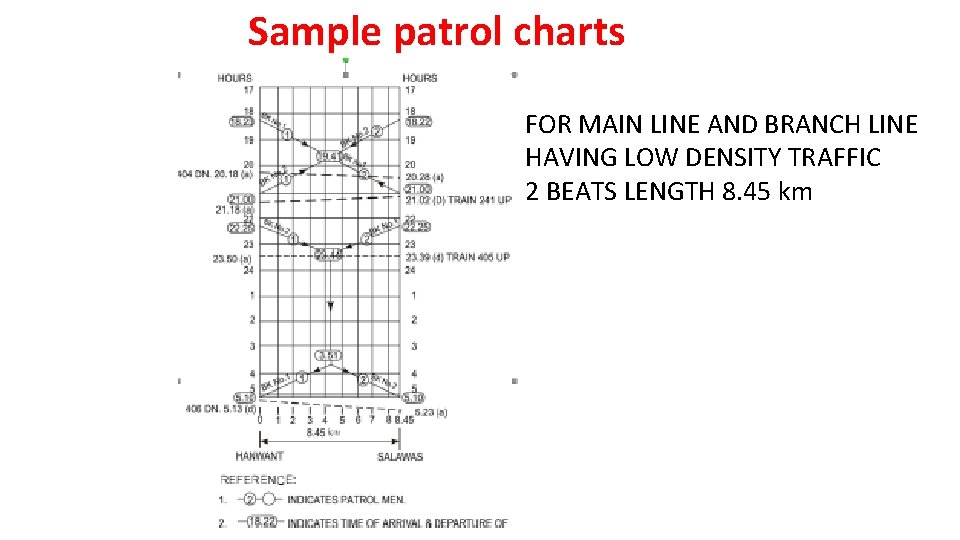
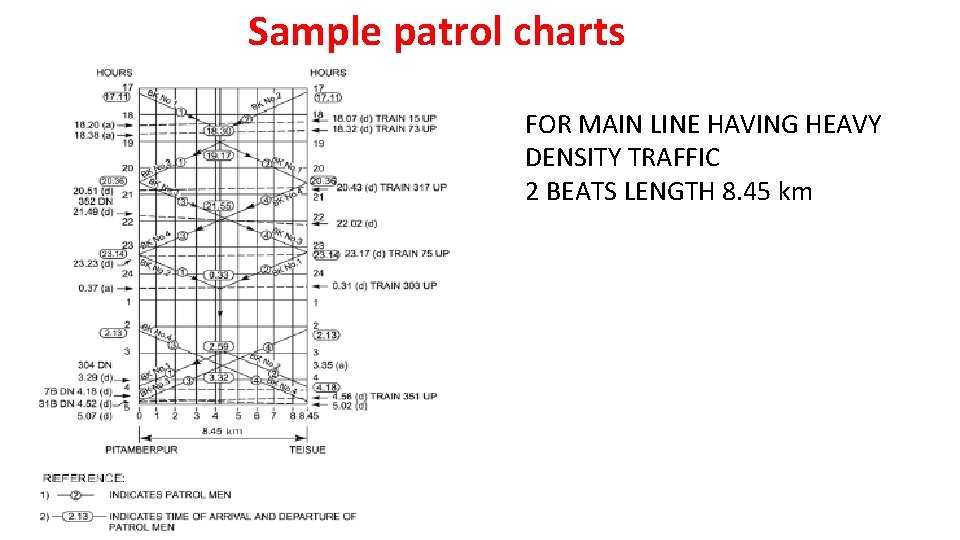
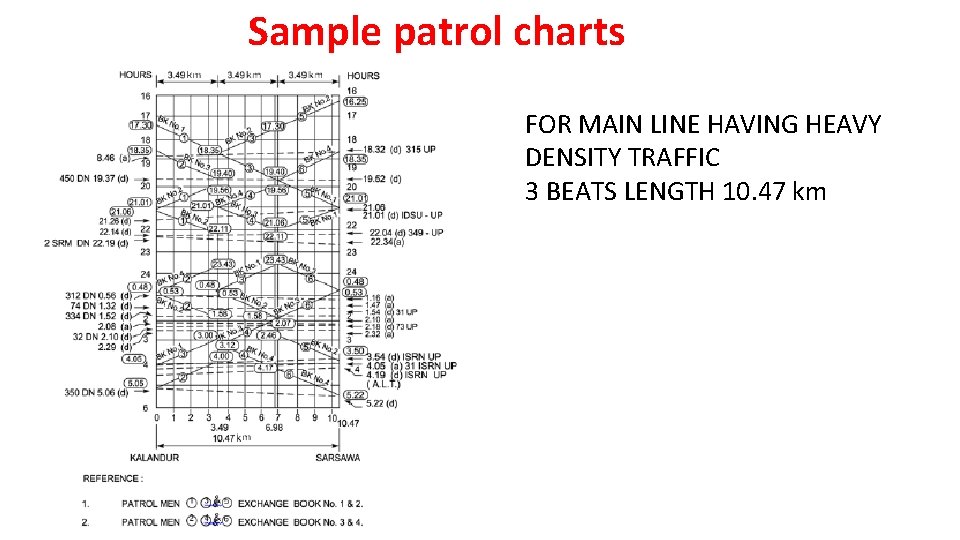
Single and double shift patrolling … v A period of at least half an hour rest is desirable between consecutive beats. v For giving better protection to passenger trains between sun-set and sun-rise, it would be advantageous to plot the scheduled paths of all passenger trains and then plot the patrol movement in such a way, so as to minimize the time interval between patrolling of the beat and passage of train. v Patrol charts should show all vulnerable locations where stationary watchmen are posted.
Sample patrol charts FOR MAIN LINE AND BRANCH LINE HAVING LOW DENSITY TRAFFIC 2 BEATS LENGTH 8. 45 km
Sample patrol charts FOR MAIN LINE HAVING HEAVY DENSITY TRAFFIC 2 BEATS LENGTH 8. 45 km
Sample patrol charts FOR MAIN LINE HAVING HEAVY DENSITY TRAFFIC 3 BEATS LENGTH 10. 47 km
THANKS