
4 Mapping the Territory Seven Traditions in the
- Slides: 19
4 Mapping the Territory (Seven Traditions in the Field of Communication Theory) A First Look at Communication Theory 8 th edition Em Griffin © 2012 The Mc. Graw-Hill Companies, Inc. All rights reserved.
Slide 2 Mapping the Territory q The Socio-Psychological Tradition q The Cybernetic Tradition q The Rhetorical Tradition q The Semiotic Tradition q The Socio-Cultural Tradition q The Critical Tradition q The Phenomenological Tradition q Fencing the Field of Communication Theory q The Ethical Tradition © 2012 The Mc. Graw-Hill Companies, Inc. All rights reserved.
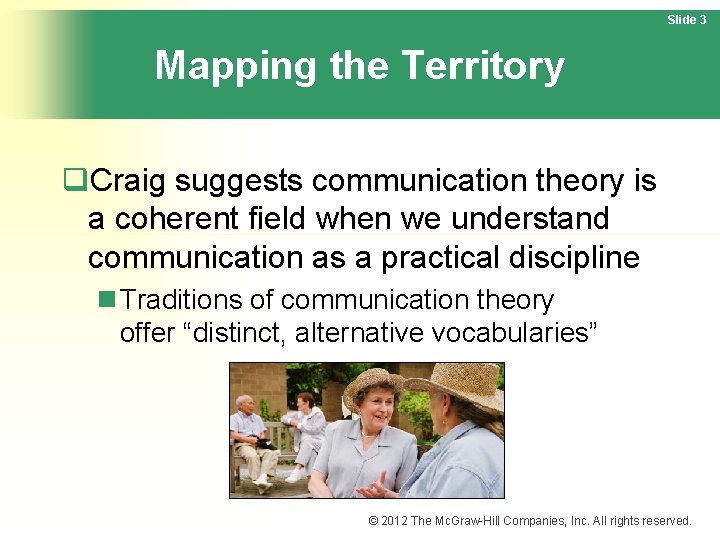
Slide 3 Mapping the Territory q. Craig suggests communication theory is a coherent field when we understand communication as a practical discipline n Traditions of communication theory offer “distinct, alternative vocabularies” © 2012 The Mc. Graw-Hill Companies, Inc. All rights reserved.
The Socio-Psychological Tradition Slide 4 q. Communication as Interpersonal Interaction and Influence n Scholars believe communication truths can be discovered by careful, systematic observation • Cause-and-effect relationships • Usually means designing a series of surveys or controlled experiments • Longitudinal study of college friendships © 2012 The Mc. Graw-Hill Companies, Inc. All rights reserved.
Slide 5 The Cybernetic Tradition q. Communication as a System of Information Processing n Cybernetics – study of information processing, feedback, and control in communication systems • Theorists ask “How can we get the bugs out of this system? ” © 2012 The Mc. Graw-Hill Companies, Inc. All rights reserved.
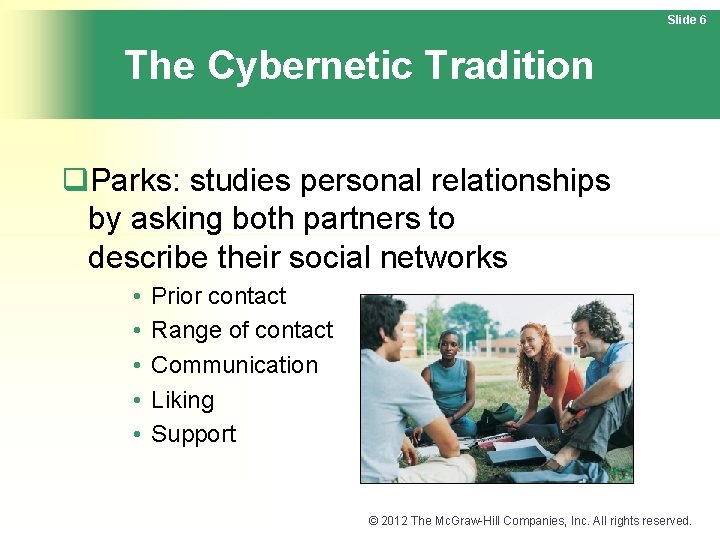
Slide 6 The Cybernetic Tradition q. Parks: studies personal relationships by asking both partners to describe their social networks • • • Prior contact Range of contact Communication Liking Support © 2012 The Mc. Graw-Hill Companies, Inc. All rights reserved.
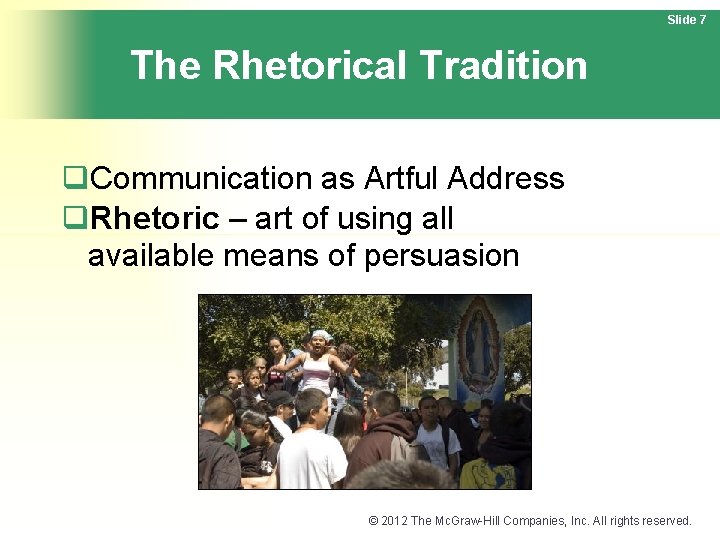
Slide 7 The Rhetorical Tradition q. Communication as Artful Address q. Rhetoric – art of using all available means of persuasion © 2012 The Mc. Graw-Hill Companies, Inc. All rights reserved.
Slide 8 The Rhetorical Tradition q. Characterized by 6 features • Speech distinguishes humans from other animals • Public address more effective than decrees • A single speaker attempts to influence an audience (one-way communication) • Oratorical training is cornerstone of a leader’s education • Rhetoric is more art than science • Oral public speaking, until the 1800 s, was province of males © 2012 The Mc. Graw-Hill Companies, Inc. All rights reserved.
Slide 9 The Semiotic Tradition q. Communication as the Process of Sharing Meaning Through Signs n Semiotics – study of verbal and nonverbal signs that stand for something else • How their interpretation impacts society n Symbols – arbitrary words and nonverbal signs that bear no natural connection with the things they describe • Meaning is learned within a given culture © 2012 The Mc. Graw-Hill Companies, Inc. All rights reserved.
Slide 10 The Semiotic Tradition q. I. A. Richards: railed against the semantic trap he labeled “the proper meaning superstition” q. Most theorists try to explain and reduce misunderstanding created by use of ambiguous symbols © 2012 The Mc. Graw-Hill Companies, Inc. All rights reserved.
Slide 11 The Socio-Cultural Tradition q. Communication as the Creation and Enactment of Social Reality n Culture produced and reproduced as people talk • Sapir-Whorf hypothesis of linguistic relativity – structure of a language shapes what people think and do n Persons-in-conversation coconstruct their own social worlds © 2012 The Mc. Graw-Hill Companies, Inc. All rights reserved.
Slide 12 The Critical Tradition q. Communication as a Reflective Challenge of Unjust Discourse n Critical theory from German scholars called “Frankfurt School” • Originally set up to test the ideas of Karl Marx © 2012 The Mc. Graw-Hill Companies, Inc. All rights reserved.
Slide 13 The Critical Tradition q Critical tradition challenges: 1. Control of language to perpetuate power imbalances 2. Role of mass media in dulling sensitivity to repression 3. Blind reliance on scientific method and uncritical acceptance of empirical findings © 2012 The Mc. Graw-Hill Companies, Inc. All rights reserved.
Slide 14 The Critical Tradition q Culture industries – entertainment businesses that n Reproduce the dominant ideology of a culture n Distract people from recognizing unjust distribution of power within a society © 2012 The Mc. Graw-Hill Companies, Inc. All rights reserved.
The Phenomenological Tradition Slide 15 q. Communication as the Experience of Self and Others Through Dialogue n Phenomenology – intentional analysis of everyday experience from standpoint of person who is living it • Explores possibility of understanding experience of self and others • Emphasizes people’s perception and interpretation of subjective experience © 2012 The Mc. Graw-Hill Companies, Inc. All rights reserved.
The Phenomenological Tradition Slide 16 q. Rogers: “Neither the Bible nor the prophets – neither Freud nor research – neither the revelations of God nor man – can take precedence over my own direct experience” n Why is it so hard to establish and sustain authentic human relationships? n How can this problem be overcome? © 2012 The Mc. Graw-Hill Companies, Inc. All rights reserved.
Fencing the Field of Communication Theory Slide 17 q. Traditions have deep roots in the field of communication theory n Hybrids possible across traditions n Charted traditions might not cover every approach to communication theory • Pragmatism – applied approach to knowledge; the philosophy that true understanding of an idea or situation has practical implications for action © 2012 The Mc. Graw-Hill Companies, Inc. All rights reserved.
Slide 18 The Ethical Tradition q. Principles of ethical communication n Advocate truthfulness, accuracy, honesty, and reason as essential to integrity of communication n Accept responsibility for short-term consequences of our communication and expect the same of others © 2012 The Mc. Graw-Hill Companies, Inc. All rights reserved.
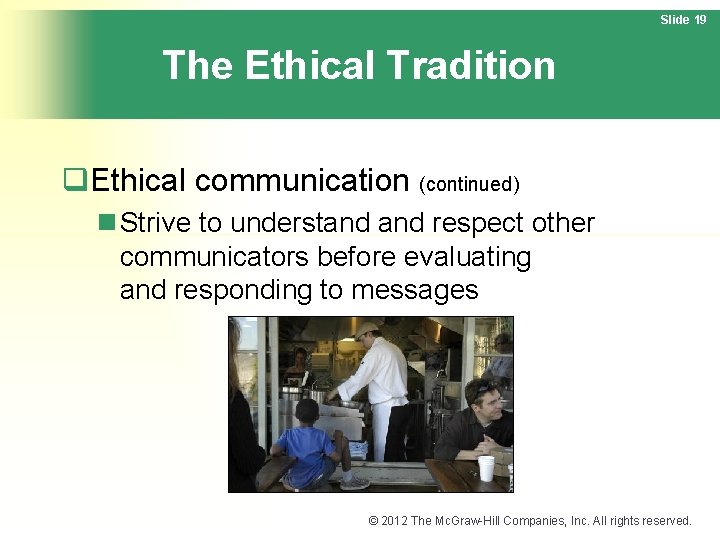
Slide 19 The Ethical Tradition q. Ethical communication (continued) n Strive to understand respect other communicators before evaluating and responding to messages © 2012 The Mc. Graw-Hill Companies, Inc. All rights reserved.