
4 Main Steps of Concolic Testing 1 Instrumentation
![Instrumentation in grep. c 1. 2. 3. 4. 5. #define BITSIZE 23 int bitmask[23];](https://slidetodoc.com/presentation_image/47defe17f6f1ecb5e019f10d2397debd/image-12.jpg "Instrumentation in grep. c 1. 2. 3. 4. 5. #define BITSIZE 23 int bitmask[23];")
![Target description -- vi � Description: � Usage: vi [OPTIONS] [FILE] … Options: �](https://slidetodoc.com/presentation_image/47defe17f6f1ecb5e019f10d2397debd/image-17.jpg "Target description -- vi � Description: � Usage: vi [OPTIONS] [FILE] … Options: �")
- Slides: 37
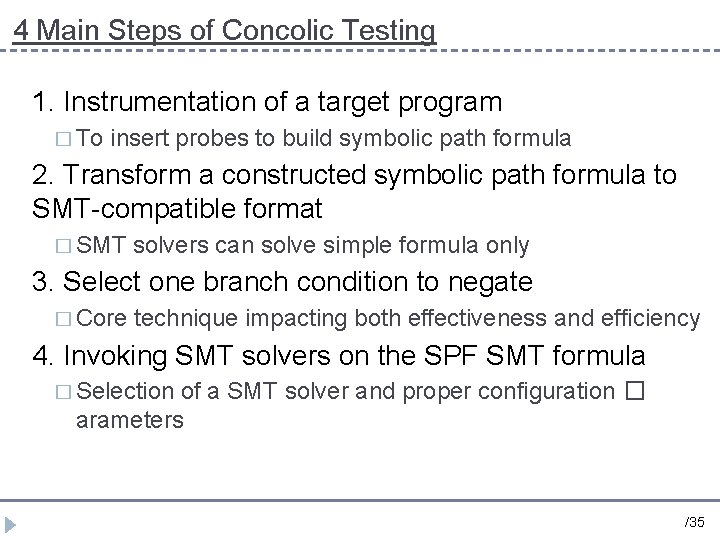
4 Main Steps of Concolic Testing 1. Instrumentation of a target program � To insert probes to build symbolic path formula 2. Transform a constructed symbolic path formula to SMT-compatible format � SMT solvers can solve simple formula only 3. Select one branch condition to negate � Core technique impacting both effectiveness and efficiency 4. Invoking SMT solvers on the SPF SMT formula � Selection of a SMT solver and proper configuration � arameters /35
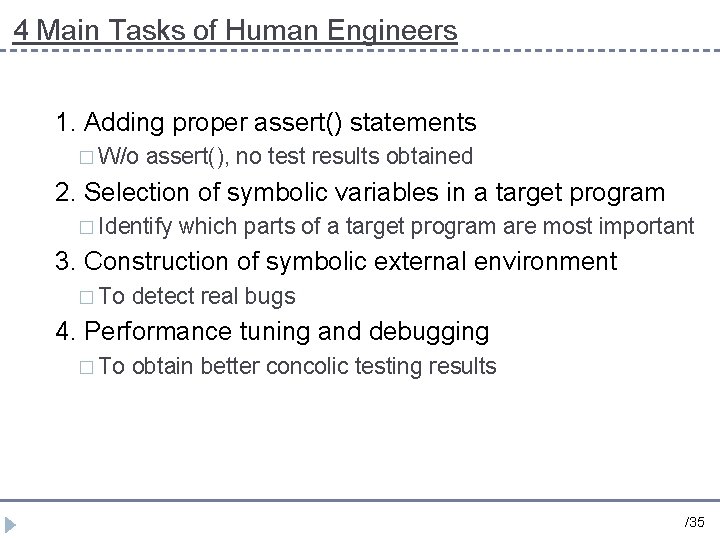
4 Main Tasks of Human Engineers 1. Adding proper assert() statements � W/o assert(), no test results obtained 2. Selection of symbolic variables in a target program � Identify which parts of a target program are most important 3. Construction of symbolic external environment � To detect real bugs 4. Performance tuning and debugging � To obtain better concolic testing results /35
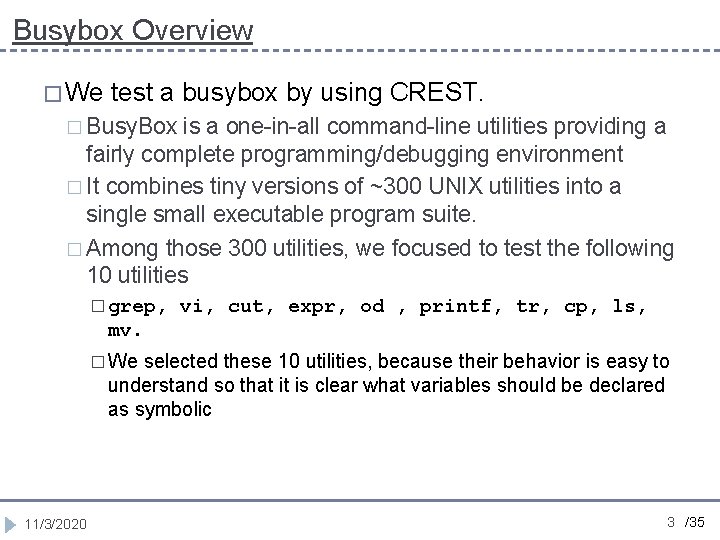
Busybox Overview � We test a busybox by using CREST. � Busy. Box is a one-in-all command-line utilities providing a fairly complete programming/debugging environment � It combines tiny versions of ~300 UNIX utilities into a single small executable program suite. � Among those 300 utilities, we focused to test the following 10 utilities � grep, vi, cut, expr, od , printf, tr, cp, ls, mv. � We selected these 10 utilities, because their behavior is easy to understand so that it is clear what variables should be declared as symbolic 11/3/2020 3 /35
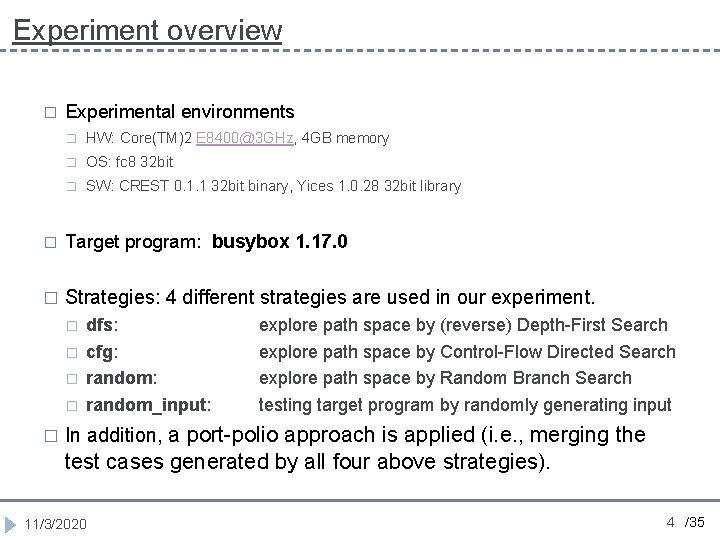
Experiment overview � Experimental environments � HW: Core(TM)2 E 8400@3 GHz, 4 GB memory � OS: fc 8 32 bit � SW: CREST 0. 1. 1 32 bit binary, Yices 1. 0. 28 32 bit library � Target program: busybox 1. 17. 0 � Strategies: 4 different strategies are used in our experiment. � � � dfs: cfg: random_input: explore path space by (reverse) Depth-First Search explore path space by Control-Flow Directed Search explore path space by Random Branch Search testing target program by randomly generating input In addition, a port-polio approach is applied (i. e. , merging the test cases generated by all four above strategies). 11/3/2020 4 /35
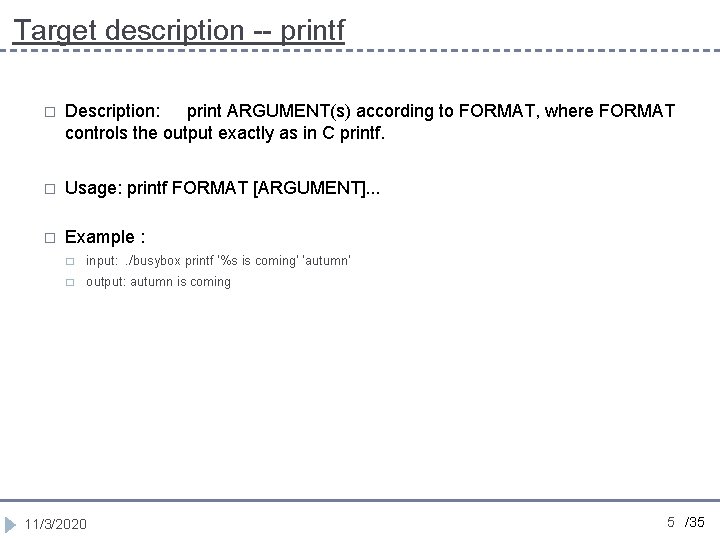
Target description -- printf � Description: print ARGUMENT(s) according to FORMAT, where FORMAT controls the output exactly as in C printf. � Usage: printf FORMAT [ARGUMENT]. . . � Example : � input: . /busybox printf ‘%s is coming' 'autumn‘ � output: autumn is coming 11/3/2020 5 /35
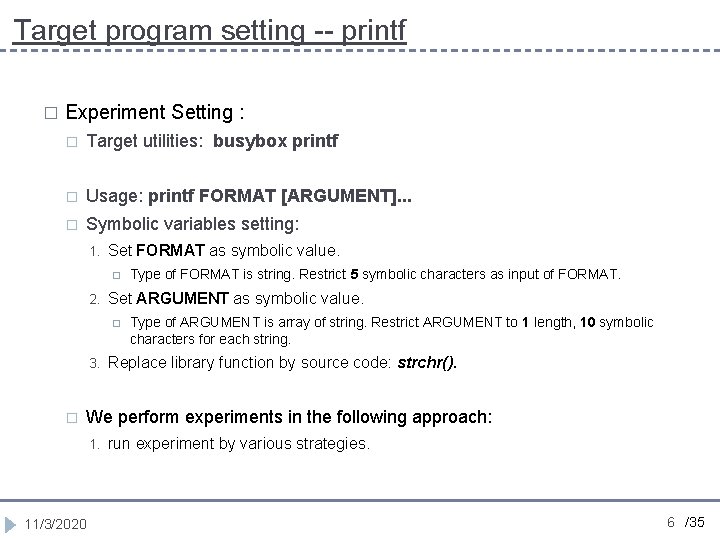
Target program setting -- printf � Experiment Setting : � Target utilities: busybox printf � Usage: printf FORMAT [ARGUMENT]. . . � Symbolic variables setting: 1. Set FORMAT as symbolic value. 2. Set ARGUMENT as symbolic value. 3. � Type of ARGUMENT is array of string. Restrict ARGUMENT to 1 length, 10 symbolic characters for each string. Replace library function by source code: strchr(). We perform experiments in the following approach: 1. 11/3/2020 Type of FORMAT is string. Restrict 5 symbolic characters as input of FORMAT. run experiment by various strategies. 6 /35
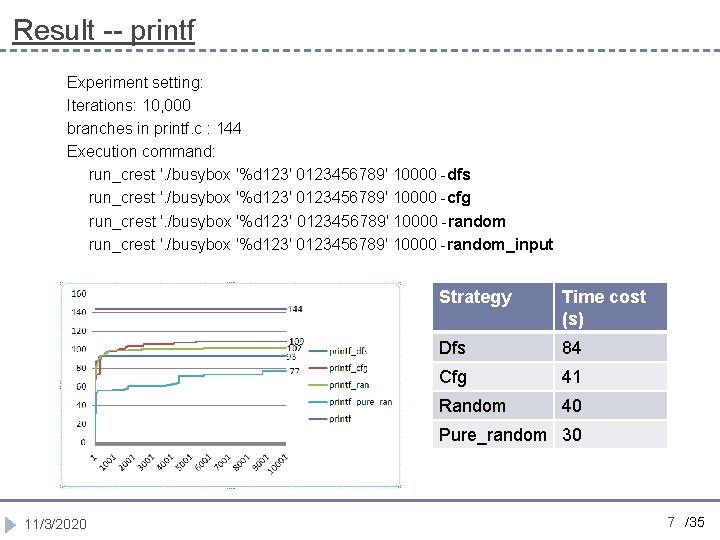
Result -- printf Experiment setting: Iterations: 10, 000 branches in printf. c : 144 Execution command: run_crest '. /busybox '%d 123' 0123456789' 10000 -dfs run_crest '. /busybox '%d 123' 0123456789' 10000 -cfg run_crest '. /busybox '%d 123' 0123456789' 10000 -random_input Strategy Time cost (s) Dfs 84 Cfg 41 Random 40 Pure_random 30 11/3/2020 7 /35
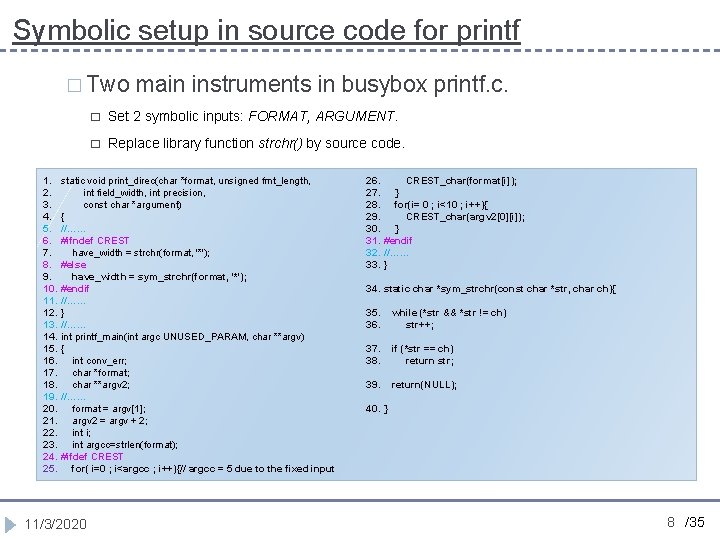
Symbolic setup in source code for printf � Two 1. 2. 3. 4. 5. 6. 7. 8. 9. 10. 11. 12. 13. 14. 15. 16. 17. 18. 19. 20. 21. 22. 23. 24. 25. main instruments in busybox printf. c. � Set 2 symbolic inputs: FORMAT, ARGUMENT. � Replace library function strchr() by source code. static void print_direc(char *format, unsigned fmt_length, int field_width, int precision, const char *argument) { //…… #ifndef CREST have_width = strchr(format, '*'); #else have_width = sym_strchr(format, '*'); #endif //…… } //…… int printf_main(int argc UNUSED_PARAM, char **argv) { int conv_err; char *format; char **argv 2; //…… format = argv[1]; argv 2 = argv + 2; int i; int argcc=strlen(format); #ifdef CREST for( i=0 ; i<argcc ; i++){// argcc = 5 due to the fixed input 11/3/2020 26. CREST_char(format[i]); 27. } 28. for(i= 0 ; i<10 ; i++){ 29. CREST_char(argv 2[0][i]); 30. } 31. #endif 32. //…… 33. } 34. static char *sym_strchr(const char *str, char ch){ 35. 36. while (*str && *str != ch) str++; 37. 38. if (*str == ch) return str; 39. return(NULL); 40. } 8 /35
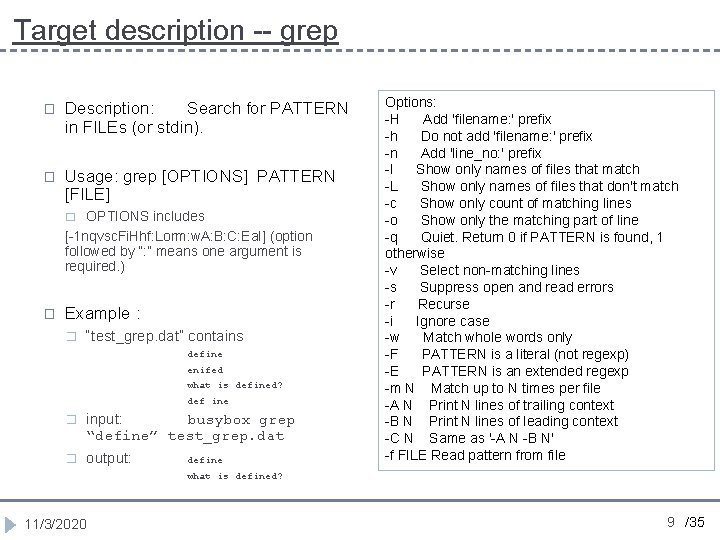
Target description -- grep � Description: Search for PATTERN in FILEs (or stdin). � Usage: grep [OPTIONS] PATTERN [FILE] OPTIONS includes [-1 nqvsc. Fi. Hhf: Lorm: w. A: B: C: Ea. I] (option followed by “: ” means one argument is required. ) � � Example : � “test_grep. dat” contains define enifed what is defined? def ine � � input: busybox grep “define” test_grep. dat output: define Options: -H Add 'filename: ' prefix -h Do not add 'filename: ' prefix -n Add 'line_no: ' prefix -l Show only names of files that match -L Show only names of files that don't match -c Show only count of matching lines -o Show only the matching part of line -q Quiet. Return 0 if PATTERN is found, 1 otherwise -v Select non-matching lines -s Suppress open and read errors -r Recurse -i Ignore case -w Match whole words only -F PATTERN is a literal (not regexp) -E PATTERN is an extended regexp -m N Match up to N times per file -A N Print N lines of trailing context -B N Print N lines of leading context -C N Same as '-A N -B N' -f FILE Read pattern from file what is defined? 11/3/2020 9 /35
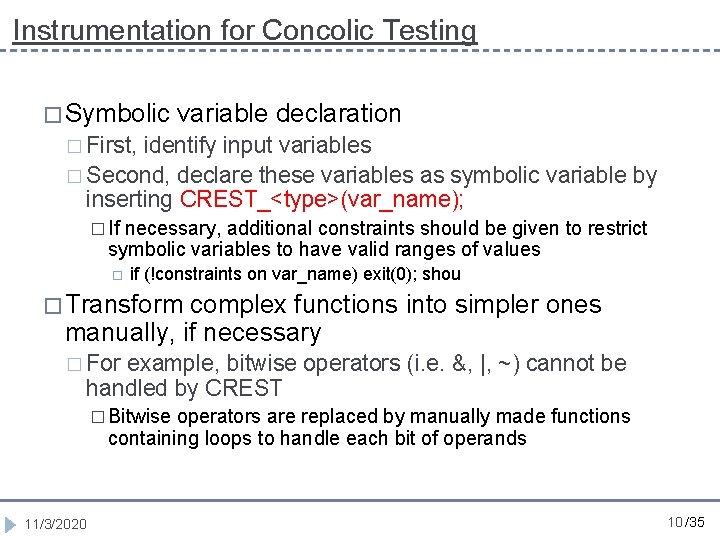
Instrumentation for Concolic Testing � Symbolic variable declaration � First, identify input variables � Second, declare these variables as symbolic variable by inserting CREST_<type>(var_name); � If necessary, additional constraints should be given to restrict symbolic variables to have valid ranges of values if (!constraints on var_name) exit(0); shou � Transform complex functions into simpler ones manually, if necessary � For example, bitwise operators (i. e. &, |, ~) cannot be handled by CREST � Bitwise operators are replaced by manually made functions containing loops to handle each bit of operands 11/3/2020 10 /35
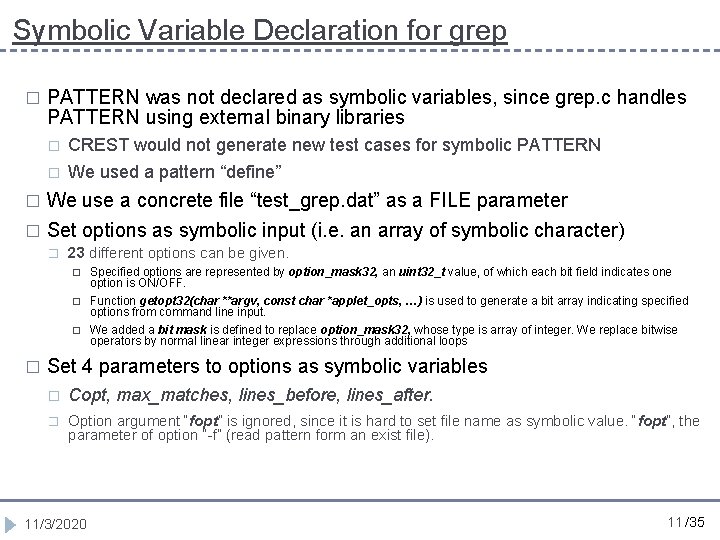
Symbolic Variable Declaration for grep � PATTERN was not declared as symbolic variables, since grep. c handles PATTERN using external binary libraries � CREST would not generate new test cases for symbolic PATTERN � We used a pattern “define” We use a concrete file “test_grep. dat” as a FILE parameter � Set options as symbolic input (i. e. an array of symbolic character) � � 23 different options can be given. Specified options are represented by option_mask 32, an uint 32_t value, of which each bit field indicates one option is ON/OFF. � Function getopt 32(char **argv, const char *applet_opts, …) is used to generate a bit array indicating specified options from command line input. � We added a bit mask is defined to replace option_mask 32, whose type is array of integer. We replace bitwise operators by normal linear integer expressions through additional loops � � Set 4 parameters to options as symbolic variables � Copt, max_matches, lines_before, lines_after. � Option argument “fopt” is ignored, since it is hard to set file name as symbolic value. “fopt”, the parameter of option “-f” (read pattern form an exist file). 11/3/2020 11 /35
Instrumentation in grep. c 1. 2. 3. 4. 5. #define BITSIZE 23 int bitmask[23]; int bitopt[23]; int grep_main (int argc UNUSED_PARAM, char **argv) 6. { 7. getopt 32(argv, OPTSTR_GREP, 8. &pattern_head, &fopt, 9. &max_matches, &lines_after, 10. &lines_before, &Copt); 11. #ifdef CREST 12. CREST_int(max_matches); 13. CREST_int(lines_after); 14. CREST_int(lines_before); 15. CREST_int(Copt); 16. int i; 17. for(i=BITSIZE-1 ; i>=0 ; i--){ 18. CREST_int(bitmask[i]); 19. } 20. #endif 21. //…… 11/3/2020 22. 23. 24. 25. 26. 27. 28. 29. 30. 31. } #ifndef CREST if (option_mask 32 & OPT_m) #else if (bit_and(bitmask, itobs(OPT_m, bitopt))) #endif { //…… } //…… 12 /35
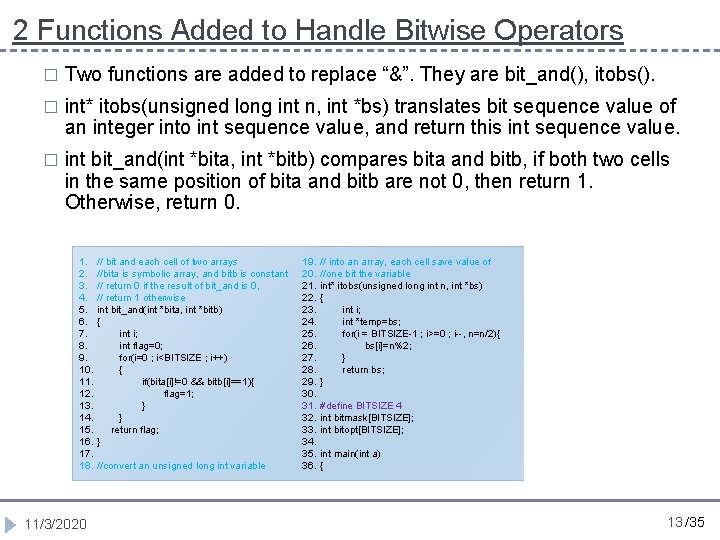
2 Functions Added to Handle Bitwise Operators � Two functions are added to replace “&”. They are bit_and(), itobs(). � int* itobs(unsigned long int n, int *bs) translates bit sequence value of an integer into int sequence value, and return this int sequence value. � int bit_and(int *bita, int *bitb) compares bita and bitb, if both two cells in the same position of bita and bitb are not 0, then return 1. Otherwise, return 0. 1. 2. 3. 4. 5. 6. 7. 8. 9. 10. 11. 12. 13. 14. 15. 16. 17. 18. 11/3/2020 // bit and each cell of two arrays //bita is symbolic array, and bitb is constant // return 0 if the result of bit_and is 0, // return 1 otherwise int bit_and(int *bita, int *bitb) { int i; int flag=0; for(i=0 ; i<BITSIZE ; i++) { if(bita[i]!=0 && bitb[i]==1){ flag=1; } } return flag; } //convert an unsigned long int variable 19. 20. 21. 22. 23. 24. 25. 26. 27. 28. 29. 30. 31. 32. 33. 34. 35. 36. // into an array, each cell save value of //one bit the variable int* itobs(unsigned long int n, int *bs) { int i; int *temp=bs; for(i = BITSIZE-1 ; i>=0 ; i--, n=n/2){ bs[i]=n%2; } return bs; } 37. 38. 39. 40. 41. int output; bitmask[0]=0; bitmask[1]=1; bitmask[2]=0; bitmask[3]=0; 42. 43. 44. 45. } bitopt= itobs(a, bitopt); output= bit_and(bitmask, bitopt); printf(“%dn”, output); #define BITSIZE 4 int bitmask[BITSIZE]; int bitopt[BITSIZE]; int main(int a) { 13 /35
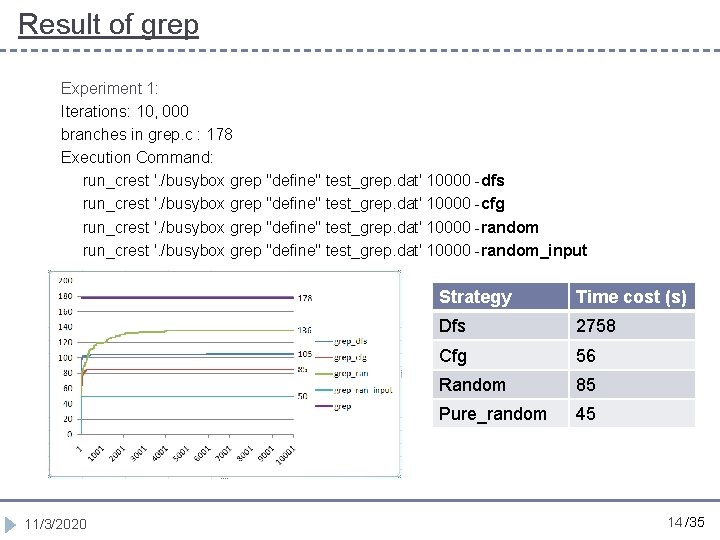
Result of grep Experiment 1: Iterations: 10, 000 branches in grep. c : 178 Execution Command: run_crest '. /busybox grep "define" test_grep. dat' 10000 -dfs run_crest '. /busybox grep "define" test_grep. dat' 10000 -cfg run_crest '. /busybox grep "define" test_grep. dat' 10000 -random_input 11/3/2020 Strategy Time cost (s) Dfs 2758 Cfg 56 Random 85 Pure_random 45 14 /35
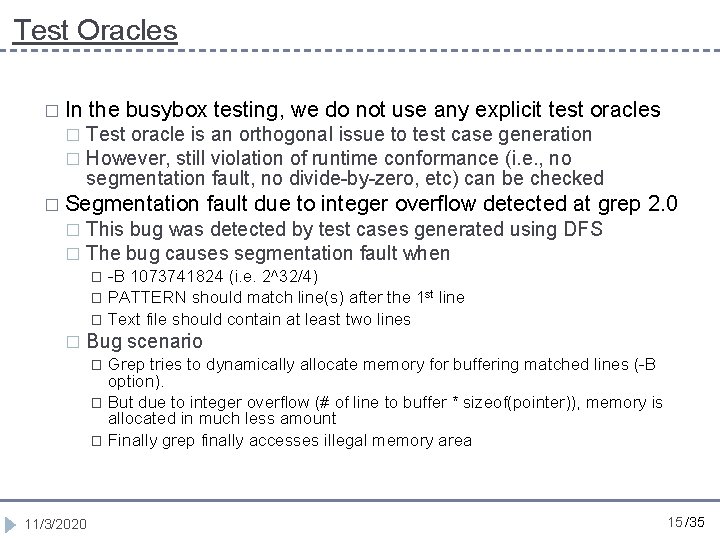
Test Oracles � In the busybox testing, we do not use any explicit test oracles Test oracle is an orthogonal issue to test case generation � However, still violation of runtime conformance (i. e. , no segmentation fault, no divide-by-zero, etc) can be checked � � Segmentation fault due to integer overflow detected at grep 2. 0 This bug was detected by test cases generated using DFS � The bug causes segmentation fault when � -B 1073741824 (i. e. 2^32/4) � PATTERN should match line(s) after the 1 st line � Text file should contain at least two lines � � Bug scenario Grep tries to dynamically allocate memory for buffering matched lines (-B option). � But due to integer overflow (# of line to buffer * sizeof(pointer)), memory is allocated in much less amount � Finally grep finally accesses illegal memory area � 11/3/2020 15 /35
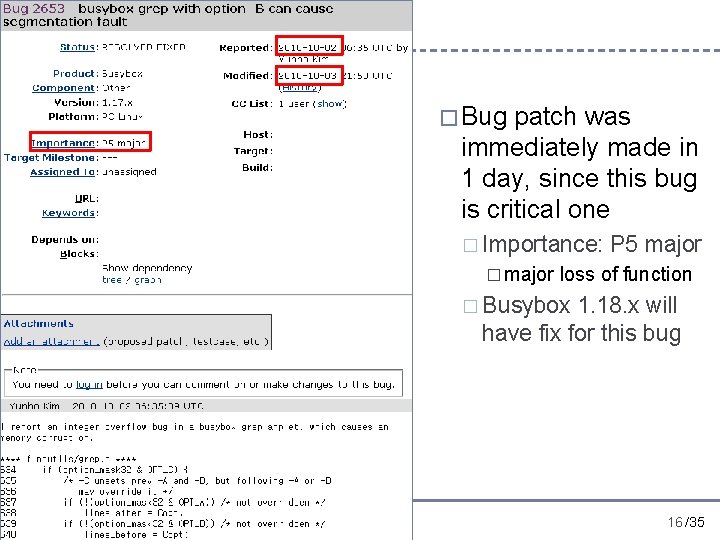
� Bug patch was immediately made in 1 day, since this bug is critical one � Importance: � major P 5 major loss of function � Busybox 1. 18. x will have fix for this bug 11/3/2020 16 /35
Target description -- vi � Description: � Usage: vi [OPTIONS] [FILE] … Options: � � � -c -R -H Edit FILE Initial command to run ($EXINIT also available) Read-only Short help regarding available features Example : � input: cat read_vi. dat test for initial command � input: cat test_vi. dat this is the test for vi @#$%&*vi? � � input: output: . /busybox vi -c ": read_vi. dat" test_vi. dat this is the test for vi test for initial command @#$%&*vi? 11/3/2020 17 /35
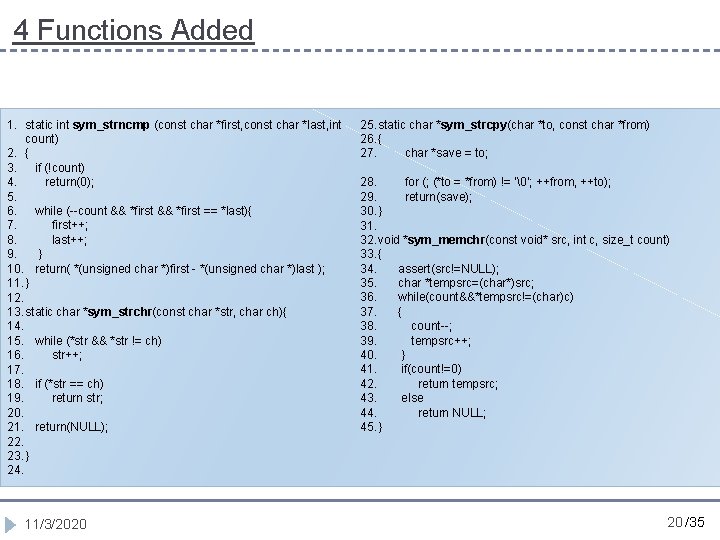
Symbolic Variable Declaration for vi �We declared a key stroke by a user as a symbolic input character � Restrict user key input to 50 symbolic characters. � We modified vi source code so that vi exits after testing 50 th key stroke. �Set initial command as symbolic input (initial command is only used when option “-c” is specified). � Type of initial command is a string (i. e. , an array of 17 characters) �Replace 4 library functions with source code: strncmp(), strchr(), strcpy(), memchr(). �We used a concrete file “test_vi. dat” 11/3/2020 18 /35
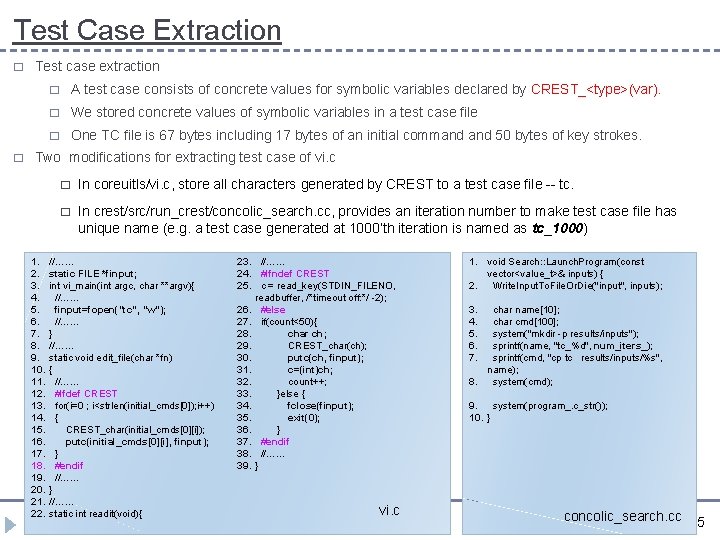
Test Case Extraction � � Test case extraction � A test case consists of concrete values for symbolic variables declared by CREST_<type>(var). � We stored concrete values of symbolic variables in a test case file � One TC file is 67 bytes including 17 bytes of an initial command 50 bytes of key strokes. Two modifications for extracting test case of vi. c 1. 2. 3. 4. 5. 6. 7. 8. 9. 10. 11. 12. 13. 14. 15. 16. 17. 18. 19. 20. 21. 22. � In coreuitls/vi. c, store all characters generated by CREST to a test case file -- tc. � In crest/src/run_crest/concolic_search. cc, provides an iteration number to make test case file has unique name (e. g. a test case generated at 1000’th iteration is named as tc_1000) //…… static FILE *finput; int vi_main(int argc, char **argv){ //…… finput=fopen("tc", "w"); //…… } //…… static void edit_file(char *fn) { //…… #ifdef CREST for(i=0 ; i<strlen(initial_cmds[0]); i++) { CREST_char(initial_cmds[0][i]); putc(initial_cmds[0][i], finput); } #endif //…… } //…… static int readit(void){ 11/3/2020 23. //…… 24. #ifndef CREST 25. c = read_key(STDIN_FILENO, readbuffer, /*timeout off: */ -2); 26. #else 27. if(count<50){ 28. char ch; 29. CREST_char(ch); 30. putc(ch, finput); 31. c=(int)ch; 32. count++; 33. }else { 34. fclose(finput); 35. exit(0); 36. } 37. #endif 38. //…… 39. } vi. c 1. void Search: : Launch. Program(const vector<value_t>& inputs) { 2. Write. Input. To. File. Or. Die("input", inputs); 3. 4. 5. 6. 7. char name[10]; char cmd[100]; system("mkdir -p results/inputs"); sprintf(name, "tc_%d", num_iters_); sprintf(cmd, "cp tc results/inputs/%s", name); 8. system(cmd); 9. system(program_. c_str()); 10. } concolic_search. cc 19 /35
4 Functions Added 1. static int sym_strncmp (const char *first, const char *last, int count) 2. { 3. if (!count) 4. return(0); 5. 6. while (--count && *first == *last){ 7. first++; 8. last++; 9. } 10. return( *(unsigned char *)first - *(unsigned char *)last ); 11. } 12. 13. static char *sym_strchr(const char *str, char ch){ 14. 15. while (*str && *str != ch) 16. str++; 17. 18. if (*str == ch) 19. return str; 20. 21. return(NULL); 22. 23. } 24. 11/3/2020 25. static char *sym_strcpy(char *to, const char *from) 26. { 27. char *save = to; 28. for (; (*to = *from) != ''; ++from, ++to); 29. return(save); 30. } 31. 32. void *sym_memchr(const void* src, int c, size_t count) 33. { 34. assert(src!=NULL); 35. char *tempsrc=(char*)src; 36. while(count&&*tempsrc!=(char)c) 37. { 38. count--; 39. tempsrc++; 40. } 41. if(count!=0) 42. return tempsrc; 43. else 44. return NULL; 45. } 20 /35
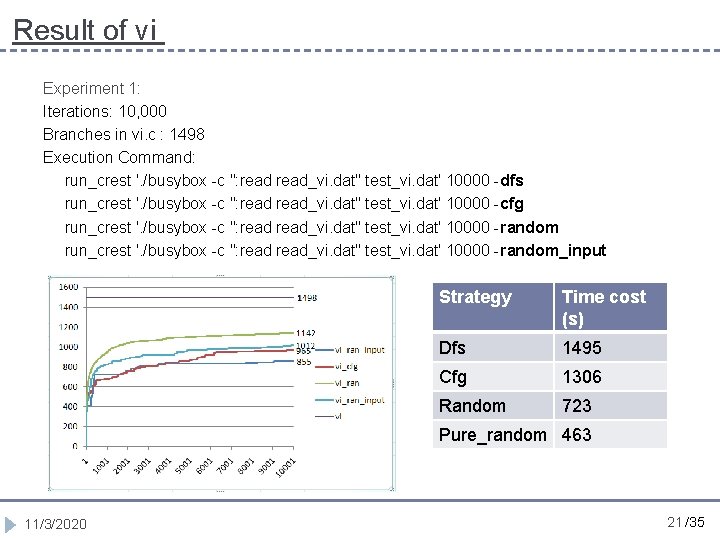
Result of vi Experiment 1: Iterations: 10, 000 Branches in vi. c : 1498 Execution Command: run_crest '. /busybox -c ": read_vi. dat" test_vi. dat' 10000 -dfs run_crest '. /busybox -c ": read_vi. dat" test_vi. dat' 10000 -cfg run_crest '. /busybox -c ": read_vi. dat" test_vi. dat' 10000 -random_input Strategy Time cost (s) Dfs 1495 Cfg 1306 Random 723 Pure_random 463 11/3/2020 21 /35
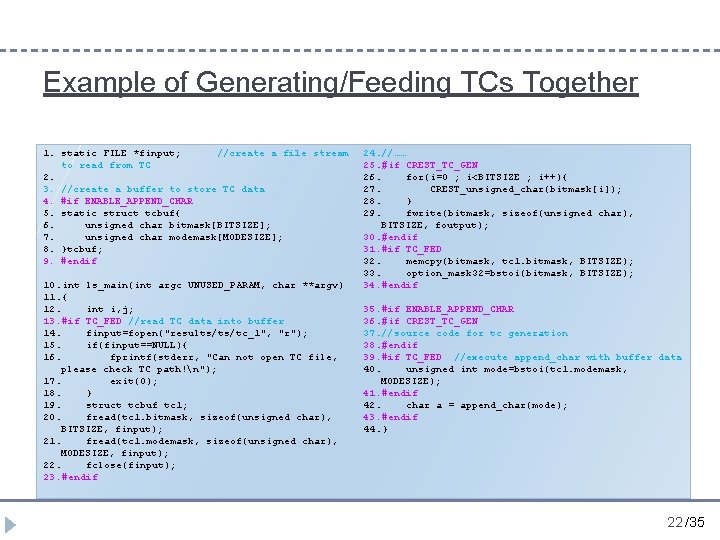
Example of Generating/Feeding TCs Together 1. static FILE *finput; //create a file stream to read from TC 2. 3. //create a buffer to store TC data 4. #if ENABLE_APPEND_CHAR 5. static struct tcbuf{ 6. unsigned char bitmask[BITSIZE]; 7. unsigned char modemask[MODESIZE]; 8. }tcbuf; 9. #endif 10. int ls_main(int argc UNUSED_PARAM, char **argv) 11. { 12. int i, j; 13. #if TC_FED //read TC data into buffer 14. finput=fopen("results/ts/tc_1", "r"); 15. if(finput==NULL){ 16. fprintf(stderr, "Can not open TC file, please check TC path!n"); 17. exit(0); 18. } 19. struct tcbuf tc 1; 20. fread(tc 1. bitmask, sizeof(unsigned char), BITSIZE, finput); 21. fread(tc 1. modemask, sizeof(unsigned char), MODESIZE, finput); 22. fclose(finput); 23. #endif 24. //…… 25. #if CREST_TC_GEN 26. for(i=0 ; i<BITSIZE ; i++){ 27. CREST_unsigned_char(bitmask[i]); 28. } 29. fwrite(bitmask, sizeof(unsigned char), BITSIZE, foutput); 30. #endif 31. #if TC_FED 32. memcpy(bitmask, tc 1. bitmask, BITSIZE); 33. option_mask 32=bstoi(bitmask, BITSIZE); 34. #endif 35. #if ENABLE_APPEND_CHAR 36. #if CREST_TC_GEN 37. //source code for tc generation 38. #endif 39. #if TC_FED //execute append_char with buffer data 40. unsigned int mode=bstoi(tc 1. modemask, MODESIZE); 41. #endif 42. char a = append_char(mode); 43. #endif 44. } 22 /35
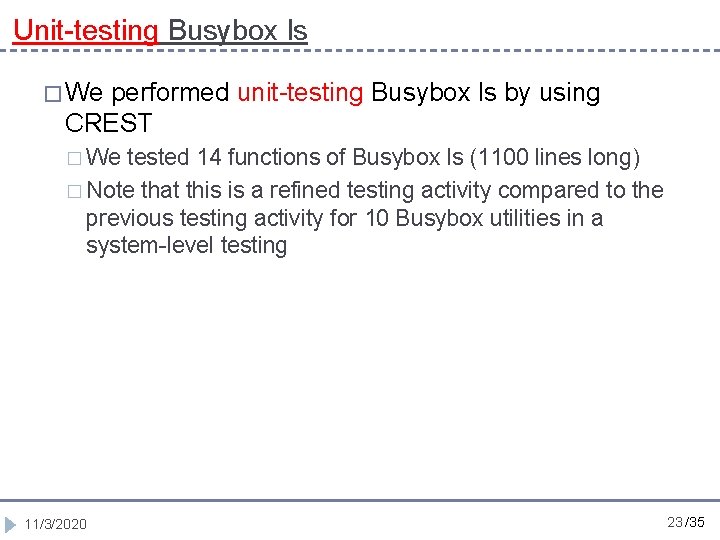
Unit-testing Busybox ls � We performed unit-testing Busybox ls by using CREST � We tested 14 functions of Busybox ls (1100 lines long) � Note that this is a refined testing activity compared to the previous testing activity for 10 Busybox utilities in a system-level testing 11/3/2020 23 /35
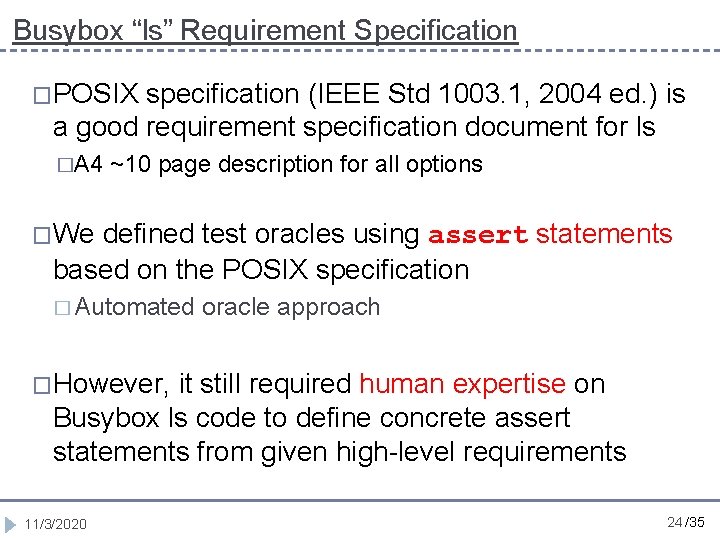
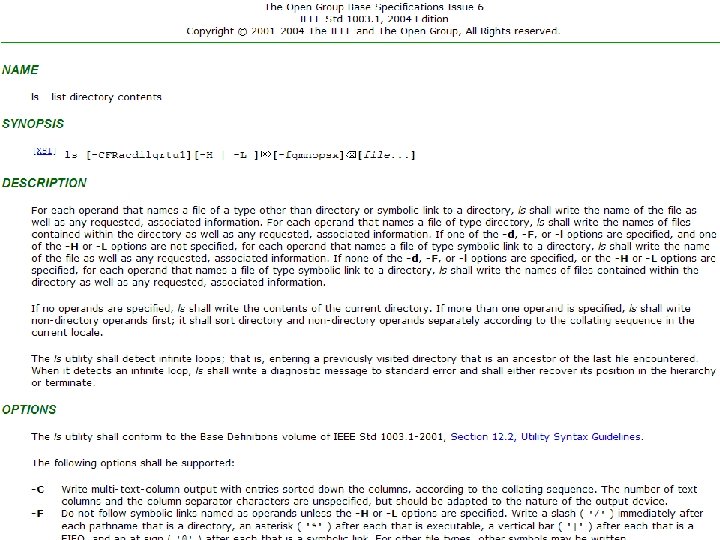
Busybox “ls” Requirement Specification �POSIX specification (IEEE Std 1003. 1, 2004 ed. ) is a good requirement specification document for ls �A 4 ~10 page description for all options �We defined test oracles using assert statements based on the POSIX specification � Automated oracle approach �However, it still required human expertise on Busybox ls code to define concrete assert statements from given high-level requirements 11/3/2020 24 /35
11/3/2020 25 /35
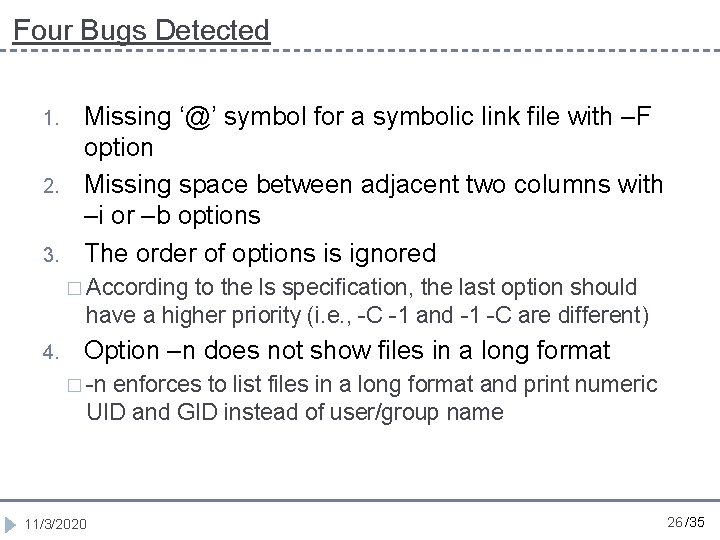
Four Bugs Detected 1. 2. 3. Missing ‘@’ symbol for a symbolic link file with –F option Missing space between adjacent two columns with –i or –b options The order of options is ignored � According to the ls specification, the last option should have a higher priority (i. e. , -C -1 and -1 -C are different) 4. Option –n does not show files in a long format � -n enforces to list files in a long format and print numeric UID and GID instead of user/group name 11/3/2020 26 /35
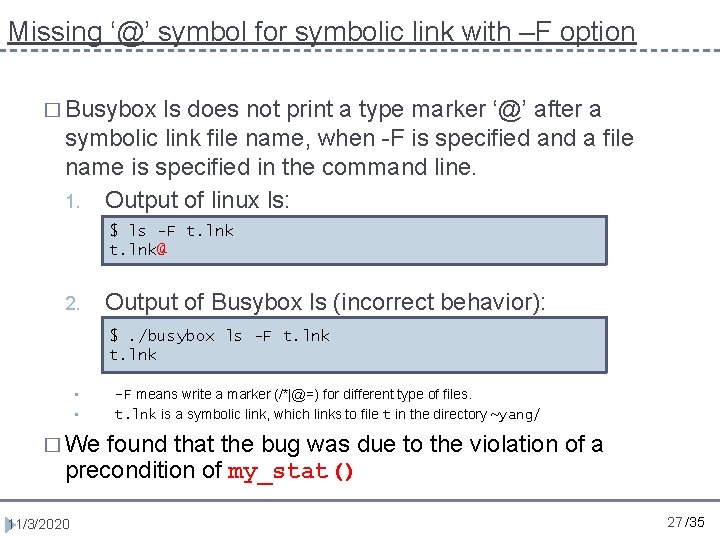
Missing ‘@’ symbol for symbolic link with –F option � Busybox ls does not print a type marker ‘@’ after a symbolic link file name, when -F is specified and a file name is specified in the command line. 1. Output of linux ls: $ ls -F t. lnk@ 2. Output of Busybox ls (incorrect behavior): $. /busybox ls -F t. lnk • • -F means write a marker (/*|@=) for different type of files. t. lnk is a symbolic link, which links to file t in the directory ~yang/ � We found that the bug was due to the violation of a precondition of my_stat() 11/3/2020 27 /35
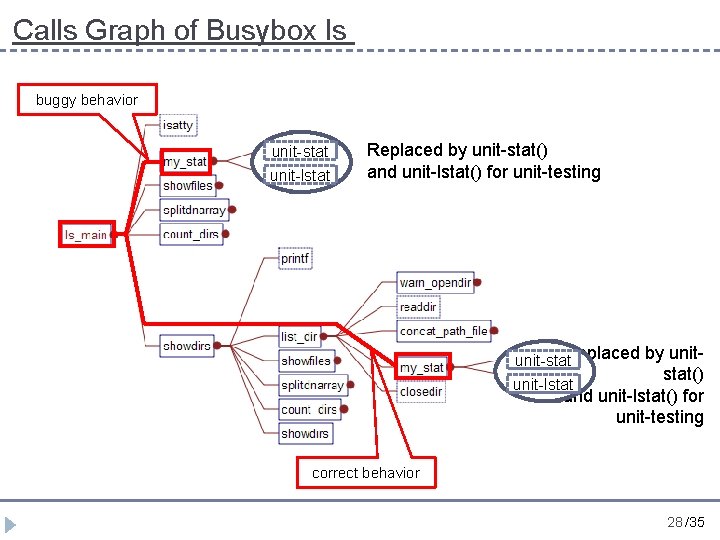
Calls Graph of Busybox ls buggy behavior unit-stat unit-lstat Replaced by unit-stat() and unit-lstat() for unit-testing Replaced by unit-stat() unit-lstat and unit-lstat() for unit-testing correct behavior 28 /35
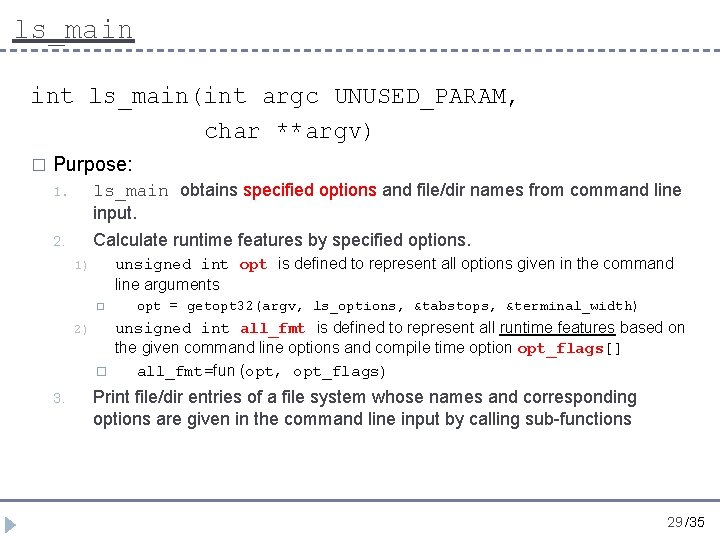
ls_main int ls_main(int argc UNUSED_PARAM, char **argv) � Purpose: ls_main obtains specified options and file/dir names from command line input. Calculate runtime features by specified options. 1. 2. unsigned int opt is defined to represent all options given in the command line arguments 1) 2) 3. opt = getopt 32(argv, ls_options, &tabstops, &terminal_width) unsigned int all_fmt is defined to represent all runtime features based on the given command line options and compile time option opt_flags[] all_fmt=fun (opt, opt_flags) Print file/dir entries of a file system whose names and corresponding options are given in the command line input by calling sub-functions 29 /35
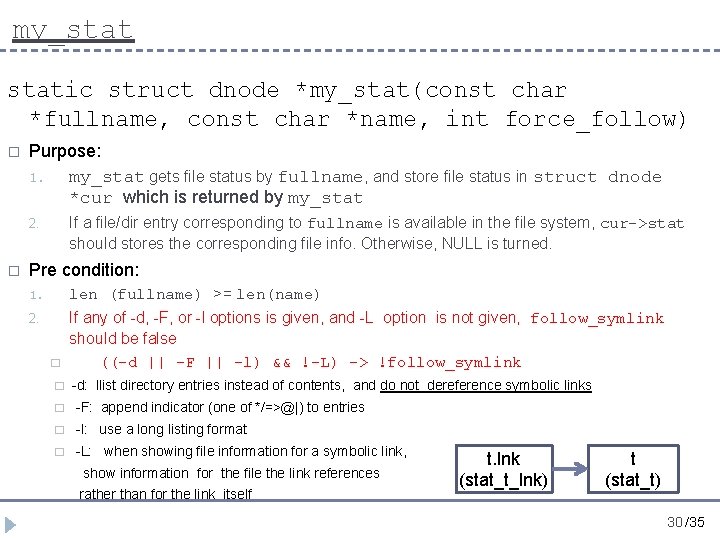
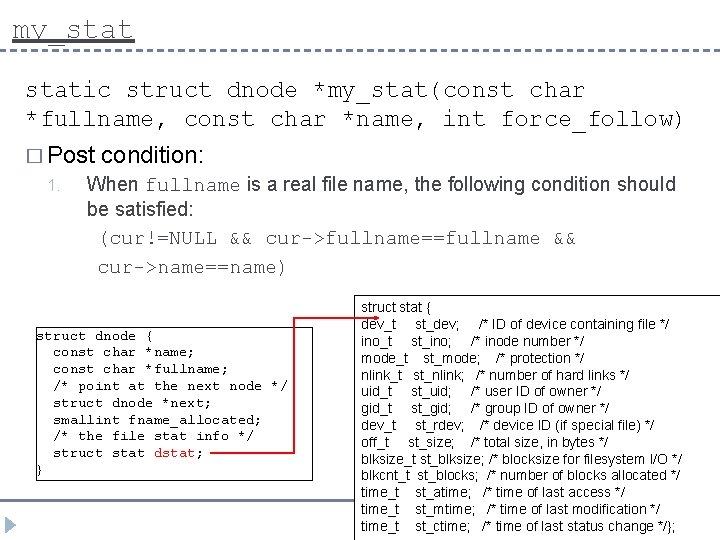
my_static struct dnode *my_stat(const char *fullname, const char *name, int force_follow) � Purpose: 1. my_stat gets file status by fullname, and store file status in struct dnode *cur which is returned by my_stat If a file/dir entry corresponding to fullname is available in the file system, cur->stat should stores the corresponding file info. Otherwise, NULL is turned. 2. � Pre condition: 1. len (fullname) >= len(name) 2. If any of -d, -F, or -l options is given, and -L option is not given, follow_symlink should be false ((-d || -F || -l) && !-L) -> !follow_symlink � � -d: llist directory entries instead of contents, and do not dereference symbolic links � -F: append indicator (one of */=>@|) to entries � -l: use a long listing format � -L: when showing file information for a symbolic link, show information for the file the link references rather than for the link itself t. lnk (stat_t_lnk) t (stat_t) 30 /35
my_static struct dnode *my_stat(const char *fullname, const char *name, int force_follow) � Post 1. condition: When fullname is a real file name, the following condition should be satisfied: (cur!=NULL && cur->fullname==fullname && cur->name==name) struct dnode { const char *name; const char *fullname; /* point at the next node */ struct dnode *next; smallint fname_allocated; /* the file stat info */ struct stat dstat; } struct stat { dev_t st_dev; /* ID of device containing file */ ino_t st_ino; /* inode number */ mode_t st_mode; /* protection */ nlink_t st_nlink; /* number of hard links */ uid_t st_uid; /* user ID of owner */ gid_t st_gid; /* group ID of owner */ dev_t st_rdev; /* device ID (if special file) */ off_t st_size; /* total size, in bytes */ blksize_t st_blksize; /* blocksize for filesystem I/O */ blkcnt_t st_blocks; /* number of blocks allocated */ time_t st_atime; /* time of last access */ time_t st_mtime; /* time of last modification */ 31 /35 time_t st_ctime; /* time of last status change */};
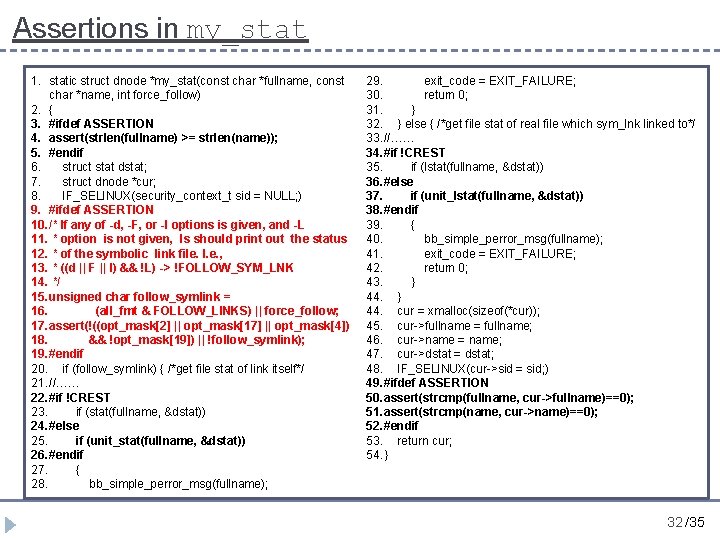
Assertions in my_stat 1. static struct dnode *my_stat(const char *fullname, const char *name, int force_follow) 2. { 3. #ifdef ASSERTION 4. assert(strlen(fullname) >= strlen(name)); 5. #endif 6. struct stat dstat; 7. struct dnode *cur; 8. IF_SELINUX(security_context_t sid = NULL; ) 9. #ifdef ASSERTION 10. /* If any of -d, -F, or -l options is given, and -L 11. * option is not given, ls should print out the status 12. * of the symbolic link file. I. e. , 13. * ((d || F || l) && !L) -> !FOLLOW_SYM_LNK 14. */ 15. unsigned char follow_symlink = 16. (all_fmt & FOLLOW_LINKS) || force_follow; 17. assert(!((opt_mask[2] || opt_mask[17] || opt_mask[4]) 18. && !opt_mask[19]) || !follow_symlink); 19. #endif 20. if (follow_symlink) { /*get file stat of link itself*/ 21. //…… 22. #if !CREST 23. if (stat(fullname, &dstat)) 24. #else 25. if (unit_stat(fullname, &dstat)) 26. #endif 27. { 28. bb_simple_perror_msg(fullname); 29. exit_code = EXIT_FAILURE; 30. return 0; 31. } 32. } else { /*get file stat of real file which sym_lnk linked to*/ 33. //…… 34. #if !CREST 35. if (lstat(fullname, &dstat)) 36. #else 37. if (unit_lstat(fullname, &dstat)) 38. #endif 39. { 40. bb_simple_perror_msg(fullname); 41. exit_code = EXIT_FAILURE; 42. return 0; 43. } 44. cur = xmalloc(sizeof(*cur)); 45. cur->fullname = fullname; 46. cur->name = name; 47. cur->dstat = dstat; 48. IF_SELINUX(cur->sid = sid; ) 49. #ifdef ASSERTION 50. assert(strcmp(fullname, cur->fullname)==0); 51. assert(strcmp(name, cur->name)==0); 52. #endif 53. return cur; 54. } 32 /35
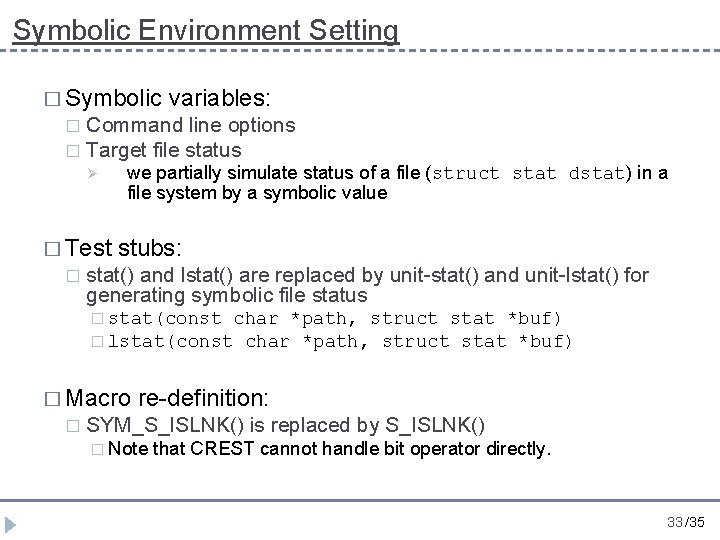
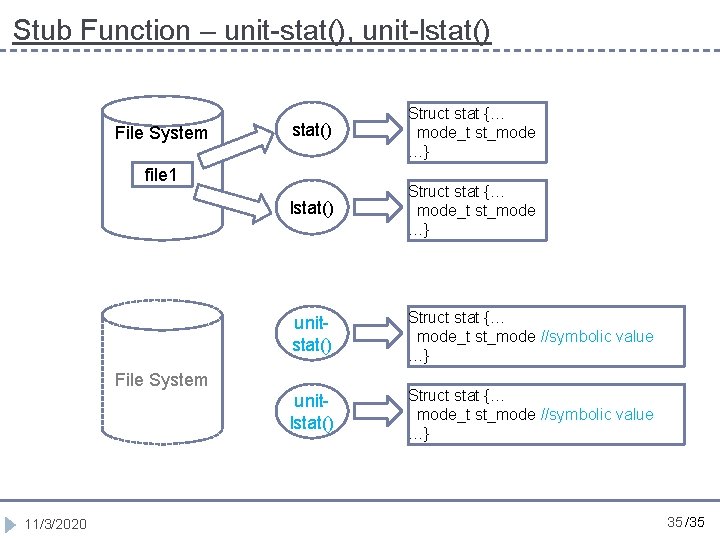
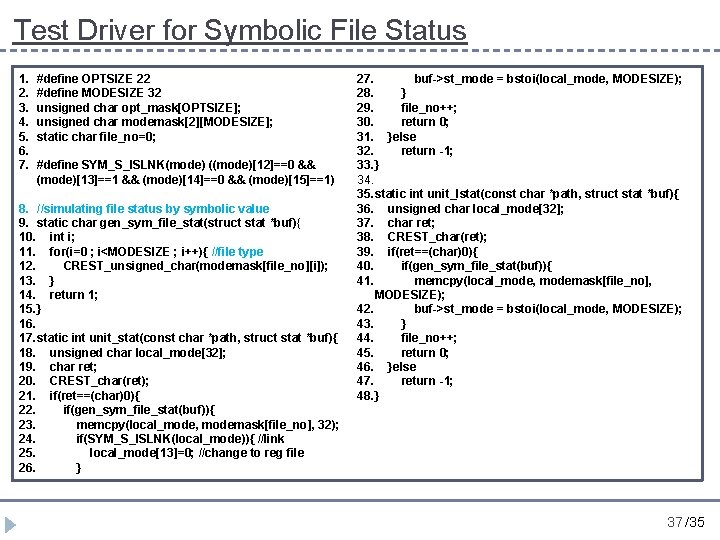
Symbolic Environment Setting � Symbolic variables: Command line options � Target file status � Ø � Test � we partially simulate status of a file (struct stat dstat) in a file system by a symbolic value stubs: stat() and lstat() are replaced by unit-stat() and unit-lstat() for generating symbolic file status � stat(const char *path, struct stat *buf) � lstat(const char *path, struct stat *buf) � Macro � re-definition: SYM_S_ISLNK() is replaced by S_ISLNK() � Note that CREST cannot handle bit operator directly. 33 /35
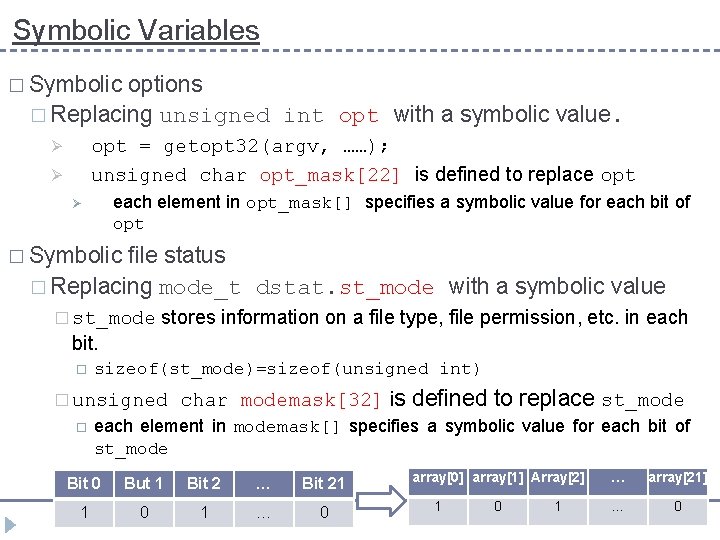
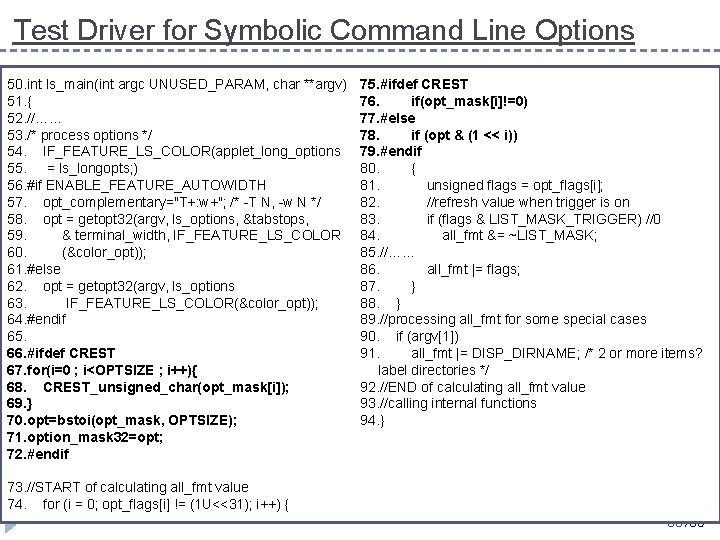
Symbolic Variables � Symbolic options � Replacing unsigned int opt with a symbolic value. opt = getopt 32(argv, ……); unsigned char opt_mask[22] is defined to replace opt Ø Ø each element in opt_mask[] specifies a symbolic value for each bit of opt Ø � Symbolic file status � Replacing mode_t dstat. st_mode with a symbolic value � st_mode stores information on a file type, file permission, etc. in each bit. sizeof(st_mode)=sizeof(unsigned int) � unsigned char modemask[32] is defined to replace st_mode each element in modemask[] specifies a symbolic value for each bit of st_mode Bit 0 But 1 Bit 2 … Bit 21 1 0 1 … 0 array[0] array[1] Array[2] 1 0 1 … array[21] … 0 34 /35
Stub Function – unit-stat(), unit-lstat() File System stat() Struct stat {… mode_t st_mode …} lstat() Struct stat {… mode_t st_mode …} unitstat() Struct stat {… mode_t st_mode //symbolic value …} unitlstat() Struct stat {… mode_t st_mode //symbolic value …} file 1 File System 11/3/2020 35 /35
Test Driver for Symbolic Command Line Options 50. int ls_main(int argc UNUSED_PARAM, char **argv) 51. { 52. //…… 53. /* process options */ 54. IF_FEATURE_LS_COLOR(applet_long_options 55. = ls_longopts; ) 56. #if ENABLE_FEATURE_AUTOWIDTH 57. opt_complementary="T+: w+"; /* -T N, -w N */ 58. opt = getopt 32(argv, ls_options, &tabstops, 59. & terminal_width, IF_FEATURE_LS_COLOR 60. (&color_opt)); 61. #else 62. opt = getopt 32(argv, ls_options 63. IF_FEATURE_LS_COLOR(&color_opt)); 64. #endif 65. 66. #ifdef CREST 67. for(i=0 ; i<OPTSIZE ; i++){ 68. CREST_unsigned_char(opt_mask[i]); 69. } 70. opt=bstoi(opt_mask, OPTSIZE); 71. option_mask 32=opt; 72. #endif 75. #ifdef CREST 76. if(opt_mask[i]!=0) 77. #else 78. if (opt & (1 << i)) 79. #endif 80. { 81. unsigned flags = opt_flags[i]; 82. //refresh value when trigger is on 83. if (flags & LIST_MASK_TRIGGER) //0 84. all_fmt &= ~LIST_MASK; 85. //…… 86. all_fmt |= flags; 87. } 88. } 89. //processing all_fmt for some special cases 90. if (argv[1]) 91. all_fmt |= DISP_DIRNAME; /* 2 or more items? label directories */ 92. //END of calculating all_fmt value 93. //calling internal functions 94. } 73. //START of calculating all_fmt value 74. for (i = 0; opt_flags[i] != (1 U<<31); i++) { 36 /35
Test Driver for Symbolic File Status 1. 2. 3. 4. 5. 6. 7. #define OPTSIZE 22 #define MODESIZE 32 unsigned char opt_mask[OPTSIZE]; unsigned char modemask[2][MODESIZE]; static char file_no=0; #define SYM_S_ISLNK(mode) ((mode)[12]==0 && (mode)[13]==1 && (mode)[14]==0 && (mode)[15]==1) 8. //simulating file status by symbolic value 9. static char gen_sym_file_stat(struct stat *buf){ 10. int i; 11. for(i=0 ; i<MODESIZE ; i++){ //file type 12. CREST_unsigned_char(modemask[file_no][i]); 13. } 14. return 1; 15. } 16. 17. static int unit_stat(const char *path, struct stat *buf){ 18. unsigned char local_mode[32]; 19. char ret; 20. CREST_char(ret); 21. if(ret==(char)0){ 22. if(gen_sym_file_stat(buf)){ 23. memcpy(local_mode, modemask[file_no], 32); 24. if(SYM_S_ISLNK(local_mode)){ //link 25. local_mode[13]=0; //change to reg file 26. } 27. buf->st_mode = bstoi(local_mode, MODESIZE); 28. } 29. file_no++; 30. return 0; 31. }else 32. return -1; 33. } 34. 35. static int unit_lstat(const char *path, struct stat *buf){ 36. unsigned char local_mode[32]; 37. char ret; 38. CREST_char(ret); 39. if(ret==(char)0){ 40. if(gen_sym_file_stat(buf)){ 41. memcpy(local_mode, modemask[file_no], MODESIZE); 42. buf->st_mode = bstoi(local_mode, MODESIZE); 43. } 44. file_no++; 45. return 0; 46. }else 47. return -1; 48. } 37 /35