
4 II Geometry of Determinants 4 II 1

- Slides: 6
4. II. Geometry of Determinants 4. II. 1. Determinants as Size Functions area of parallelogram = area of rectangle area of A area of B area of C area of D area of E area of F = area of rectangle 2 area of A 2 area of E 2 area of C
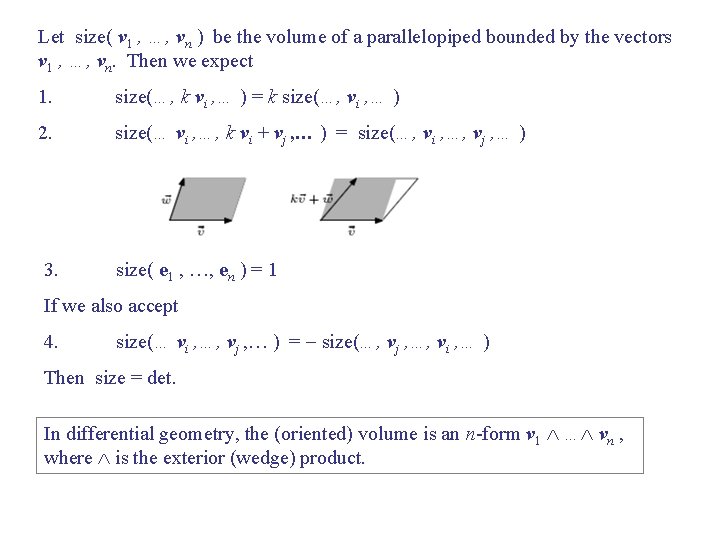
Let size( v 1 , …, vn ) be the volume of a parallelopiped bounded by the vectors v 1 , …, vn. Then we expect 1. size(…, k vi , … ) = k size(…, vi , … ) 2. size(… vi , …, k vi + vj , … ) = size(…, vi , …, vj , … ) 3. size( e 1 , …, en ) = 1 If we also accept 4. size(… vi , …, vj , … ) = size(…, vj , …, vi , … ) Then size = det. In differential geometry, the (oriented) volume is an n-form v 1 … vn , where is the exterior (wedge) product.
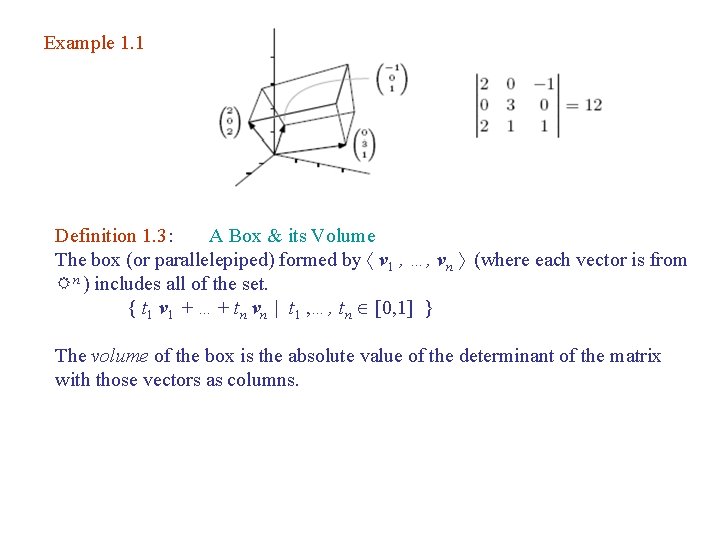
Example 1. 1 Definition 1. 3: A Box & its Volume The box (or parallelepiped) formed by v 1 , …, vn (where each vector is from Rn ) includes all of the set. { t 1 v 1 + …+ tn vn | t 1 , …, tn [0, 1] } The volume of the box is the absolute value of the determinant of the matrix with those vectors as columns.
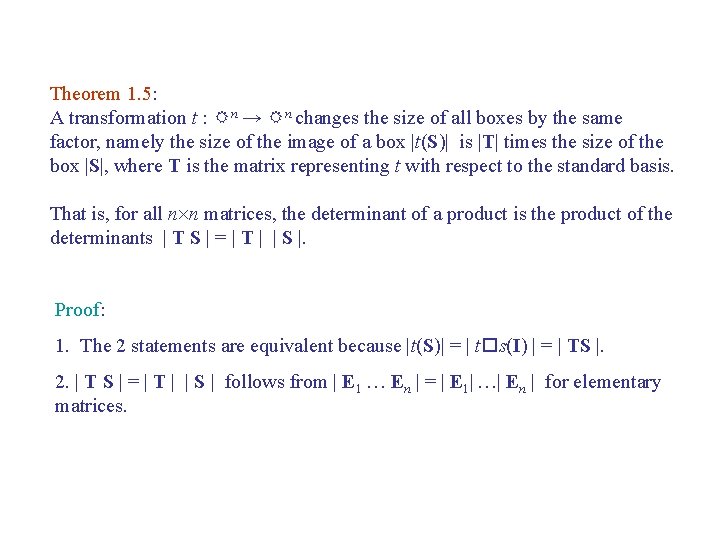
Theorem 1. 5: A transformation t : Rn → Rn changes the size of all boxes by the same factor, namely the size of the image of a box |t(S)| is |T| times the size of the box |S|, where T is the matrix representing t with respect to the standard basis. That is, for all n n matrices, the determinant of a product is the product of the determinants | T S | = | T | | S |. Proof: 1. The 2 statements are equivalent because |t(S)| = | t s(I) | = | TS |. 2. | T S | = | T | | S | follows from | E 1 … En | = | E 1| …| En | for elementary matrices.
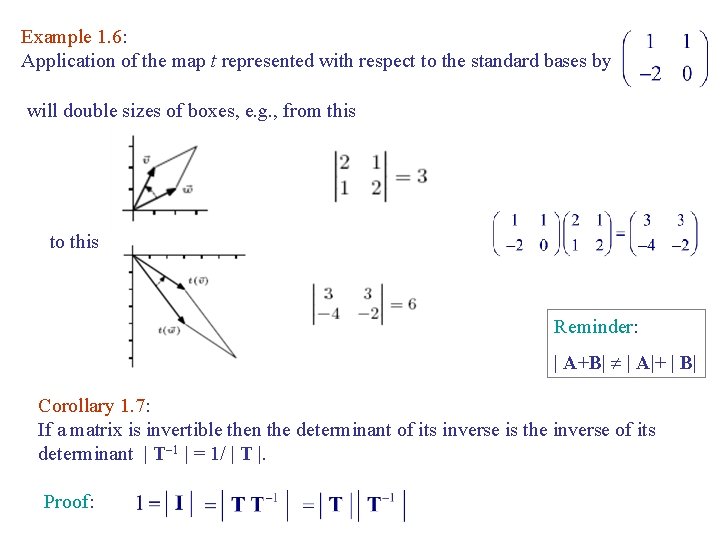
Example 1. 6: Application of the map t represented with respect to the standard bases by will double sizes of boxes, e. g. , from this to this Reminder: | A+B| | A|+ | B| Corollary 1. 7: If a matrix is invertible then the determinant of its inverse is the inverse of its determinant | T 1 | = 1/ | T |. Proof:
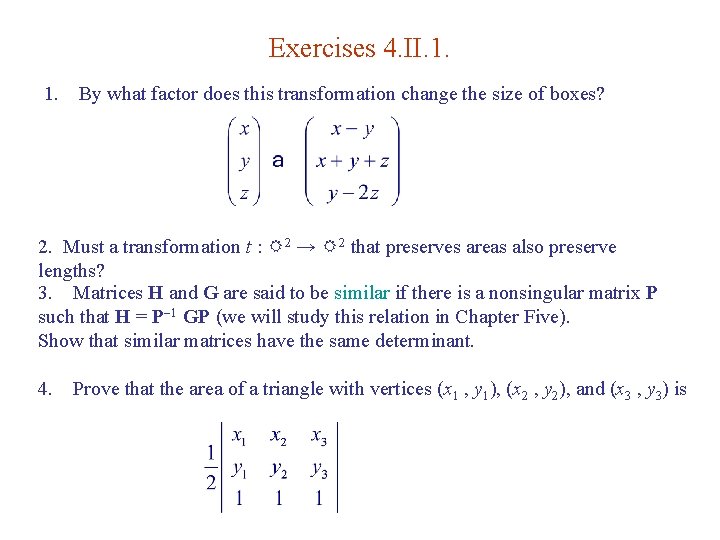
Exercises 4. II. 1. 1. By what factor does this transformation change the size of boxes? 2. Must a transformation t : R 2 → R 2 that preserves areas also preserve lengths? 3. Matrices H and G are said to be similar if there is a nonsingular matrix P such that H = P 1 GP (we will study this relation in Chapter Five). Show that similar matrices have the same determinant. 4. Prove that the area of a triangle with vertices (x 1 , y 1), (x 2 , y 2), and (x 3 , y 3) is