
4 I11 Case studies in Inorganic Chemistry Imperial
- Slides: 20
4 I-11 Case studies in Inorganic Chemistry Imperial College London Lecture 8 Biorenewable Polymers 2: The Stereoselective Polymerisation of Lactide Dr. Ed Marshall Rm: M 220, Mezzanine Floor, RCS 1 e. marshall@imperial. ac. uk www. ch. ic. ac. uk/marshall/4 I 11. html 4 I-11 - Lecture 8 - Slide 1
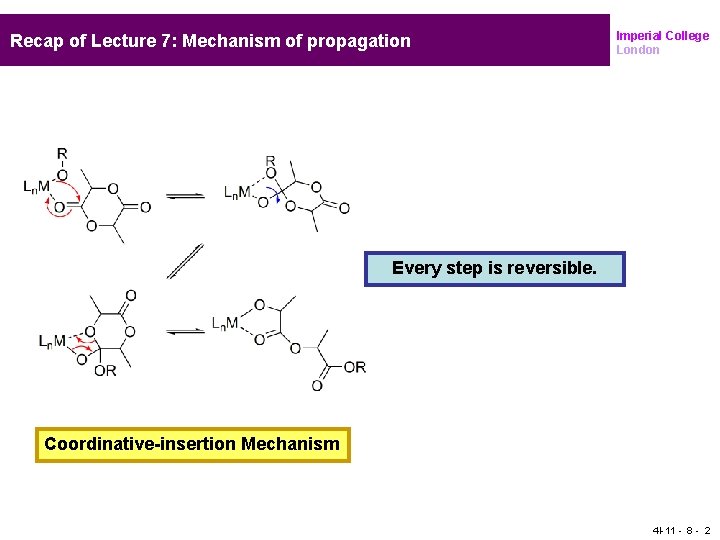
Recap of Lecture 7: Mechanism of propagation Imperial College London Every step is reversible. Coordinative-insertion Mechanism 4 I-11 - 8 - 2
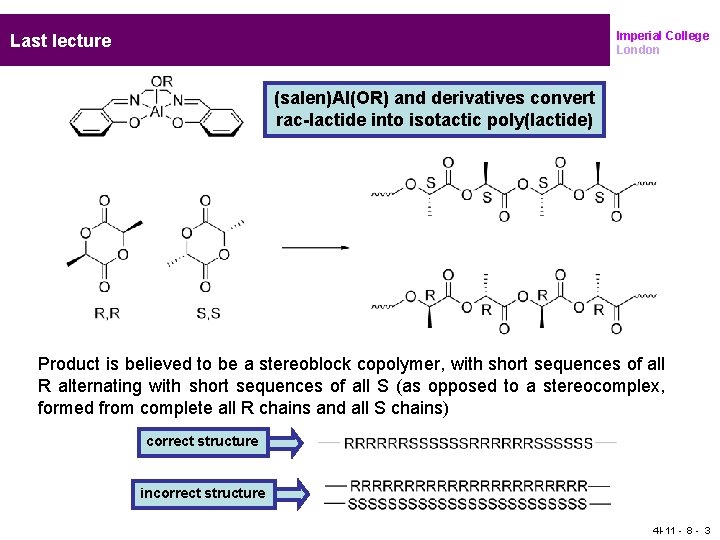
Imperial College London Last lecture (salen)Al(OR) and derivatives convert rac-lactide into isotactic poly(lactide) Product is believed to be a stereoblock copolymer, with short sequences of all R alternating with short sequences of all S (as opposed to a stereocomplex, formed from complete all R chains and all S chains) correct structure incorrect structure 4 I-11 - 8 - 3
Remaining learning outcomes Imperial College London Over these two lectures you should acquire the knowledge to allow you to: 1. Describe why the polymerisation of lactide is so intensely researched. 2. Explain how chiral and achiral (salen)-supported Al complexes may be used to prepare isotactic and syndiotactic polylactide. 3. Explain how b-diketiminate supported complexes of Zn and Mg may be used to prepare heterotactic polylactide. 4. Understand how computational chemistry may be used to investigate polymerisation mechanisms and to shed light onto the causes of stereoselectivity. 4 I-11 - 8 - 4
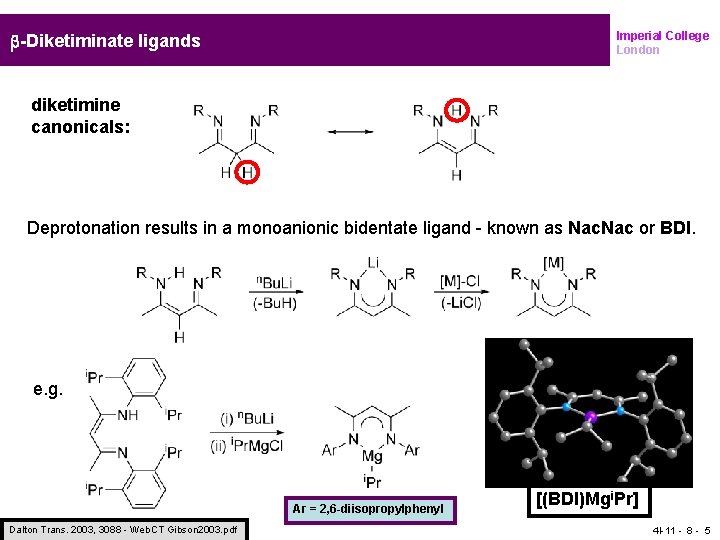
Imperial College London b-Diketiminate ligands diketimine canonicals: Deprotonation results in a monoanionic bidentate ligand - known as Nac or BDI. e. g. Ar = 2, 6 -diisopropylphenyl Dalton Trans. 2003, 3088 - Web. CT Gibson 2003. pdf [(BDI)Mgi. Pr] 4 I-11 - 8 - 5
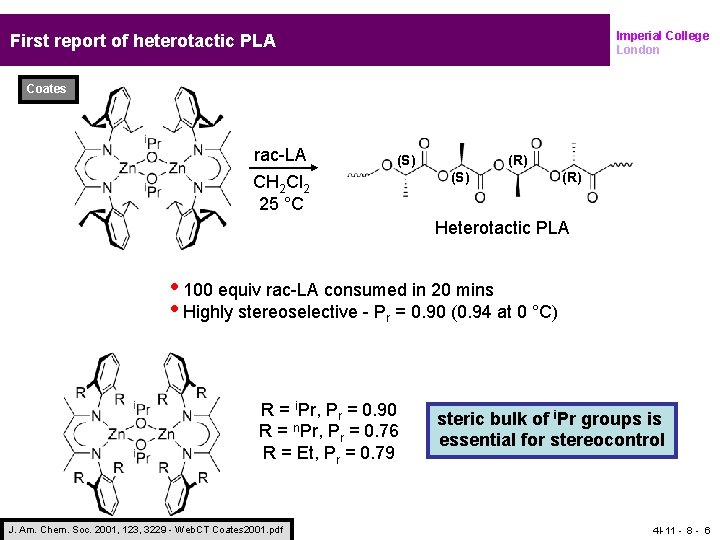
Imperial College London First report of heterotactic PLA Coates rac-LA (R) (S) CH 2 Cl 2 25 °C (S) (R) Heterotactic PLA • 100 equiv rac-LA consumed in 20 mins • Highly stereoselective - Pr = 0. 90 (0. 94 at 0 °C) R = i. Pr, Pr = 0. 90 R = n. Pr, Pr = 0. 76 R = Et, Pr = 0. 79 J. Am. Chem. Soc. 2001, 123, 3229 - Web. CT Coates 2001. pdf steric bulk of i. Pr groups is essential for stereocontrol 4 I-11 - 8 - 6
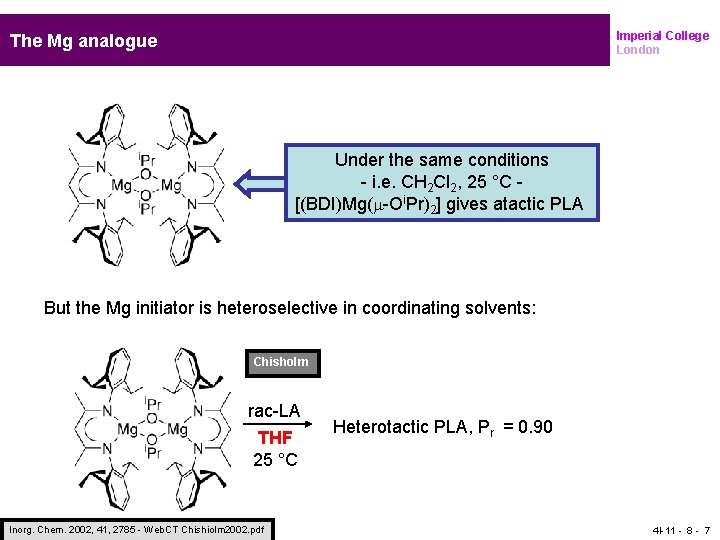
Imperial College London The Mg analogue Under the same conditions - i. e. CH 2 Cl 2, 25 °C [(BDI)Mg(m-Oi. Pr)2] gives atactic PLA But the Mg initiator is heteroselective in coordinating solvents: Chisholm rac-LA THF 25 °C Inorg. Chem. 2002, 41, 2785 - Web. CT Chishiolm 2002. pdf Heterotactic PLA, Pr = 0. 90 4 I-11 - 8 - 7
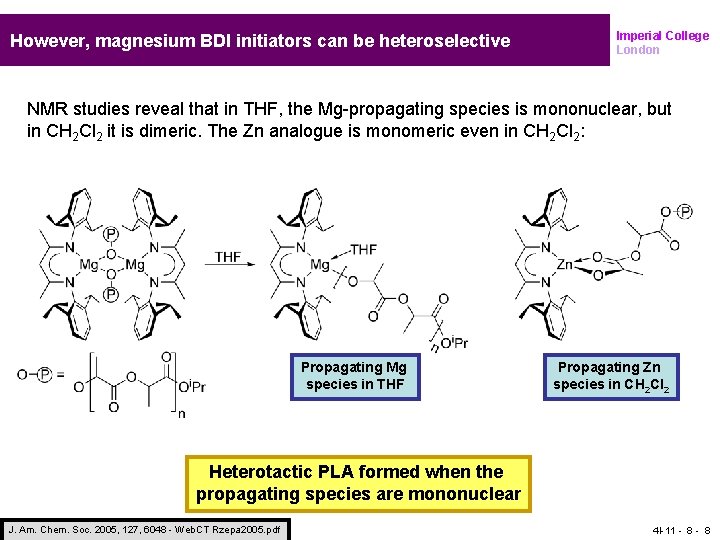
However, magnesium BDI initiators can be heteroselective Imperial College London NMR studies reveal that in THF, the Mg-propagating species is mononuclear, but in CH 2 Cl 2 it is dimeric. The Zn analogue is monomeric even in CH 2 Cl 2: Propagating Mg species in THF Propagating Zn species in CH 2 Cl 2 Heterotactic PLA formed when the propagating species are mononuclear J. Am. Chem. Soc. 2005, 127, 6048 - Web. CT Rzepa 2005. pdf 4 I-11 - 8
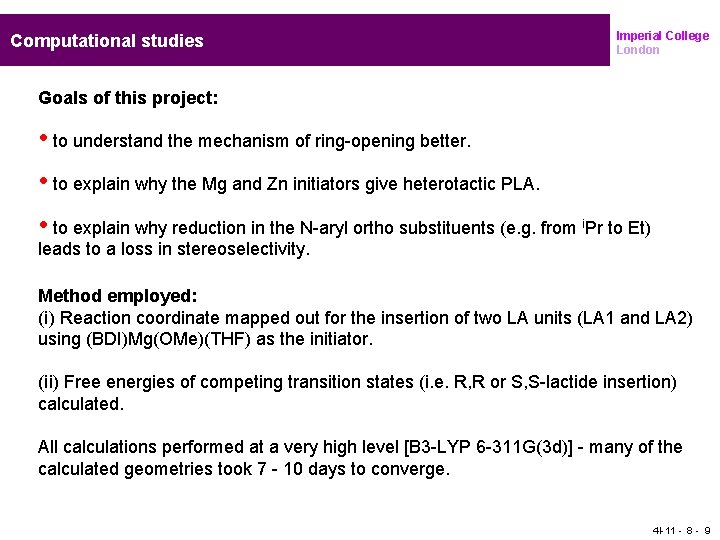
Computational studies Imperial College London Goals of this project: • to understand the mechanism of ring-opening better. • to explain why the Mg and Zn initiators give heterotactic PLA. • to explain why reduction in the N-aryl ortho substituents (e. g. from i. Pr to Et) leads to a loss in stereoselectivity. Method employed: (i) Reaction coordinate mapped out for the insertion of two LA units (LA 1 and LA 2) using (BDI)Mg(OMe)(THF) as the initiator. (ii) Free energies of competing transition states (i. e. R, R or S, S-lactide insertion) calculated. All calculations performed at a very high level [B 3 -LYP 6 -311 G(3 d)] - many of the calculated geometries took 7 - 10 days to converge. 4 I-11 - 8 - 9
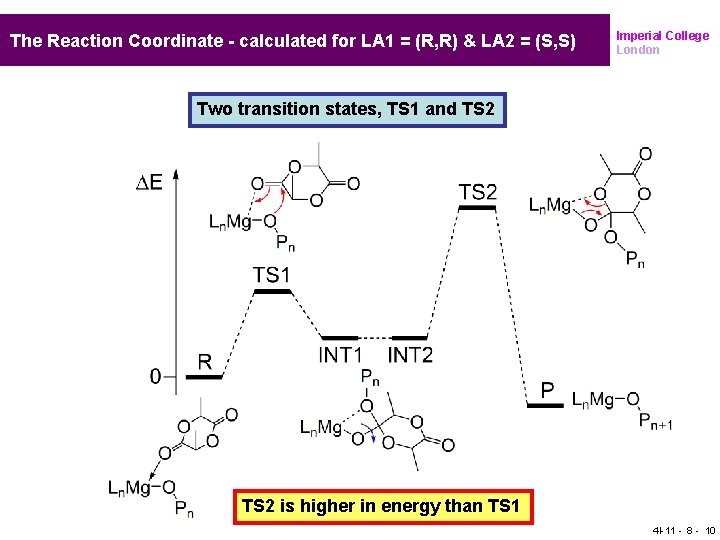
The Reaction Coordinate - calculated for LA 1 = (R, R) & LA 2 = (S, S) Imperial College London Two transition states, TS 1 and TS 2 is higher in energy than TS 1 4 I-11 - 8 - 10
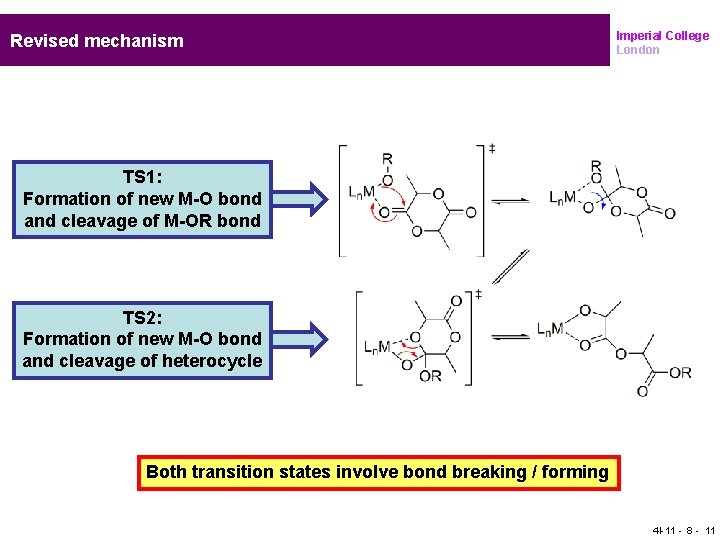
Revised mechanism Imperial College London TS 1: Formation of new M-O bond and cleavage of M-OR bond TS 2: Formation of new M-O bond and cleavage of heterocycle Both transition states involve bond breaking / forming 4 I-11 - 8 - 11
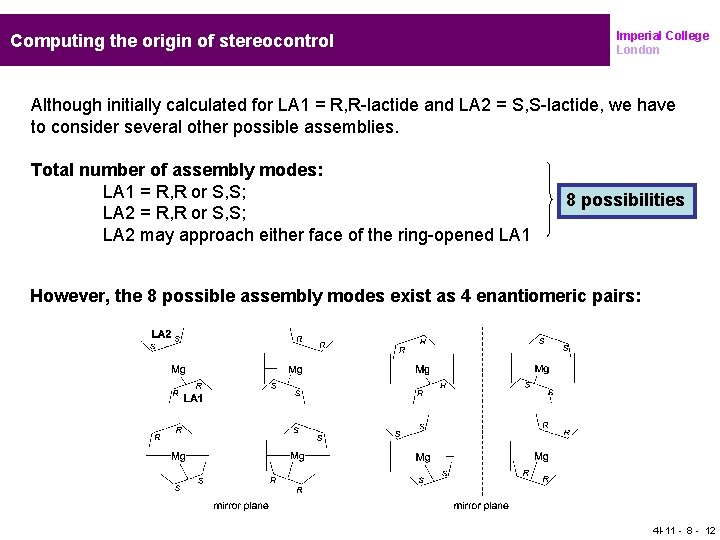
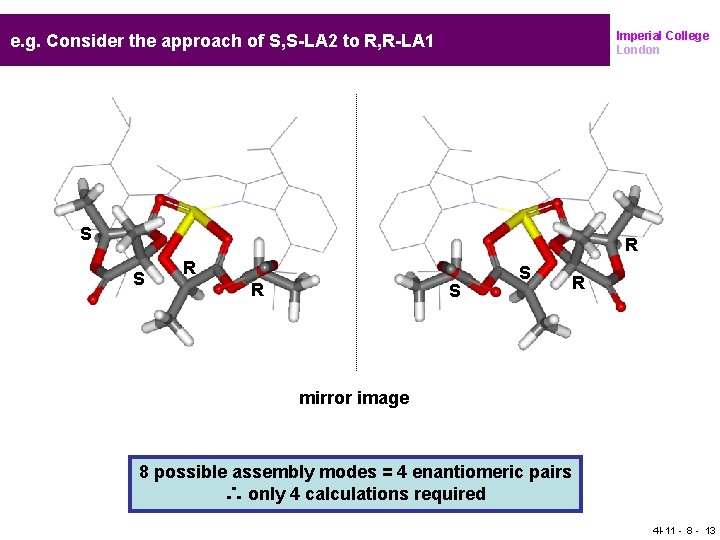
Computing the origin of stereocontrol Imperial College London Although initially calculated for LA 1 = R, R-lactide and LA 2 = S, S-lactide, we have to consider several other possible assemblies. Total number of assembly modes: LA 1 = R, R or S, S; LA 2 may approach either face of the ring-opened LA 1 8 possibilities However, the 8 possible assembly modes exist as 4 enantiomeric pairs: 4 I-11 - 8 - 12
Imperial College London e. g. Consider the approach of S, S-LA 2 to R, R-LA 1 S R R S S R mirror image 8 possible assembly modes = 4 enantiomeric pairs ∴ only 4 calculations required 4 I-11 - 8 - 13
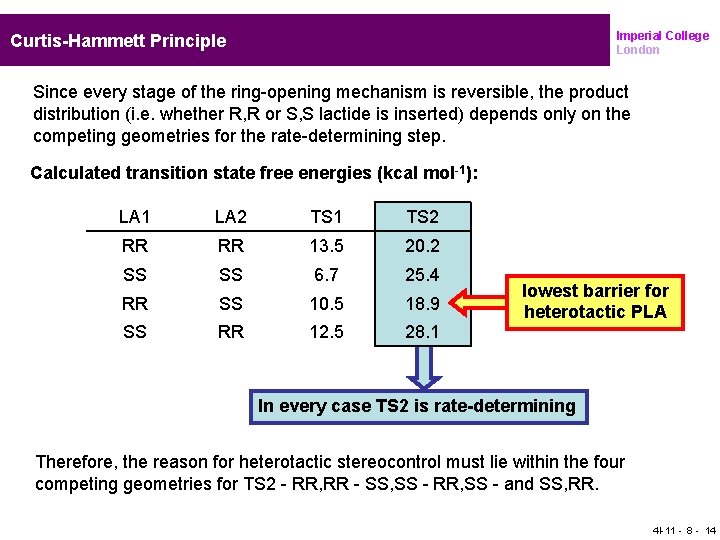
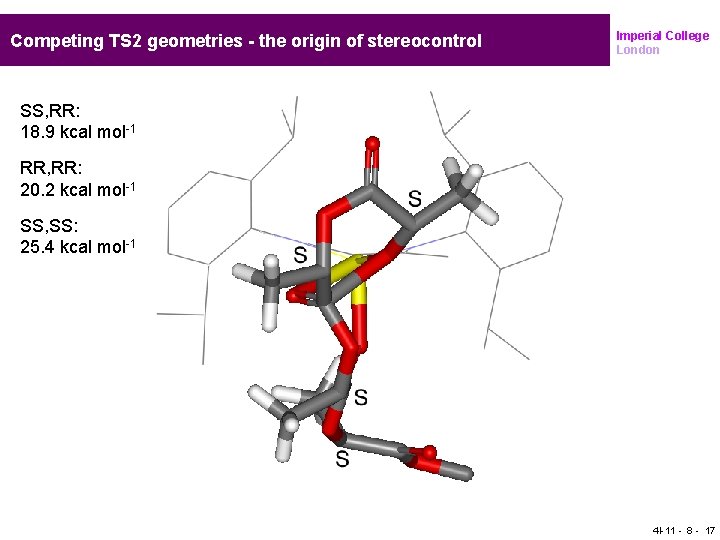
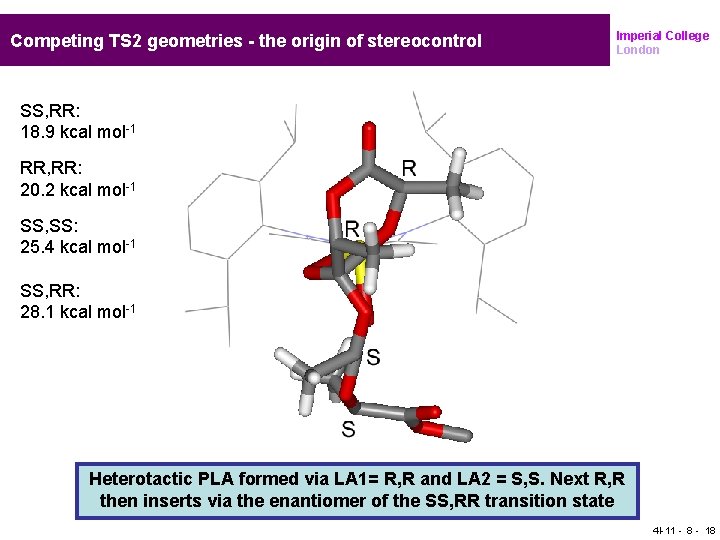
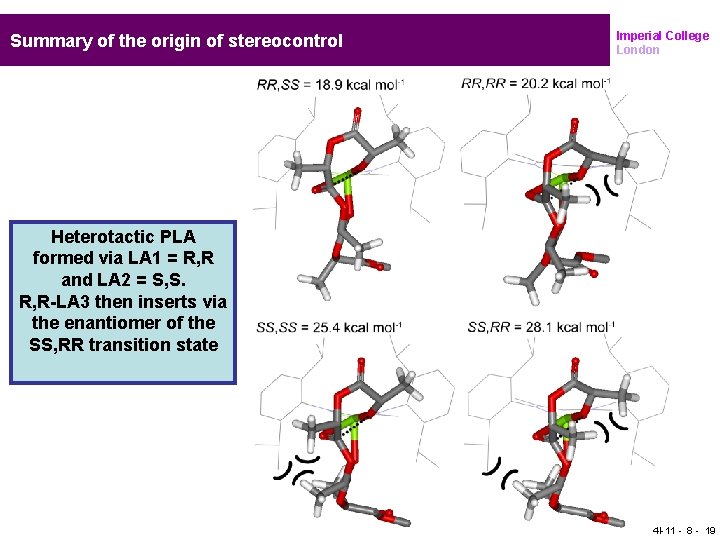
Imperial College London Curtis-Hammett Principle Since every stage of the ring-opening mechanism is reversible, the product distribution (i. e. whether R, R or S, S lactide is inserted) depends only on the competing geometries for the rate-determining step. Calculated transition state free energies (kcal mol-1): LA 1 LA 2 TS 1 TS 2 RR RR 13. 5 20. 2 SS SS 6. 7 25. 4 RR SS 10. 5 18. 9 SS RR 12. 5 28. 1 lowest barrier for heterotactic PLA In every case TS 2 is rate-determining Therefore, the reason for heterotactic stereocontrol must lie within the four competing geometries for TS 2 - RR, RR - SS, SS - RR, SS - and SS, RR. 4 I-11 - 8 - 14
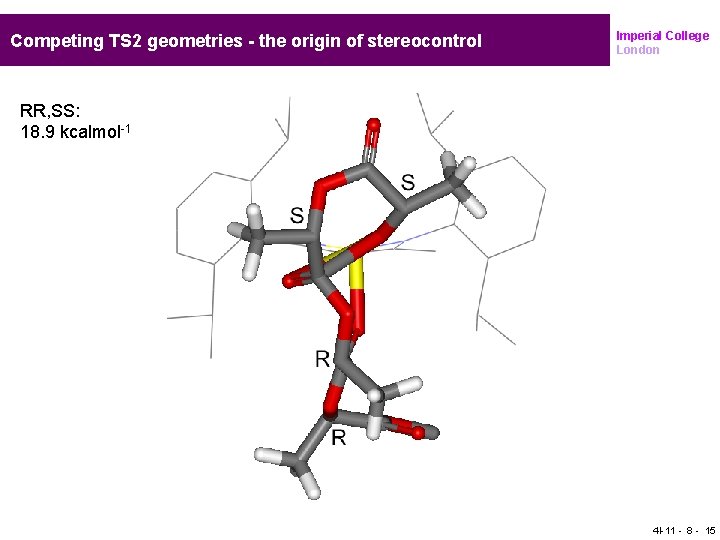
Competing TS 2 geometries - the origin of stereocontrol Imperial College London RR, SS: 18. 9 kcalmol-1 4 I-11 - 8 - 15
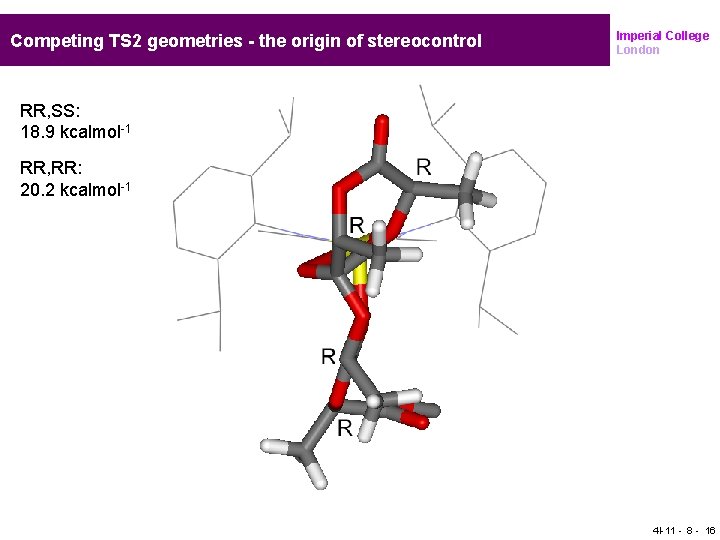
Competing TS 2 geometries - the origin of stereocontrol Imperial College London RR, SS: 18. 9 kcalmol-1 RR, RR: 20. 2 kcalmol-1 4 I-11 - 8 - 16
Competing TS 2 geometries - the origin of stereocontrol Imperial College London SS, RR: 18. 9 kcal mol-1 RR, RR: 20. 2 kcal mol-1 SS, SS: 25. 4 kcal mol-1 4 I-11 - 8 - 17
Competing TS 2 geometries - the origin of stereocontrol Imperial College London SS, RR: 18. 9 kcal mol-1 RR, RR: 20. 2 kcal mol-1 SS, SS: 25. 4 kcal mol-1 SS, RR: 28. 1 kcal mol-1 Heterotactic PLA formed via LA 1= R, R and LA 2 = S, S. Next R, R then inserts via the enantiomer of the SS, RR transition state 4 I-11 - 8 - 18
Summary of the origin of stereocontrol Imperial College London Heterotactic PLA formed via LA 1 = R, R and LA 2 = S, S. R, R-LA 3 then inserts via the enantiomer of the SS, RR transition state 4 I-11 - 8 - 19
Conclusions Imperial College London • Heterotactic PLA may be prepared using b-diketiminate Zn and Mg alkoxides, but the Mg initiators must be used in THF. • The propagating species responsible for heterotactic PLA formation is mononuclear. • Computational analysis reveals that the rate determining step is TS 2, i. e. the cleavage of the monomer heterocycle. • Heterotactic PLA arises because of the minimisation of Me - Me steric clashes in the competing geometries of TS 2. 4 I-11 - 8 - 20