
4 From Chemistry to Energy to Life Part
- Slides: 26
4 From Chemistry to Energy to Life Part B Power. Point® Slides prepared by Jay Withgott and Kristy Manning Copyright © 2006 Pearson Education, Inc. , publishing as Benjamin Cummings
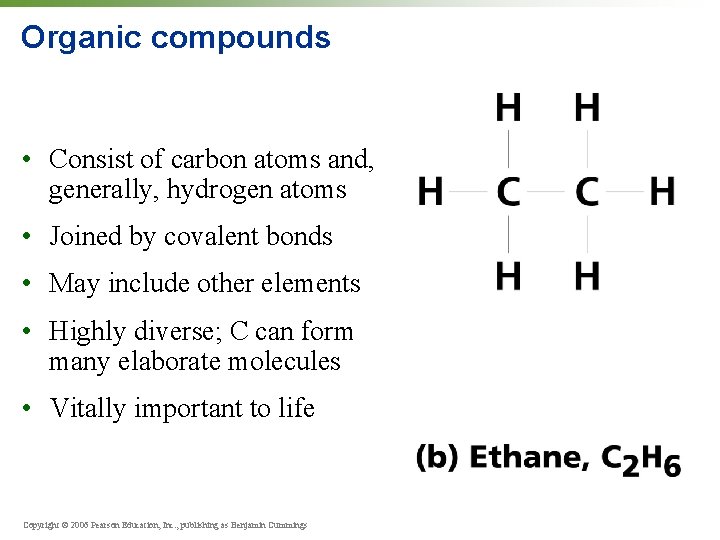
Organic compounds • Consist of carbon atoms and, generally, hydrogen atoms • Joined by covalent bonds • May include other elements • Highly diverse; C can form many elaborate molecules • Vitally important to life Copyright © 2006 Pearson Education, Inc. , publishing as Benjamin Cummings
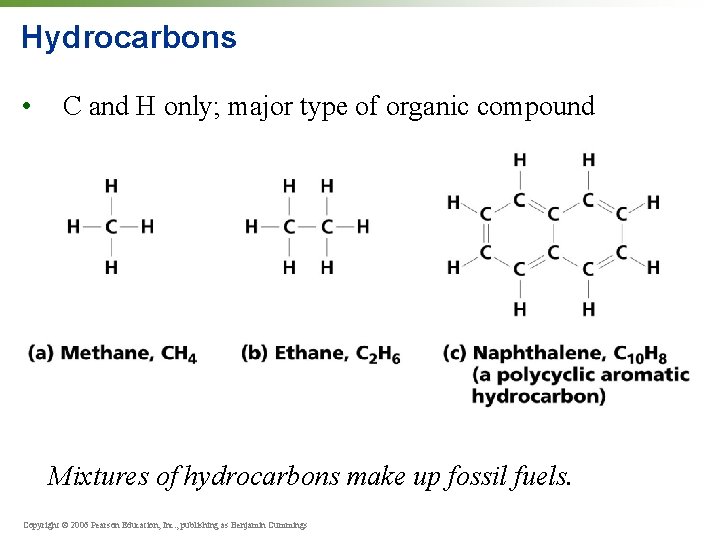
Hydrocarbons • C and H only; major type of organic compound Mixtures of hydrocarbons make up fossil fuels. Copyright © 2006 Pearson Education, Inc. , publishing as Benjamin Cummings
Macromolecules • Large molecules essential for life: • Proteins • Nucleic acids • Carbohydrates • Lipids • The first three are polymers, long chains of repeated molecules. Copyright © 2006 Pearson Education, Inc. , publishing as Benjamin Cummings
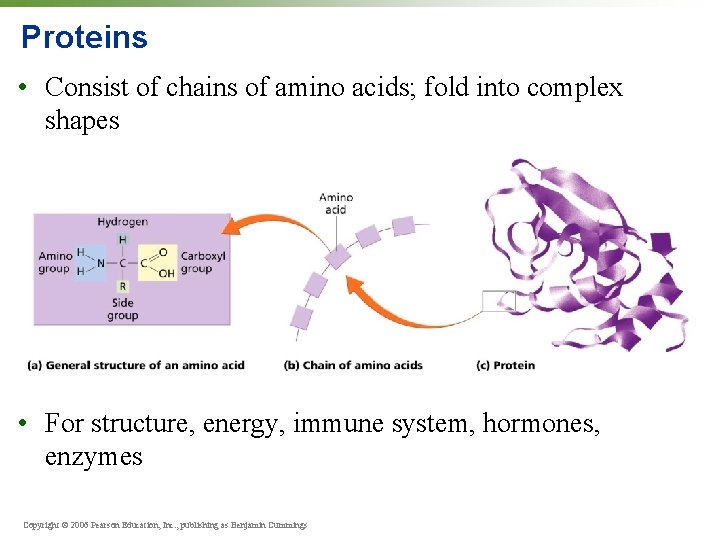
Proteins • Consist of chains of amino acids; fold into complex shapes • For structure, energy, immune system, hormones, enzymes Copyright © 2006 Pearson Education, Inc. , publishing as Benjamin Cummings
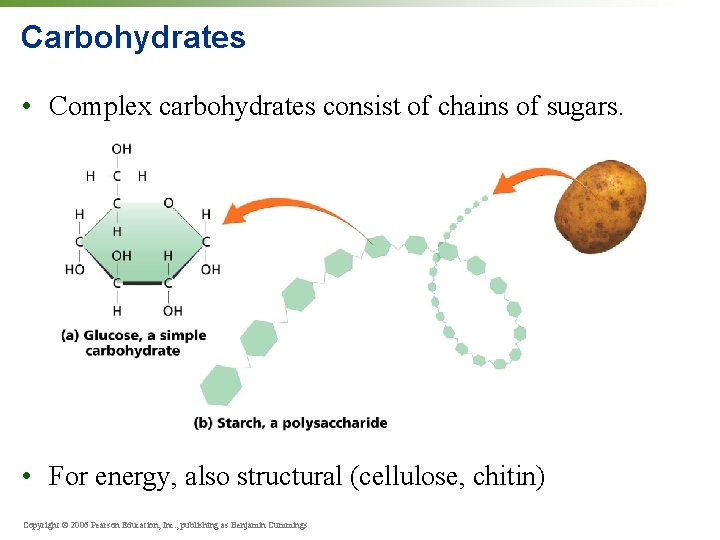
Carbohydrates • Complex carbohydrates consist of chains of sugars. • For energy, also structural (cellulose, chitin) Copyright © 2006 Pearson Education, Inc. , publishing as Benjamin Cummings
Lipids • Do not dissolve in water • Fats and oils • Phospholipids • Waxes • Steroids Copyright © 2006 Pearson Education, Inc. , publishing as Benjamin Cummings
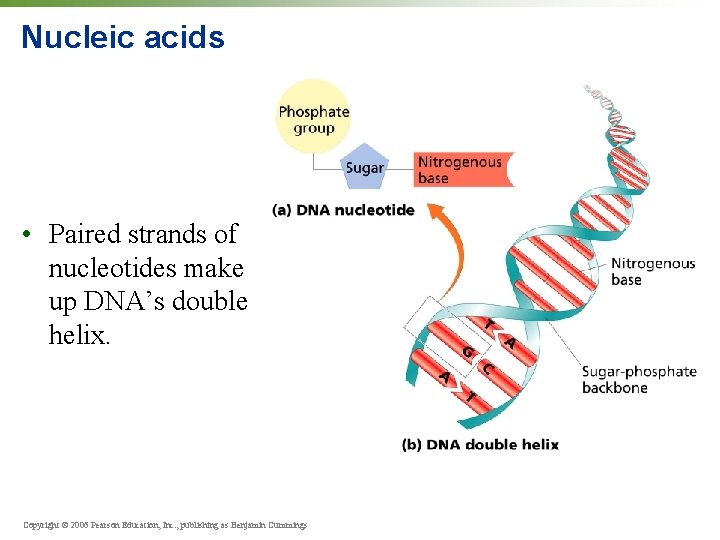
Nucleic acids • DNA and RNA • Encode genetic information and pass it on from generation to generation • DNA = double-stranded chain (double helix) • RNA = single-stranded chain Copyright © 2006 Pearson Education, Inc. , publishing as Benjamin Cummings
Nucleic acids • Paired strands of nucleotides make up DNA’s double helix. Copyright © 2006 Pearson Education, Inc. , publishing as Benjamin Cummings
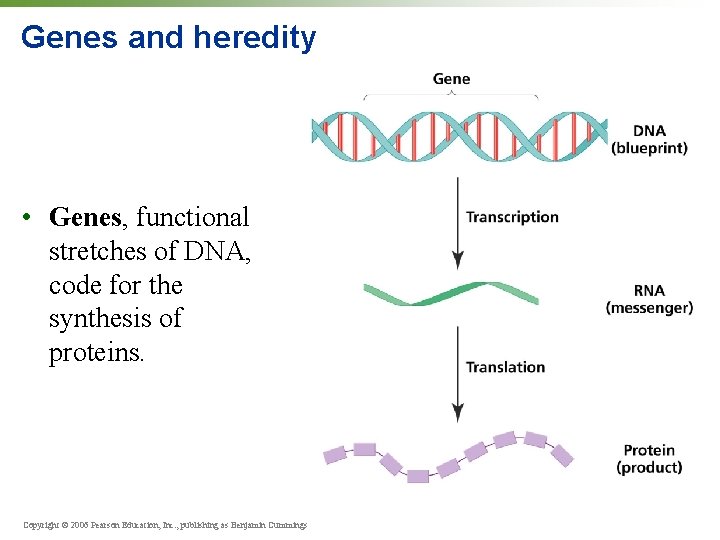
Genes and heredity • Genes, functional stretches of DNA, code for the synthesis of proteins. Copyright © 2006 Pearson Education, Inc. , publishing as Benjamin Cummings
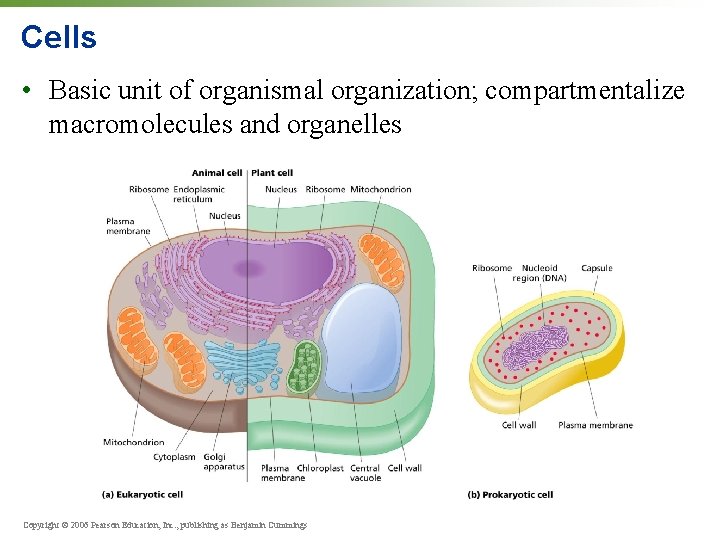
Cells • Basic unit of organismal organization; compartmentalize macromolecules and organelles Copyright © 2006 Pearson Education, Inc. , publishing as Benjamin Cummings
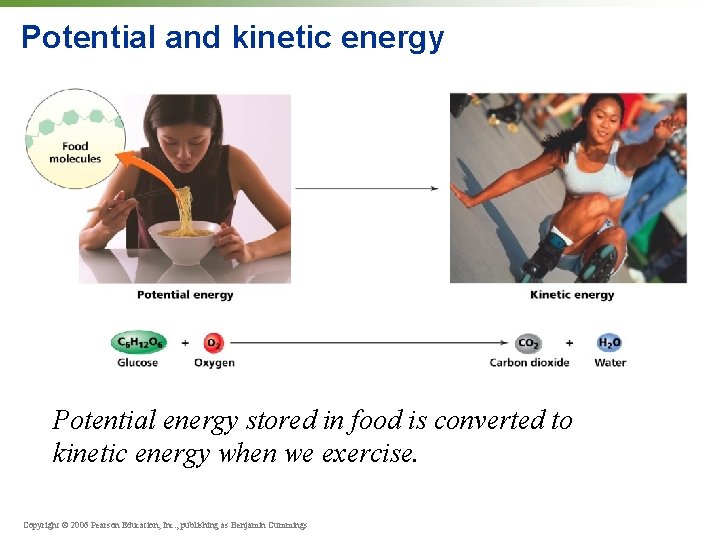
Energy • Can change position, physical composition, or temperature of matter • Potential energy = energy of position (water held behind a dam) • Kinetic energy = energy of movement (rushing water released from a dam) Copyright © 2006 Pearson Education, Inc. , publishing as Benjamin Cummings
Potential and kinetic energy Potential energy stored in food is converted to kinetic energy when we exercise. Copyright © 2006 Pearson Education, Inc. , publishing as Benjamin Cummings
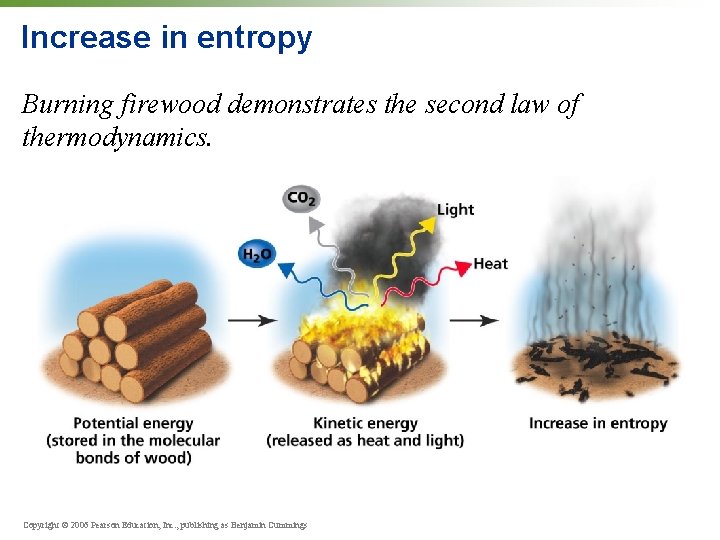
Laws of thermodynamics • First Law: Energy can change form, but cannot be created or lost. • Second Law: Energy will tend to progress from a moreordered state to a less-ordered state (increase in entropy). Copyright © 2006 Pearson Education, Inc. , publishing as Benjamin Cummings
Increase in entropy Burning firewood demonstrates the second law of thermodynamics. Copyright © 2006 Pearson Education, Inc. , publishing as Benjamin Cummings
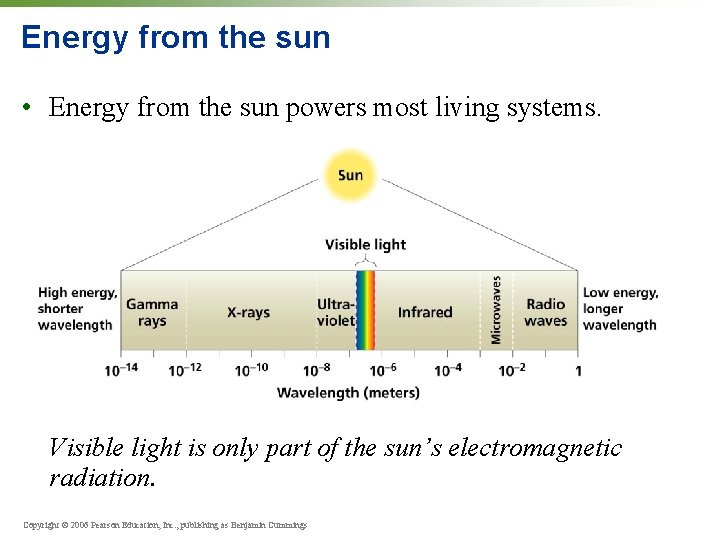
Energy from the sun • Energy from the sun powers most living systems. Visible light is only part of the sun’s electromagnetic radiation. Copyright © 2006 Pearson Education, Inc. , publishing as Benjamin Cummings
Autotrophs and photosynthesis • The sun’s energy is used by autotrophic organisms, or primary producers (e. g. , plants), to manufacture food. • Photosynthesis turns light energy from the sun into chemical energy that organisms can use. Copyright © 2006 Pearson Education, Inc. , publishing as Benjamin Cummings
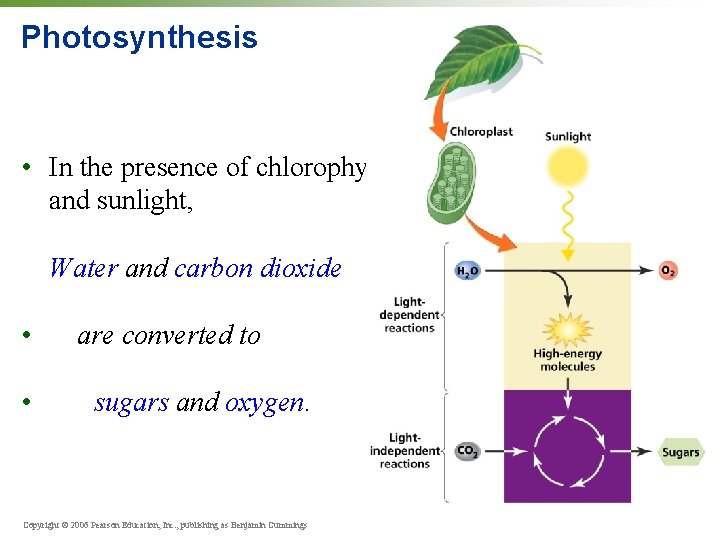
Photosynthesis • In the presence of chlorophyll and sunlight, Water and carbon dioxide • • are converted to sugars and oxygen. Copyright © 2006 Pearson Education, Inc. , publishing as Benjamin Cummings
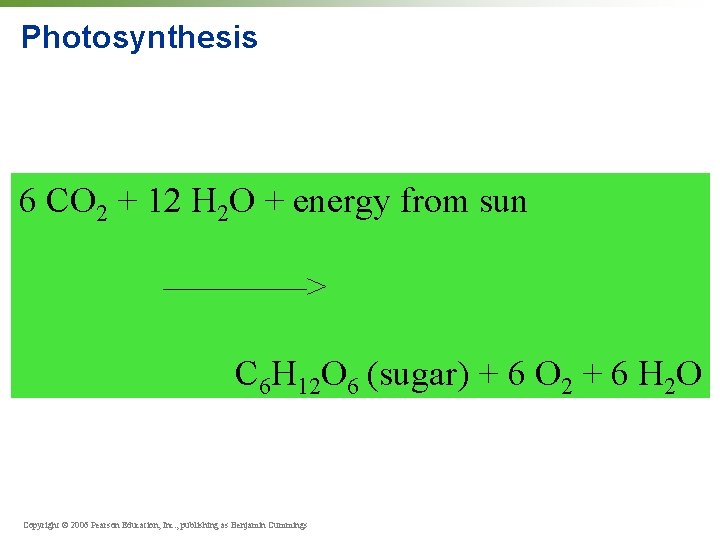
Photosynthesis 6 CO 2 + 12 H 2 O + energy from sun ————> C 6 H 12 O 6 (sugar) + 6 O 2 + 6 H 2 O Copyright © 2006 Pearson Education, Inc. , publishing as Benjamin Cummings
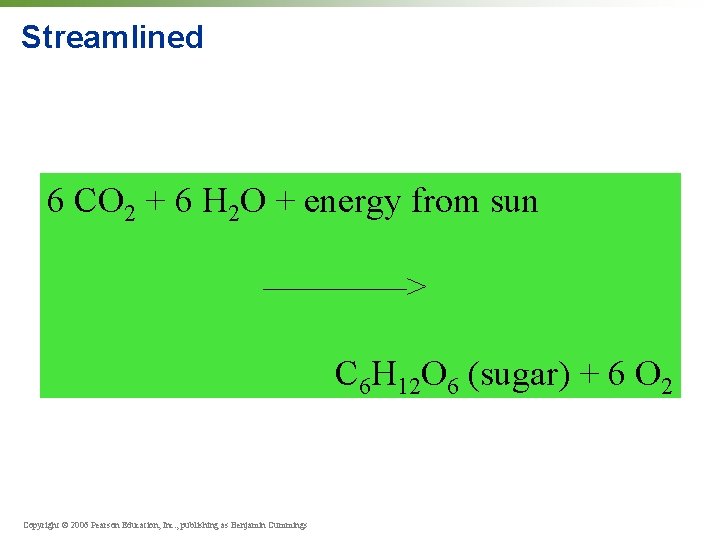
Streamlined 6 CO 2 + 6 H 2 O + energy from sun ————> C 6 H 12 O 6 (sugar) + 6 O 2 Copyright © 2006 Pearson Education, Inc. , publishing as Benjamin Cummings
Respiration and heterotrophs • Organisms use stored energy via respiration, which splits sugar molecules to release chemical energy. • This occurs in autotrophs and in the heterotrophs (animals, fungi, most microbes) that eat them. Copyright © 2006 Pearson Education, Inc. , publishing as Benjamin Cummings
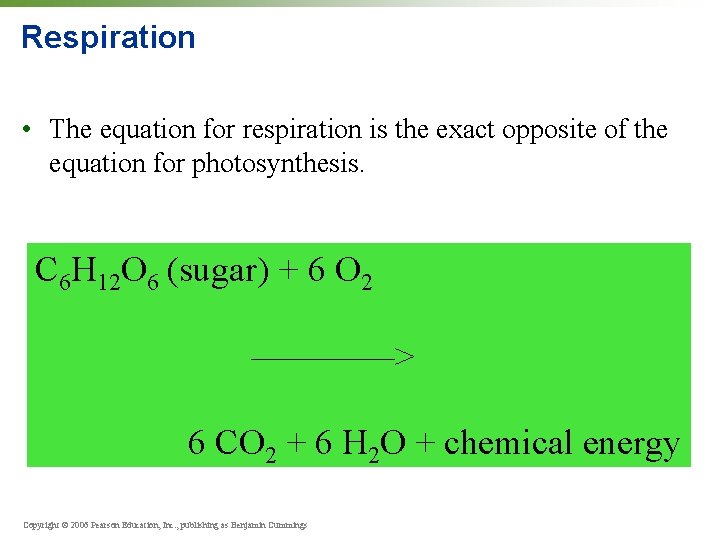
Respiration • The equation for respiration is the exact opposite of the equation for photosynthesis. C 6 H 12 O 6 (sugar) + 6 O 2 ————> 6 CO 2 + 6 H 2 O + chemical energy Copyright © 2006 Pearson Education, Inc. , publishing as Benjamin Cummings
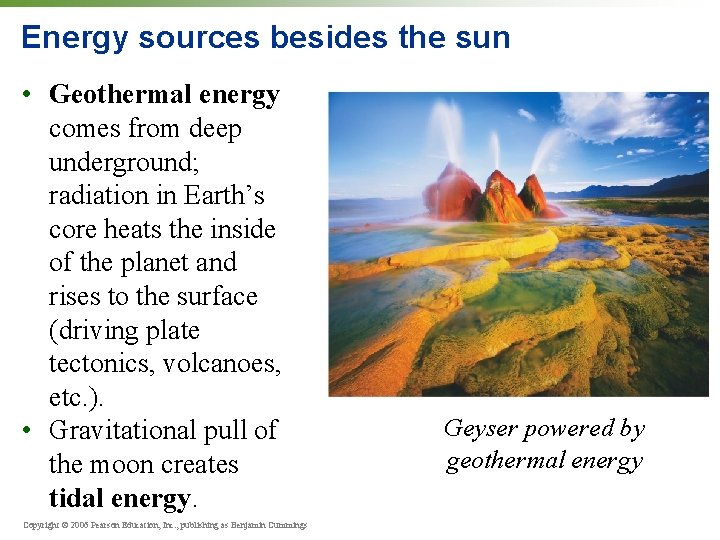
Energy sources besides the sun • Geothermal energy comes from deep underground; radiation in Earth’s core heats the inside of the planet and rises to the surface (driving plate tectonics, volcanoes, etc. ). • Gravitational pull of the moon creates tidal energy. Copyright © 2006 Pearson Education, Inc. , publishing as Benjamin Cummings Geyser powered by geothermal energy
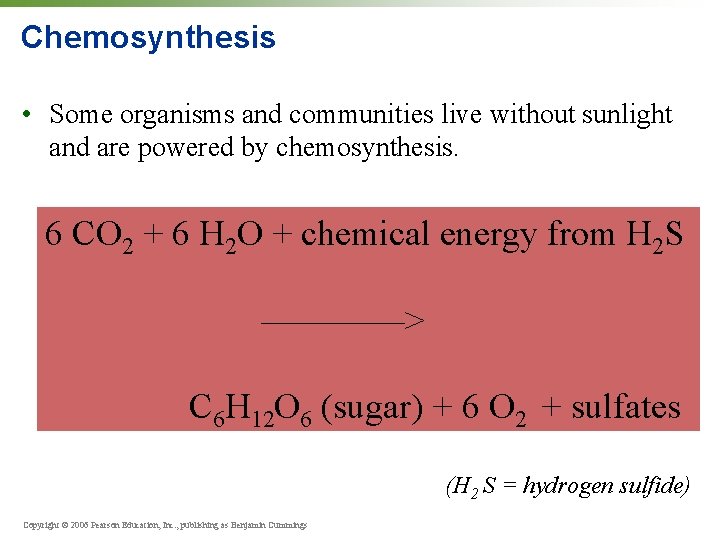
Chemosynthesis • Some organisms and communities live without sunlight and are powered by chemosynthesis. 6 CO 2 + 6 H 2 O + chemical energy from H 2 S ————> C 6 H 12 O 6 (sugar) + 6 O 2 + sulfates (H 2 S = hydrogen sulfide) Copyright © 2006 Pearson Education, Inc. , publishing as Benjamin Cummings
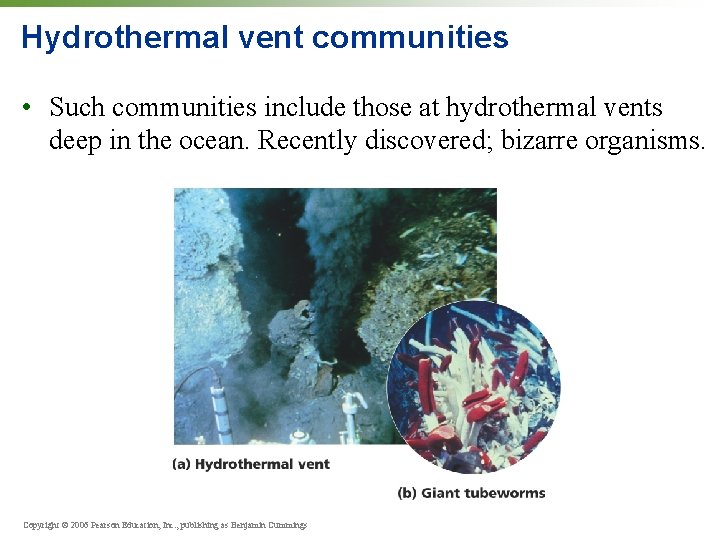
Hydrothermal vent communities • Such communities include those at hydrothermal vents deep in the ocean. Recently discovered; bizarre organisms. Copyright © 2006 Pearson Education, Inc. , publishing as Benjamin Cummings
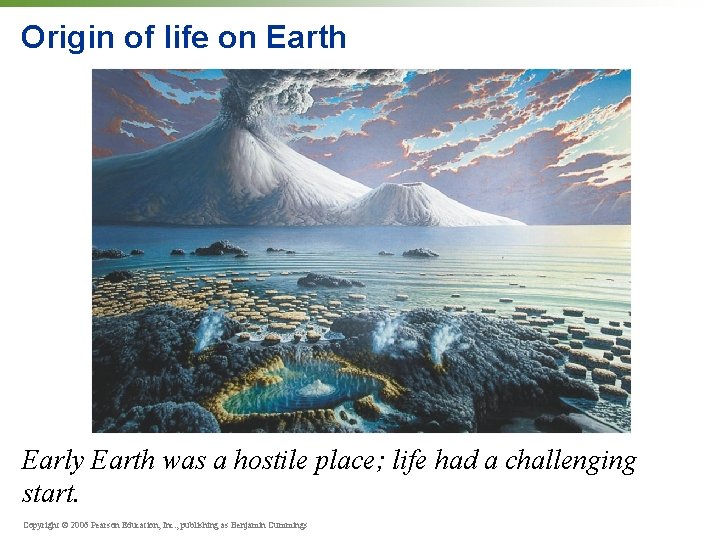
Origin of life on Earth Early Earth was a hostile place; life had a challenging start. Copyright © 2006 Pearson Education, Inc. , publishing as Benjamin Cummings