
4 Floating Point Numbers Chapt 5 ITEC 1011
4. Floating Point Numbers Chapt. 5 ITEC 1011 Introduction to Information Technologies
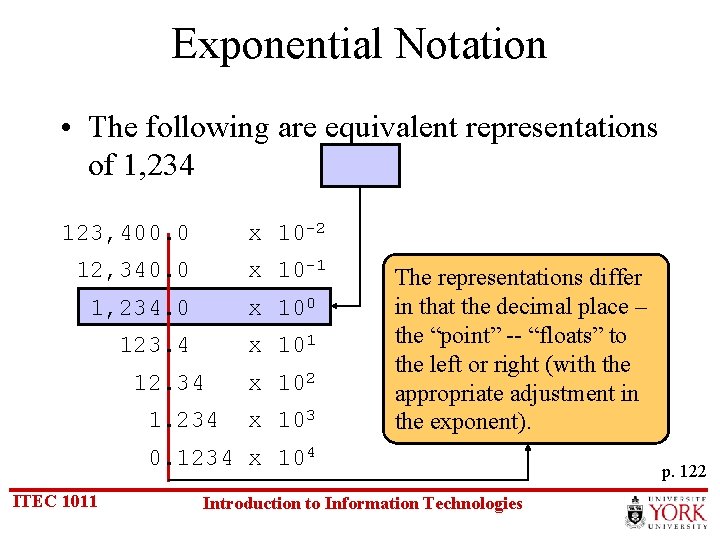
Exponential Notation • The following are equivalent representations of 1, 234 123, 400. 0 x 10 -2 12, 340. 0 x 10 -1 1, 234. 0 x 100 123. 4 x 101 12. 34 1. 234 x 102 x 103 The representations differ in that the decimal place – the “point” -- “floats” to the left or right (with the appropriate adjustment in the exponent). 0. 1234 x 104 ITEC 1011 Introduction to Information Technologies p. 122
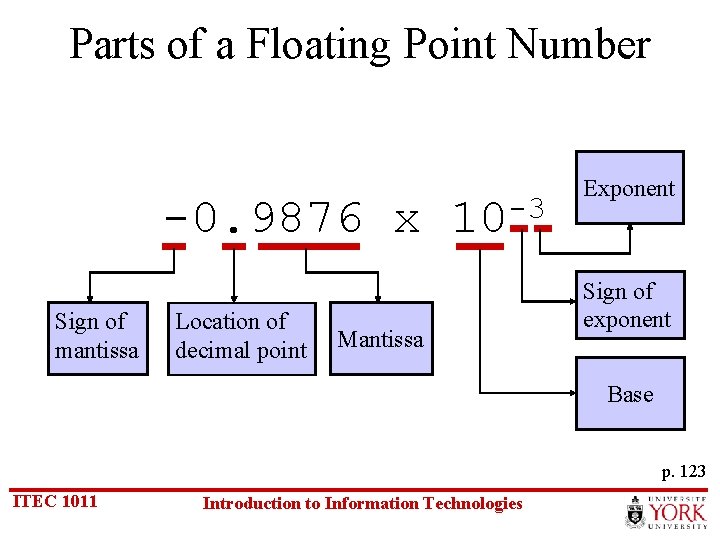
Parts of a Floating Point Number -0. 9876 x Sign of mantissa Location of decimal point -3 10 Mantissa Exponent Sign of exponent Base p. 123 ITEC 1011 Introduction to Information Technologies
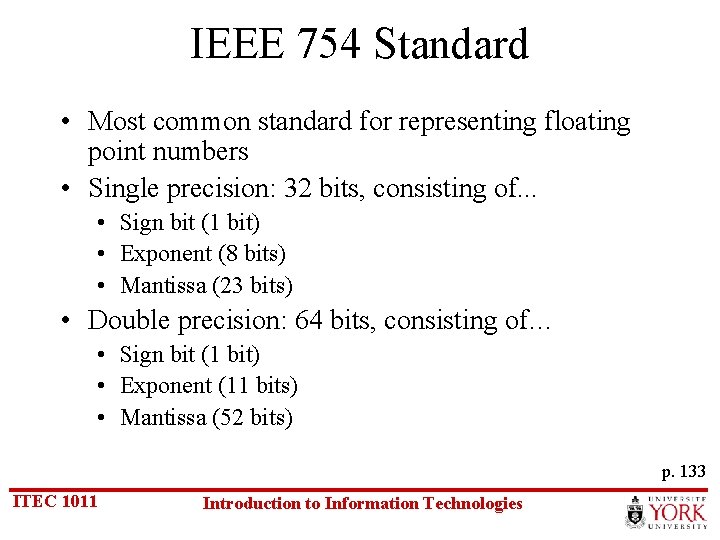
IEEE 754 Standard • Most common standard for representing floating point numbers • Single precision: 32 bits, consisting of. . . • Sign bit (1 bit) • Exponent (8 bits) • Mantissa (23 bits) • Double precision: 64 bits, consisting of… • Sign bit (1 bit) • Exponent (11 bits) • Mantissa (52 bits) p. 133 ITEC 1011 Introduction to Information Technologies
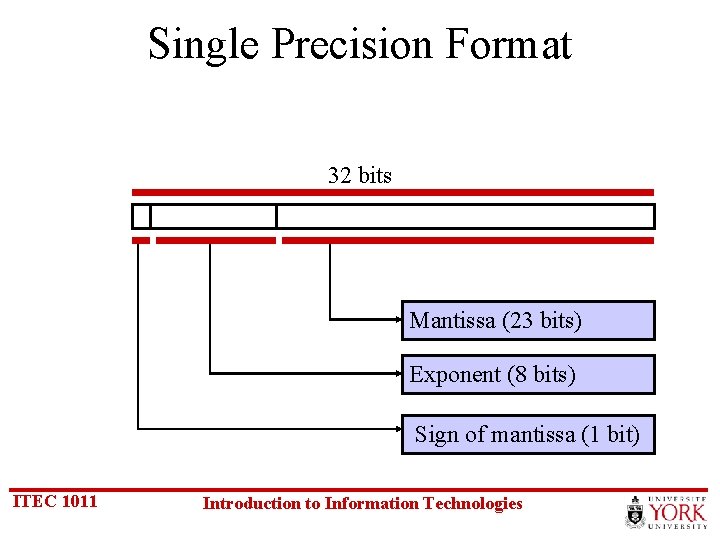
Single Precision Format 32 bits Mantissa (23 bits) Exponent (8 bits) Sign of mantissa (1 bit) ITEC 1011 Introduction to Information Technologies
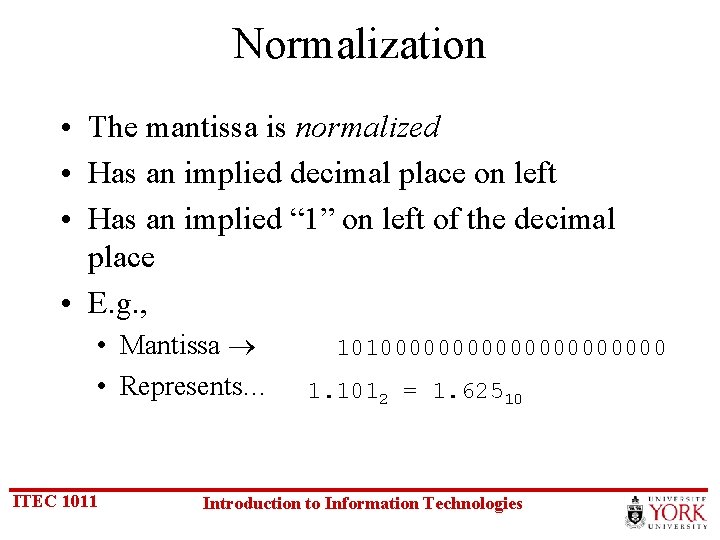
Normalization • The mantissa is normalized • Has an implied decimal place on left • Has an implied “ 1” on left of the decimal place • E. g. , • Mantissa • Represents… ITEC 1011 1010000000000 1. 1012 = 1. 62510 Introduction to Information Technologies
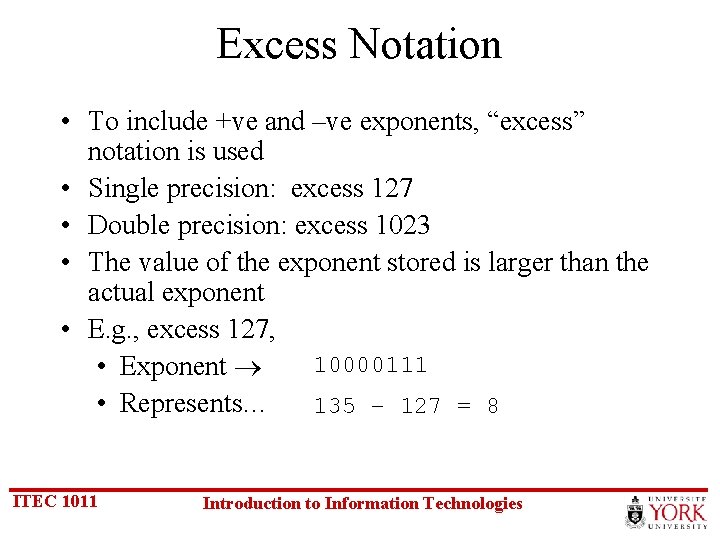
Excess Notation • To include +ve and –ve exponents, “excess” notation is used • Single precision: excess 127 • Double precision: excess 1023 • The value of the exponent stored is larger than the actual exponent • E. g. , excess 127, 10000111 • Exponent • Represents… 135 – 127 = 8 ITEC 1011 Introduction to Information Technologies

Example • Single precision 0 10000010 1100000000000 1. 112 130 – 127 = 3 0 = positive mantissa +1. 112 x 23 = 1110. 02 = 14. 010 ITEC 1011 Introduction to Information Technologies
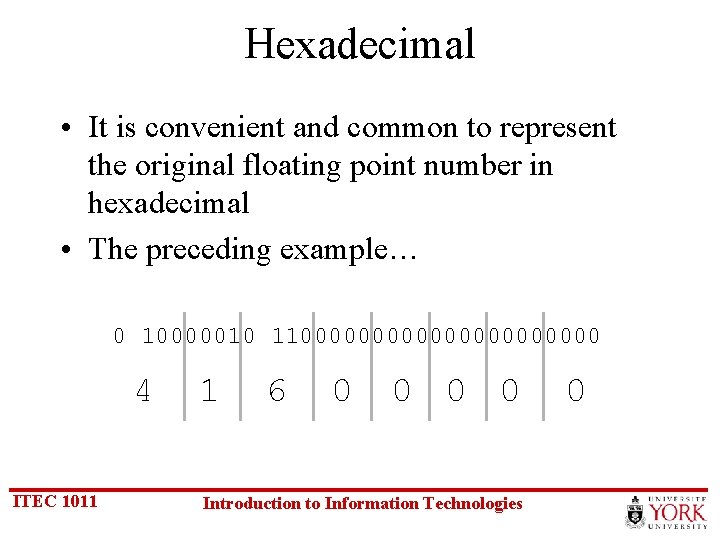
Hexadecimal • It is convenient and common to represent the original floating point number in hexadecimal • The preceding example… 0 10000010 1100000000000 4 ITEC 1011 1 6 0 0 Introduction to Information Technologies 0
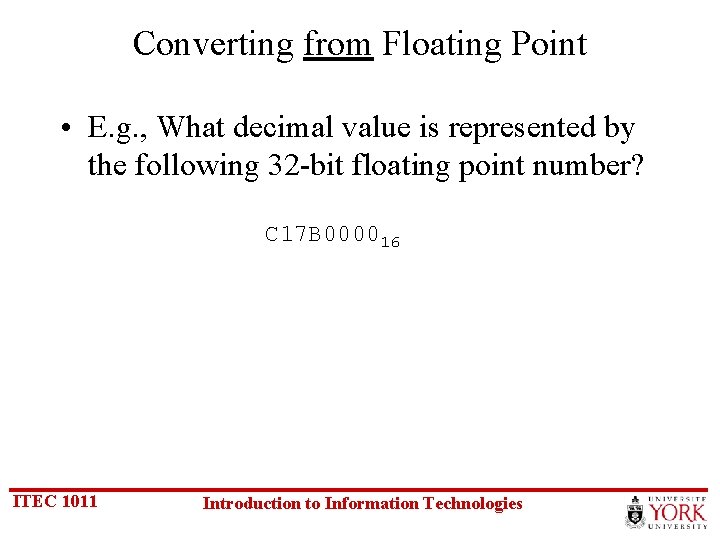
Converting from Floating Point • E. g. , What decimal value is represented by the following 32 -bit floating point number? C 17 B 000016 ITEC 1011 Introduction to Information Technologies
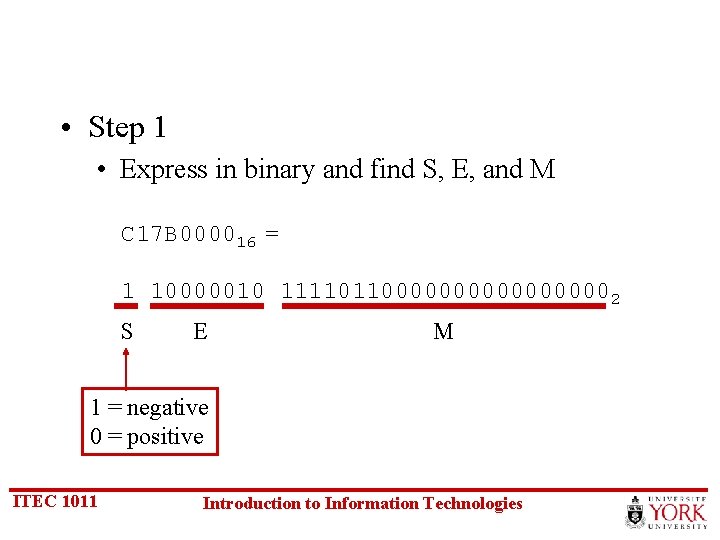
• Step 1 • Express in binary and find S, E, and M C 17 B 000016 = 1 10000010 1111011000000002 S E M 1 = negative 0 = positive ITEC 1011 Introduction to Information Technologies
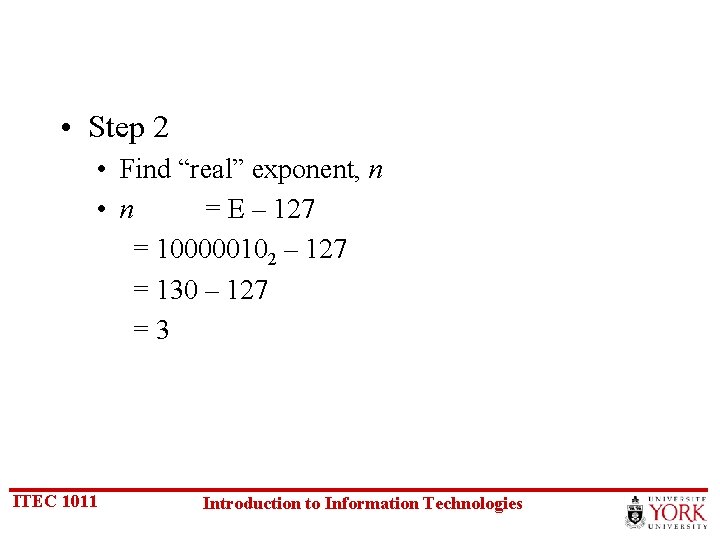
• Step 2 • Find “real” exponent, n • n = E – 127 = 100000102 – 127 = 130 – 127 =3 ITEC 1011 Introduction to Information Technologies
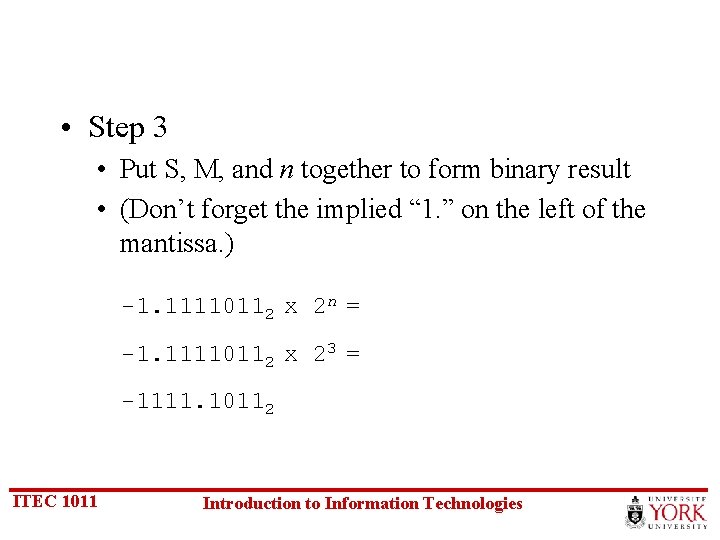
• Step 3 • Put S, M, and n together to form binary result • (Don’t forget the implied “ 1. ” on the left of the mantissa. ) -1. 11110112 x 2 n = -1. 11110112 x 23 = -1111. 10112 ITEC 1011 Introduction to Information Technologies
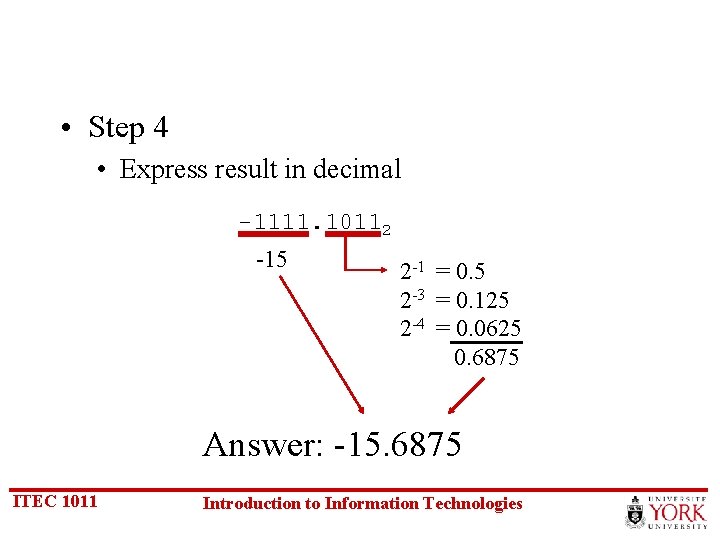
• Step 4 • Express result in decimal -1111. 10112 -15 2 -1 = 0. 5 2 -3 = 0. 125 2 -4 = 0. 0625 0. 6875 Answer: -15. 6875 ITEC 1011 Introduction to Information Technologies
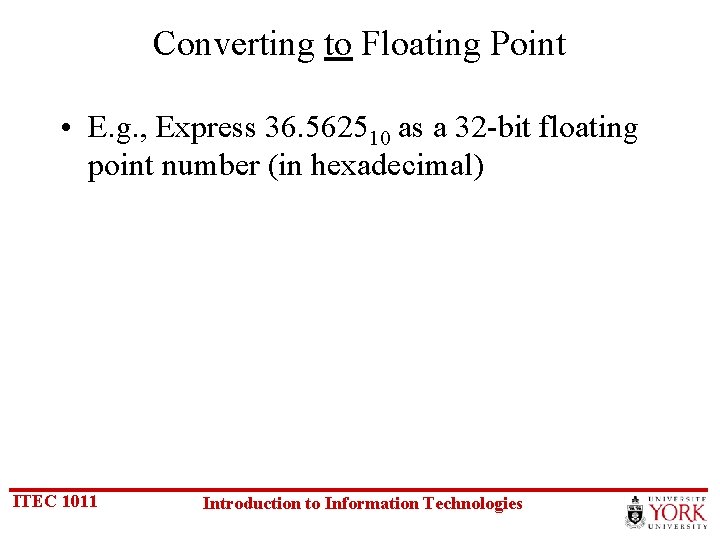
Converting to Floating Point • E. g. , Express 36. 562510 as a 32 -bit floating point number (in hexadecimal) ITEC 1011 Introduction to Information Technologies
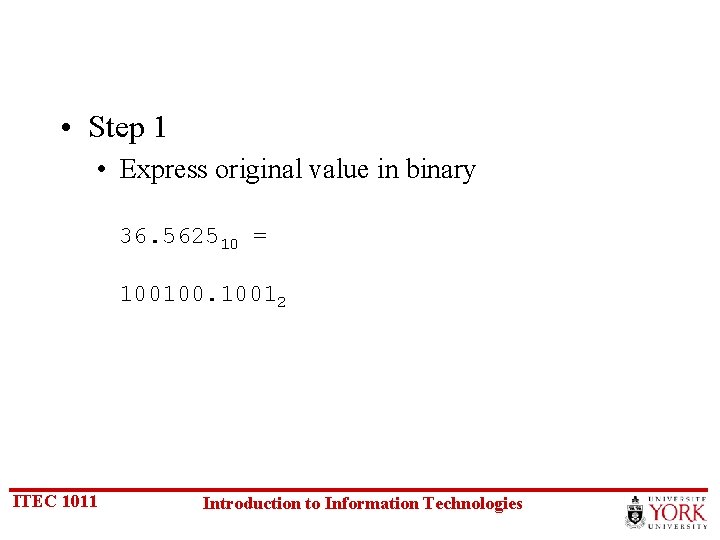
• Step 1 • Express original value in binary 36. 562510 = 100100. 10012 ITEC 1011 Introduction to Information Technologies
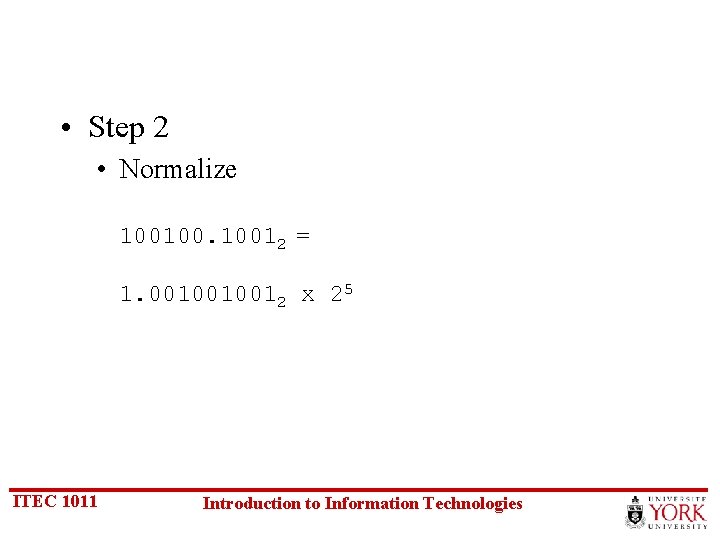
• Step 2 • Normalize 100100. 10012 = 1. 0010010012 x 25 ITEC 1011 Introduction to Information Technologies
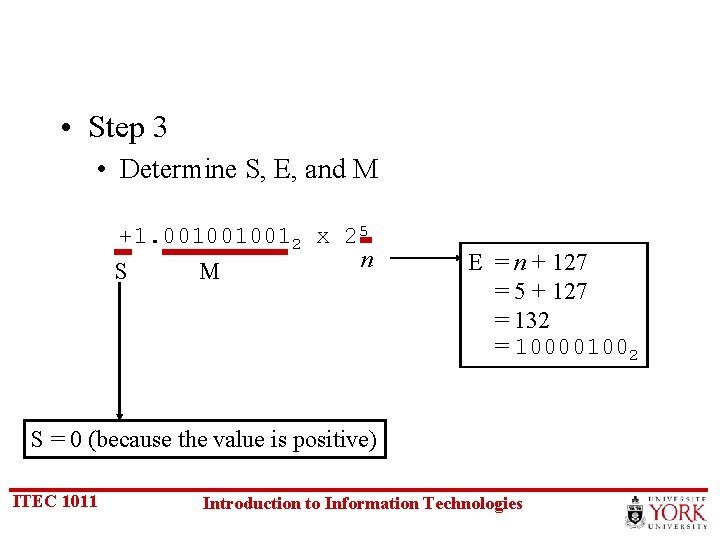
• Step 3 • Determine S, E, and M +1. 0010010012 x 25 n S M E = n + 127 = 5 + 127 = 132 = 100001002 S = 0 (because the value is positive) ITEC 1011 Introduction to Information Technologies
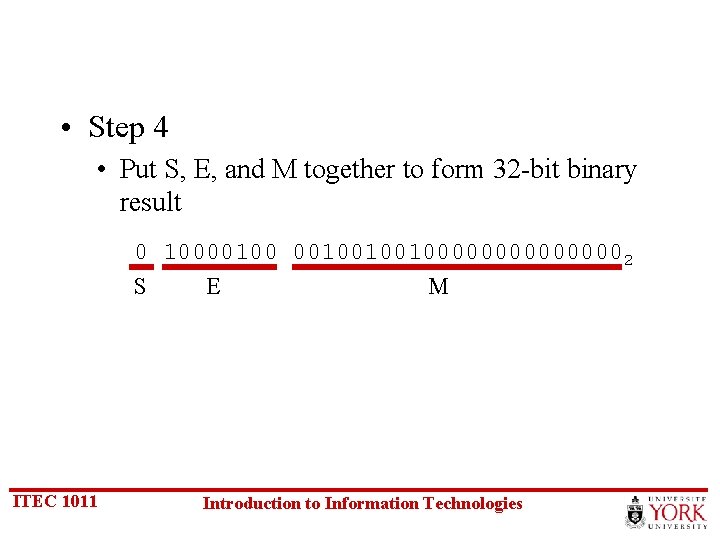
• Step 4 • Put S, E, and M together to form 32 -bit binary result 0 10000100100100000002 S E M ITEC 1011 Introduction to Information Technologies
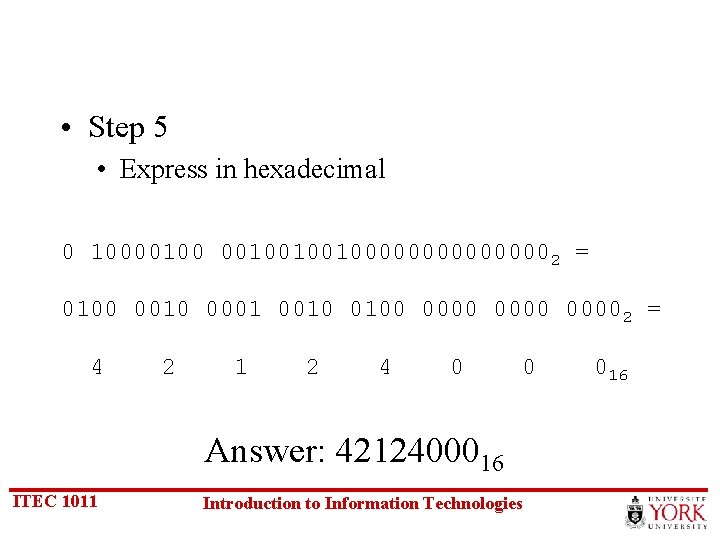
• Step 5 • Express in hexadecimal 0 10000100100100000002 = 0100 0010 0001 0010 0100 00002 = 4 2 1 2 4 0 0 Answer: 4212400016 ITEC 1011 Introduction to Information Technologies 016
Thank you ITEC 1011 Introduction to Information Technologies
- Slides: 21