
4 Equilibrium I o You do not need
4: Equilibrium I
o You do not need to copy the outcome, but you should read it o No drill – just immediately start CW 1 Drill 1 12/17 (A) 12/18 (B) Outcome: I can explain chemical equilibrium in terms of the equilibrium constant. Goal: CW 1 Hand In: Rate Law of CV Lab Report

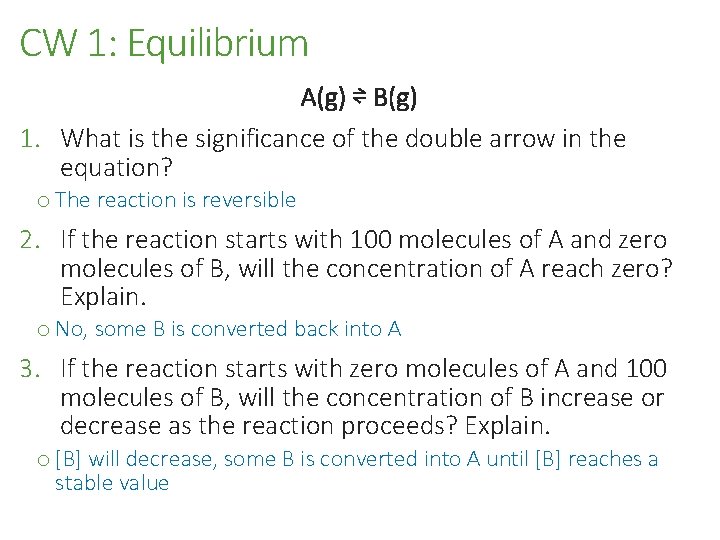
CW 1: Equilibrium A(g) ⇌ B(g) 1. What is the significance of the double arrow in the equation? o The reaction is reversible 2. If the reaction starts with 100 molecules of A and zero molecules of B, will the concentration of A reach zero? Explain. o No, some B is converted back into A 3. If the reaction starts with zero molecules of A and 100 molecules of B, will the concentration of B increase or decrease as the reaction proceeds? Explain. o [B] will decrease, some B is converted into A until [B] reaches a stable value
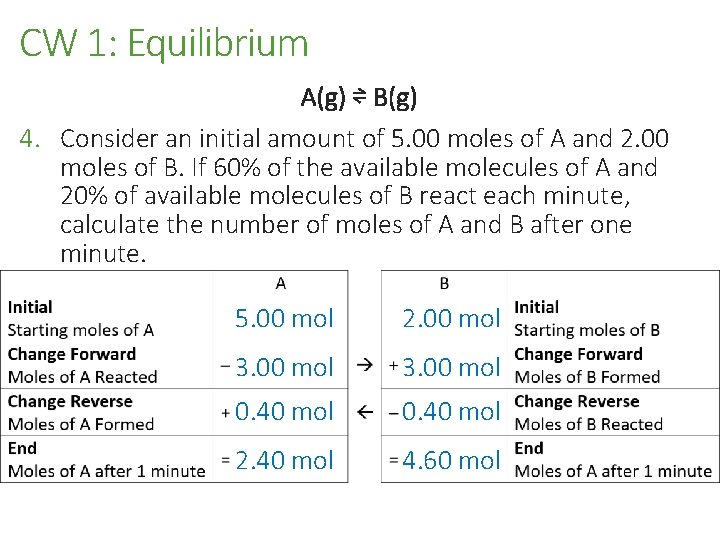
CW 1: Equilibrium A(g) ⇌ B(g) 4. Consider an initial amount of 5. 00 moles of A and 2. 00 moles of B. If 60% of the available molecules of A and 20% of available molecules of B react each minute, calculate the number of moles of A and B after one minute. 5. 00 mol 2. 00 mol 3. 00 mol 0. 40 mol 2. 40 mol 4. 60 mol
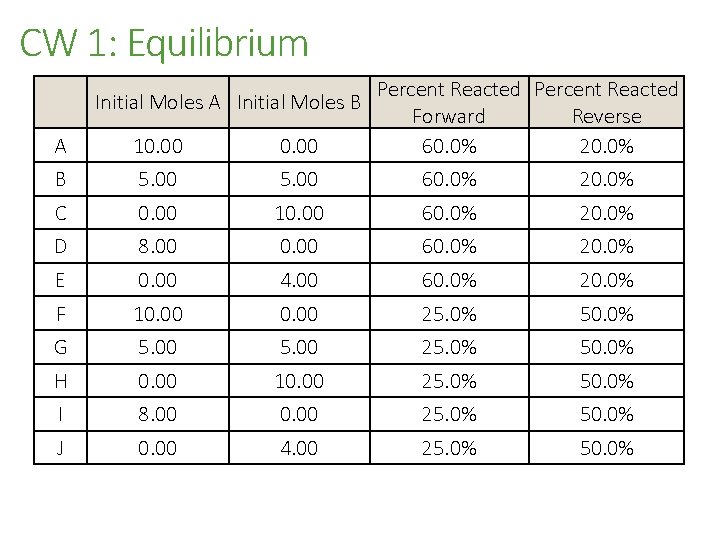
CW 1: Equilibrium Initial Moles A Initial Moles B Percent Reacted Forward Reverse 60. 0% 20. 0% A 10. 00 B 5. 00 60. 0% 20. 0% C 0. 00 10. 00 60. 0% 20. 0% D 8. 00 0. 00 60. 0% 20. 0% E 0. 00 4. 00 60. 0% 20. 0% F 10. 00 25. 0% 50. 0% G 5. 00 25. 0% 50. 0% H 0. 00 10. 00 25. 0% 50. 0% I 8. 00 0. 00 25. 0% 50. 0% J 0. 00 4. 00 25. 0% 50. 0%
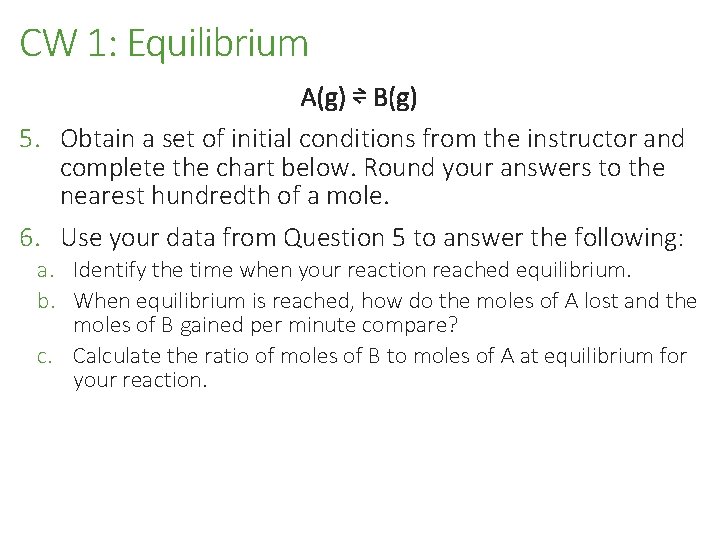
CW 1: Equilibrium A(g) ⇌ B(g) 5. Obtain a set of initial conditions from the instructor and complete the chart below. Round your answers to the nearest hundredth of a mole. 6. Use your data from Question 5 to answer the following: a. Identify the time when your reaction reached equilibrium. b. When equilibrium is reached, how do the moles of A lost and the moles of B gained per minute compare? c. Calculate the ratio of moles of B to moles of A at equilibrium for your reaction.
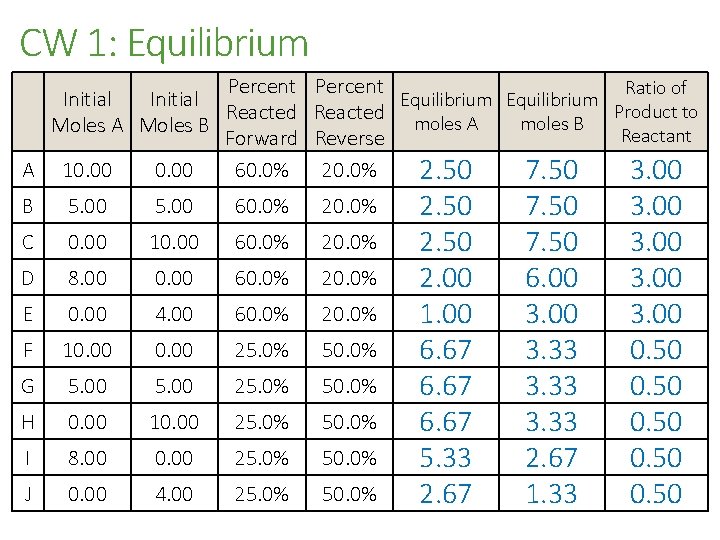
CW 1: Equilibrium Percent Ratio of Initial Equilibrium Product to Reacted moles A moles B Moles A Moles B Reactant Forward Reverse A 10. 00 60. 0% 2. 50 7. 50 3. 00 B 5. 00 60. 0% 20. 0% C 0. 00 10. 00 60. 0% 20. 0% D 8. 00 0. 00 60. 0% 20. 0% E 0. 00 4. 00 60. 0% 20. 0% F 10. 00 25. 0% 50. 0% G 5. 00 25. 0% 50. 0% H 0. 00 10. 00 25. 0% 50. 0% I 8. 00 0. 00 25. 0% 50. 0% J 0. 00 4. 00 25. 0% 50. 0% 2. 50 2. 00 1. 00 6. 67 5. 33 2. 67 7. 50 6. 00 3. 33 2. 67 1. 33 3. 00 0. 50
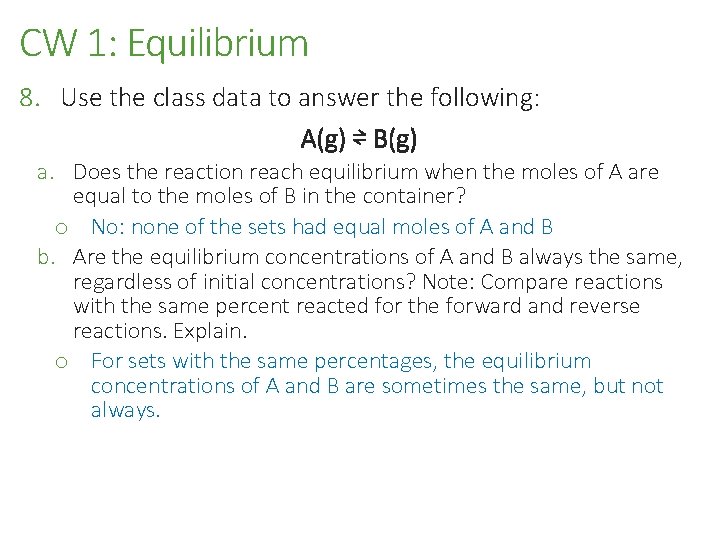
CW 1: Equilibrium 8. Use the class data to answer the following: A(g) ⇌ B(g) a. Does the reaction reach equilibrium when the moles of A are equal to the moles of B in the container? o No: none of the sets had equal moles of A and B b. Are the equilibrium concentrations of A and B always the same, regardless of initial concentrations? Note: Compare reactions with the same percent reacted for the forward and reverse reactions. Explain. o For sets with the same percentages, the equilibrium concentrations of A and B are sometimes the same, but not always.
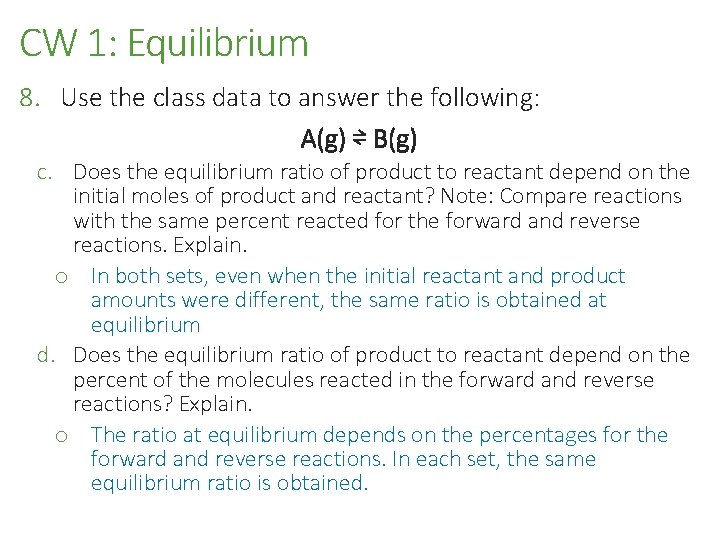
CW 1: Equilibrium 8. Use the class data to answer the following: A(g) ⇌ B(g) c. Does the equilibrium ratio of product to reactant depend on the initial moles of product and reactant? Note: Compare reactions with the same percent reacted for the forward and reverse reactions. Explain. o In both sets, even when the initial reactant and product amounts were different, the same ratio is obtained at equilibrium d. Does the equilibrium ratio of product to reactant depend on the percent of the molecules reacted in the forward and reverse reactions? Explain. o The ratio at equilibrium depends on the percentages for the forward and reverse reactions. In each set, the same equilibrium ratio is obtained.
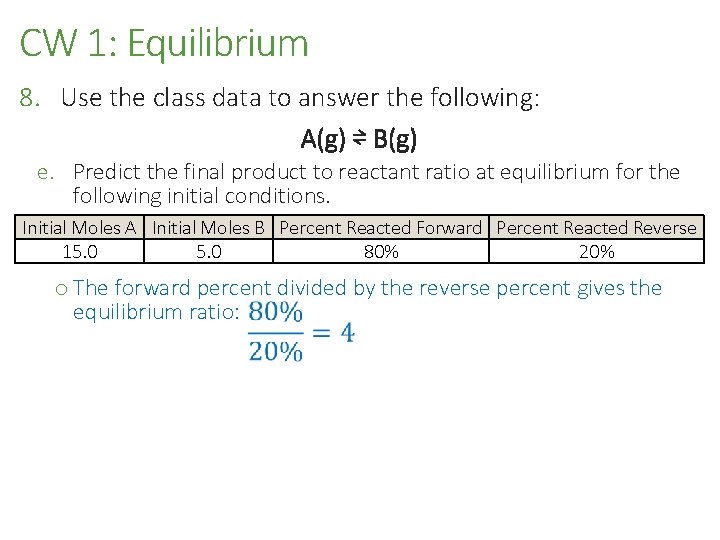
CW 1: Equilibrium 8. Use the class data to answer the following: A(g) ⇌ B(g) e. Predict the final product to reactant ratio at equilibrium for the following initial conditions. Initial Moles A Initial Moles B Percent Reacted Forward Percent Reacted Reverse 15. 0 80% 20% o The forward percent divided by the reverse percent gives the equilibrium ratio:
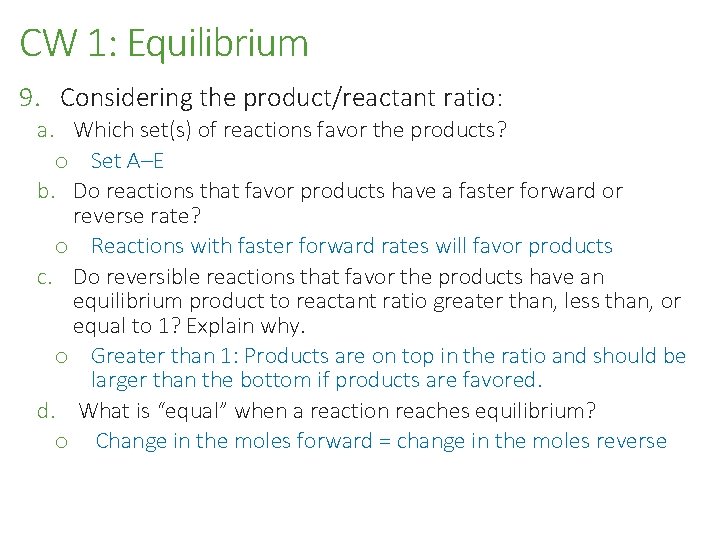
CW 1: Equilibrium 9. Considering the product/reactant ratio: a. Which set(s) of reactions favor the products? o Set A–E b. Do reactions that favor products have a faster forward or reverse rate? o Reactions with faster forward rates will favor products c. Do reversible reactions that favor the products have an equilibrium product to reactant ratio greater than, less than, or equal to 1? Explain why. o Greater than 1: Products are on top in the ratio and should be larger than the bottom if products are favored. d. What is “equal” when a reaction reaches equilibrium? o Change in the moles forward = change in the moles reverse

CW 1: Equilibrium o Note: Your textbook uses K instead of Kc when describing an equilibrium with concentrations. By convention, equilibrium constants are reported without units.
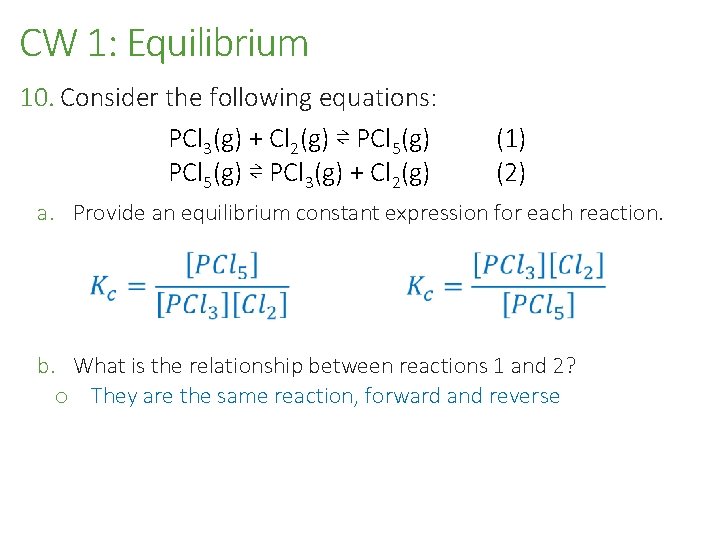
CW 1: Equilibrium 10. Consider the following equations: PCl 3(g) + Cl 2(g) ⇌ PCl 5(g) ⇌ PCl 3(g) + Cl 2(g) (1) (2) a. Provide an equilibrium constant expression for each reaction. b. What is the relationship between reactions 1 and 2? o They are the same reaction, forward and reverse
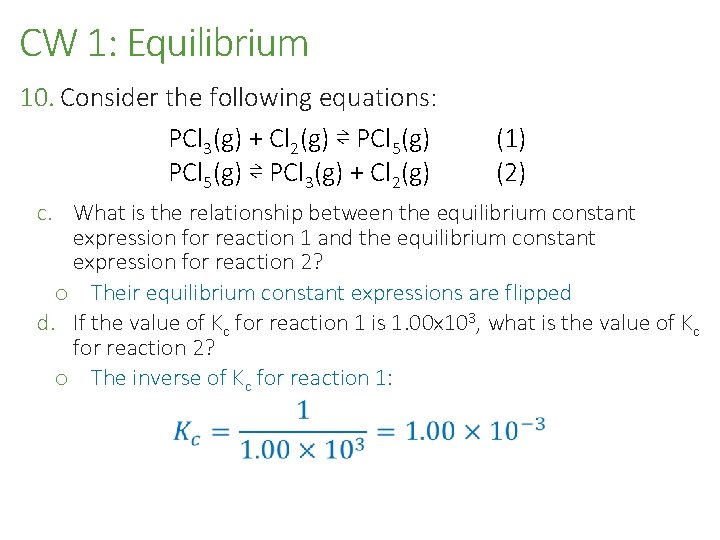
CW 1: Equilibrium 10. Consider the following equations: PCl 3(g) + Cl 2(g) ⇌ PCl 5(g) ⇌ PCl 3(g) + Cl 2(g) (1) (2) c. What is the relationship between the equilibrium constant expression for reaction 1 and the equilibrium constant expression for reaction 2? o Their equilibrium constant expressions are flipped d. If the value of Kc for reaction 1 is 1. 00 x 103, what is the value of Kc for reaction 2? o The inverse of Kc for reaction 1:
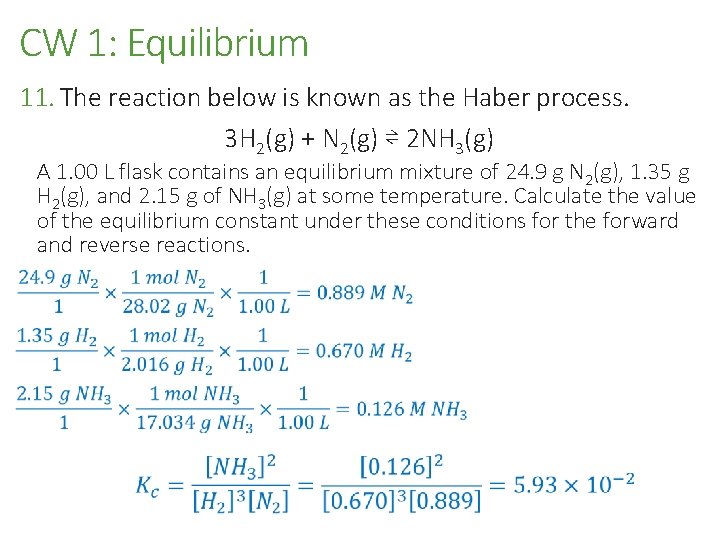
CW 1: Equilibrium 11. The reaction below is known as the Haber process. 3 H 2(g) + N 2(g) ⇌ 2 NH 3(g) A 1. 00 L flask contains an equilibrium mixture of 24. 9 g N 2(g), 1. 35 g H 2(g), and 2. 15 g of NH 3(g) at some temperature. Calculate the value of the equilibrium constant under these conditions for the forward and reverse reactions.
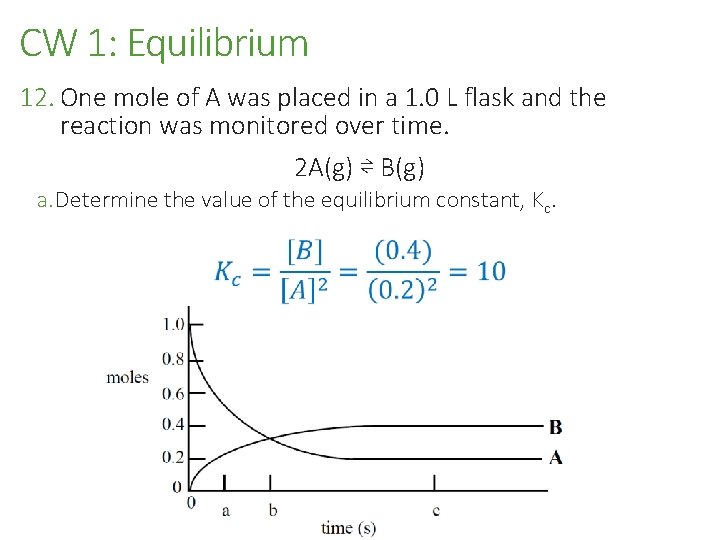
CW 1: Equilibrium 12. One mole of A was placed in a 1. 0 L flask and the reaction was monitored over time. 2 A(g) ⇌ B(g) a. Determine the value of the equilibrium constant, Kc.

CW 1: Equilibrium 12. One mole of A was placed in a 1. 0 L flask and the reaction was monitored over time. 2 A(g) ⇌ B(g) b. Which is larger at time "a", the forward rate or the reverse rate? o A: forward rate o B: forward rate o C: forward rate = reverse rate
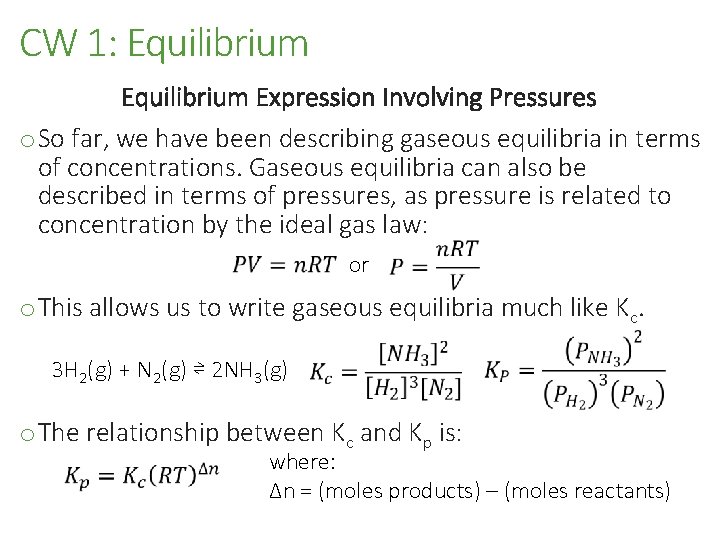
CW 1: Equilibrium Expression Involving Pressures o So far, we have been describing gaseous equilibria in terms of concentrations. Gaseous equilibria can also be described in terms of pressures, as pressure is related to concentration by the ideal gas law: or o This allows us to write gaseous equilibria much like Kc. 3 H 2(g) + N 2(g) ⇌ 2 NH 3(g) o The relationship between Kc and Kp is: where: Δn = (moles products) – (moles reactants)
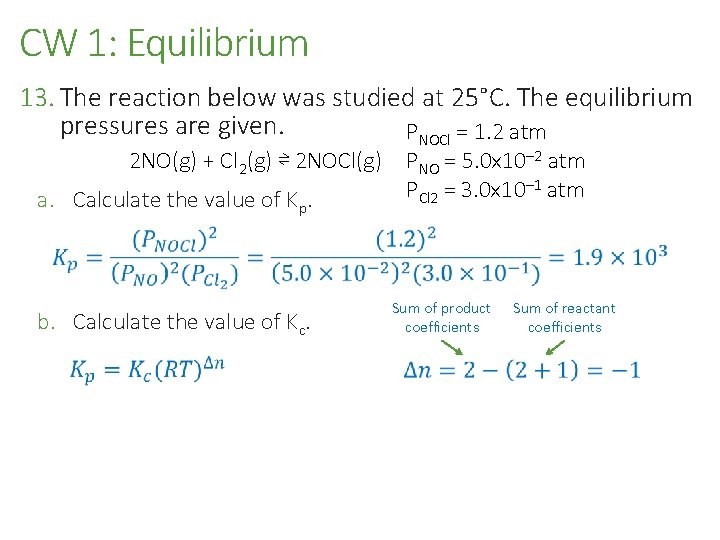
CW 1: Equilibrium 13. The reaction below was studied at 25°C. The equilibrium pressures are given. PNOCl = 1. 2 atm 2 NO(g) + Cl 2(g) ⇌ 2 NOCl(g) a. Calculate the value of Kp. PNO = 5. 0 x 10– 2 atm PCl 2 = 3. 0 x 10– 1 atm b. Calculate the value of Kc. Sum of product coefficients Sum of reactant coefficients
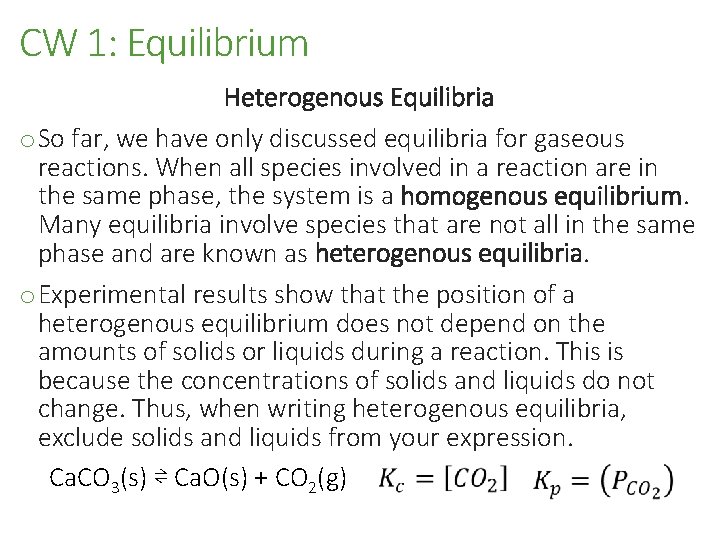
CW 1: Equilibrium Heterogenous Equilibria o So far, we have only discussed equilibria for gaseous reactions. When all species involved in a reaction are in the same phase, the system is a homogenous equilibrium. Many equilibria involve species that are not all in the same phase and are known as heterogenous equilibria. o Experimental results show that the position of a heterogenous equilibrium does not depend on the amounts of solids or liquids during a reaction. This is because the concentrations of solids and liquids do not change. Thus, when writing heterogenous equilibria, exclude solids and liquids from your expression. Ca. CO 3(s) ⇌ Ca. O(s) + CO 2(g)
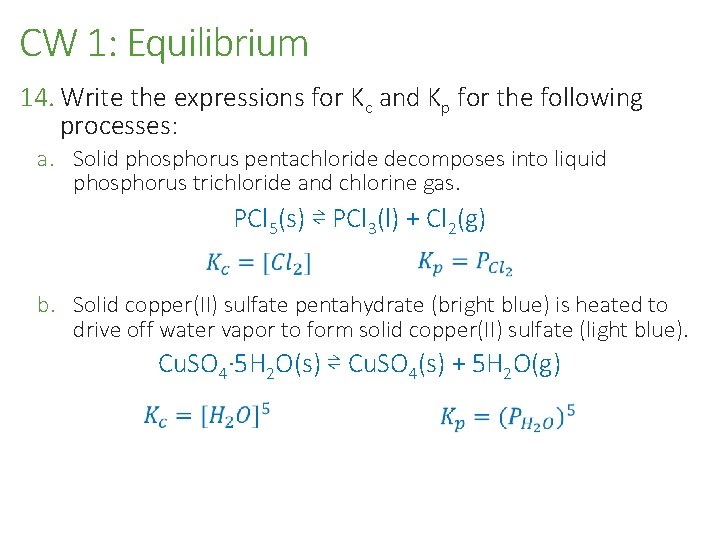
CW 1: Equilibrium 14. Write the expressions for Kc and Kp for the following processes: a. Solid phosphorus pentachloride decomposes into liquid phosphorus trichloride and chlorine gas. PCl 5(s) ⇌ PCl 3(l) + Cl 2(g) b. Solid copper(II) sulfate pentahydrate (bright blue) is heated to drive off water vapor to form solid copper(II) sulfate (light blue). Cu. SO 4∙ 5 H 2 O(s) ⇌ Cu. SO 4(s) + 5 H 2 O(g)
o HW 1: Equilibrium Cornell Notes o Due: 12/19 (A) & 12/20 (B) o Read sections 13. 1 to 13. 4 (Pages 511 to 522) and create Cornell Notes, hand in during class. Summary 1 12/17 (A) 12/16 (B) Outcome: I can explain chemical equilibrium in terms of the equilibrium constant. Goal: CW 1 Hand In: Rate Law of CV Lab Report
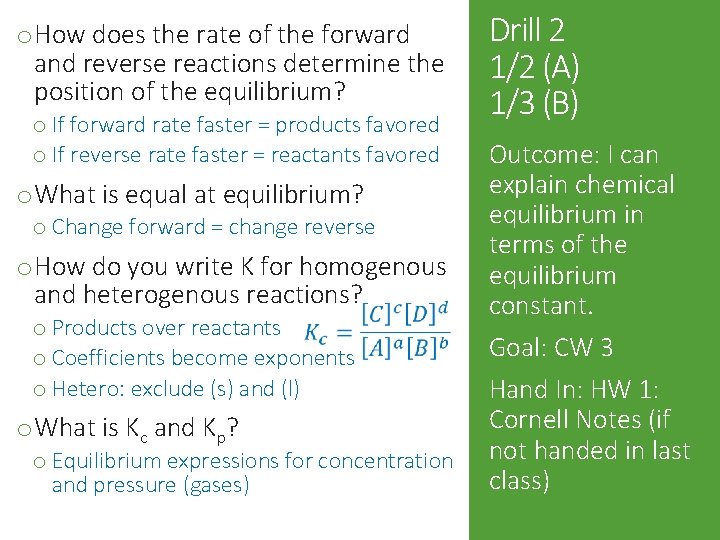
o How does the rate of the forward and reverse reactions determine the position of the equilibrium? o If forward rate faster = products favored o If reverse rate faster = reactants favored o What is equal at equilibrium? o Change forward = change reverse o How do you write K for homogenous and heterogenous reactions? o Products over reactants o Coefficients become exponents o Hetero: exclude (s) and (l) o What is Kc and Kp? o Equilibrium expressions for concentration and pressure (gases) Drill 2 1/2 (A) 1/3 (B) Outcome: I can explain chemical equilibrium in terms of the equilibrium constant. Goal: CW 3 Hand In: HW 1: Cornell Notes (if not handed in last class)
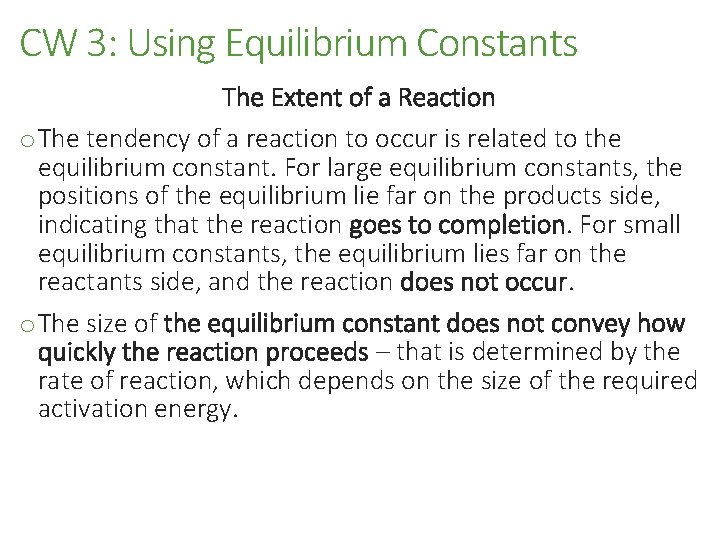
CW 3: Using Equilibrium Constants The Extent of a Reaction o The tendency of a reaction to occur is related to the equilibrium constant. For large equilibrium constants, the positions of the equilibrium lie far on the products side, indicating that the reaction goes to completion. For small equilibrium constants, the equilibrium lies far on the reactants side, and the reaction does not occur. o The size of the equilibrium constant does not convey how quickly the reaction proceeds – that is determined by the rate of reaction, which depends on the size of the required activation energy.
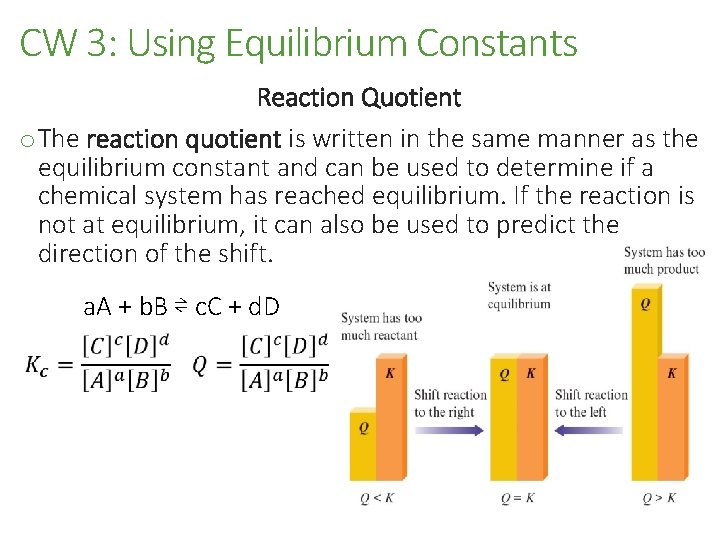
CW 3: Using Equilibrium Constants Reaction Quotient o The reaction quotient is written in the same manner as the equilibrium constant and can be used to determine if a chemical system has reached equilibrium. If the reaction is not at equilibrium, it can also be used to predict the direction of the shift. a. A + b. B ⇌ c. C + d. D
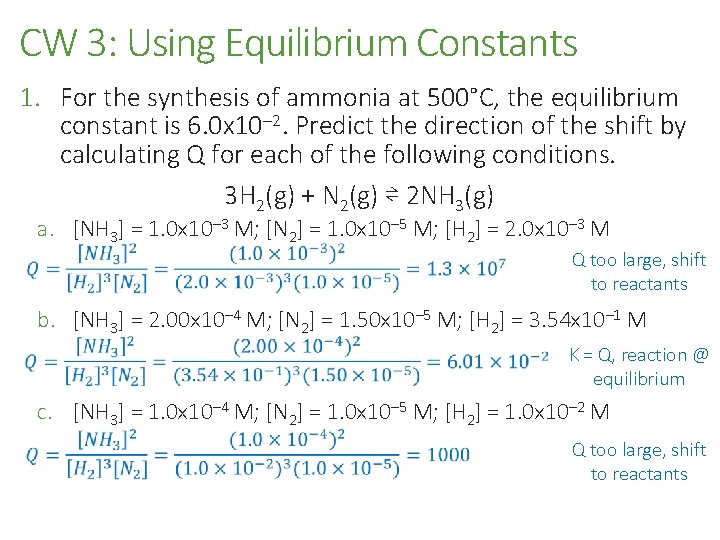
CW 3: Using Equilibrium Constants 1. For the synthesis of ammonia at 500°C, the equilibrium constant is 6. 0 x 10– 2. Predict the direction of the shift by calculating Q for each of the following conditions. 3 H 2(g) + N 2(g) ⇌ 2 NH 3(g) a. [NH 3] = 1. 0 x 10– 3 M; [N 2] = 1. 0 x 10– 5 M; [H 2] = 2. 0 x 10– 3 M Q too large, shift to reactants b. [NH 3] = 2. 00 x 10– 4 M; [N 2] = 1. 50 x 10– 5 M; [H 2] = 3. 54 x 10– 1 M K = Q, reaction @ equilibrium c. [NH 3] = 1. 0 x 10– 4 M; [N 2] = 1. 0 x 10– 5 M; [H 2] = 1. 0 x 10– 2 M Q too large, shift to reactants
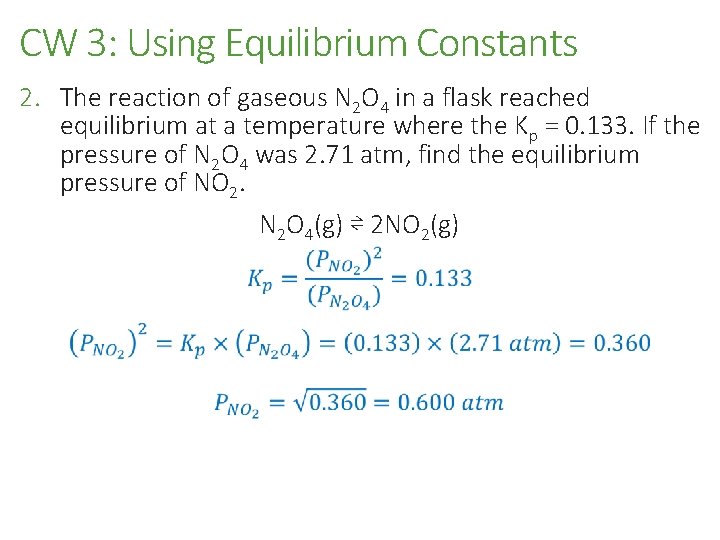
CW 3: Using Equilibrium Constants 2. The reaction of gaseous N 2 O 4 in a flask reached equilibrium at a temperature where the Kp = 0. 133. If the pressure of N 2 O 4 was 2. 71 atm, find the equilibrium pressure of NO 2. N 2 O 4(g) ⇌ 2 NO 2(g)
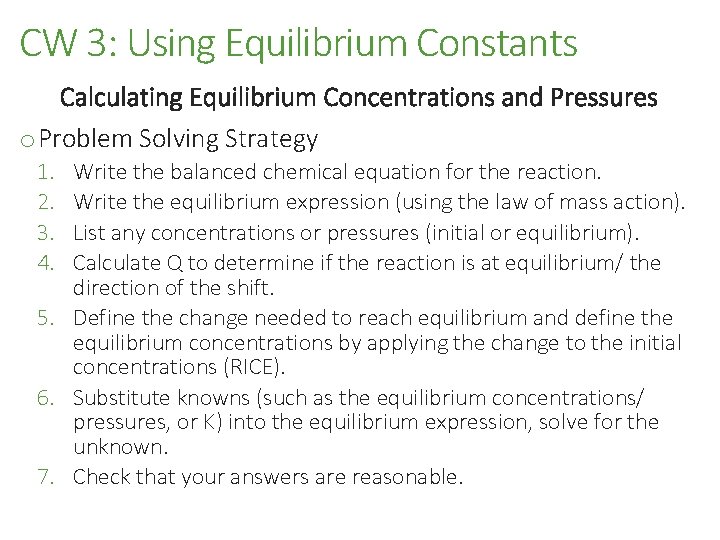
CW 3: Using Equilibrium Constants Calculating Equilibrium Concentrations and Pressures o Problem Solving Strategy 1. 2. 3. 4. Write the balanced chemical equation for the reaction. Write the equilibrium expression (using the law of mass action). List any concentrations or pressures (initial or equilibrium). Calculate Q to determine if the reaction is at equilibrium/ the direction of the shift. 5. Define the change needed to reach equilibrium and define the equilibrium concentrations by applying the change to the initial concentrations (RICE). 6. Substitute knowns (such as the equilibrium concentrations/ pressures, or K) into the equilibrium expression, solve for the unknown. 7. Check that your answers are reasonable.
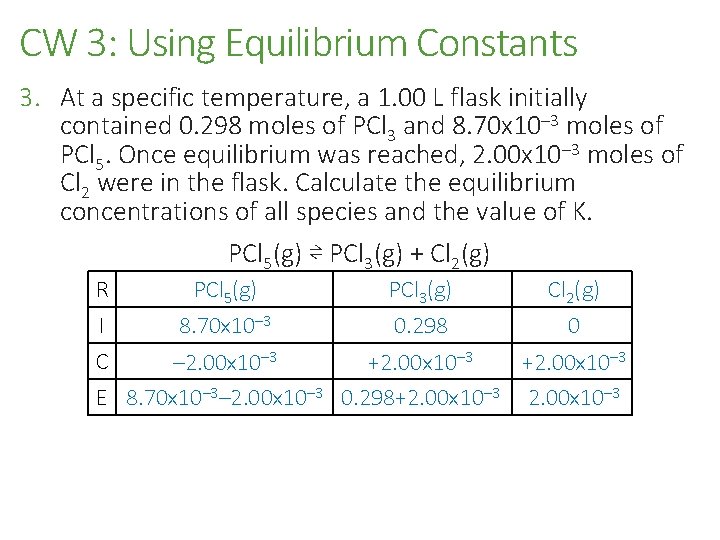
CW 3: Using Equilibrium Constants 3. At a specific temperature, a 1. 00 L flask initially contained 0. 298 moles of PCl 3 and 8. 70 x 10– 3 moles of PCl 5. Once equilibrium was reached, 2. 00 x 10– 3 moles of Cl 2 were in the flask. Calculate the equilibrium concentrations of all species and the value of K. PCl 5(g) ⇌ PCl 3(g) + Cl 2(g) PCl 5(g) PCl 3(g) Cl 2(g) R 8. 70 x 10– 3 0. 298 0 I C – 2. 00 x 10– 3 +2. 00 x 10– 3 E 8. 70 x 10– 3– 2. 00 x 10– 3 0. 298+2. 00 x 10– 3
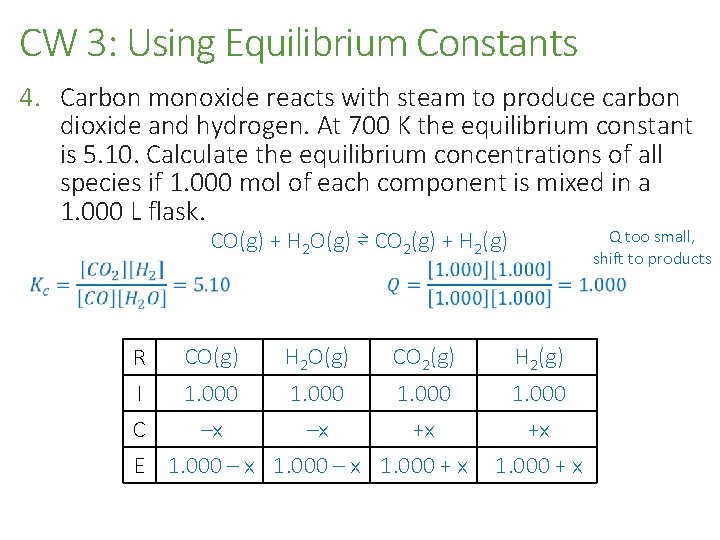
CW 3: Using Equilibrium Constants 4. Carbon monoxide reacts with steam to produce carbon dioxide and hydrogen. At 700 K the equilibrium constant is 5. 10. Calculate the equilibrium concentrations of all species if 1. 000 mol of each component is mixed in a 1. 000 L flask. CO(g) + H 2 O(g) ⇌ CO 2(g) + H 2(g) Q too small, shift to products CO(g) H 2 O(g) CO 2(g) R I 1. 000 C –x –x +x E 1. 000 – x 1. 000 + x H 2(g) 1. 000 +x 1. 000 + x
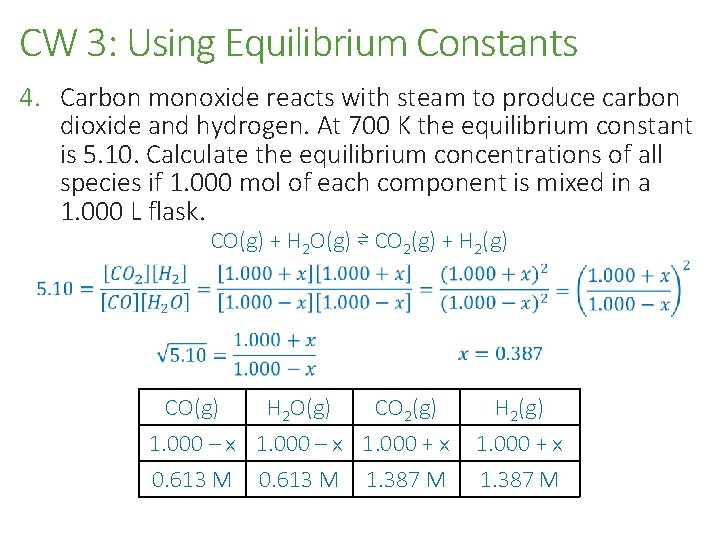
CW 3: Using Equilibrium Constants 4. Carbon monoxide reacts with steam to produce carbon dioxide and hydrogen. At 700 K the equilibrium constant is 5. 10. Calculate the equilibrium concentrations of all species if 1. 000 mol of each component is mixed in a 1. 000 L flask. CO(g) + H 2 O(g) ⇌ CO 2(g) + H 2(g) CO(g) H 2 O(g) CO 2(g) 1. 000 – x 1. 000 + x 0. 613 M 1. 387 M H 2(g) 1. 000 + x 1. 387 M

CW 3: Using Equilibrium Constants 5. Assume that the reaction for the formation of HF(g) from hydrogen and fluorine has an equilibrium constant of 1. 15 x 102 at a certain temperature. If 3. 000 moles of each component were added to a 1. 500 L flask, calculate the equilibrium concentrations of all species. H 2(g) + F 2(g) ⇌ 2 HF(g) Q too small, shift to products H 2(g) F 2(g) R I 2. 000 C –x –x E 2. 000 – x 2 HF(g) 2. 000 +2 x 2. 000 + 2 x
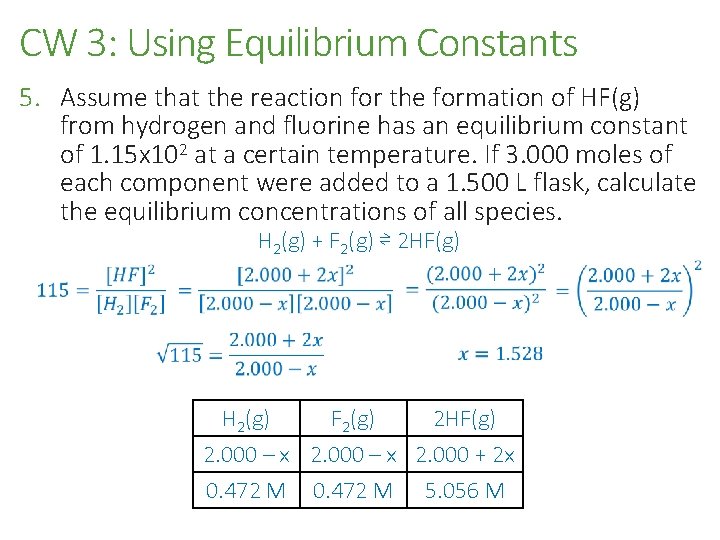
CW 3: Using Equilibrium Constants 5. Assume that the reaction for the formation of HF(g) from hydrogen and fluorine has an equilibrium constant of 1. 15 x 102 at a certain temperature. If 3. 000 moles of each component were added to a 1. 500 L flask, calculate the equilibrium concentrations of all species. H 2(g) + F 2(g) ⇌ 2 HF(g) H 2(g) F 2(g) 2 HF(g) 2. 000 – x 2. 000 + 2 x 0. 472 M 5. 056 M
CW 3: Using Equilibrium Constants Equilibria with Very Small Equilibrium Constants o In the last few examples, we have seen that equilibrium problems are often mathematically difficult to solve – we had to use the quadratic formula. We can make simplifications to the math involved if the equilibrium constant is small.
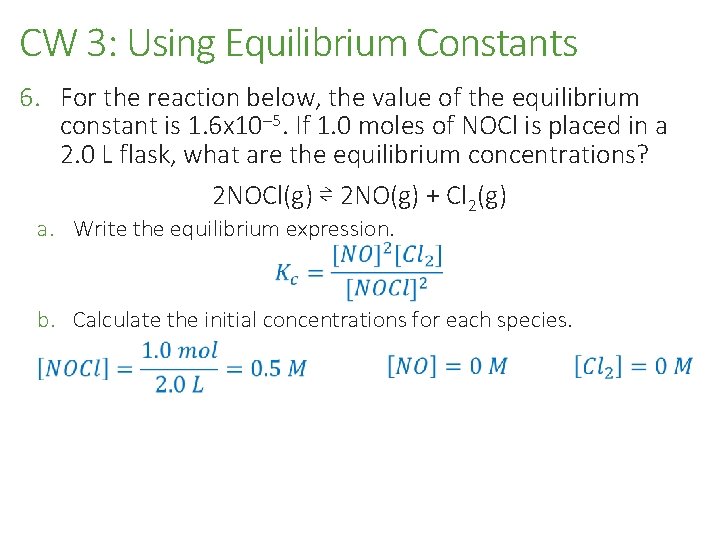
CW 3: Using Equilibrium Constants 6. For the reaction below, the value of the equilibrium constant is 1. 6 x 10– 5. If 1. 0 moles of NOCl is placed in a 2. 0 L flask, what are the equilibrium concentrations? 2 NOCl(g) ⇌ 2 NO(g) + Cl 2(g) a. Write the equilibrium expression. b. Calculate the initial concentrations for each species.
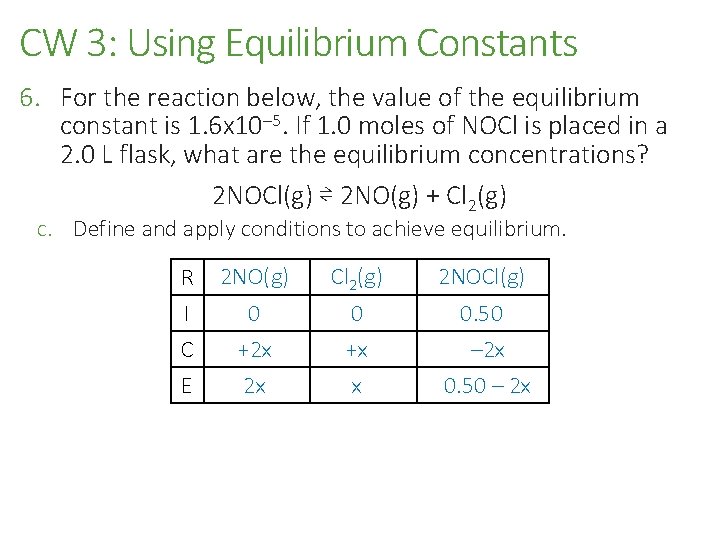
CW 3: Using Equilibrium Constants 6. For the reaction below, the value of the equilibrium constant is 1. 6 x 10– 5. If 1. 0 moles of NOCl is placed in a 2. 0 L flask, what are the equilibrium concentrations? 2 NOCl(g) ⇌ 2 NO(g) + Cl 2(g) c. Define and apply conditions to achieve equilibrium. R I C E 2 NO(g) Cl 2(g) 2 NOCl(g) 0 +2 x 0 +x 0. 50 – 2 x 2 x x 0. 50 – 2 x
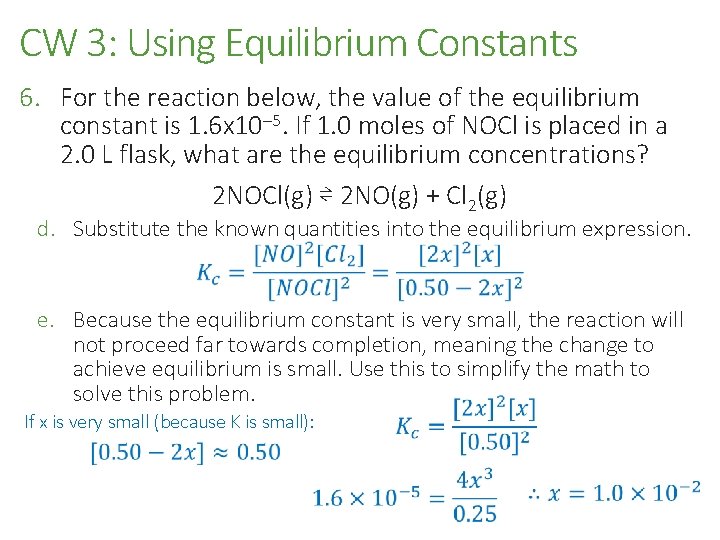
CW 3: Using Equilibrium Constants 6. For the reaction below, the value of the equilibrium constant is 1. 6 x 10– 5. If 1. 0 moles of NOCl is placed in a 2. 0 L flask, what are the equilibrium concentrations? 2 NOCl(g) ⇌ 2 NO(g) + Cl 2(g) d. Substitute the known quantities into the equilibrium expression. e. Because the equilibrium constant is very small, the reaction will not proceed far towards completion, meaning the change to achieve equilibrium is small. Use this to simplify the math to solve this problem. If x is very small (because K is small):
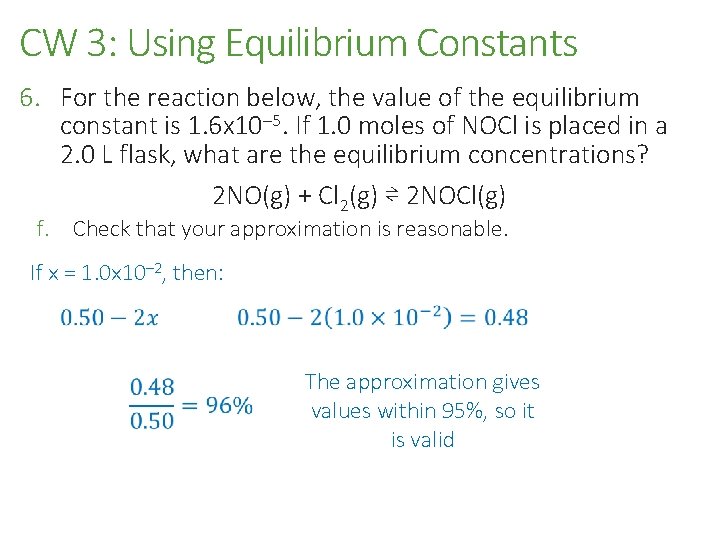
CW 3: Using Equilibrium Constants 6. For the reaction below, the value of the equilibrium constant is 1. 6 x 10– 5. If 1. 0 moles of NOCl is placed in a 2. 0 L flask, what are the equilibrium concentrations? 2 NO(g) + Cl 2(g) ⇌ 2 NOCl(g) f. Check that your approximation is reasonable. If x = 1. 0 x 10– 2, then: The approximation gives values within 95%, so it is valid
o HW 2: Equilibrium Problem Protein Synthesis o Due: 1/6 (A) & 1/7 (B) o Complete the assigned problem set, hand in during class. Summary 2 1/2 (A) 1/3 (B) Outcome: I can explain chemical equilibrium in terms of the equilibrium constant. Goal: CW 3 Hand In: HW 1: Cornell Notes
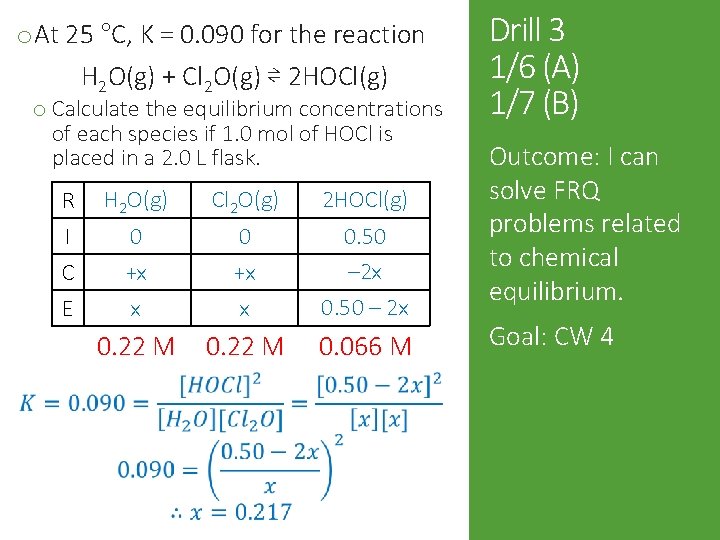
o At 25 °C, K = 0. 090 for the reaction H 2 O(g) + Cl 2 O(g) ⇌ 2 HOCl(g) o Calculate the equilibrium concentrations of each species if 1. 0 mol of HOCl is placed in a 2. 0 L flask. R I C E H 2 O(g) Cl 2 O(g) 2 HOCl(g) 0 +x 0. 50 – 2 x x x 0. 50 – 2 x 0. 22 M 0. 066 M Drill 3 1/6 (A) 1/7 (B) Outcome: I can solve FRQ problems related to chemical equilibrium. Goal: CW 4
Chemathon Level II o Chemistry competition at UMd on Maryland Day (4/25) o Students compete in several events, some lab based, some “theory” based o First meeting is Friday 1/10 during 1 st block
CW 4: Equilibrium FRQ Problems o Choose one problem from Questions 1 to 3 and two problems from Questions 4 to 6. Complete all work on a separate sheet of paper in a small group. Use the answer keys to check your work.
o HW 3: Equilibrium Problems o Due: 1/8 (A) & 1/9 (B) o Complete HW 3 through OWL. o Prelab (see CW 5, Page 26) due next class o Intro and SDS – no procedure (all procedures will be in the procedural notes section) Summary 3 1/6 (A) 1/7 (B) Outcome: I can solve FRQ problems related to chemical equilibrium. Goal: CW 4

o If 2. 5 mol NO 2 of is placed in a 1. 0 L vessel, what are the equilibrium concentrations of all gases? 2 NO 2(g) ⇌ 2 NO(g) +O 2(g) K = 6. 8 x 10– 7 Drill 4 1/8 (A) 1/9 (B) Outcome: I can explain solution formation as an equilibrium process using the solubility product constant. Goal: CW 6
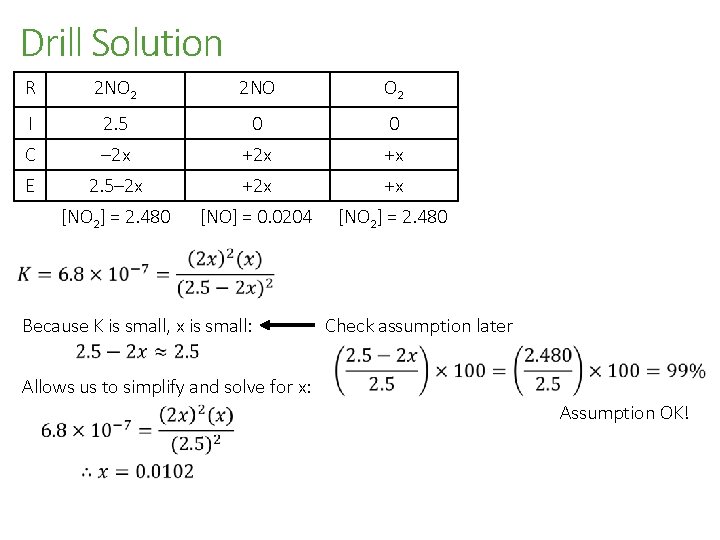
Drill Solution R 2 NO 2 2 NO O 2 I 2. 5 0 0 C – 2 x +x E 2. 5– 2 x +x [NO 2] = 2. 480 [NO] = 0. 0204 [NO 2] = 2. 480 Because K is small, x is small: Check assumption later Allows us to simplify and solve for x: Assumption OK!
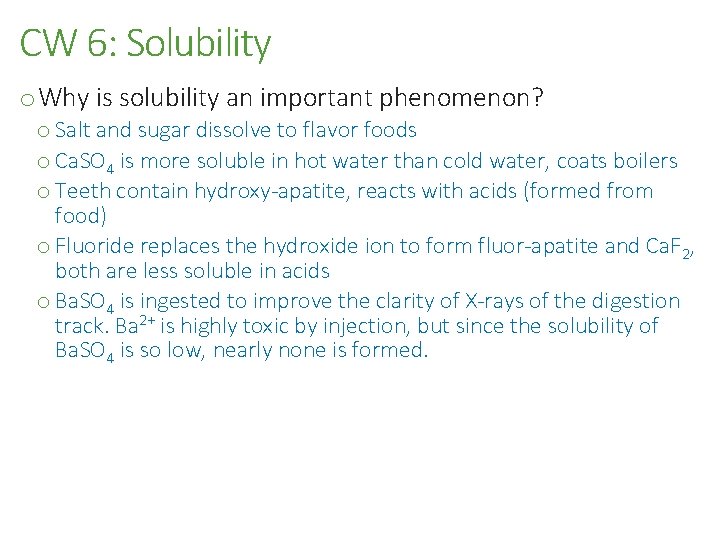
CW 6: Solubility o Why is solubility an important phenomenon? o Salt and sugar dissolve to flavor foods o Ca. SO 4 is more soluble in hot water than cold water, coats boilers o Teeth contain hydroxy-apatite, reacts with acids (formed from food) o Fluoride replaces the hydroxide ion to form fluor-apatite and Ca. F 2, both are less soluble in acids o Ba. SO 4 is ingested to improve the clarity of X-rays of the digestion track. Ba 2+ is highly toxic by injection, but since the solubility of Ba. SO 4 is so low, nearly none is formed.
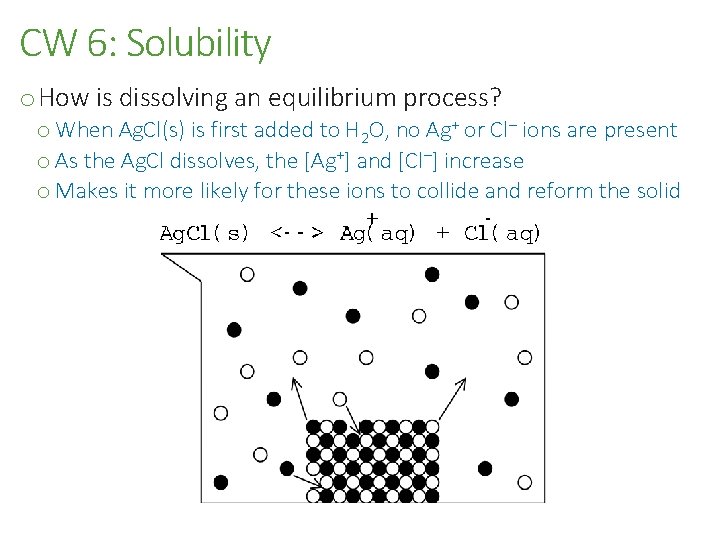
CW 6: Solubility o How is dissolving an equilibrium process? o When Ag. Cl(s) is first added to H 2 O, no Ag+ or Cl– ions are present o As the Ag. Cl dissolves, the [Ag+] and [Cl–] increase o Makes it more likely for these ions to collide and reform the solid
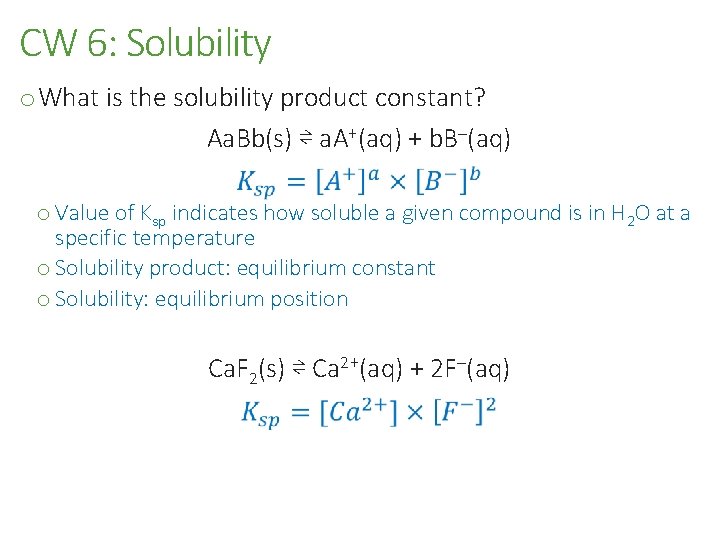
CW 6: Solubility o What is the solubility product constant? Aa. Bb(s) ⇌ a. A+(aq) + b. B–(aq) o Value of Ksp indicates how soluble a given compound is in H 2 O at a specific temperature o Solubility product: equilibrium constant o Solubility: equilibrium position Ca. F 2(s) ⇌ Ca 2+(aq) + 2 F–(aq)

CW 6: Solubility o Copper(I) bromide has a measured solubility of 2. 0 x 10– 4 mol/L at 25°C. Calculate its Ksp value. Cu. Br(s) ⇌ Cu+(aq) + Br–(aq) Solubility Cu. Br = 2. 0 x 10– 4 mol/L If you have 1 L of H 2 O, 2. 0 x 10– 4 moles of Cu. Br will dissolve
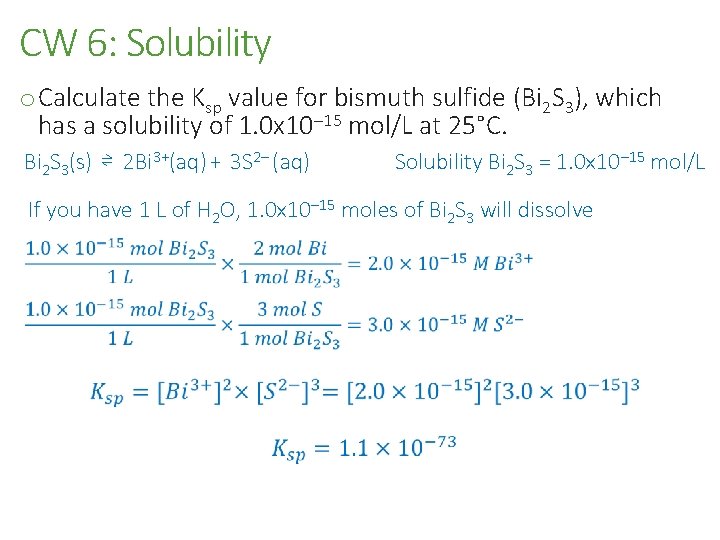
CW 6: Solubility o Calculate the Ksp value for bismuth sulfide (Bi 2 S 3), which has a solubility of 1. 0 x 10– 15 mol/L at 25°C. Bi 2 S 3(s) ⇌ 2 Bi 3+(aq) + 3 S 2– (aq) Solubility Bi 2 S 3 = 1. 0 x 10– 15 mol/L If you have 1 L of H 2 O, 1. 0 x 10– 15 moles of Bi 2 S 3 will dissolve

CW 6: Solubility o The Ksp value for copper(II) iodate, Cu(IO 3)2, is 1. 4 x 10– 7 at 25°C. Calculate its solubility at 25°C. Cu(IO 3)2(s) ⇌ Cu 2+(aq) + 2 IO 3– (aq) R Cu(IO 3)2(s) Cu 2+(aq) I 0 0 C –x +x E –x x 2 IO 3– (aq) 0 +2 x 2 x Ksp = 1. 4 x 10– 7 x = amount of Cu(IO 3)2(s) that dissolves Solubility Cu(OI 3)2 = 3. 3 x 10– 3 mol/L
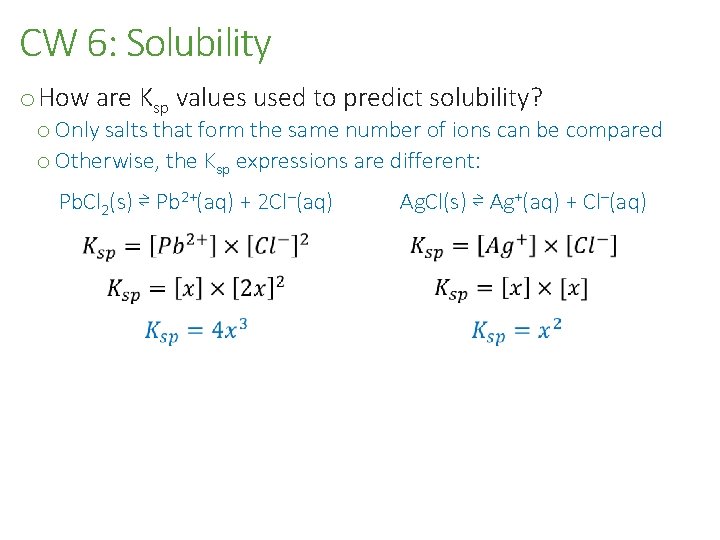
CW 6: Solubility o How are Ksp values used to predict solubility? o Only salts that form the same number of ions can be compared o Otherwise, the Ksp expressions are different: Pb. Cl 2(s) ⇌ Pb 2+(aq) + 2 Cl–(aq) Ag. Cl(s) ⇌ Ag+(aq) + Cl–(aq)
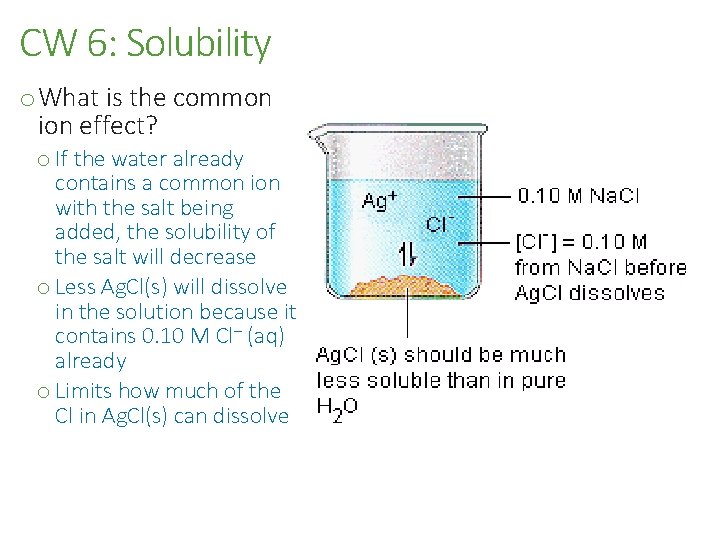
CW 6: Solubility o What is the common ion effect? o If the water already contains a common ion with the salt being added, the solubility of the salt will decrease o Less Ag. Cl(s) will dissolve in the solution because it contains 0. 10 M Cl– (aq) already o Limits how much of the Cl in Ag. Cl(s) can dissolve
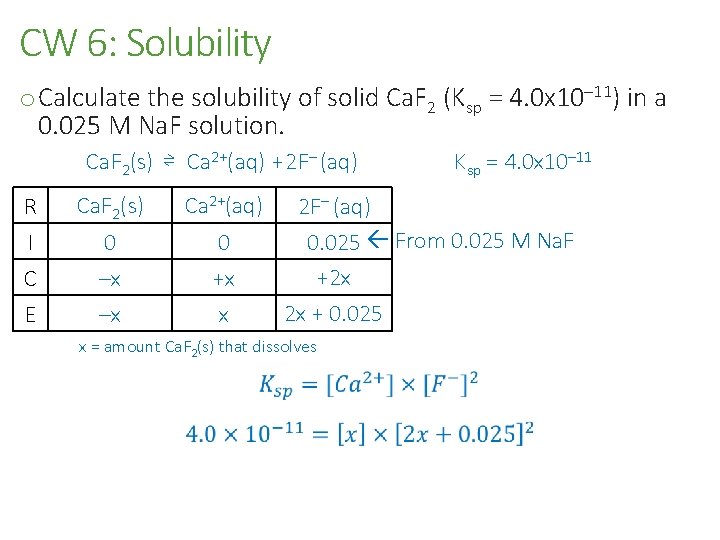
CW 6: Solubility o Calculate the solubility of solid Ca. F 2 (Ksp = 4. 0 x 10– 11) in a 0. 025 M Na. F solution. Ca. F 2(s) ⇌ Ca 2+(aq) + 2 F– (aq) R I C E Ca. F 2(s) Ca 2+(aq) 0 –x 0 +x –x x 2 F– (aq) 0. 025 From 0. 025 M Na. F +2 x 2 x + 0. 025 x = amount Ca. F 2(s) that dissolves Ksp = 4. 0 x 10– 11

CW 6: Solubility o Calculate the solubility of solid Ca. F 2 (Ksp = 4. 0 x 10– 11) in a 0. 025 M Na. F solution. Assuming that 2 x is negligible compared with 0. 025 (because K sp is small) 6. 4 x 10– 8 mol/L of solid Ca. F 2 dissolves per liter of the 0. 025 M Na. F solution
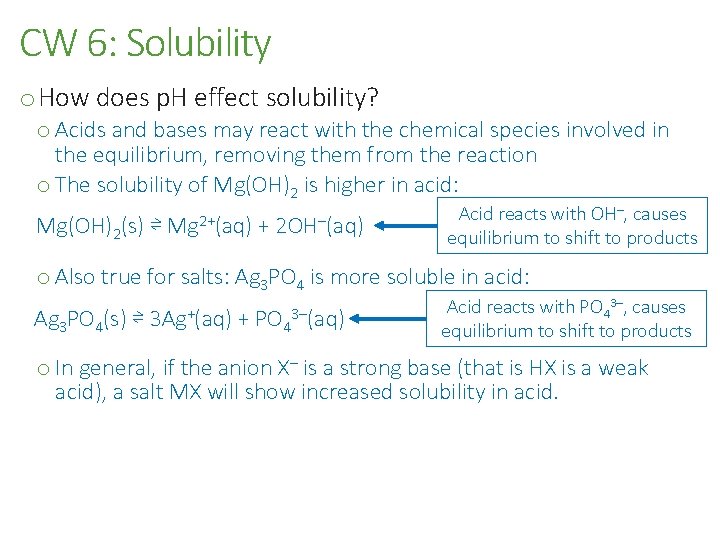
CW 6: Solubility o How does p. H effect solubility? o Acids and bases may react with the chemical species involved in the equilibrium, removing them from the reaction o The solubility of Mg(OH)2 is higher in acid: Mg(OH)2 (s) ⇌ Mg 2+(aq) + 2 OH–(aq) Acid reacts with OH–, causes equilibrium to shift to products o Also true for salts: Ag 3 PO 4 is more soluble in acid: Ag 3 PO 4(s) ⇌ 3 Ag+(aq) + PO 43–(aq) Acid reacts with PO 43–, causes equilibrium to shift to products o In general, if the anion X– is a strong base (that is HX is a weak acid), a salt MX will show increased solubility in acid.
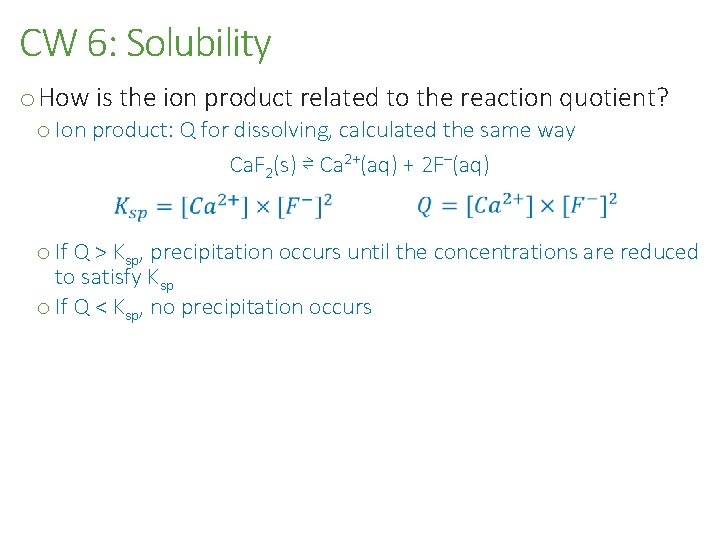
CW 6: Solubility o How is the ion product related to the reaction quotient? o Ion product: Q for dissolving, calculated the same way Ca. F 2(s) ⇌ Ca 2+(aq) + 2 F–(aq) o If Q > Ksp, precipitation occurs until the concentrations are reduced to satisfy Ksp o If Q < Ksp, no precipitation occurs
CW 6: Solubility o Create a summary of your notes, explaining: o Write dissociation equations and Ksp expressions o Common ion effect o Ion product (Q) and Ksp o Calculating Ksp, solubility, concentrations, RICE
o HW 4: Review for Unit test o Due: 1/14 (A) & 1/15 (B) o Complete the review guide using your notes/ unit packet/ resources, hand in during class. o Complete Pre-Lab (See CW 5) for next class Summary 4 1/8 (A) 1/9 (B) Outcome: I can explain solution formation as an equilibrium process using the solubility product constant. Goal: CW 6
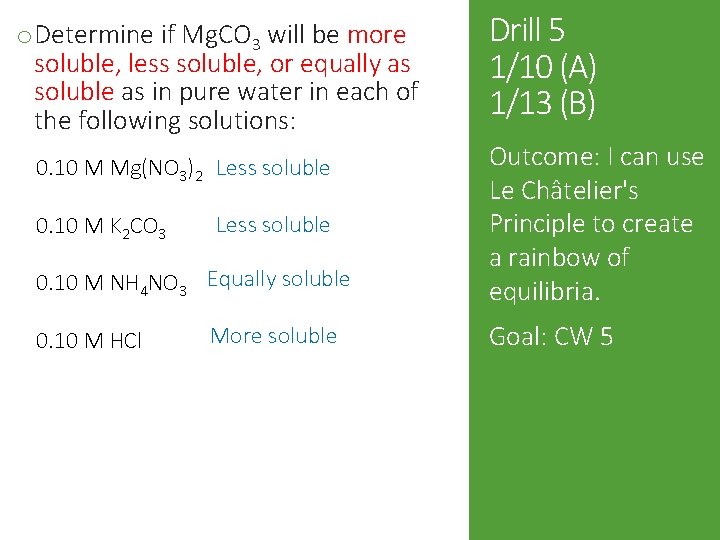
o Determine if Mg. CO 3 will be more soluble, less soluble, or equally as soluble as in pure water in each of the following solutions: 0. 10 M Mg(NO 3)2 Less soluble 0. 10 M K 2 CO 3 Less soluble 0. 10 M NH 4 NO 3 Equally soluble 0. 10 M HCl More soluble Drill 5 1/10 (A) 1/13 (B) Outcome: I can use Le Châtelier's Principle to create a rainbow of equilibria. Goal: CW 5
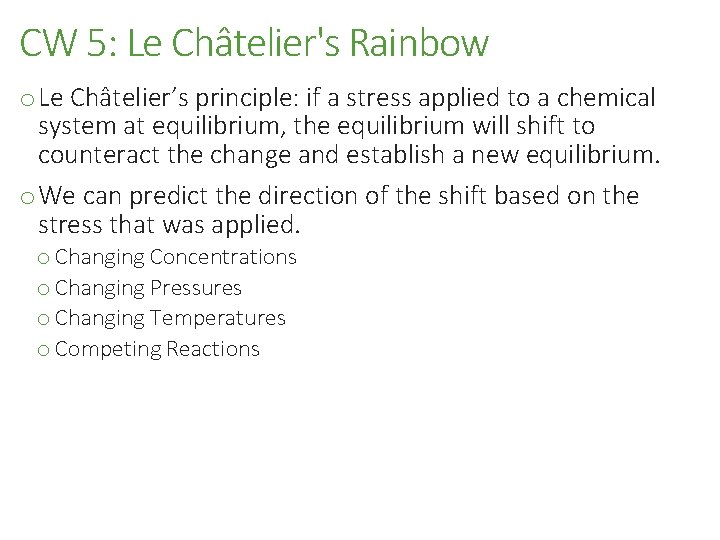
CW 5: Le Châtelier's Rainbow o Le Châtelier’s principle: if a stress applied to a chemical system at equilibrium, the equilibrium will shift to counteract the change and establish a new equilibrium. o We can predict the direction of the shift based on the stress that was applied. o Changing Concentrations o Changing Pressures o Changing Temperatures o Competing Reactions
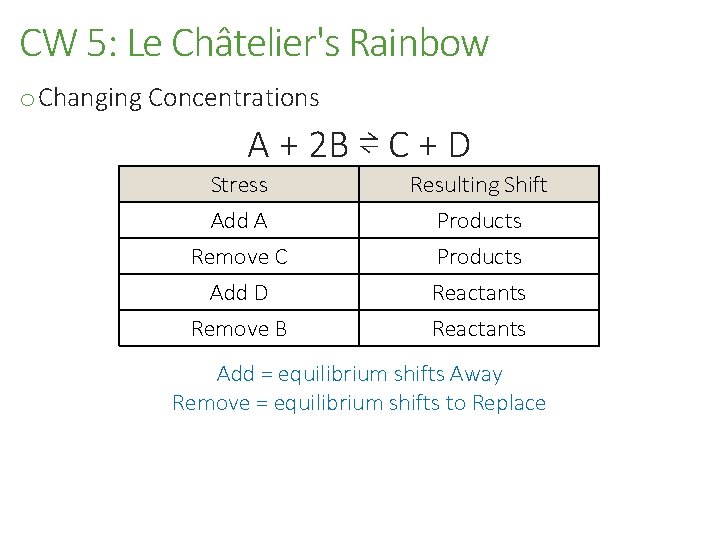
CW 5: Le Châtelier's Rainbow o Changing Concentrations A + 2 B ⇌ C + D Stress Add A Remove C Add D Resulting Shift Products Reactants Remove B Reactants Add = equilibrium shifts Away Remove = equilibrium shifts to Replace
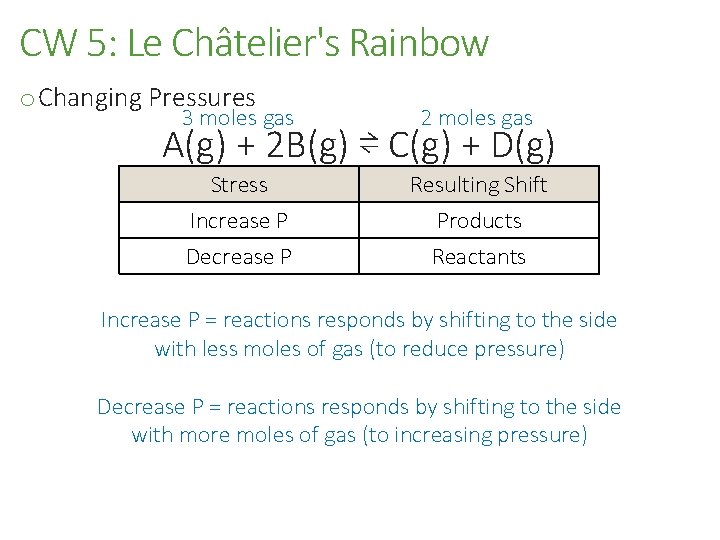
CW 5: Le Châtelier's Rainbow o Changing Pressures 3 moles gas 2 moles gas Stress Increase P Decrease P Resulting Shift Products Reactants A(g) + 2 B(g) ⇌ C(g) + D(g) Increase P = reactions responds by shifting to the side with less moles of gas (to reduce pressure) Decrease P = reactions responds by shifting to the side with more moles of gas (to increasing pressure)
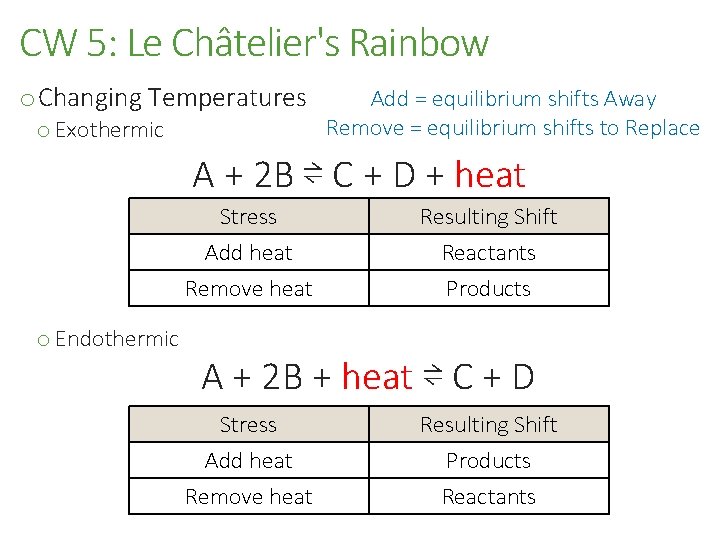
CW 5: Le Châtelier's Rainbow o Changing Temperatures o Exothermic Add = equilibrium shifts Away Remove = equilibrium shifts to Replace A + 2 B ⇌ C + D + heat Stress Add heat Remove heat o Endothermic Resulting Shift Reactants Products A + 2 B + heat ⇌ C + D Stress Add heat Remove heat Resulting Shift Products Reactants
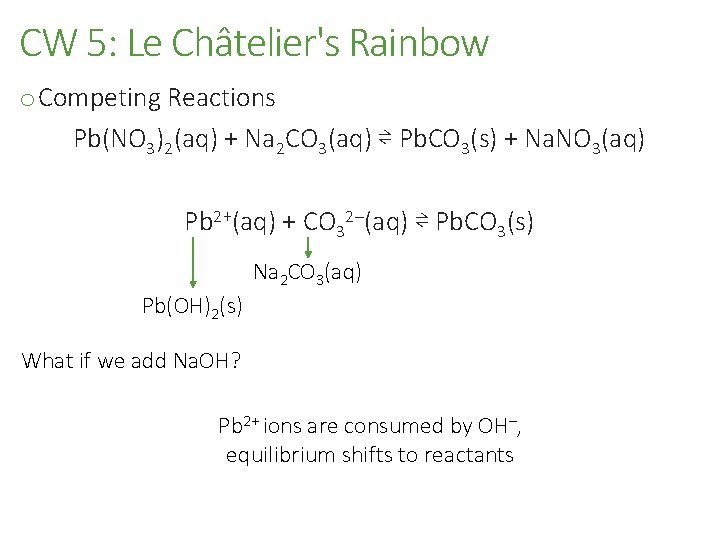
CW 5: Le Châtelier's Rainbow o Competing Reactions Pb(NO 3)2(aq) + Na 2 CO 3(aq) ⇌ Pb. CO 3(s) + Na. NO 3(aq) Pb 2+(aq) + CO 32–(aq) ⇌ Pb. CO 3(s) Na 2 CO 3(aq) Pb(OH)2(s) What if we add Na. OH? Pb 2+ ions are consumed by OH–, equilibrium shifts to reactants
o HW 4: Review for Unit test o Due: 1/14 (A) & 1/15 (B) o Complete the review guide using your notes/ unit packet/ resources, hand in during class. o Le Châtelier’s Rainbow Lab Report o Due: 1/23 (A) & 1/22 (B) Summary 5 1/10 (A) 1/13 (B) Outcome: I can use Le Châtelier's Principle to create a rainbow of equilibria. Goal: CW 5
- Slides: 67