
4 Differential forms A The Algebra and Integral
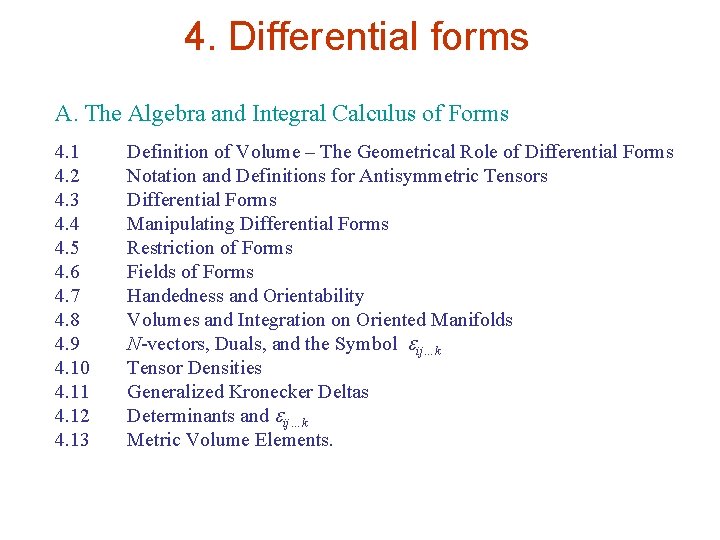
4. Differential forms A. The Algebra and Integral Calculus of Forms 4. 1 4. 2 4. 3 4. 4 4. 5 4. 6 4. 7 4. 8 4. 9 4. 10 4. 11 4. 12 4. 13 Definition of Volume – The Geometrical Role of Differential Forms Notation and Definitions for Antisymmetric Tensors Differential Forms Manipulating Differential Forms Restriction of Forms Fields of Forms Handedness and Orientability Volumes and Integration on Oriented Manifolds N-vectors, Duals, and the Symbol ij…k Tensor Densities Generalized Kronecker Deltas Determinants and ij…k Metric Volume Elements.
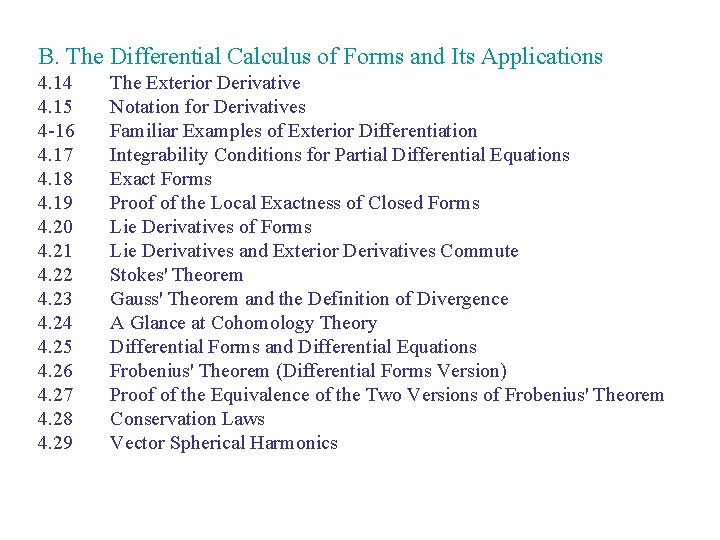
B. The Differential Calculus of Forms and Its Applications 4. 14 4. 15 4 -16 4. 17 4. 18 4. 19 4. 20 4. 21 4. 22 4. 23 4. 24 4. 25 4. 26 4. 27 4. 28 4. 29 The Exterior Derivative Notation for Derivatives Familiar Examples of Exterior Differentiation Integrability Conditions for Partial Differential Equations Exact Forms Proof of the Local Exactness of Closed Forms Lie Derivatives of Forms Lie Derivatives and Exterior Derivatives Commute Stokes' Theorem Gauss' Theorem and the Definition of Divergence A Glance at Cohomology Theory Differential Forms and Differential Equations Frobenius' Theorem (Differential Forms Version) Proof of the Equivalence of the Two Versions of Frobenius' Theorem Conservation Laws Vector Spherical Harmonics
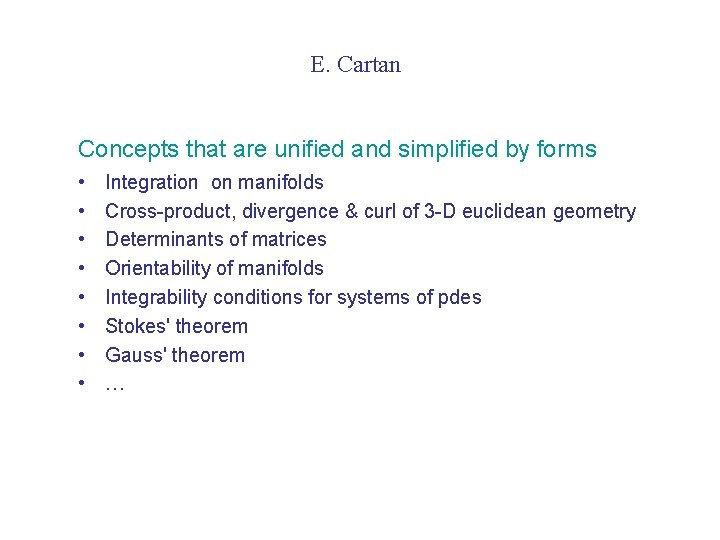
E. Cartan Concepts that are unified and simplified by forms • • Integration on manifolds Cross-product, divergence & curl of 3 -D euclidean geometry Determinants of matrices Orientability of manifolds Integrability conditions for systems of pdes Stokes' theorem Gauss' theorem …
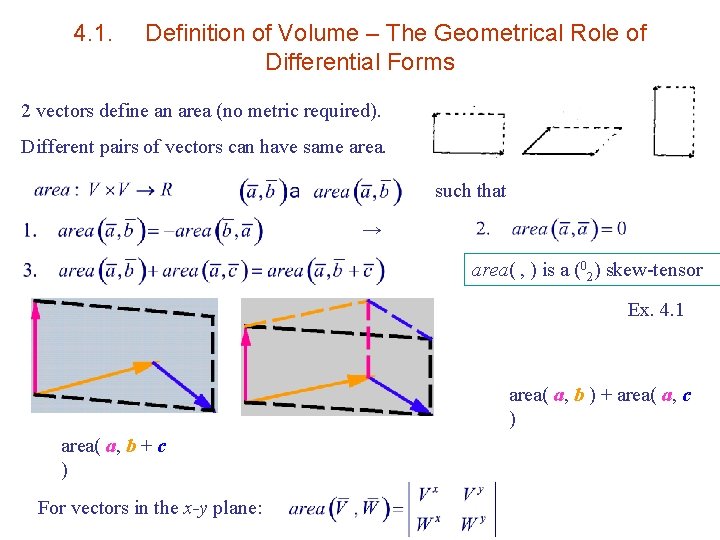
4. 1. Definition of Volume – The Geometrical Role of Differential Forms 2 vectors define an area (no metric required). Different pairs of vectors can have same area. such that → area( , ) is a (02) skew-tensor Ex. 4. 1 area( a, b ) + area( a, c ) area( a, b + c ) For vectors in the x-y plane:
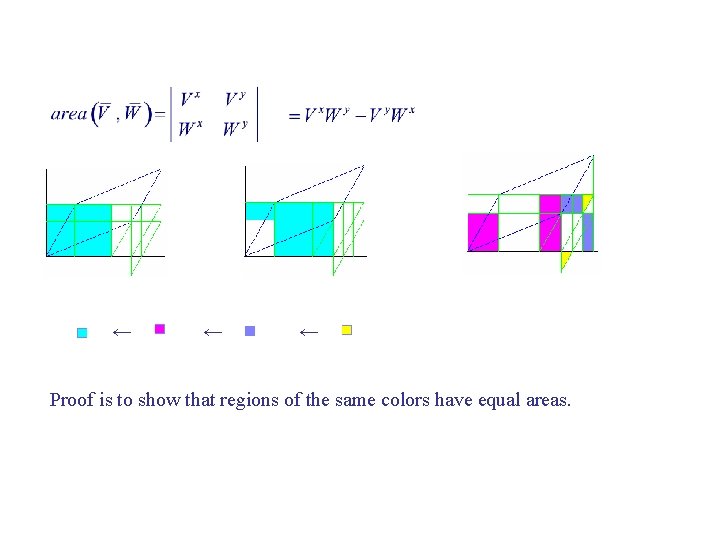
← ← ← Proof is to show that regions of the same colors have equal areas.
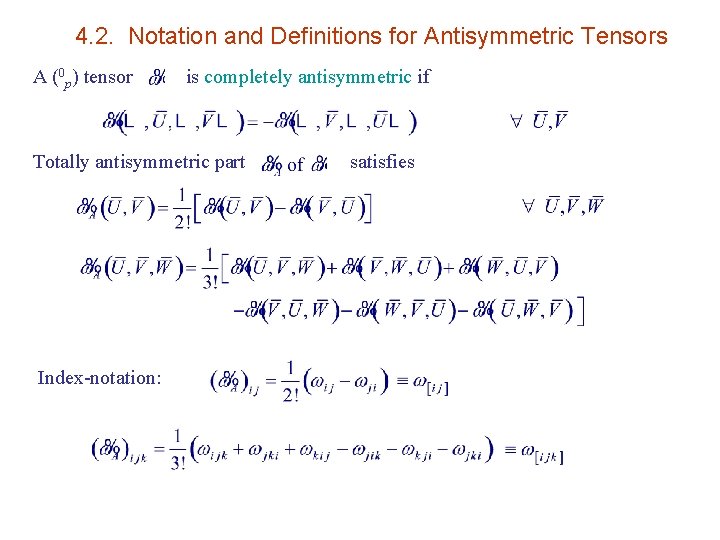
4. 2. Notation and Definitions for Antisymmetric Tensors A (0 p) tensor is completely antisymmetric if Totally antisymmetric part Index-notation: satisfies
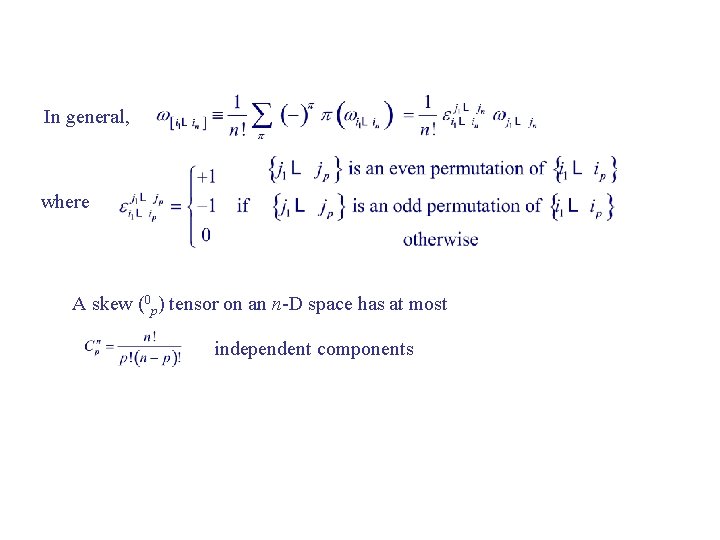
In general, where A skew (0 p) tensor on an n-D space has at most independent components
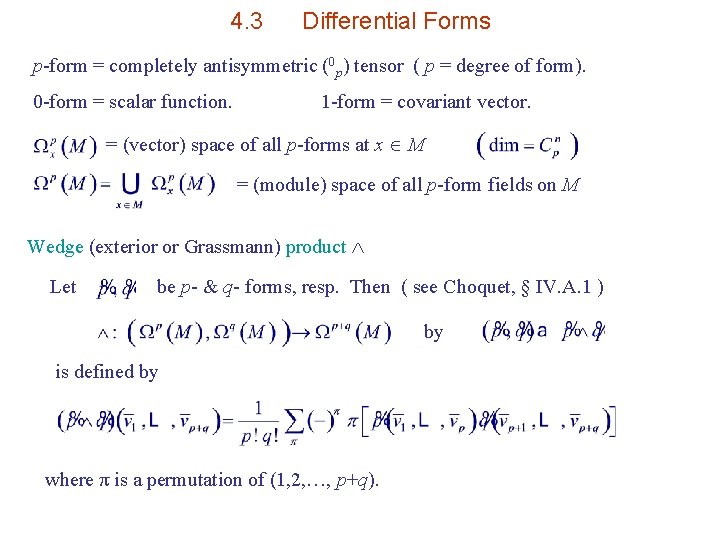
4. 3 Differential Forms p-form = completely antisymmetric (0 p) tensor ( p = degree of form). 0 -form = scalar function. 1 -form = covariant vector. = (vector) space of all p-forms at x M = (module) space of all p-form fields on M Wedge (exterior or Grassmann) product Let be p- & q- forms, resp. Then ( see Choquet, § IV. A. 1 ) by is defined by where π is a permutation of (1, 2, …, p+q).
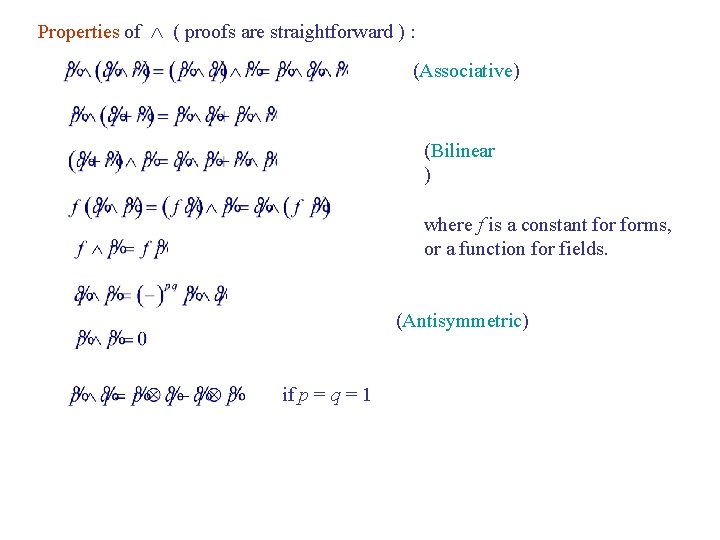
Properties of ( proofs are straightforward ) : (Associative) (Bilinear ) where f is a constant forms, or a function for fields. (Antisymmetric) if p = q = 1
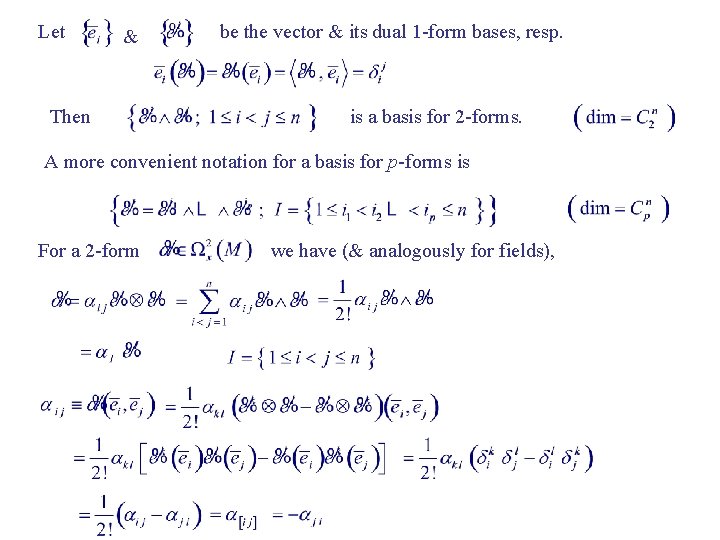
Let & Then be the vector & its dual 1 -form bases, resp. is a basis for 2 -forms. A more convenient notation for a basis for p-forms is For a 2 -form we have (& analogously for fields),
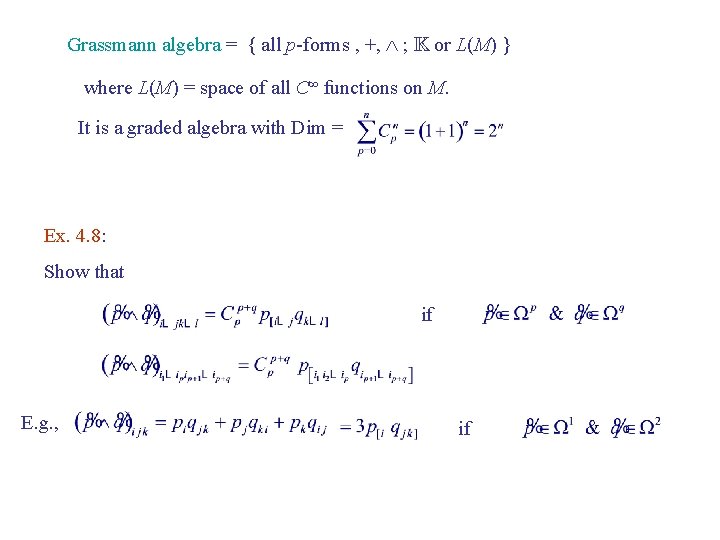
Grassmann algebra = { all p-forms , +, ; K or L(M) } where L(M) = space of all C functions on M. It is a graded algebra with Dim = Ex. 4. 8: Show that if E. g. , if
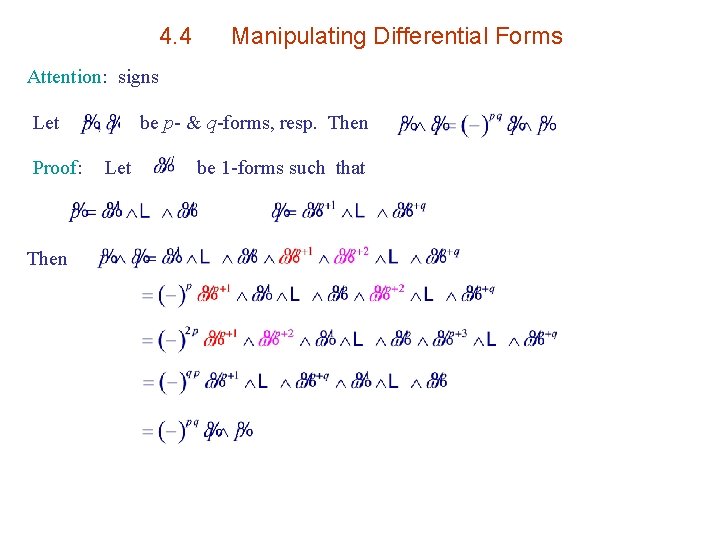
4. 4 Manipulating Differential Forms Attention: signs Let Proof: Then be p- & q-forms, resp. Then Let be 1 -forms such that
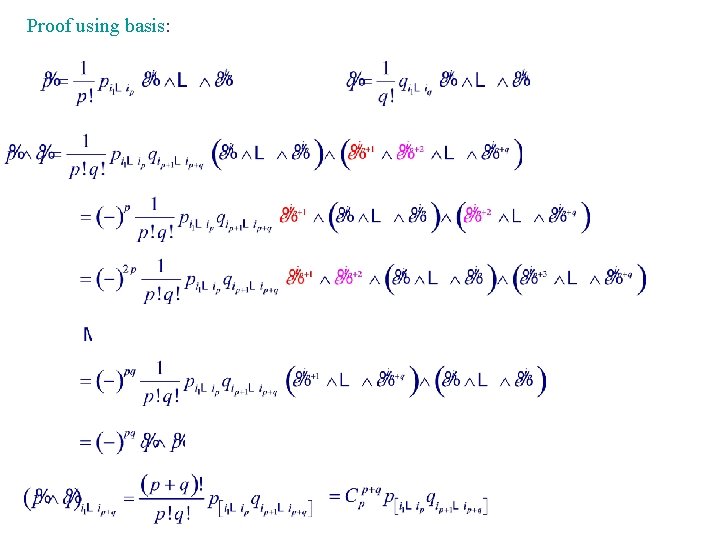
Proof using basis:
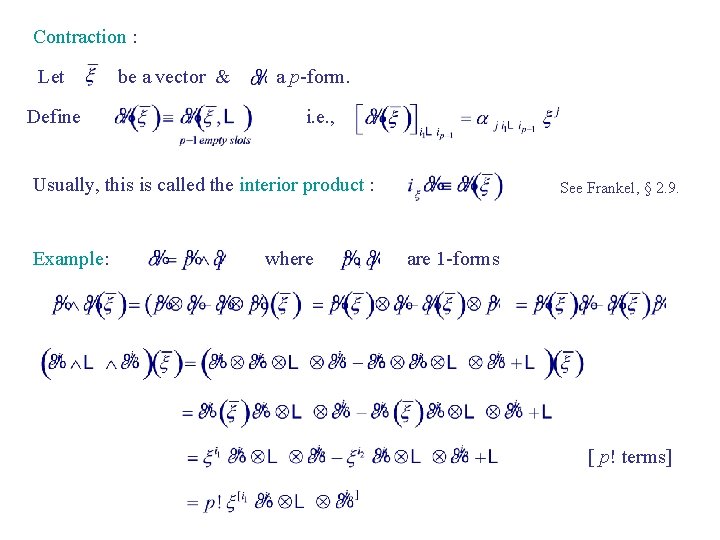
Contraction : Let Define be a vector & a p-form. i. e. , Usually, this is called the interior product : Example: where See Frankel, § 2. 9. are 1 -forms [ p! terms]
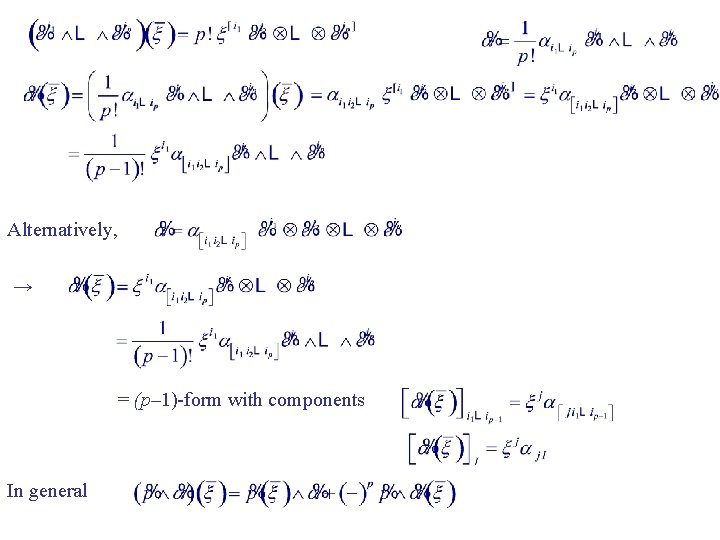
Alternatively, → = (p– 1)-form with components In general
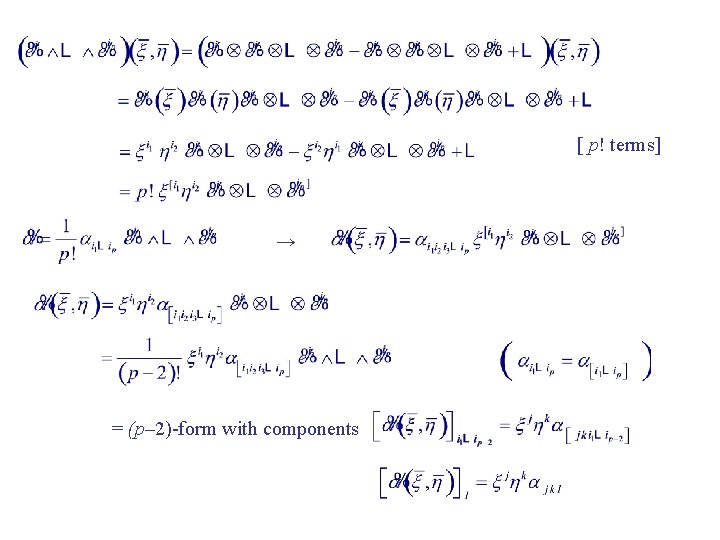
[ p! terms] → = (p– 2)-form with components
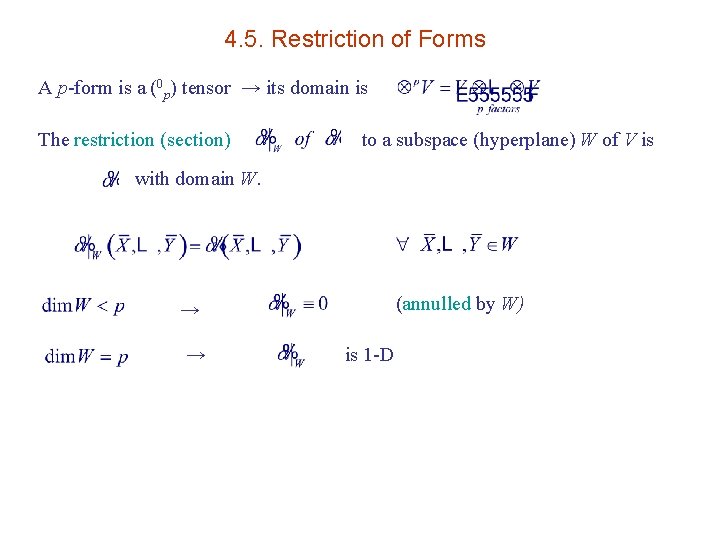
4. 5. Restriction of Forms A p-form is a (0 p) tensor → its domain is The restriction (section) to a subspace (hyperplane) W of V is with domain W. (annulled by W) → → is 1 -D
4. 6. Fields of Forms A field Ωp(M) of p-forms on a manifold M = a rule that gives a p-form at each point of M. Ditto p-vector field. A submanifold S of M picks a subspace VP of TP P S. → Restriction of p-form field to S = restriction of p-form at P to VP P S.
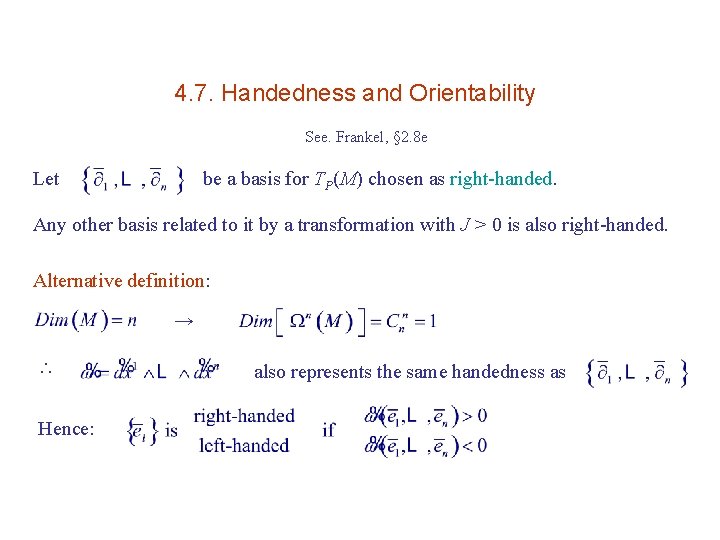
4. 7. Handedness and Orientability See. Frankel, § 2. 8 e Let be a basis for TP(M) chosen as right-handed. Any other basis related to it by a transformation with J > 0 is also right-handed. Alternative definition: → Hence: also represents the same handedness as
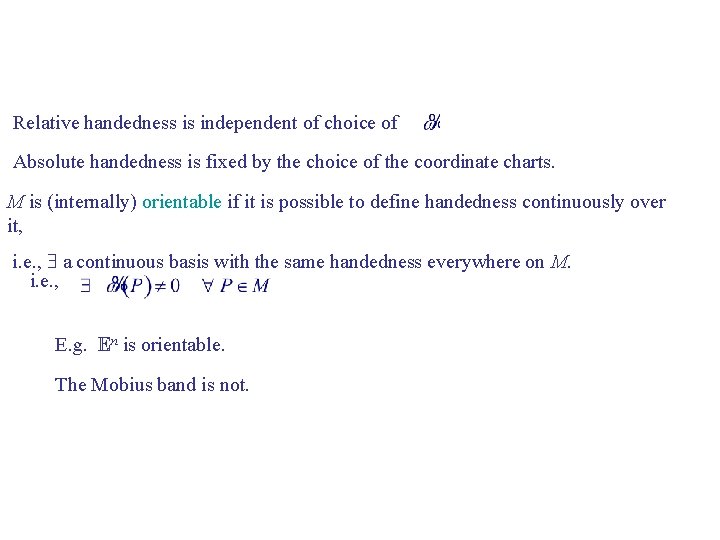
Relative handedness is independent of choice of Absolute handedness is fixed by the choice of the coordinate charts. M is (internally) orientable if it is possible to define handedness continuously over it, i. e. , a continuous basis with the same handedness everywhere on M. i. e. , E. g. En is orientable. The Mobius band is not.
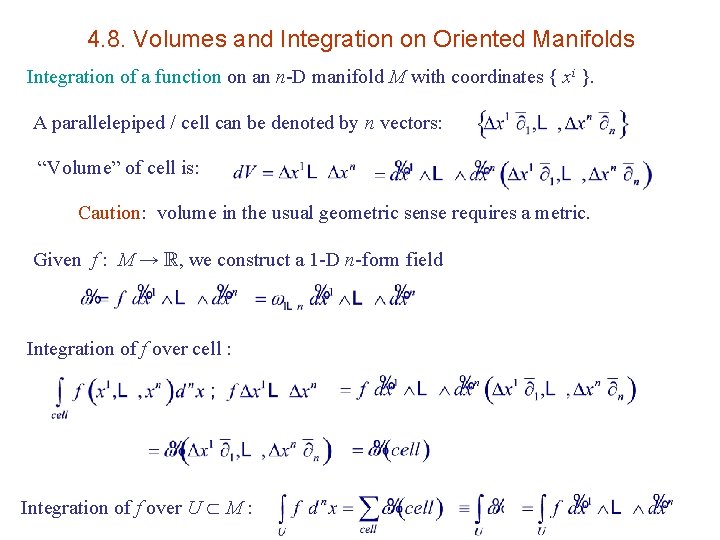
4. 8. Volumes and Integration on Oriented Manifolds Integration of a function on an n-D manifold M with coordinates { xi }. A parallelepiped / cell can be denoted by n vectors: “Volume” of cell is: Caution: volume in the usual geometric sense requires a metric. Given f : M → R, we construct a 1 -D n-form field Integration of f over cell : Integration of f over U M :
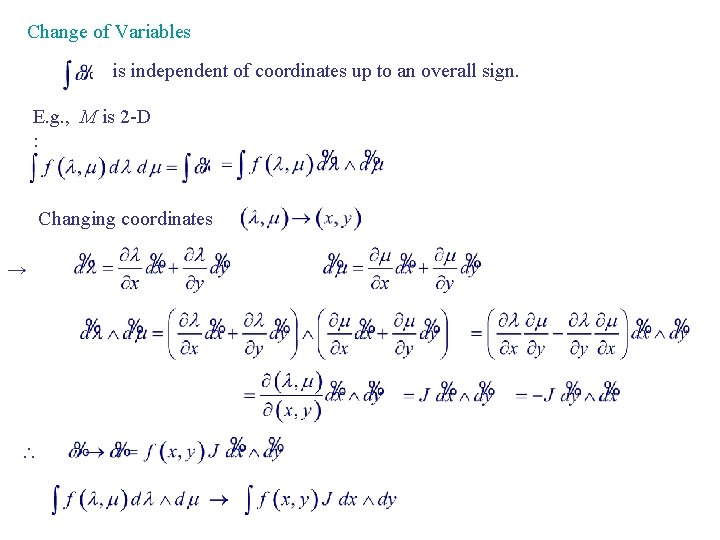
Change of Variables is independent of coordinates up to an overall sign. E. g. , M is 2 -D : Changing coordinates →
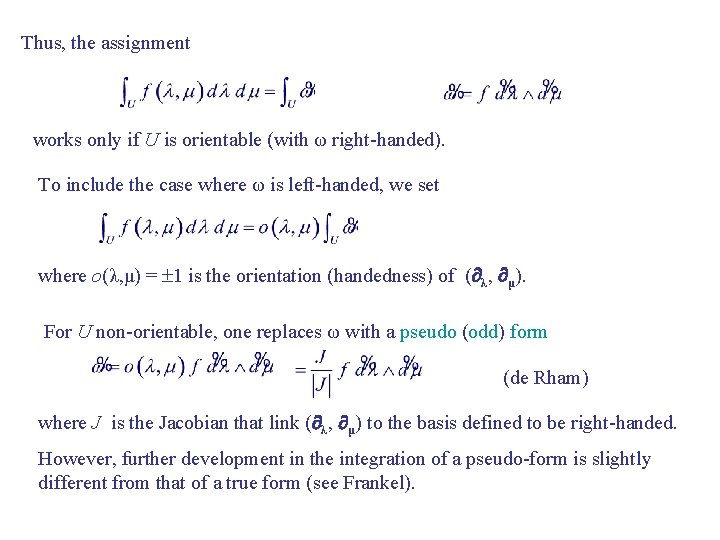
Thus, the assignment works only if U is orientable (with ω right-handed). To include the case where ω is left-handed, we set where o(λ, μ) = 1 is the orientation (handedness) of ( λ, μ). For U non-orientable, one replaces ω with a pseudo (odd) form (de Rham) where J is the Jacobian that link ( λ, μ) to the basis defined to be right-handed. However, further development in the integration of a pseudo-form is slightly different from that of a true form (see Frankel).
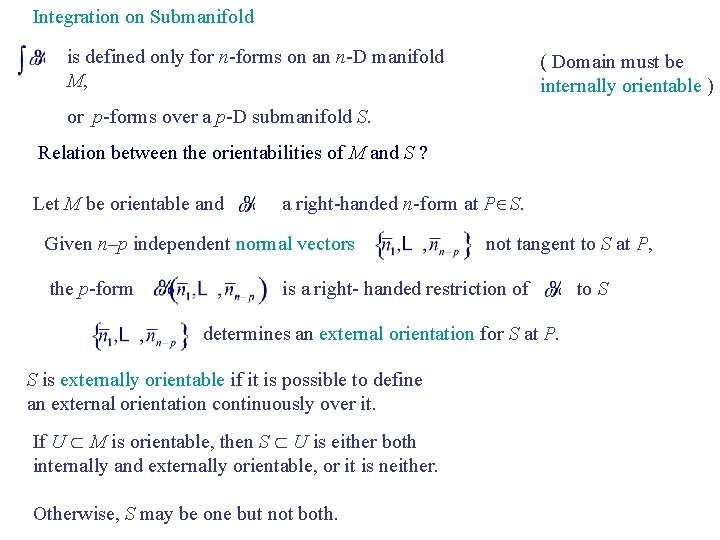
Integration on Submanifold is defined only for n-forms on an n-D manifold M, ( Domain must be internally orientable ) or p-forms over a p-D submanifold S. Relation between the orientabilities of M and S ? Let M be orientable and a right-handed n-form at P S. Given n–p independent normal vectors the p-form not tangent to S at P, is a right- handed restriction of determines an external orientation for S at P. S is externally orientable if it is possible to define an external orientation continuously over it. If U M is orientable, then S U is either both internally and externally orientable, or it is neither. Otherwise, S may be one but not both. to S
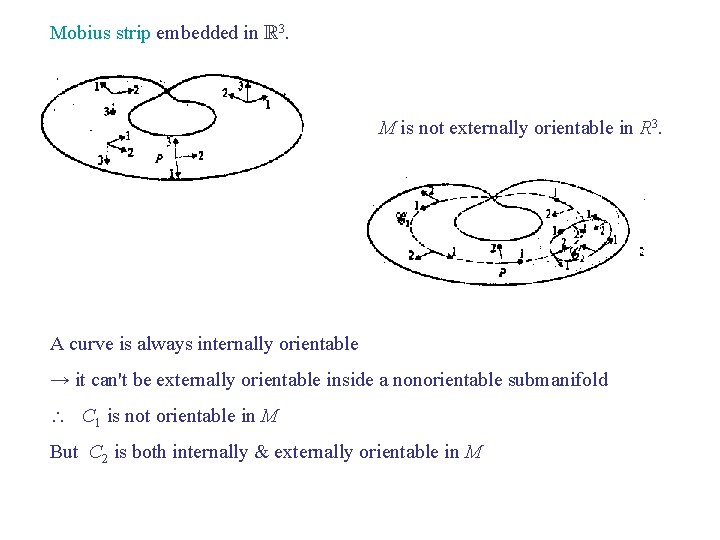
Mobius strip embedded in R 3. M is not externally orientable in R 3. A curve is always internally orientable → it can't be externally orientable inside a nonorientable submanifold C 1 is not orientable in M But C 2 is both internally & externally orientable in M

4. 9. N-vectors, Duals, and the Symbol εijk… Caution: The following differs substantially from Schutz’s version. See Frankel, §§ 2. 8 e & 14. 1 a, Choquet, §V. A. 4, and Schutz, § 4. 13. Let M be an n-D Riemannian manifold with a metric tensor g. Under a coordinate transformation Λ, → ( see § 2. 29 ) where i. e. , g transforms like the component of an n-form. The volume pseudo n-form is therefore defined as so that In an orthonormal basis Euclidean metric in spherical coordinates (r, θ, φ) : →
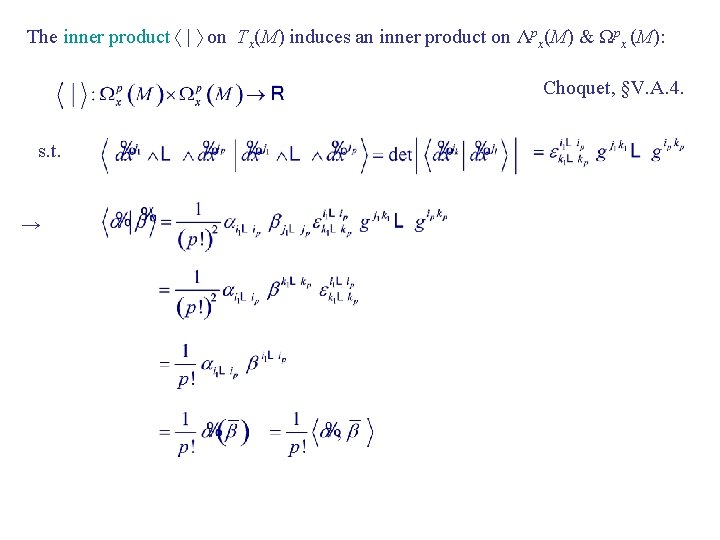
The inner product | on Tx(M) induces an inner product on Λpx(M) & Ωpx (M): Choquet, §V. A. 4. s. t. →
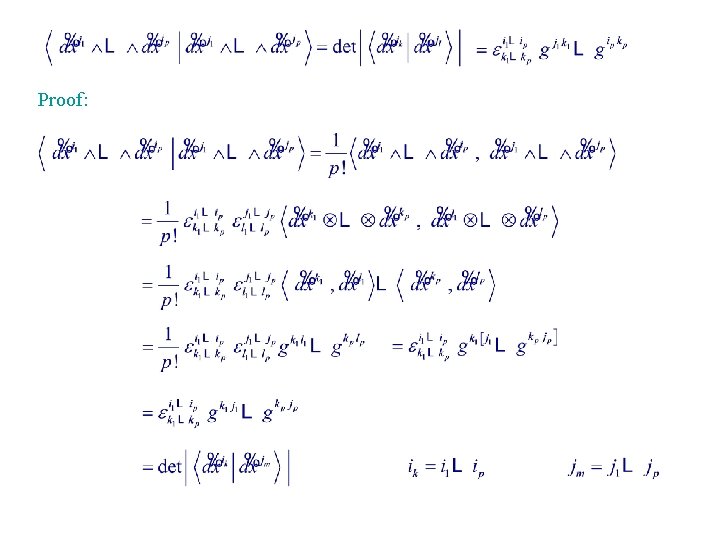
Proof:
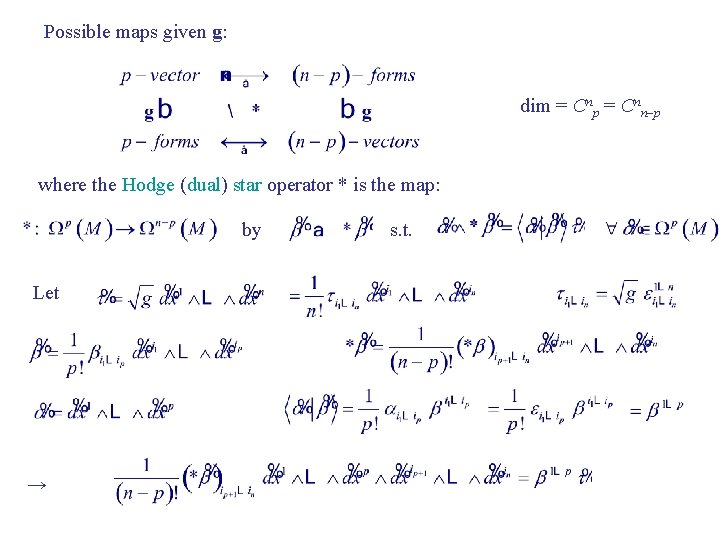
Possible maps given g: dim = Cnp = Cnn p where the Hodge (dual) star operator * is the map: by Let → s. t.
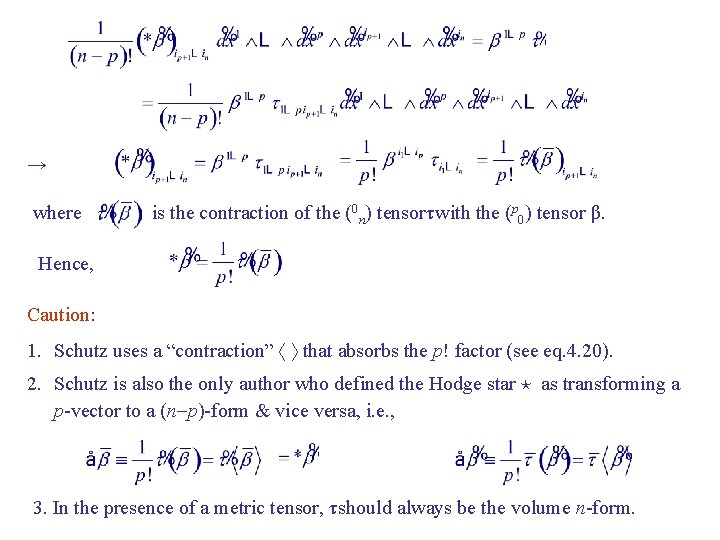
→ where is the contraction of the (0 n) tensorτwith the (p 0) tensor β. Hence, Caution: 1. Schutz uses a “contraction” that absorbs the p! factor (see eq. 4. 20). 2. Schutz is also the only author who defined the Hodge star as transforming a p-vector to a (n p)-form & vice versa, i. e. , 3. In the presence of a metric tensor, τshould always be the volume n-form.
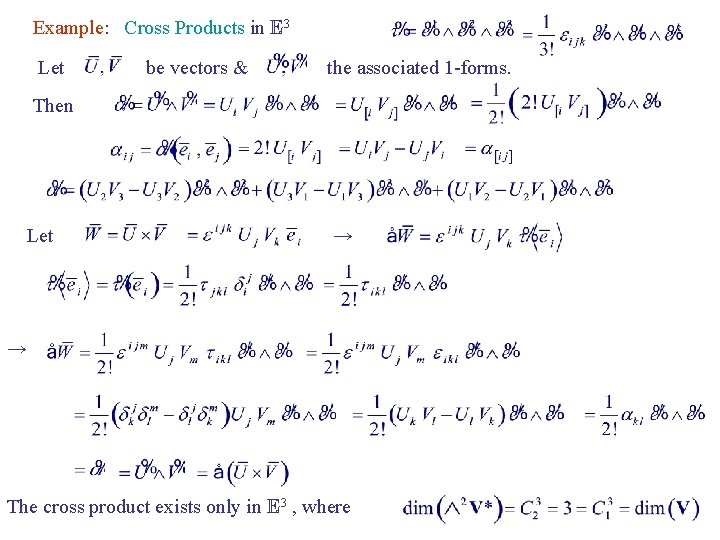
Example: Cross Products in E 3 Let be vectors & the associated 1 -forms. Then Let → → The cross product exists only in E 3 , where
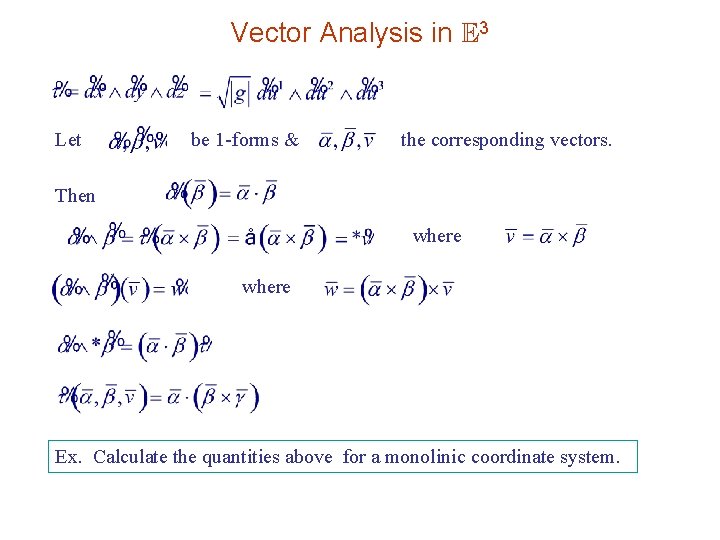
Vector Analysis in E 3 Let be 1 -forms & the corresponding vectors. Then where Ex. Calculate the quantities above for a monolinic coordinate system.
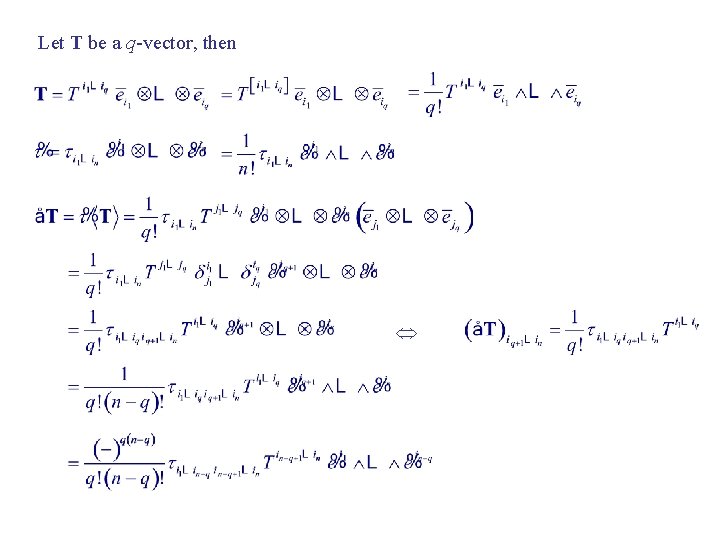
Let T be a q-vector, then
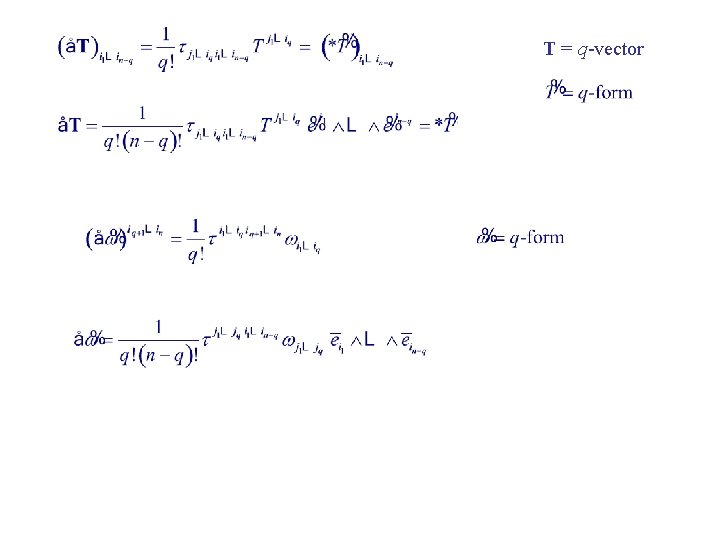
T = q-vector
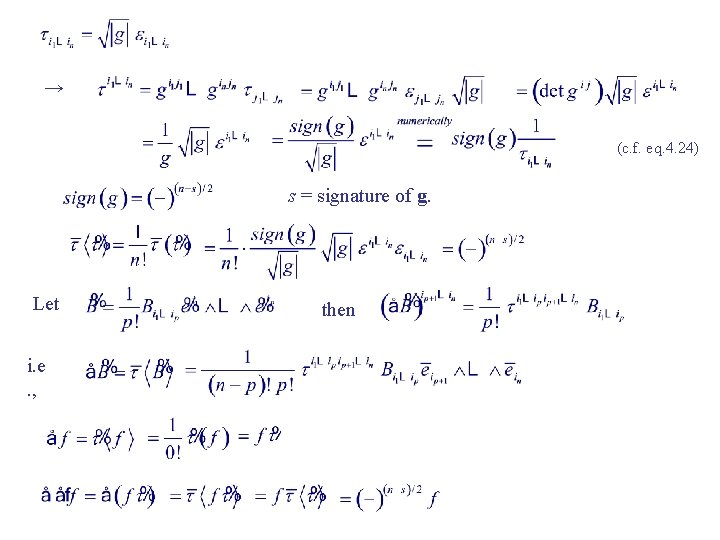
→ (c. f. eq. 4. 24) s = signature of g. Let i. e. , then
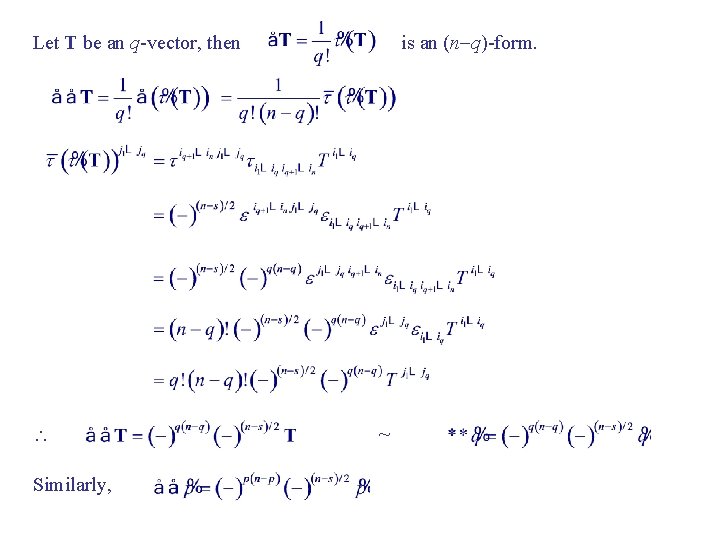
Let T be an q-vector, then Similarly, is an (n q)-form. ~
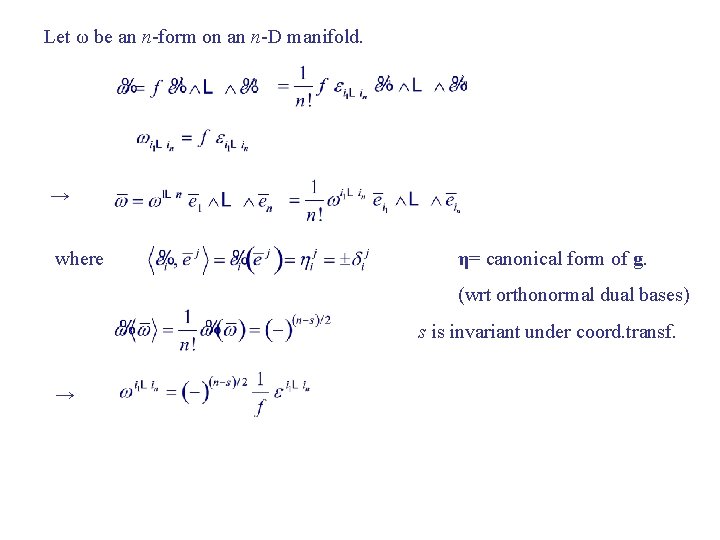
Let ω be an n-form on an n-D manifold. → where η= canonical form of g. (wrt orthonormal dual bases) s is invariant under coord. transf. →
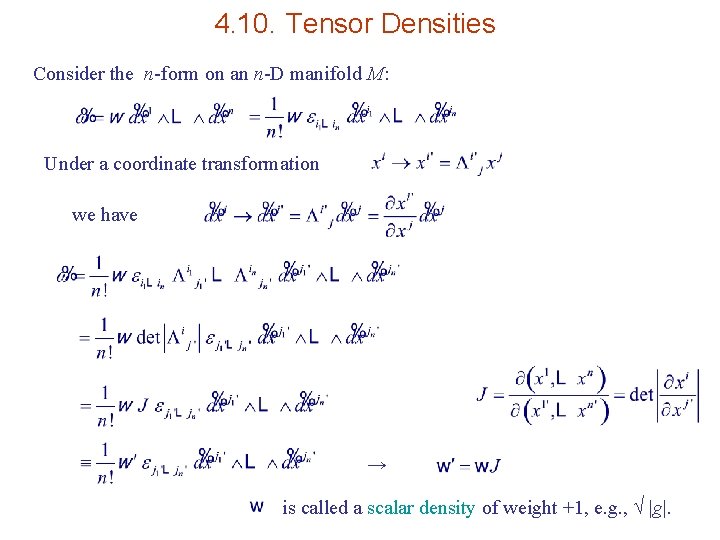
4. 10. Tensor Densities Consider the n-form on an n-D manifold M: Under a coordinate transformation we have → is called a scalar density of weight +1, e. g. , |g|.
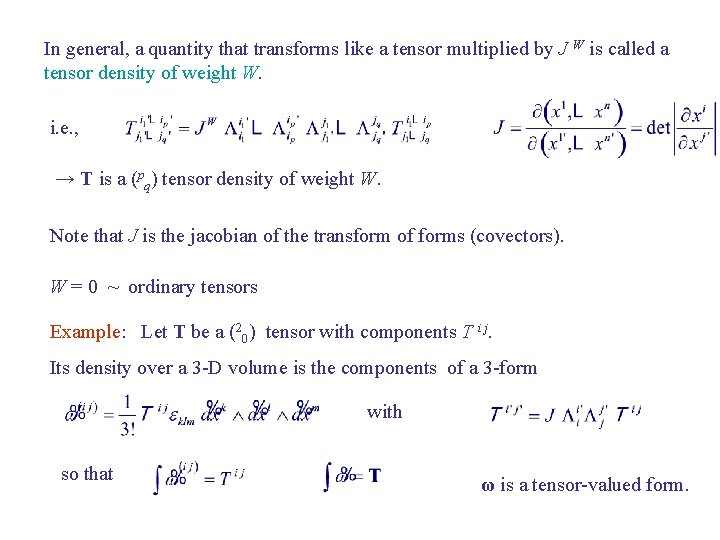
In general, a quantity that transforms like a tensor multiplied by J W is called a tensor density of weight W. i. e. , → T is a (pq) tensor density of weight W. Note that J is the jacobian of the transform of forms (covectors). W = 0 ~ ordinary tensors Example: Let T be a (20) tensor with components T i j. Its density over a 3 -D volume is the components of a 3 -form with so that ω is a tensor-valued form.
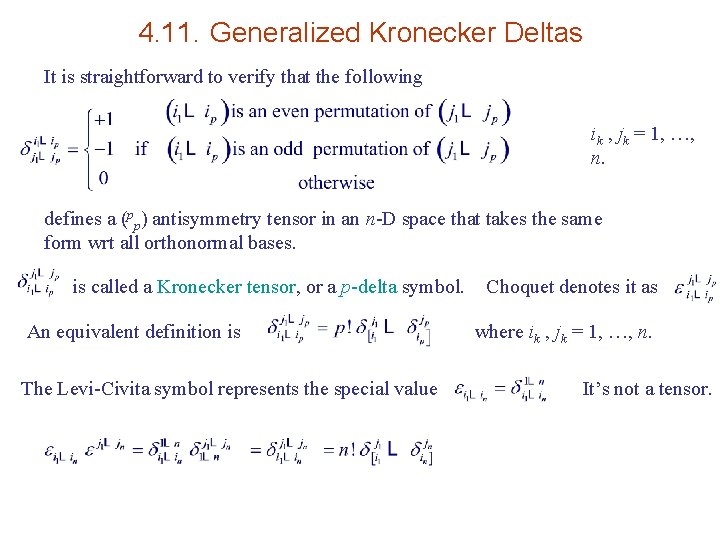
4. 11. Generalized Kronecker Deltas It is straightforward to verify that the following ik , jk = 1, …, n. defines a (pp) antisymmetry tensor in an n-D space that takes the same form wrt all orthonormal bases. is called a Kronecker tensor, or a p-delta symbol. An equivalent definition is The Levi-Civita symbol represents the special value Choquet denotes it as where ik , jk = 1, …, n. It’s not a tensor.
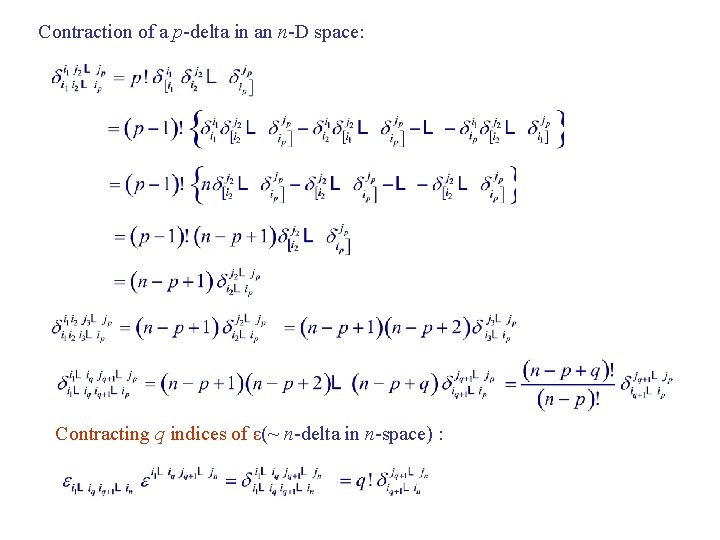
Contraction of a p-delta in an n-D space: Contracting q indices of ε(~ n-delta in n-space) :
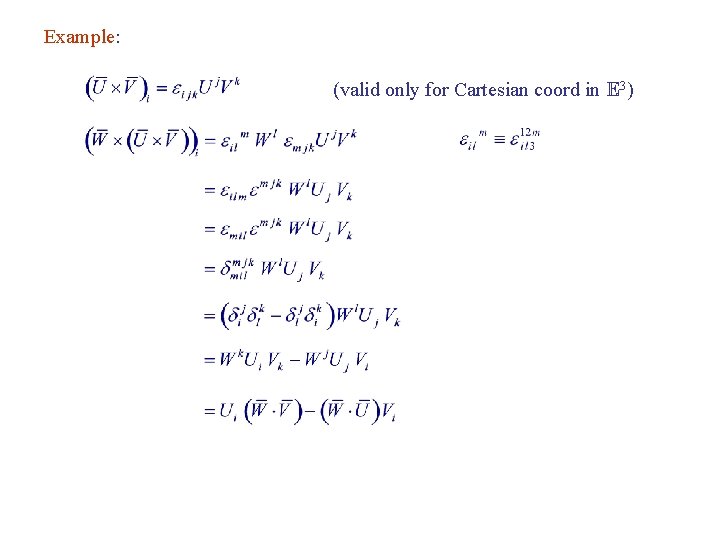
Example: (valid only for Cartesian coord in E 3)
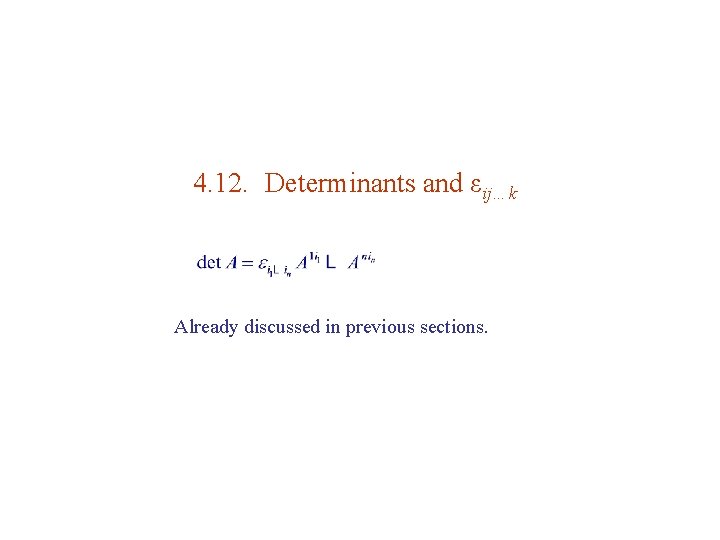
4. 12. Determinants and εij…k Already discussed in previous sections.
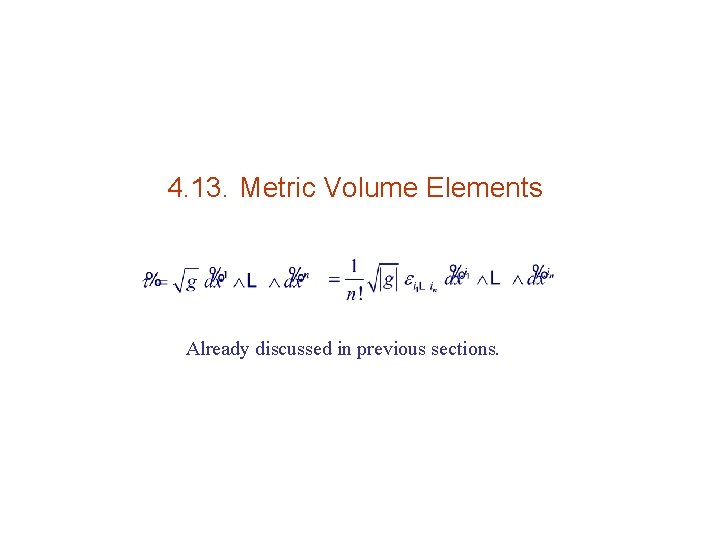
4. 13. Metric Volume Elements Already discussed in previous sections.
- Slides: 44