
4 CPR Cardiopulmonary Resuscitation CPR Cardiopulmonary Resuscitation Korean

- Slides: 16
4 CPR (Cardiopulmonary Resuscitation)
CPR (Cardiopulmonary Resuscitation) Korean Red Cross Important Definitions Cardiac Arrest: Condition in which the heart has stopped or is too weak to pump effectively enough to provide a palpable pulse Cardiopulmonary Resuscitation (CPR): The technique which combines air resuscitation and external chest compressions for a victim whose breathing and have stopped. Learning Objectives: Be able to define CPR and CPR-related terms. Know the CPR process. Fully understand the stages for CPR and be able to put them into action. Differentiate the CPR processes between adults, children and infants.
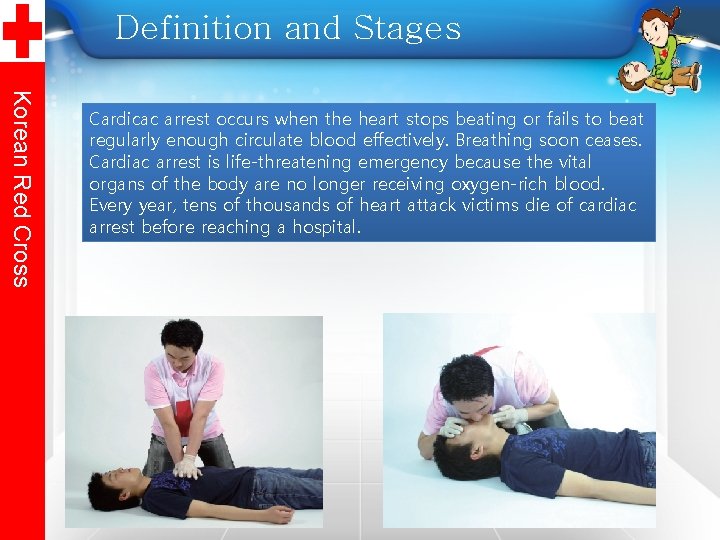
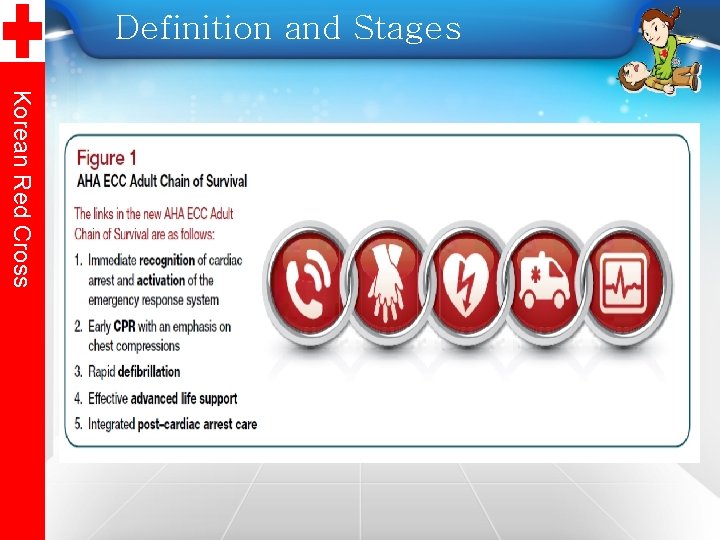
Definition and Stages Korean Red Cross Cardicac arrest occurs when the heart stops beating or fails to beat regularly enough circulate blood effectively. Breathing soon ceases. Cardiac arrest is life-threatening emergency because the vital organs of the body are no longer receiving oxygen-rich blood. Every year, tens of thousands of heart attack victims die of cardiac arrest before reaching a hospital.
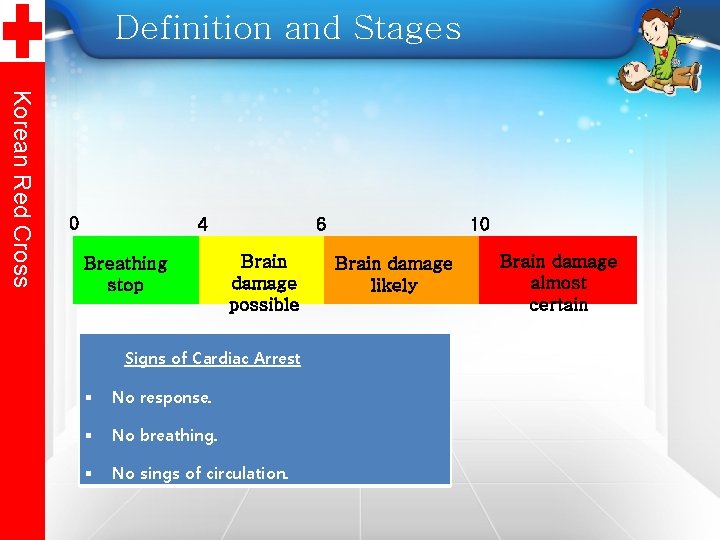
Definition and Stages Korean Red Cross 0 4 Breathing stop 6 Brain damage possible Signs of Cardiac Arrest No response. No breathing. No sings of circulation. 10 Brain damage likely Brain damage almost certain
Definition and Stages Korean Red Cross
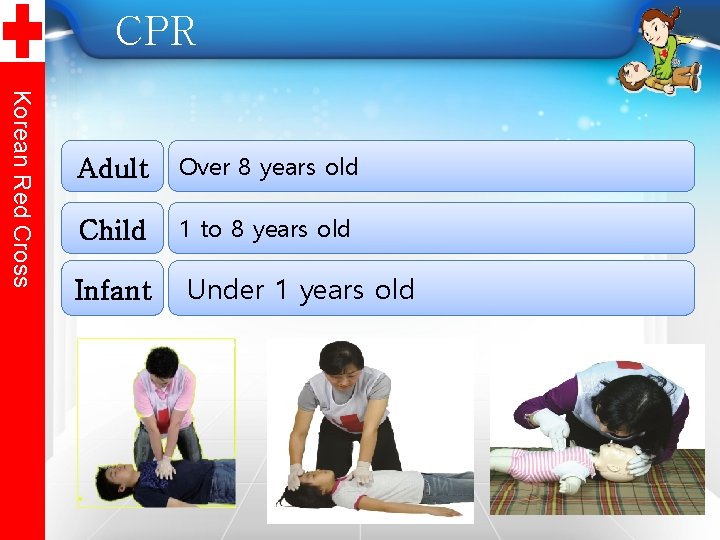
CPR Korean Red Cross Adult Over 8 years old Child 1 to 8 years old Infant Under 1 years old
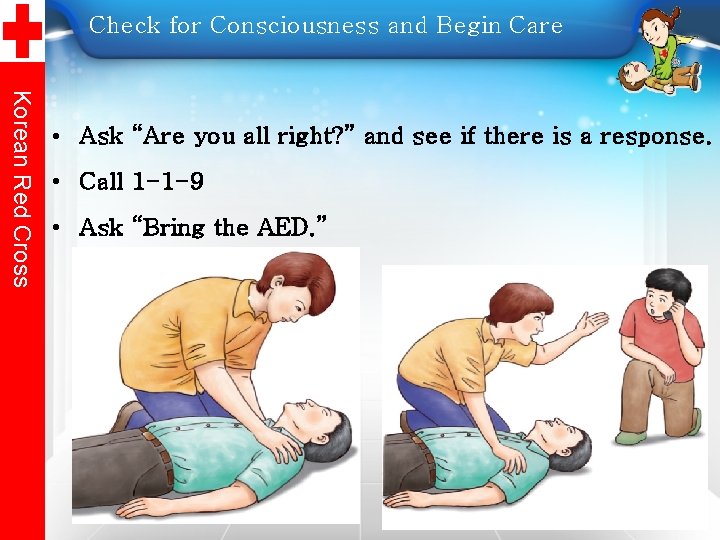
Check for Consciousness and Begin Care Korean Red Cross • Ask “Are you all right? ” and see if there is a response. • Call 1 -1 -9 • Ask “Bring the AED. ”
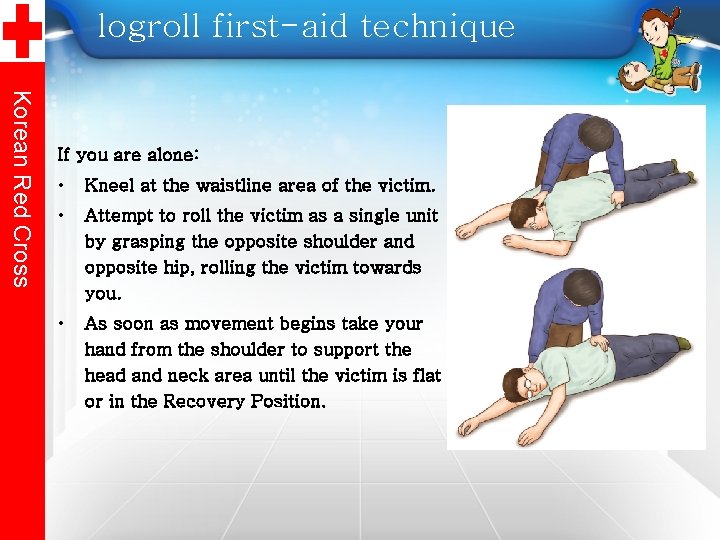
logroll first-aid technique Korean Red Cross If you are alone: • Kneel at the waistline area of the victim. • Attempt to roll the victim as a single unit by grasping the opposite shoulder and opposite hip, rolling the victim towards you. • As soon as movement begins take your hand from the shoulder to support the head and neck area until the victim is flat or in the Recovery Position.
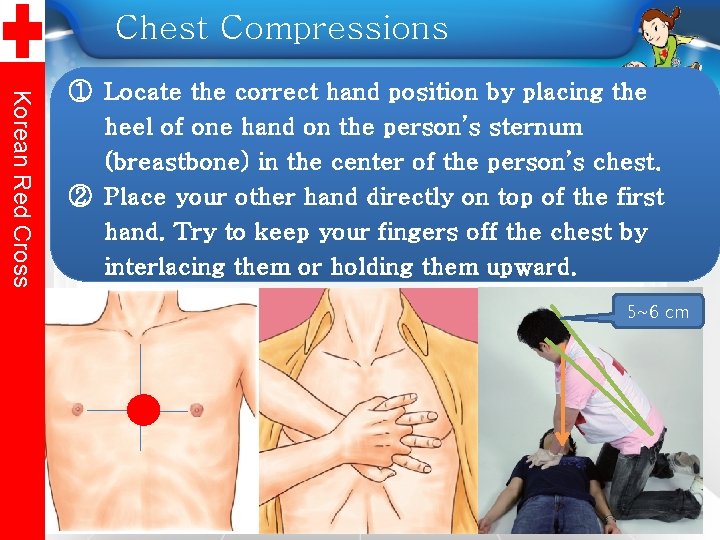
Chest Compressions Korean Red Cross ① Locate the correct hand position by placing the heel of one hand on the person’s sternum (breastbone) in the center of the person’s chest. ② Place your other hand directly on top of the first hand. Try to keep your fingers off the chest by interlacing them or holding them upward. 5~6 cm
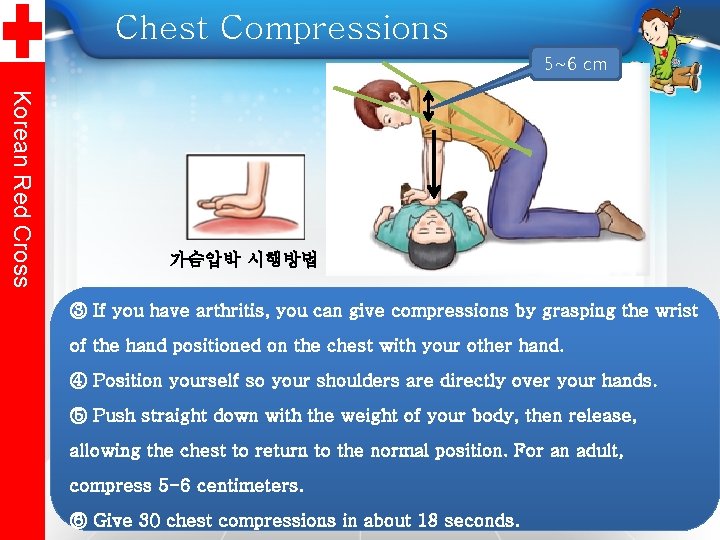
Chest Compressions 5~6 cm Korean Red Cross 가슴압박 시행방법 ③ If you have arthritis, you can give compressions by grasping the wrist of the hand positioned on the chest with your other hand. ④ Position yourself so your shoulders are directly over your hands. ⑤ Push straight down with the weight of your body, then release, allowing the chest to return to the normal position. For an adult, compress 5 -6 centimeters. ⑥ Give 30 chest compressions in about 18 seconds.
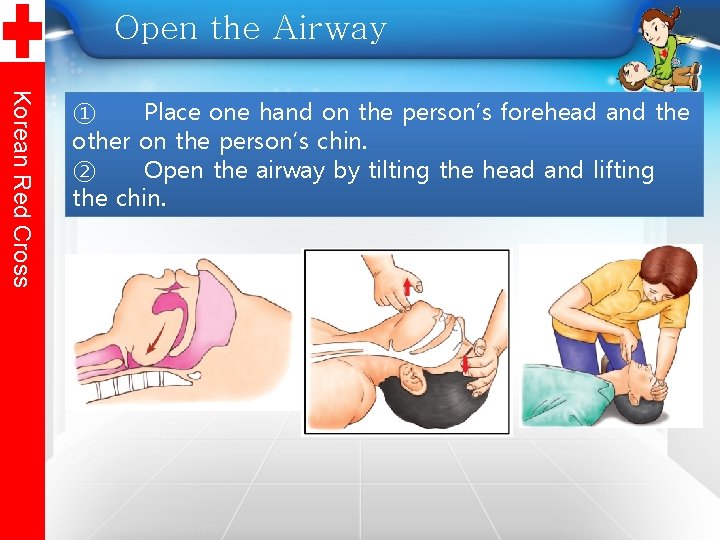
Open the Airway Korean Red Cross ① Place one hand on the person’s forehead and the other on the person’s chin. ② Open the airway by tilting the head and lifting the chin.
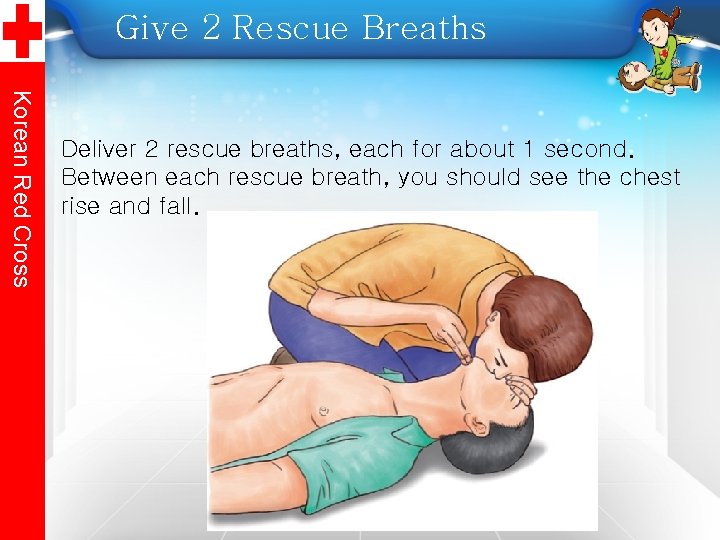
Give 2 Rescue Breaths Korean Red Cross Deliver 2 rescue breaths, each for about 1 second. Between each rescue breath, you should see the chest rise and fall.
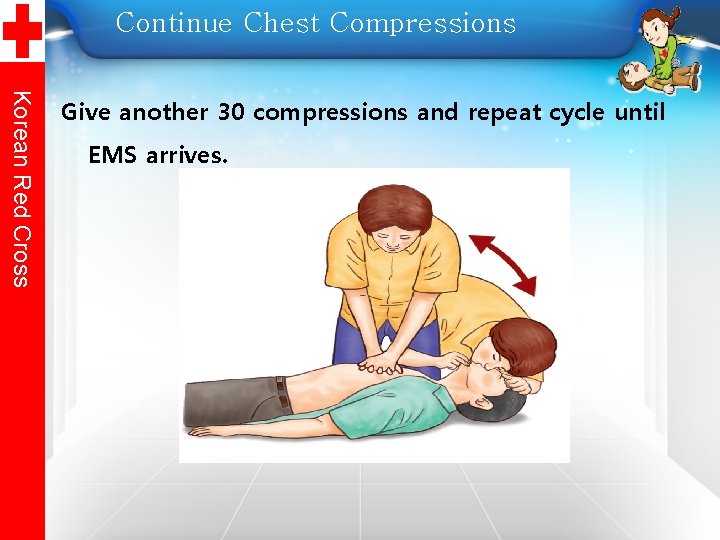
Continue Chest Compressions Korean Red Cross Give another 30 compressions and repeat cycle until EMS arrives.
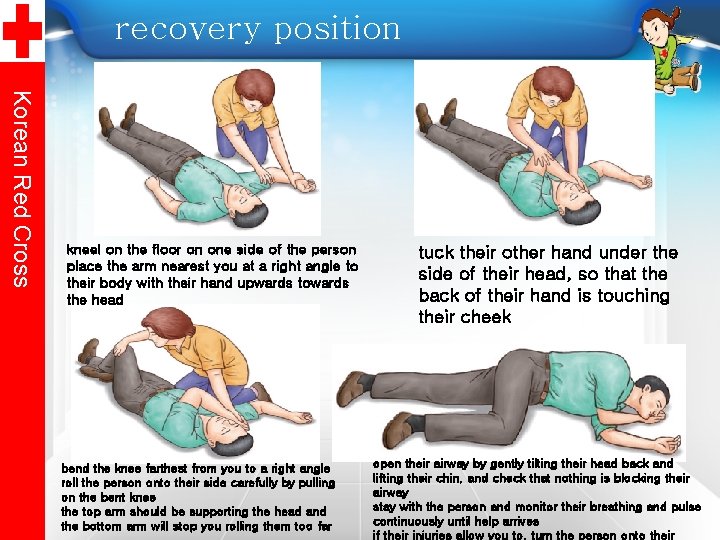
recovery position Korean Red Cross kneel on the floor on one side of the person place the arm nearest you at a right angle to their body with their hand upwards towards the head bend the knee farthest from you to a right angle roll the person onto their side carefully by pulling on the bent knee the top arm should be supporting the head and the bottom arm will stop you rolling them too far tuck their other hand under the side of their head, so that the back of their hand is touching their cheek open their airway by gently tilting their head back and lifting their chin, and check that nothing is blocking their airway stay with the person and monitor their breathing and pulse continuously until help arrives if their injuries allow you to, turn the person onto their
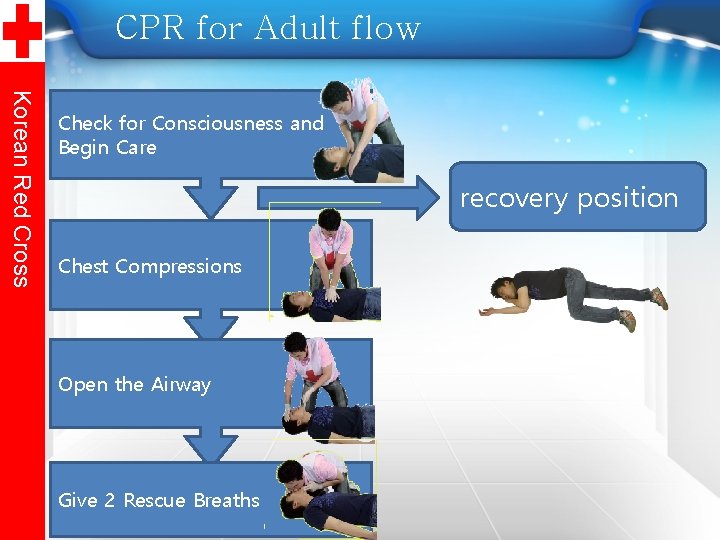
CPR for Adult flow Korean Red Cross Check for Consciousness and Begin Care recovery position Chest Compressions Open the Airway Give 2 Rescue Breaths
Q&A