
4 Communication Challenges 1 Define important words in
- Slides: 46
4 Communication Challenges 1. Define important words in this chapter airway the natural passageway for air to enter into the lungs. anxiety unease or worry, often about a situation or condition. artificial airway any tube inserted into the respiratory tract for the purpose of maintaining an airway and facilitating ventilation. coma state of unconsciousness in which a person is unable to respond to any change in the environment, including pain. combative violent or hostile.
4 Communication Challenges 1. Define important words in this chapter confusion the inability to think clearly and logically. defense mechanisms unconscious behaviors used to release tension and/or help a person cope with stress. disorientation confusion about person, place, or time; may be permanent or temporary. dyspnea difficulty breathing. impairment a partial or complete loss of function or ability.
4 Communication Challenges 1. Define important words in this chapter major depressive disorder an illness that causes social withdrawal, lack of energy, and loss of interest in activities, as well as other symptoms. masturbation to touch or rub sexual organs in order to give oneself or another person sexual pleasure. tracheostomy a surgically-created opening through the neck into the trachea. ventilation in medicine, the exchange of air between the lungs and the environment.
4 Communication Challenges 2. Identify communication guidelines for visual impairment Define the following term: impairment a partial or complete loss of function or ability.
4 Communication Challenges 2. Identify communication guidelines for visual impairment REMEMBER: There are many causes for visual impairment, including diseases such as diabetes and glaucoma. A visual impairment is also something that can exist at birth. People of all ages can be visually impaired, and it can affect one or both eyes.
4 Communication Challenges 2. Identify communication guidelines for visual impairment Remember these guidelines for visual impairment: • Knock, announce yourself, and greet the resident when entering the room. Explain the care you are going to provide. • Face the resident while speaking to him. • Make sure there is proper lighting. • Do not shout. • Use the face of an imaginary clock to explain the position of objects. • Make sure the resident has his eyeglasses on if he wears them.
4 Communication Challenges 2. Identify communication guidelines for visual impairment Guidelines for visual impairment (cont’d): • Do not move personal items or furniture, and put everything back where it was found. • Read menus to the resident. • Encourage resident to use his other senses. • Let the resident know when you leave the area. • Do not play with, distract, or feed guide dogs. • Offer helpful items such as audiobooks, large-print books, digital books, and large clocks. • Be empathetic.
4 Communication Challenges 3. Identify communication guidelines for hearing impairment REMEMBER: Residents may have different kinds of hearing impairment. Having a partial hearing loss in one ear is one example. Being unable to hear at all is another example. Hearing may also be temporarily impaired due to the noise level in a room.
4 Communication Challenges 3. Identify communication guidelines for hearing impairment The following are symptoms of hearing loss to observe and report: • Trouble hearing high-pitched noises • Trouble hearing soft consonants, such as “s” and “t” • Trouble hearing what is said in a setting that has background noise • Not understanding the meaning of words
4 Communication Challenges 3. Identify communication guidelines for hearing impairment Symptoms of hearing loss (cont'd): • Being unable to hear people when they are not in the same room • Favoring one ear over the other one • Avoiding movies or special events due to not being able to understand the dialogue • Complaints of ringing in the ears • Complaints of pain in one or both ears
4 Communication Challenges 3. Identify communication guidelines for hearing impairment Remember these guidelines for hearing impairment: • Get resident’s attention before speaking. • Stand or sit so the resident can see your face. • Look at the resident directly while speaking. • Make sure hearing aids are worn and are turned on. • Turn off TV or radio. • Speak clearly and do not shout.
4 Communication Challenges 3. Identify communication guidelines for hearing impairment Guidelines for hearing impairment (cont'd): • Lower the pitch of your voice. • Do not chew gum, eat, or cover your mouth while speaking. • Do not exaggerate pronunciation of words or mouth words in an exaggerated way. • Use simple words and short sentences. • Use pen and paper or picture cards.
4 Communication Challenges 3. Identify communication guidelines for hearing impairment Think about these questions: How would it feel to not be able to hear? If you were in this position, what things could others do that you would appreciate?
4 Communication Challenges 4. Explain defense mechanisms as methods of coping with stress Define the following term: defense mechanisms unconscious behaviors used to release tension and/or help a person cope with stress.
4 Communication Challenges 4. Explain defense mechanisms as methods of coping with stress Defense mechanisms are unconscious behaviors, but they can prevent a person from dealing with his or her real feelings. Can you think of examples of each of the following defense mechanisms? • Denial • Displacement • Projection • Rationalization • Repression • Regression
4 Communication Challenges 4. Explain defense mechanisms as methods of coping with stress Think about this question: Why might it be helpful for a nursing assistant to understand be alert to different defense mechanisms?
4 Communication Challenges 5. List communication guidelines for anxiety or fear Define the following term: anxiety unease or worry, often about a situation or condition.
4 Communication Challenges 5. List communication guidelines for anxiety or fear REMEMBER: Feeling anxious is not the same as feeling afraid. Anxiety is a vague emotional state. The unpleasant feelings are coming from the anticipation of something bad that could happen or a future danger. The danger is not happening in the present time, but anxiety can cause physical symptoms such as nausea, shaking, sweating, chest pain, and rapid heartbeat. With fear, one is dealing with the present. Fear is a reaction to an actual danger.
4 Communication Challenges 5. List communication guidelines for anxiety or fear Remember these guidelines for communicating with a resident who is anxious or fearful: • Knock on the door, announce yourself, and greet the resident when you enter the room. • Speak softly. Reduce the noise level. • Speak slowly and calmly. • Listen to the resident. Be patient. • Be empathetic, calm, and reassuring. • Avoid demanding behavior.
4 Communication Challenges 6. Discuss communication guidelines for depression Define the following term: major depressive disorder an illness that causes social withdrawal, lack of energy, and loss of interest in activities, as well as other symptoms.
4 Communication Challenges 6. Discuss communication guidelines for depression Think about these questions: What different losses and changes occur in a person’s life when he or she has to move into a facility? How would it feel to experience these losses? What losses or changes would be hardest for you?
4 Communication Challenges 6. Discuss communication guidelines for depression Remember these guidelines for communicating with residents with depression: • Be pleasant, respectful, and supportive. • Use touch to help comfort the resident. • Listen carefully to the resident. Lean forward and maintain eye contact. • Think before you speak and be empathetic. • Use a normal tone of voice. • Talk about feelings if the resident wishes. • Encourage social interaction.
4 Communication Challenges 6. Discuss communication guidelines for depression REMEMBER: Clinical depression is an illness, just like any other illness. Depressed people cannot simply choose to be well. The nursing assistant’s role is to be supportive and compassionate, and to try to make each day as pleasant an experience as possible for residents.
4 Communication Challenges 6. Discuss communication guidelines for depression Think about this question: What can happen if a nursing assistant mistakenly thinks that residents who are depressed can simply choose to be well?
4 Communication Challenges 7. Identify communication guidelines for anger REMEMBER: Anger is a natural human emotion. Nursing assistants may see residents, their families and friends, and other staff members express anger. Residents may feel angry due to illness, fear, pain, grief, loneliness, or a loss of independence. Even minor things, such as a change in the dinner menu, can trigger anger. Anger may also just be a part of someone’s personality.
4 Communication Challenges 7. Identify communication guidelines for anger Remember these guidelines for angry behavior: • Be pleasant and supportive. • Try to find out what caused the anger. • Observe the resident’s body language. • Empathize with the resident. • Do not argue with the resident. Stay calm. • Treat the resident with dignity and respect. • Answer call lights promptly. • If the resident’s anger increases, get the nurse immediately. • Try to involve the resident in activities.
4 Communication Challenges 8. Identify communication guidelines for combative behavior Define the following term: combative violent or hostile.
4 Communication Challenges 8. Identify communication guidelines for combative behavior REMEMBER: When anger increases, a person may become combative. Combative means violent or hostile. Such behavior includes hitting, shoving, kicking, throwing things, and insulting others. Combative behavior may be due to a disease affecting the brain. It may be due to a worsening of anger or frustration. Medication or changes in health may cause a resident to become combative.
4 Communication Challenges 8. Identify communication guidelines for combative behavior REMEMBER: Combative behavior should not be taken personally. When a resident becomes combative, the role of the nursing assistant is to keep everyone safe.
4 Communication Challenges 8. Identify communication guidelines for combative behavior Remember these guidelines for combative behavior: • Call for the nurse immediately. • Keep yourself and others at a safe distance. • Stay calm and do not appear threatening to the resident. • Be reassuring. Consider what might have triggered the behavior. • Stay neutral. Do not respond to insults and do not argue. • Follow direction of the nurses. • Report facts you observed. • When the resident has calmed down, stay with her if she wishes to talk.
4 Communication Challenges 9. Identify communication guidelines for inappropriate sexual behavior Define the following term: masturbation to touch or rub sexual organs in order to give oneself or another person sexual pleasure.
4 Communication Challenges 9. Identify communication guidelines for inappropriate sexual behavior REMEMBER: Older adults, like all humans, are sexual beings. Residents have the right to choose how they express their sexuality. Sometimes residents will show inappropriate sexual behavior. This behavior does not seem normal or makes you or others uncomfortable. It includes sexual advances or comments. Inappropriate behavior also includes things like removing clothing in public places.
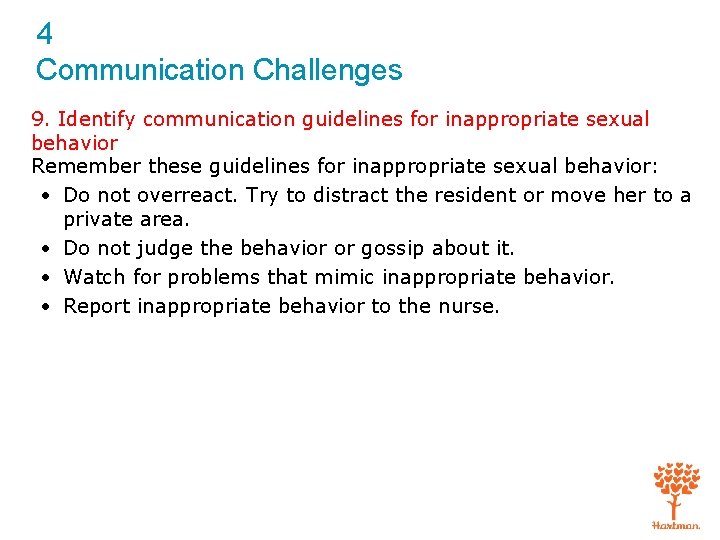
4 Communication Challenges 9. Identify communication guidelines for inappropriate sexual behavior Remember these guidelines for inappropriate sexual behavior: • Do not overreact. Try to distract the resident or move her to a private area. • Do not judge the behavior or gossip about it. • Watch for problems that mimic inappropriate behavior. • Report inappropriate behavior to the nurse.
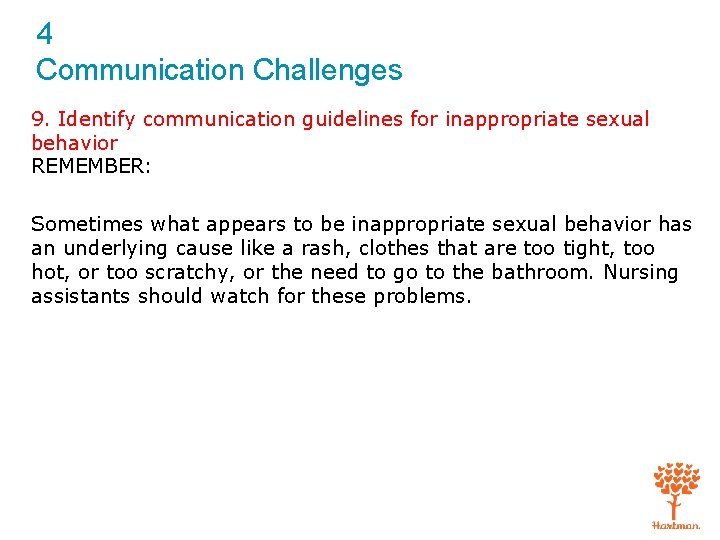
4 Communication Challenges 9. Identify communication guidelines for inappropriate sexual behavior REMEMBER: Sometimes what appears to be inappropriate sexual behavior has an underlying cause like a rash, clothes that are too tight, too hot, or too scratchy, or the need to go to the bathroom. Nursing assistants should watch for these problems.
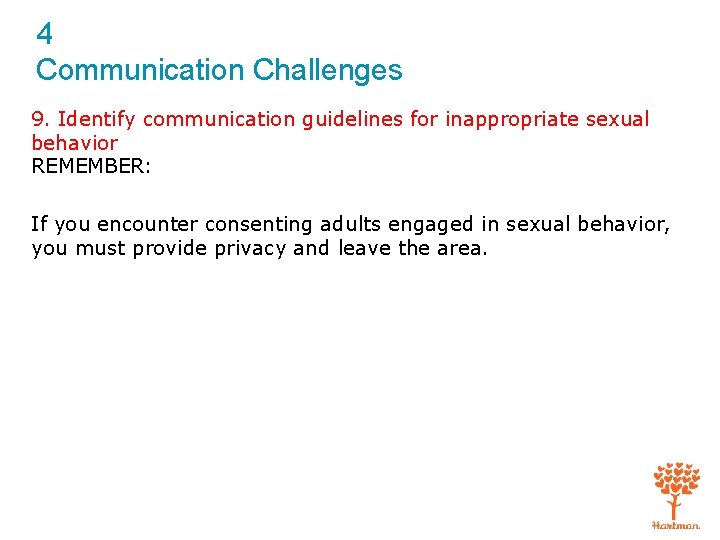
4 Communication Challenges 9. Identify communication guidelines for inappropriate sexual behavior REMEMBER: If you encounter consenting adults engaged in sexual behavior, you must provide privacy and leave the area.
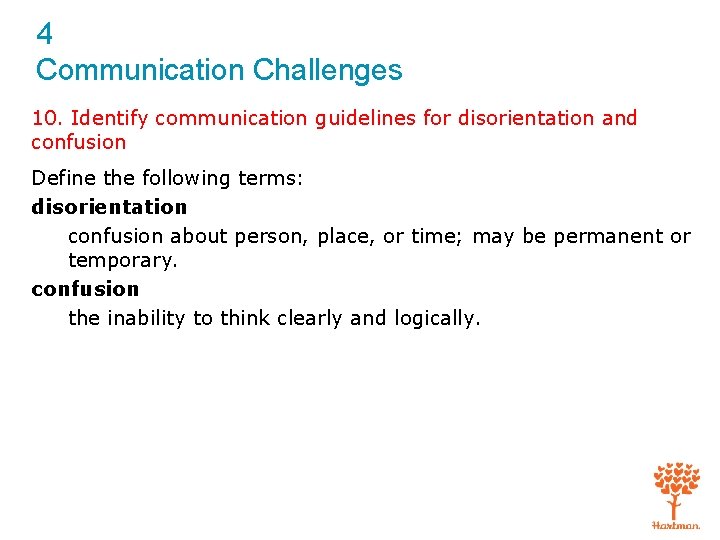
4 Communication Challenges 10. Identify communication guidelines for disorientation and confusion Define the following terms: disorientation confusion about person, place, or time; may be permanent or temporary. confusion the inability to think clearly and logically.
4 Communication Challenges 10. Identify communication guidelines for disorientation and confusion Think about these questions: What is the difference between disorientation and confusion? What are some possible causes of confusion?
4 Communication Challenges 10. Identify communication guidelines for disorientation and confusion Remember these guidelines for disorientation or confusion: • Do not leave a confused resident alone. • Stay calm and provide a quiet environment. • Speak in a lower tone of voice. Speak clearly and slowly. • Introduce yourself each time you see the resident. Remind the resident of the location, his name, and the date. • Explain what you are going to do, using short, simple sentences. Break tasks into steps.
4 Communication Challenges 10. Identify communication guidelines for disorientation and confusion Guidelines for disorientation or confusion (cont'd): • Be patient with the resident. • Listen to the resident closely. Pay attention to body language. • Tell the resident the plans for the day. • Encourage the use of eyeglasses and hearing aids. • Tell the resident when you are leaving the area. • Report observations to the nurse.
4 Communication Challenges 11. Identify communication guidelines for the comatose resident Define the following term: coma state of unconsciousness in which a person is unable to respond to any change in the environment, including pain.
4 Communication Challenges 11. Identify communication guidelines for the comatose resident REMEMBER: A person in a coma cannot respond to any change in the environment, including pain. A resident who is comatose deserves the same respect as an alert resident.
4 Communication Challenges 11. Identify communication guidelines for the comatose resident Remember these guidelines for caring for a comatose resident: • Introduce yourself when entering the resident’s room. • Explain each step of each procedure you will be performing. • Do not hold personal discussions while caring for the resident. • Let the resident know when you are going to leave the room.
4 Communication Challenges 11. Identify communication guidelines for the comatose resident A person in a coma can transition to a persistent vegetative state (PVS), which means the person may have some level of consciousness. He may open his eyes and have some facial movements, but these are mostly physical reactions and not a response to external stimuli. A minimally conscious state (MCS) is different than a coma or vegetative state. The person exhibits some cognitive behavior and shows sporadic signs of consciousness, such as crying or laughing appropriately.
4 Communication Challenges 12. Identify communication guidelines for functional barriers Define the following terms: airway the natural passageway for air to enter into the lungs. artificial airway any tube inserted into the respiratory tract for the purpose of maintaining an airway and facilitating ventilation. tracheostomy a surgically-created opening through the neck into the trachea. ventilation in medicine, the exchange of air between the lungs and the environment.
4 Communication Challenges 12. Identify communication guidelines for functional barriers These functional problems may cause residents to have difficulty speaking: • Lip, mouth, or tongue sores • Dental problems of any kind • Poorly-fitting dentures • Birth defects, such as cleft palate • Paralysis of one side of the mouth due to stroke
4 Communication Challenges 12. Identify communication guidelines for functional barriers Remember these guidelines for functional barriers: • Give resident plenty of time to speak. • Ask the resident to write down anything you do not understand. • Allow for rest periods if resident becomes tired. • Do not remove a resident’s oxygen for any reason. • Report mouth sores, poorly-fitting dentures, or complaints of pain. • Use other methods of communication such as writing notes, drawing pictures, and communication boards. • Be reassuring, calm, and empathetic.