
4 Choosing a Form of Business Ownership Copyright
4 Choosing a Form of Business Ownership Copyright © 2017 Cengage Learning. All Rights Reserved. May not be copied, scanned, or duplicated, in whole or in part, except for use as permitted in a license distributed with a certain product or service or otherwise on a password-protected website for classroom use.
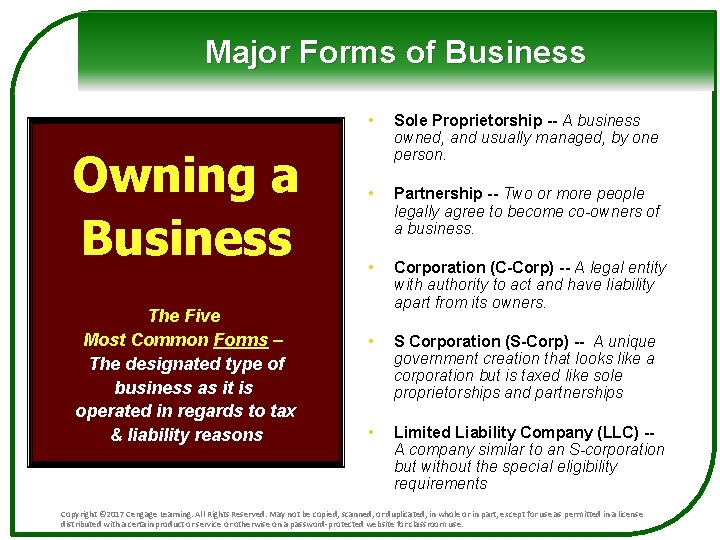
Major Forms of Business Owning a Business The Five Most Common Forms – The designated type of business as it is operated in regards to tax & liability reasons • Sole Proprietorship -- A business owned, and usually managed, by one person. • Partnership -- Two or more people legally agree to become co-owners of a business. • Corporation (C-Corp) -- A legal entity with authority to act and have liability apart from its owners. • S Corporation (S-Corp) -- A unique government creation that looks like a corporation but is taxed like sole proprietorships and partnerships • Limited Liability Company (LLC) -A company similar to an S-corporation but without the special eligibility requirements Copyright © 2017 Cengage Learning. All Rights Reserved. May not be copied, scanned, or duplicated, in whole or in part, except for use as permitted in a license distributed with a certain product or service or otherwise on a password-protected website for classroom use.
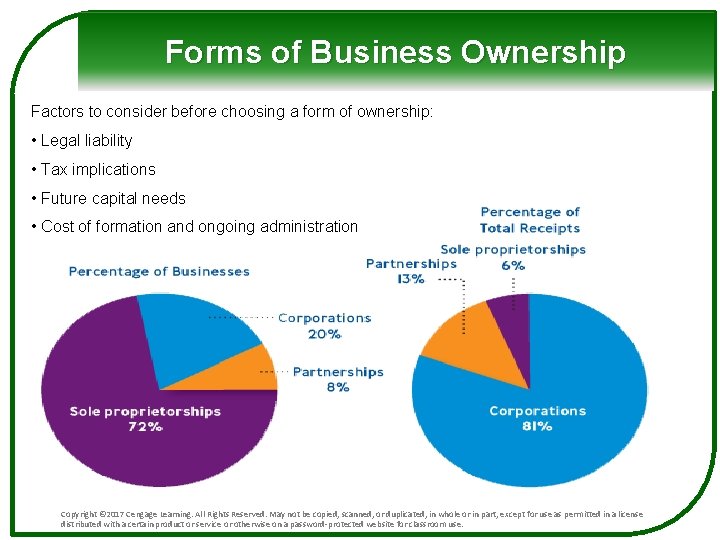
Forms of Business Ownership Factors to consider before choosing a form of ownership: • Legal liability • Tax implications • Future capital needs • Cost of formation and ongoing administration Copyright © 2017 Cengage Learning. All Rights Reserved. May not be copied, scanned, or duplicated, in whole or in part, except for use as permitted in a license distributed with a certain product or service or otherwise on a password-protected website for classroom use.
Sole Proprietorships § A business that is owned (and usually operated) by one person § The simplest form of business ownership and the easiest to start § Many large businesses began as a small struggling sole proprietorships § The most popular form of business ownership Copyright © 2017 Cengage Learning. All Rights Reserved. May not be copied, scanned, or duplicated, in whole or in part, except for use as permitted in a license distributed with a certain product or service or otherwise on a password-protected website for classroom use.
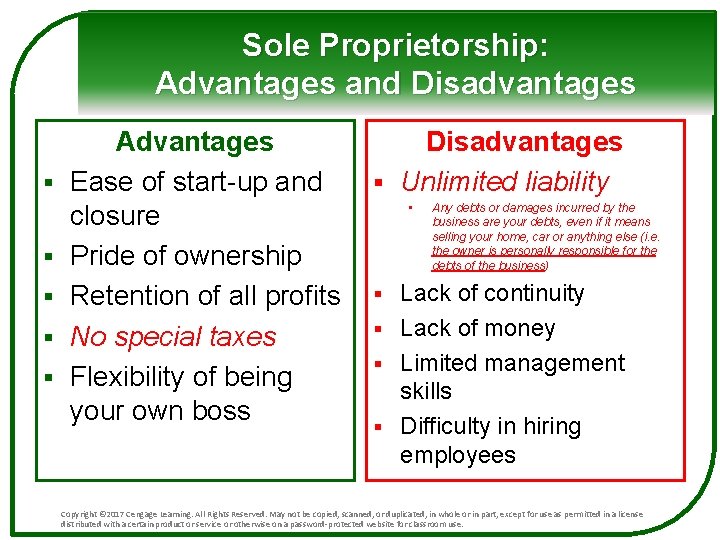
Sole Proprietorship: Advantages and Disadvantages § § § Advantages Ease of start-up and closure Pride of ownership Retention of all profits No special taxes Flexibility of being your own boss Disadvantages § Unlimited liability • Any debts or damages incurred by the business are your debts, even if it means selling your home, car or anything else (i. e. the owner is personally responsible for the debts of the business) Lack of continuity § Lack of money § Limited management skills § Difficulty in hiring employees § Copyright © 2017 Cengage Learning. All Rights Reserved. May not be copied, scanned, or duplicated, in whole or in part, except for use as permitted in a license distributed with a certain product or service or otherwise on a password-protected website for classroom use.
Partnerships § A voluntary association of two or more persons to act as co-owners of a business for profit § Less common form of ownership than sole proprietorship or corporation § No legal limit on the maximum number of partners; most have only two § Large accounting, law, and advertising partnerships have multiple partners § Partnerships are usually a pooling of special talents or the result of a sole proprietor taking on a partner Copyright © 2017 Cengage Learning. All Rights Reserved. May not be copied, scanned, or duplicated, in whole or in part, except for use as permitted in a license distributed with a certain product or service or otherwise on a password-protected website for classroom use.
Types of Partners § General partner • A person who assumes full or shared responsibility for operating a business • General partnership: a business co-owned by two or more general partners who are liable for everything the business does § Limited partner • A person who contributes capital to a business but has no management responsibility or liability for losses beyond the amount he or she invested in the partnership • Limited partnership: a business co-owned by one or more general partners who manage the business and limited partners who invest money in it (but have no personal liability) • Master limited partnership (MLP): a business partnership that is owned and managed like a corporation but taxed like a partnership Copyright © 2017 Cengage Learning. All Rights Reserved. May not be copied, scanned, or duplicated, in whole or in part, except for use as permitted in a license distributed with a certain product or service or otherwise on a password-protected website for classroom use.
The Partnership Agreement § Articles of partnership refers to an agreement listing and explaining the terms of the partnership; written is preferable to oral § Agreement should state • • Who will make final decisions What each partner’s duties will be The investment each partner will make How much profit or loss each partner receives or is responsible for • What happens if a partner wants to dissolve the partnership or dies Copyright © 2017 Cengage Learning. All Rights Reserved. May not be copied, scanned, or duplicated, in whole or in part, except for use as permitted in a license distributed with a certain product or service or otherwise on a password-protected website for classroom use.
Picking Your Partner There is no such thing as a perfect partner but ask these questions when you try to find your best match: • Do you share the same goals? • Do you share the same vision for the company? • What skills does he/she have? Are yours the same? • What can he/she bring to the business? • What type of decision maker is he/she? • Do you trust each other? • How does he/she problem solve? Copyright © 2017 Cengage Learning. All Rights Reserved. May not be copied, scanned, or duplicated, in whole or in part, except for use as permitted in a license distributed with a certain product or service or otherwise on a password-protected website for classroom use.
Advantages and Disadvantages of Partnerships Advantages Disadvantages § Ease of start-up § Unlimited liability § Availability of capital and credit § Management disagreements § Personal interest § Lack of continuity § Combined business skills and knowledge § Frozen investment § Retention of profits § No special taxes Copyright © 2017 Cengage Learning. All Rights Reserved. May not be copied, scanned, or duplicated, in whole or in part, except for use as permitted in a license distributed with a certain product or service or otherwise on a password-protected website for classroom use.
Corporations A corporation is an artificial person created by law with most of the legal rights of a real person, including the rights to start and operate a business, to buy or sell property, to borrow money, to sue or be sued, and to enter into binding contracts • Most common type of corporation is a “C” § Exists only on paper corporation is a legal entity, separate from § Approx. 6 million in the • its. Aowners • Requirements vary by state, many states are United States “corporation-friendly” • Corporations are owned by stockholders § 19% of all businesses • Articles of incorporations must be filed and corporate bylaws adopted § 82% of sales revenue Copyright © 2017 Cengage Learning. All Rights Reserved. May not be copied, scanned, or duplicated, in whole or in part, except for use as permitted in a license distributed with a certain product or service or otherwise on a password-protected website for classroom use.
Corporate Ownership: Stock § Stock: The shares of ownership of a corporation § Two Types: 1) Common Stock (voting privileges), 2) Preferred Stock (no voting rights, dividends paid first) § Stockholder: A person who owns a corporation's stock § Dividend: A portion of the corporation’s profit (earnings) that is distributed to stockholders § Closed (Private) Corporation: Stock is owned by relatively few people and not sold to public § Open (Public) Corporation: Stock is bought and sold on security exchanges and can be bought by anyone Copyright © 2017 Cengage Learning. All Rights Reserved. May not be copied, scanned, or duplicated, in whole or in part, except for use as permitted in a license distributed with a certain product or service or otherwise on a password-protected website for classroom use.
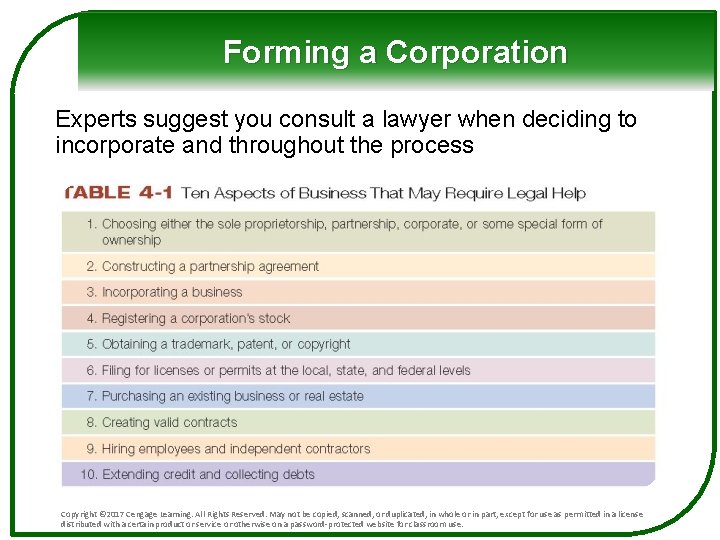
Forming a Corporation Experts suggest you consult a lawyer when deciding to incorporate and throughout the process Copyright © 2017 Cengage Learning. All Rights Reserved. May not be copied, scanned, or duplicated, in whole or in part, except for use as permitted in a license distributed with a certain product or service or otherwise on a password-protected website for classroom use.
Forming a Corporation: Where to Incorporate § A business can incorporate in any state it chooses § The decision is usually based on cost and the advantages and disadvantages of each state’s corporate laws and tax structure § A domestic corporation is a corporation in the state in which it is incorporated § A foreign corporation is a corporation in any state Copyright © 2017 Cengage Learning. All Rights Reserved. May not be copied, scanned, or duplicated, in whole or in part, except for use as permitted in a license distributed with a certain product or service or otherwise on a password-protected website for classroom use.
Forming a Corporation: The Corporate Charter § Articles of incorporation: a contract between the corporation and the state in which the state recognizes the formation of the artificial person that is the corporation • • Firm’s name and address Incorporators’ names and addresses Purpose of the corporation Maximum amount of stock and types of stock to be issued • Rights and privileges of stockholders • Length of time the corporation is to exist Copyright © 2017 Cengage Learning. All Rights Reserved. May not be copied, scanned, or duplicated, in whole or in part, except for use as permitted in a license distributed with a certain product or service or otherwise on a password-protected website for classroom use.
Corporate Structure: Board of Directors § The top governing body of a corporation, the members of which are elected by the stockholders § Responsible for setting corporate goals, developing strategic plans to meet those goals, and the firm’s overall operation § Outside directors: experienced managers or entrepreneurs from outside the corporation who have specific talents § Inside directors: top managers from within the corporation Copyright © 2017 Cengage Learning. All Rights Reserved. May not be copied, scanned, or duplicated, in whole or in part, except for use as permitted in a license distributed with a certain product or service or otherwise on a password-protected website for classroom use.
Corporate Structure: Corporate Officers § The chairman of the board, president, executive vice presidents, corporate secretary, treasurer, and any other top executive appointed by the board § Responsible for implementing the chosen strategy and directing the work of the corporation, periodically reporting results to the board and stockholders Copyright © 2017 Cengage Learning. All Rights Reserved. May not be copied, scanned, or duplicated, in whole or in part, except for use as permitted in a license distributed with a certain product or service or otherwise on a password-protected website for classroom use.
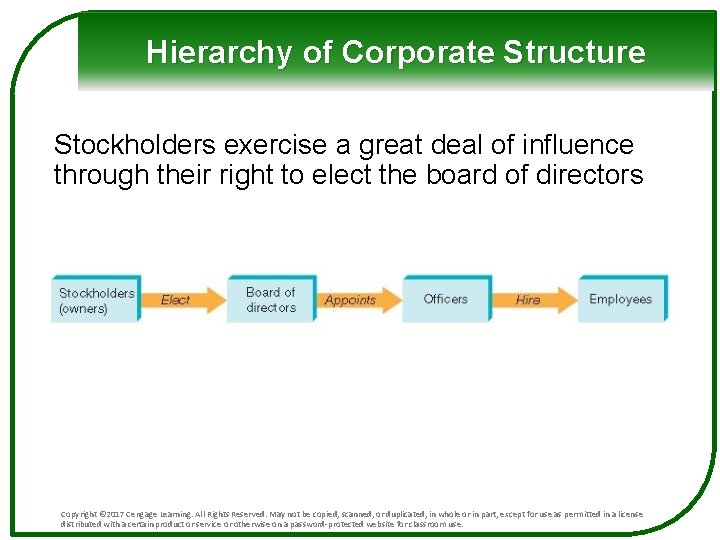
Hierarchy of Corporate Structure Stockholders exercise a great deal of influence through their right to elect the board of directors Copyright © 2017 Cengage Learning. All Rights Reserved. May not be copied, scanned, or duplicated, in whole or in part, except for use as permitted in a license distributed with a certain product or service or otherwise on a password-protected website for classroom use.
Advantages and Disadvantages of Corporations Advantages § § § Limited liability – each owner's financial liability is limited to the amount of money that he or she has paid for stock Ease of raising capital Ease of transfer of ownership Perpetual life Specialized management Disadvantages Difficulty and expense of formation § Government regulation and increased paperwork § Conflict within the corporation § Double taxation § Corporations pay a tax on their profit; stockholders who receive a dividend also have to pay a tax § Lack of secrecy Copyright © 2017 Cengage Learning. All Rights Reserved. May not be copied, scanned, or duplicated, in whole or in part, except for use as permitted in a license distributed with a certain product or service or otherwise on a password-protected website for classroom use.
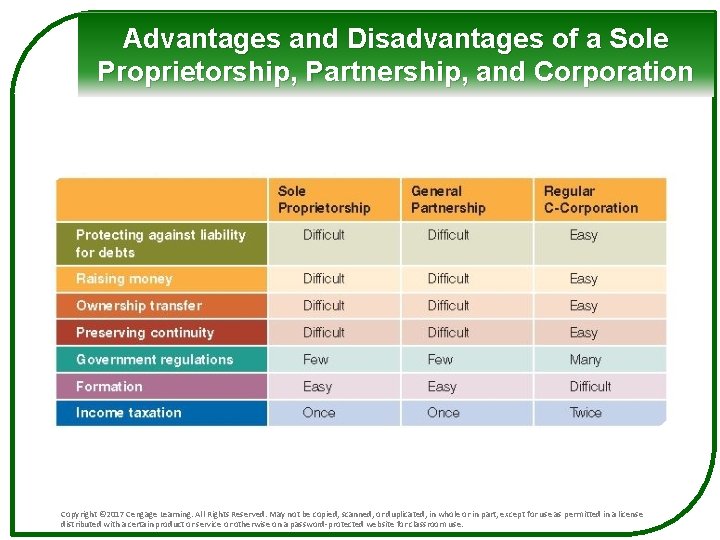
Advantages and Disadvantages of a Sole Proprietorship, Partnership, and Corporation Copyright © 2017 Cengage Learning. All Rights Reserved. May not be copied, scanned, or duplicated, in whole or in part, except for use as permitted in a license distributed with a certain product or service or otherwise on a password-protected website for classroom use.
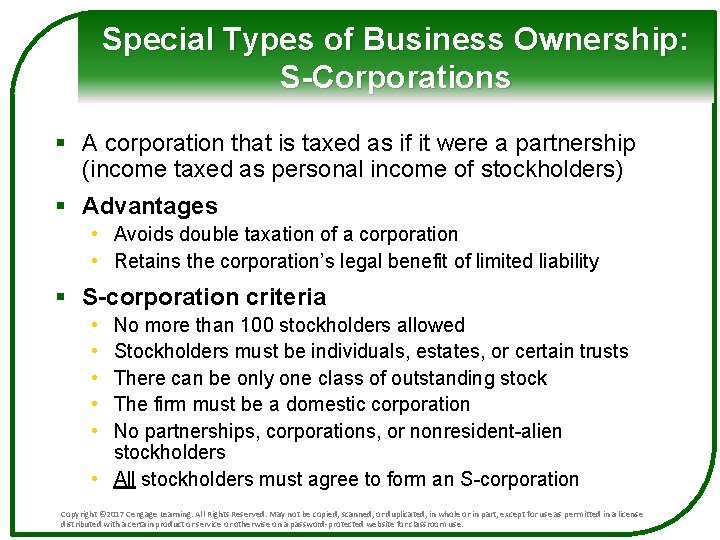
Special Types of Business Ownership: S-Corporations § A corporation that is taxed as if it were a partnership (income taxed as personal income of stockholders) § Advantages • Avoids double taxation of a corporation • Retains the corporation’s legal benefit of limited liability § S-corporation criteria • • • No more than 100 stockholders allowed Stockholders must be individuals, estates, or certain trusts There can be only one class of outstanding stock The firm must be a domestic corporation No partnerships, corporations, or nonresident-alien stockholders • All stockholders must agree to form an S-corporation Copyright © 2017 Cengage Learning. All Rights Reserved. May not be copied, scanned, or duplicated, in whole or in part, except for use as permitted in a license distributed with a certain product or service or otherwise on a password-protected website for classroom use.
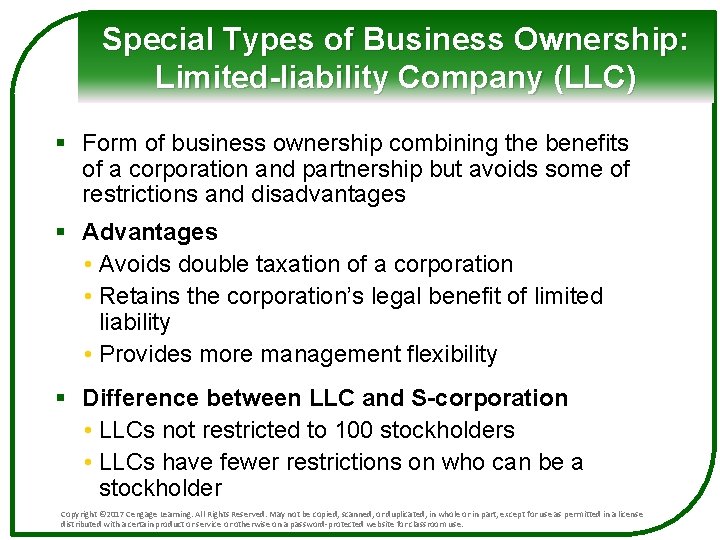
Special Types of Business Ownership: Limited-liability Company (LLC) § Form of business ownership combining the benefits of a corporation and partnership but avoids some of restrictions and disadvantages § Advantages • Avoids double taxation of a corporation • Retains the corporation’s legal benefit of limited liability • Provides more management flexibility § Difference between LLC and S-corporation • LLCs not restricted to 100 stockholders • LLCs have fewer restrictions on who can be a stockholder Copyright © 2017 Cengage Learning. All Rights Reserved. May not be copied, scanned, or duplicated, in whole or in part, except for use as permitted in a license distributed with a certain product or service or otherwise on a password-protected website for classroom use.
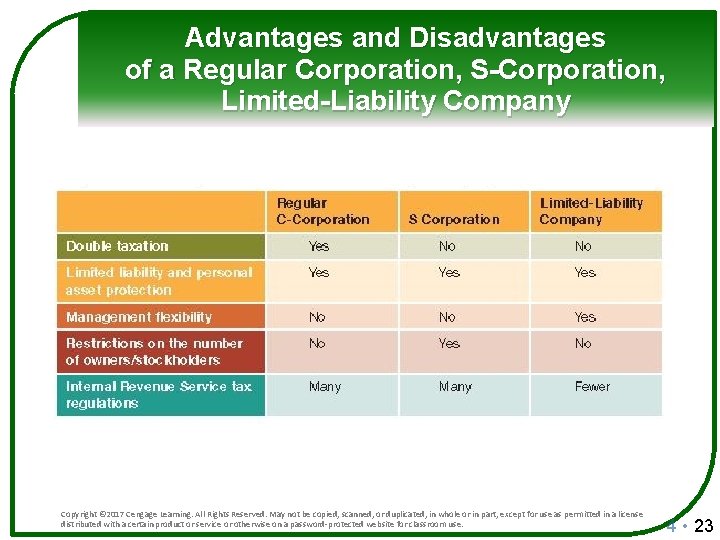
Advantages and Disadvantages of a Regular Corporation, S-Corporation, Limited-Liability Company Copyright © 2017 Cengage Learning. All Rights Reserved. May not be copied, scanned, or duplicated, in whole or in part, except for use as permitted in a license distributed with a certain product or service or otherwise on a password-protected website for classroom use. 4 • 23
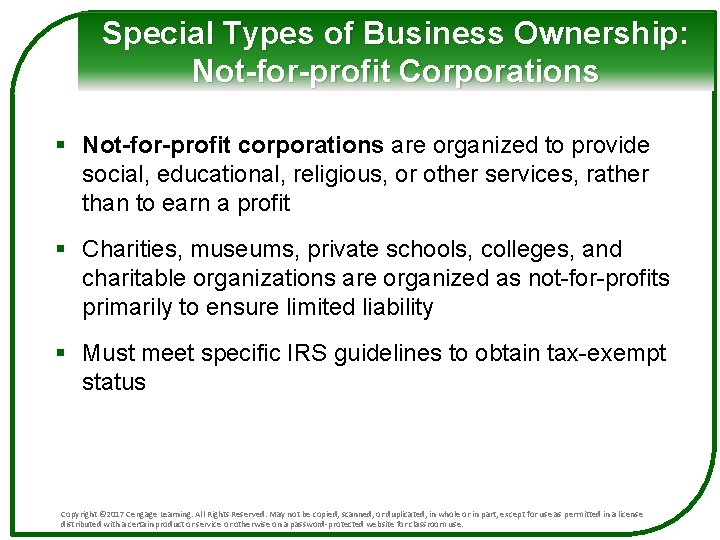
Special Types of Business Ownership: Not-for-profit Corporations § Not-for-profit corporations are organized to provide social, educational, religious, or other services, rather than to earn a profit § Charities, museums, private schools, colleges, and charitable organizations are organized as not-for-profits primarily to ensure limited liability § Must meet specific IRS guidelines to obtain tax-exempt status Copyright © 2017 Cengage Learning. All Rights Reserved. May not be copied, scanned, or duplicated, in whole or in part, except for use as permitted in a license distributed with a certain product or service or otherwise on a password-protected website for classroom use.
- Slides: 24