
4 Chapter 4 Entity Relationship ER Modeling Database
4 Chapter 4 Entity Relationship (ER) Modeling Database Systems: Design, Implementation, and Management, Sixth Edition, Rob and Coronel Database Systems: Design, Implementation, & Management, 6 th Edition, Rob & Coronel
4 In this chapter, you will learn: • How relationships between entities are defined and refined, and how such relationships are incorporated into the database design process • How ERD components affect database design and implementation • How to interpret the modeling symbols for the four most popular ER modeling tools • That real-world database design often requires that you reconcile conflicting goals Database Systems: Design, Implementation, & Management, 6 th Edition, Rob & Coronel 2
4 The Entity Relationship (ER) Model • ER model forms the basis of an ER diagram • ERD represents the conceptual database as viewed by end user • ERDs depict the ER model’s three main components: – Entities – Attributes – Relationships Database Systems: Design, Implementation, & Management, 6 th Edition, Rob & Coronel 3
4 Entities • Refers to the entity set and not to a single entity occurrence • Corresponds to a table and not to a row in the relational environment • In both the Chen and Crow’s Foot models, an entity is represented by a rectangle containing the entity’s name • Entity name, a noun, is usually written in capital letters Database Systems: Design, Implementation, & Management, 6 th Edition, Rob & Coronel 4

4 Attributes • Characteristics of entities • In Chen model, attributes are represented by ovals and are connected to the entity rectangle with a line • Each oval contains the name of the attribute it represents • In the Crow’s Foot model, the attributes are simply written in the attribute box below the entity rectangle Database Systems: Design, Implementation, & Management, 6 th Edition, Rob & Coronel 5

4 The Attributes of the STUDENT Entity Database Systems: Design, Implementation, & Management, 6 th Edition, Rob & Coronel 6

4 Domains • Attributes have a domain: – The attribute’s set of possible values • Attributes may share a domain Database Systems: Design, Implementation, & Management, 6 th Edition, Rob & Coronel 7

4 Primary Keys • Underlined in the ER diagram • Key attributes are also underlined in frequently used table structure shorthand • Ideally composed of only a single attribute • Possible to use a composite key: – Primary key composed of more than one attribute Database Systems: Design, Implementation, & Management, 6 th Edition, Rob & Coronel 8
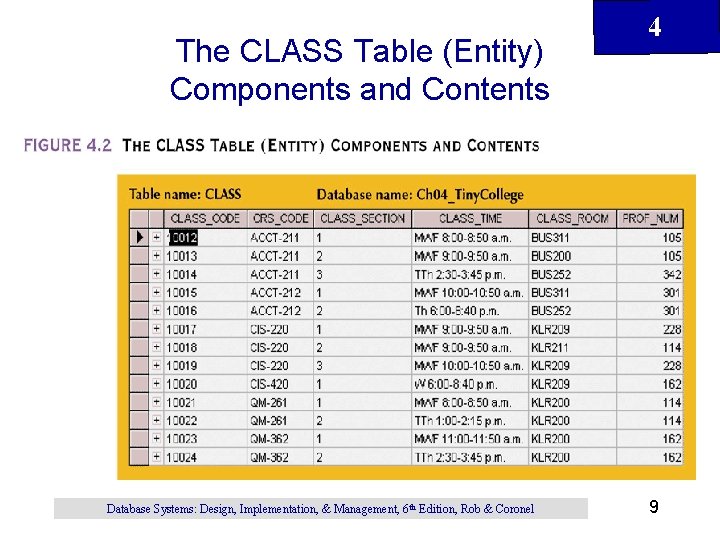
The CLASS Table (Entity) Components and Contents Database Systems: Design, Implementation, & Management, 6 th Edition, Rob & Coronel 4 9

4 Attributes • Composite attribute • Simple attribute • Single-value attribute • Multivalued attributes Database Systems: Design, Implementation, & Management, 6 th Edition, Rob & Coronel 10
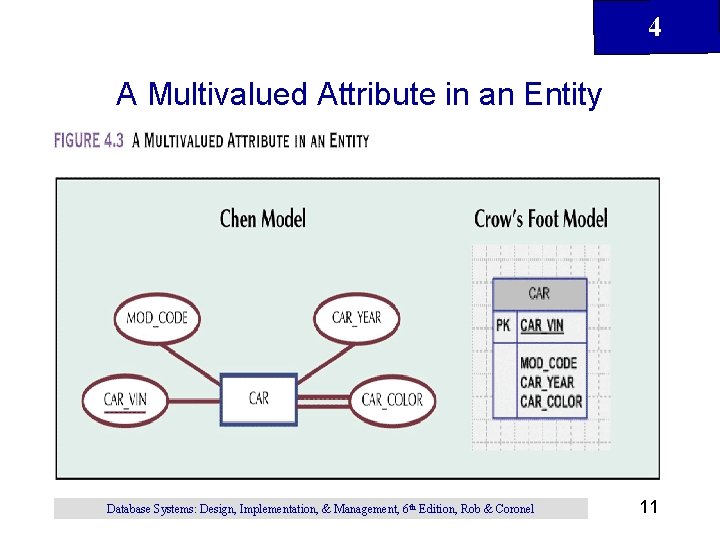
4 A Multivalued Attribute in an Entity Database Systems: Design, Implementation, & Management, 6 th Edition, Rob & Coronel 11
4 Resolving Multivalued Attribute Problems • Although the conceptual model can handle multivalued attributes, you should not implement them in the relational DBMS – Within original entity, create several new attributes, one for each of the original multivalued attribute’s components • Can lead to major structural problems in the table – Create a new entity composed of original multivalued attribute’s components Database Systems: Design, Implementation, & Management, 6 th Edition, Rob & Coronel 12
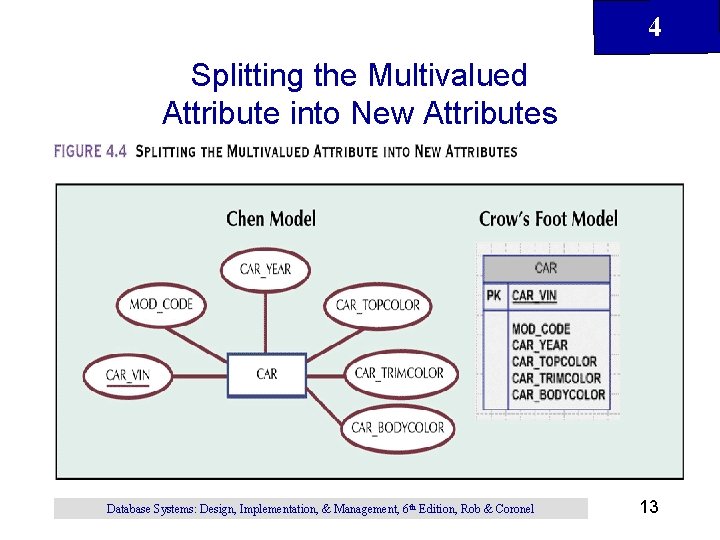
4 Splitting the Multivalued Attribute into New Attributes Database Systems: Design, Implementation, & Management, 6 th Edition, Rob & Coronel 13

4 Components of the Multivalued Attribute Database Systems: Design, Implementation, & Management, 6 th Edition, Rob & Coronel 14
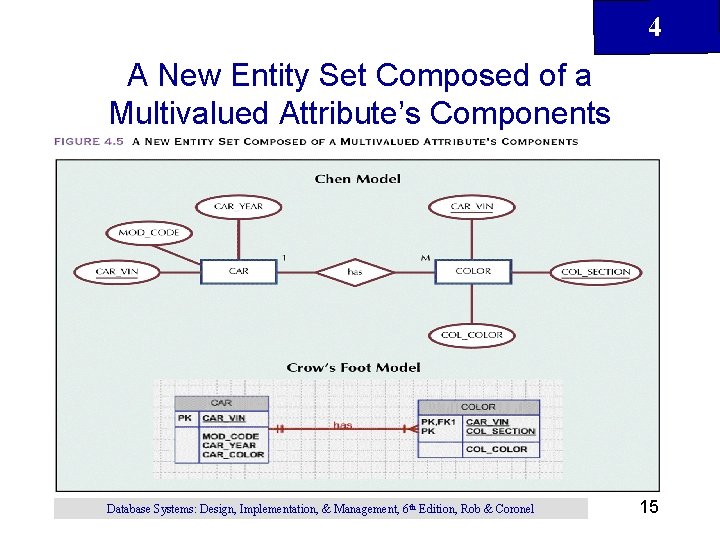
4 A New Entity Set Composed of a Multivalued Attribute’s Components Database Systems: Design, Implementation, & Management, 6 th Edition, Rob & Coronel 15

4 Derived Attributes • Attribute whose value may be calculated (derived) from other attributes • Need not be physically stored within the database • Can be derived by using an algorithm Database Systems: Design, Implementation, & Management, 6 th Edition, Rob & Coronel 16

4 Depiction of a Derived Attribute Database Systems: Design, Implementation, & Management, 6 th Edition, Rob & Coronel 17
4 Relationships • Association between entities • Participants: – Entities that participate in a relationship • Relationships between entities always operate in both directions • Relationship can be classified as 1: M • Relationship classification is difficult to establish if you only know one side Database Systems: Design, Implementation, & Management, 6 th Edition, Rob & Coronel 18

4 Connectivity and Cardinality • Connectivity – Used to describe the relationship classification • Cardinality – Expresses the specific number of entity occurrences associated with one occurrence of the related entity • Established by very concise statements known as business rules Database Systems: Design, Implementation, & Management, 6 th Edition, Rob & Coronel 19
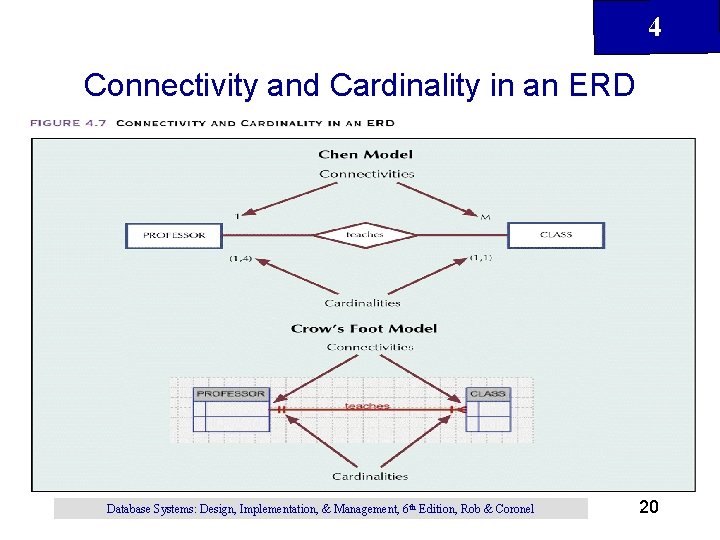
4 Connectivity and Cardinality in an ERD Database Systems: Design, Implementation, & Management, 6 th Edition, Rob & Coronel 20

4 RELATIONSHIP Strength • Existence dependence – Entity’s existence depends on the existence of one or more other entities • Existence independence – Entity can exist apart from one or more related entities • Weak (non-identifying) relationships – One entity is not existence-independent on another entity • Strong (Identifying) Relationships – Related entities are existence-dependent Database Systems: Design, Implementation, & Management, 6 th Edition, Rob & Coronel 21

4 A Weak (Non-Identifying) Relationship Between COURSE and CLASS Database Systems: Design, Implementation, & Management, 6 th Edition, Rob & Coronel 22

A Weak Relationship Between COURSE and CLASS Database Systems: Design, Implementation, & Management, 6 th Edition, Rob & Coronel 4 23

4 Relationship Participation • Optional: – One entity occurrence does not require a corresponding entity occurrence in a particular relationship • Mandatory: – One entity occurrence requires a corresponding entity occurrence in a particular relationship Database Systems: Design, Implementation, & Management, 6 th Edition, Rob & Coronel 24

4 A Strong (Identifying) Relationship Between COURSE and CLASS Database Systems: Design, Implementation, & Management, 6 th Edition, Rob & Coronel 25
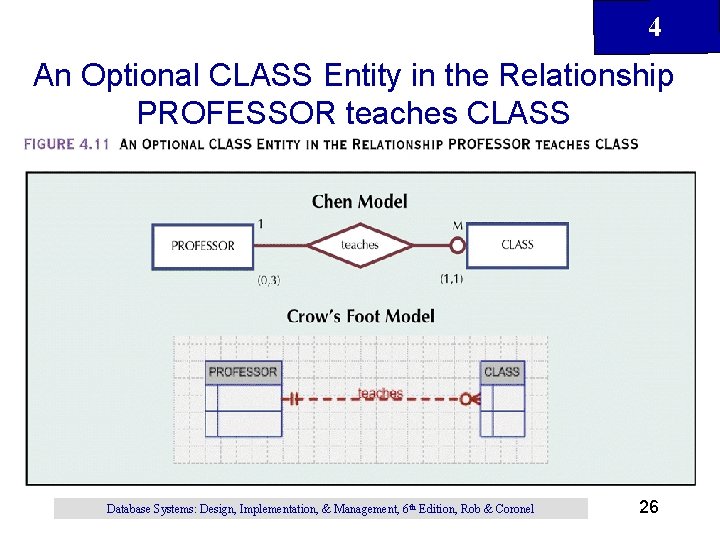
4 An Optional CLASS Entity in the Relationship PROFESSOR teaches CLASS Database Systems: Design, Implementation, & Management, 6 th Edition, Rob & Coronel 26
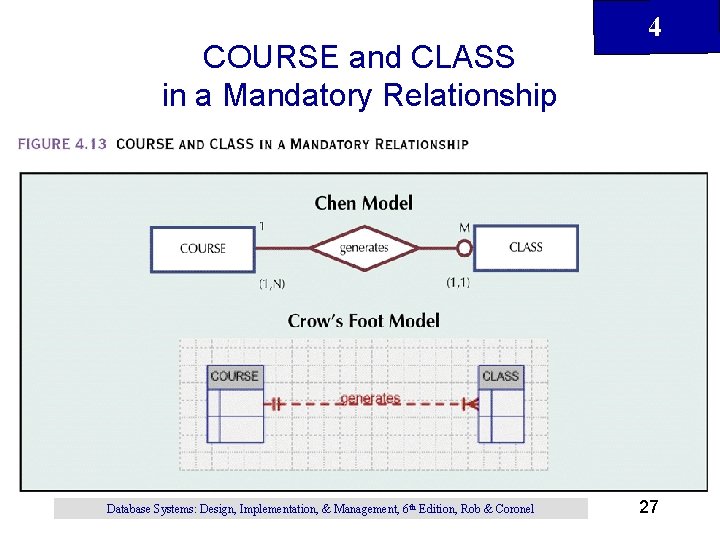
COURSE and CLASS in a Mandatory Relationship Database Systems: Design, Implementation, & Management, 6 th Edition, Rob & Coronel 4 27
4 Relationship Strength and Weak Entities • Weak entity meets two conditions – Existence-dependent: • Cannot exist without entity with which it has a relationship – Has primary key that is partially or totally derived from the parent entity in the relationship • Database designer usually determines whether an entity can be described as weak based on the business rules Database Systems: Design, Implementation, & Management, 6 th Edition, Rob & Coronel 28

4 A Weak Entity in an ERD Database Systems: Design, Implementation, & Management, 6 th Edition, Rob & Coronel 29

4 A Weak Entity in a Strong Relationship Database Systems: Design, Implementation, & Management, 6 th Edition, Rob & Coronel 30

4 Relationship Degree • Indicates number of associated entities or participants • Unary relationship – Association is maintained within a single entity • Binary relationship – Two entities are associated • Ternary relationship – Three entities are associated Database Systems: Design, Implementation, & Management, 6 th Edition, Rob & Coronel 31

Three Types of Relationships Database Systems: Design, Implementation, & Management, 6 th Edition, Rob & Coronel 4 32

The Implementation of a Ternary Relationship Database Systems: Design, Implementation, & Management, 6 th Edition, Rob & Coronel 4 33

4 Recursive Relationships • Relationship can exist between occurrences of the same entity set • Naturally found within a unary relationship Database Systems: Design, Implementation, & Management, 6 th Edition, Rob & Coronel 34

An ER Representation of Recursive Relationships Database Systems: Design, Implementation, & Management, 6 th Edition, Rob & Coronel 4 35

4 The 1: 1 Recursive Relationship “EMPLOYEE is Married to EMPLOYEE” Database Systems: Design, Implementation, & Management, 6 th Edition, Rob & Coronel 36
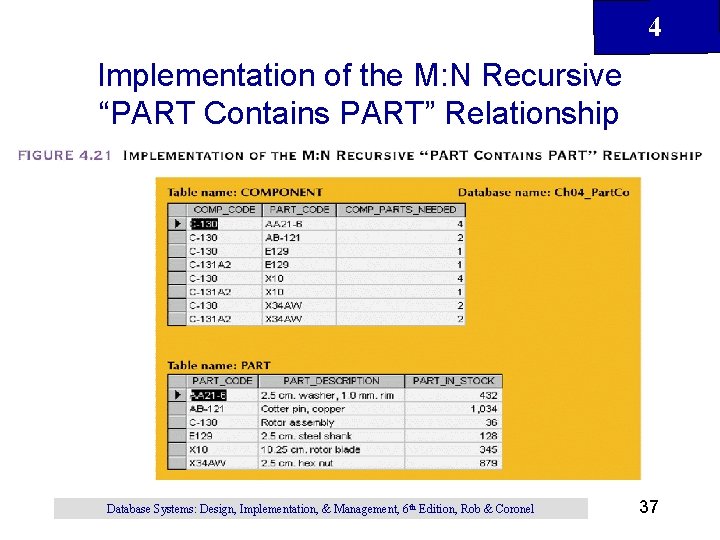
4 Implementation of the M: N Recursive “PART Contains PART” Relationship Database Systems: Design, Implementation, & Management, 6 th Edition, Rob & Coronel 37

4 Implementation of the 1: M “EMPLOYEE Manages EMPLOYEE” Recursive Relationship Database Systems: Design, Implementation, & Management, 6 th Edition, Rob & Coronel 38
4 Composite Entities • Also known as bridge entities • Composed of the primary keys of each of the entities to be connected • May also contain additional attributes that play no role in the connective process Database Systems: Design, Implementation, & Management, 6 th Edition, Rob & Coronel 39

4 Converting the M: N Relationship into Two 1: M Relationships Database Systems: Design, Implementation, & Management, 6 th Edition, Rob & Coronel 40
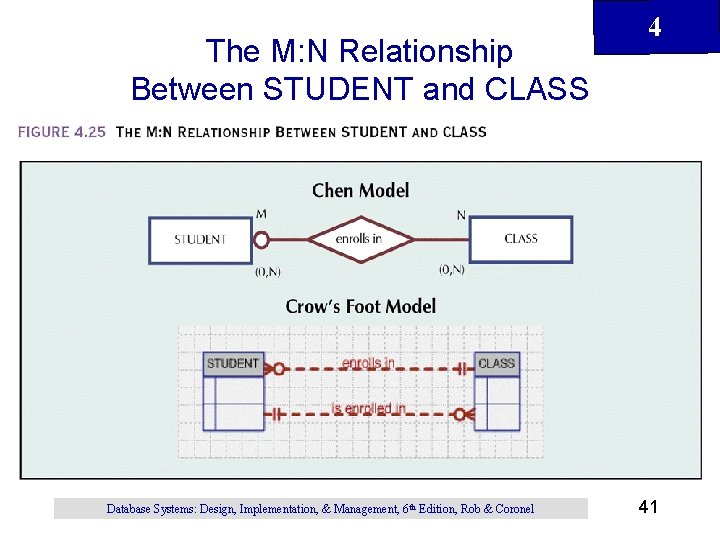
The M: N Relationship Between STUDENT and CLASS Database Systems: Design, Implementation, & Management, 6 th Edition, Rob & Coronel 4 41
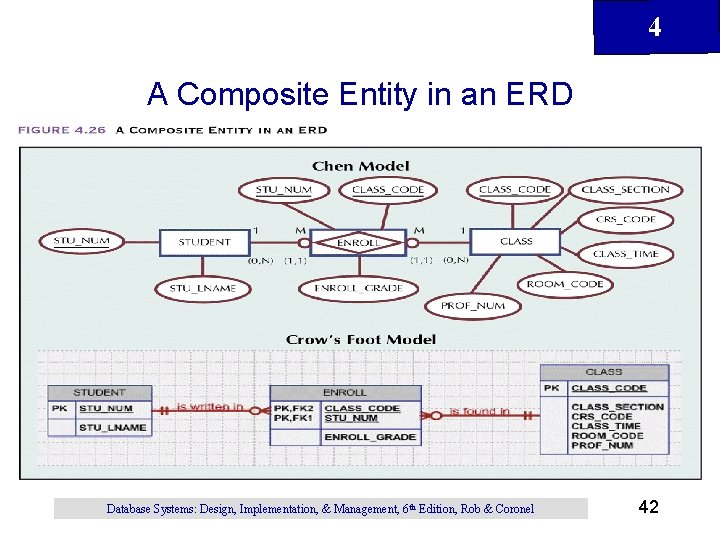
4 A Composite Entity in an ERD Database Systems: Design, Implementation, & Management, 6 th Edition, Rob & Coronel 42

4 Entity Supertypes and Subtypes • Generalization hierarchy – Depicts a relationship between a higher-level supertype entity and a lower-level subtype entity • Supertype entity – Contains shared attributes • Subtype entity – Contains unique attributes Database Systems: Design, Implementation, & Management, 6 th Edition, Rob & Coronel 43

4 Nulls Created by Unique Attributes Database Systems: Design, Implementation, & Management, 6 th Edition, Rob & Coronel 44

4 A Generalization Hierarchy Database Systems: Design, Implementation, & Management, 6 th Edition, Rob & Coronel 45

4 Disjoint Subtypes • Also known as non-overlapping subtypes – Subtypes that contain a subset of the supertype entity set – Each entity instance (row) of the supertype can appear in only one of the disjoint subtypes • Supertype and its subtype(s) maintain a 1: 1 relationship Database Systems: Design, Implementation, & Management, 6 th Edition, Rob & Coronel 46

The EMPLOYEE/PILOT Supertype/Subtype Relationship Database Systems: Design, Implementation, & Management, 6 th Edition, Rob & Coronel 4 47

A Generalization Hierarchy with Overlapping Subtypes Database Systems: Design, Implementation, & Management, 6 th Edition, Rob & Coronel 4 48
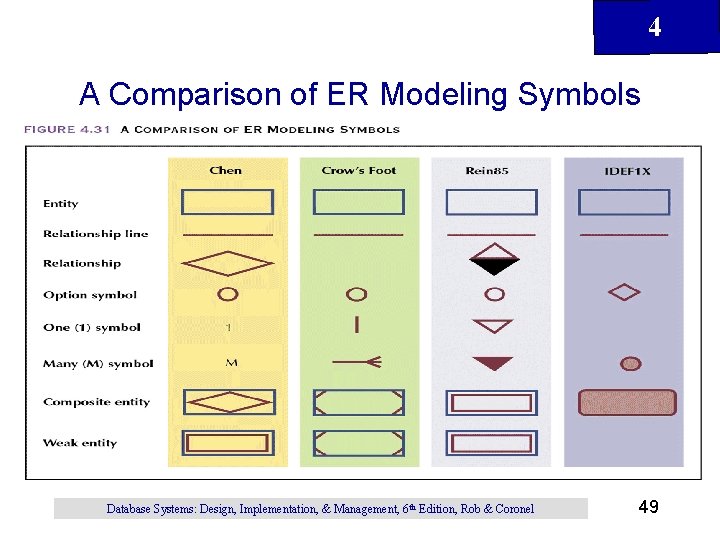
4 A Comparison of ER Modeling Symbols Database Systems: Design, Implementation, & Management, 6 th Edition, Rob & Coronel 49
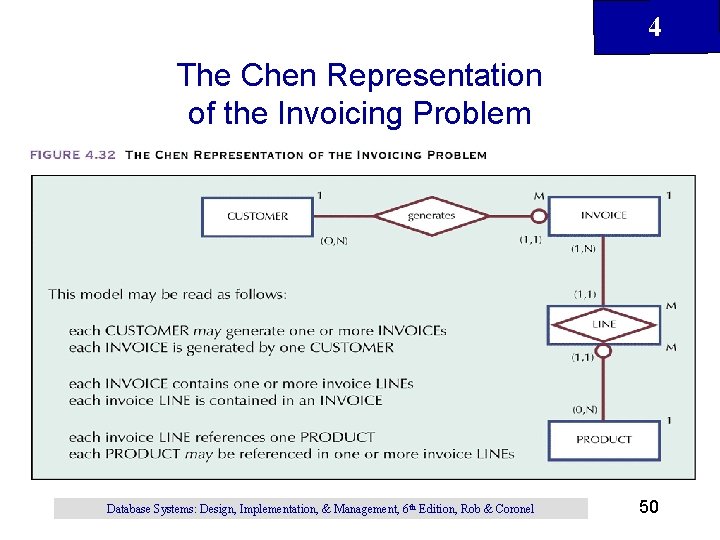
4 The Chen Representation of the Invoicing Problem Database Systems: Design, Implementation, & Management, 6 th Edition, Rob & Coronel 50
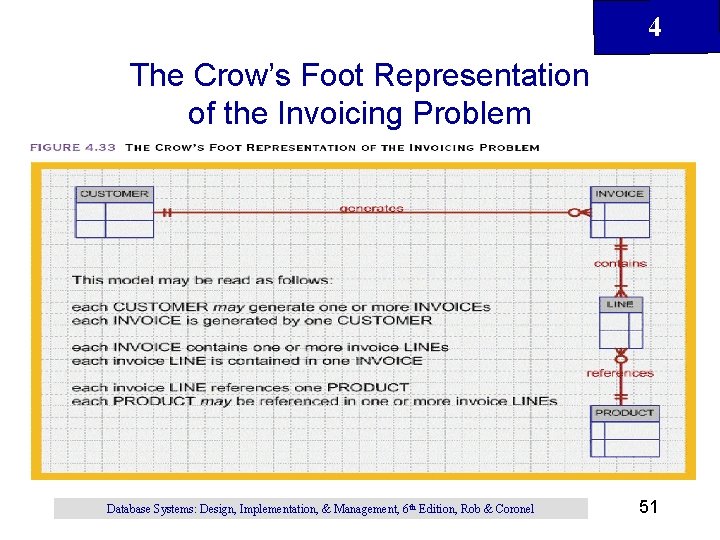
4 The Crow’s Foot Representation of the Invoicing Problem Database Systems: Design, Implementation, & Management, 6 th Edition, Rob & Coronel 51

The Rein 85 Representation of the Invoicing Problem Database Systems: Design, Implementation, & Management, 6 th Edition, Rob & Coronel 4 52
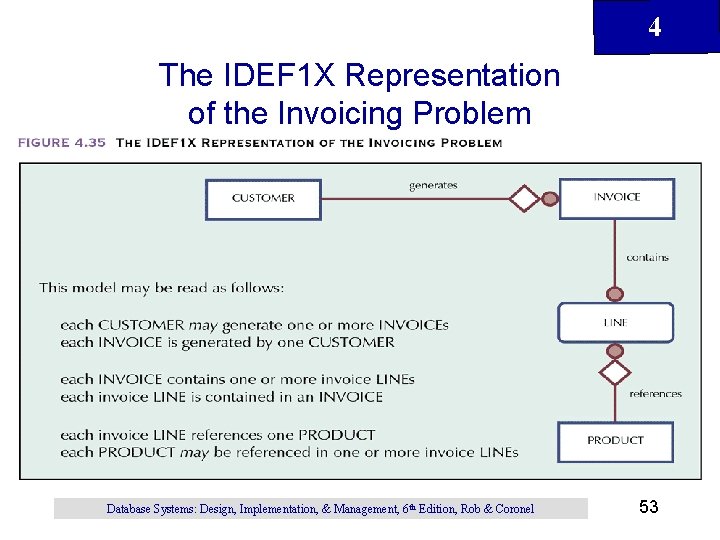
4 The IDEF 1 X Representation of the Invoicing Problem Database Systems: Design, Implementation, & Management, 6 th Edition, Rob & Coronel 53
4 Developing an ER Diagram • Database design is an iterative rather than a linear or sequential process • Iterative process – Based on repetition of processes and procedures Database Systems: Design, Implementation, & Management, 6 th Edition, Rob & Coronel 54

4 A Supertype/Subtype Relationship Database Systems: Design, Implementation, & Management, 6 th Edition, Rob & Coronel 55
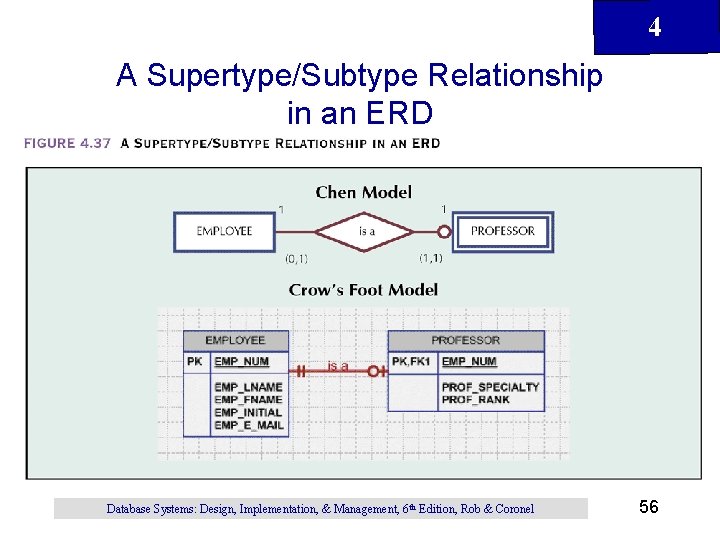
4 A Supertype/Subtype Relationship in an ERD Database Systems: Design, Implementation, & Management, 6 th Edition, Rob & Coronel 56
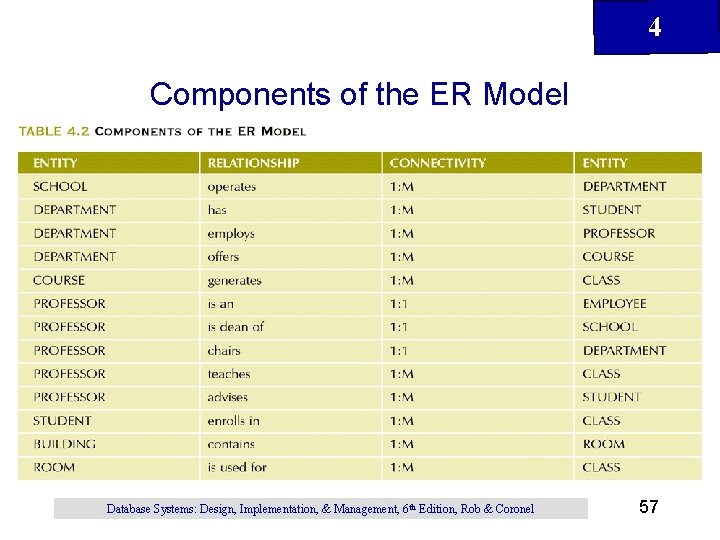
4 Components of the ER Model Database Systems: Design, Implementation, & Management, 6 th Edition, Rob & Coronel 57
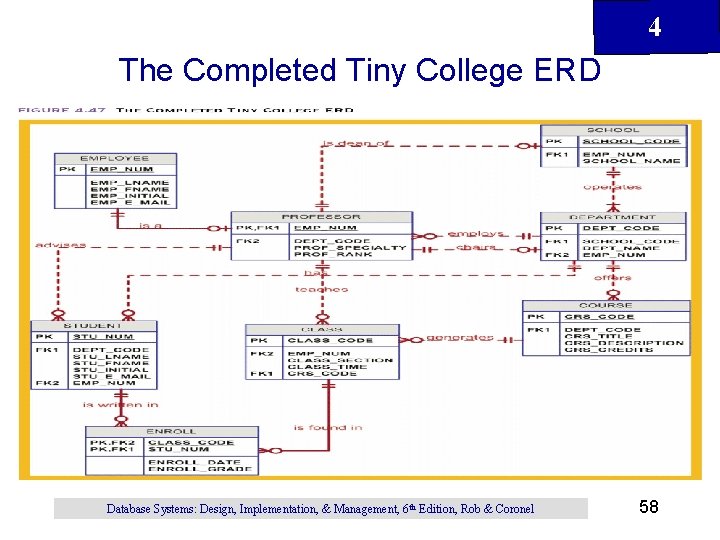
4 The Completed Tiny College ERD Database Systems: Design, Implementation, & Management, 6 th Edition, Rob & Coronel 58

4 The Challenge of Database Design: Conflicting Goals • Database design must conform to design standards • High processing speeds are often a top priority in database design • Quest for timely information might be the focus of database design Database Systems: Design, Implementation, & Management, 6 th Edition, Rob & Coronel 59
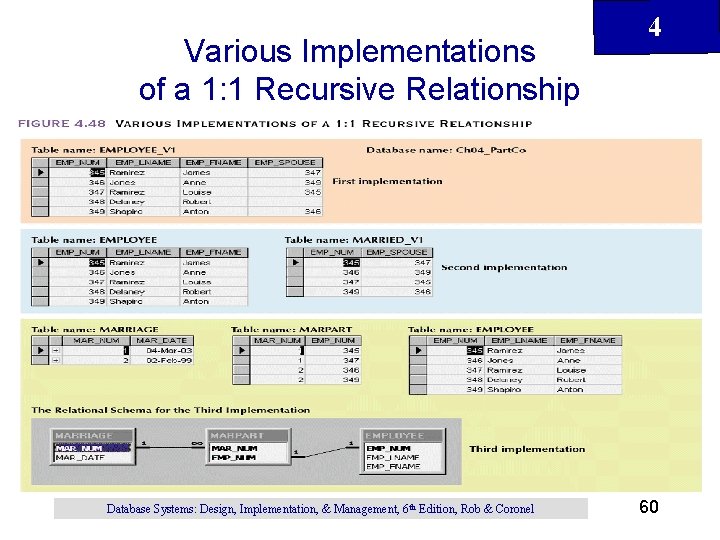
Various Implementations of a 1: 1 Recursive Relationship Database Systems: Design, Implementation, & Management, 6 th Edition, Rob & Coronel 4 60
4 Summary • Entity relationship (ER) model – Uses ER diagrams to represent conceptual database as viewed by the end user – Three main components • Entities • Relationships • Attributes – Includes connectivity and cardinality notations • Connectivities and cardinalities are based on business rules Database Systems: Design, Implementation, & Management, 6 th Edition, Rob & Coronel 61
4 Summary (continued) • ER symbols are used to graphically depict the ER model’s components and relationships • ERDs may be based on many different ER models • Entities can also be classified as supertypes and subtypes within a generalization hierarchy • Database designers are often forced to make design compromises Database Systems: Design, Implementation, & Management, 6 th Edition, Rob & Coronel 62
- Slides: 62