
4 Business Communication Process and Product 8 e
4 Business Communication: Process and Product, 8 e Mary Ellen Guffey and Dana Loewy Instructor Power. Point Library, 8 e Ch. 4, Slide 1 © 2015 Cengage Learning. All Rights Reserved. May not be scanned, copied or duplicated, or posted to a publicly accessible website, in whole or in part. Planning Business Messages
Understand the nature of communication and its barriers in the digital age. Communication: the transmission of information and meaning from one individual or group to another Ch. 4, Slide 2 © 2015 Cengage Learning. All Rights Reserved. May not be scanned, copied or duplicated, or posted to a publicly accessible website, in whole or in part. © Melisende. Vector. com/Fotolia Learning Objective 1

Sender has idea Feedback returns to sender Receiver decodes message Sender encodes idea Sender selects channel and transmits message Ch. 4, Slide 3 © 2015 Cengage Learning. All Rights Reserved. May not be scanned, copied or duplicated, or posted to a publicly accessible website, in whole or in part. © yuuen/Fotolia The Communication Process
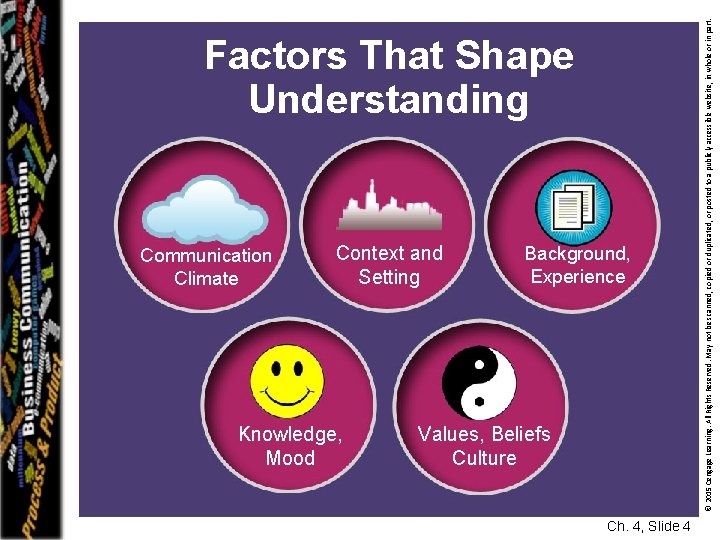
Communication Climate Context and Setting Knowledge, Mood Background, Experience Values, Beliefs Culture Ch. 4, Slide 4 © 2015 Cengage Learning. All Rights Reserved. May not be scanned, copied or duplicated, or posted to a publicly accessible website, in whole or in part. Factors That Shape Understanding
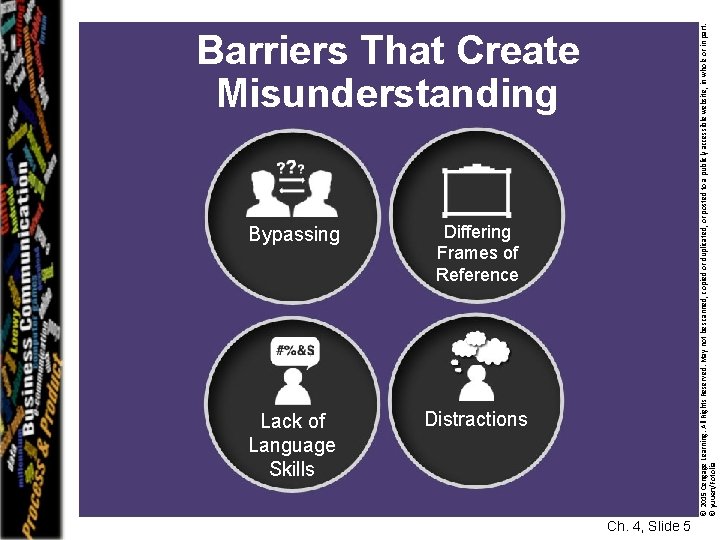
Bypassing Differing Frames of Reference Lack of Language Skills Distractions © 2015 Cengage Learning. All Rights Reserved. May not be scanned, copied or duplicated, or posted to a publicly accessible website, in whole or in part. © yuuen/Fotolia Barriers That Create Misunderstanding Ch. 4, Slide 5
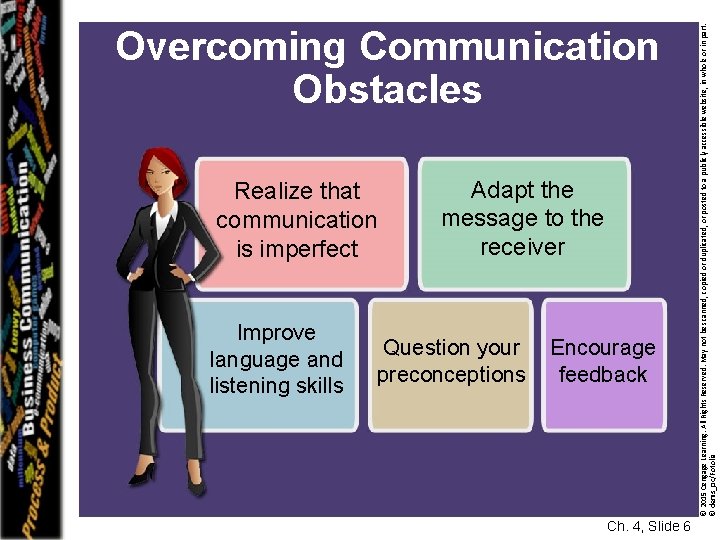
Realize that communication is imperfect Improve language and listening skills Adapt the message to the receiver Question your preconceptions Encourage feedback Ch. 4, Slide 6 © 2015 Cengage Learning. All Rights Reserved. May not be scanned, copied or duplicated, or posted to a publicly accessible website, in whole or in part. © denis_pc/Fotolia Overcoming Communication Obstacles
Summarize the 3 -x-3 writing process and explain how it guides a writer. A digital message is one that is generated, stored, processed, and transmitted electronically by computers using strings of positive and nonpositive binary code (0 s and 1 s). Ch. 4, Slide 7 © 2015 Cengage Learning. All Rights Reserved. May not be scanned, copied or duplicated, or posted to a publicly accessible website, in whole or in part. Learning Objective 2
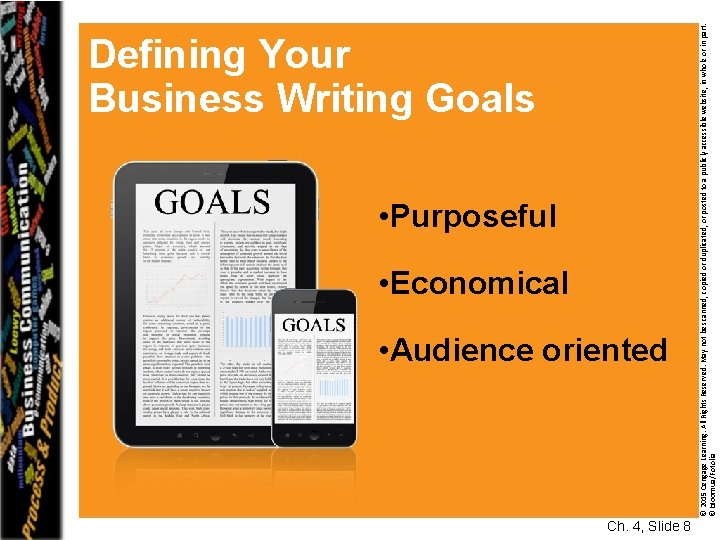
• Purposeful • Economical • Audience oriented Ch. 4, Slide 8 © 2015 Cengage Learning. All Rights Reserved. May not be scanned, copied or duplicated, or posted to a publicly accessible website, in whole or in part. © bloomua/Fotolia Defining Your Business Writing Goals
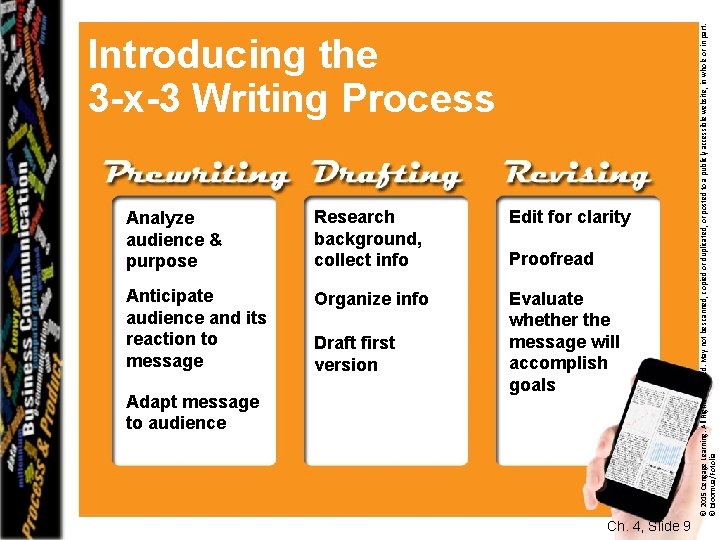
Analyze audience & purpose Research background, collect info Edit for clarity Anticipate audience and its reaction to message Organize info Evaluate whether the message will accomplish goals Adapt message to audience Draft first version Proofread Ch. 4, Slide 9 © 2015 Cengage Learning. All Rights Reserved. May not be scanned, copied or duplicated, or posted to a publicly accessible website, in whole or in part. © bloomua/Fotolia Introducing the 3 -x-3 Writing Process
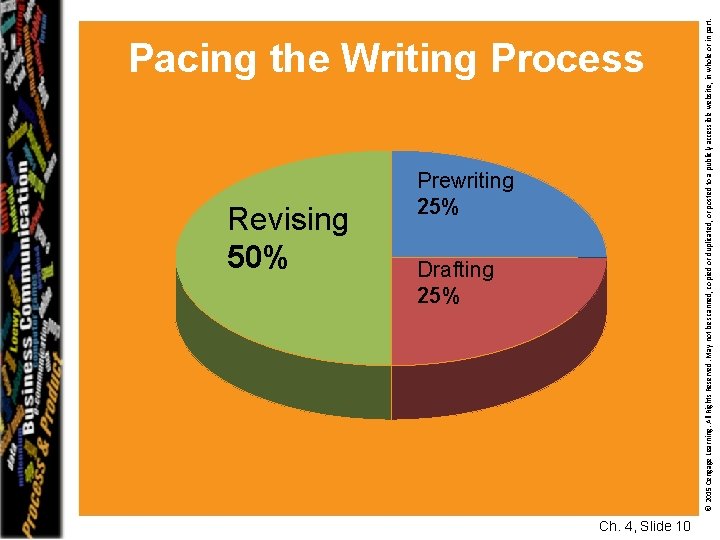
Revising 50% Prewriting 25% Drafting 25% Ch. 4, Slide 10 © 2015 Cengage Learning. All Rights Reserved. May not be scanned, copied or duplicated, or posted to a publicly accessible website, in whole or in part. Pacing the Writing Process
Analyze the purpose of a message, anticipate its audience, and select the best communication channel. Why are you sending the message? What do you hope to achieve? Primary Purpose: To inform and to persuade Secondary Purpose: To promote goodwill Ch. 4, Slide 11 © 2015 Cengage Learning. All Rights Reserved. May not be scanned, copied or duplicated, or posted to a publicly accessible website, in whole or in part. Learning Objective 3
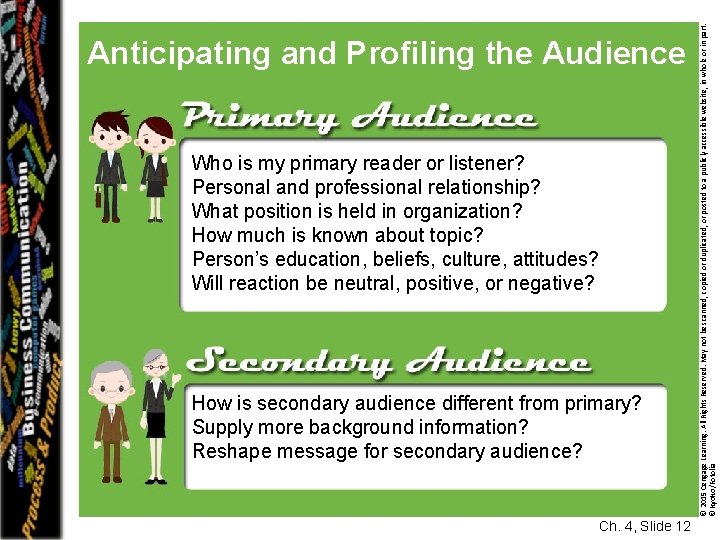
Who is my primary reader or listener? Personal and professional relationship? What position is held in organization? How much is known about topic? Person’s education, beliefs, culture, attitudes? Will reaction be neutral, positive, or negative? How is secondary audience different from primary? Supply more background information? Reshape message for secondary audience? Ch. 4, Slide 12 © 2015 Cengage Learning. All Rights Reserved. May not be scanned, copied or duplicated, or posted to a publicly accessible website, in whole or in part. © kyoko/Fotolia Anticipating and Profiling the Audience
WIIFM (What’s in it for me? ) Ch. 4, Slide 13 © 2015 Cengage Learning. All Rights Reserved. May not be scanned, copied or duplicated, or posted to a publicly accessible website, in whole or in part. Remember that receivers will be thinking…
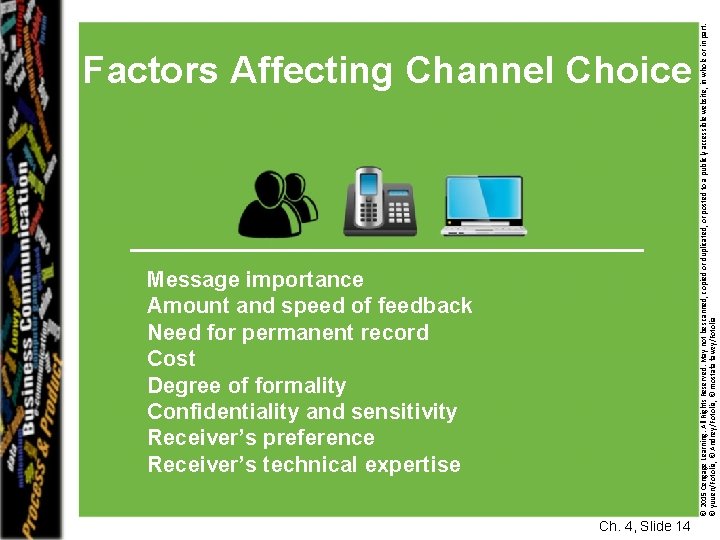
Message importance Amount and speed of feedback Need for permanent record Cost Degree of formality Confidentiality and sensitivity Receiver’s preference Receiver’s technical expertise Ch. 4, Slide 14 © 2015 Cengage Learning. All Rights Reserved. May not be scanned, copied or duplicated, or posted to a publicly accessible website, in whole or in part. © yuuen/Fotolia, © Andrey/Fotolia, © mostafa fawzy/Fotolia Factors Affecting Channel Choice
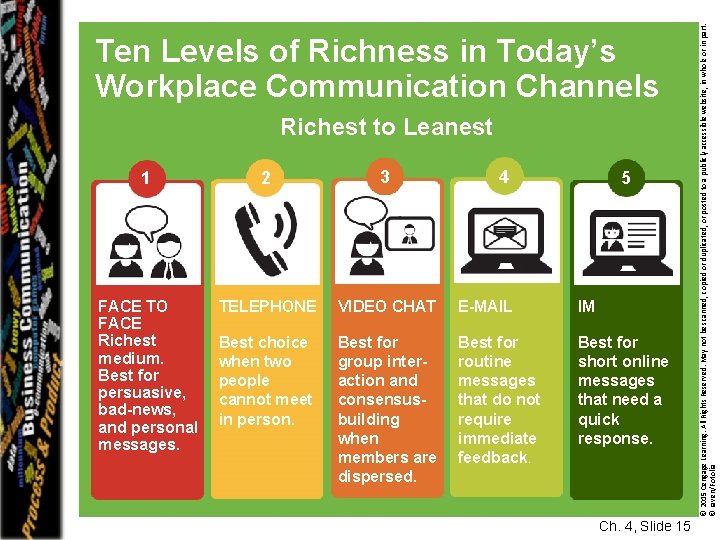
Richest to Leanest 4 1 2 3 FACE TO FACE Richest medium. Best for persuasive, bad-news, and personal messages. TELEPHONE VIDEO CHAT E-MAIL IM Best choice when two people cannot meet in person. Best for group interaction and consensusbuilding when members are dispersed. Best for routine messages that do not require immediate feedback. Best for short online messages that need a quick response. 5 Ch. 4, Slide 15 © 2015 Cengage Learning. All Rights Reserved. May not be scanned, copied or duplicated, or posted to a publicly accessible website, in whole or in part. © raven/Fotolia Ten Levels of Richness in Today’s Workplace Communication Channels
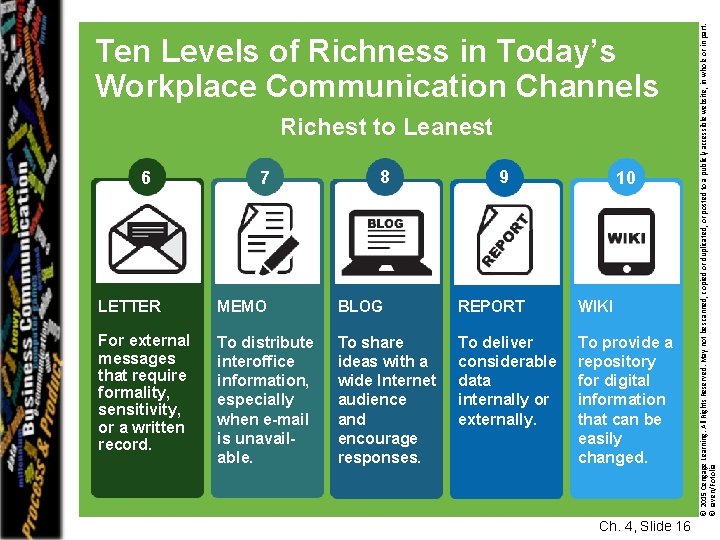
Richest to Leanest 6 7 8 9 10 LETTER MEMO BLOG REPORT WIKI For external messages that require formality, sensitivity, or a written record. To distribute interoffice information, especially when e-mail is unavailable. To share ideas with a wide Internet audience and encourage responses. To deliver considerable data internally or externally. To provide a repository for digital information that can be easily changed. Ch. 4, Slide 16 © 2015 Cengage Learning. All Rights Reserved. May not be scanned, copied or duplicated, or posted to a publicly accessible website, in whole or in part. © raven/Fotolia Ten Levels of Richness in Today’s Workplace Communication Channels
Employ expert writing techniques to adapt to your audience. © 2015 Cengage Learning. All Rights Reserved. May not be scanned, copied or duplicated, or posted to a publicly accessible website, in whole or in part. Learning Objective 4 Ch. 4, Slide 17
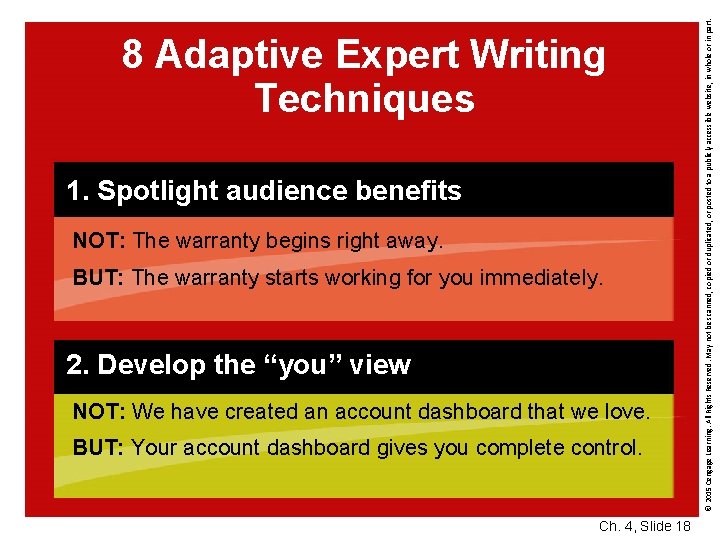
1. Spotlight audience benefits NOT: The warranty begins right away. BUT: The warranty starts working for you immediately. 2. Develop the “you” view NOT: We have created an account dashboard that we love. BUT: Your account dashboard gives you complete control. Ch. 4, Slide 18 © 2015 Cengage Learning. All Rights Reserved. May not be scanned, copied or duplicated, or posted to a publicly accessible website, in whole or in part. 8 Adaptive Expert Writing Techniques
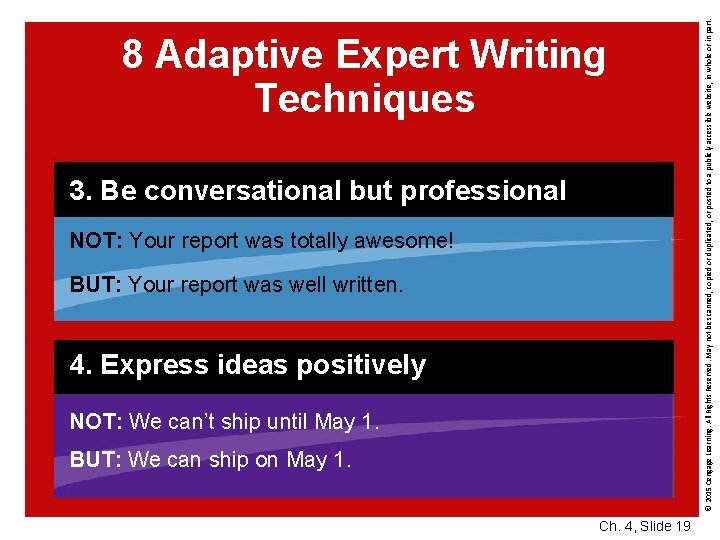
3. Be conversational but professional NOT: Your report was totally awesome! BUT: Your report was well written. 4. Express ideas positively NOT: We can’t ship until May 1. BUT: We can ship on May 1. Ch. 4, Slide 19 © 2015 Cengage Learning. All Rights Reserved. May not be scanned, copied or duplicated, or posted to a publicly accessible website, in whole or in part. 8 Adaptive Expert Writing Techniques
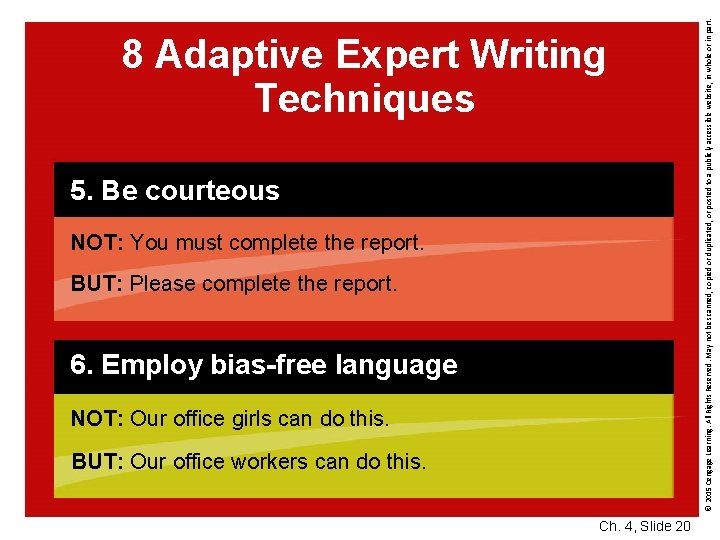
5. Be courteous NOT: You must complete the report. BUT: Please complete the report. 6. Employ bias-free language NOT: Our office girls can do this. BUT: Our office workers can do this. Ch. 4, Slide 20 © 2015 Cengage Learning. All Rights Reserved. May not be scanned, copied or duplicated, or posted to a publicly accessible website, in whole or in part. 8 Adaptive Expert Writing Techniques
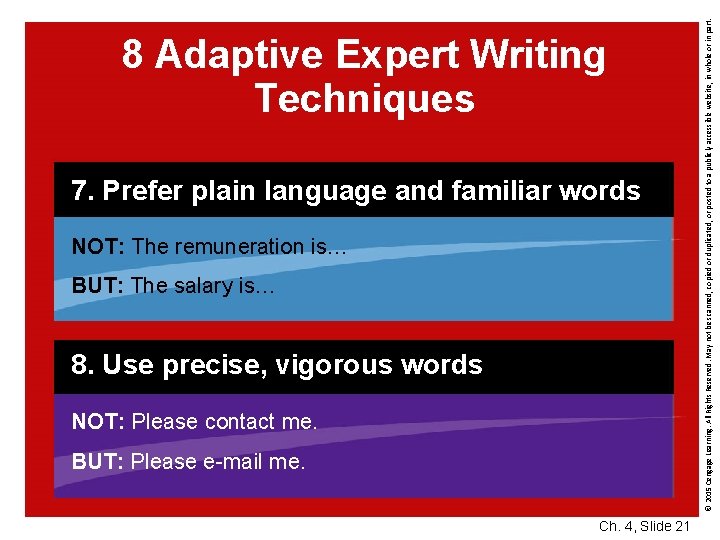
7. Prefer plain language and familiar words NOT: The remuneration is… BUT: The salary is… 8. Use precise, vigorous words NOT: Please contact me. BUT: Please e-mail me. Ch. 4, Slide 21 © 2015 Cengage Learning. All Rights Reserved. May not be scanned, copied or duplicated, or posted to a publicly accessible website, in whole or in part. 8 Adaptive Expert Writing Techniques
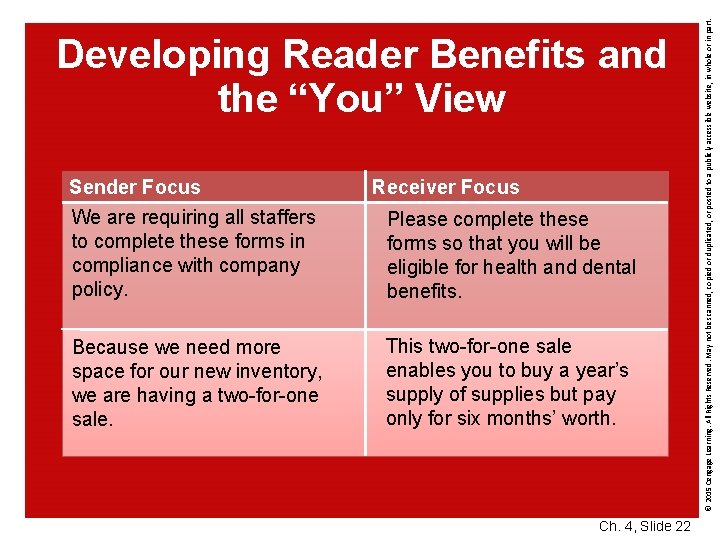
Sender Focus Receiver Focus We are requiring all staffers to complete these forms in compliance with company policy. Please complete these forms so that you will be eligible for health and dental benefits. Because we need more space for our new inventory, we are having a two-for-one sale. This two-for-one sale enables you to buy a year’s supply of supplies but pay only for six months’ worth. Ch. 4, Slide 22 © 2015 Cengage Learning. All Rights Reserved. May not be scanned, copied or duplicated, or posted to a publicly accessible website, in whole or in part. Developing Reader Benefits and the “You” View
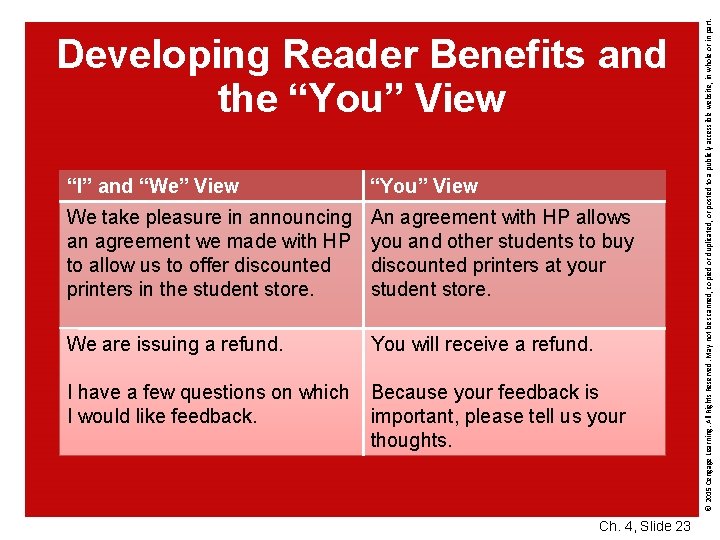
“I” and “We” View “You” View We take pleasure in announcing an agreement we made with HP to allow us to offer discounted printers in the student store. An agreement with HP allows you and other students to buy discounted printers at your student store. We are issuing a refund. You will receive a refund. I have a few questions on which I would like feedback. Because your feedback is important, please tell us your thoughts. Ch. 4, Slide 23 © 2015 Cengage Learning. All Rights Reserved. May not be scanned, copied or duplicated, or posted to a publicly accessible website, in whole or in part. Developing Reader Benefits and the “You” View
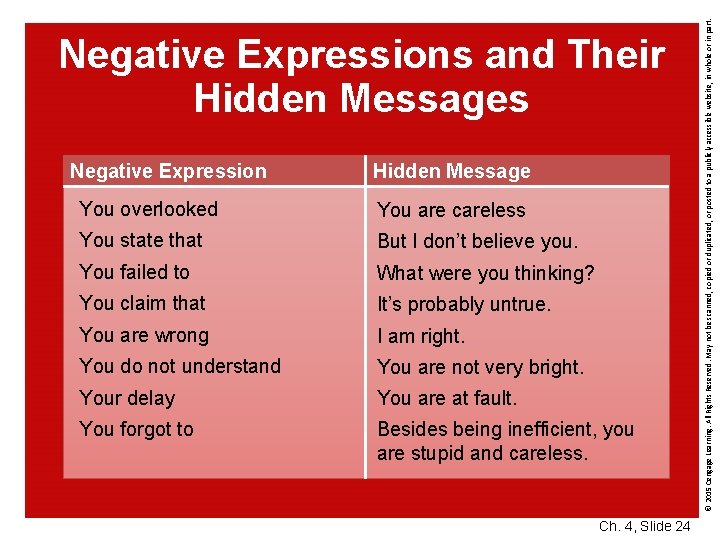
Negative Expression Hidden Message You overlooked You are careless You state that But I don’t believe you. You failed to What were you thinking? You claim that It’s probably untrue. You are wrong I am right. You do not understand You are not very bright. Your delay You are at fault. You forgot to Besides being inefficient, you are stupid and careless. Ch. 4, Slide 24 © 2015 Cengage Learning. All Rights Reserved. May not be scanned, copied or duplicated, or posted to a publicly accessible website, in whole or in part. Negative Expressions and Their Hidden Messages
Understand how teams approach collaborative writing projects and what collaboration tools support team writing. Ch. 4, Slide 25 © 2015 Cengage Learning. All Rights Reserved. May not be scanned, copied or duplicated, or posted to a publicly accessible website, in whole or in part. Learning Objective 5
q When projects are larger than one person can handle q When projects have short deadlines q When projects require the expertise or consensus of many people Ch. 4, Slide 26 © 2015 Cengage Learning. All Rights Reserved. May not be scanned, copied or duplicated, or posted to a publicly accessible website, in whole or in part. When is team writing necessary?
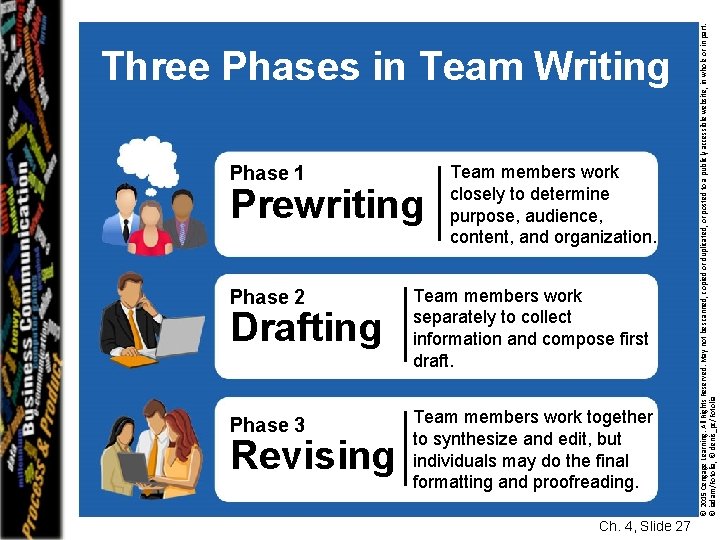
Phase 1 Prewriting Team members work closely to determine purpose, audience, content, and organization. Phase 2 Team members work separately to collect information and compose first draft. Phase 3 Team members work together to synthesize and edit, but individuals may do the final formatting and proofreading. Drafting Revising Ch. 4, Slide 27 © 2015 Cengage Learning. All Rights Reserved. May not be scanned, copied or duplicated, or posted to a publicly accessible website, in whole or in part. © iadam/Fotolia, © denis_pc/Fotolia Three Phases in Team Writing
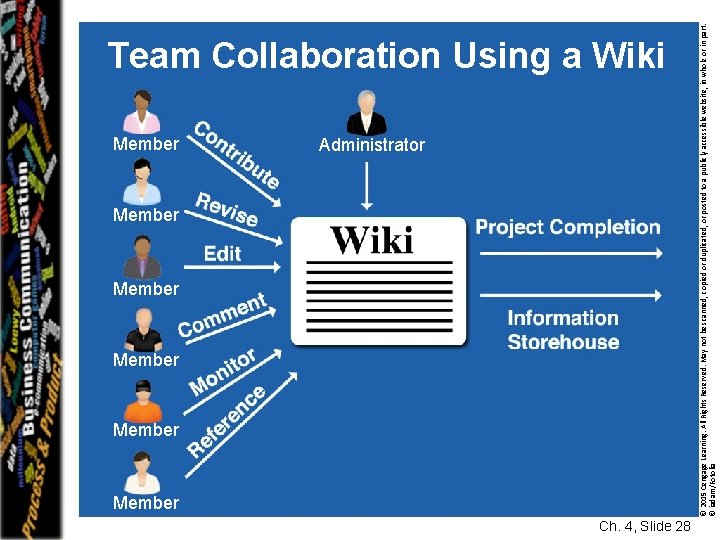
Member Administrator Member Member Ch. 4, Slide 28 © 2015 Cengage Learning. All Rights Reserved. May not be scanned, copied or duplicated, or posted to a publicly accessible website, in whole or in part. © iadam/Fotolia Team Collaboration Using a Wiki
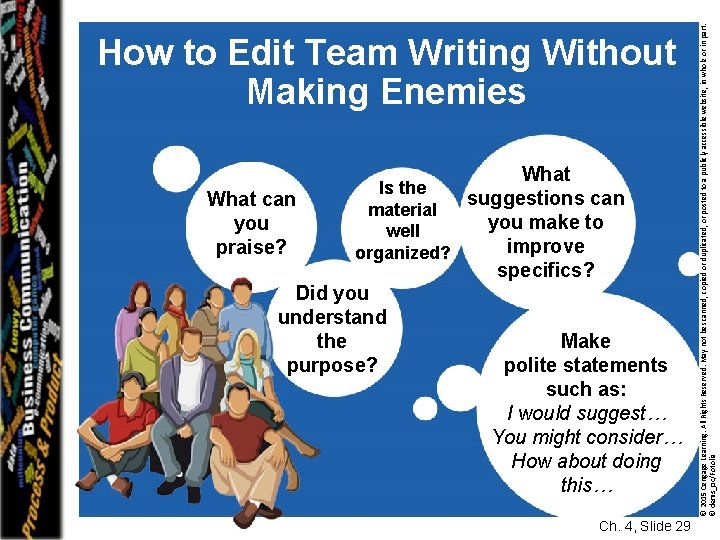
What can you praise? Is the suggestions can material you make to well improve organized? specifics? Did you understand the purpose? Make polite statements such as: I would suggest… You might consider… How about doing this… Ch. 4, Slide 29 © 2015 Cengage Learning. All Rights Reserved. May not be scanned, copied or duplicated, or posted to a publicly accessible website, in whole or in part. © denis_pc/Fotolia How to Edit Team Writing Without Making Enemies
© 2015 Cengage Learning. All Rights Reserved. May not be scanned, copied or duplicated, or posted to a publicly accessible website, in whole or in part. © Melisende. Vector. com/Fotolia End Ch. 4, Slide 30
- Slides: 30