
4 Body Composition Cengage Learning 2015 Body Composition

4 Body Composition © Cengage Learning 2015
Body Composition • To determine recommended body weight, we need to assess body composition – Fat mass or percent body fat – Non-fat component or lean body mass • Percent body fat (fat mass) – Proportional amount of fat in the body based on the person’s total weight – Includes both essential fat and storage fat • Lean body mass: body weight without body fat © Cengage Learning 2015

Body Composition (cont’d. ) • Recommended body weight (healthy weight) – Body weight at which there seems to be no harm to human health • Body composition – Fat and non-fat components of the body – Used to assess recommended body weight © Cengage Learning 2015
Recommended Body Weight • To determine whether people are truly overweight or falsely at recommended body weight, assess body composition – Obesity is an excess of body fat – Overweight vs. obese • Overweight: an excess amount of weight against a given standard • Obese: excessive accumulation of body fat, usually at least 30% above recommended body weight © Cengage Learning 2015

Essential and Storage Fat • Essential fat is needed for normal physiological functions – 3% of total weight in men; 12% in women • Storage fat is fat stored in adipose tissue – Insulator to retain body heat – Energy substrate for metabolism – Padding against physical trauma © Cengage Learning 2015

Typical Body Composition © Cengage Learning 2015
Techniques to Assess Body Composition • Dual energy x-ray absorptiometry (DXA) – Method to assess body composition that uses very low-dose beams of x-ray energy to measure total body fat mass, fat distribution pattern, and bone density – SEE ± 1. 8% • Due to costs, DXA is not readily available to most fitness participants © Cengage Learning 2015
Techniques to Assess Body Composition (cont’d. ) • Hydrostatic weighing – Underwater technique to assess body composition; considered the most accurate of the body composition assessment techniques. – “Regular” weight vs. underwater weight (fat buoyancy) – SEE ± 2. 5% – Some people are aquaphobic © Cengage Learning 2015
Techniques to Assess Body Composition (cont’d. ) • Air displacement – Technique to assess body composition by calculating the body volume from the air replaced by an individual sitting inside a small chamber (Bod Pod) – SEE ± 2. 2% – Percent body fat is about 5% higher than hydrostatic weighing © Cengage Learning 2015
Techniques to Assess Body Composition (cont’d. ) • Skinfold thickness – Technique to assess body composition by measuring a double thickness of skin at specific body sites – Based on the principle that fat under the skin (subcutaneous fat) is proportional to total body fat – SEE ± 3. 5 percent © Cengage Learning 2015
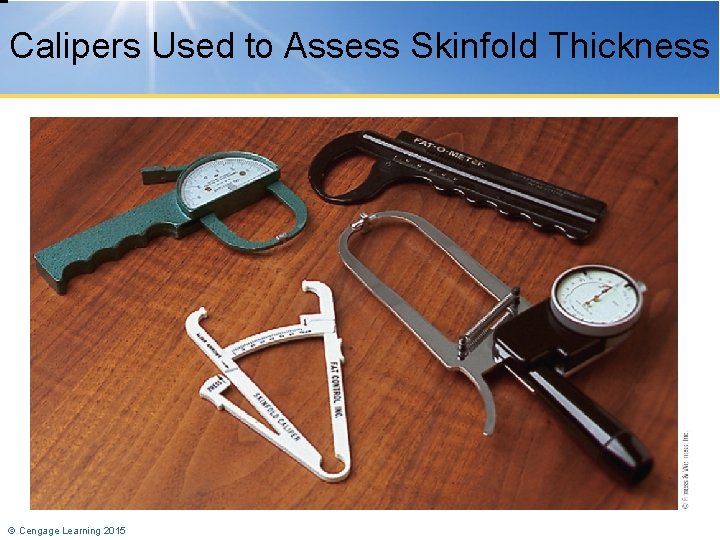
Calipers Used to Assess Skinfold Thickness © Cengage Learning 2015
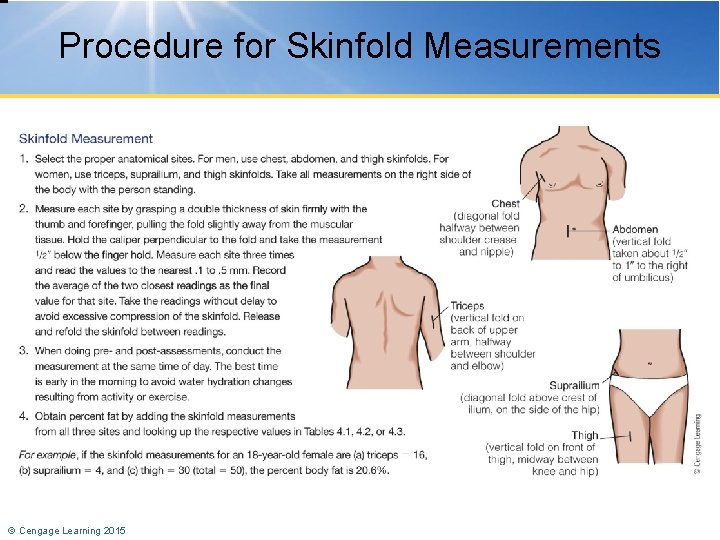
Procedure for Skinfold Measurements © Cengage Learning 2015
Techniques to Assess Body Composition (cont’d. ) • Girth measurements – Assesses body composition by measuring circumferences at specific body sites – Women: upper arm, hip, and wrist – Men: waist and wrist – Requires little equipment – SEE ± 4% © Cengage Learning 2015
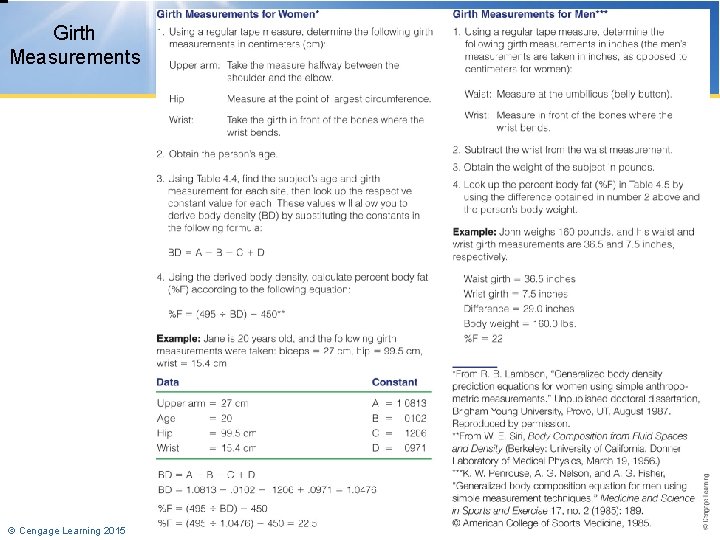
Girth Measurements © Cengage Learning 2015
Techniques to Assess Body Composition (cont’d. ) • Bioelectrical impedance – Assesses body composition by running a weak electrical current through the body – Fat tissue is a less efficient conductor of electrical current than lean tissue – Simple to administer – Accuracy is questionable – Measurements may be off by as much as 10% © Cengage Learning 2015
Techniques to Assess Body Composition (cont’d. ) • Body mass index (BMI) – Technique to determine thinness and excessive fatness that incorporates height and weight to estimate critical fat values at which the risk for disease increases • BMI = [Body weight in pounds x 705 ÷ (height in inches)2] © Cengage Learning 2015
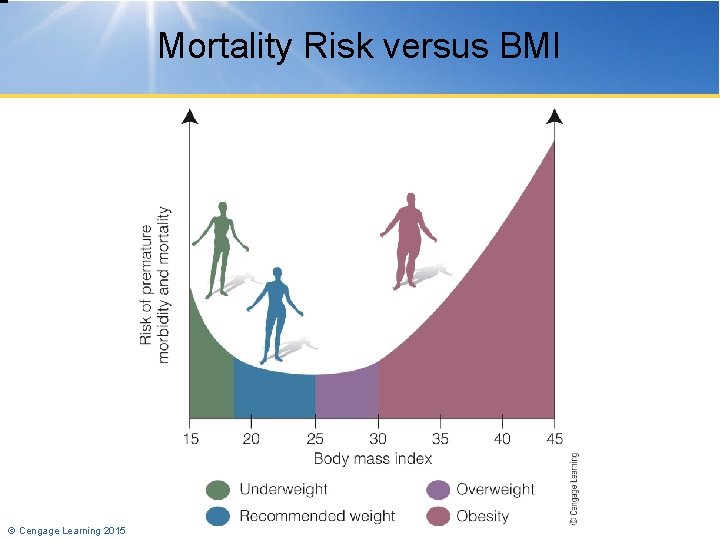
Mortality Risk versus BMI © Cengage Learning 2015
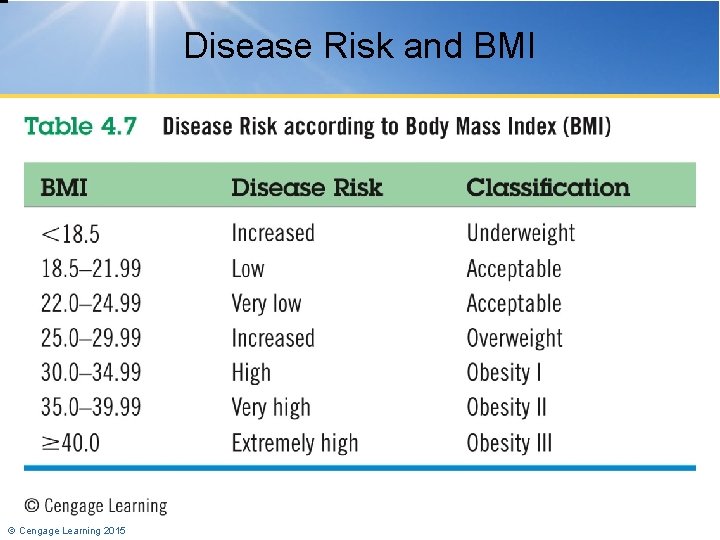
Disease Risk and BMI © Cengage Learning 2015
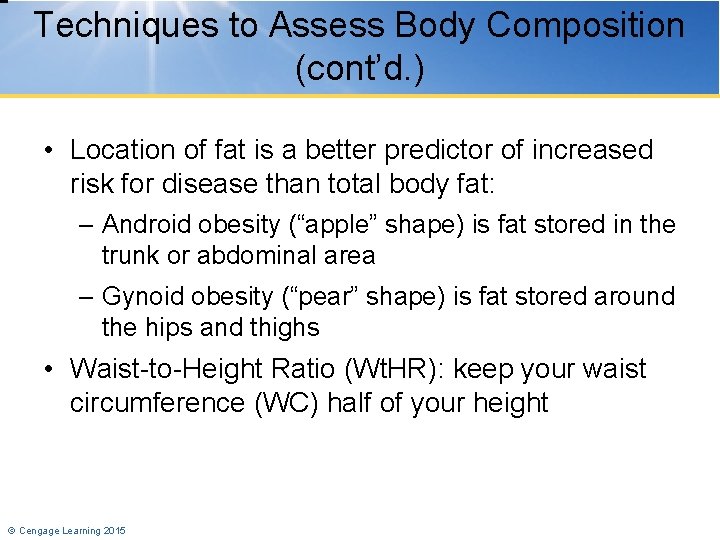
Techniques to Assess Body Composition (cont’d. ) • Location of fat is a better predictor of increased risk for disease than total body fat: – Android obesity (“apple” shape) is fat stored in the trunk or abdominal area – Gynoid obesity (“pear” shape) is fat stored around the hips and thighs • Waist-to-Height Ratio (Wt. HR): keep your waist circumference (WC) half of your height © Cengage Learning 2015
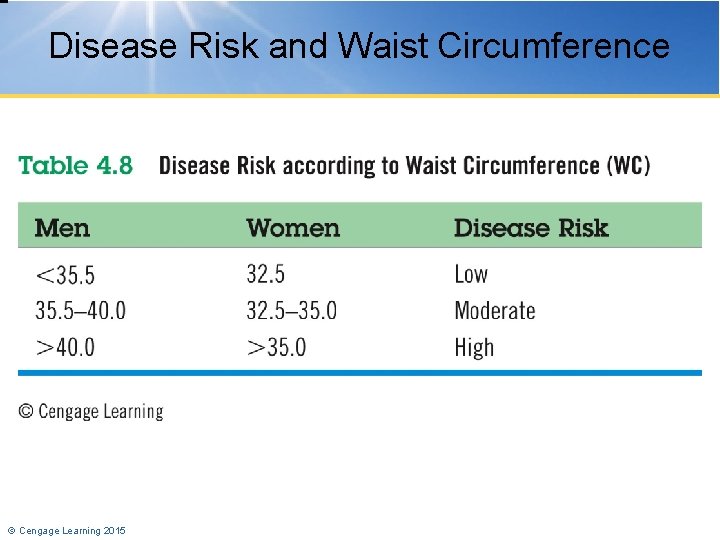
Disease Risk and Waist Circumference © Cengage Learning 2015
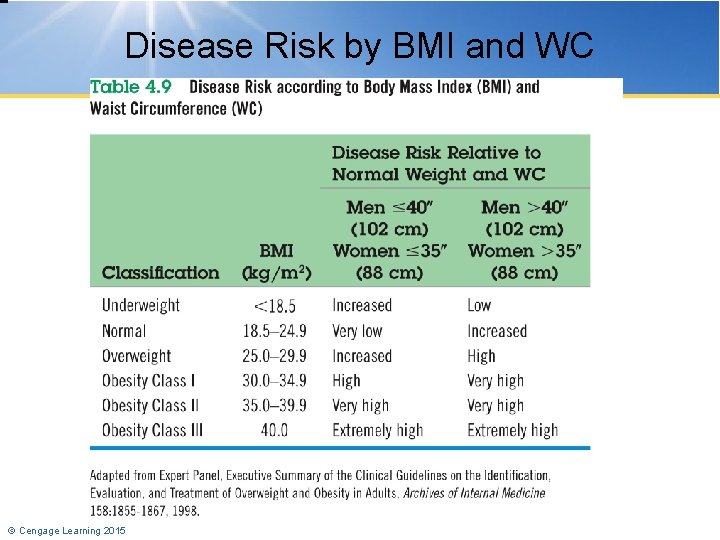
Disease Risk by BMI and WC © Cengage Learning 2015
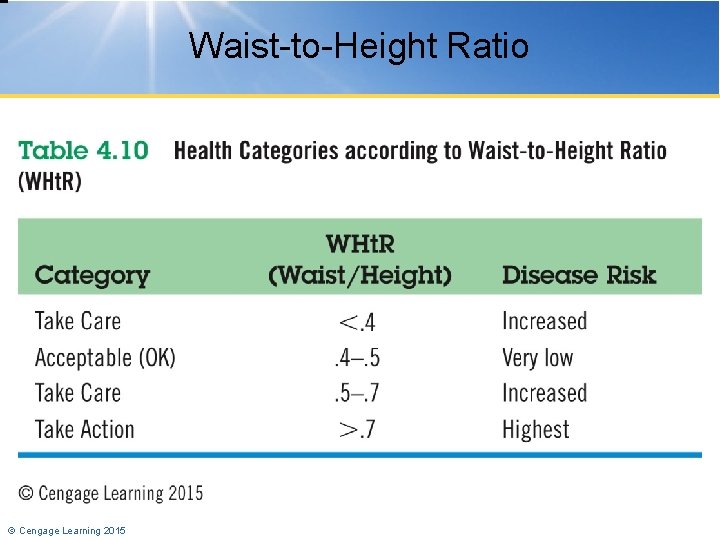
Waist-to-Height Ratio © Cengage Learning 2015
Determining Recommended Body Weight • After finding your percent body fat, determine your body composition class – Health fitness standard – High physical fitness standard • Mortality rate is generally higher for obese people, and for underweight people © Cengage Learning 2015
Critical Thinking • Do you think you have a weight problem? • Do your body composition results make you feel any different about the way you perceive your current body weight and image? © Cengage Learning 2015
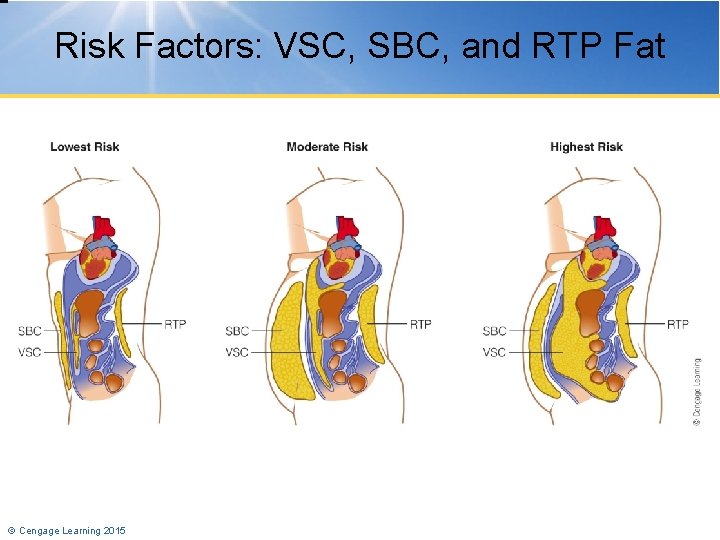
Risk Factors: VSC, SBC, and RTP Fat © Cengage Learning 2015
Body Weight and Aging • Your recommended body weight is based on your age and gender • Because lean tissue decreases with age, one extra percentage point is allowed for every additional decade of life © Cengage Learning 2015
Importance of Regular Body Composition Assessment • Adults in the US tend to gain 1 to 2 pounds per year, and lose ½ pound lean tissue per year • These changes can only be detected by assessing body composition periodically • To make valid comparisons, use the same technique for both pre- and post-program assessments © Cengage Learning 2015
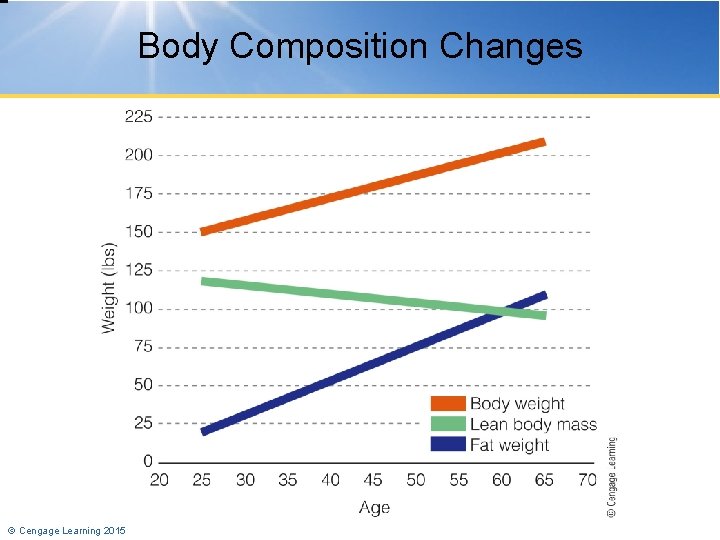
Body Composition Changes © Cengage Learning 2015
Assess Yourself • Have you been able to maintain your body weight at a stable level during the past 12 months? • Do you understand the following concepts? – Body composition vs. body weight – Recommended body weight – Techniques for assessing body composition – Effects of BMI and waist circumference on risk for disease © Cengage Learning 2015
- Slides: 29