
4 b Lexical analysis Finite Automata CMSC 331
4 b Lexical analysis Finite Automata CMSC 331, Some material © 1998 by Addison Wesley Longman, Inc. 1
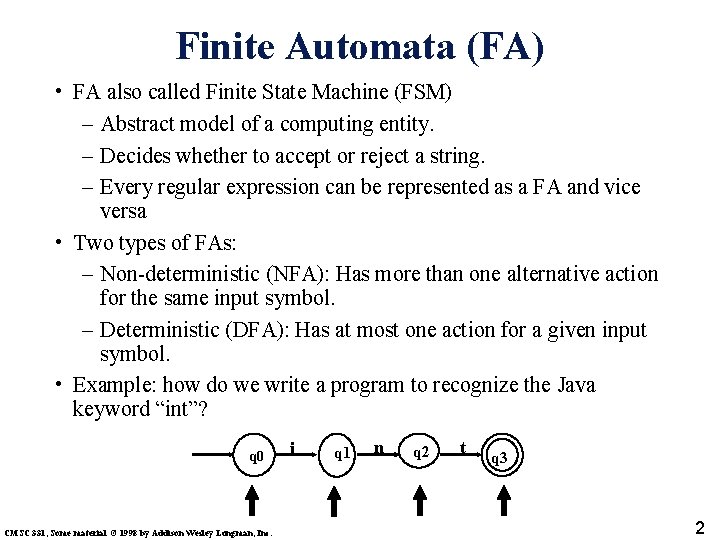
Finite Automata (FA) • FA also called Finite State Machine (FSM) – Abstract model of a computing entity. – Decides whether to accept or reject a string. – Every regular expression can be represented as a FA and vice versa • Two types of FAs: – Non-deterministic (NFA): Has more than one alternative action for the same input symbol. – Deterministic (DFA): Has at most one action for a given input symbol. • Example: how do we write a program to recognize the Java keyword “int”? q 0 CMSC 331, Some material © 1998 by Addison Wesley Longman, Inc. i q 1 n q 2 t q 3 2
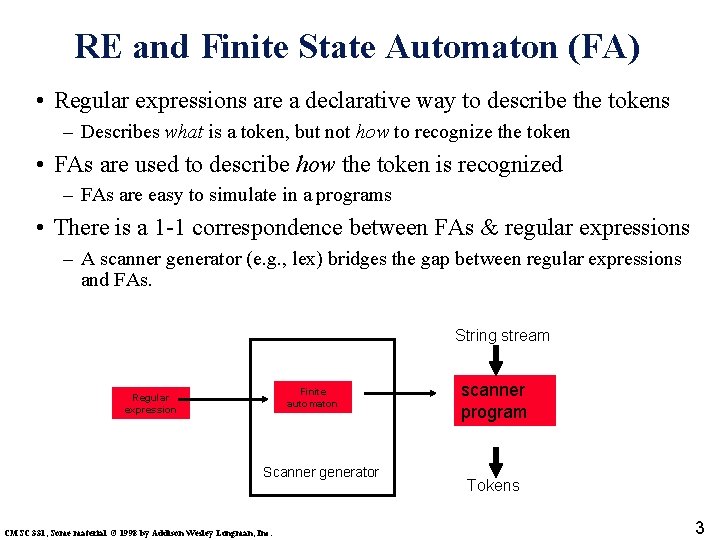
RE and Finite State Automaton (FA) • Regular expressions are a declarative way to describe the tokens – Describes what is a token, but not how to recognize the token • FAs are used to describe how the token is recognized – FAs are easy to simulate in a programs • There is a 1 -1 correspondence between FAs & regular expressions – A scanner generator (e. g. , lex) bridges the gap between regular expressions and FAs. String stream Finite automaton Regular expression Scanner generator CMSC 331, Some material © 1998 by Addison Wesley Longman, Inc. scanner program Tokens 3
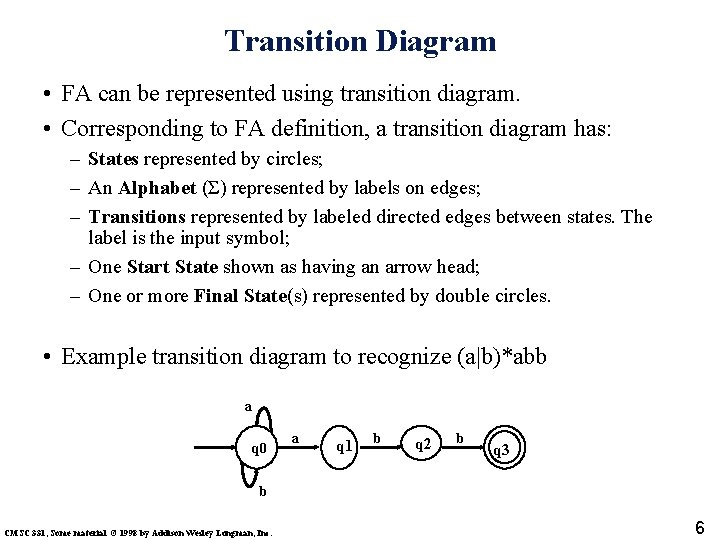
Transition Diagram • FA can be represented using transition diagram. • Corresponding to FA definition, a transition diagram has: – States represented by circles; – An Alphabet (Σ) represented by labels on edges; – Transitions represented by labeled directed edges between states. The label is the input symbol; – One Start State shown as having an arrow head; – One or more Final State(s) represented by double circles. • Example transition diagram to recognize (a|b)*abb a q 0 a q 1 b q 2 b q 3 b CMSC 331, Some material © 1998 by Addison Wesley Longman, Inc. 6

Simple examples of FA a start a 0 1 a a* start 0 a start a+ a 0 1 a (a|b)* start a, b start 0 0 b CMSC 331, Some material © 1998 by Addison Wesley Longman, Inc. 7
Procedures of defining a DFA/NFA • Defining input alphabet and initial state • Draw the transition diagram • Check – Do all states have out-going arcs labeled with all the input symbols (DFA) – Any missing final states? – Any duplicate states? – Can all strings in the language can be accepted? – Are any strings not in the language accepted? • Naming all the states • Defining (S, , , q 0, F) CMSC 331, Some material © 1998 by Addison Wesley Longman, Inc. 8
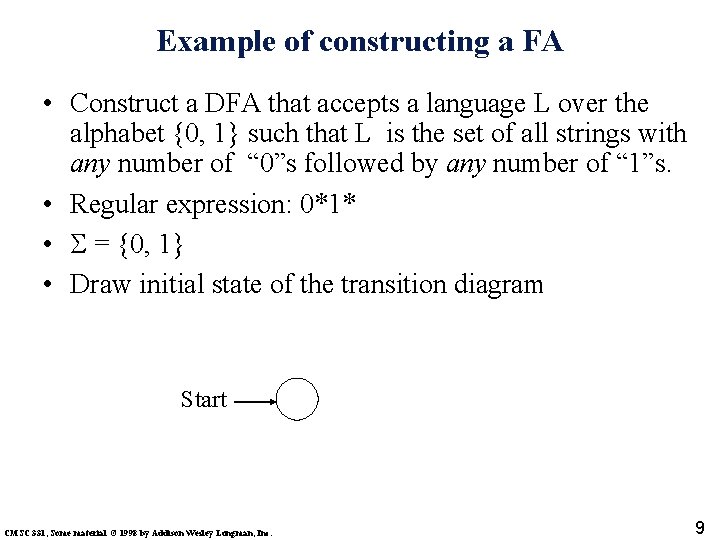
Example of constructing a FA • Construct a DFA that accepts a language L over the alphabet {0, 1} such that L is the set of all strings with any number of “ 0”s followed by any number of “ 1”s. • Regular expression: 0*1* • = {0, 1} • Draw initial state of the transition diagram Start CMSC 331, Some material © 1998 by Addison Wesley Longman, Inc. 9
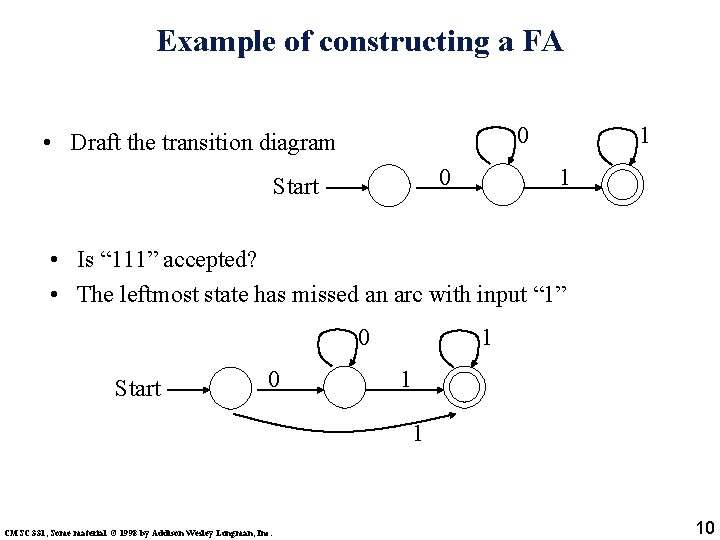
Example of constructing a FA 0 • Draft the transition diagram 0 Start 1 1 • Is “ 111” accepted? • The leftmost state has missed an arc with input “ 1” 0 Start 0 1 1 1 CMSC 331, Some material © 1998 by Addison Wesley Longman, Inc. 10
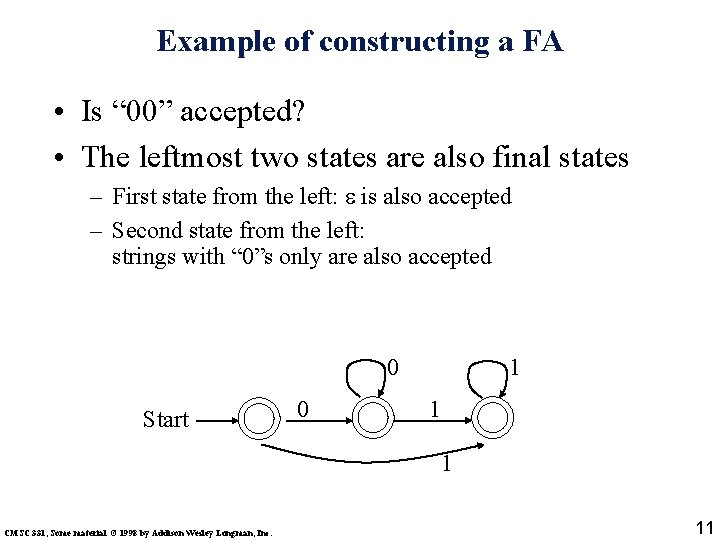
Example of constructing a FA • Is “ 00” accepted? • The leftmost two states are also final states – First state from the left: is also accepted – Second state from the left: strings with “ 0”s only are also accepted 0 Start 0 1 1 1 CMSC 331, Some material © 1998 by Addison Wesley Longman, Inc. 11
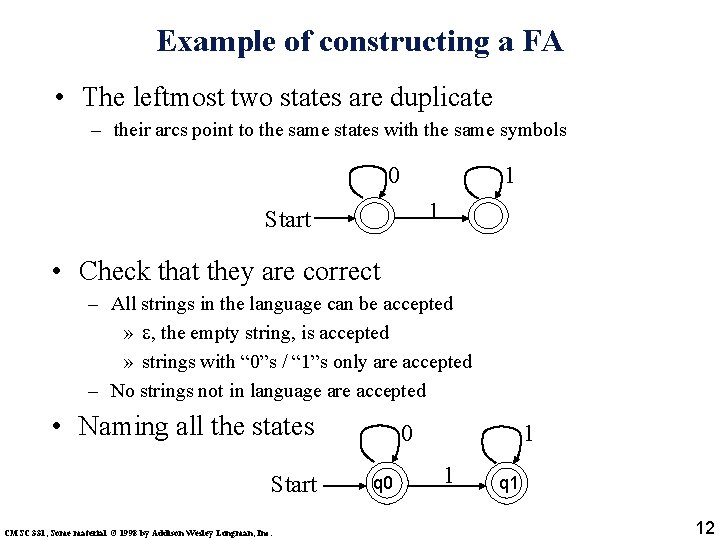
Example of constructing a FA • The leftmost two states are duplicate – their arcs point to the same states with the same symbols 0 1 1 Start • Check that they are correct – All strings in the language can be accepted » , the empty string, is accepted » strings with “ 0”s / “ 1”s only are accepted – No strings not in language are accepted • Naming all the states Start CMSC 331, Some material © 1998 by Addison Wesley Longman, Inc. 0 q 0 1 1 q 1 12
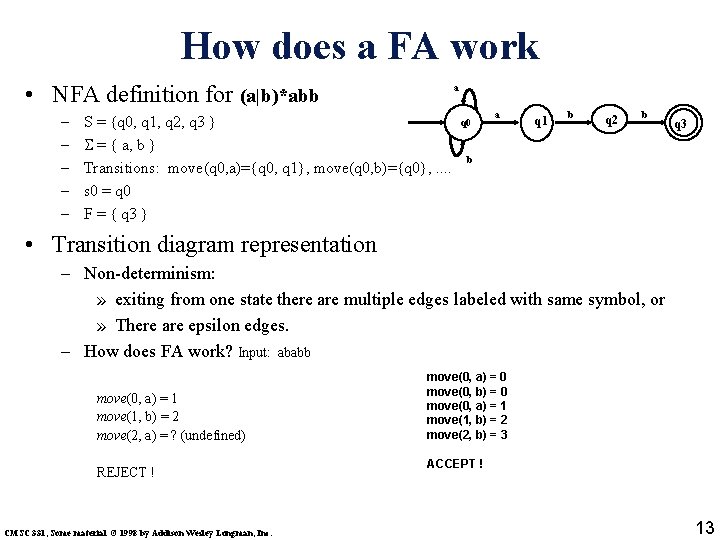
How does a FA work • NFA definition for (a|b)*abb – – – a S = {q 0, q 1, q 2, q 3 } = { a, b } Transitions: move(q 0, a)={q 0, q 1}, move(q 0, b)={q 0}, . . s 0 = q 0 F = { q 3 } q 0 a q 1 b q 2 b q 3 b • Transition diagram representation – Non-determinism: » exiting from one state there are multiple edges labeled with same symbol, or » There are epsilon edges. – How does FA work? Input: ababb move(0, a) = 1 move(1, b) = 2 move(2, a) = ? (undefined) REJECT ! CMSC 331, Some material © 1998 by Addison Wesley Longman, Inc. move(0, a) = 0 move(0, b) = 0 move(0, a) = 1 move(1, b) = 2 move(2, b) = 3 ACCEPT ! 13
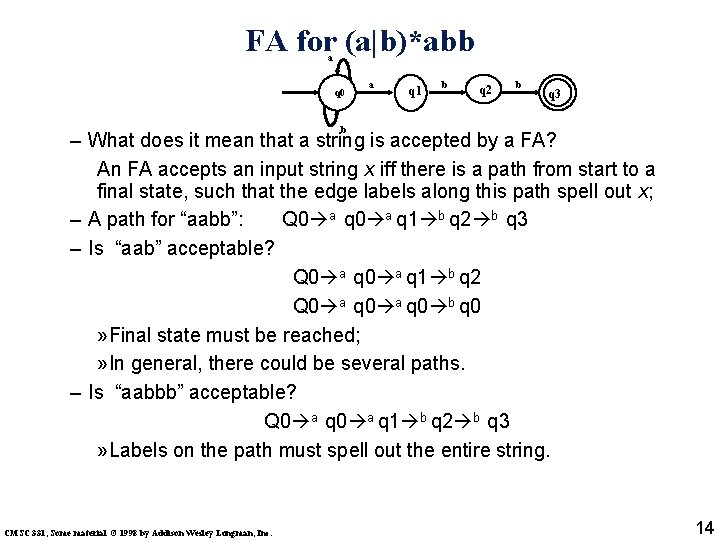
FA for (a|b)*abb a q 0 a q 1 b q 2 b q 3 b – What does it mean that a string is accepted by a FA? An FA accepts an input string x iff there is a path from start to a final state, such that the edge labels along this path spell out x; – A path for “aabb”: Q 0 a q 1 b q 2 b q 3 – Is “aab” acceptable? Q 0 a q 1 b q 2 Q 0 a q 0 b q 0 » Final state must be reached; » In general, there could be several paths. – Is “aabbb” acceptable? Q 0 a q 1 b q 2 b q 3 » Labels on the path must spell out the entire string. CMSC 331, Some material © 1998 by Addison Wesley Longman, Inc. 14
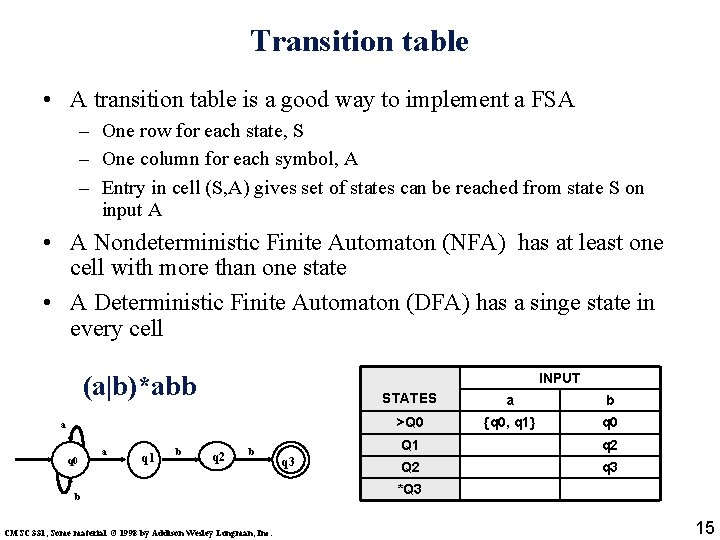
Transition table • A transition table is a good way to implement a FSA – One row for each state, S – One column for each symbol, A – Entry in cell (S, A) gives set of states can be reached from state S on input A • A Nondeterministic Finite Automaton (NFA) has at least one cell with more than one state • A Deterministic Finite Automaton (DFA) has a singe state in every cell (a|b)*abb INPUT a q 0 a q 1 b q 2 b b CMSC 331, Some material © 1998 by Addison Wesley Longman, Inc. q 3 STATES a b >Q 0 {q 0, q 1} q 0 Q 1 q 2 Q 2 q 3 *Q 3 15
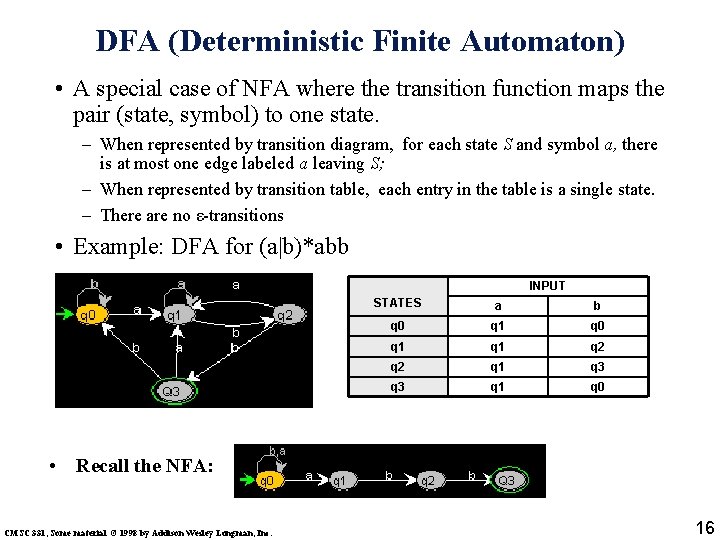
DFA (Deterministic Finite Automaton) • A special case of NFA where the transition function maps the pair (state, symbol) to one state. – When represented by transition diagram, for each state S and symbol a, there is at most one edge labeled a leaving S; – When represented by transition table, each entry in the table is a single state. – There are no ε-transitions • Example: DFA for (a|b)*abb INPUT STATES a b q 0 q 1 q 1 q 2 q 1 q 3 q 1 q 0 • Recall the NFA: CMSC 331, Some material © 1998 by Addison Wesley Longman, Inc. 16
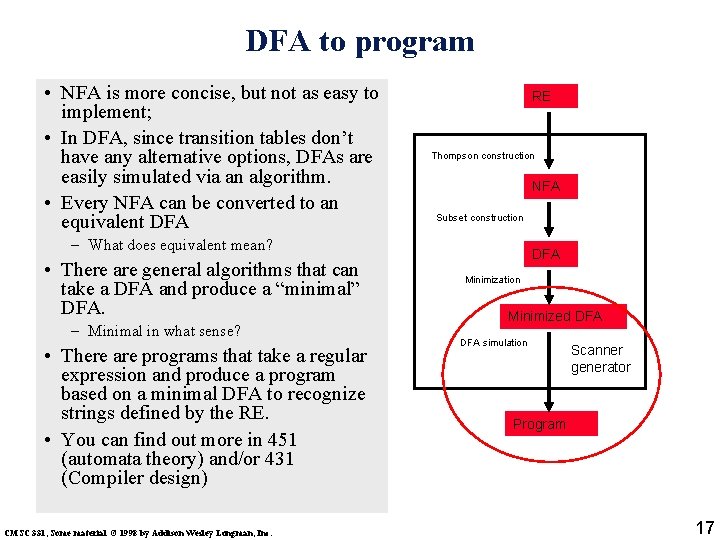
DFA to program • NFA is more concise, but not as easy to implement; • In DFA, since transition tables don’t have any alternative options, DFAs are easily simulated via an algorithm. • Every NFA can be converted to an equivalent DFA RE Thompson construction NFA Subset construction – What does equivalent mean? • There are general algorithms that can take a DFA and produce a “minimal” DFA. – Minimal in what sense? • There are programs that take a regular expression and produce a program based on a minimal DFA to recognize strings defined by the RE. • You can find out more in 451 (automata theory) and/or 431 (Compiler design) CMSC 331, Some material © 1998 by Addison Wesley Longman, Inc. DFA Minimization Minimized DFA simulation Scanner generator Program 17
- Slides: 15