
4 Axial Load 4 5 FORCE METHOD OF
- Slides: 39
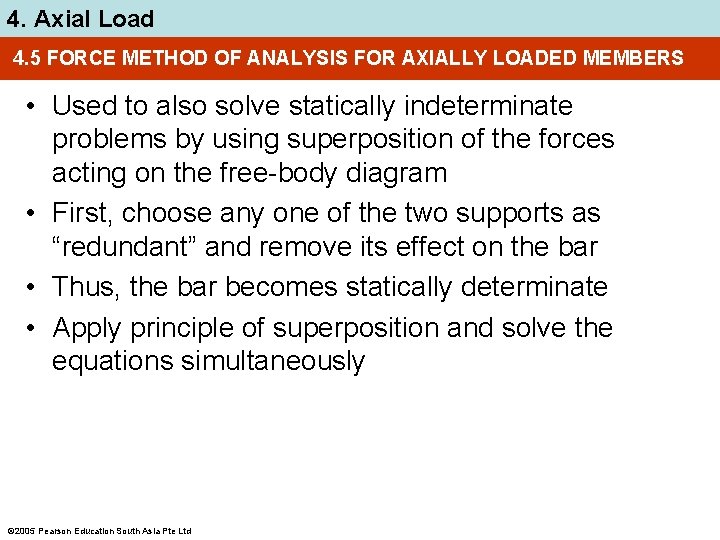
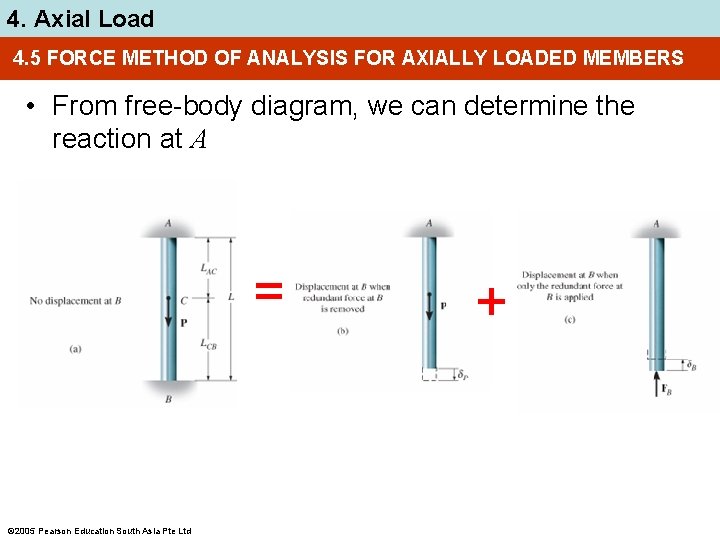
4. Axial Load 4. 5 FORCE METHOD OF ANALYSIS FOR AXIALLY LOADED MEMBERS • Used to also solve statically indeterminate problems by using superposition of the forces acting on the free-body diagram • First, choose any one of the two supports as “redundant” and remove its effect on the bar • Thus, the bar becomes statically determinate • Apply principle of superposition and solve the equations simultaneously 2005 Pearson Education South Asia Pte Ltd
4. Axial Load 4. 5 FORCE METHOD OF ANALYSIS FOR AXIALLY LOADED MEMBERS • From free-body diagram, we can determine the reaction at A = 2005 Pearson Education South Asia Pte Ltd +
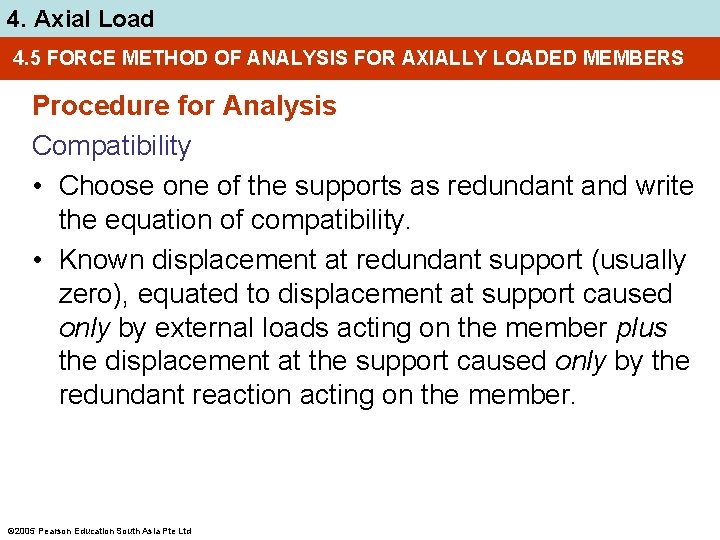
4. Axial Load 4. 5 FORCE METHOD OF ANALYSIS FOR AXIALLY LOADED MEMBERS Procedure for Analysis Compatibility • Choose one of the supports as redundant and write the equation of compatibility. • Known displacement at redundant support (usually zero), equated to displacement at support caused only by external loads acting on the member plus the displacement at the support caused only by the redundant reaction acting on the member. 2005 Pearson Education South Asia Pte Ltd
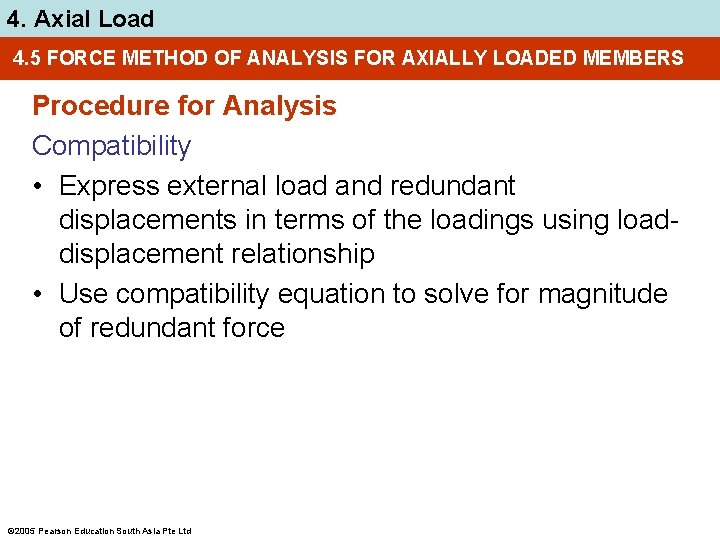
4. Axial Load 4. 5 FORCE METHOD OF ANALYSIS FOR AXIALLY LOADED MEMBERS Procedure for Analysis Compatibility • Express external load and redundant displacements in terms of the loadings using loaddisplacement relationship • Use compatibility equation to solve for magnitude of redundant force 2005 Pearson Education South Asia Pte Ltd
4. Axial Load 4. 5 FORCE METHOD OF ANALYSIS FOR AXIALLY LOADED MEMBERS Procedure for Analysis Equilibrium • Draw a free-body diagram and write appropriate equations of equilibrium for member using calculated result for redundant force. • Solve the equations for other reactions 2005 Pearson Education South Asia Pte Ltd
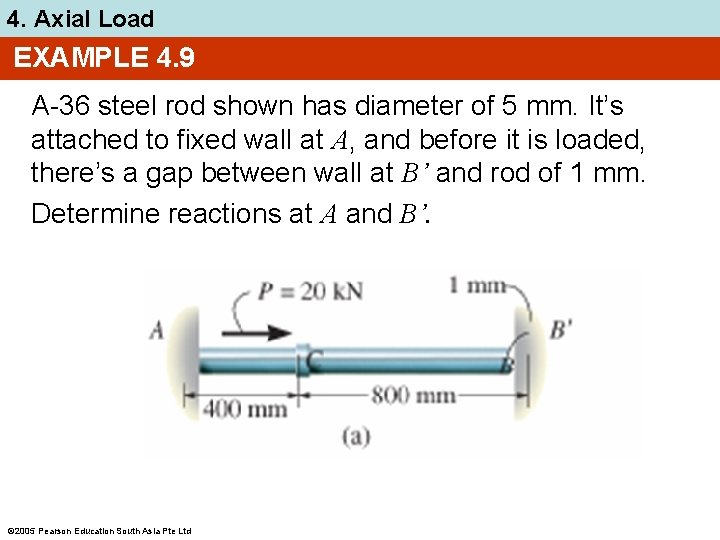
4. Axial Load EXAMPLE 4. 9 A-36 steel rod shown has diameter of 5 mm. It’s attached to fixed wall at A, and before it is loaded, there’s a gap between wall at B’ and rod of 1 mm. Determine reactions at A and B’. 2005 Pearson Education South Asia Pte Ltd
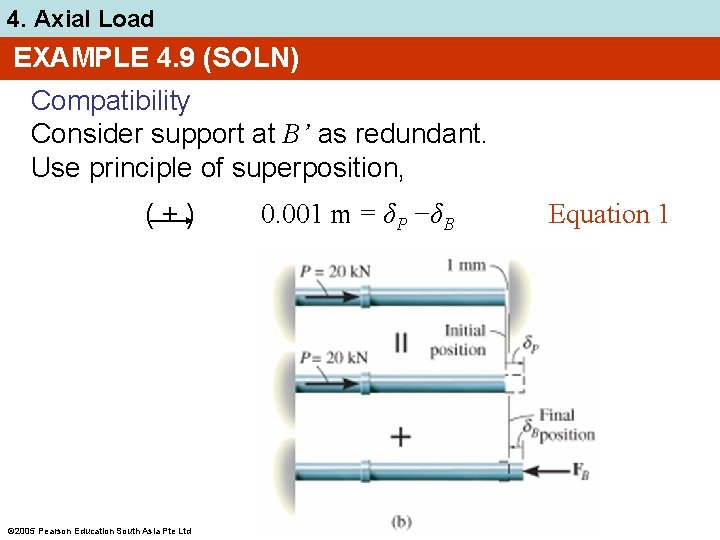
4. Axial Load EXAMPLE 4. 9 (SOLN) Compatibility Consider support at B’ as redundant. Use principle of superposition, (+) 2005 Pearson Education South Asia Pte Ltd 0. 001 m = δP −δB Equation 1
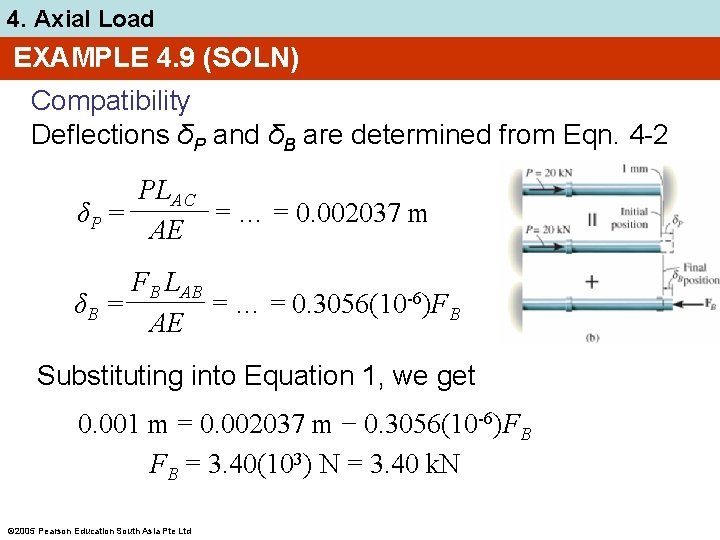
4. Axial Load EXAMPLE 4. 9 (SOLN) Compatibility Deflections δP and δB are determined from Eqn. 4 -2 PLAC δP = = … = 0. 002037 m AE FB LAB δB = = … = 0. 3056(10 -6)FB AE Substituting into Equation 1, we get 0. 001 m = 0. 002037 m − 0. 3056(10 -6)FB FB = 3. 40(103) N = 3. 40 k. N 2005 Pearson Education South Asia Pte Ltd
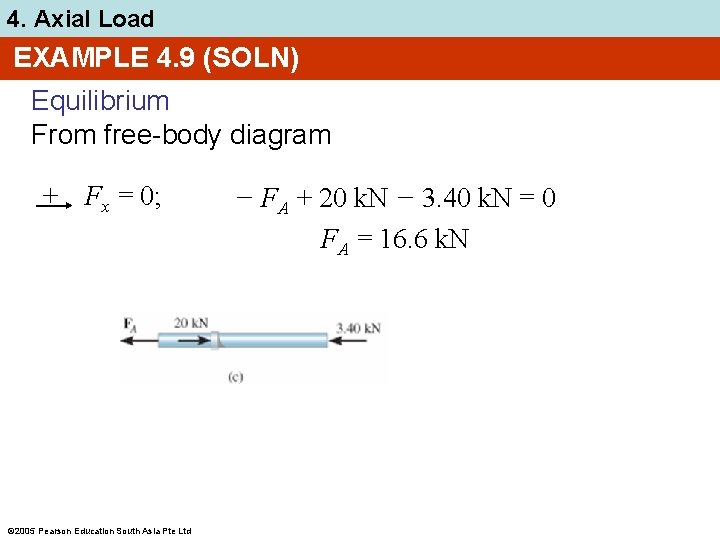
4. Axial Load EXAMPLE 4. 9 (SOLN) Equilibrium From free-body diagram + Fx = 0; 2005 Pearson Education South Asia Pte Ltd − FA + 20 k. N − 3. 40 k. N = 0 FA = 16. 6 k. N
4. Axial Load 4. 6 THERMAL STRESS • Expansion or contraction of material is linearly related to temperature increase or decrease that occurs (for homogenous and isotropic material) • From experiment, deformation of a member having length L is δT = α ∆T L α = liner coefficient of thermal expansion. Unit o measure strain per degree of temperature: 1/ C o (Celsius) or 1/ K (Kelvin) ∆T = algebraic change in temperature of member δT = algebraic change in length of member 2005 Pearson Education South Asia Pte Ltd
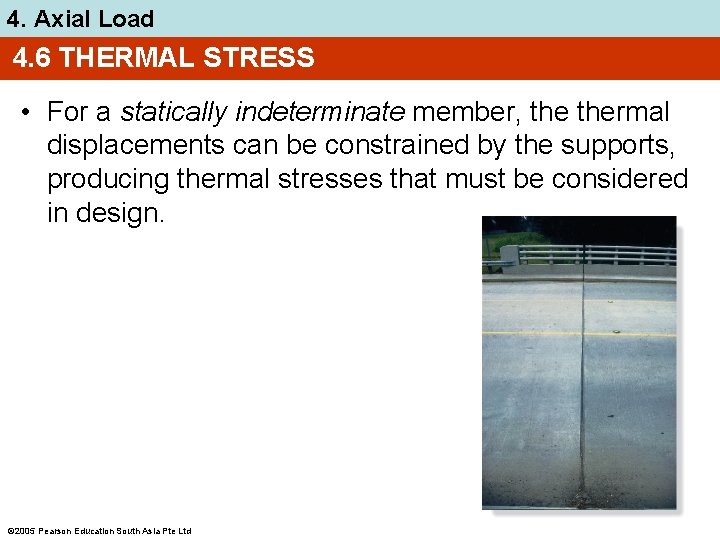
4. Axial Load 4. 6 THERMAL STRESS • For a statically indeterminate member, thermal displacements can be constrained by the supports, producing thermal stresses that must be considered in design. 2005 Pearson Education South Asia Pte Ltd
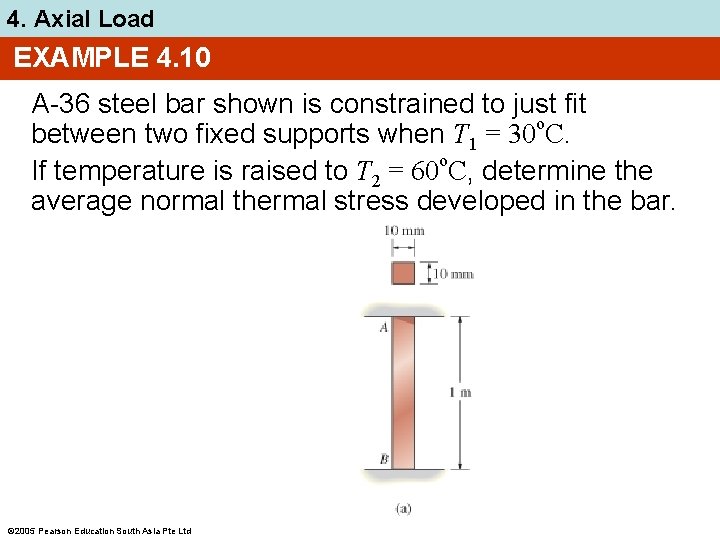
4. Axial Load EXAMPLE 4. 10 A-36 steel bar shown is constrained to just fit between two fixed supports when T 1 = 30 o. C. If temperature is raised to T 2 = 60 o. C, determine the average normal thermal stress developed in the bar. 2005 Pearson Education South Asia Pte Ltd
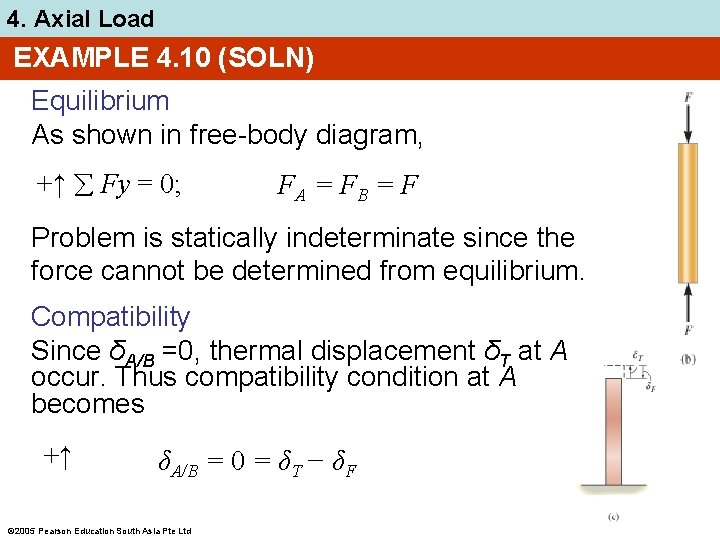
4. Axial Load EXAMPLE 4. 10 (SOLN) Equilibrium As shown in free-body diagram, +↑ Fy = 0; FA = F B = F Problem is statically indeterminate since the force cannot be determined from equilibrium. Compatibility Since δA/B =0, thermal displacement δT at A occur. Thus compatibility condition at A becomes +↑ δA/B = 0 = δT − δF 2005 Pearson Education South Asia Pte Ltd
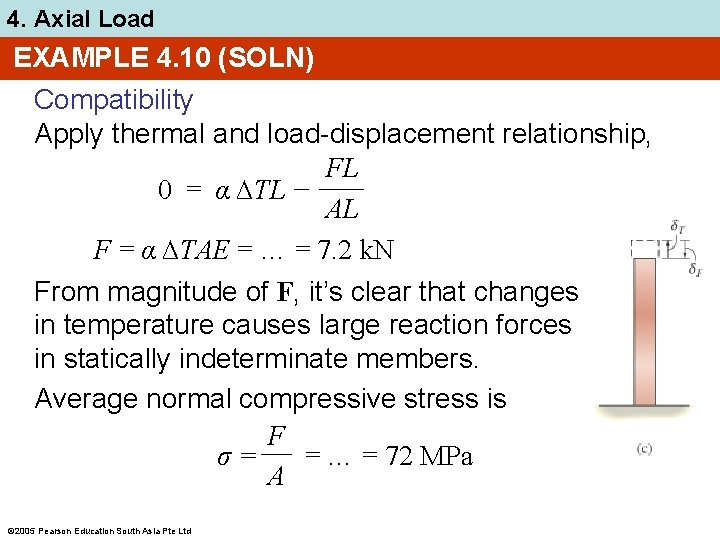
4. Axial Load EXAMPLE 4. 10 (SOLN) Compatibility Apply thermal and load-displacement relationship, FL 0 = α ∆TL − AL F = α ∆TAE = … = 7. 2 k. N From magnitude of F, it’s clear that changes in temperature causes large reaction forces in statically indeterminate members. Average normal compressive stress is F σ= = … = 72 MPa A 2005 Pearson Education South Asia Pte Ltd
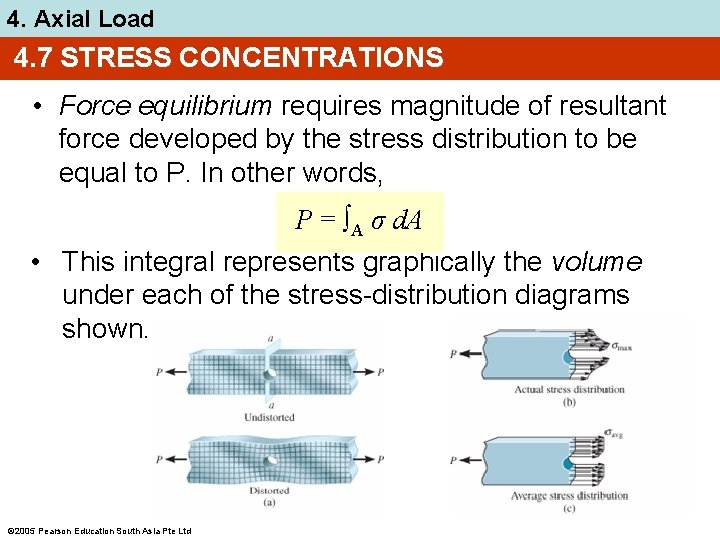
4. Axial Load 4. 7 STRESS CONCENTRATIONS • Force equilibrium requires magnitude of resultant force developed by the stress distribution to be equal to P. In other words, P = ∫A σ d. A • This integral represents graphically the volume under each of the stress-distribution diagrams shown. 2005 Pearson Education South Asia Pte Ltd
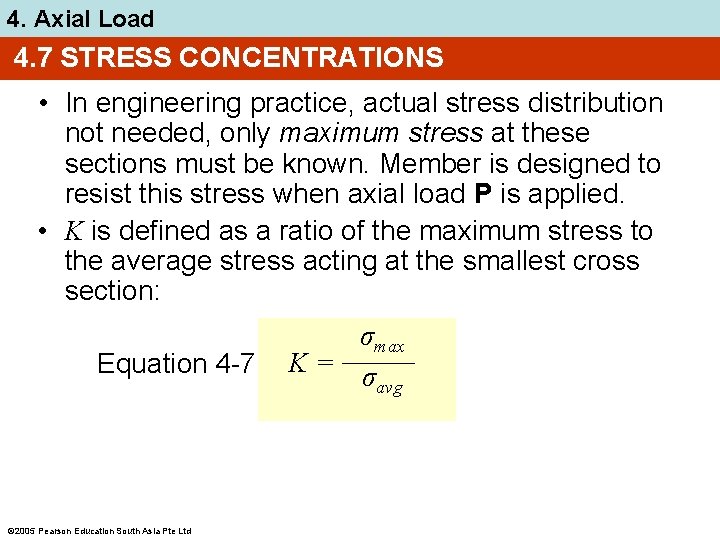
4. Axial Load 4. 7 STRESS CONCENTRATIONS • In engineering practice, actual stress distribution not needed, only maximum stress at these sections must be known. Member is designed to resist this stress when axial load P is applied. • K is defined as a ratio of the maximum stress to the average stress acting at the smallest cross section: Equation 4 -7 2005 Pearson Education South Asia Pte Ltd σmax K= σ avg
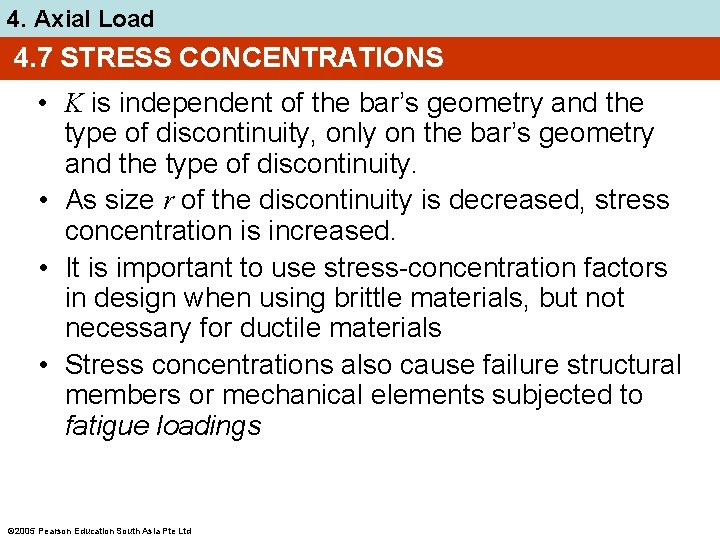
4. Axial Load 4. 7 STRESS CONCENTRATIONS • K is independent of the bar’s geometry and the type of discontinuity, only on the bar’s geometry and the type of discontinuity. • As size r of the discontinuity is decreased, stress concentration is increased. • It is important to use stress-concentration factors in design when using brittle materials, but not necessary for ductile materials • Stress concentrations also cause failure structural members or mechanical elements subjected to fatigue loadings 2005 Pearson Education South Asia Pte Ltd
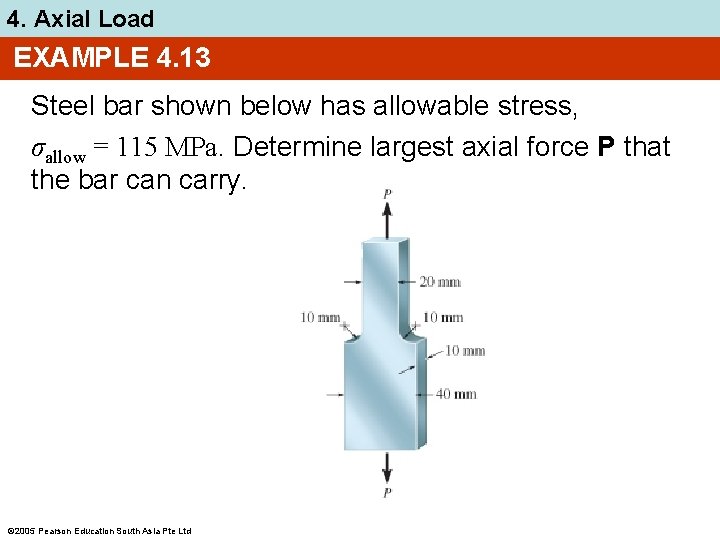
4. Axial Load EXAMPLE 4. 13 Steel bar shown below has allowable stress, σallow = 115 MPa. Determine largest axial force P that the bar can carry. 2005 Pearson Education South Asia Pte Ltd
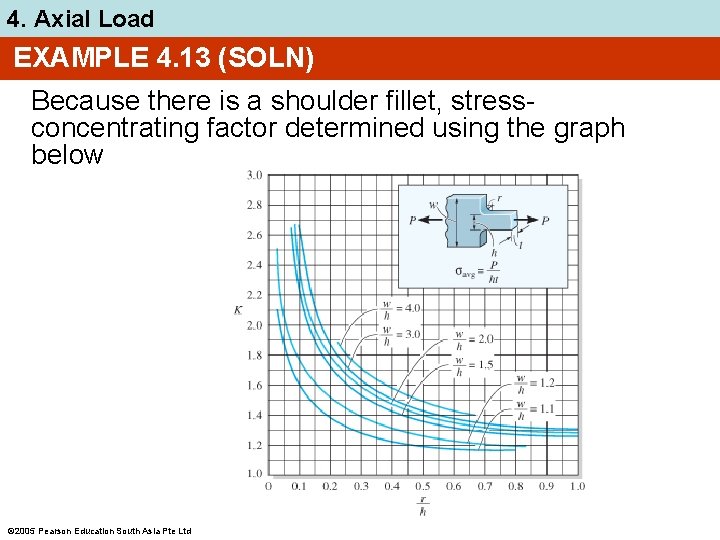
4. Axial Load EXAMPLE 4. 13 (SOLN) Because there is a shoulder fillet, stressconcentrating factor determined using the graph below 2005 Pearson Education South Asia Pte Ltd
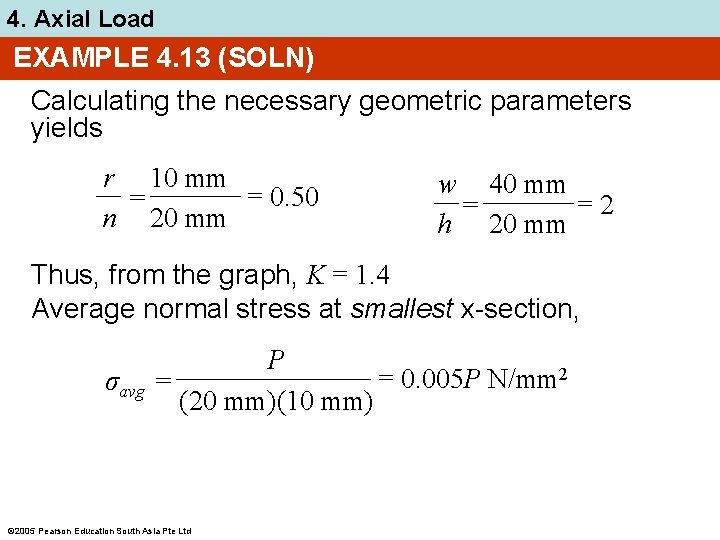
4. Axial Load EXAMPLE 4. 13 (SOLN) Calculating the necessary geometric parameters yields r 10 mm = 0. 50 = n 20 mm w 40 mm =2 = h 20 mm Thus, from the graph, K = 1. 4 Average normal stress at smallest x-section, P = 0. 005 P N/mm 2 σavg = (20 mm)(10 mm) 2005 Pearson Education South Asia Pte Ltd
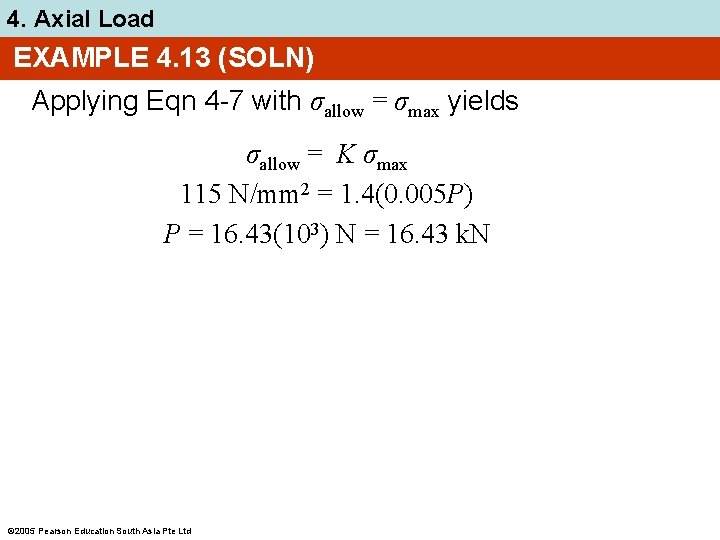
4. Axial Load EXAMPLE 4. 13 (SOLN) Applying Eqn 4 -7 with σallow = σmax yields σallow = K σmax 115 N/mm 2 = 1. 4(0. 005 P) P = 16. 43(103) N = 16. 43 k. N 2005 Pearson Education South Asia Pte Ltd
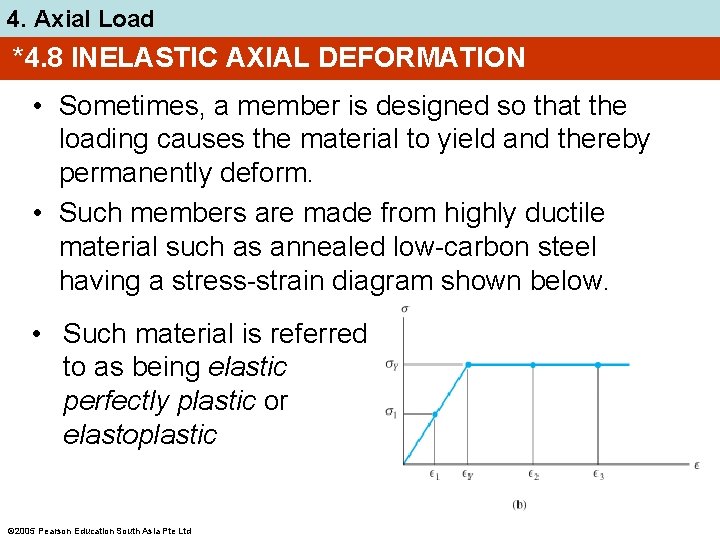
4. Axial Load *4. 8 INELASTIC AXIAL DEFORMATION • Sometimes, a member is designed so that the loading causes the material to yield and thereby permanently deform. • Such members are made from highly ductile material such as annealed low-carbon steel having a stress-strain diagram shown below. • Such material is referred to as being elastic perfectly plastic or elastoplastic 2005 Pearson Education South Asia Pte Ltd
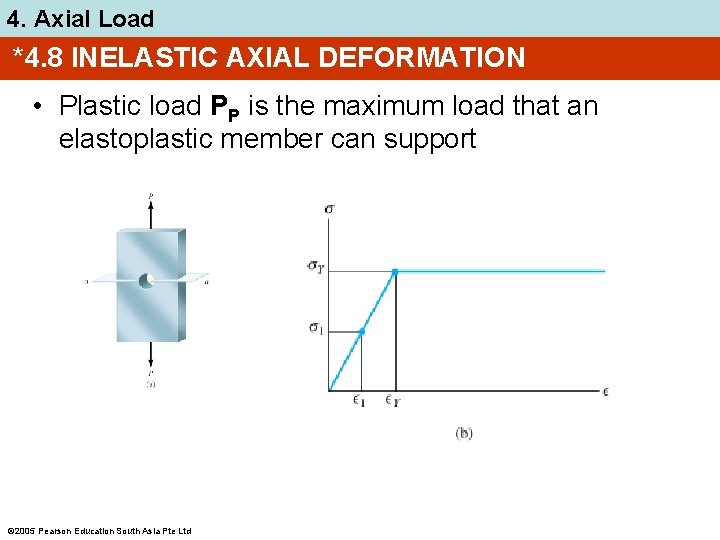
4. Axial Load *4. 8 INELASTIC AXIAL DEFORMATION • Plastic load PP is the maximum load that an elastoplastic member can support 2005 Pearson Education South Asia Pte Ltd
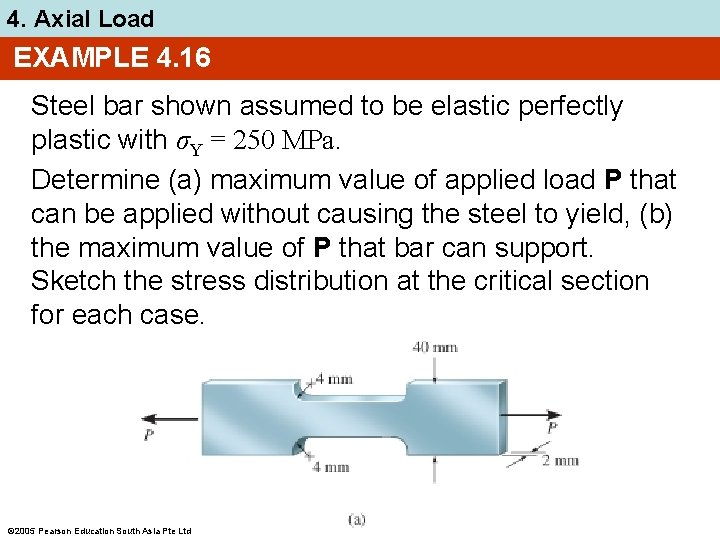
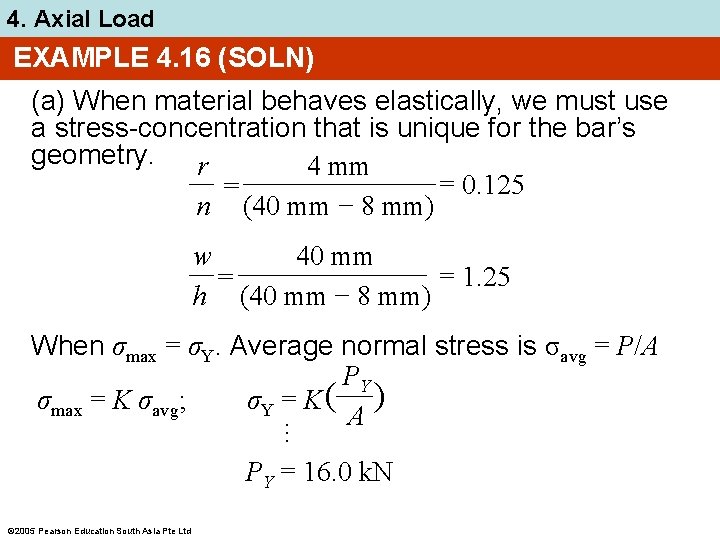
4. Axial Load EXAMPLE 4. 16 Steel bar shown assumed to be elastic perfectly plastic with σY = 250 MPa. Determine (a) maximum value of applied load P that can be applied without causing the steel to yield, (b) the maximum value of P that bar can support. Sketch the stress distribution at the critical section for each case. 2005 Pearson Education South Asia Pte Ltd
4. Axial Load EXAMPLE 4. 16 (SOLN) (a) When material behaves elastically, we must use a stress-concentration that is unique for the bar’s geometry. r 4 mm = 0. 125 = n (40 mm − 8 mm) w 40 mm = 1. 25 = h (40 mm − 8 mm) … When σmax = σY. Average normal stress is σavg = P/A PY σmax = K σavg; σY = K ( ) A PY = 16. 0 k. N 2005 Pearson Education South Asia Pte Ltd
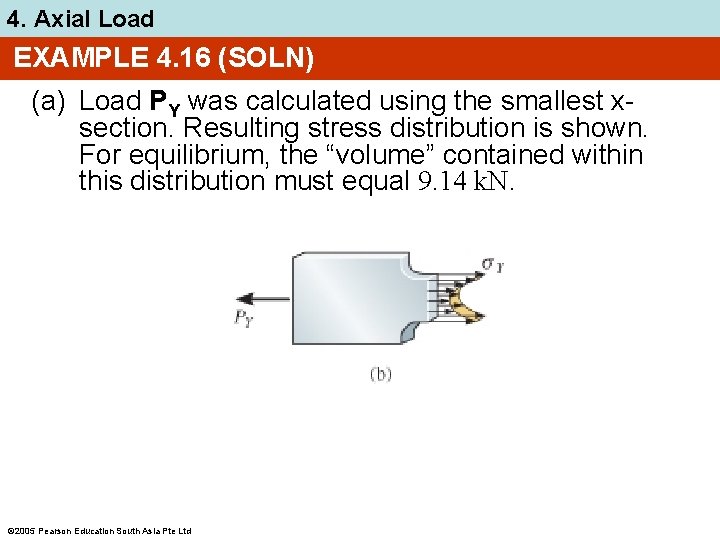
4. Axial Load EXAMPLE 4. 16 (SOLN) (a) Load PY was calculated using the smallest xsection. Resulting stress distribution is shown. For equilibrium, the “volume” contained within this distribution must equal 9. 14 k. N. 2005 Pearson Education South Asia Pte Ltd
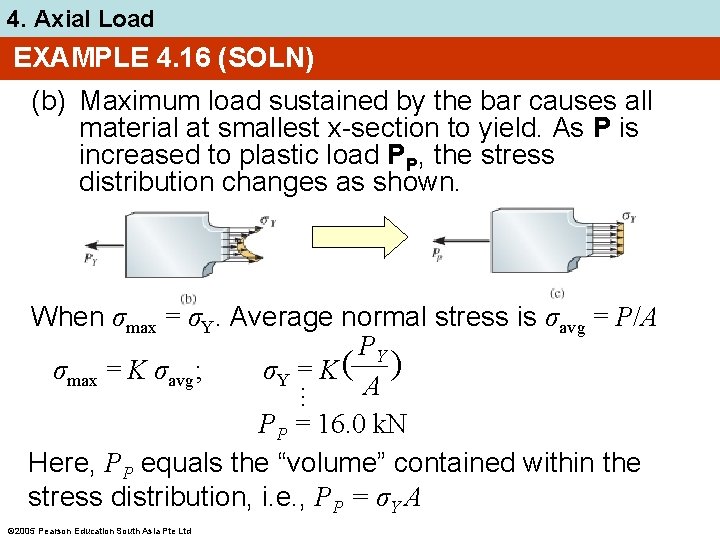
4. Axial Load EXAMPLE 4. 16 (SOLN) (b) Maximum load sustained by the bar causes all material at smallest x-section to yield. As P is increased to plastic load PP, the stress distribution changes as shown. … When σmax = σY. Average normal stress is σavg = P/A PY σmax = K σavg; σY = K ( ) A PP = 16. 0 k. N Here, PP equals the “volume” contained within the stress distribution, i. e. , PP = σY A 2005 Pearson Education South Asia Pte Ltd
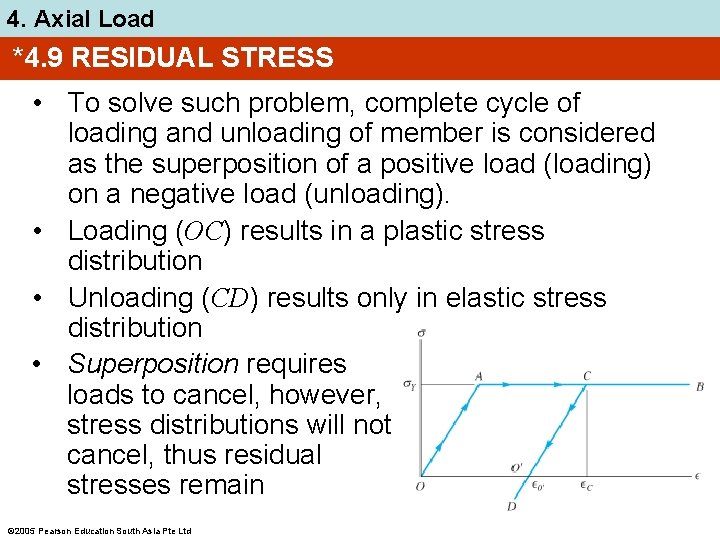
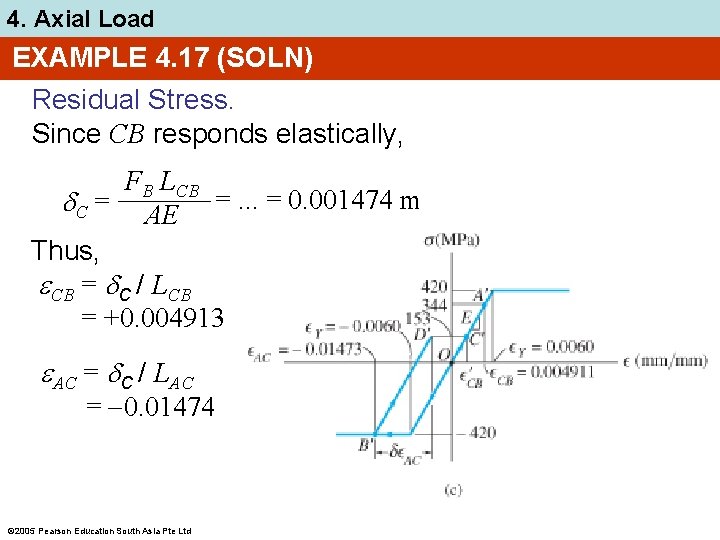
4. Axial Load *4. 9 RESIDUAL STRESS • For axially loaded member or group of such members, that form a statically indeterminate system that can support both tensile and compressive loads, • Then, excessive external loadings which cause yielding of the material, creates residual stresses in the members when loads are removed. • Reason is the elastic recovery of the material during unloading 2005 Pearson Education South Asia Pte Ltd
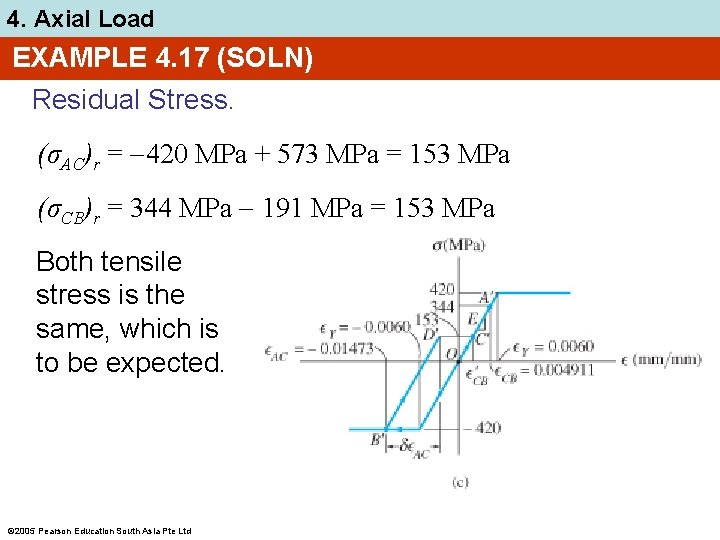
4. Axial Load *4. 9 RESIDUAL STRESS • To solve such problem, complete cycle of loading and unloading of member is considered as the superposition of a positive load (loading) on a negative load (unloading). • Loading (OC) results in a plastic stress distribution • Unloading (CD) results only in elastic stress distribution • Superposition requires loads to cancel, however, stress distributions will not cancel, thus residual stresses remain 2005 Pearson Education South Asia Pte Ltd
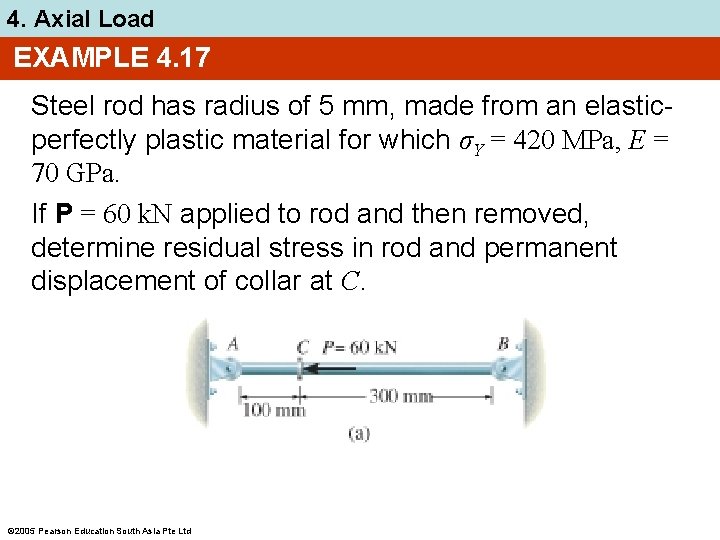
4. Axial Load EXAMPLE 4. 17 Steel rod has radius of 5 mm, made from an elasticperfectly plastic material for which σY = 420 MPa, E = 70 GPa. If P = 60 k. N applied to rod and then removed, determine residual stress in rod and permanent displacement of collar at C. 2005 Pearson Education South Asia Pte Ltd
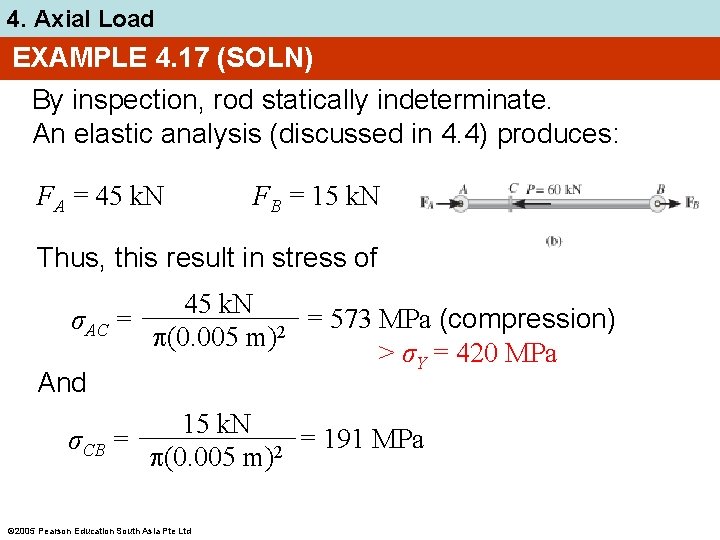
4. Axial Load EXAMPLE 4. 17 (SOLN) By inspection, rod statically indeterminate. An elastic analysis (discussed in 4. 4) produces: FA = 45 k. N FB = 15 k. N Thus, this result in stress of 45 k. N = 573 MPa (compression) σAC = 2 (0. 005 m) > σY = 420 MPa And 15 k. N = 191 MPa σCB = 2 (0. 005 m) 2005 Pearson Education South Asia Pte Ltd
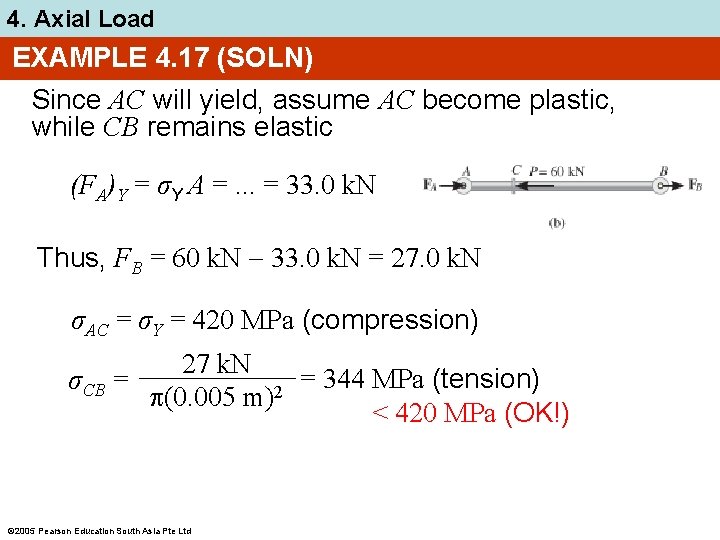
4. Axial Load EXAMPLE 4. 17 (SOLN) Since AC will yield, assume AC become plastic, while CB remains elastic (FA)Y = σY A =. . . = 33. 0 k. N Thus, FB = 60 k. N 33. 0 k. N = 27. 0 k. N σAC = σY = 420 MPa (compression) 27 k. N = 344 MPa (tension) σCB = 2 (0. 005 m) < 420 MPa (OK!) 2005 Pearson Education South Asia Pte Ltd
4. Axial Load EXAMPLE 4. 17 (SOLN) Residual Stress. Since CB responds elastically, FB LCB C = AE =. . . = 0. 001474 m Thus, CB = C / LCB = +0. 004913 AC = C / LAC = 0. 01474 2005 Pearson Education South Asia Pte Ltd
4. Axial Load EXAMPLE 4. 17 (SOLN) Residual Stress. (σAC)r = 420 MPa + 573 MPa = 153 MPa (σCB)r = 344 MPa 191 MPa = 153 MPa Both tensile stress is the same, which is to be expected. 2005 Pearson Education South Asia Pte Ltd
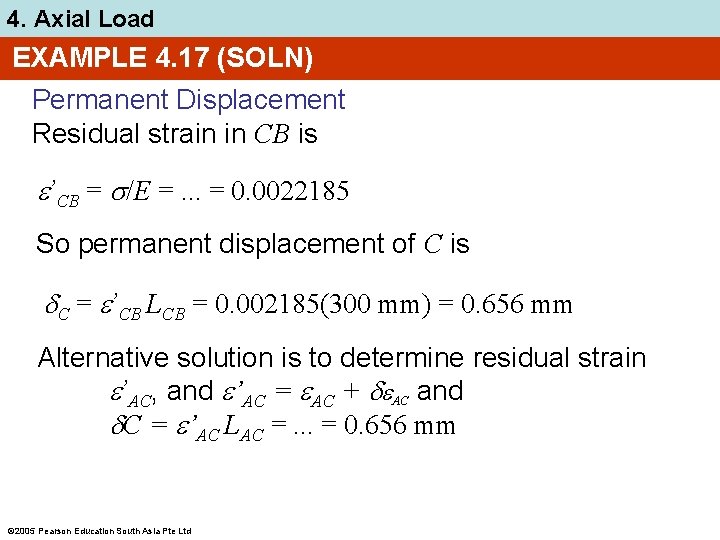
4. Axial Load EXAMPLE 4. 17 (SOLN) Permanent Displacement Residual strain in CB is ’CB = /E =. . . = 0. 0022185 So permanent displacement of C is C = ’CB LCB = 0. 002185(300 mm) = 0. 656 mm Alternative solution is to determine residual strain ’AC, and ’AC = AC + AC and C = ’AC LAC =. . . = 0. 656 mm 2005 Pearson Education South Asia Pte Ltd
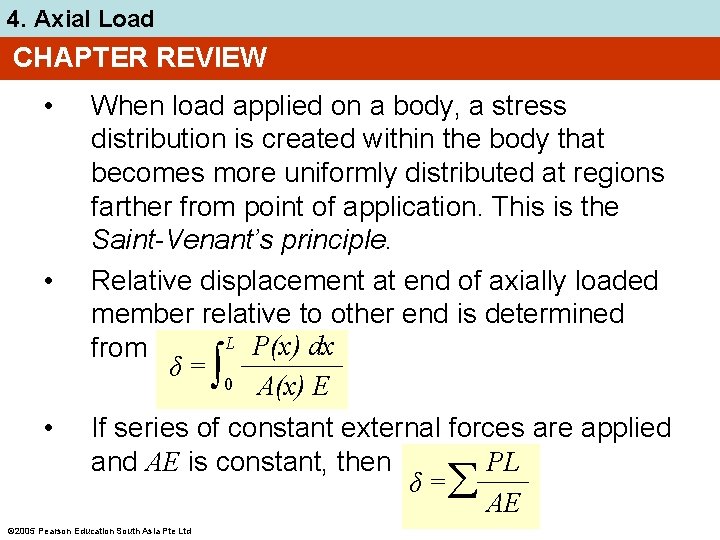
4. Axial Load CHAPTER REVIEW • • When load applied on a body, a stress distribution is created within the body that becomes more uniformly distributed at regions farther from point of application. This is the Saint-Venant’s principle. Relative displacement at end of axially loaded member relative to other end is determined L P(x) dx from δ= 0 A(x) E ∫ • If series of constant external forces are applied and AE is constant, then PL δ = AE 2005 Pearson Education South Asia Pte Ltd
4. Axial Load CHAPTER REVIEW • • • Make sure to use sign convention for internal load P and that material does not yield, but remains linear elastic Superposition of load & displacement is possible provided material remains linear elastic and no changes in geometry occur Reactions on statically indeterminate bar determined using equilibrium and compatibility conditions that specify displacement at the supports. Use the load-displacement relationship, = PL/AE 2005 Pearson Education South Asia Pte Ltd
4. Axial Load CHAPTER REVIEW • • Change in temperature can cause member made from homogenous isotropic material to change its length by = TL. If member is confined, expansion will produce thermal stress in the member Holes and sharp transitions at x-section create stress concentrations. For design, obtain stress concentration factor K from graph, which is determined empirically. The K value is multiplied by average stress to obtain maximum stress at x-section, max = K avg 2005 Pearson Education South Asia Pte Ltd
4. Axial Load CHAPTER REVIEW • • • If loading in bar causes material to yield, then stress distribution that’s produced can be determined from the strain distribution and stress-strain diagram For perfectly plastic material, yielding causes stress distribution at x-section of hole or transition to even out and become uniform If member is constrained and external loading causes yielding, then when load is released, it will cause residual stress in the material 2005 Pearson Education South Asia Pte Ltd