
4 Applications of Differentiation Copyright Cengage Learning All


- Slides: 27
4 Applications of Differentiation Copyright © Cengage Learning. All rights reserved.
4. 5 Limits at Infinity Copyright © Cengage Learning. All rights reserved.
Objectives Determine (finite) limits at infinity. Determine the horizontal asymptotes, if any, of the graph of a function. Determine infinite limits at infinity. 3
Limits at Infinity 4
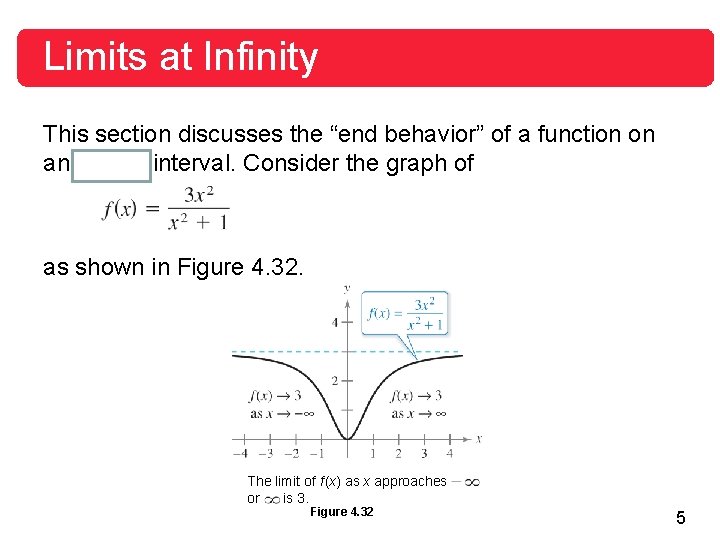
Limits at Infinity This section discusses the “end behavior” of a function on an infinite interval. Consider the graph of as shown in Figure 4. 32. The limit of f (x) as x approaches or is 3. Figure 4. 32 5
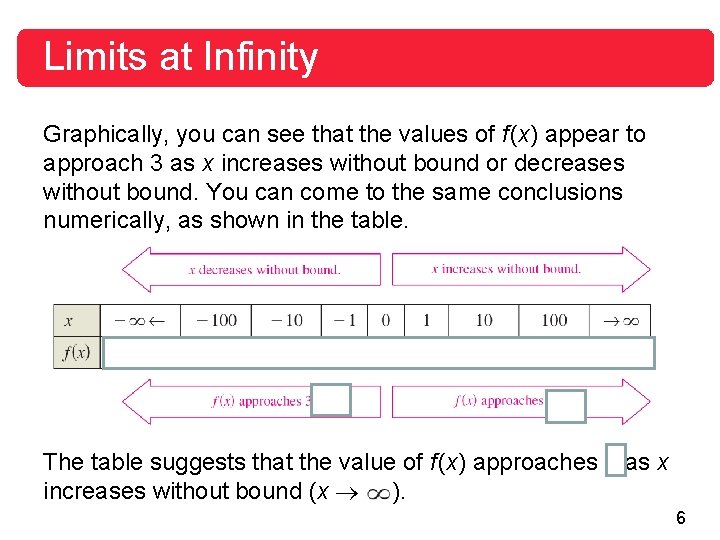
Limits at Infinity Graphically, you can see that the values of f (x) appear to approach 3 as x increases without bound or decreases without bound. You can come to the same conclusions numerically, as shown in the table. The table suggests that the value of f (x) approaches 3 as x increases without bound (x ). 6
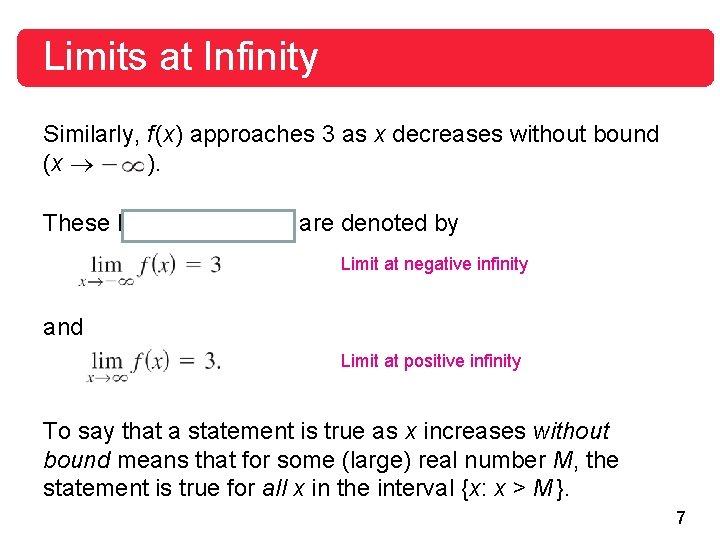
Limits at Infinity Similarly, f (x) approaches 3 as x decreases without bound (x ). These limits at infinity are denoted by Limit at negative infinity and Limit at positive infinity To say that a statement is true as x increases without bound means that for some (large) real number M, the statement is true for all x in the interval {x: x > M }. 7
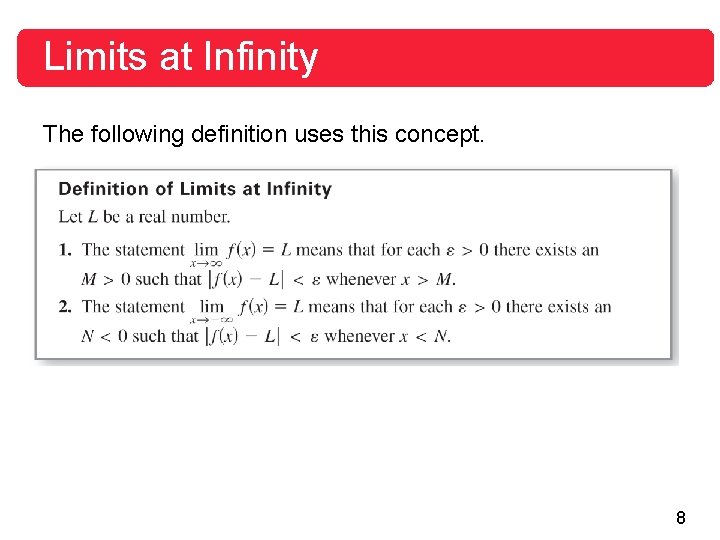
Limits at Infinity The following definition uses this concept. 8
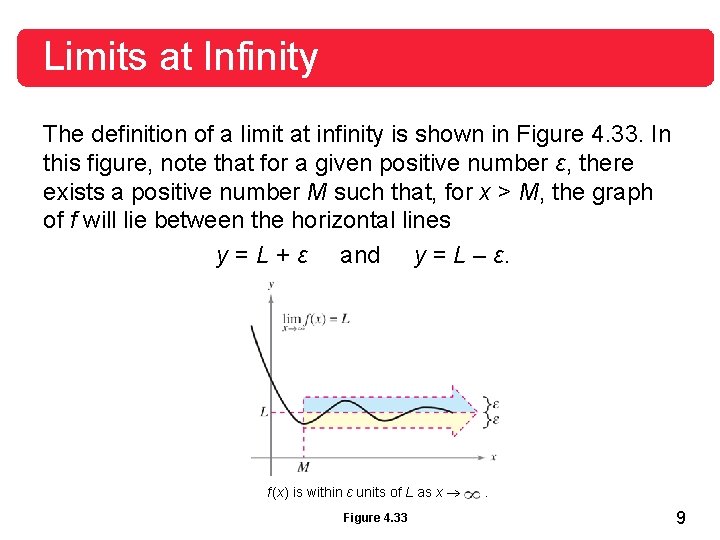
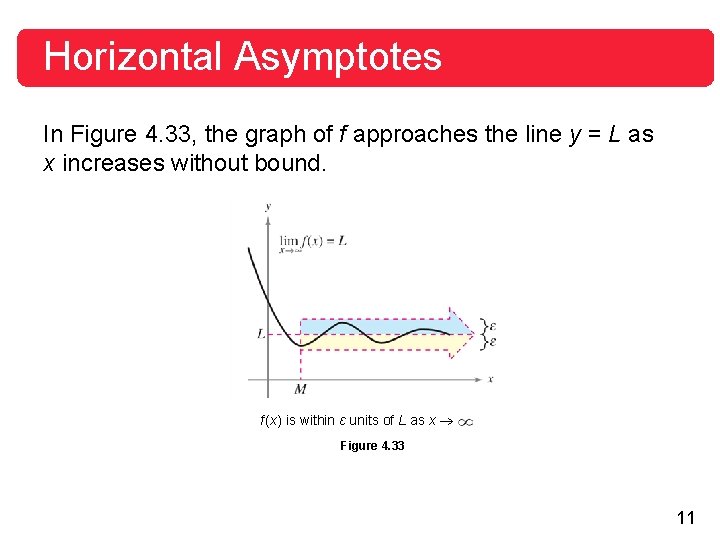
Limits at Infinity The definition of a limit at infinity is shown in Figure 4. 33. In this figure, note that for a given positive number ε, there exists a positive number M such that, for x > M, the graph of f will lie between the horizontal lines y = L + ε and y = L – ε. f (x) is within ε units of L as x Figure 4. 33 . 9
Horizontal Asymptotes 10
Horizontal Asymptotes In Figure 4. 33, the graph of f approaches the line y = L as x increases without bound. f (x) is within ε units of L as x Figure 4. 33 11
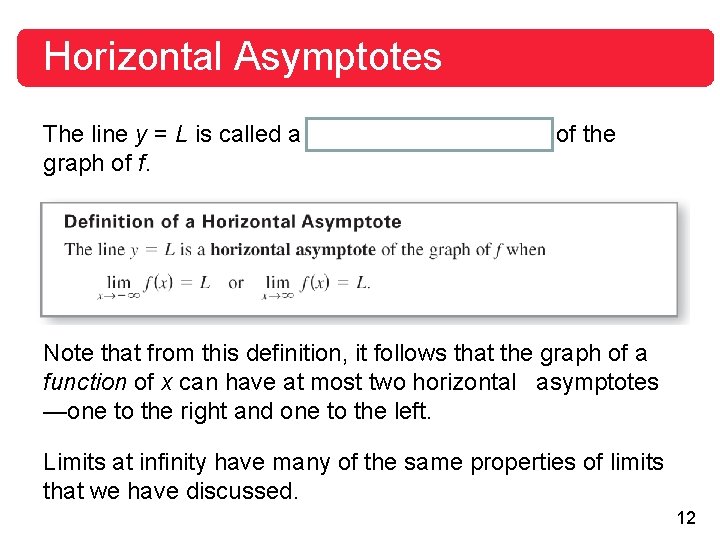
Horizontal Asymptotes The line y = L is called a horizontal asymptote of the graph of f. Note that from this definition, it follows that the graph of a function of x can have at most two horizontal asymptotes —one to the right and one to the left. Limits at infinity have many of the same properties of limits that we have discussed. 12
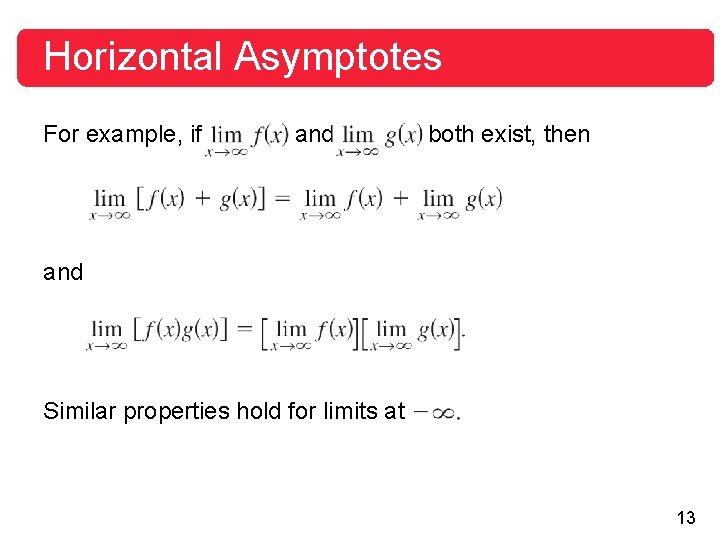
Horizontal Asymptotes For example, if and both exist, then and Similar properties hold for limits at 13
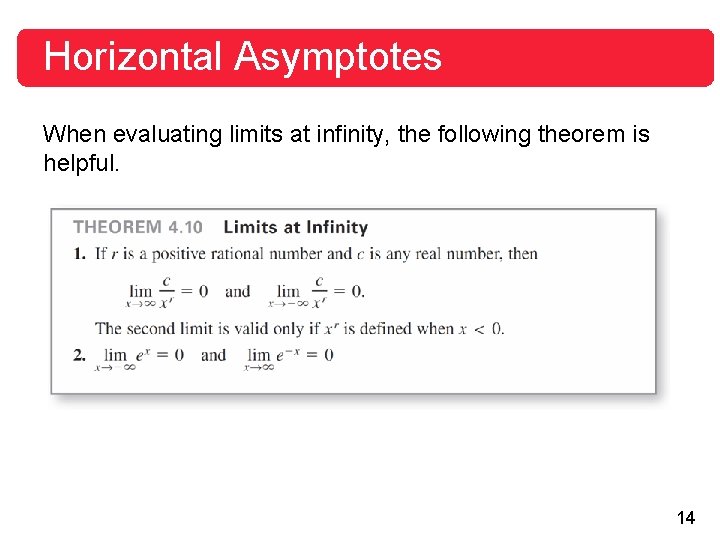
Horizontal Asymptotes When evaluating limits at infinity, the following theorem is helpful. 14
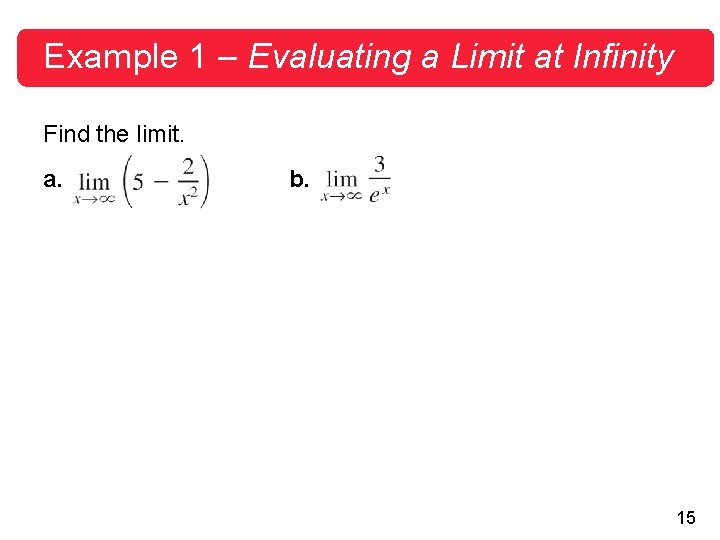
Example 1 – Evaluating a Limit at Infinity Find the limit. a. b. 15
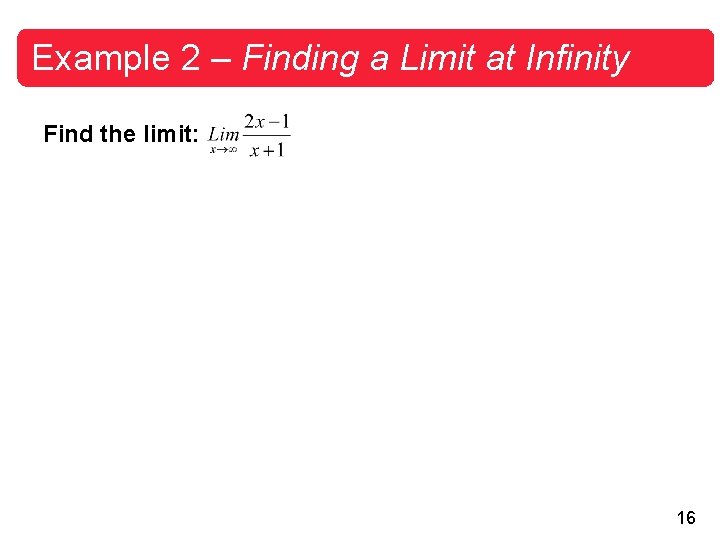
Example 2 – Finding a Limit at Infinity Find the limit: 16
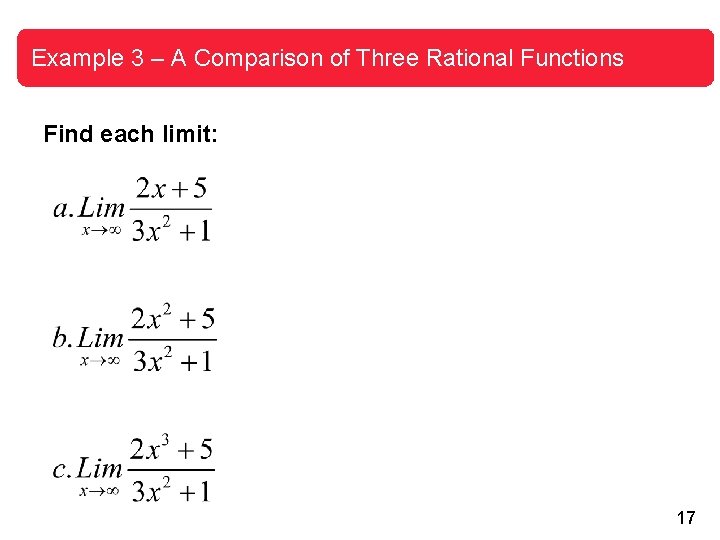
Example 3 – A Comparison of Three Rational Functions Find each limit: 17
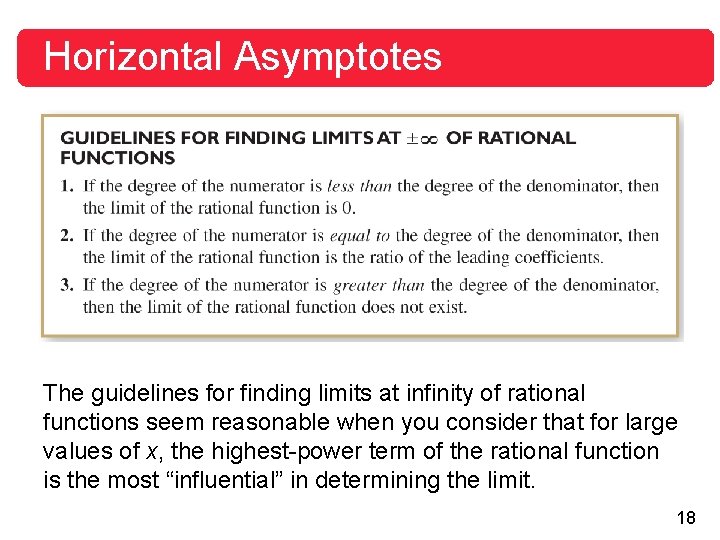
Horizontal Asymptotes The guidelines for finding limits at infinity of rational functions seem reasonable when you consider that for large values of x, the highest-power term of the rational function is the most “influential” in determining the limit. 18
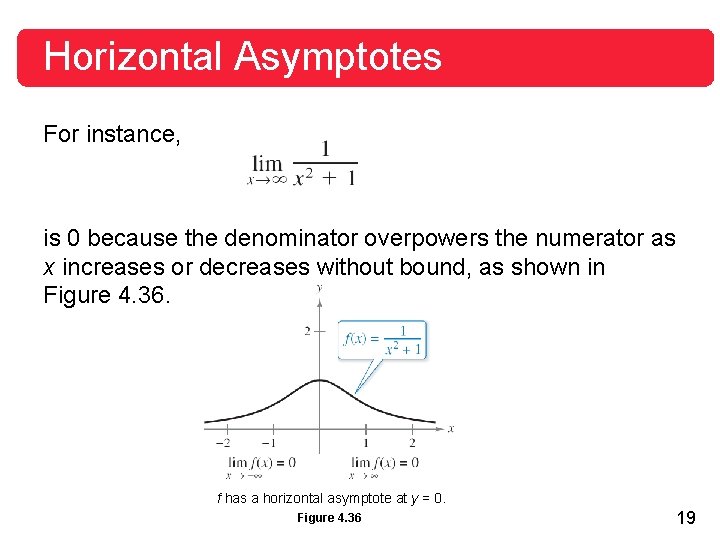
Horizontal Asymptotes For instance, is 0 because the denominator overpowers the numerator as x increases or decreases without bound, as shown in Figure 4. 36. f has a horizontal asymptote at y = 0. Figure 4. 36 19
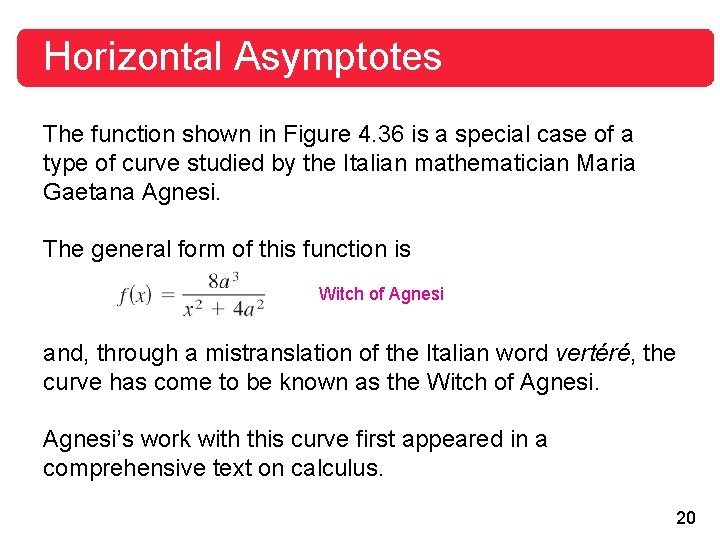
Horizontal Asymptotes The function shown in Figure 4. 36 is a special case of a type of curve studied by the Italian mathematician Maria Gaetana Agnesi. The general form of this function is Witch of Agnesi and, through a mistranslation of the Italian word vertéré, the curve has come to be known as the Witch of Agnesi’s work with this curve first appeared in a comprehensive text on calculus. 20
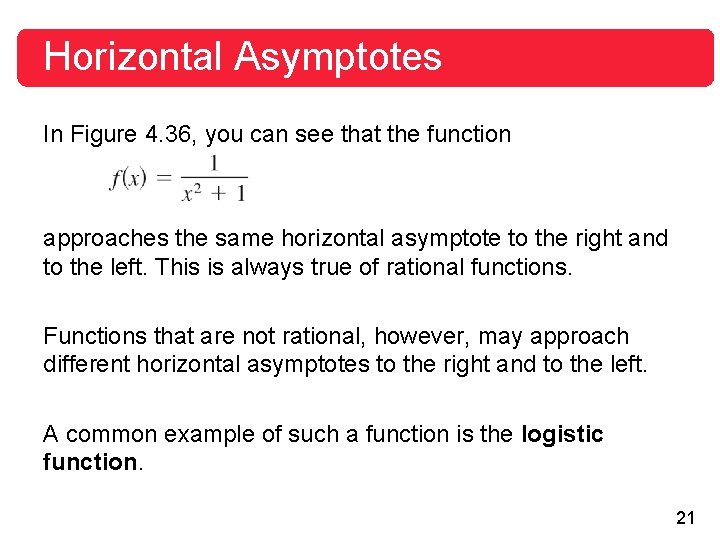
Horizontal Asymptotes In Figure 4. 36, you can see that the function approaches the same horizontal asymptote to the right and to the left. This is always true of rational functions. Functions that are not rational, however, may approach different horizontal asymptotes to the right and to the left. A common example of such a function is the logistic function. 21
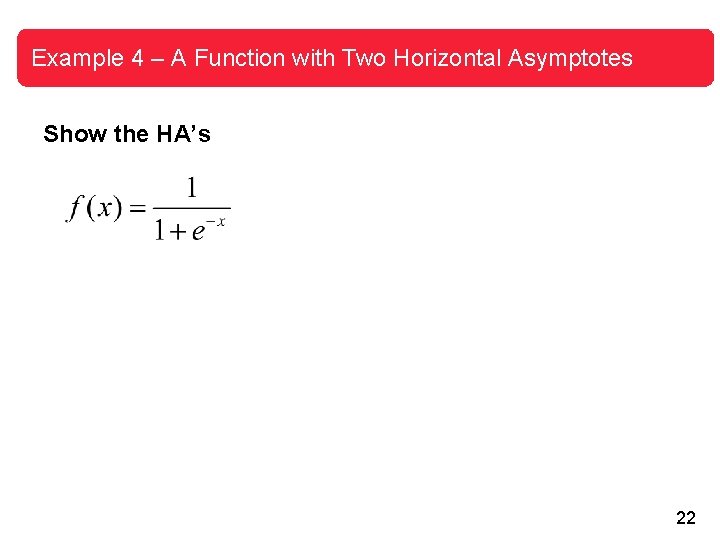
Example 4 – A Function with Two Horizontal Asymptotes Show the HA’s 22
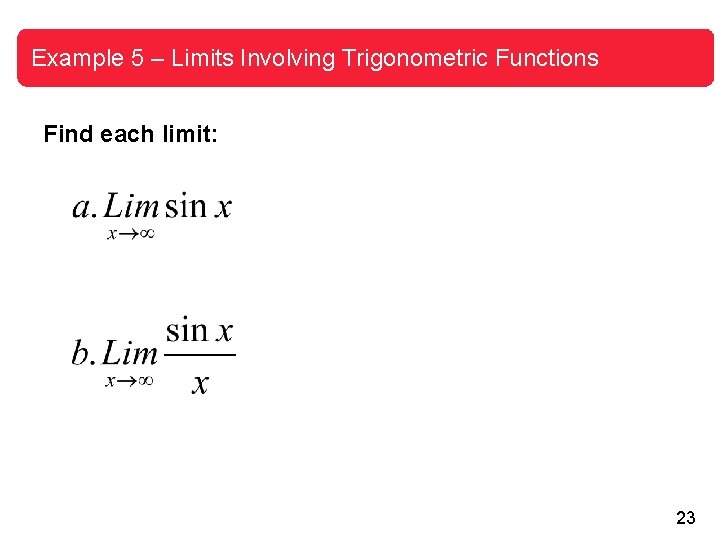
Example 5 – Limits Involving Trigonometric Functions Find each limit: 23
Infinite Limits at Infinity 24
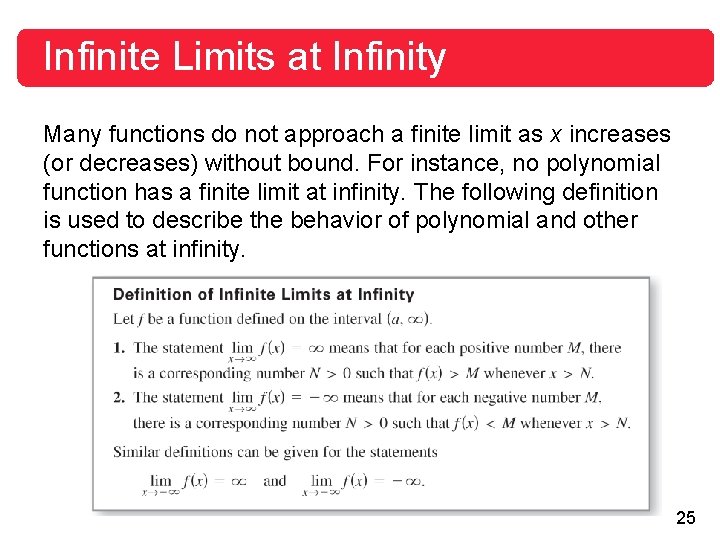
Infinite Limits at Infinity Many functions do not approach a finite limit as x increases (or decreases) without bound. For instance, no polynomial function has a finite limit at infinity. The following definition is used to describe the behavior of polynomial and other functions at infinity. 25
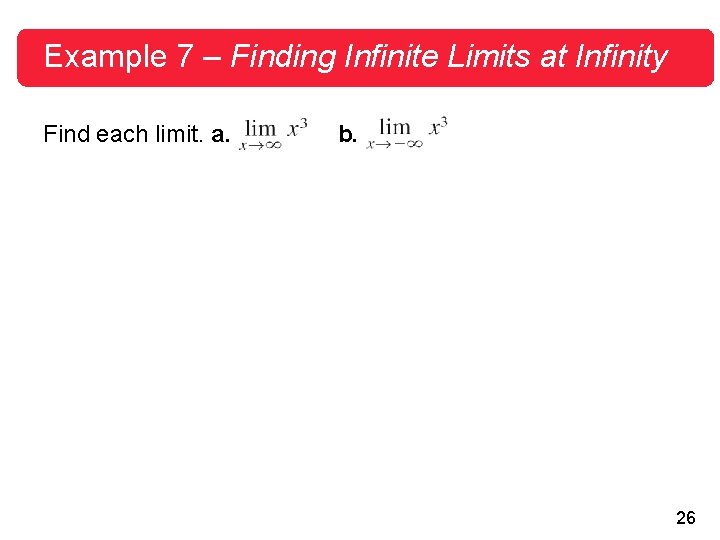
Example 7 – Finding Infinite Limits at Infinity Find each limit. a. b. 26
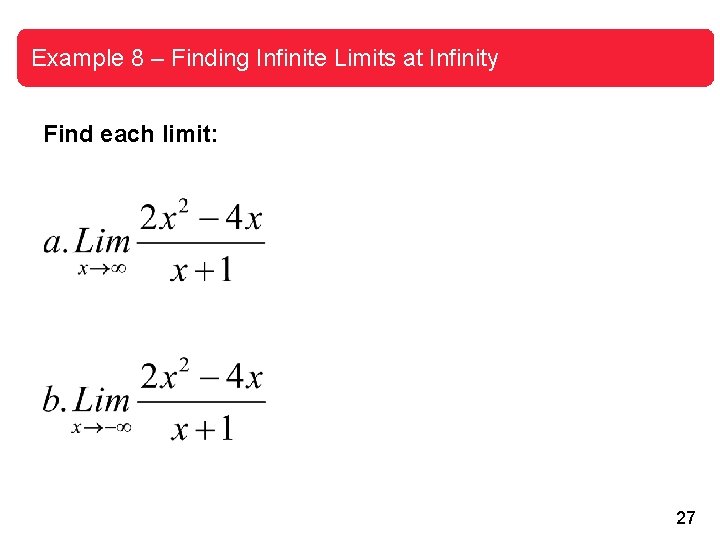
Example 8 – Finding Infinite Limits at Infinity Find each limit: 27