
4 ALLOWABLE STRESSES FOR WELDED JOINTS 1 Allowable
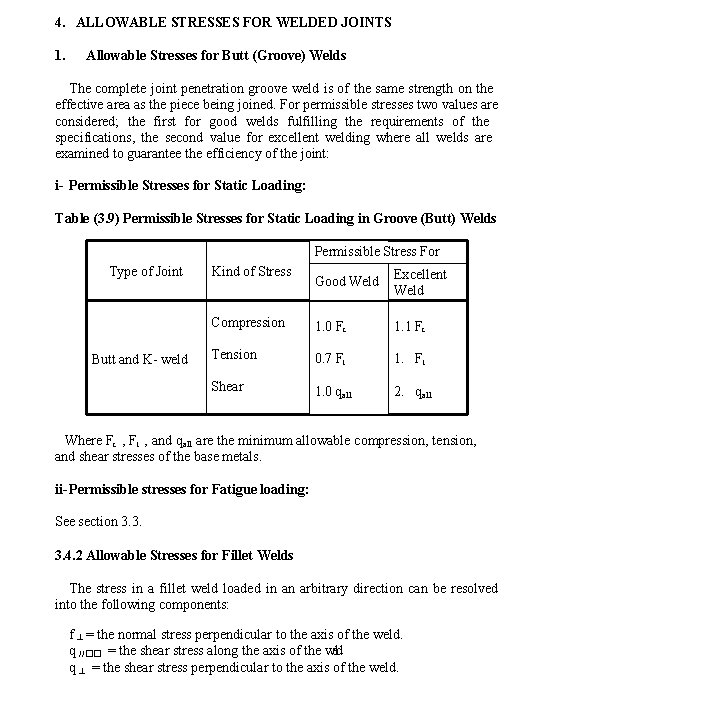
4. ALLOWABLE STRESSES FOR WELDED JOINTS 1. Allowable Stresses for Butt (Groove) Welds The complete joint penetration groove weld is of the same strength on the effective area as the piece being joined. For permissible stresses two values are considered; the first for good welds fulfilling the requirements of the specifications, the second value for excellent welding where all welds are examined to guarantee the efficiency of the joint: i- Permissible Stresses for Static Loading: Table (3. 9) Permissible Stresses for Static Loading in Groove (Butt) Welds Permissible Stress For Type of Joint Butt and K- weld Kind of Stress Good Weld Excellent Weld Compression 1. 0 Fc 1. 1 Fc Tension 0. 7 Ft 1. Ft Shear 1. 0 qall 2. qall Where Fc , Ft , and qall are the minimum allowable compression, tension, and shear stresses of the base metals. ii- Permissible stresses for Fatigue loading: See section 3. 3. 3. 4. 2 Allowable Stresses for Fillet Welds The stress in a fillet weld loaded in an arbitrary direction can be resolved into the following components: f = the normal stress perpendicular to the axis of the weld. q //�� = the shear stress along the axis of the weld. q = the shear stress perpendicular to the axis of the weld.
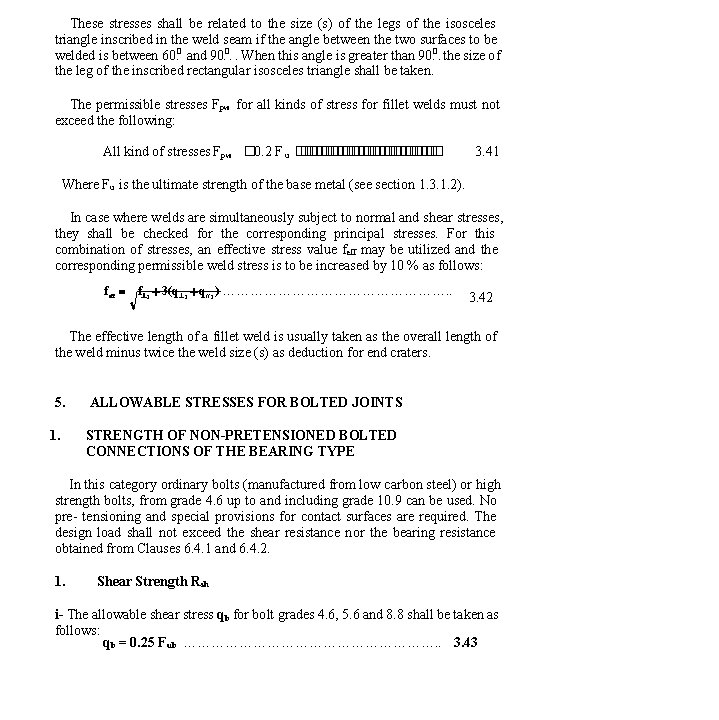
These stresses shall be related to the size (s) of the legs of the isosceles triangle inscribed in the weld seam if the angle between the two surfaces to be welded is between 60 O and 90 O. When this angle is greater than 90 O the size of the leg of the inscribed rectangular isosceles triangle shall be taken. P P P The permissible stresses Fpw for all kinds of stress for fillet welds must not exceed the following: All kind of stresses Fpw � 0. 2 F u � � � … � … � … �. � � 3. 41 Where Fu is the ultimate strength of the base metal (see section 1. 3. 1. 2). In case where welds are simultaneously subject to normal and shear stresses, they shall be checked for the corresponding principal stresses. For this combination of stresses, an effective stress value feff may be utilized and the corresponding permissible weld stress is to be increased by 10 % as follows: feff f 2 3(q 2 q // 2) ……………………. . 3. 42 The effective length of a fillet weld is usually taken as the overall length of the weld minus twice the weld size (s) as deduction for end craters. 5. 1. ALLOWABLE STRESSES FOR BOLTED JOINTS STRENGTH OF NON-PRETENSIONED BOLTED CONNECTIONS OF THE BEARING TYPE In this category ordinary bolts (manufactured from low carbon steel) or high strength bolts, from grade 4. 6 up to and including grade 10. 9 can be used. No pre- tensioning and special provisions for contact surfaces are required. The design load shall not exceed the shear resistance nor the bearing resistance obtained from Clauses 6. 4. 1 and 6. 4. 2. 1. Shear Strength Rsh i- The allowable shear stress qb for bolt grades 4. 6, 5. 6 and 8. 8 shall be taken as follows: qb = 0. 25 Fub ………………………. . 3. 43

ii- For bolt grades 4. 8, 5. 8 , 6. 8, and 10. 9, the allowable shear stress qb is reduced to the following: qb = 0. 2 Fub ………………. . ……………… 3. 44 iii- For the determination of the design shear strength per bolt (Rsh) , where the shear plane passes through the threaded portion of the bolt: Rsh = qb. As. n. …………………. 3. 45 Where : As = The tensile stress area of bolt. n = Number of shear planes. iv. For bolts where threads are excluded from the shear planes the gross cross sectional area of bolt (A) is to be utilized. v. The values for the design of shear strength given in Equations 6. 43 and 6. 44 are to be applied only where the bolts used in holes with nominal clearances not exceeding those for standard holes as specified in Clause 6. 2. 2 of Code. 3. 5. 1. 2 Bearing Strength Rb i- The bearing strength of a single bolt shall be the effective bearing area of bolt times the allowable bearing stress at bolt holes: Rb = Fb. d. min ∑ t ……………………. 3. 46 Where: Fb = Allowable bearing stress. d = Shank diameter of bolt. Min = Smallest sum of plate thicknesses in the same direction of the bearing pressure. ∑t ii- For distance center- to center of bolts not less than 3 d, and for end distance in the line of force greater than or equal to 1. 5 d, the allowable bearing stress Fb (t/cm 2): P P Fb = Fu …………………. . . ………………. 3. 47 Where: Fu = The ultimate tensile strength of the connected plates.
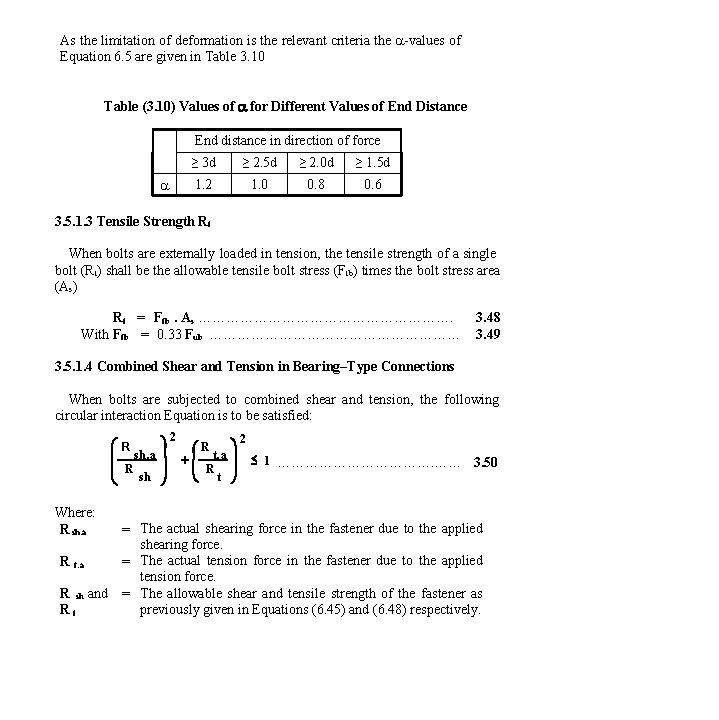
As the limitation of deformation is the relevant criteria the -values of Equation 6. 5 are given in Table 3. 10 Table (3. 10) Values of for Different Values of End Distance End distance in direction of force ≥ 3 d ≥ 2. 5 d ≥ 2. 0 d ≥ 1. 5 d 1. 2 1. 0 0. 8 0. 6 3. 5. 1. 3 Tensile Strength Rt When bolts are externally loaded in tension, the tensile strength of a single bolt (Rt) shall be the allowable tensile bolt stress (Ftb) times the bolt stress area (As) Rt = Ftb. As ………………………. With Ftb = 0. 33 Fub ……………………… 3. 48 3. 49 3. 5. 1. 4 Combined Shear and Tension in Bearing–Type Connections When bolts are subjected to combined shear and tension, the following circular interaction Equation is to be satisfied: 2 R R sh. a t. a R R sh t Where: R sh. a 2 1 ………………. …… 3. 50 = The actual shearing force in the fastener due to the applied shearing force. = The actual tension force in the fastener due to the applied R t. a tension force. R sh and = The allowable shear and tensile strength of the fastener as previously given in Equations (6. 45) and (6. 48) respectively. Rt
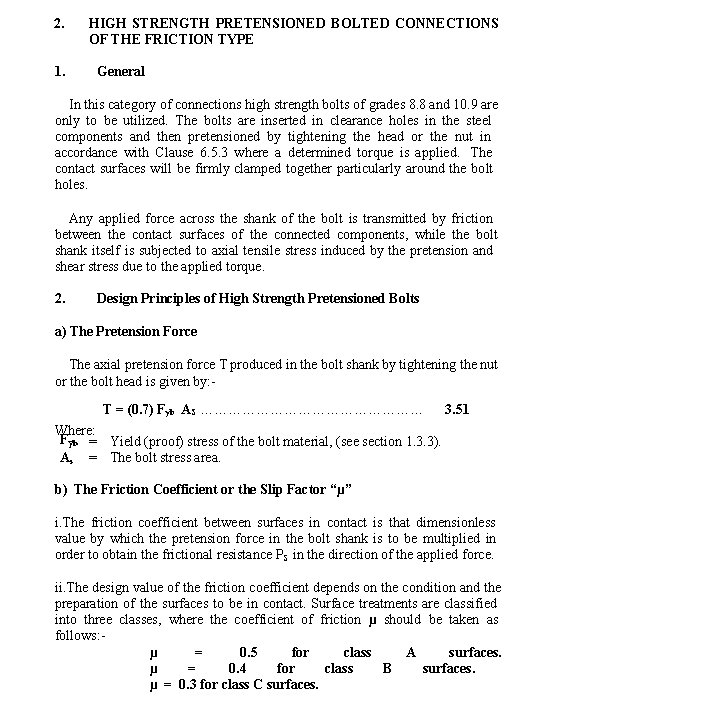
2. 1. HIGH STRENGTH PRETENSIONED BOLTED CONNECTIONS OF THE FRICTION TYPE General In this category of connections high strength bolts of grades 8. 8 and 10. 9 are only to be utilized. The bolts are inserted in clearance holes in the steel components and then pretensioned by tightening the head or the nut in accordance with Clause 6. 5. 3 where a determined torque is applied. The contact surfaces will be firmly clamped together particularly around the bolt holes. Any applied force across the shank of the bolt is transmitted by friction between the contact surfaces of the connected components, while the bolt shank itself is subjected to axial tensile stress induced by the pretension and shear stress due to the applied torque. 2. Design Principles of High Strength Pretensioned Bolts a) The Pretension Force The axial pretension force T produced in the bolt shank by tightening the nut or the bolt head is given by: T = (0. 7) Fyb AS …………………… 3. 51 Where: Fyb = Yield (proof) stress of the bolt material, (see section 1. 3. 3). As = The bolt stress area. b) The Friction Coefficient or the Slip Factor “µ” i. The friction coefficient between surfaces in contact is that dimensionless value by which the pretension force in the bolt shank is to be multiplied in order to obtain the frictional resistance PS in the direction of the applied force. ii. The design value of the friction coefficient depends on the condition and the preparation of the surfaces to be in contact. Surface treatments are classified into three classes, where the coefficient of friction µ should be taken as follows: µ = 0. 5 for class A surfaces. µ = 0. 4 for class B surfaces. µ = 0. 3 for class C surfaces.
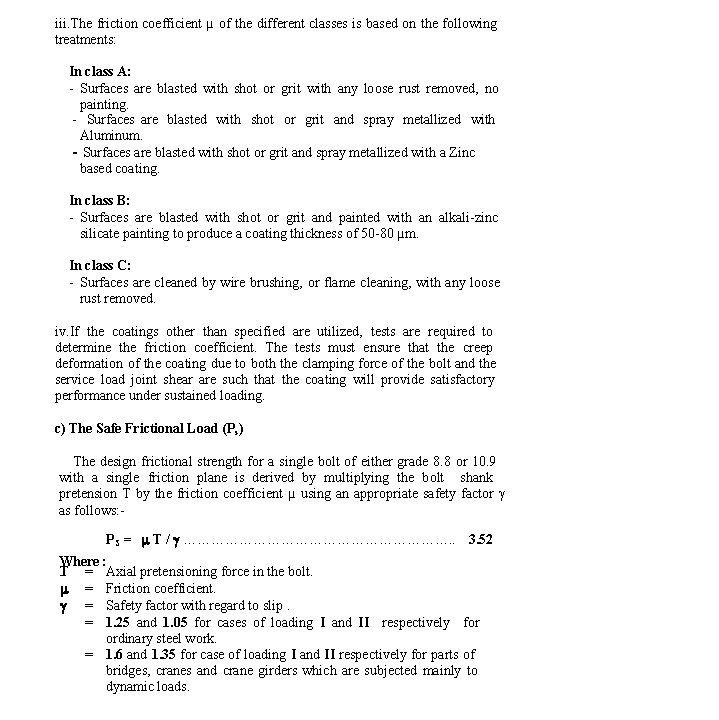
iii. The friction coefficient µ of the different classes is based on the following treatments: In class A: - Surfaces are blasted with shot or grit with any loose rust removed, no painting. - Surfaces are blasted with shot or grit and spray metallized with Aluminum. - Surfaces are blasted with shot or grit and spray metallized with a Zinc based coating. In class B: - Surfaces are blasted with shot or grit and painted with an alkali-zinc silicate painting to produce a coating thickness of 50 -80 µm. In class C: - Surfaces are cleaned by wire brushing, or flame cleaning, with any loose rust removed. iv. If the coatings other than specified are utilized, tests are required to determine the friction coefficient. The tests must ensure that the creep deformation of the coating due to both the clamping force of the bolt and the service load joint shear are such that the coating will provide satisfactory performance under sustained loading. c) The Safe Frictional Load (Ps) The design frictional strength for a single bolt of either grade 8. 8 or 10. 9 with a single friction plane is derived by multiplying the bolt shank pretension T by the friction coefficient µ using an appropriate safety factor as follows: PS = T / …………………………. . 3. 52 Where : T = Axial pretensioning force in the bolt. = Friction coefficient. = Safety factor with regard to slip. = 1. 25 and 1. 05 for cases of loading I and II respectively for ordinary steel work. = 1. 6 and 1. 35 for case of loading I and II respectively for parts of bridges, cranes and crane girders which are subjected mainly to dynamic loads. 0 B
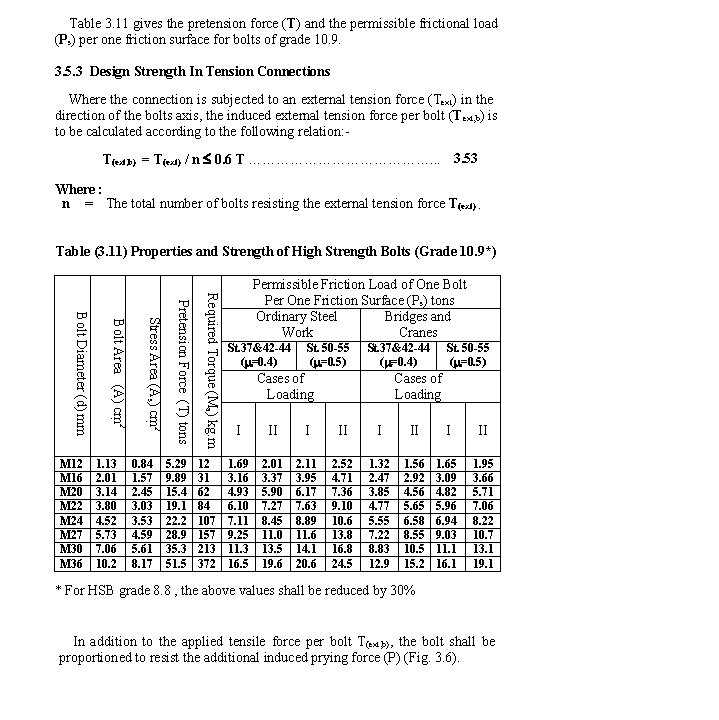
Table 3. 11 gives the pretension force (T) and the permissible frictional load (Ps) per one friction surface for bolts of grade 10. 9. 3. 5. 3 Design Strength In Tension Connections Where the connection is subjected to an external tension force (Text) in the direction of the bolts axis, the induced external tension force per bolt (Text, b) is to be calculated according to the following relation: T(ext, b) = T(ext) / n 0. 6 T …………………. . . 3. 53 Where : n = The total number of bolts resisting the external tension force T(ext). 1 B Table (3. 11) Properties and Strength of High Strength Bolts (Grade 10. 9*) 5. 29 9. 89 15. 4 19. 1 22. 2 28. 9 35. 3 51. 5 Required Torque (Ma) kg. m 0. 84 1. 57 2. 45 3. 03 3. 53 4. 59 5. 61 8. 17 Pretension Force (T) tons P 1. 13 2. 01 3. 14 3. 80 4. 52 5. 73 7. 06 10. 2 Stress Area (As) cm 2 P Bolt Area (A) cm 2 Bolt Diameter (d) mm M 12 M 16 M 20 M 22 M 24 M 27 M 30 M 36 12 31 62 84 107 157 213 372 Permissible Friction Load of One Bolt Per One Friction Surface (Ps) tons Ordinary Steel Bridges and Work Cranes St. 37&42 -44 ( =0. 4) St. 50 -55 ( =0. 5) St. 37&42 -44 ( =0. 4) Cases of Loading St. 50 -55 ( =0. 5) Cases of Loading I II 1. 69 3. 16 4. 93 6. 10 7. 11 9. 25 11. 3 16. 5 2. 01 3. 37 5. 90 7. 27 8. 45 11. 0 13. 5 19. 6 2. 11 3. 95 6. 17 7. 63 8. 89 11. 6 14. 1 20. 6 2. 52 4. 71 7. 36 9. 10 10. 6 13. 8 16. 8 24. 5 1. 32 2. 47 3. 85 4. 77 5. 55 7. 22 8. 83 12. 9 1. 56 2. 92 4. 56 5. 65 6. 58 8. 55 10. 5 15. 2 1. 65 3. 09 4. 82 5. 96 6. 94 9. 03 11. 1 16. 1 1. 95 3. 66 5. 71 7. 06 8. 22 10. 7 13. 1 19. 1 * For HSB grade 8. 8 , the above values shall be reduced by 30% In addition to the applied tensile force per bolt T(ext, b), the bolt shall be proportioned to resist the additional induced prying force (P) (Fig. 3. 6).
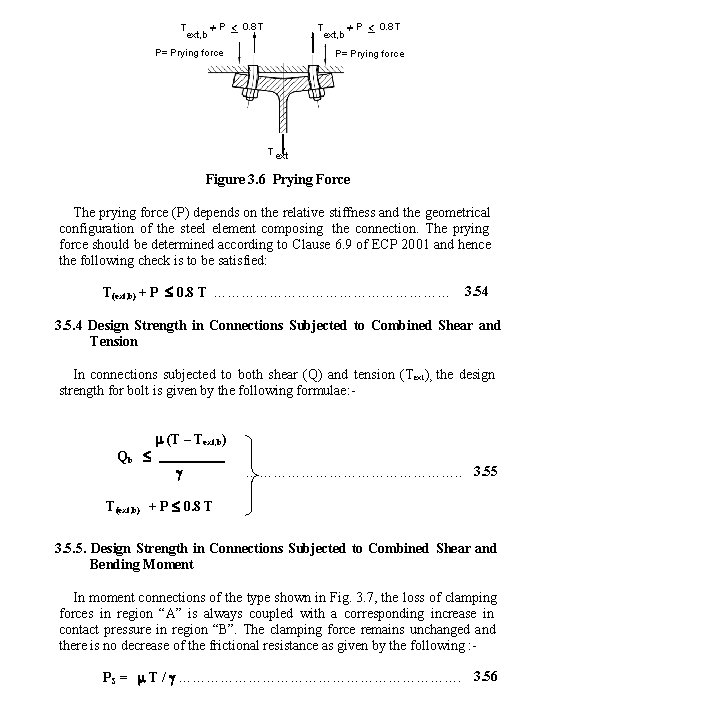
T ext, b P 0. 8 T T ext, b P= Prying force P 0. 8 T P= Prying force T ext Figure 3. 6 Prying Force The prying force (P) depends on the relative stiffness and the geometrical configuration of the steel element composing the connection. The prying force should be determined according to Clause 6. 9 of ECP 2001 and hence the following check is to be satisfied: T(ext, b) + P 0. 8 T ……………………… 3. 54 3. 5. 4 Design Strength in Connections Subjected to Combined Shear and Tension In connections subjected to both shear (Q) and tension (Text), the design strength for bolt is given by the following formulae: - Qb (T – Text, b) ……………………. . 3. 55 T(ext, b) + P 0. 8 T 3. 5. 5. Design Strength in Connections Subjected to Combined Shear and Bending Moment In moment connections of the type shown in Fig. 3. 7, the loss of clamping forces in region “A” is always coupled with a corresponding increase in contact pressure in region “B”. The clamping force remains unchanged and there is no decrease of the frictional resistance as given by the following : PS = T / …………………………. 3. 56
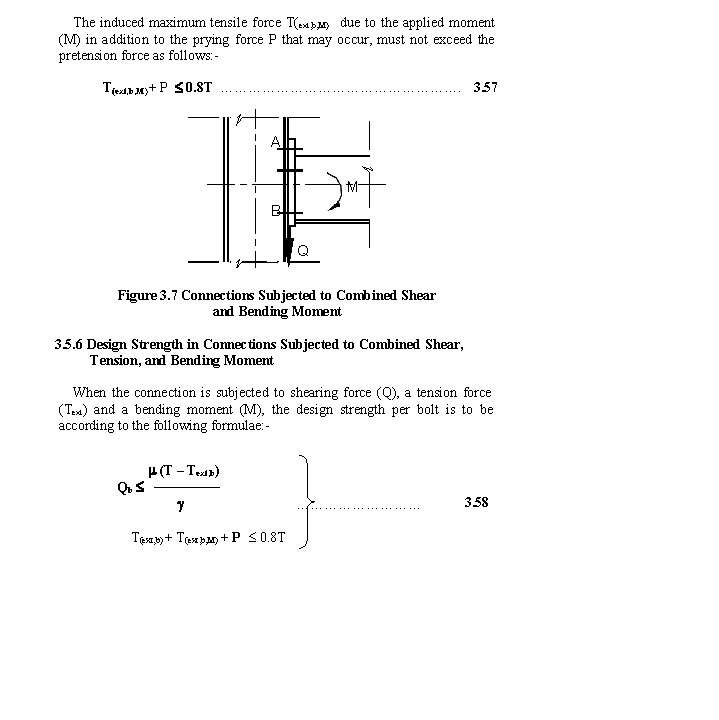
The induced maximum tensile force T(ext, b, M) due to the applied moment (M) in addition to the prying force P that may occur, must not exceed the pretension force as follows: T(ext, b, M) + P 0. 8 T ………………………. 3. 57 A M B Q Figure 3. 7 Connections Subjected to Combined Shear and Bending Moment 3. 5. 6 Design Strength in Connections Subjected to Combined Shear, Tension, and Bending Moment When the connection is subjected to shearing force (Q), a tension force (Text) and a bending moment (M), the design strength per bolt is to be according to the following formulae: - Qb (T – Text, b) T(ext, b) + T(ext, b, M) + P 0. 8 T …………… 3. 58
- Slides: 9