
4 Absorbance is measured at 490 nm 5
4. Absorbance is measured at 490 nm. 5. The average absorbance of the blanks is subtracted, and the amount of sugar is determined by references to a standard curve. 21 Dr. Sahar Abd El-Hakeem
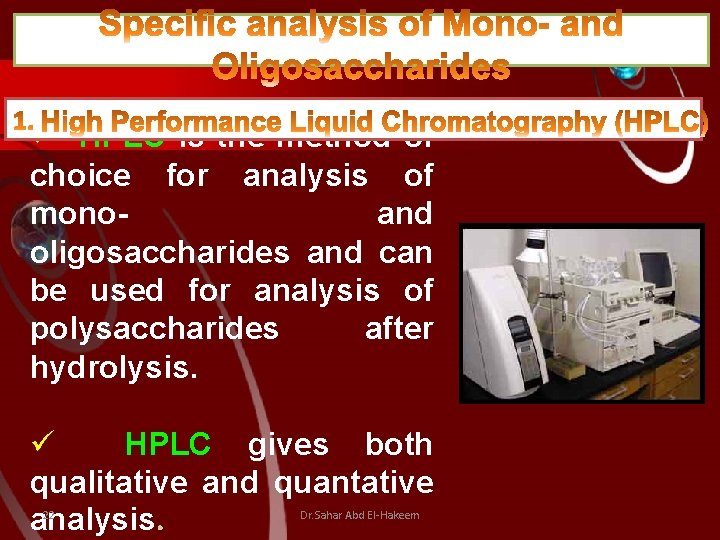
ü HPLC is the method of choice for analysis of monoand oligosaccharides and can be used for analysis of polysaccharides after hydrolysis. ü HPLC gives both qualitative and quantative analysis. 22 Dr. Sahar Abd El-Hakeem
üHPLC analysis is rapid, can tolerate a wide range of sample concentrations, and provides a high degree of precision and accuracy. ü The basic principles and important parameters of HPLC are (the stationary phase, mobile phase, and the detector). ü The USDA Food Safety and Inspection Service recommends use of HPLC for determination of sugars in meat and poultry products 23 Dr. Sahar Abd El-Hakeem
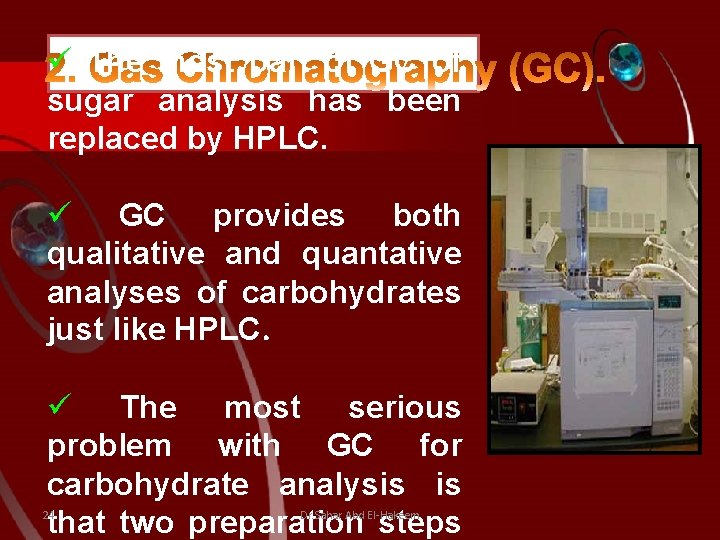
ü The most part of GC of sugar analysis has been replaced by HPLC. ü GC provides both qualitative and quantative analyses of carbohydrates just like HPLC. ü The most serious problem with GC for carbohydrate analysis is that two preparation steps 24 Dr. Sahar Abd El-Hakeem
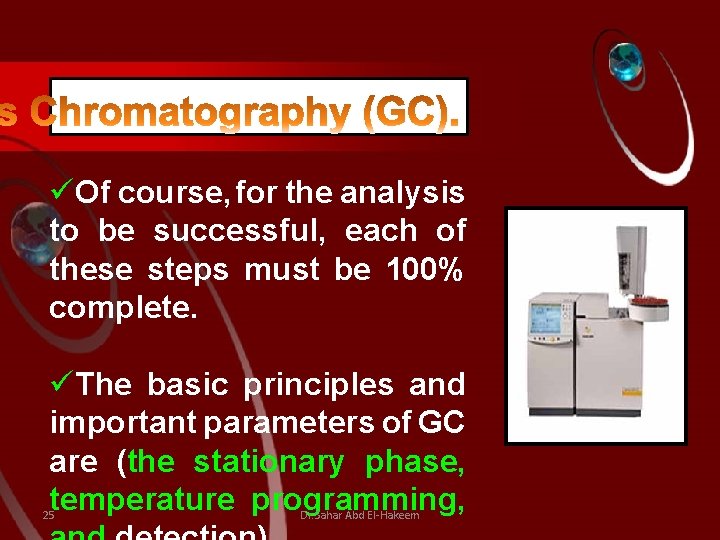
üOf course, for the analysis to be successful, each of these steps must be 100% complete. üThe basic principles and important parameters of GC are (the stationary phase, temperature programming, 25 Dr. Sahar Abd El-Hakeem
v. The method of choice for the determination of starch. v. This methods employs a combination of enzymes in sequential enzyme-catalyzed reactions. v. It is specific for starch, as long as purified enzyme preparations are used. 26 Dr. Sahar Abd El-Hakeem
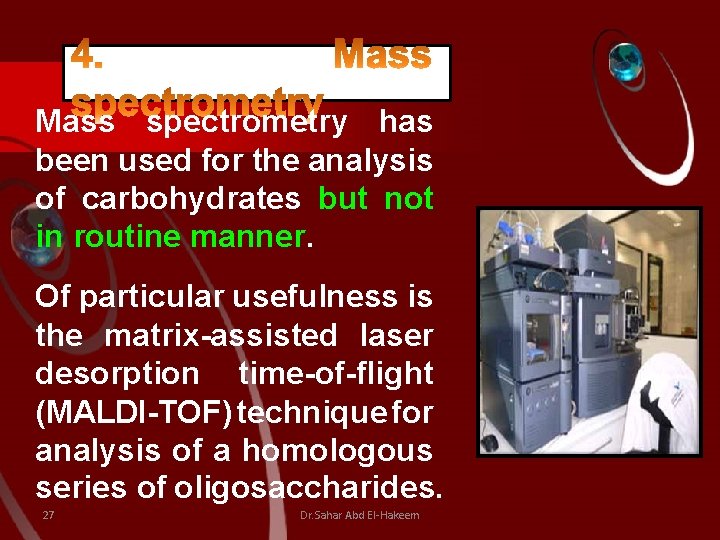
Mass spectrometry has been used for the analysis of carbohydrates but not in routine manner. Of particular usefulness is the matrix-assisted laser desorption time-of-flight (MALDI-TOF) technique for analysis of a homologous series of oligosaccharides. 27 Dr. Sahar Abd El-Hakeem
v. Thin-Layer Chromatography has been used for identification and quantitation of the sugars present in the molasses from sugar beet and cane processing. v. It is particularly useful for rapid screening of several samples simultaneously. 28 Dr. Sahar Abd El-Hakeem
v. Capillary Zone Electrophoresis has been used to separate and measure carbohydrates, but because carbohydrates lack chromosphores, pre-column derivatization and detection with a UV or fluorescence detector is required. v. Generally, this method provides no advantage over 29 Dr. Sahar Abd El-Hakeem
◙ Microscopy ◙ Spectrometry ◙ Specific Gravity ◙ Refractive Index ◙ Polarimetry 30 Dr. Sahar Abd El-Hakeem
- Slides: 10