
4 a Price Elasticity of Demand This web

4 a – Price Elasticity of Demand This web quiz may appear as two pages on tablets and laptops. I recommend that you view it as one page by clicking on the open book icon at the bottom of the page.
4 a – Price Elasticity of Demand • Price Elasticity of Demand • Tax Incidence and Efficiency Loss
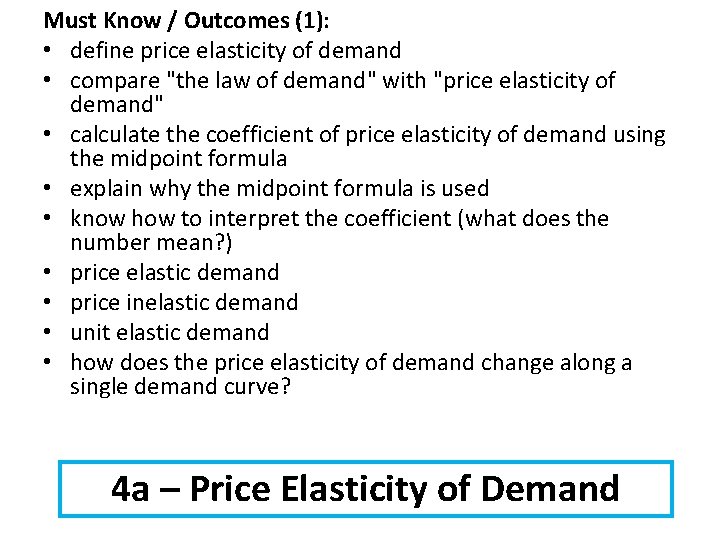
Must Know / Outcomes (1): • define price elasticity of demand • compare "the law of demand" with "price elasticity of demand" • calculate the coefficient of price elasticity of demand using the midpoint formula • explain why the midpoint formula is used • know how to interpret the coefficient (what does the number mean? ) • price elastic demand • price inelastic demand • unit elastic demand • how does the price elasticity of demand change along a single demand curve? 4 a – Price Elasticity of Demand
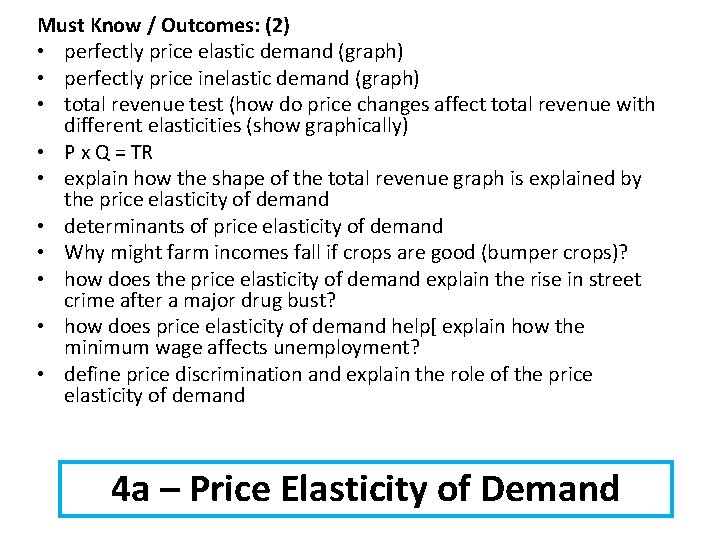
Must Know / Outcomes: (2) • perfectly price elastic demand (graph) • perfectly price inelastic demand (graph) • total revenue test (how do price changes affect total revenue with different elasticities (show graphically) • P x Q = TR • explain how the shape of the total revenue graph is explained by the price elasticity of demand • determinants of price elasticity of demand • Why might farm incomes fall if crops are good (bumper crops)? • how does the price elasticity of demand explain the rise in street crime after a major drug bust? • how does price elasticity of demand help[ explain how the minimum wage affects unemployment? • define price discrimination and explain the role of the price elasticity of demand 4 a – Price Elasticity of Demand
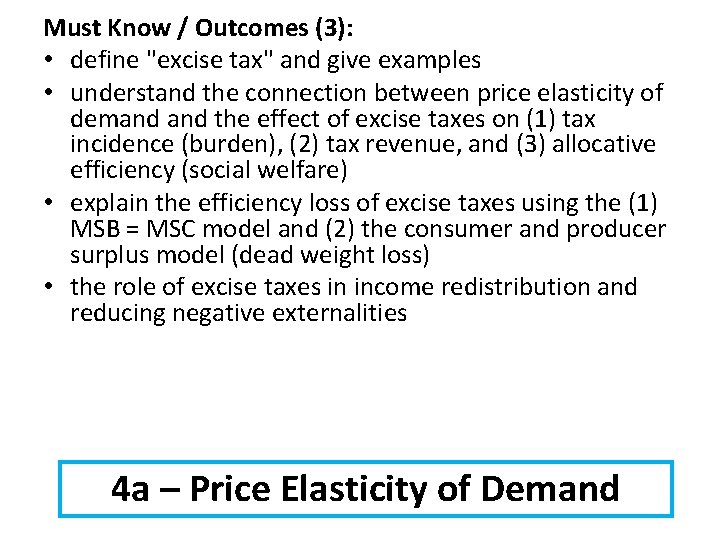
Must Know / Outcomes (3): • define "excise tax" and give examples • understand the connection between price elasticity of demand the effect of excise taxes on (1) tax incidence (burden), (2) tax revenue, and (3) allocative efficiency (social welfare) • explain the efficiency loss of excise taxes using the (1) MSB = MSC model and (2) the consumer and producer surplus model (dead weight loss) • the role of excise taxes in income redistribution and reducing negative externalities 4 a – Price Elasticity of Demand
KEY TERMS: elasticity, price elasticity of demand, midpoint formula, coefficient of price elasticity of demand, price elastic demand, price inelastic demand, unit elastic demand, perfectly elastic demand perfectly inelastic demand, total revenue, price discrimination, excise tax, tax incidence (tax burden), efficiency loss of a tax, payroll tax, 4 a – Price Elasticity of Demand
ELASTICITY: HOW MUCH does one variable change in response to a change in another variable. Elasticity = HOW MUCH 4 a – Price Elasticity of Demand
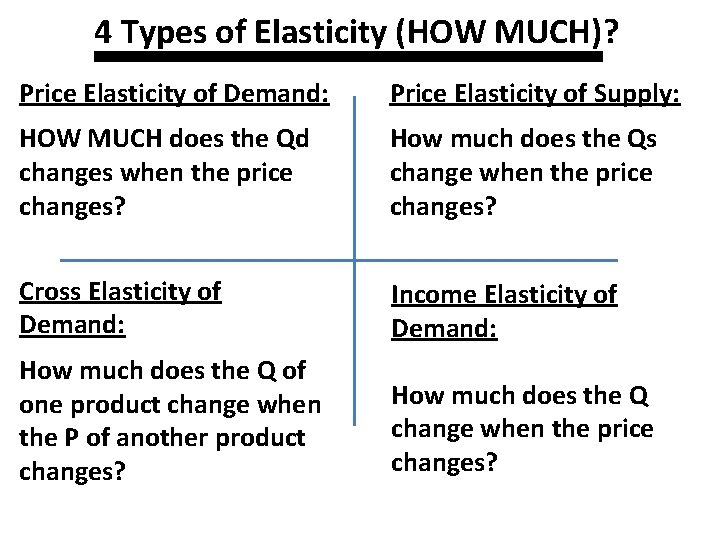
4 Types of Elasticity (HOW MUCH)? Price Elasticity of Demand: Price Elasticity of Supply: HOW MUCH does the Qd changes when the price changes? How much does the Qs change when the price changes? Cross Elasticity of Demand: Income Elasticity of Demand: How much does the Q of one product change when the P of another product changes? How much does the Q change when the price changes?
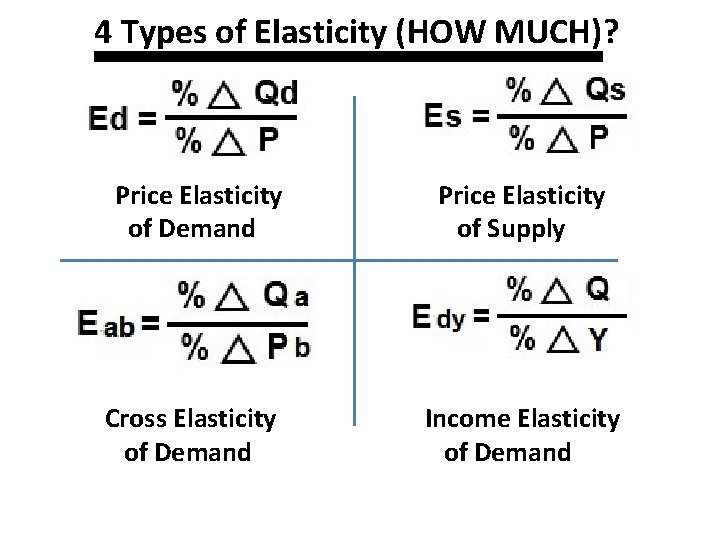
4 Types of Elasticity (HOW MUCH)? Price Elasticity of Demand Price Elasticity of Supply Cross Elasticity of Demand Income Elasticity of Demand
1. Another term for “elasticity” might be: 1. 2. 3. 4. effectiveness shortage surplus responsiveness
1. Another term for “elasticity” might be: 1. 2. 3. 4. effectiveness shortage surplus responsiveness

4 a – Price Elasticity of Demand Definition of Price Elasticity of Demand A measure of the responsiveness of buyers to a change in the price of a product or resource. The ratio of the percentage change in quantity demanded of a product or resource to the percentage change in its price. HOW MUCH does quantity demanded change when the price changes
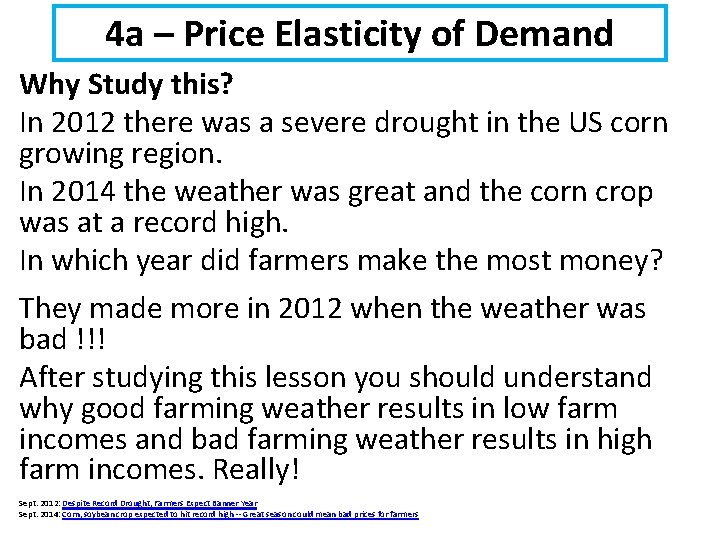
4 a – Price Elasticity of Demand Why Study this? In 2012 there was a severe drought in the US corn growing region. In 2014 the weather was great and the corn crop was at a record high. In which year did farmers make the most money? They made more in 2012 when the weather was bad !!! After studying this lesson you should understand why good farming weather results in low farm incomes and bad farming weather results in high farm incomes. Really! Sept. 2012: Despite Record Drought, Farmers Expect Banner Year Sept. 2014: Corn, soybean crop expected to hit record high -- Great season could mean bad prices for farmers
2. Firm’s use the price elasticity of demand to determine how a change in price will affect: 1. 2. 3. 4. prices of other goods revenues supply demand
2. Firm’s use the price elasticity of demand to determine how a change in price will affect: 1. 2. 3. 4. prices of other goods revenues supply demand
4 a – Price Elasticity of Demand Ways to Assess the Price Elasticity of Demand: 1. Guess • • gasoline? Big Mac? salt? new car? 2. Calculate the Coefficient 3. Total Revenue Test 4. Make an informed guess: use the Determinants
4 a – Price Elasticity of Demand Ways to Assess the Price Elasticity of Demand: 1. Guess 2. Calculate the Coefficient • • Midpoint formula YP 2 Elastic, inelastic, unit elastic Interpret the coefficient YP 5 #3 Perfectly elastic, perfectly inelastic 3. Total Revenue Test 4. Make an informed guess: use the Determinants
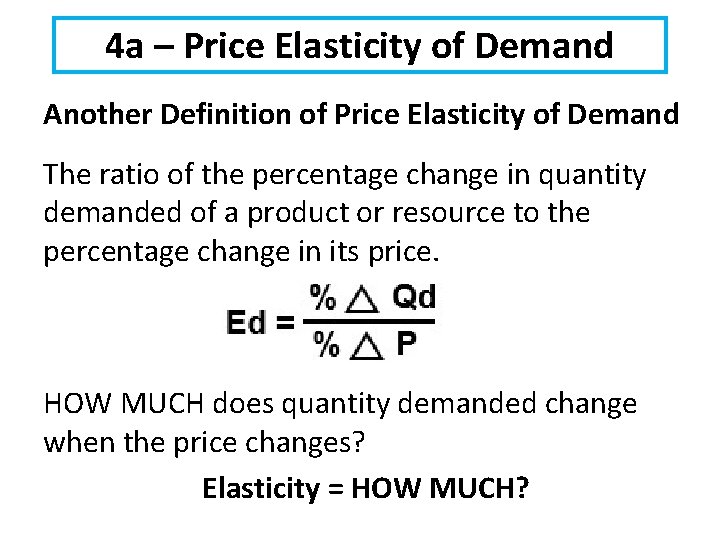
4 a – Price Elasticity of Demand Another Definition of Price Elasticity of Demand The ratio of the percentage change in quantity demanded of a product or resource to the percentage change in its price. HOW MUCH does quantity demanded change when the price changes? Elasticity = HOW MUCH?
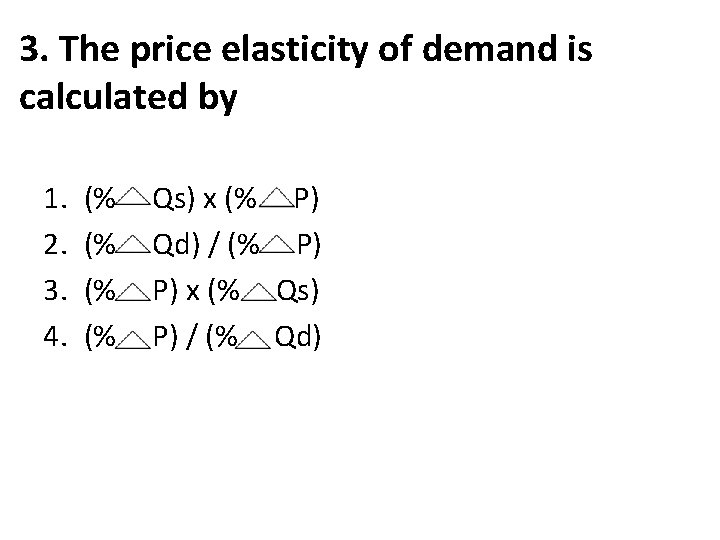
3. The price elasticity of demand is calculated by 1. 2. 3. 4. (% (% Qs) x (% P) Qd) / (% P) P) x (% Qs) P) / (% Qd)
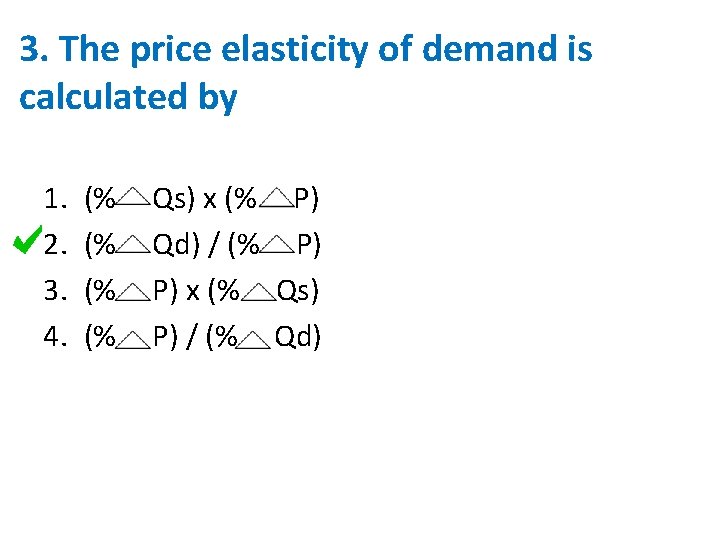
3. The price elasticity of demand is calculated by 1. 2. 3. 4. (% (% Qs) x (% P) Qd) / (% P) P) x (% Qs) P) / (% Qd)
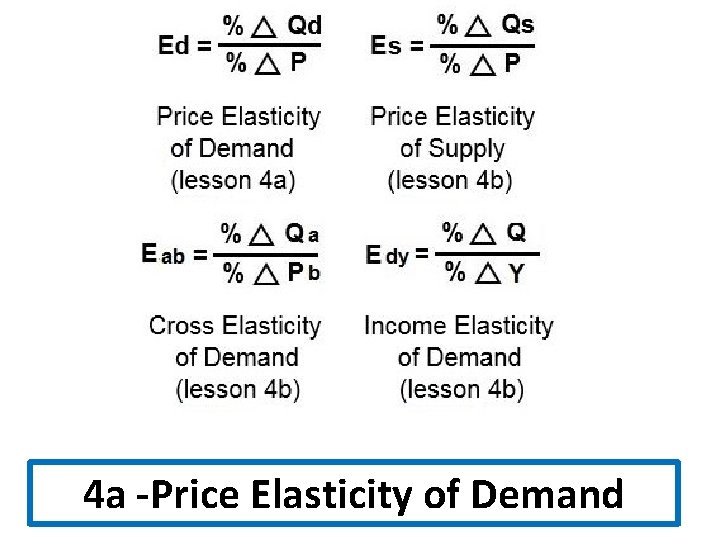
4 a -Price Elasticity of Demand
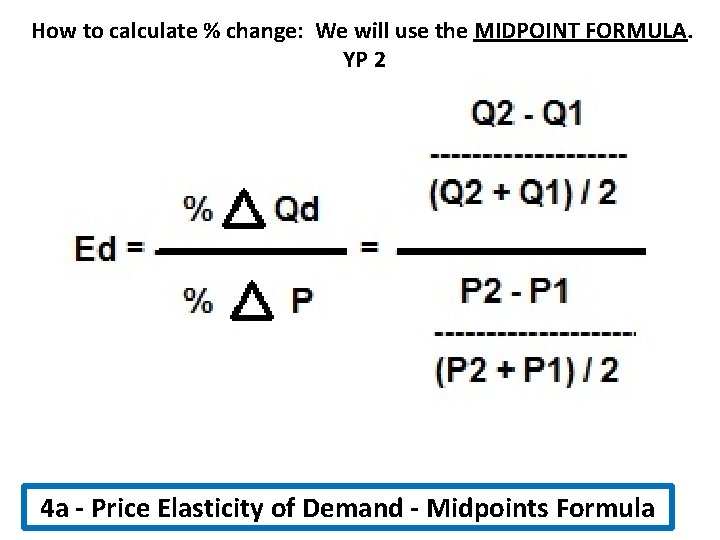
How to calculate % change: We will use the MIDPOINT FORMULA. YP 2 4 a - Price Elasticity of Demand - Midpoints Formula
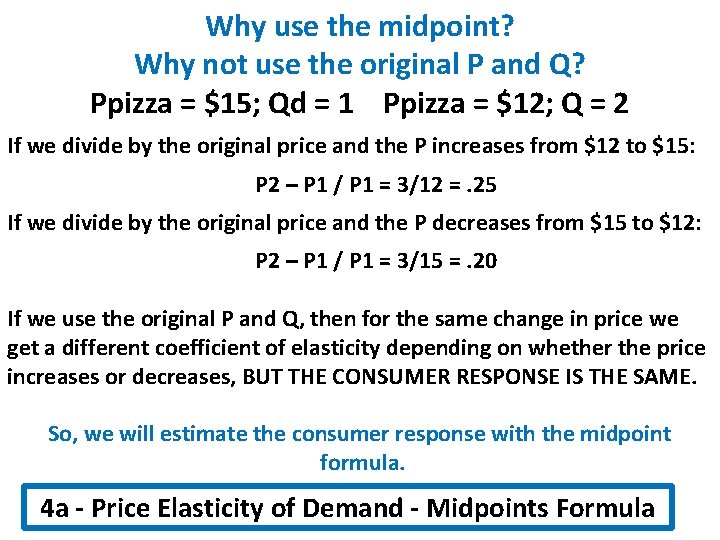
Why use the midpoint? Why not use the original P and Q? Ppizza = $15; Qd = 1 Ppizza = $12; Q = 2 If we divide by the original price and the P increases from $12 to $15: P 2 – P 1 / P 1 = 3/12 =. 25 If we divide by the original price and the P decreases from $15 to $12: P 2 – P 1 / P 1 = 3/15 =. 20 If we use the original P and Q, then for the same change in price we get a different coefficient of elasticity depending on whether the price increases or decreases, BUT THE CONSUMER RESPONSE IS THE SAME. So, we will estimate the consumer response with the midpoint formula. 4 a - Price Elasticity of Demand - Midpoints Formula
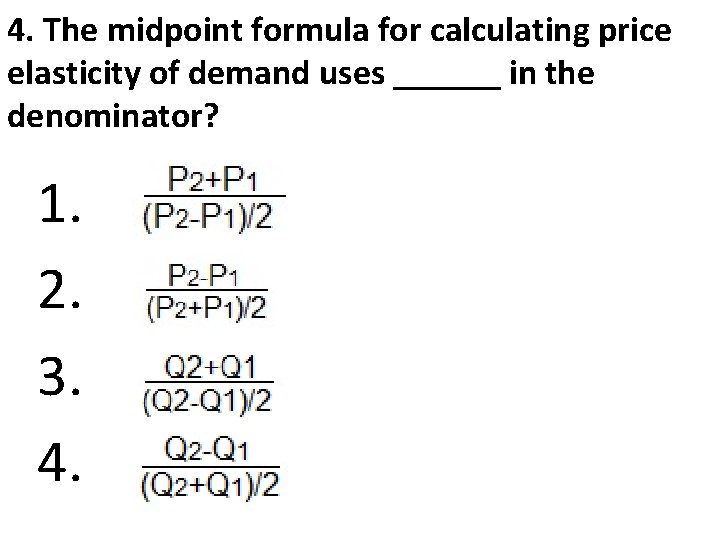
4. The midpoint formula for calculating price elasticity of demand uses ______ in the denominator? 1. 2. 3. 4.
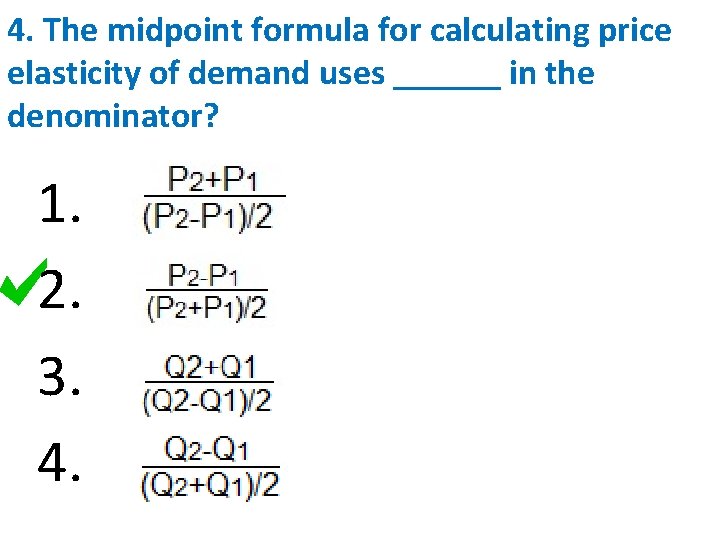
4. The midpoint formula for calculating price elasticity of demand uses ______ in the denominator? 1. 2. 3. 4.
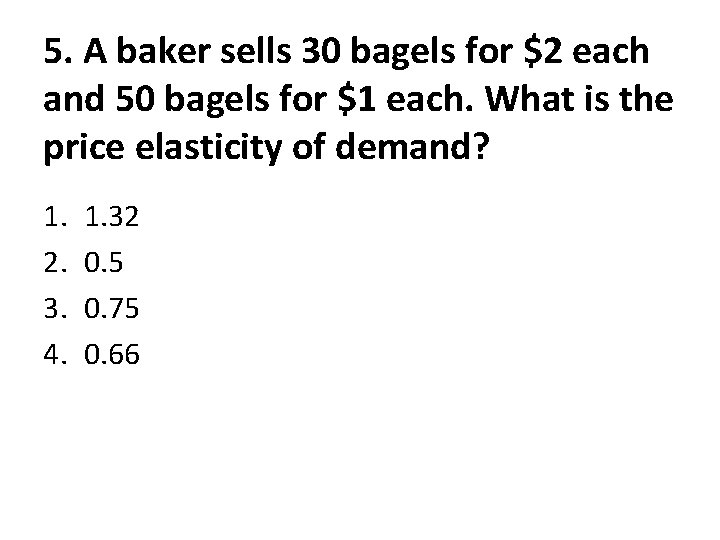
5. A baker sells 30 bagels for $2 each and 50 bagels for $1 each. What is the price elasticity of demand? 1. 2. 3. 4. 1. 32 0. 5 0. 75 0. 66
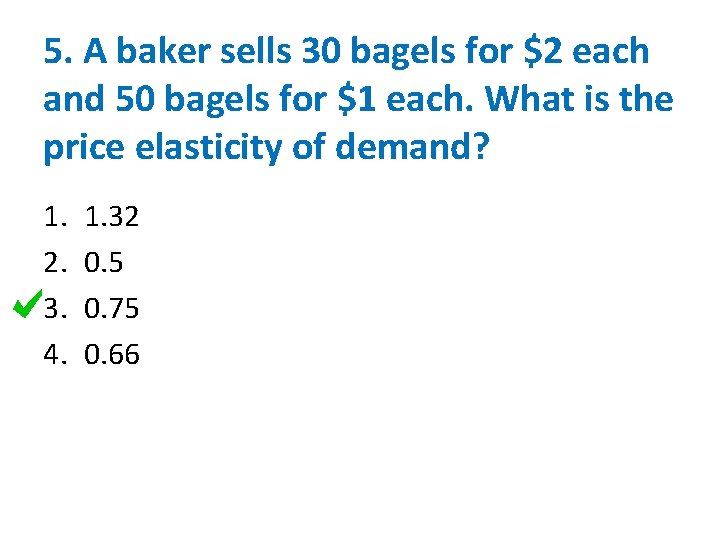
5. A baker sells 30 bagels for $2 each and 50 bagels for $1 each. What is the price elasticity of demand? 1. 2. 3. 4. 1. 32 0. 5 0. 75 0. 66
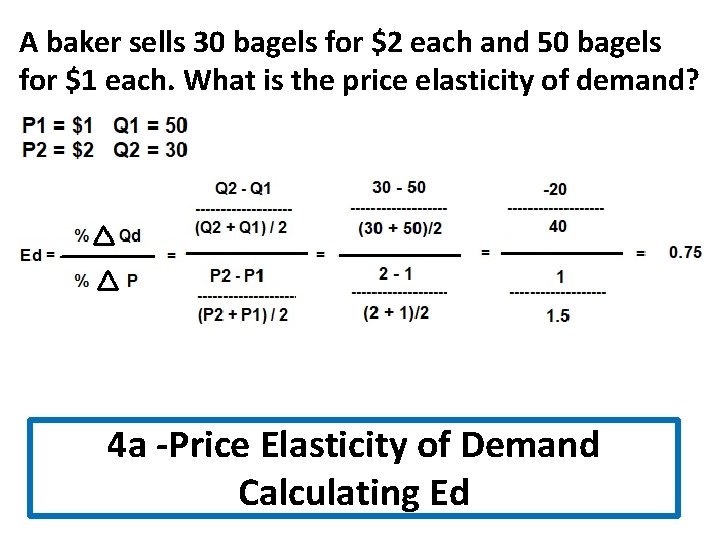
A baker sells 30 bagels for $2 each and 50 bagels for $1 each. What is the price elasticity of demand? 4 a -Price Elasticity of Demand Calculating Ed
6. An excellent harvest of oranges has caused the price to fall by 10%. Consumers respond by buying 5% more. The demand for oranges: 1. 2. 3. 4. is price elastic is price inelastic is unit elastic has increased
6. An excellent harvest of oranges has caused the price to fall by 10%. Consumers respond by buying 5% more. The demand for oranges: 1. 2. 3. 4. is price elastic is price inelastic is unit elastic has increased
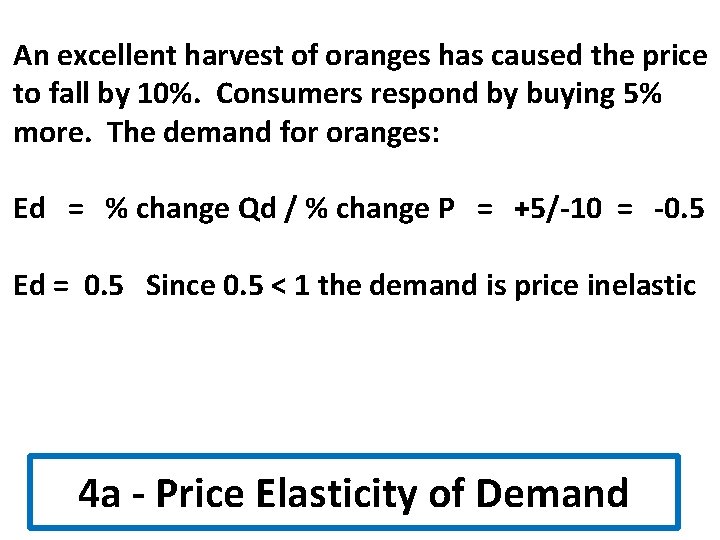
An excellent harvest of oranges has caused the price to fall by 10%. Consumers respond by buying 5% more. The demand for oranges: Ed = % change Qd / % change P = +5/-10 = -0. 5 Ed = 0. 5 Since 0. 5 < 1 the demand is price inelastic 4 a - Price Elasticity of Demand
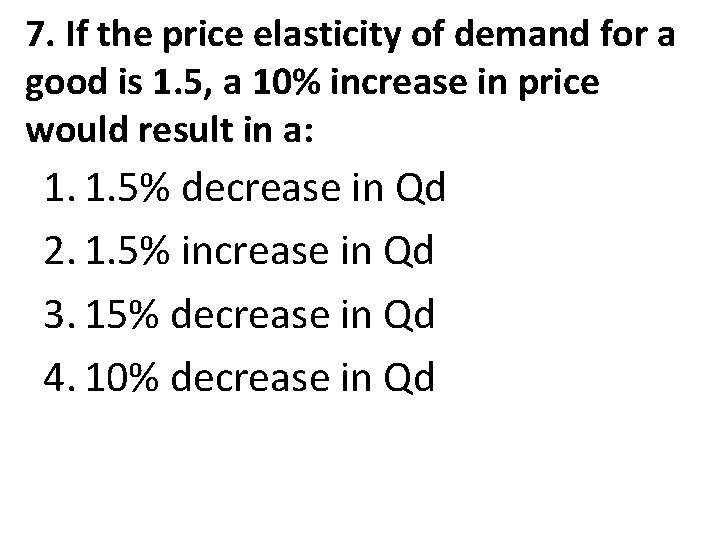
7. If the price elasticity of demand for a good is 1. 5, a 10% increase in price would result in a: 1. 1. 5% decrease in Qd 2. 1. 5% increase in Qd 3. 15% decrease in Qd 4. 10% decrease in Qd
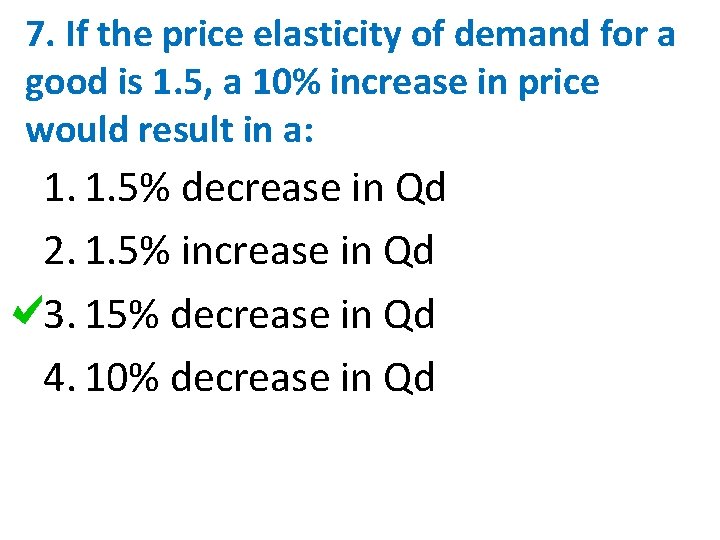
7. If the price elasticity of demand for a good is 1. 5, a 10% increase in price would result in a: 1. 1. 5% decrease in Qd 2. 1. 5% increase in Qd 3. 15% decrease in Qd 4. 10% decrease in Qd
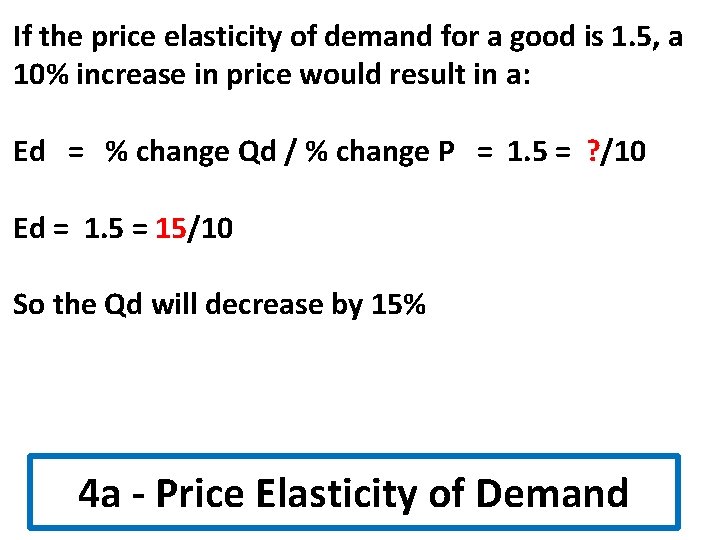
If the price elasticity of demand for a good is 1. 5, a 10% increase in price would result in a: Ed = % change Qd / % change P = 1. 5 = ? /10 Ed = 1. 5 = 15/10 So the Qd will decrease by 15% 4 a - Price Elasticity of Demand
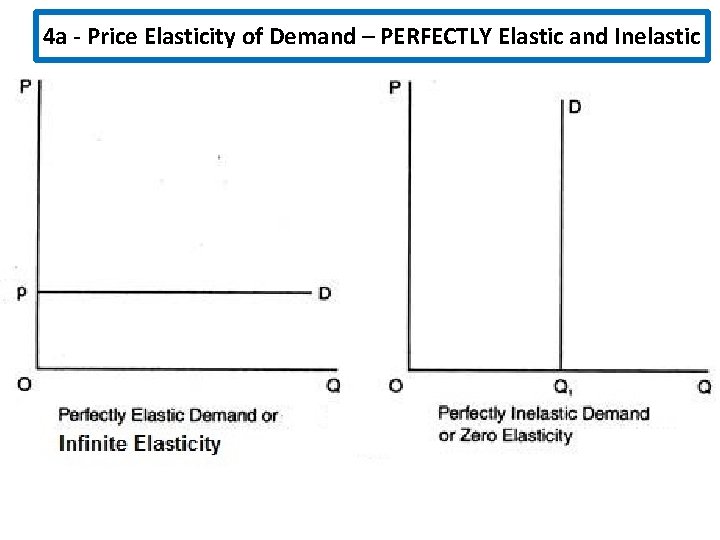
4 a - Price Elasticity of Demand – PERFECTLY Elastic and Inelastic
4 a – Price Elasticity of Demand Ways to Assess the Price Elasticity of Demand: 1. Guess 2. Calculate the Coefficient 3. Total Revenue Test • YP 2 • YP 5 #4 and #5 • YP 6 #11 4. Make an informed guess: use the Determinants
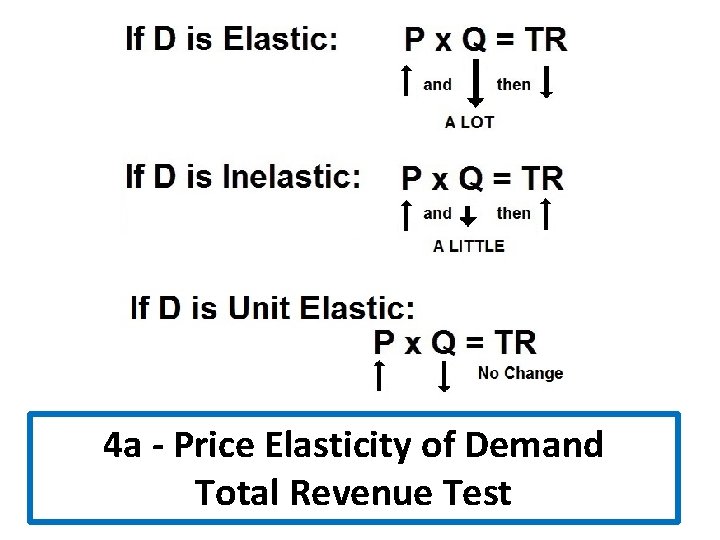
4 a - Price Elasticity of Demand Total Revenue Test
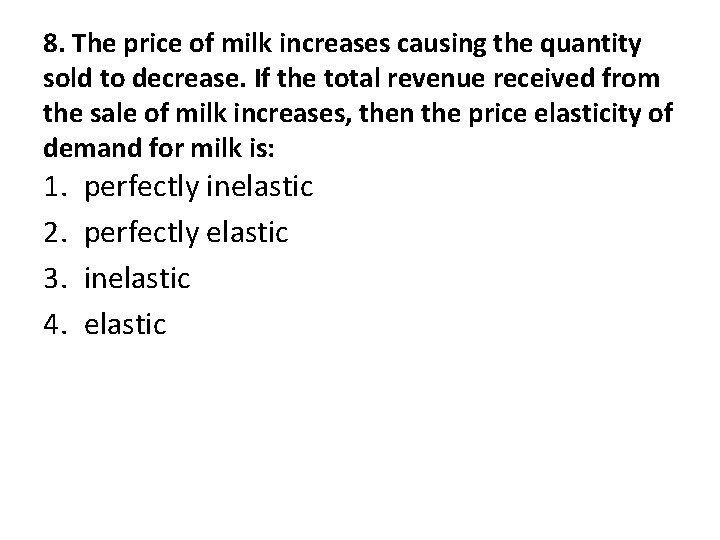
8. The price of milk increases causing the quantity sold to decrease. If the total revenue received from the sale of milk increases, then the price elasticity of demand for milk is: 1. 2. 3. 4. perfectly inelastic perfectly elastic inelastic
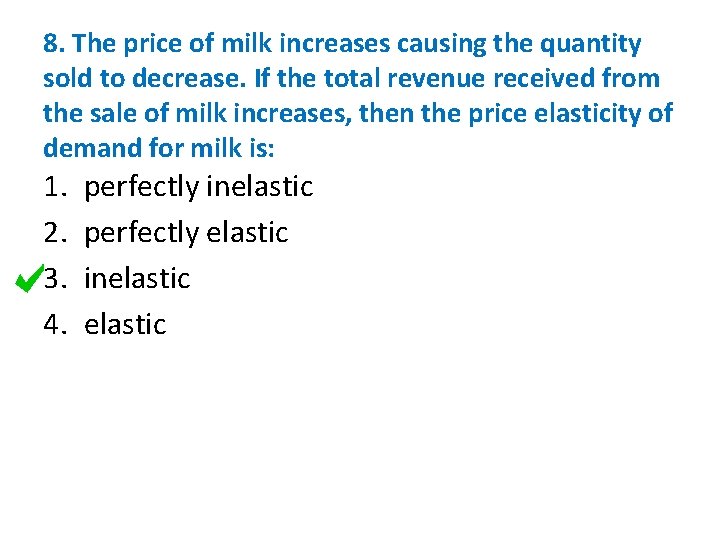
8. The price of milk increases causing the quantity sold to decrease. If the total revenue received from the sale of milk increases, then the price elasticity of demand for milk is: 1. 2. 3. 4. perfectly inelastic perfectly elastic inelastic
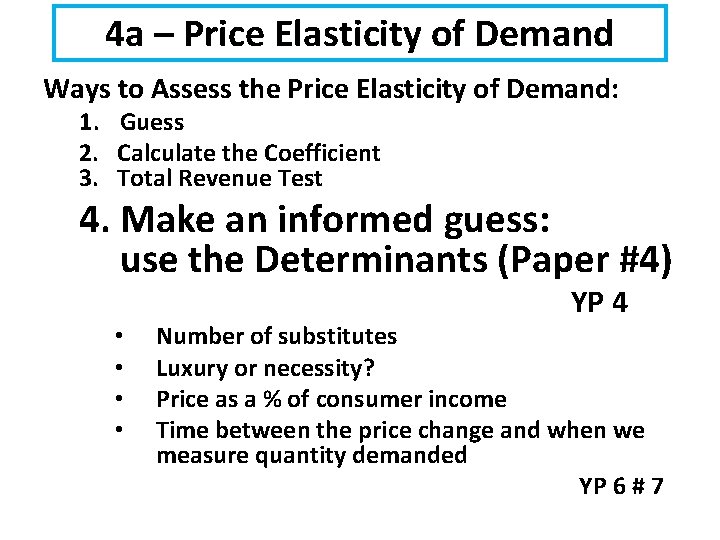
4 a – Price Elasticity of Demand Ways to Assess the Price Elasticity of Demand: 1. Guess 2. Calculate the Coefficient 3. Total Revenue Test 4. Make an informed guess: use the Determinants (Paper #4) • • YP 4 Number of substitutes Luxury or necessity? Price as a % of consumer income Time between the price change and when we measure quantity demanded YP 6 # 7
9. Which of the following is NOT a determinant of the price elasticity of demand? 1. The quantity produced 2. The amount of time available to adjust to a price change 3. The availability of close substitutes 4. The percentage of one’s budget spent on the product 5. Luxury or Necessity
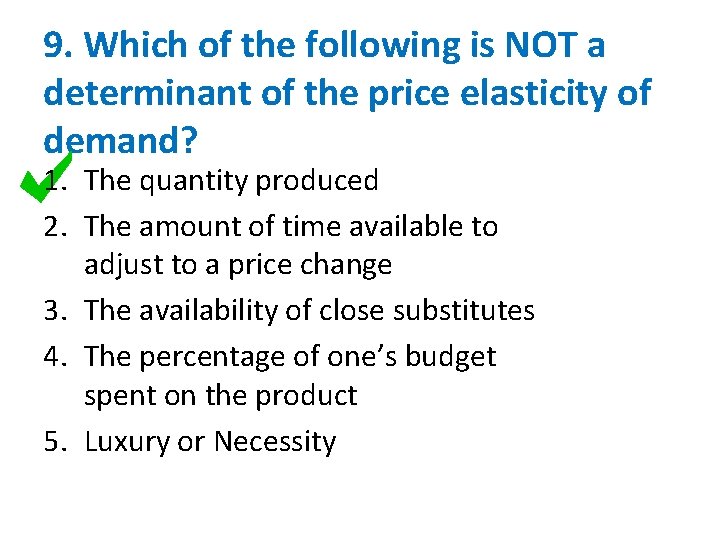
9. Which of the following is NOT a determinant of the price elasticity of demand? 1. The quantity produced 2. The amount of time available to adjust to a price change 3. The availability of close substitutes 4. The percentage of one’s budget spent on the product 5. Luxury or Necessity
10. Compared to the price elasticity of demand for gasoline, the elasticity of demand for Mobil gasoline is: 1. more inelastic 2. unit elastic 3. the same 4. more elastic
10. Compared to the price elasticity of demand for gasoline, the elasticity of demand for Mobil gasoline is: 1. more inelastic 2. unit elastic 3. the same 4. more elastic
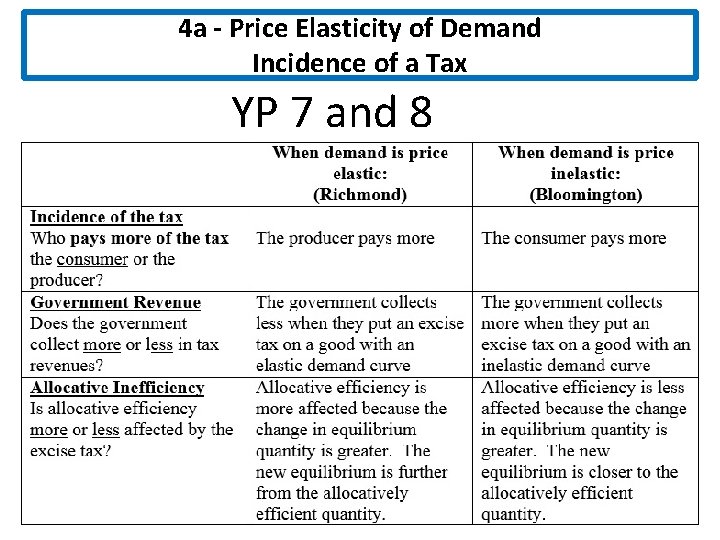
4 a - Price Elasticity of Demand Incidence of a Tax YP 7 and 8
- Slides: 45