
4 9 Antiderivatives A physicist who knows the


- Slides: 16
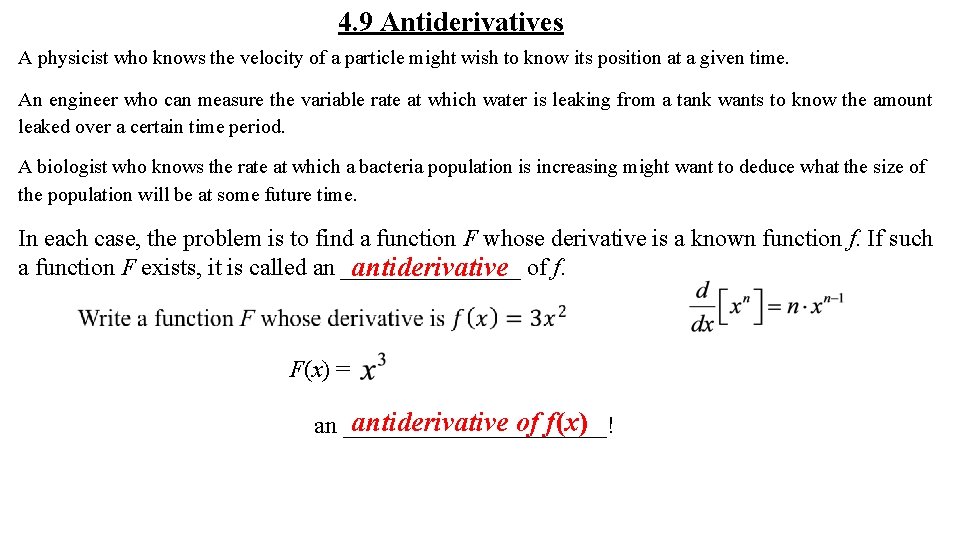
4. 9 Antiderivatives A physicist who knows the velocity of a particle might wish to know its position at a given time. An engineer who can measure the variable rate at which water is leaking from a tank wants to know the amount leaked over a certain time period. A biologist who knows the rate at which a bacteria population is increasing might want to deduce what the size of the population will be at some future time. In each case, the problem is to find a function F whose derivative is a known function f. If such a function F exists, it is called an ________ antiderivative of f. F(x) = antiderivative of f(x) an ___________!
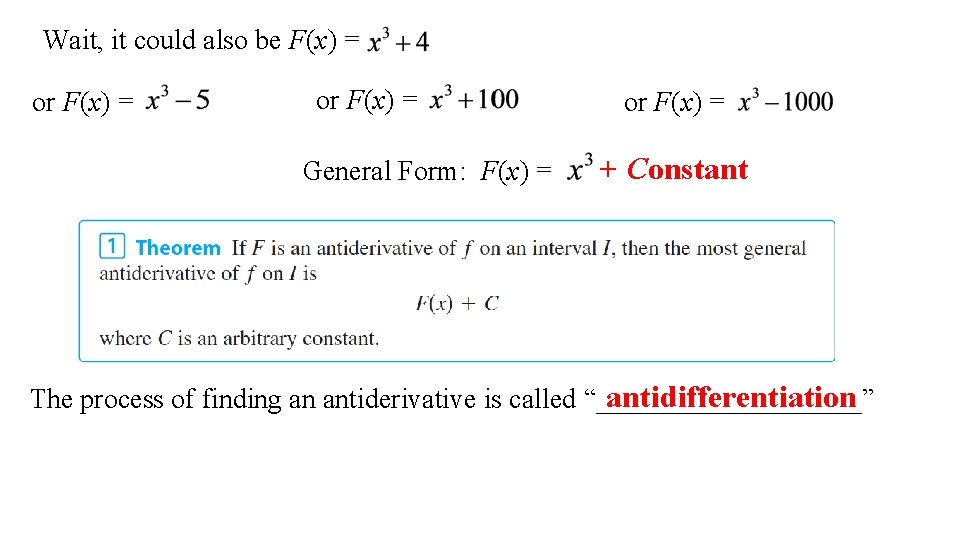
Wait, it could also be F(x) = or F(x) = General Form: F(x) = or F(x) = + Constant antidifferentiation The process of finding an antiderivative is called “__________”
EX #1: Find the most general antiderivative of each of the following functions. a. ) f (x) = sin x b. ) f (x) = 1/x c. ) f (x) = xn, n – 1 Working the Power Rule backwards… WAIT!
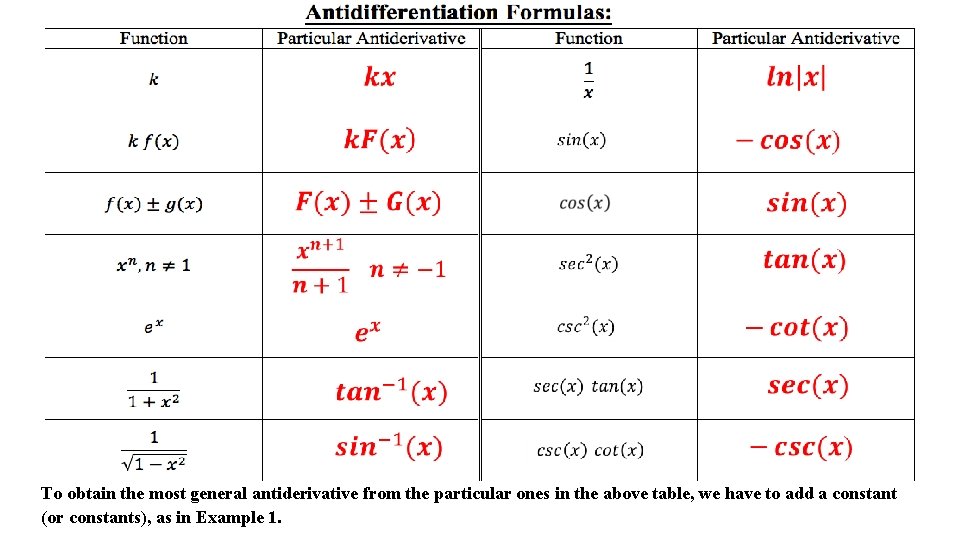
To obtain the most general antiderivative from the particular ones in the above table, we have to add a constant (or constants), as in Example 1.
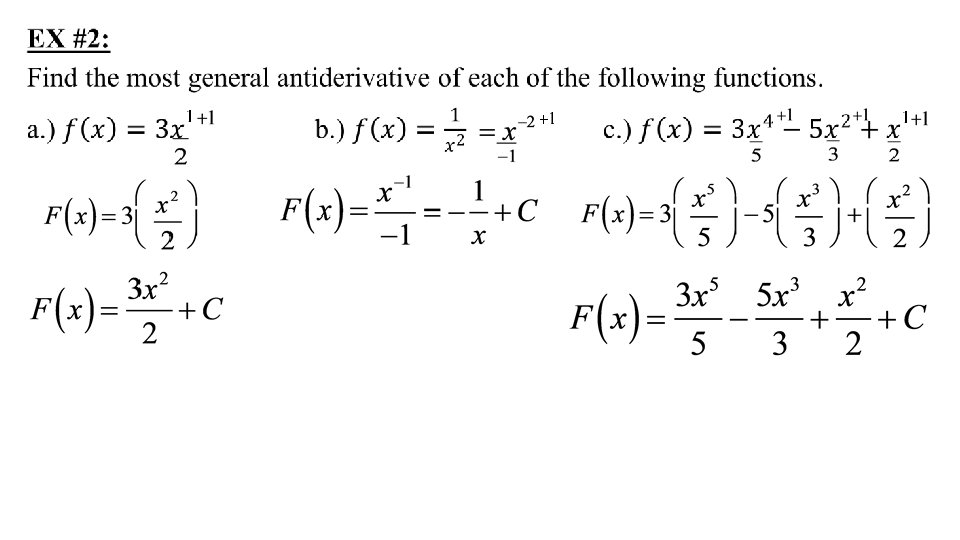
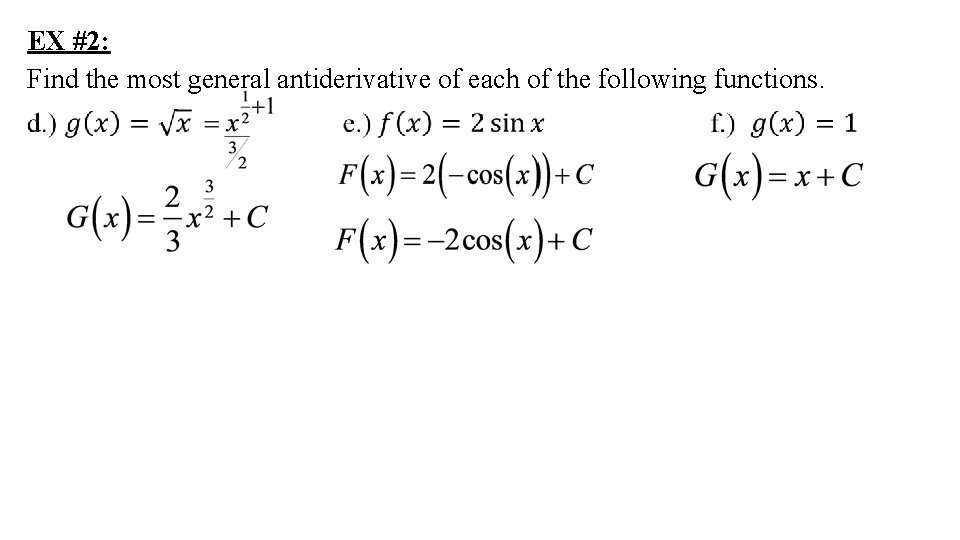
EX #2: Find the most general antiderivative of each of the following functions.
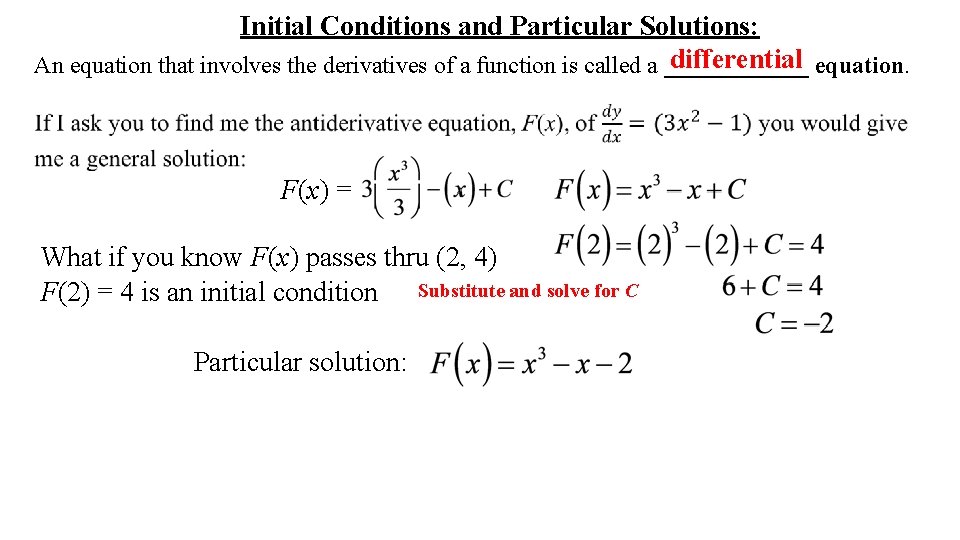
Initial Conditions and Particular Solutions: differential equation. An equation that involves the derivatives of a function is called a ______ F(x) = What if you know F(x) passes thru (2, 4) F(2) = 4 is an initial condition Substitute and solve for C Particular solution:
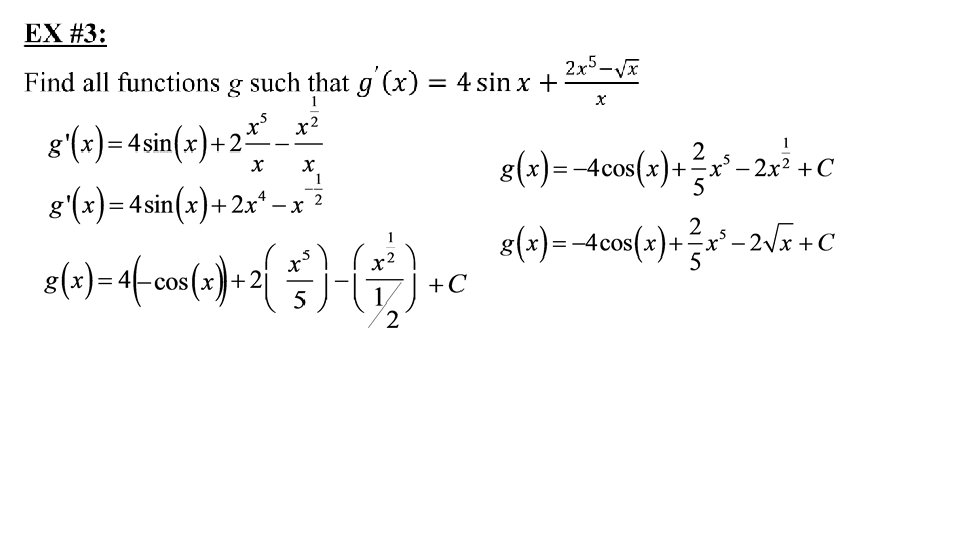
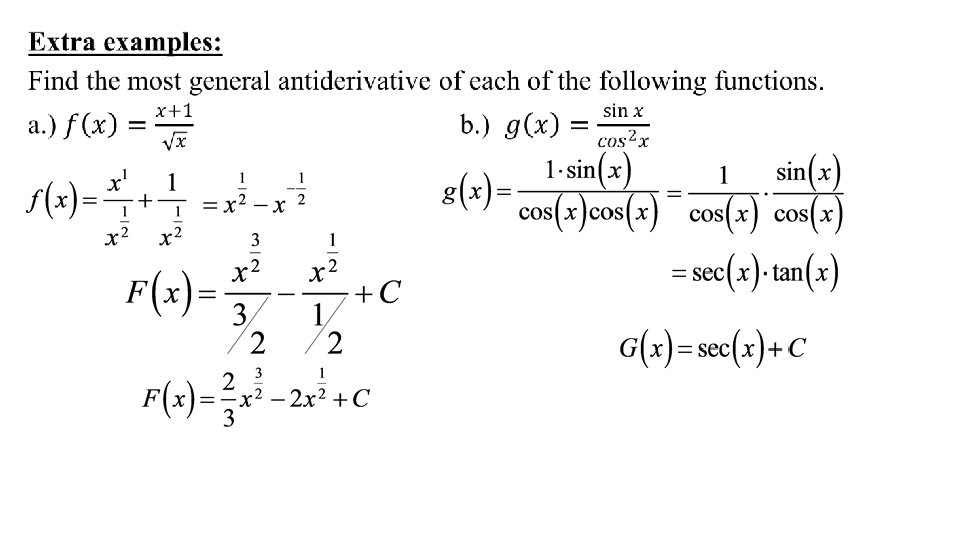
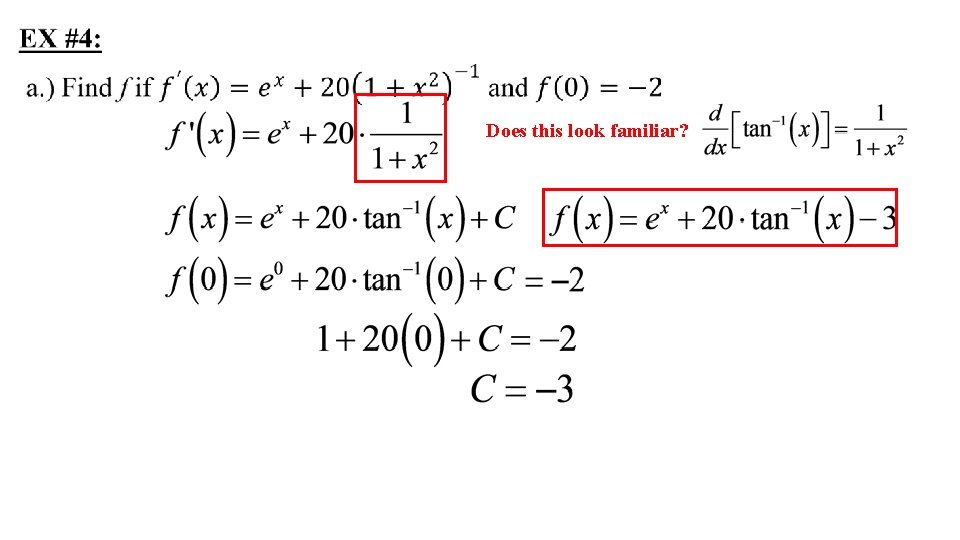
Does this look familiar?
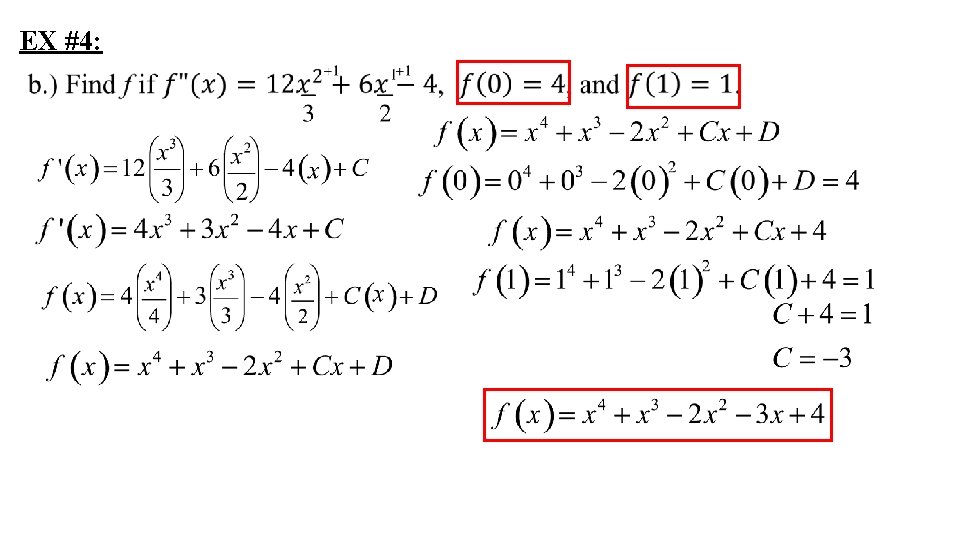
EX #4:
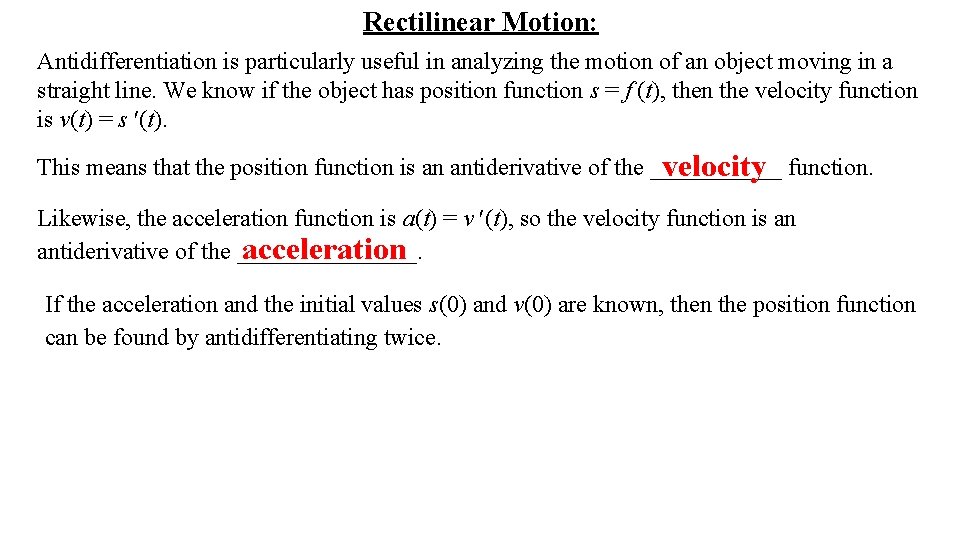
Rectilinear Motion: Antidifferentiation is particularly useful in analyzing the motion of an object moving in a straight line. We know if the object has position function s = f (t), then the velocity function is v(t) = s (t). This means that the position function is an antiderivative of the ______ velocity function. Likewise, the acceleration function is a(t) = v (t), so the velocity function is an acceleration antiderivative of the ________. If the acceleration and the initial values s(0) and v(0) are known, then the position function can be found by antidifferentiating twice.
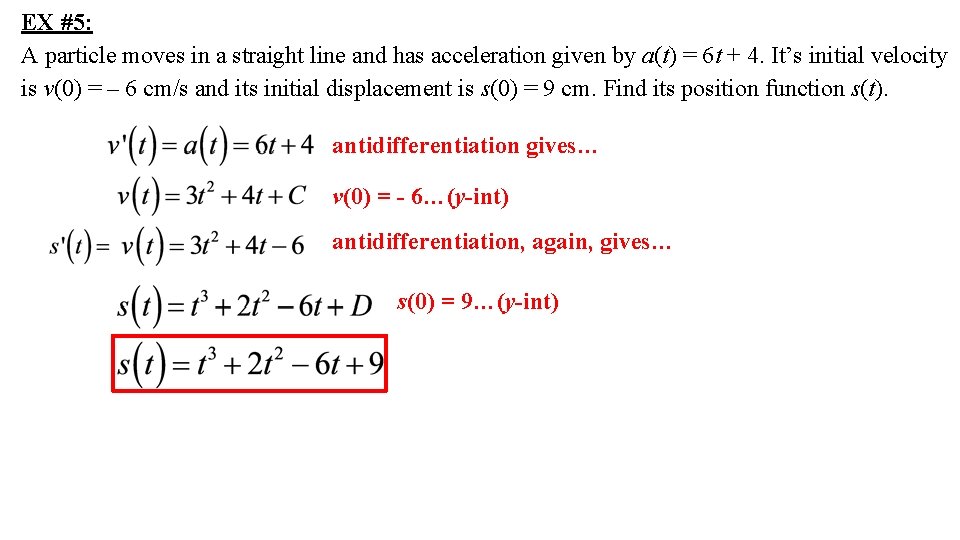
EX #5: A particle moves in a straight line and has acceleration given by a(t) = 6 t + 4. It’s initial velocity is v(0) = – 6 cm/s and its initial displacement is s(0) = 9 cm. Find its position function s(t). antidifferentiation gives… v(0) = - 6…(y-int) antidifferentiation, again, gives… s(0) = 9…(y-int)
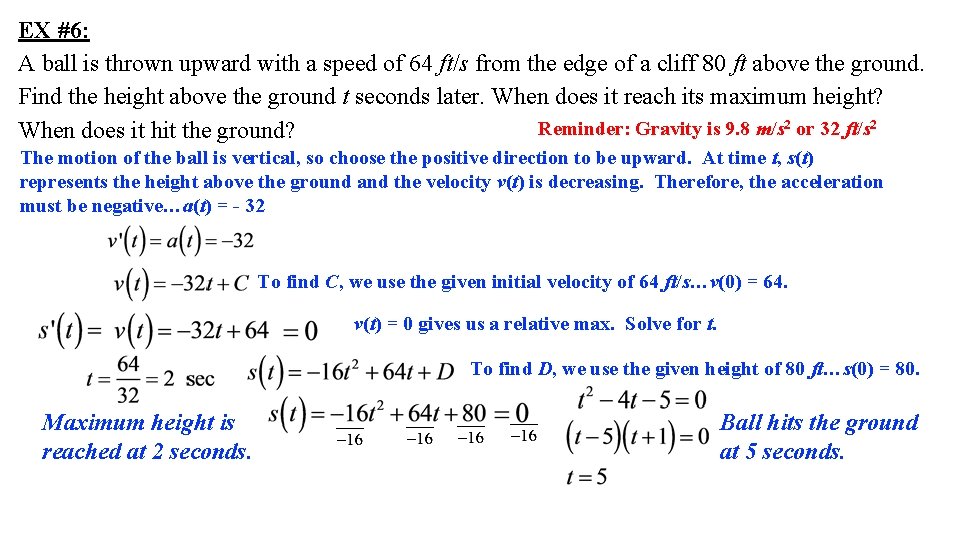
EX #6: A ball is thrown upward with a speed of 64 ft/s from the edge of a cliff 80 ft above the ground. Find the height above the ground t seconds later. When does it reach its maximum height? Reminder: Gravity is 9. 8 m/s 2 or 32 ft/s 2 When does it hit the ground? The motion of the ball is vertical, so choose the positive direction to be upward. At time t, s(t) represents the height above the ground and the velocity v(t) is decreasing. Therefore, the acceleration must be negative…a(t) = - 32 To find C, we use the given initial velocity of 64 ft/s…v(0) = 64. v(t) = 0 gives us a relative max. Solve for t. To find D, we use the given height of 80 ft…s(0) = 80. Maximum height is reached at 2 seconds. Ball hits the ground at 5 seconds.