
4 6 Matrix Equations and Systems of Linear
- Slides: 11
4. 6 Matrix Equations and Systems of Linear Equations In this section, you will study matrix equations and how to use them to solve systems of linear equations as well other applications.
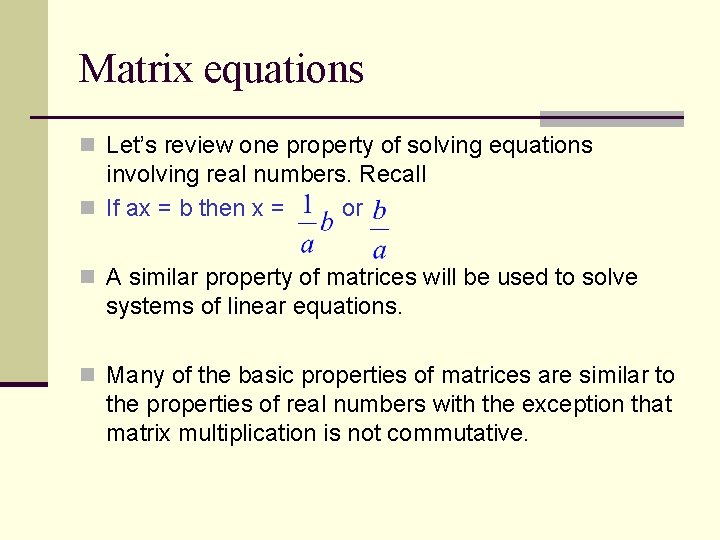
Matrix equations n Let’s review one property of solving equations involving real numbers. Recall n If ax = b then x = or n A similar property of matrices will be used to solve systems of linear equations. n Many of the basic properties of matrices are similar to the properties of real numbers with the exception that matrix multiplication is not commutative.
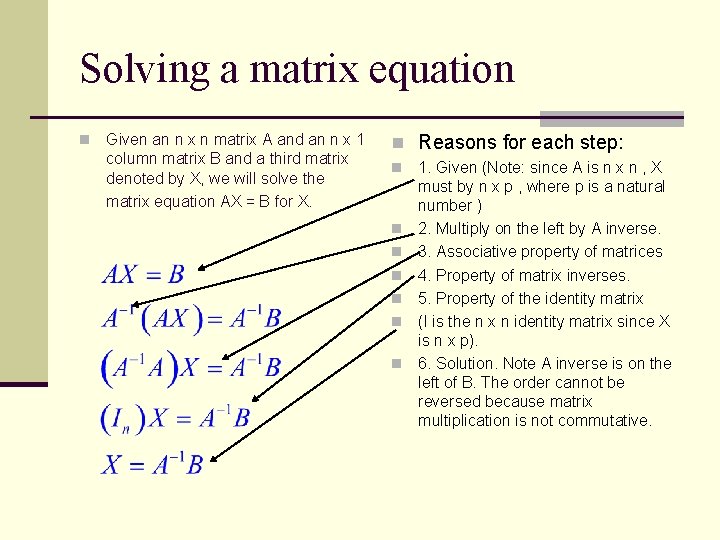
Solving a matrix equation n Given an n x n matrix A and an n x 1 column matrix B and a third matrix denoted by X, we will solve the matrix equation AX = B for X. n Reasons for each step: n n n n 1. Given (Note: since A is n x n , X must by n x p , where p is a natural number ) 2. Multiply on the left by A inverse. 3. Associative property of matrices 4. Property of matrix inverses. 5. Property of the identity matrix (I is the n x n identity matrix since X is n x p). 6. Solution. Note A inverse is on the left of B. The order cannot be reversed because matrix multiplication is not commutative.
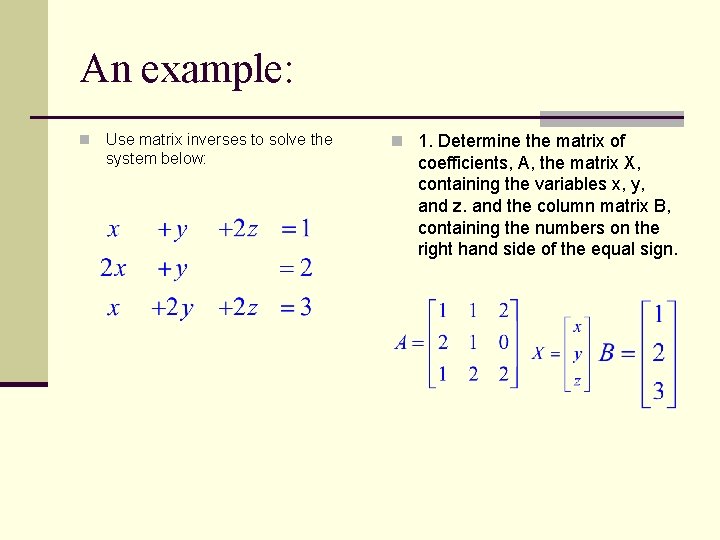
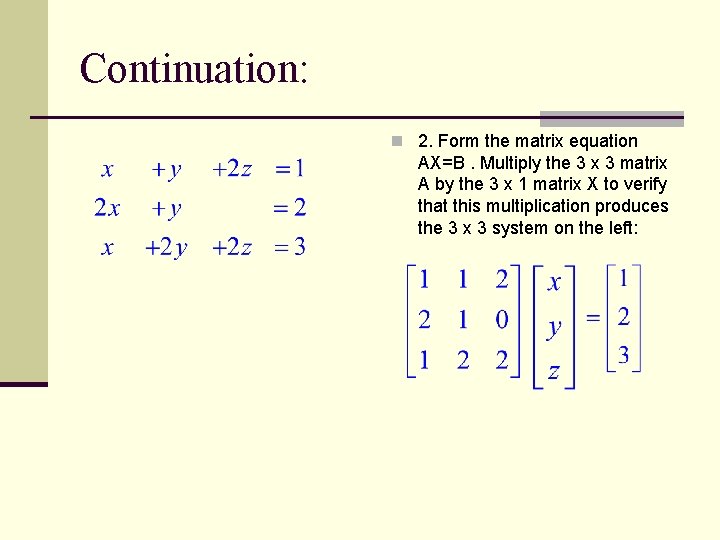
An example: n Use matrix inverses to solve the system below: n 1. Determine the matrix of coefficients, A, the matrix X, containing the variables x, y, and z. and the column matrix B, containing the numbers on the right hand side of the equal sign.
Continuation: n 2. Form the matrix equation AX=B. Multiply the 3 x 3 matrix A by the 3 x 1 matrix X to verify that this multiplication produces the 3 x 3 system on the left:
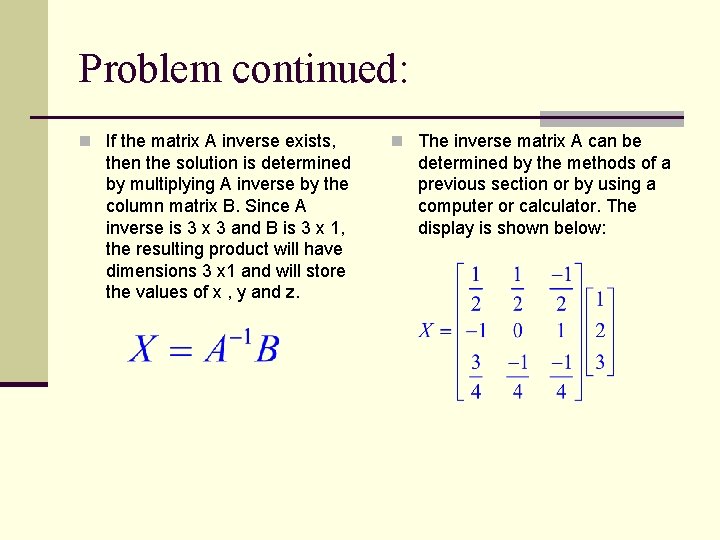
Problem continued: n If the matrix A inverse exists, then the solution is determined by multiplying A inverse by the column matrix B. Since A inverse is 3 x 3 and B is 3 x 1, the resulting product will have dimensions 3 x 1 and will store the values of x , y and z. n The inverse matrix A can be determined by the methods of a previous section or by using a computer or calculator. The display is shown below:
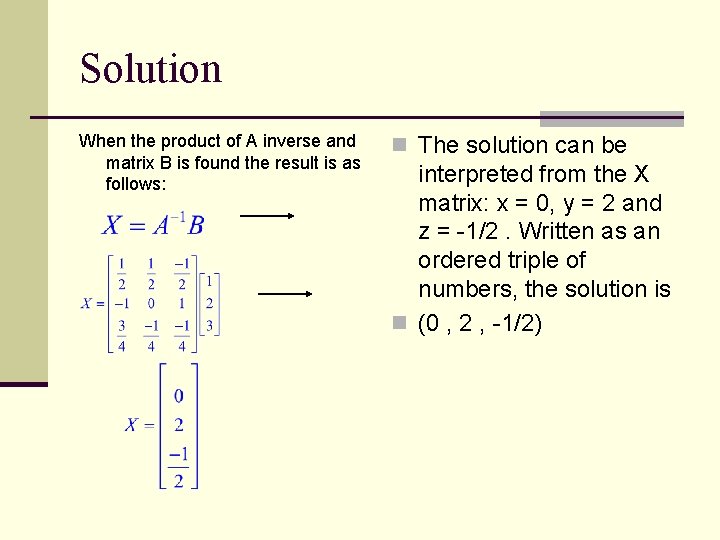
Solution When the product of A inverse and matrix B is found the result is as follows: n The solution can be interpreted from the X matrix: x = 0, y = 2 and z = -1/2. Written as an ordered triple of numbers, the solution is n (0 , 2 , -1/2)
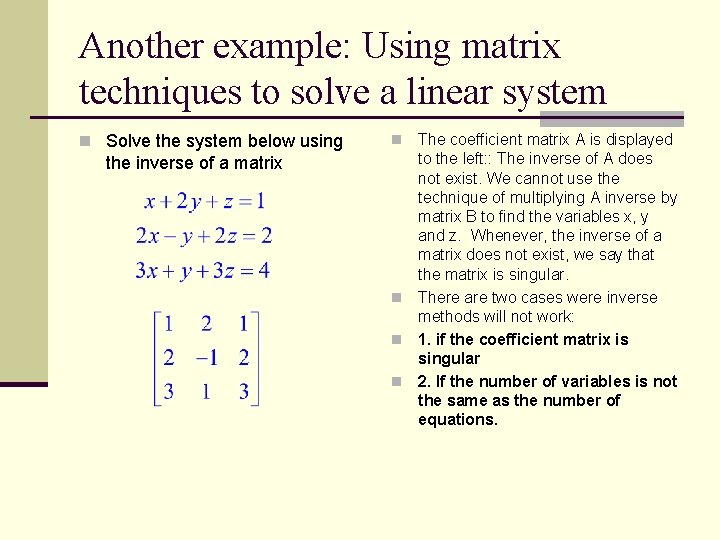
Another example: Using matrix techniques to solve a linear system n Solve the system below using the inverse of a matrix The coefficient matrix A is displayed to the left: : The inverse of A does not exist. We cannot use the technique of multiplying A inverse by matrix B to find the variables x, y and z. Whenever, the inverse of a matrix does not exist, we say that the matrix is singular. n There are two cases were inverse methods will not work: n 1. if the coefficient matrix is singular n 2. If the number of variables is not the same as the number of equations. n
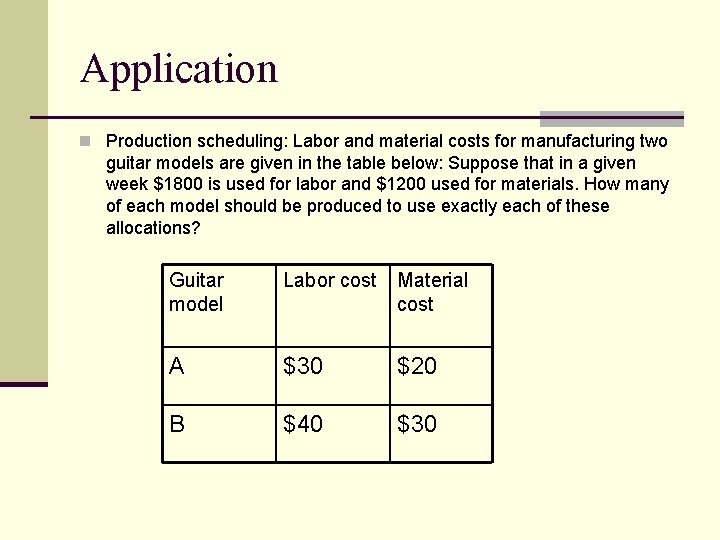
Application n Production scheduling: Labor and material costs for manufacturing two guitar models are given in the table below: Suppose that in a given week $1800 is used for labor and $1200 used for materials. How many of each model should be produced to use exactly each of these allocations? Guitar model Labor cost Material cost A $30 $20 B $40 $30
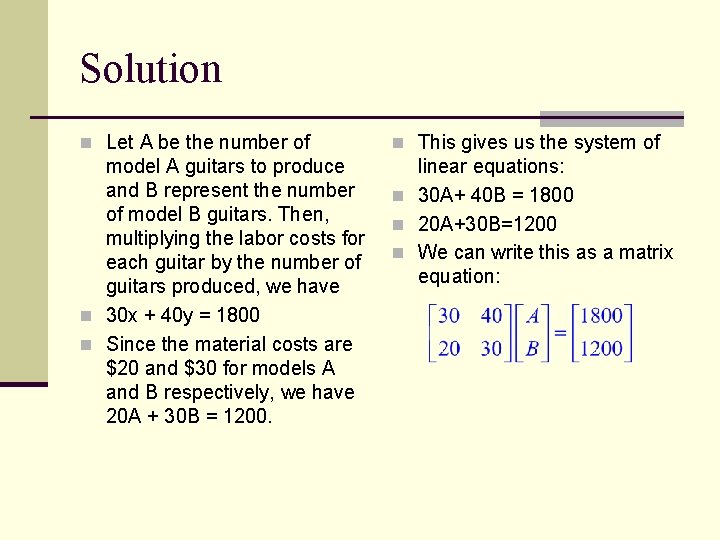
Solution n Let A be the number of n This gives us the system of model A guitars to produce and B represent the number of model B guitars. Then, multiplying the labor costs for each guitar by the number of guitars produced, we have n 30 x + 40 y = 1800 n Since the material costs are $20 and $30 for models A and B respectively, we have 20 A + 30 B = 1200. linear equations: n 30 A+ 40 B = 1800 n 20 A+30 B=1200 n We can write this as a matrix equation:
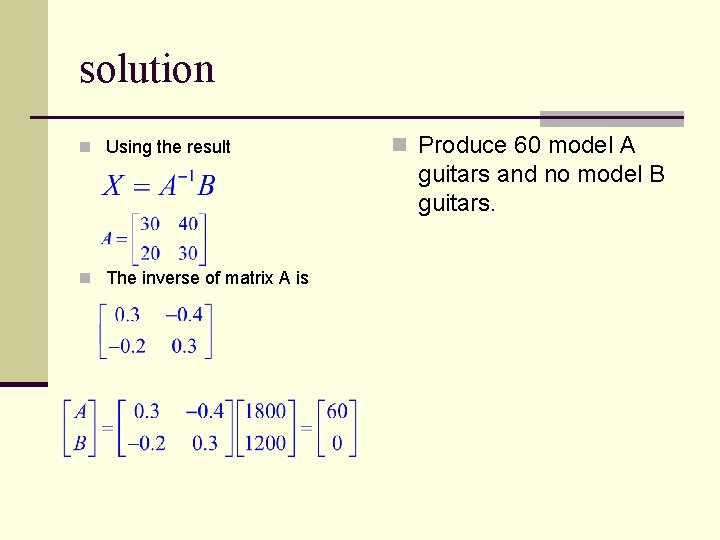
solution n Using the result n Produce 60 model A guitars and no model B guitars. n The inverse of matrix A is