
4 5 Program Correctness Definition 1 A program
- Slides: 8
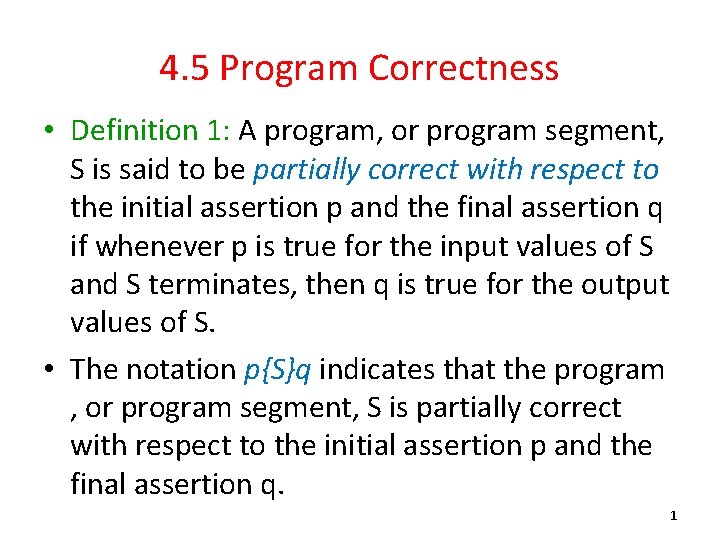
4. 5 Program Correctness • Definition 1: A program, or program segment, S is said to be partially correct with respect to the initial assertion p and the final assertion q if whenever p is true for the input values of S and S terminates, then q is true for the output values of S. • The notation p{S}q indicates that the program , or program segment, S is partially correct with respect to the initial assertion p and the final assertion q. 1
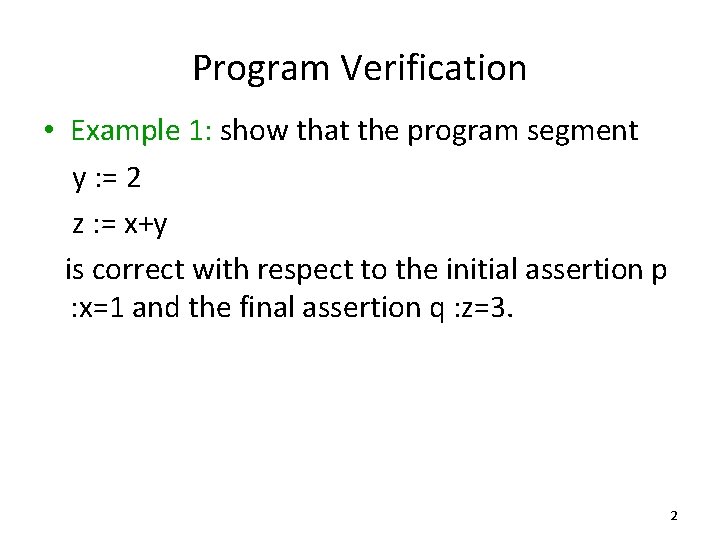
Program Verification • Example 1: show that the program segment y : = 2 z : = x+y is correct with respect to the initial assertion p : x=1 and the final assertion q : z=3. 2
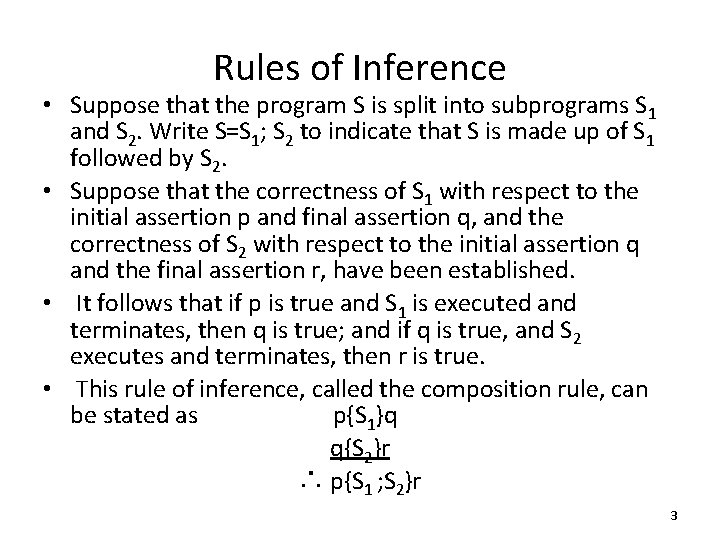
Rules of Inference • Suppose that the program S is split into subprograms S 1 and S 2. Write S=S 1; S 2 to indicate that S is made up of S 1 followed by S 2. • Suppose that the correctness of S 1 with respect to the initial assertion p and final assertion q, and the correctness of S 2 with respect to the initial assertion q and the final assertion r, have been established. • It follows that if p is true and S 1 is executed and terminates, then q is true; and if q is true, and S 2 executes and terminates, then r is true. • This rule of inference, called the composition rule, can be stated as p{S 1}q q{S 2}r ∴ p{S 1 ; S 2}r 3
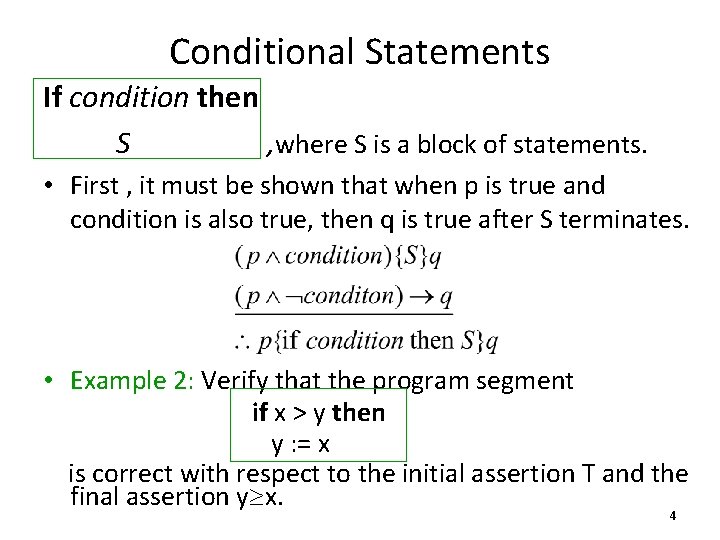
Conditional Statements If condition then S , where S is a block of statements. • First , it must be shown that when p is true and condition is also true, then q is true after S terminates. • Example 2: Verify that the program segment if x > y then y : = x is correct with respect to the initial assertion T and the final assertion y x. 4
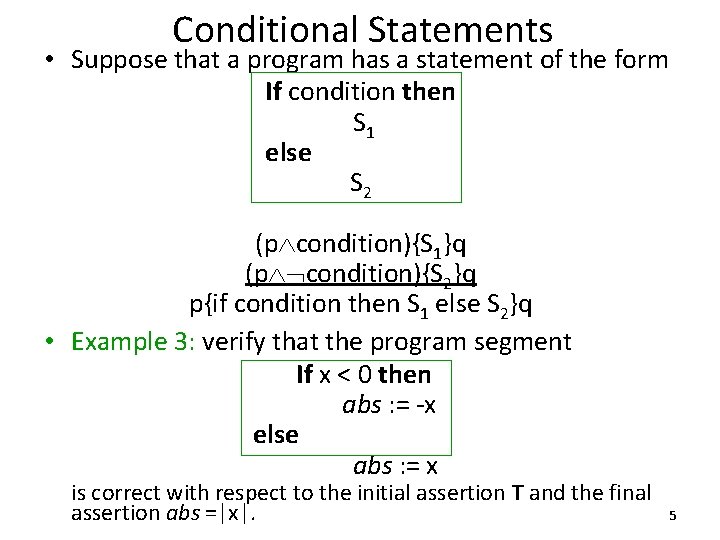
Conditional Statements • Suppose that a program has a statement of the form If condition then S 1 else S 2 (p condition){S 1}q (p condition){S 2}q p{if condition then S 1 else S 2}q • Example 3: verify that the program segment If x < 0 then abs : = -x else abs : = x is correct with respect to the initial assertion T and the final assertion abs =|x|. 5
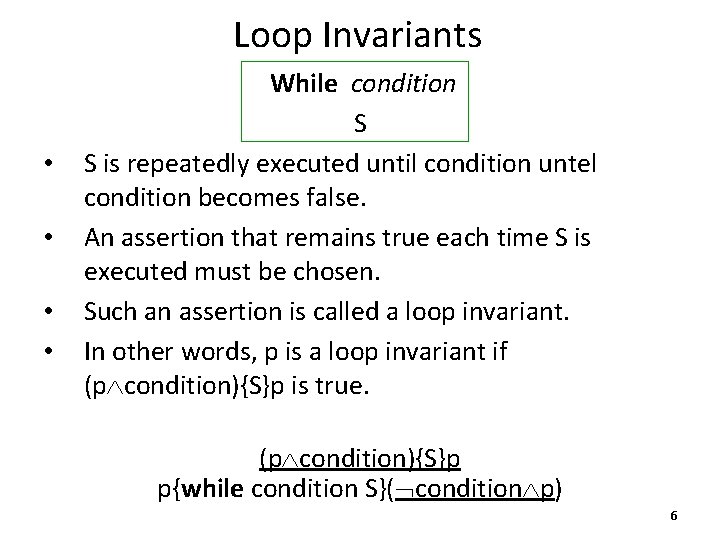
Loop Invariants • • While condition S S is repeatedly executed until condition untel condition becomes false. An assertion that remains true each time S is executed must be chosen. Such an assertion is called a loop invariant. In other words, p is a loop invariant if (p condition){S}p is true. (p condition){S}p p{while condition S}( condition p) 6
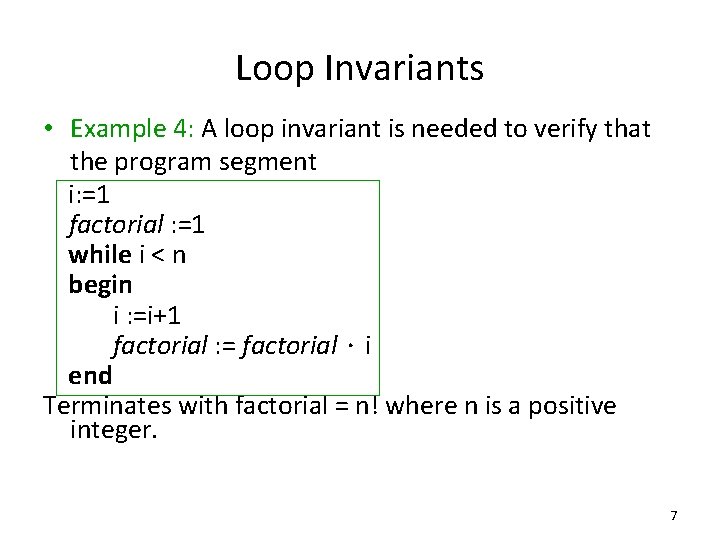
Loop Invariants • Example 4: A loop invariant is needed to verify that the program segment i: =1 factorial : =1 while i < n begin i : =i+1 factorial : = factorial.i end Terminates with factorial = n! where n is a positive integer. 7
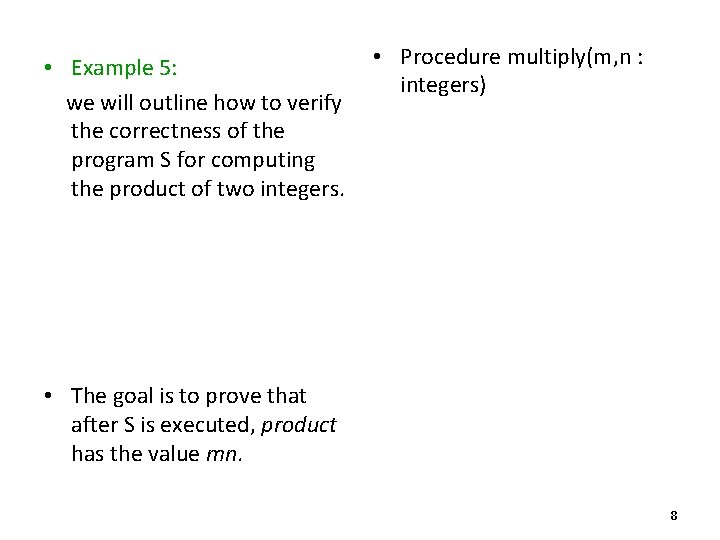
• Example 5: we will outline how to verify the correctness of the program S for computing the product of two integers. • Procedure multiply(m, n : integers) • The goal is to prove that after S is executed, product has the value mn. 8