
4 4 THE FUNDAMENTAL THEOREM OF CALCULUS MS

- Slides: 18
4 -4 THE FUNDAMENTAL THEOREM OF CALCULUS MS. BATTAGLIA – AP CALCULUS
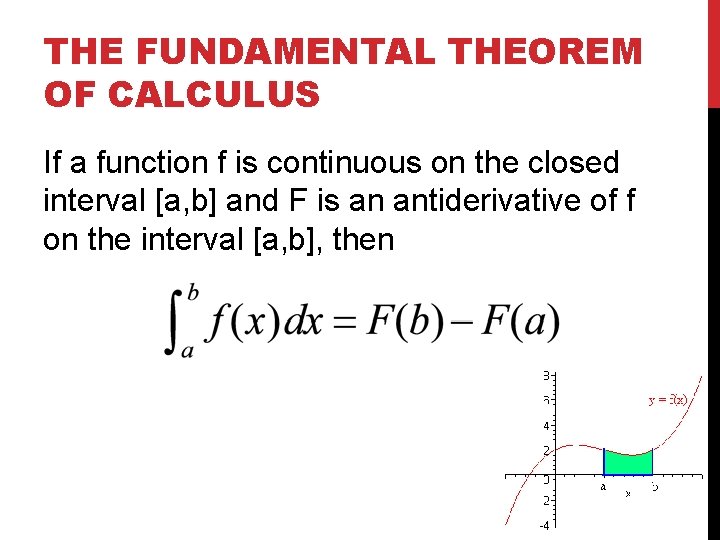
THE FUNDAMENTAL THEOREM OF CALCULUS If a function f is continuous on the closed interval [a, b] and F is an antiderivative of f on the interval [a, b], then
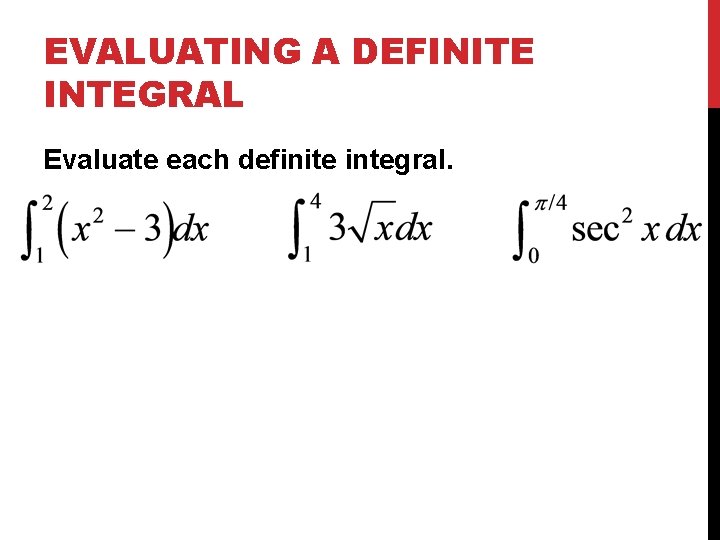
EVALUATING A DEFINITE INTEGRAL Evaluate each definite integral.
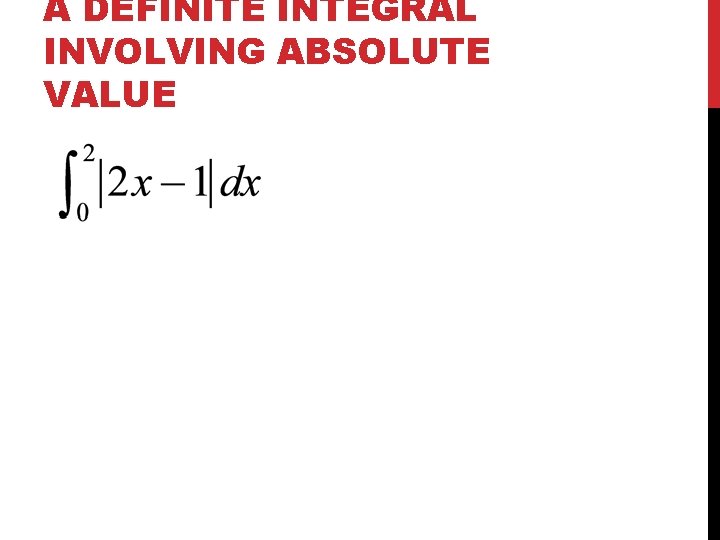
A DEFINITE INTEGRAL INVOLVING ABSOLUTE VALUE
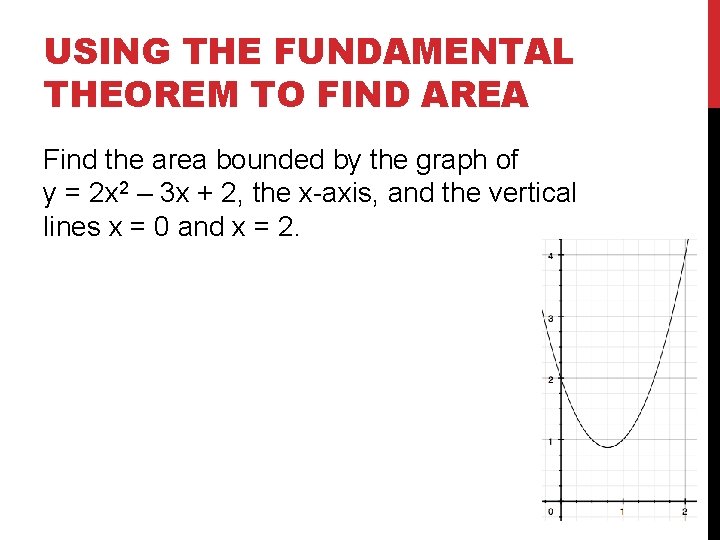
USING THE FUNDAMENTAL THEOREM TO FIND AREA Find the area bounded by the graph of y = 2 x 2 – 3 x + 2, the x-axis, and the vertical lines x = 0 and x = 2.
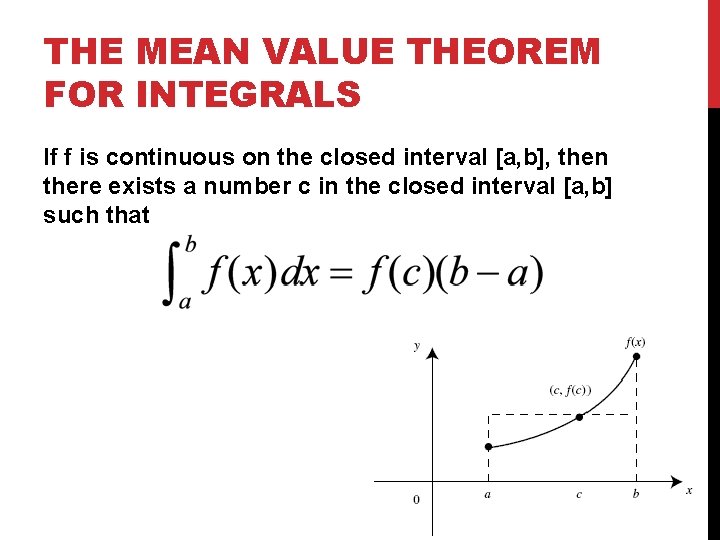
THE MEAN VALUE THEOREM FOR INTEGRALS If f is continuous on the closed interval [a, b], then there exists a number c in the closed interval [a, b] such that
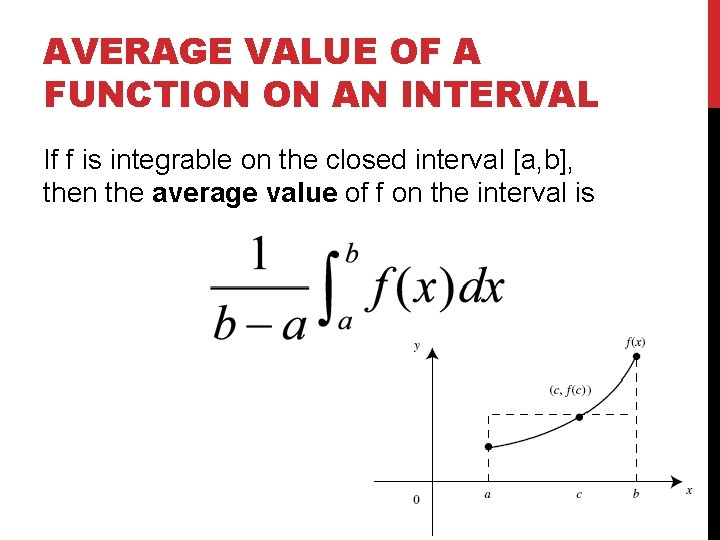
AVERAGE VALUE OF A FUNCTION ON AN INTERVAL If f is integrable on the closed interval [a, b], then the average value of f on the interval is
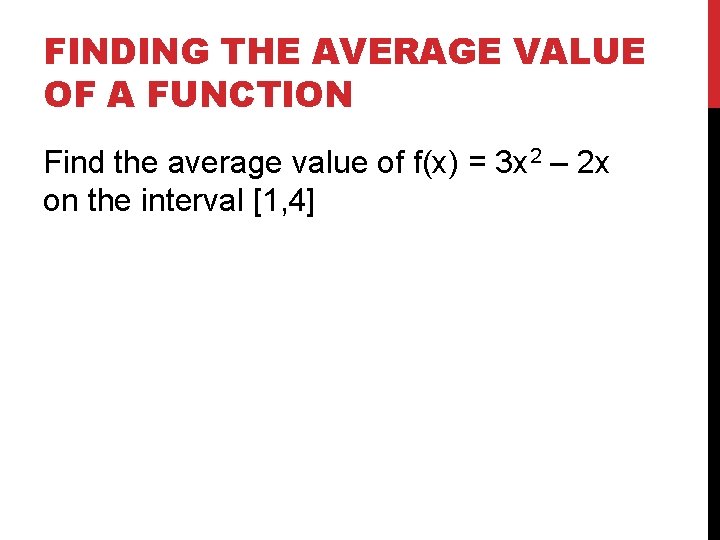
FINDING THE AVERAGE VALUE OF A FUNCTION Find the average value of f(x) = 3 x 2 – 2 x on the interval [1, 4]
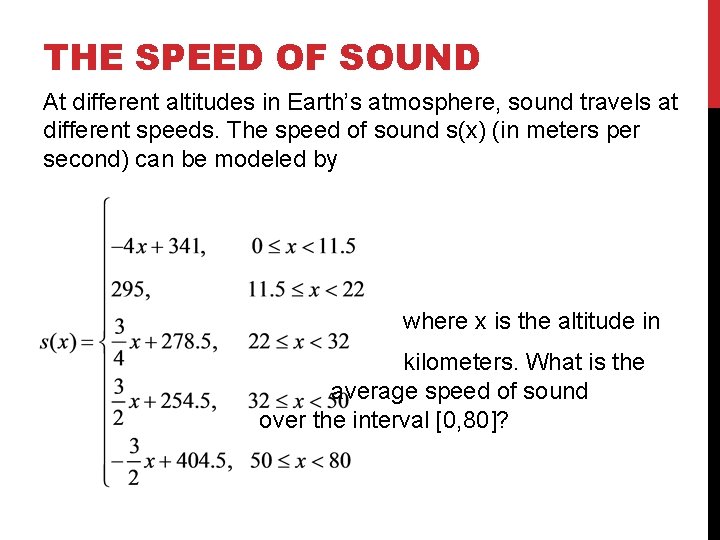
THE SPEED OF SOUND At different altitudes in Earth’s atmosphere, sound travels at different speeds. The speed of sound s(x) (in meters per second) can be modeled by where x is the altitude in kilometers. What is the average speed of sound over the interval [0, 80]?
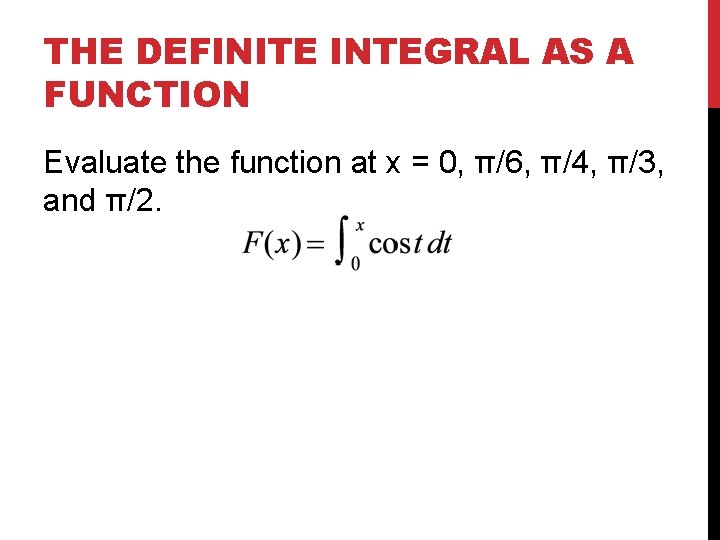
THE DEFINITE INTEGRAL AS A FUNCTION Evaluate the function at x = 0, π/6, π/4, π/3, and π/2.
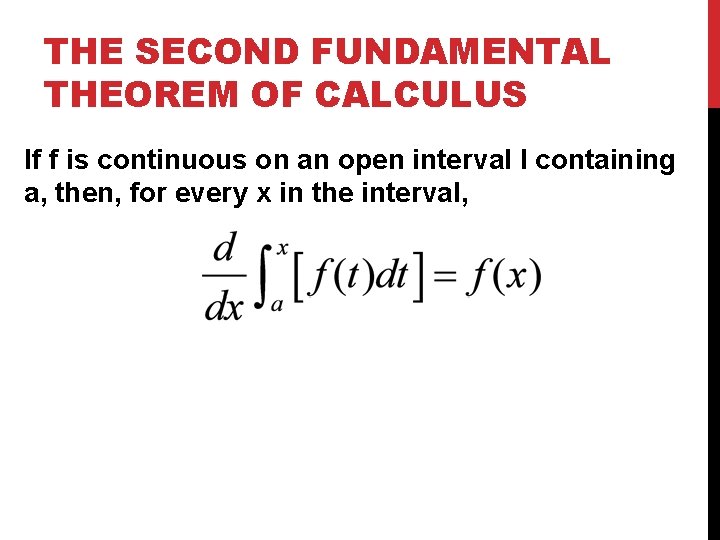
THE SECOND FUNDAMENTAL THEOREM OF CALCULUS If f is continuous on an open interval I containing a, then, for every x in the interval,
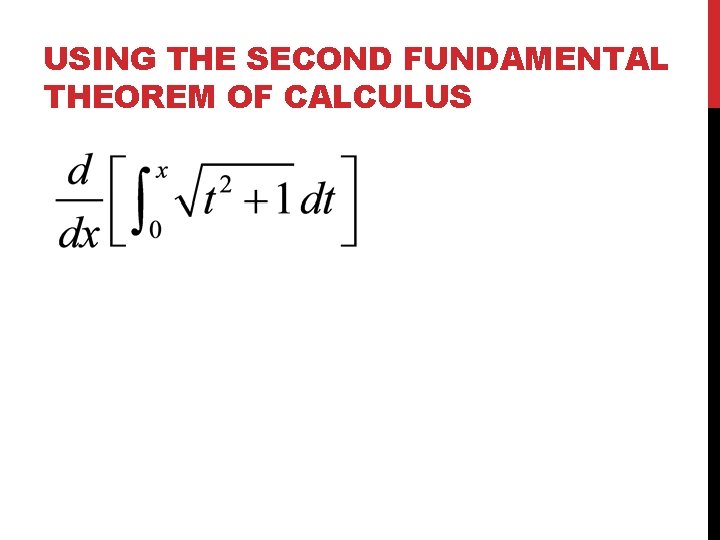
USING THE SECOND FUNDAMENTAL THEOREM OF CALCULUS
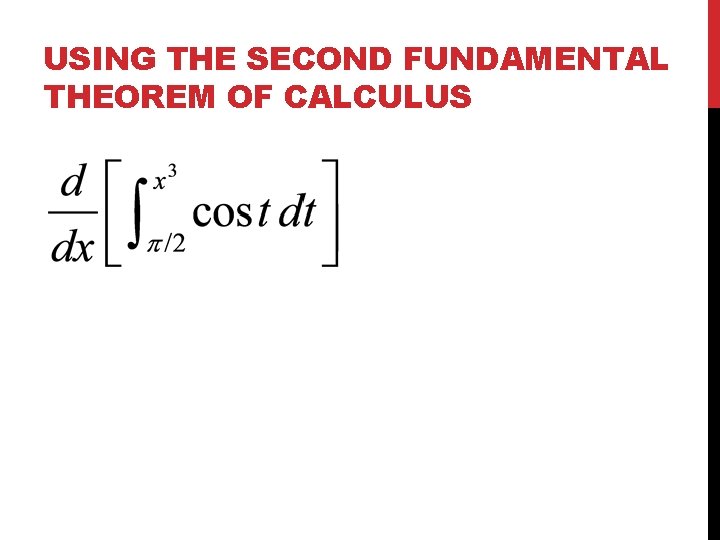
USING THE SECOND FUNDAMENTAL THEOREM OF CALCULUS
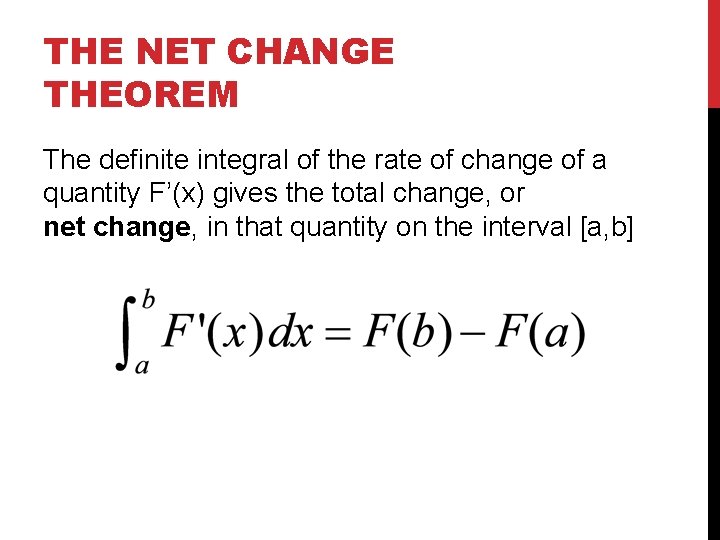
THE NET CHANGE THEOREM The definite integral of the rate of change of a quantity F’(x) gives the total change, or net change, in that quantity on the interval [a, b]
USING THE NET CHANGE THEOREM A chemical flows into a storage tank at a rate of 180+3 t liters per minute, where 0 < t < 60. Find the amount of the chemical that flows into the tank during the first 20 minutes.
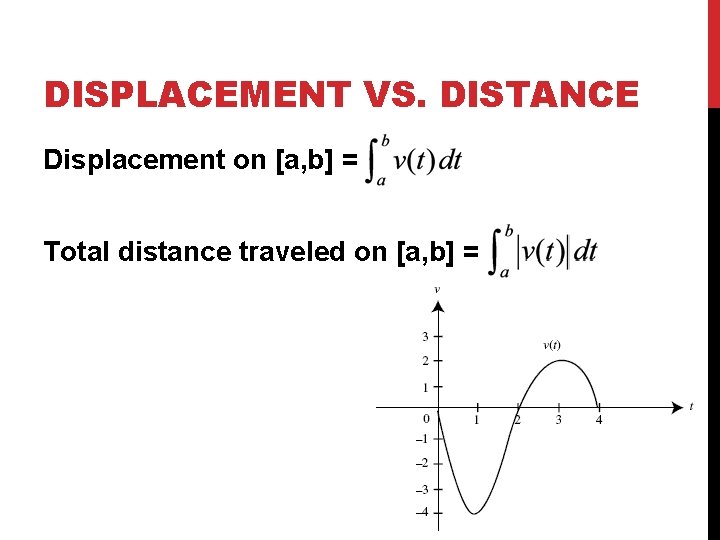
DISPLACEMENT VS. DISTANCE Displacement on [a, b] = Total distance traveled on [a, b] =
SOLVING A PARTICLE MOTION PROBLEM A particle is moving along a line so that its velocity is v(t) = t 3 – 10 t 2 + 29 t – 20 feet per second at time t. a. What is the displacement of the particle on the time interval 1 < t < 5? b. What is the total distance traveled by the particle on the time interval 1 < t < 5?
HOMEWORK Page 306 #2, 3, 7 -10, 13, 29, 31, 33, 37, 39, 47, 53, 107 Page 307 #62, 67 -87 odd, 91, 129134 all