
4 4 prism and its unfolding In sec


- Slides: 52
4. 4 prism(棱镜) and its unfolding(展开) In sec. 4. 3 we have mentioned that in order to keep the angle of two mirrors unchanged, the two mirrors are usually made on a common glass.
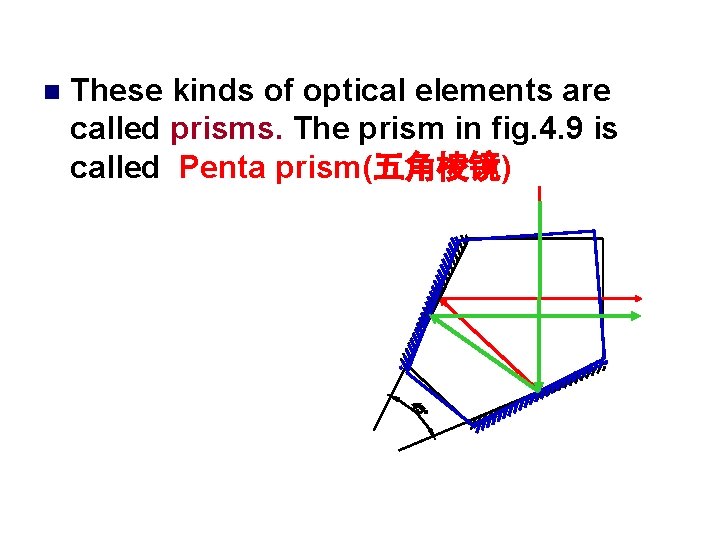
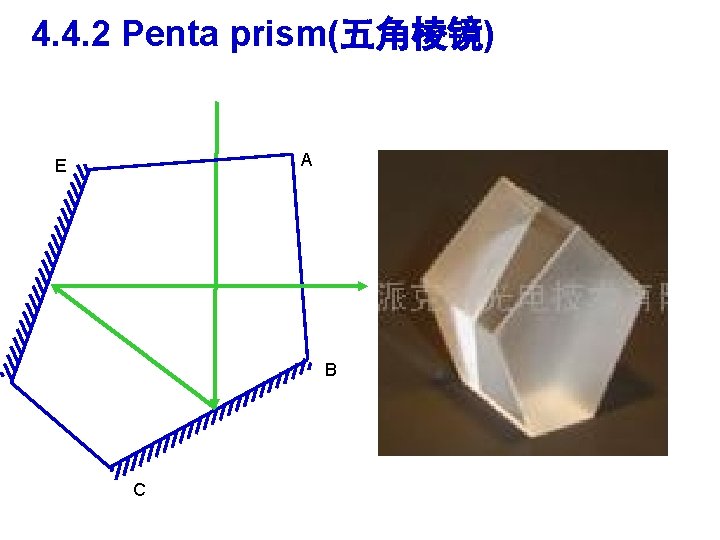
n These kinds of optical elements are called prisms. The prism in fig. 4. 9 is called Penta prism(五角棱镜)
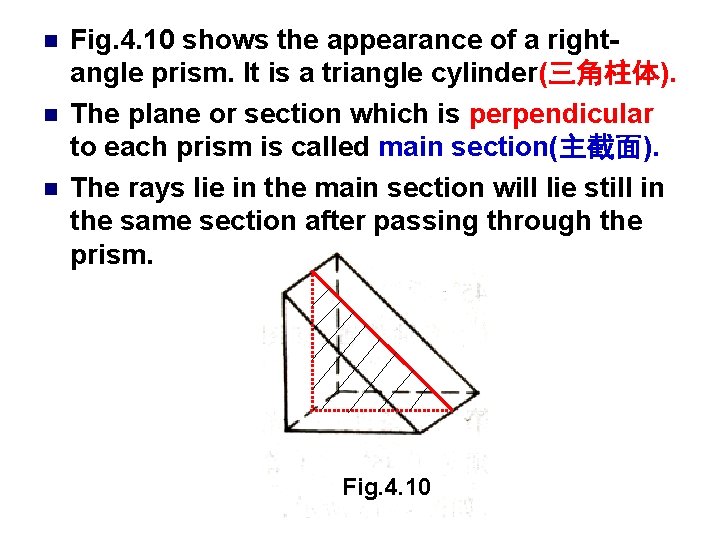
n n n Fig. 4. 10 shows the appearance of a rightangle prism. It is a triangle cylinder(三角柱体). The plane or section which is perpendicular to each prism is called main section(主截面). The rays lie in the main section will lie still in the same section after passing through the prism. Fig. 4. 10
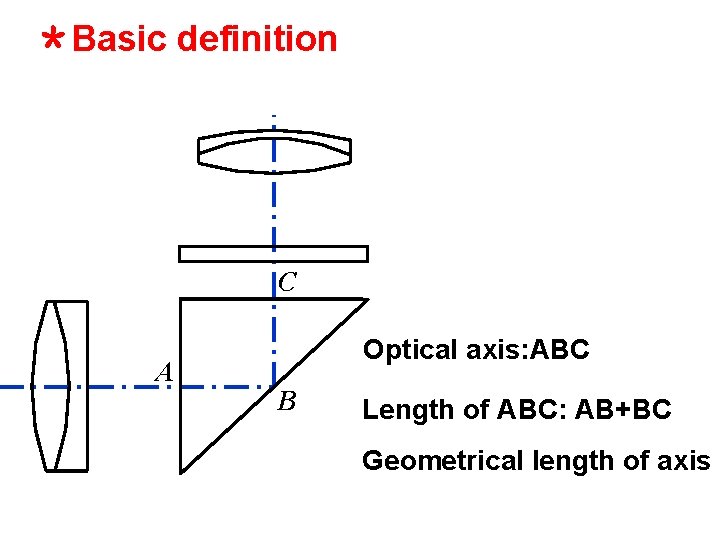
*Basic definition C A Optical axis: ABC B Length of ABC: AB+BC Geometrical length of axis
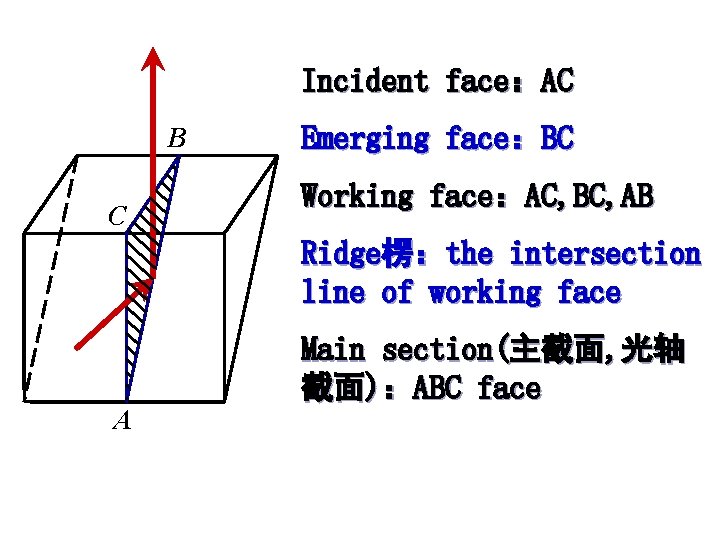
Incident face:AC B C Emerging face:BC Working face:AC, BC, AB Ridge楞:the intersection line of working face Main section(主截面, 光轴 截面):ABC face A
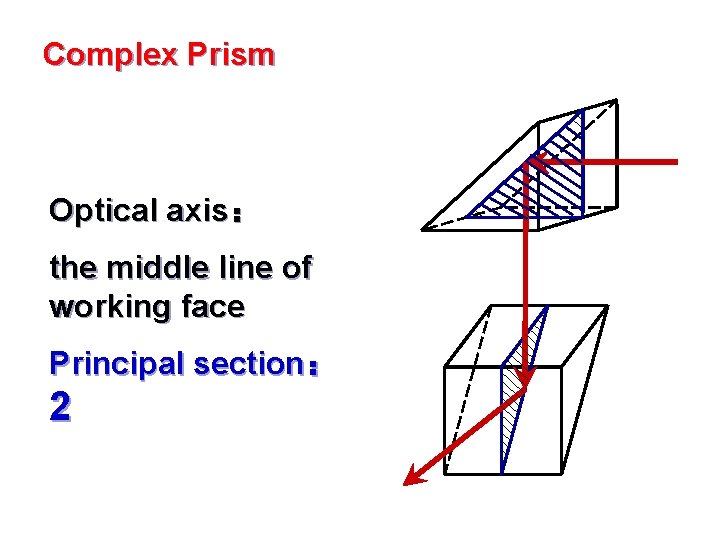
Complex Prism Optical axis: the middle line of working face Principal section: 2
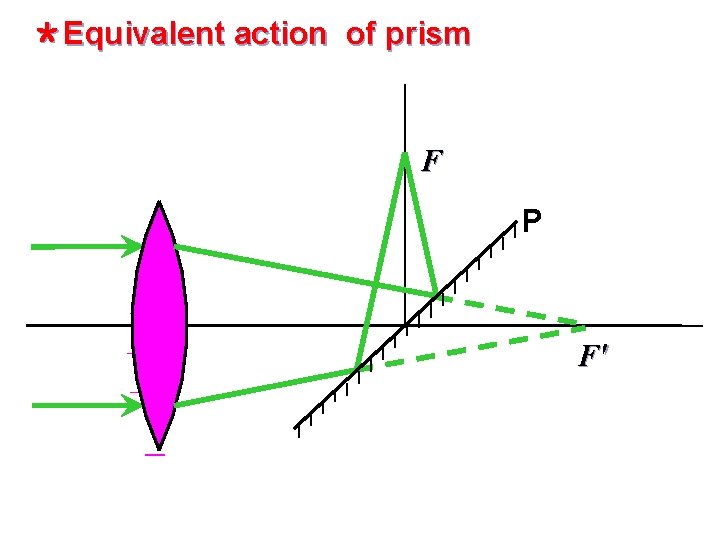
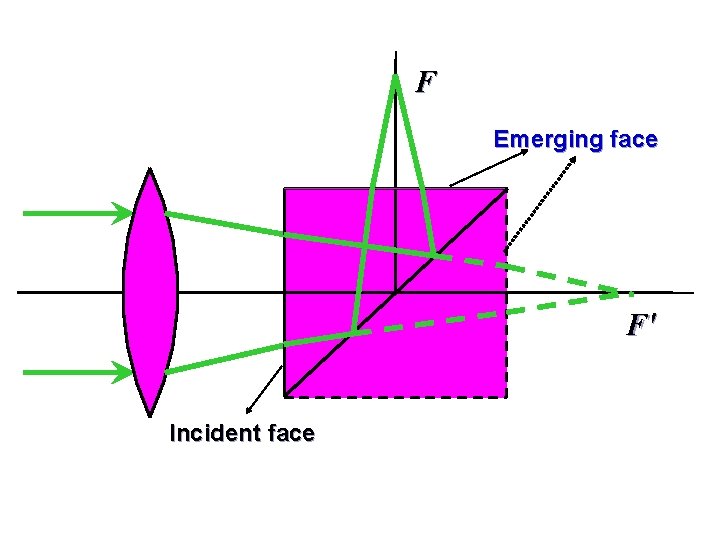
*Equivalent action of prism F P F′
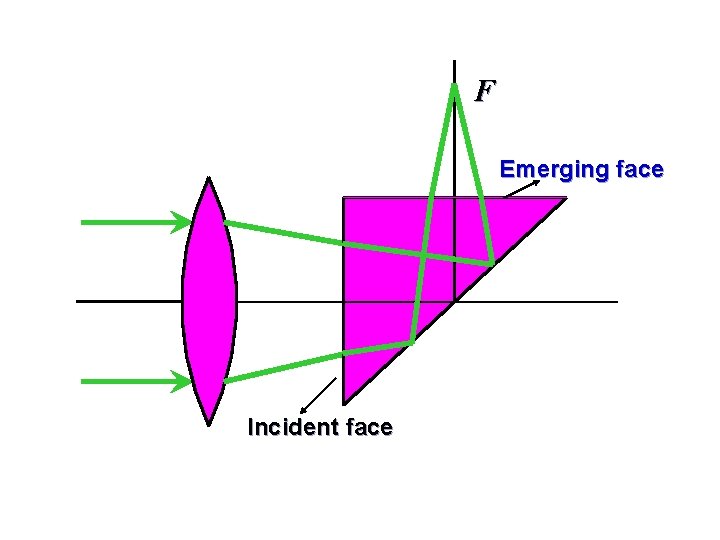
F Emerging face Incident face
F Emerging face F' Incident face
*Conclusion Equivalent action of a prism in optical system corresponds with a parellel glass board(平行平板)
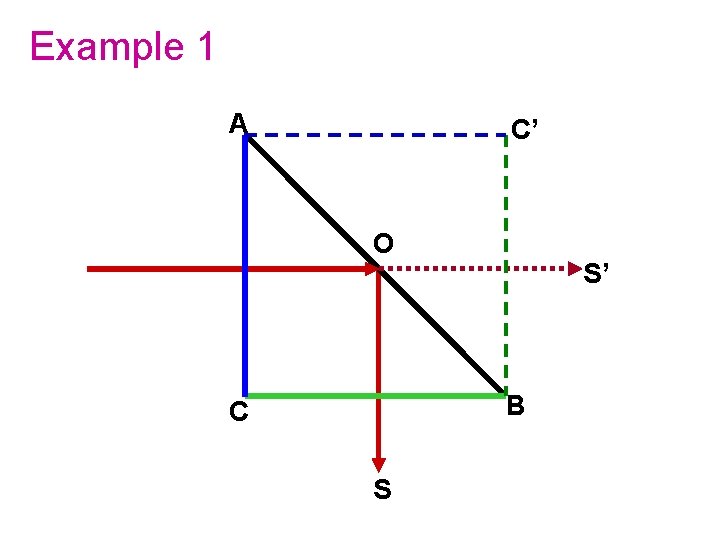
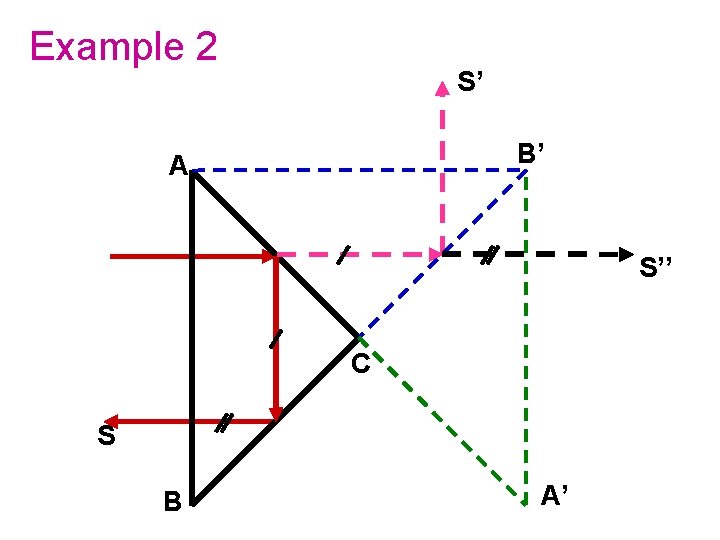
*unfolding of prism This method, unfolding the prism, canceling the reflection and replacing prism’s refractions by glass block’s refraction, is called prism unfolding. n 把棱镜的光轴截面沿着它的反射面展开, 取消棱镜的反射,以平行玻璃板的折射代 替棱镜折射的方法称为“棱镜的展开”。 n
The prism must be demanded to meet two requirements: n n After unfolding the prism, the two faces of the glass block must be parallel to each other. (棱镜展开后玻璃板的两个表面必须平行) When the prism locates in converging rays, the axis must be perpendicular to both incident and emergent faces. (如果棱镜位于会 聚光束中,则光轴必须和棱镜的入射及出射表面 相垂直)
Example 1 A C’ O S’ B C S
Example 2 S’ B’ A S’’ C S B A’
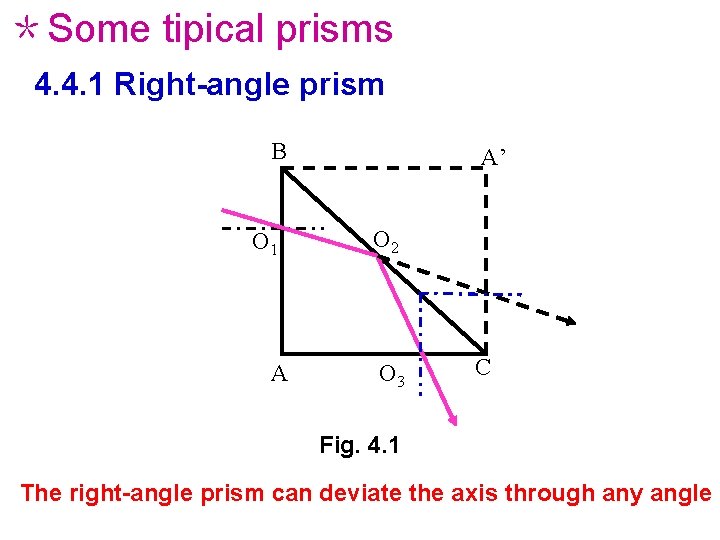
*Some tipical prisms 4. 4. 1 Right-angle prism B O 1 A A’ O 2 O 3 C Fig. 4. 1 The right-angle prism can deviate the axis through any angle
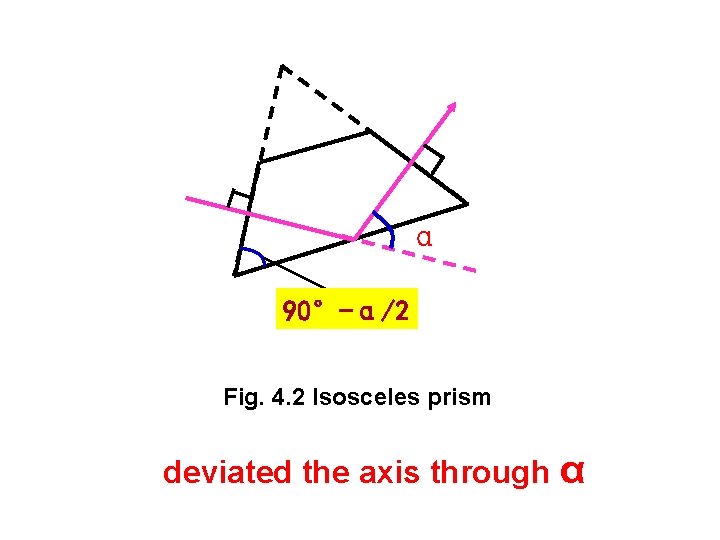
α 90°-α/2 Fig. 4. 2 Isosceles prism deviated the axis through α
4. 4. 2 Penta prism(五角棱镜) A E B C
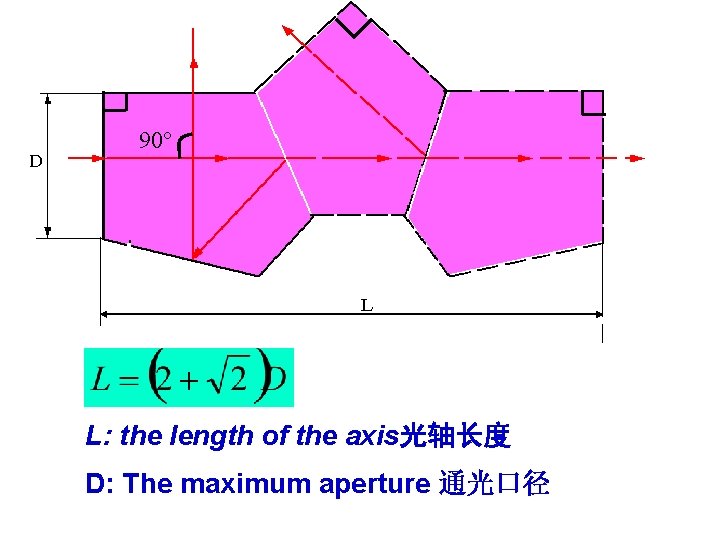
90° L: the length of the axis光轴长度 D: The maximum aperture 通光口径
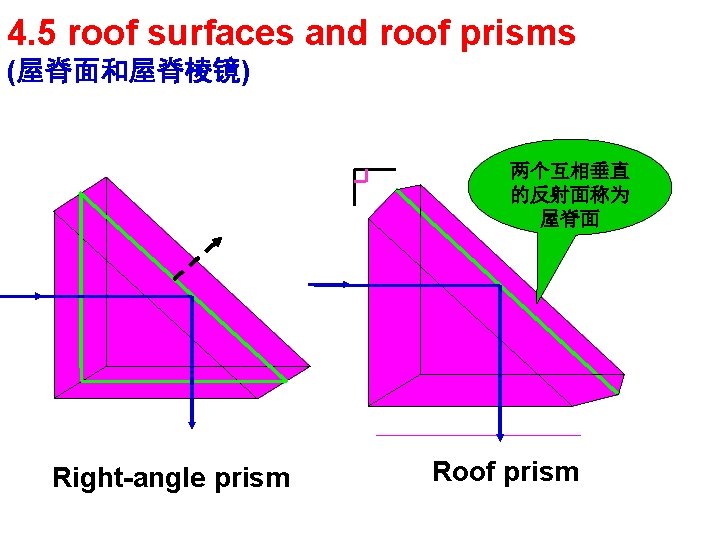
4. 5 roof surfaces and roof prisms (屋脊面和屋脊棱镜) 两个互相垂直 的反射面称为 屋脊面 Right-angle prism Roof prism
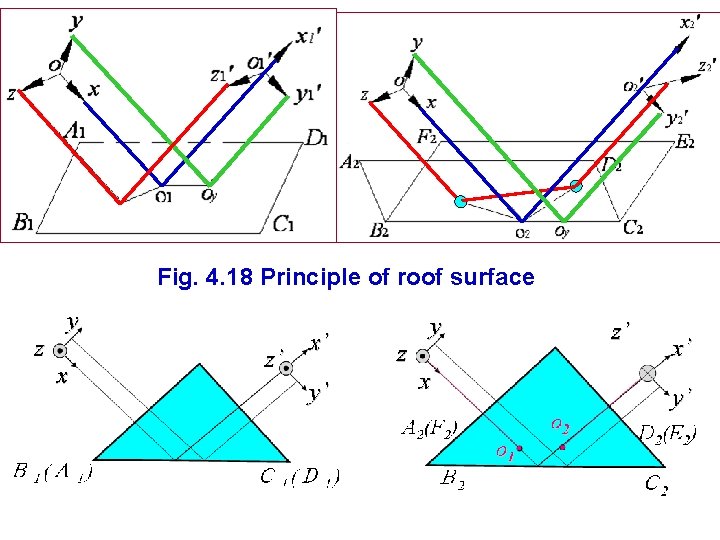
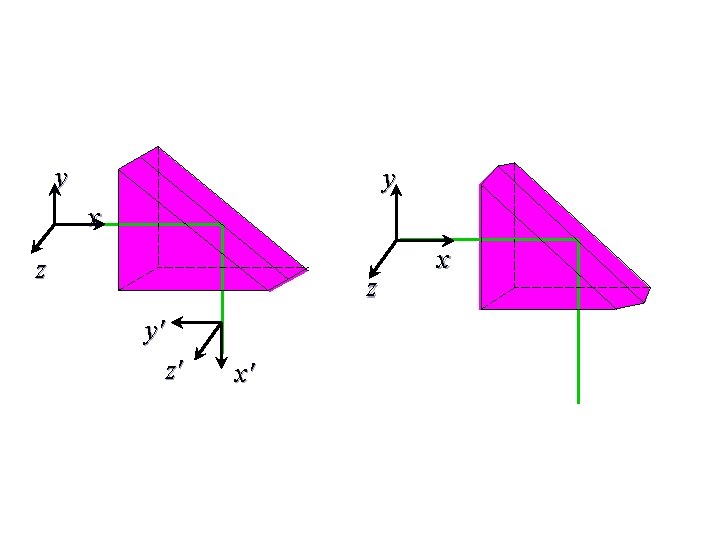
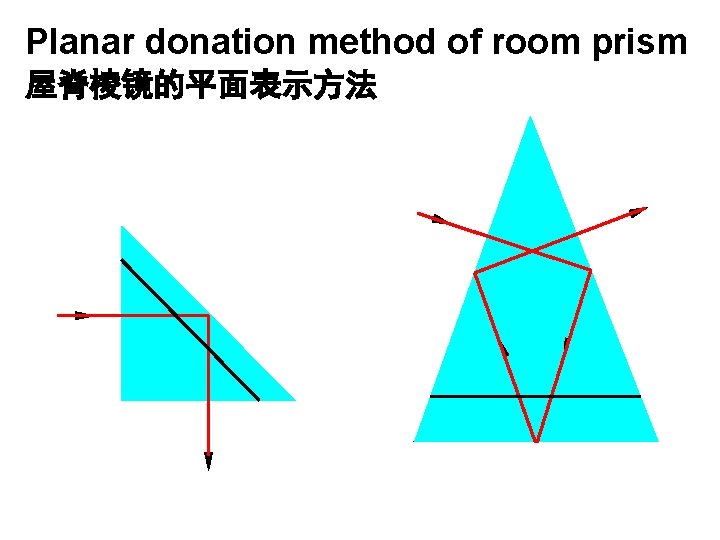
In order to get an image similar to the object, two surfaces at 90°whose intersection lies in the hypotenuse(斜边 ) can be used to replace one of the reflecting surfaces. n These special surfaces are called roof surfaces (屋脊面). n A prism containing roof surfaces is called roof prism (屋脊棱镜). n
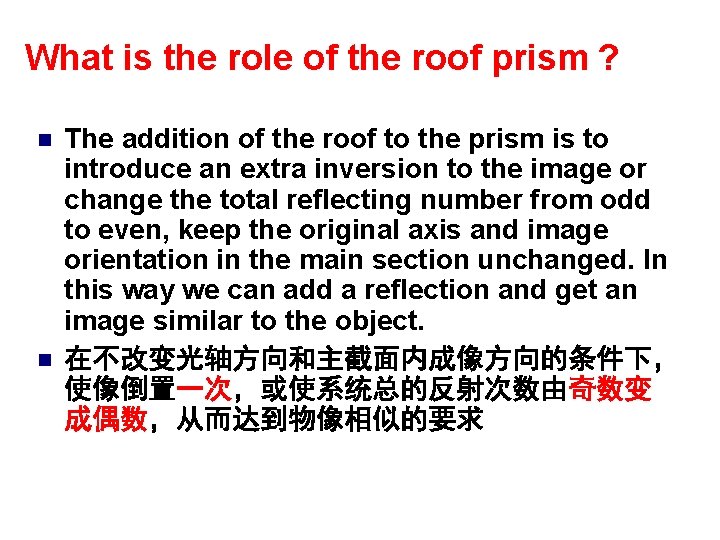
What is the role of the roof prism ? n n The addition of the roof to the prism is to introduce an extra inversion to the image or change the total reflecting number from odd to even, keep the original axis and image orientation in the main section unchanged. In this way we can add a reflection and get an image similar to the object. 在不改变光轴方向和主截面内成像方向的条件下, 使像倒置一次,或使系统总的反射次数由奇数变 成偶数,从而达到物像相似的要求
Fig. 4. 18 Principle of roof surface
y y x z z y′ z′ x′ x
Planar donation method of room prism 屋脊棱镜的平面表示方法
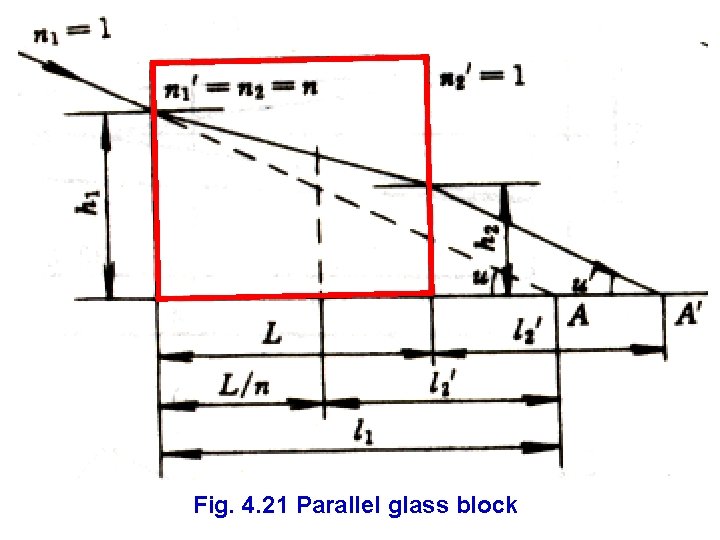
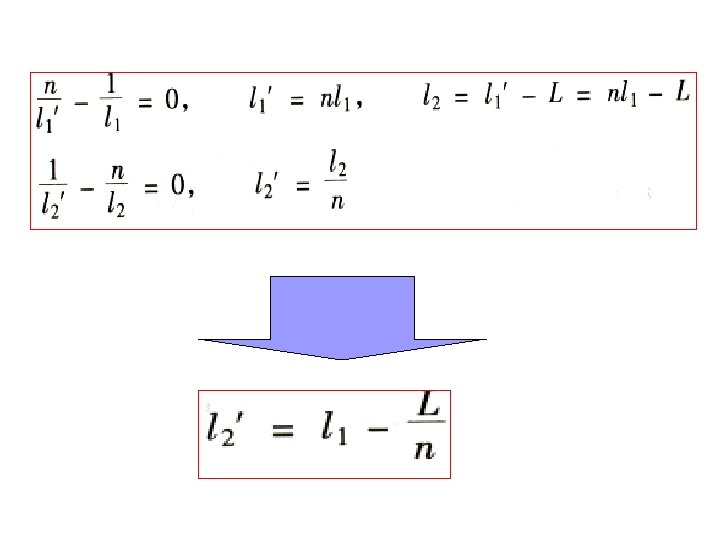
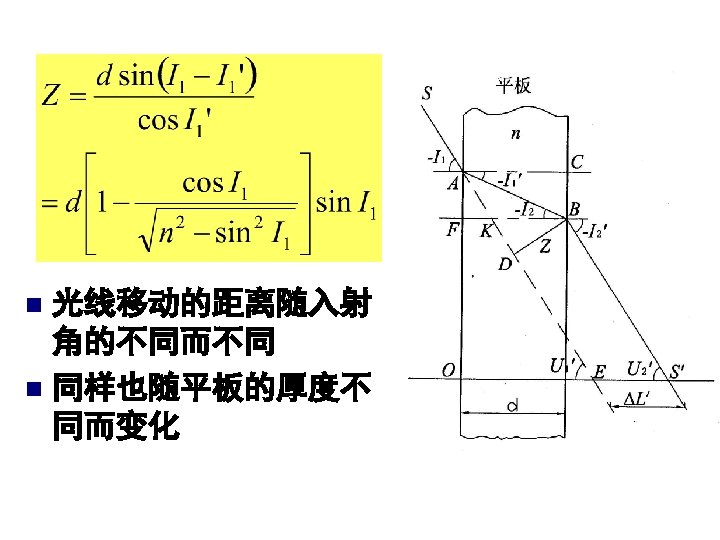
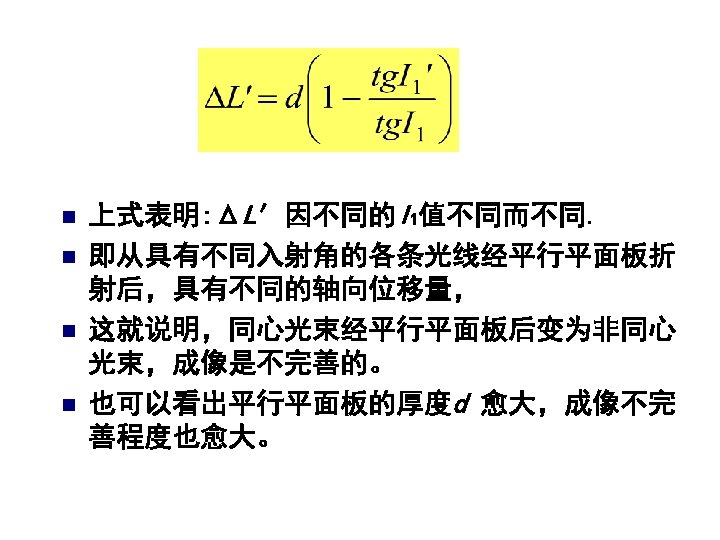
4. 6 imaging property of parallel glass block and prism size calculation n We mentioned in the previous section that by using a prism to replace mirrors corresponds to add a parallel glass block.
Fig. 4. 21 Parallel glass block
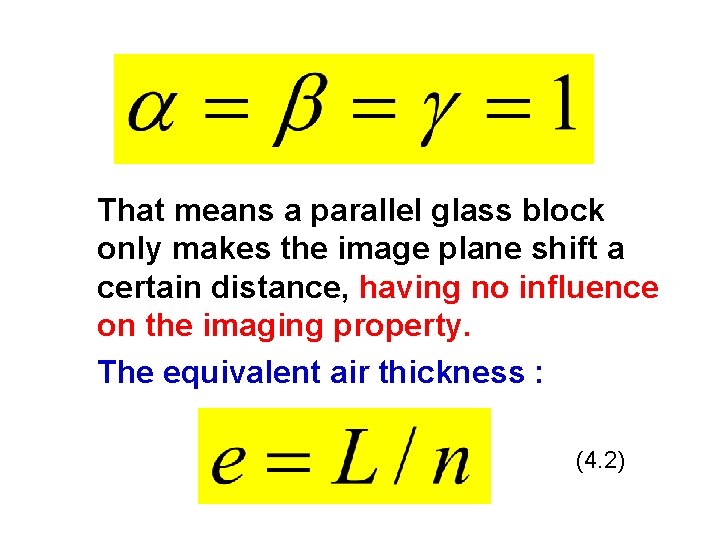
That means a parallel glass block only makes the image plane shift a certain distance, having no influence on the imaging property. The equivalent air thickness : (4. 2)
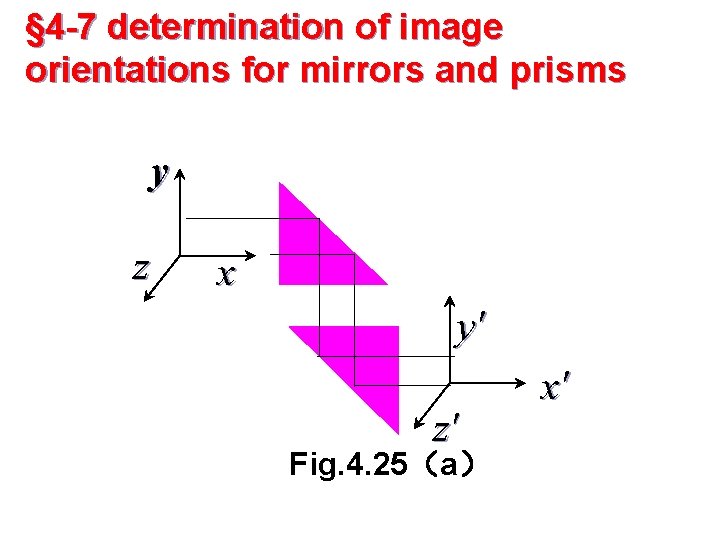
§ 4 -7 determination of image orientations for mirrors and prisms y z x y′ z′ Fig. 4. 25(a) x′
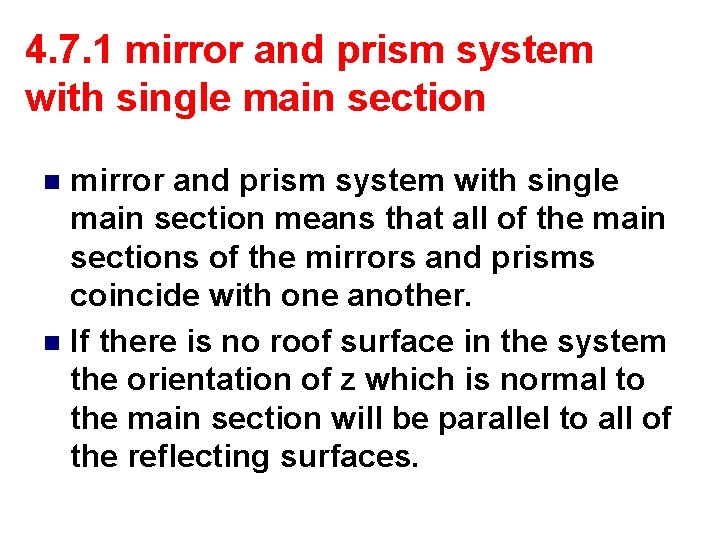
4. 7. 1 mirror and prism system with single main section means that all of the main sections of the mirrors and prisms coincide with one another. n If there is no roof surface in the system the orientation of z which is normal to the main section will be parallel to all of the reflecting surfaces. n
n According to the mirror imaging properties, the object and the image are symmetrical to the mirror, so the orientation of z’ in image space will be as the same as that of z in the object space no matter how many reflections have happened.
However, if there is a roof surface in the system, according to the roof surface property, the orientations z’ and z will be reversed. n In this way we can easily determine the orientation of z’ in a mirror and prism system with the single main section. n
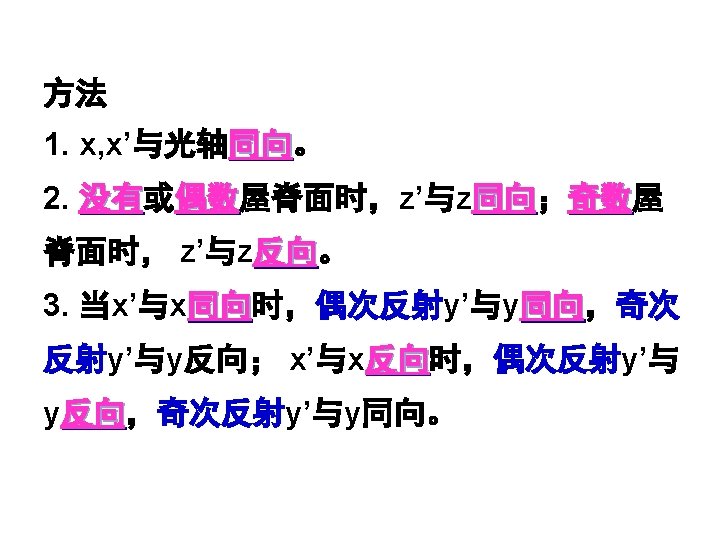
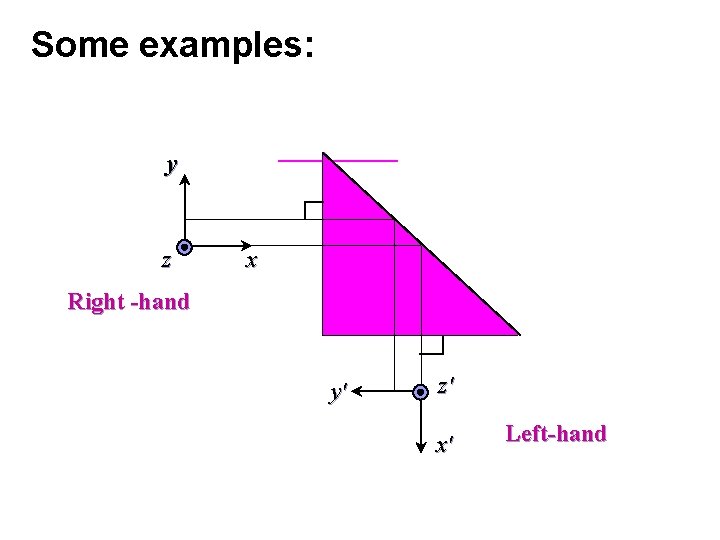
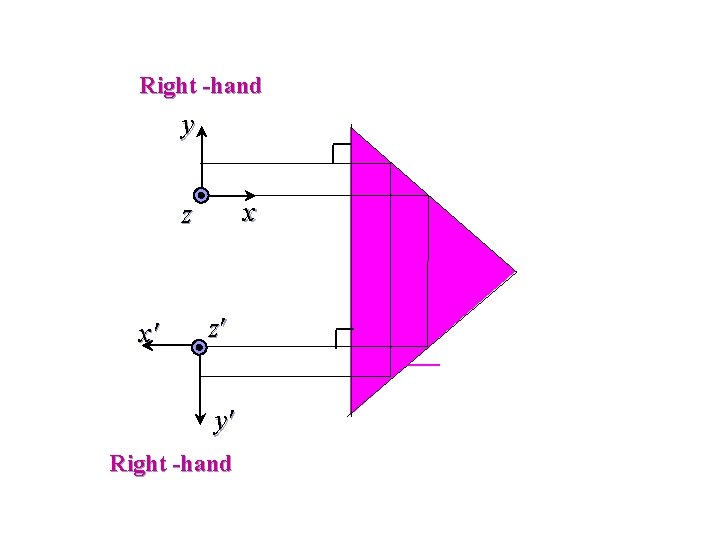
First of all, suppose there is no roof surfaces in the system and means z’ will be the same orientation as z. n on this condition, if the total number of the reflectors is even, the image will be similar to the object, y’ and y have the same orientation if the orientation of axis x’ coincides with x, as shown in fig. 4. 25(a). n
n On the contrary, if the orientation of axis x’ is reversed to x, y’ will be opposite to y, as shown in fig. 4. 25(b). n Similarly, if the total number of the reflectors is odd, the image will be a mirror image, y’ and y have the opposite orientation of axis x’ coincides with x, as shown in fig. 4. 26(a).
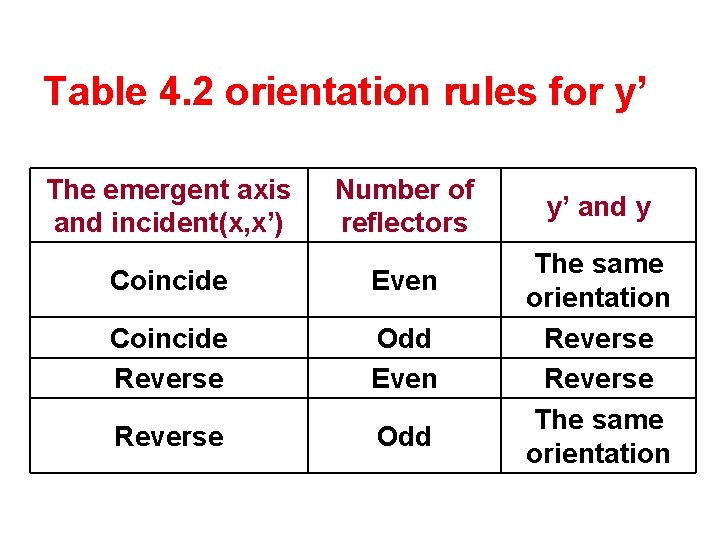
On the contrary, if the orientation of the axis x’ is reversed to x, y’ will have the same orientation as y, as shown in fig. 4. 26(b). n Thus, for a mirror and prism system with single main section we can get the following rules, as shown in table 4. 2. n
Table 4. 2 orientation rules for y’ The emergent axis and incident(x, x’) Number of reflectors Coincide Even Coincide Reverse Odd Even Reverse Odd y’ and y The same orientation Reverse The same orientation
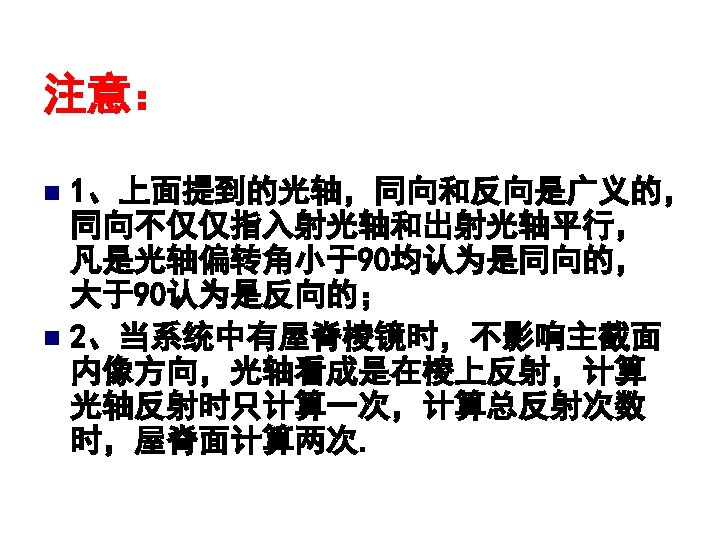
n If there is a roof surface in the system, according to its imaging property, it does not affect the orientations which lie in the man section, thus, on this condition the above rules can also be used.
n For the roof surface the axis can be taken as if it is reflected at the roof line and the reflector number should be counted as on time. However, for the total number of reflectors, the roof surface should be counted twice.
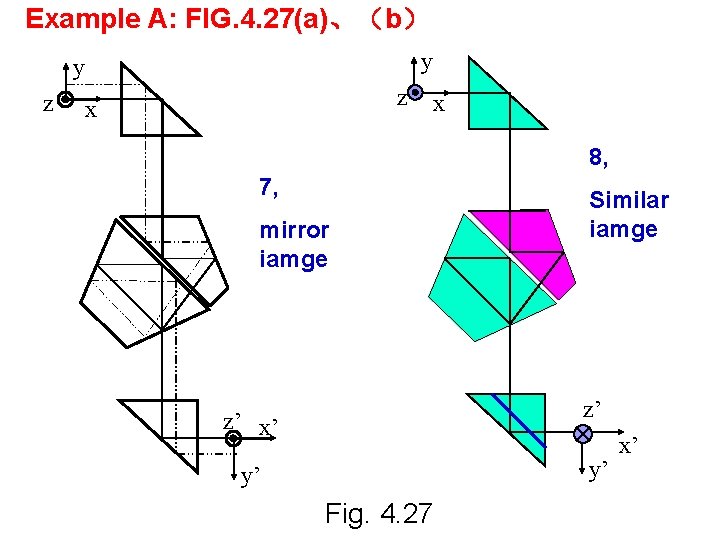
Example A: FIG. 4. 27(a)、(b) y y z z x x 8, 7, mirror iamge Similar iamge z’ x’ z’ y’ y’ Fig. 4. 27 x’
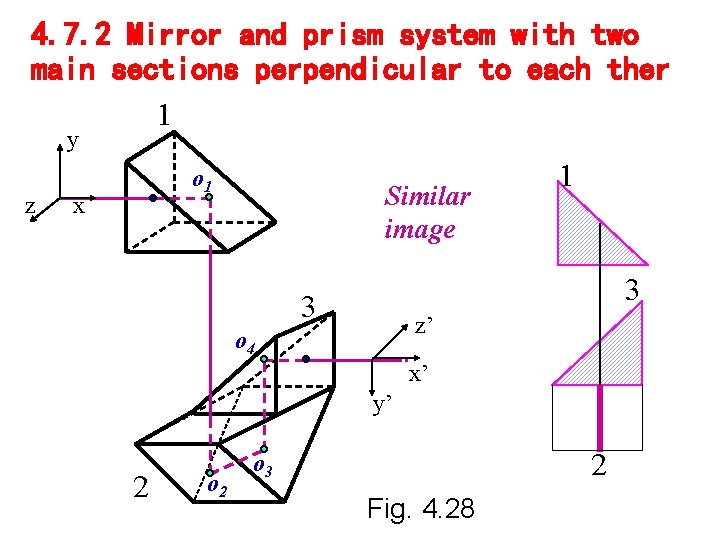
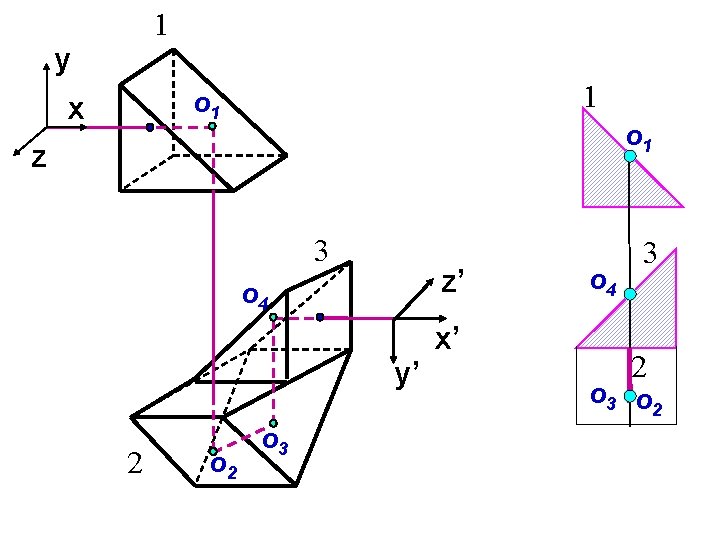
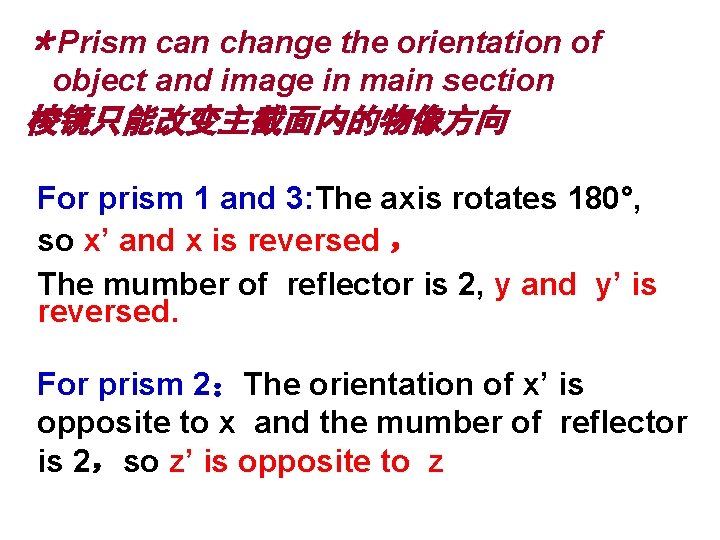
4. 7. 2 Mirror and prism system with two main sections perpendicular to each ther 1 y z o 1 x Similar image 1 3 3 z’ o 4 x’ y’ 2 o 2 2 o 3 Fig. 4. 28
1 y 1 o 1 x o 1 z 3 z’ o 4 y’ 2 o 3 x’ o 4 3 2 o 3 o 2
*Prism can change the orientation of object and image in main section 棱镜只能改变主截面内的物像方向 For prism 1 and 3: The axis rotates 180°, so x’ and x is reversed , The mumber of reflector is 2, y and y’ is reversed. For prism 2:The orientation of x’ is opposite to x and the mumber of reflector is 2,so z’ is opposite to z
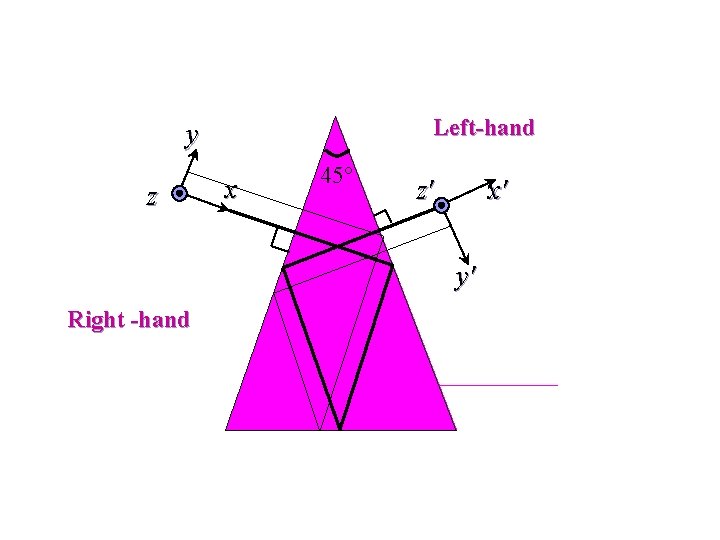
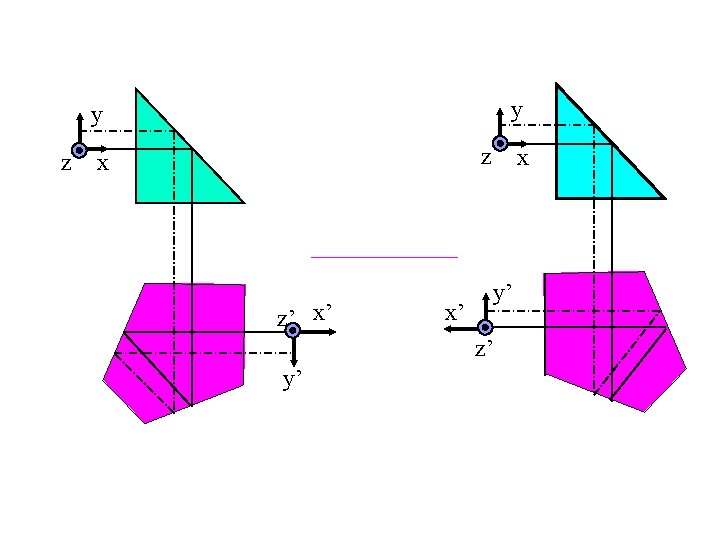
Some examples: y z x Right -hand y′ z′ x′ Left-hand
Right -hand y x z x′ z′ y′ Right -hand
Left-hand y z x 45° z′ x′ y′ Right -hand