
4 4 Overview of Cellular Respiration KEY CONCEPT
- Slides: 9
4. 4 Overview of Cellular Respiration KEY CONCEPT The overall process of cellular respiration converts sugar into ATP using oxygen.
4. 4 Overview of Cellular Respiration Objectives • Describe the process of cellular respiration. • Compare cellular respiration to photosynthesis.
4. 4 Overview of Cellular Respiration Vocabulary • Cellular Respiration – Process of producing ATP by breaking down carbon-based molecules when oxygen is present. • Aerobic – Process that requires oxygen to occur. • Glycolysis – Anaerobic process in which glucose is broken down into two molecules of pyruvate and two net ATP are produced. • Anaerobic – Process that does not require oxygen to occur. • Krebs Cycle – Process during cellular respiration that breaks down a carbon molecule to produce molecules that are used in the electron transport chain.
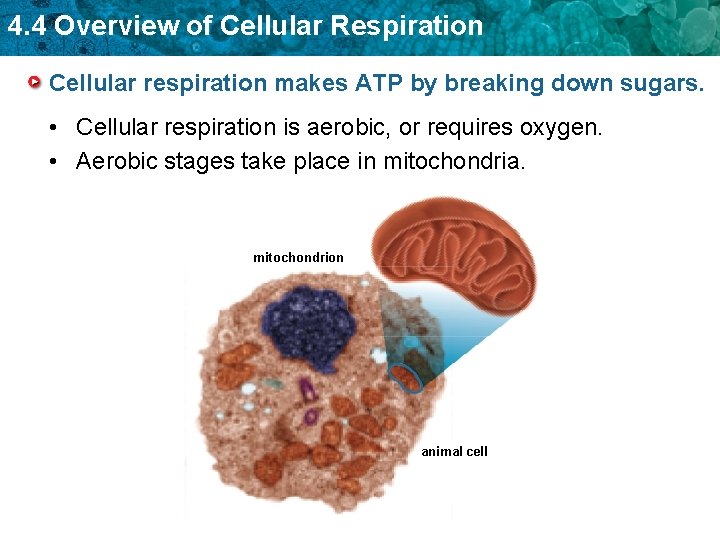
4. 4 Overview of Cellular Respiration Cellular respiration makes ATP by breaking down sugars. • Cellular respiration is aerobic, or requires oxygen. • Aerobic stages take place in mitochondria. mitochondrion animal cell
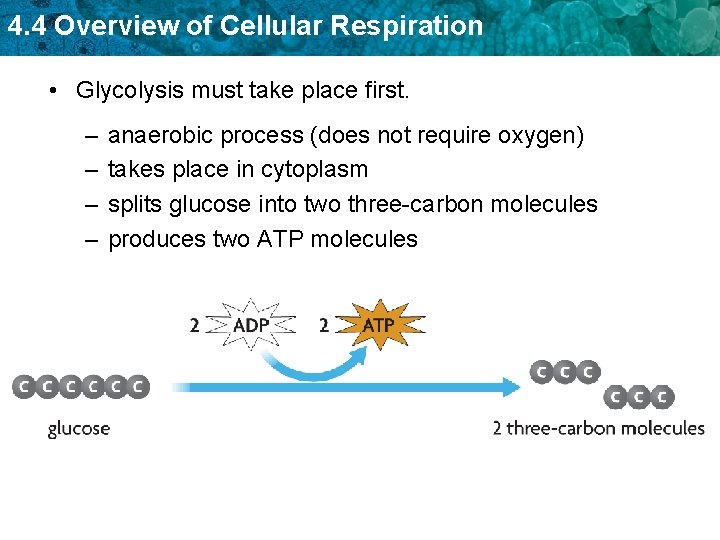
4. 4 Overview of Cellular Respiration • Glycolysis must take place first. – – anaerobic process (does not require oxygen) takes place in cytoplasm splits glucose into two three-carbon molecules produces two ATP molecules
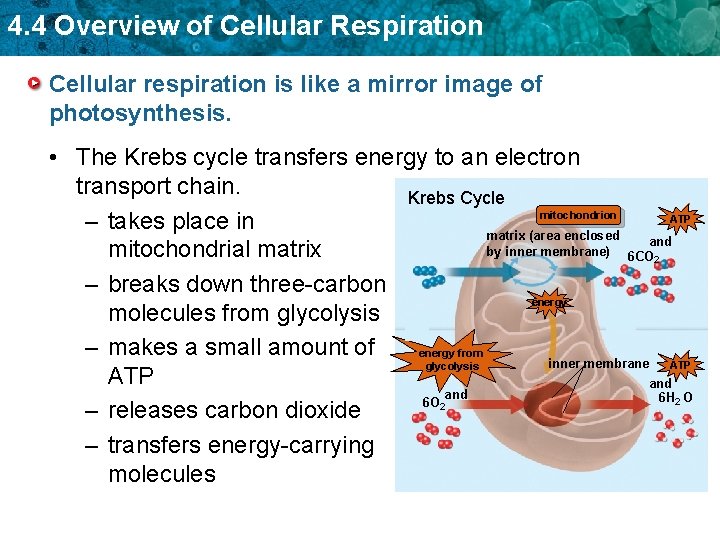
4. 4 Overview of Cellular Respiration Cellular respiration is like a mirror image of photosynthesis. • The Krebs cycle transfers energy to an electron transport chain. Krebs Cycle 1 mitochondrion ATP – takes place in matrix (area enclosed and by inner membrane) 6 CO mitochondrial matrix 2 – breaks down three-carbon energy molecules from glycolysis 2 3 – makes a small amount of energy from inner membrane ATP glycolysis ATP and 6 H 2 O 6 O 2 – releases carbon dioxide – transfers energy-carrying 4 molecules
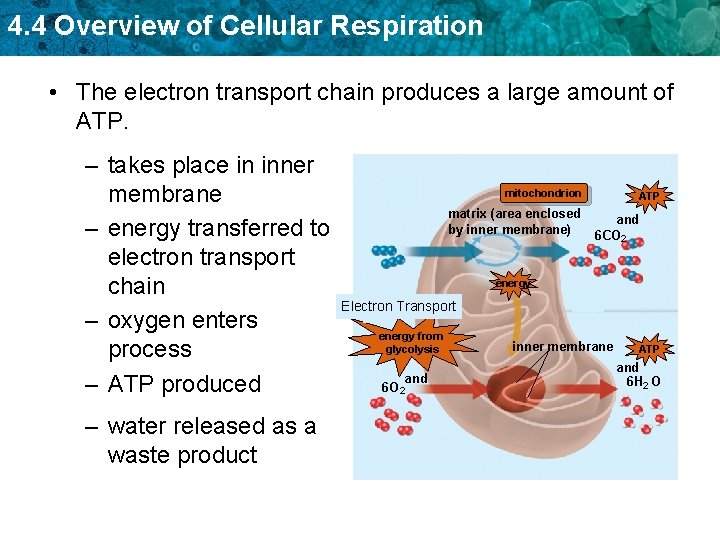
4. 4 Overview of Cellular Respiration • The electron transport chain produces a large amount of ATP. – takes place in inner membrane – energy transferred to electron transport chain – oxygen enters process – ATP produced – water released as a waste product 1 mitochondrion matrix (area enclosed by inner membrane) energy Electron Transport 3 energy from glycolysis and 6 O 2 ATP and 6 CO 2 2 inner membrane ATP and 6 H 2 O 4
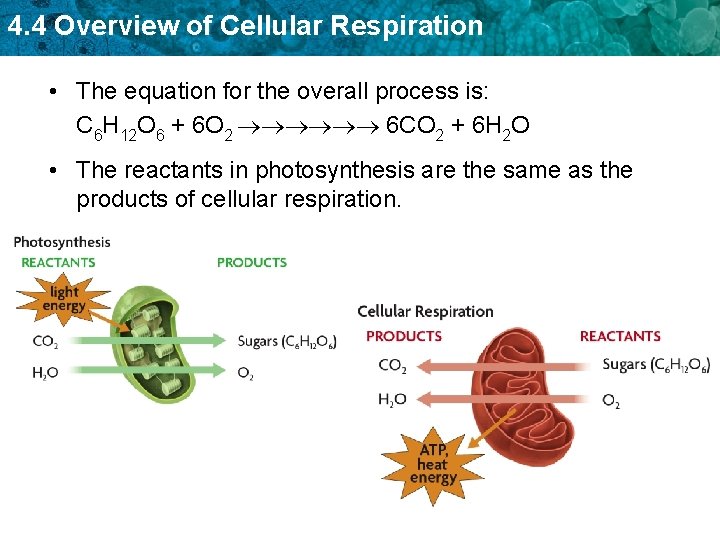
4. 4 Overview of Cellular Respiration • The equation for the overall process is: C 6 H 12 O 6 + 6 O 2 6 CO 2 + 6 H 2 O • The reactants in photosynthesis are the same as the products of cellular respiration.
4. 4 Overview of Cellular Respiration Question/Answer • What is the function of cellular respiration? – Cellular respiration breaks down sugars to produce ATP for cell activities. • What process leads to cellular respiration, and where does it take place? – Glycolysis, which occurs in the cytoplasm • Does glucose actually react with oxygen during cellular respiration? Explain. – No, glucose is split by glycolysis prior to the aerobic parts of cellular respiration, when oxygen enters the process. • Where does cellular respiration occur? – Mitochondria • What are the reactants and products of cellular respiration? – The reactants are three-carbon molecules and oxygen. The products are water and carbon dioxide.