
4 4 Overview of Cellular Respiration KEY CONCEPT
- Slides: 16
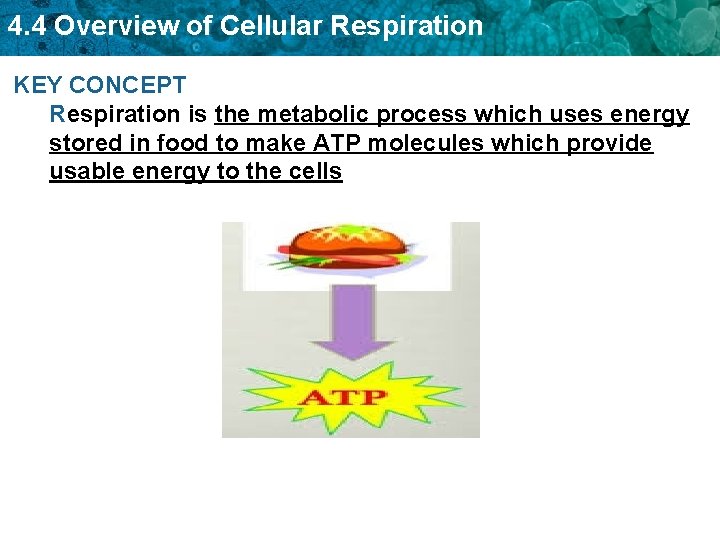
4. 4 Overview of Cellular Respiration KEY CONCEPT Respiration is the metabolic process which uses energy stored in food to make ATP molecules which provide usable energy to the cells
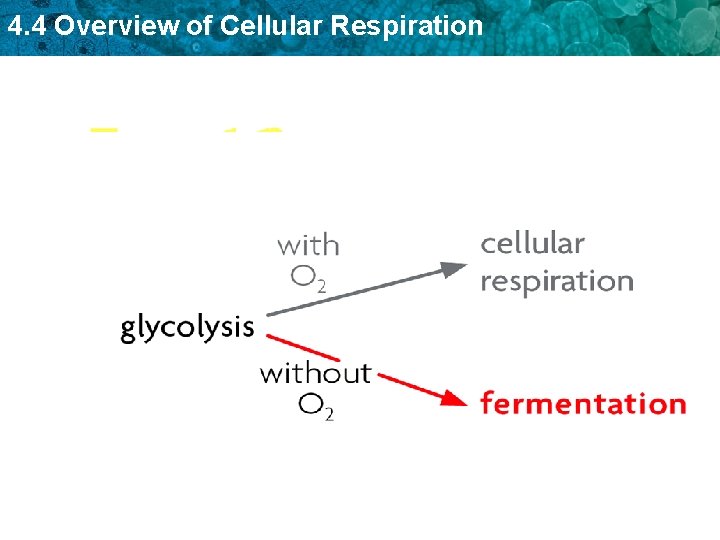
4. 4 Overview of Cellular Respiration Two forms of Respiration 1. Aerobic Respiration-Requires Oxygen gas 2. Anaerobic Respiration– No Oxygen gas
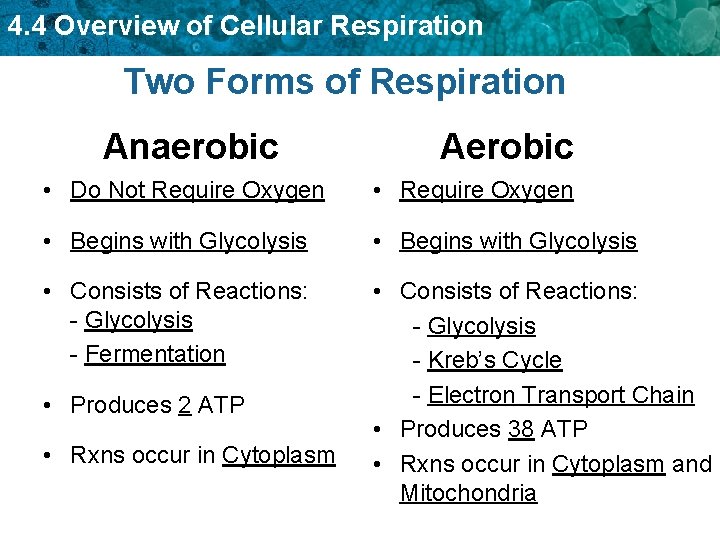
4. 4 Overview of Cellular Respiration Two Forms of Respiration Anaerobic Aerobic • Do Not Require Oxygen • Begins with Glycolysis • Consists of Reactions: - Glycolysis - Fermentation • Consists of Reactions: - Glycolysis - Kreb’s Cycle - Electron Transport Chain • Produces 38 ATP • Rxns occur in Cytoplasm and Mitochondria • Produces 2 ATP • Rxns occur in Cytoplasm
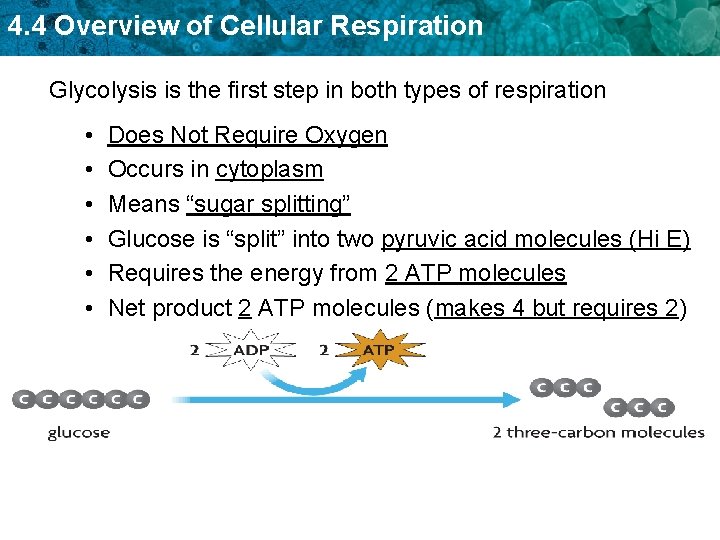
4. 4 Overview of Cellular Respiration Glycolysis is the first step in both types of respiration • • • Does Not Require Oxygen Occurs in cytoplasm Means “sugar splitting” Glucose is “split” into two pyruvic acid molecules (Hi E) Requires the energy from 2 ATP molecules Net product 2 ATP molecules (makes 4 but requires 2)
4. 4 Overview of Cellular Respiration
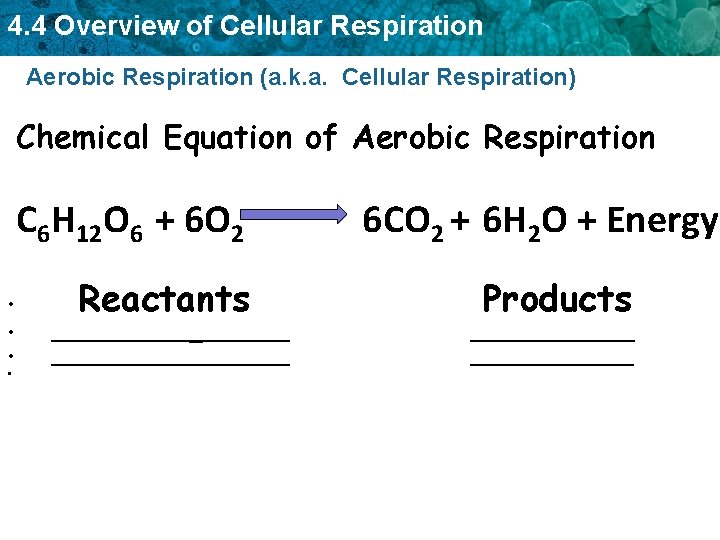
4. 4 Overview of Cellular Respiration Aerobic Respiration (a. k. a. Cellular Respiration) Chemical Equation of Aerobic Respiration C 6 H 12 O 6 + 6 O 2 • • Reactants ___________________ 6 CO 2 + 6 H 2 O + Energy Products _____________
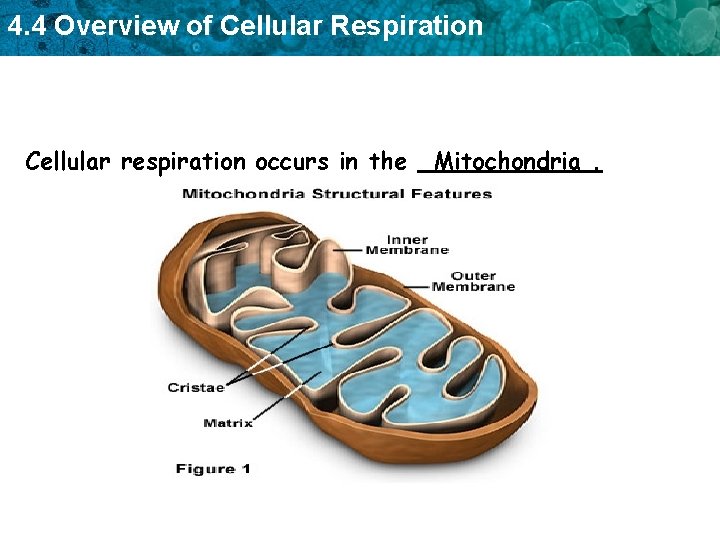
4. 4 Overview of Cellular Respiration Cellular respiration occurs in the _Mitochondria.
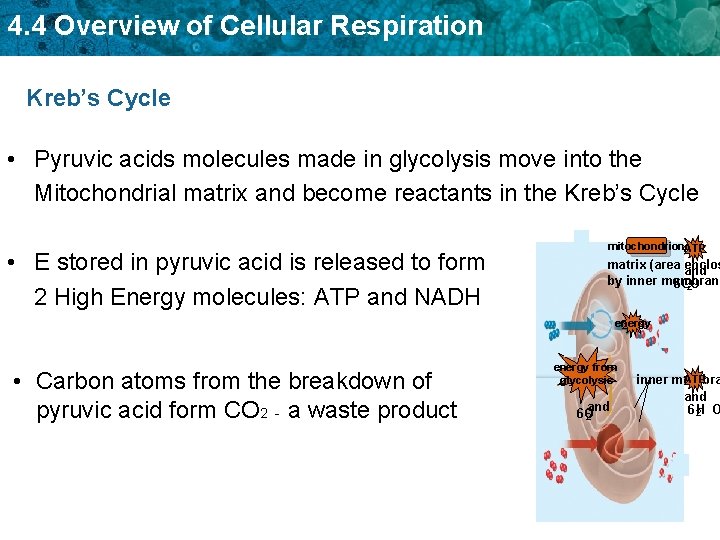
4. 4 Overview of Cellular Respiration Kreb’s Cycle • Pyruvic acids molecules made in glycolysis move into the Mitochondrial matrix and become reactants in the Kreb’s Cycle 1 • E stored in pyruvic acid is released to form 2 High Energy molecules: ATP and NADH mitochondrion. ATP matrix (area and enclos by inner membrane 6 CO 2 energy 3 • Carbon atoms from the breakdown of pyruvic acid form CO 2 - a waste product energy from glycolysis and 6 O 2 2 ATP inner membra and 6 H 2 O 4
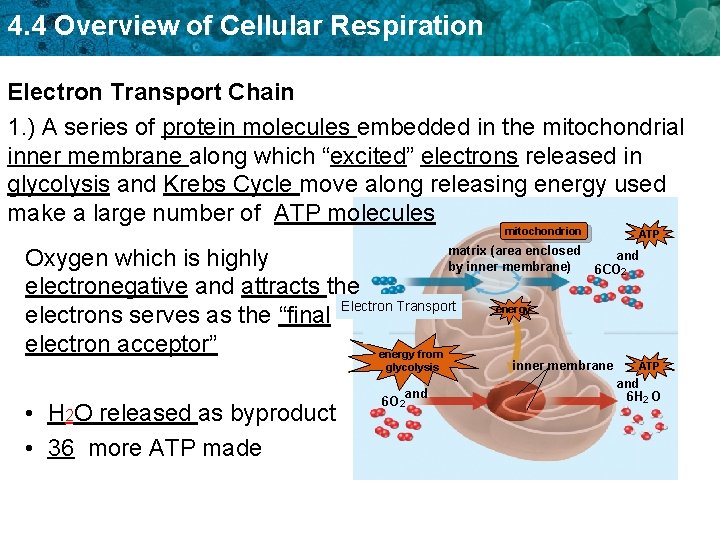
4. 4 Overview of Cellular Respiration Electron Transport Chain 1. ) A series of protein molecules embedded in the mitochondrial inner membrane along which “excited” electrons released in glycolysis and Krebs Cycle move along releasing energy used make a large number of ATP molecules 1 mitochondrion ATP matrix (area enclosed and Oxygen which is highly by inner membrane) 6 CO 2 electronegative and attracts the energy electrons serves as the “final Electron Transport 2 3 electron acceptor” energy from glycolysis • H 2 O released as byproduct • 36 more ATP made and 6 O 2 inner membrane ATP and 6 H 2 O 4
4. 4 Overview of Cellular Respiration Anaerobic Respiration • Occurs in the cytoplasm • Breakdown of food molecules without oxygen • Begins with glycolysis (just like in aerobic respiration) • Glycolysis makes 2 ATP • The only way glycolysis can keep working is to replace the molecule NAD+ that is the electron acceptor/transporter
4. 4 Overview of Cellular Respiration Fermentation • Occurs when Oxygen is not available – anaerobic process • Occurs in mitochondria • Resupplies the NAD+ so glycolysis can keep happening and ATP can be made • NO ATP Made
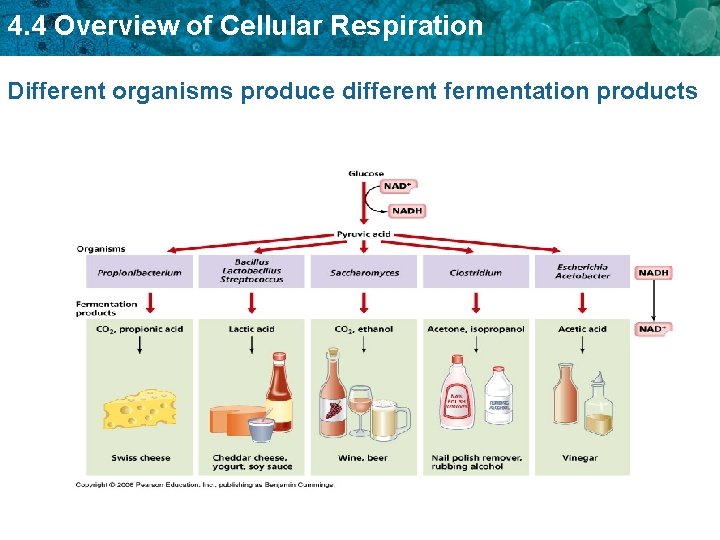
4. 4 Overview of Cellular Respiration Two Types of Fermentation • There are two chemical pathways of fermentation • They are named for the final product made • Alcoholic fermentation Yeast – Bread, Wine Bacteria - Yogurt Lactic Acid fermentation Muscles - “The Burn”
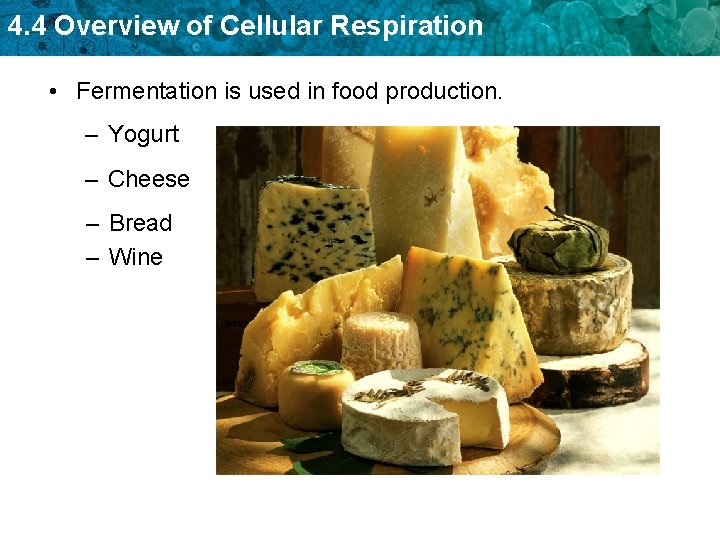
4. 4 Overview of Cellular Respiration • Fermentation is used in food production. – Yogurt – Cheese – Bread – Wine
4. 4 Overview of Cellular Respiration Different organisms produce different fermentation products
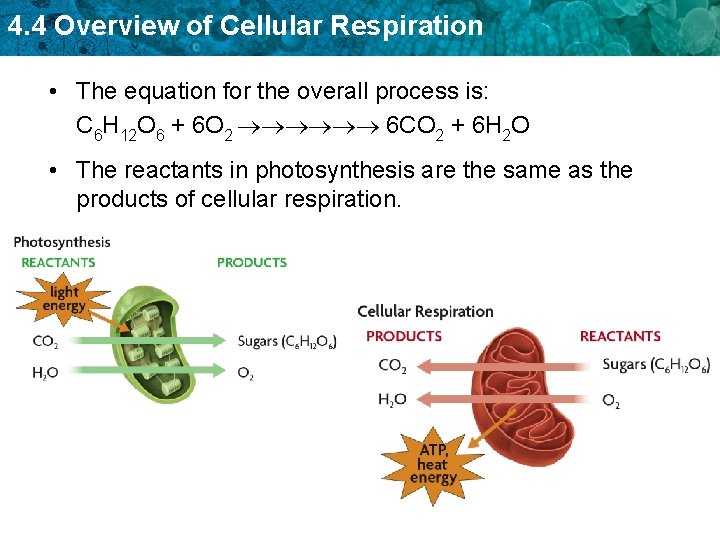
4. 4 Overview of Cellular Respiration • The equation for the overall process is: C 6 H 12 O 6 + 6 O 2 6 CO 2 + 6 H 2 O • The reactants in photosynthesis are the same as the products of cellular respiration.
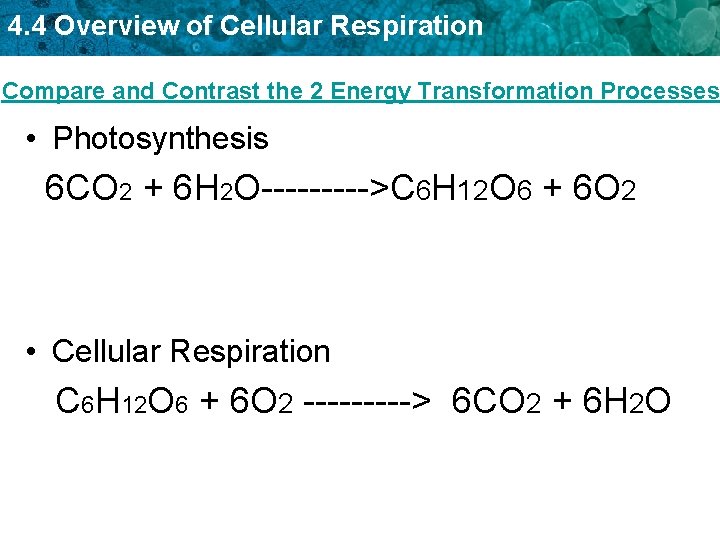
4. 4 Overview of Cellular Respiration Compare and Contrast the 2 Energy Transformation Processes • Photosynthesis 6 CO 2 + 6 H 2 O----->C 6 H 12 O 6 + 6 O 2 • Cellular Respiration C 6 H 12 O 6 + 6 O 2 -----> 6 CO 2 + 6 H 2 O