
4 4 Deductive Reasoning Reminders Statement Conditional statement
- Slides: 18
4. 4 Deductive Reasoning
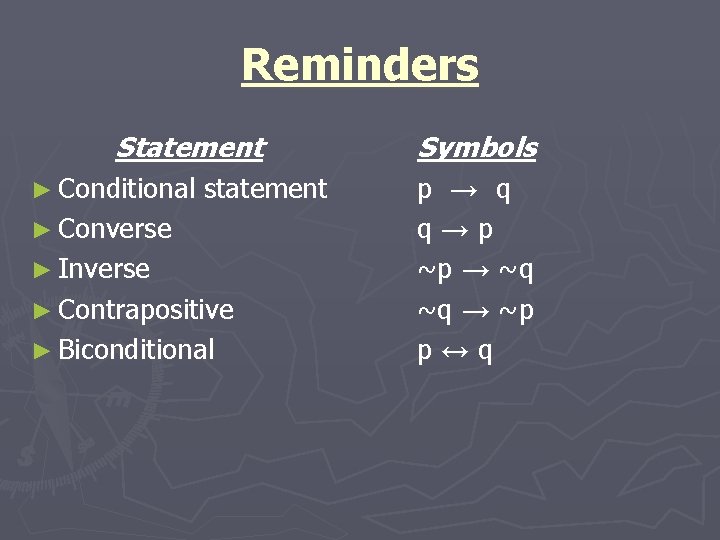
Reminders Statement ► Conditional statement ► Converse ► Inverse ► Contrapositive ► Biconditional Symbols p → q q→p ~p → ~q ~q → ~p p↔q
What is Deductive Reasoning? Uses facts, definitions, accepted properties, and the laws of logic to form a logical argument.
Laws of Deductive Reasoning 1. LAW OF DETACHMENTIf the hypothesis of a true conditional statement is true, then the conclusion is also true.
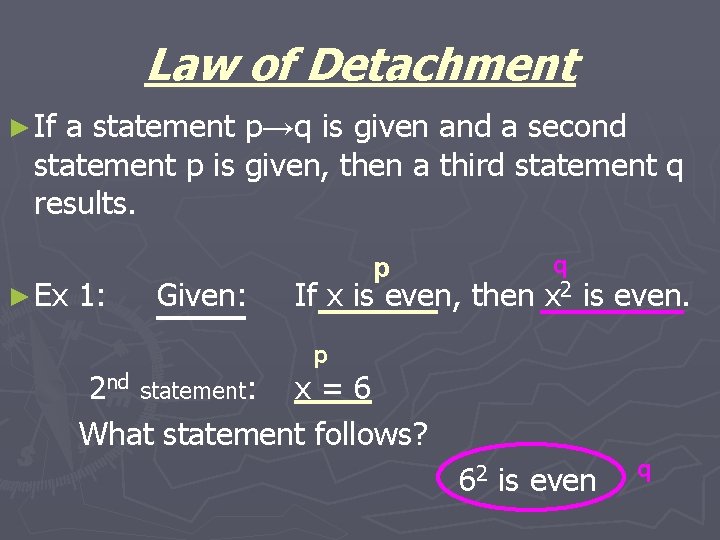
Law of Detachment ► If a statement p→q is given and a second statement p is given, then a third statement q results. ► Ex 1: Given: p q If x is even, then x 2 is even. p 2 nd statement: x = 6 What statement follows? 62 is even q
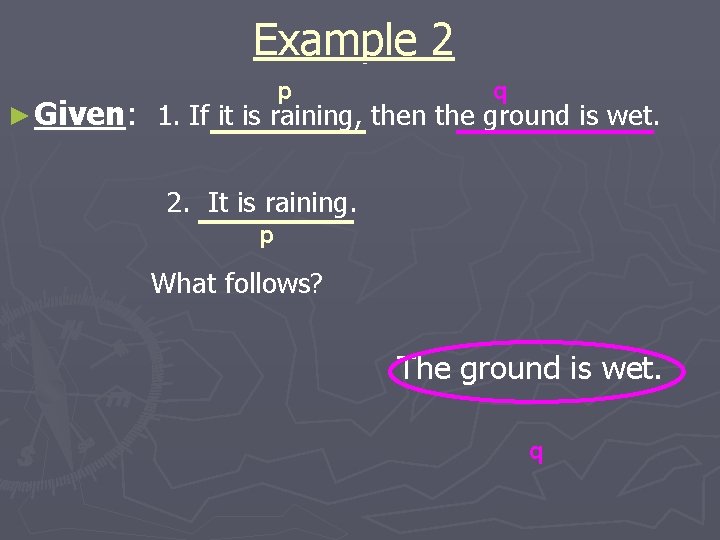
Example 2 p q ► Given: 1. If it is raining, then the ground is wet. 2. It is raining. p What follows? The ground is wet. q
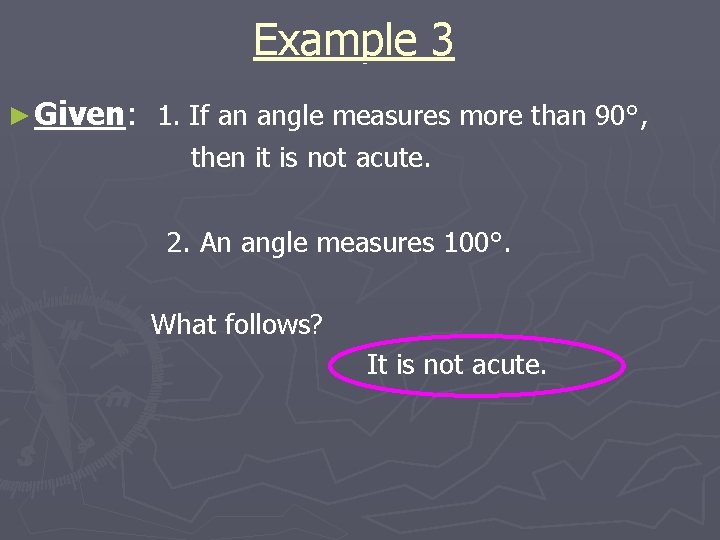
Example 3 ► Given: 1. If an angle measures more than 90°, then it is not acute. 2. An angle measures 100°. What follows? It is not acute.
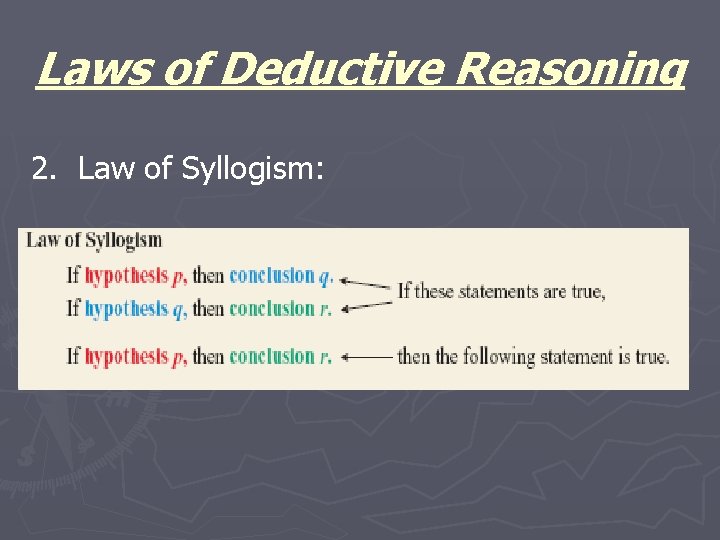
Laws of Deductive Reasoning 2. Law of Syllogism:
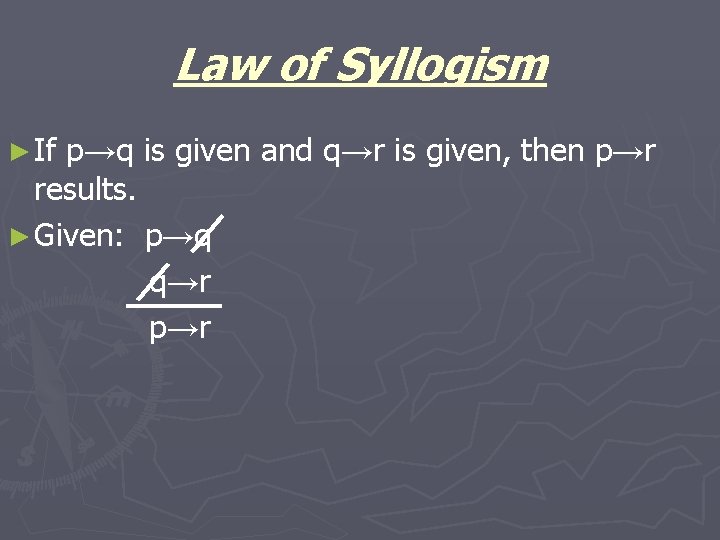
Law of Syllogism ► If p→q is given and q→r is given, then p→r results. ► Given: p→q q→r p→r
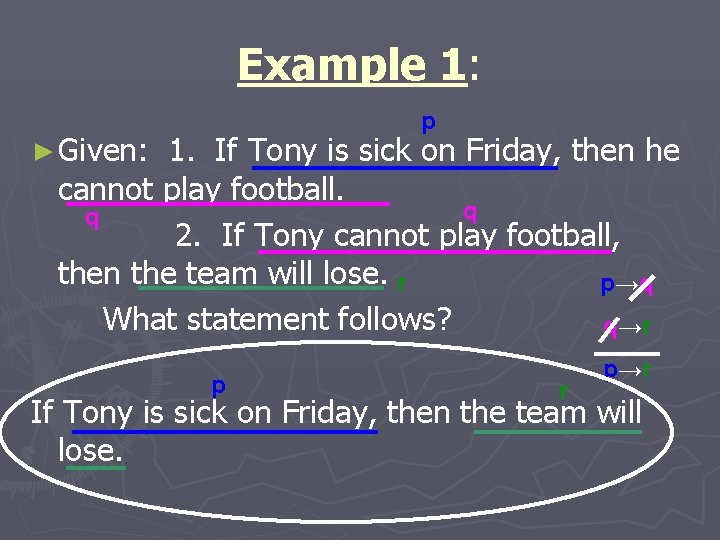
Example 1: p ► Given: 1. If Tony is sick on Friday, then he cannot play football. q q 2. If Tony cannot play football, then the team will lose. r p→q What statement follows? q→r p r p→r If Tony is sick on Friday, then the team will lose.
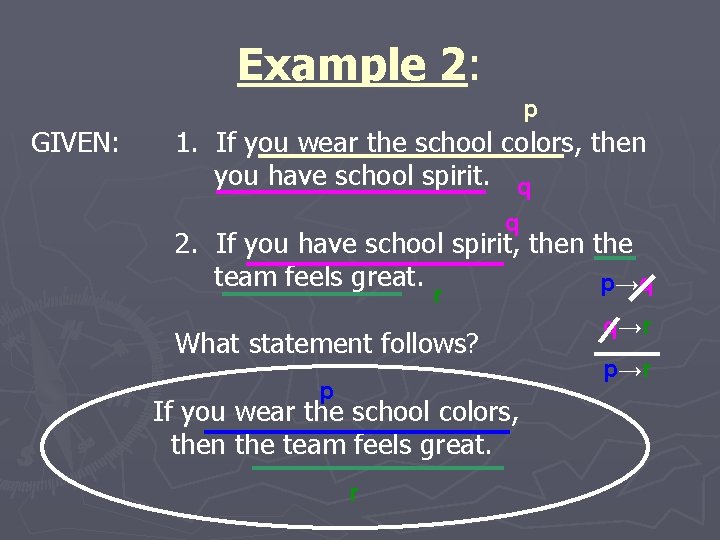
Example 2: p GIVEN: 1. If you wear the school colors, then you have school spirit. q q 2. If you have school spirit, then the team feels great. p→q r What statement follows? p If you wear the school colors, then the team feels great. r q→r p→r
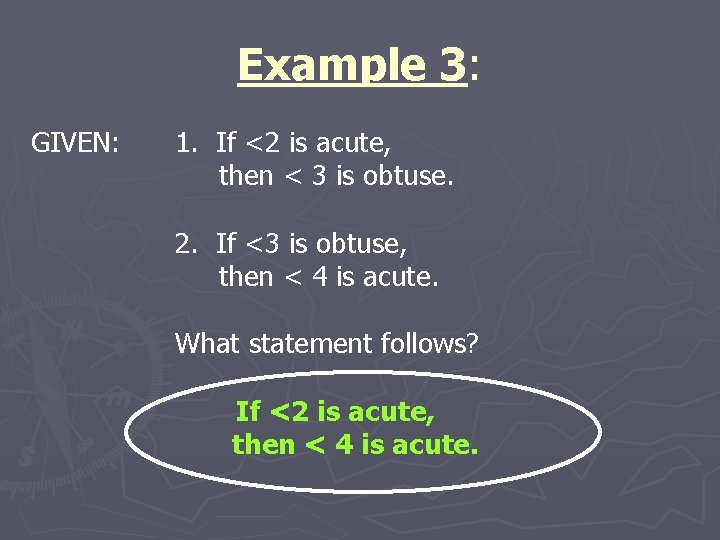
Example 3: GIVEN: 1. If <2 is acute, then < 3 is obtuse. 2. If <3 is obtuse, then < 4 is acute. What statement follows? If <2 is acute, then < 4 is acute.
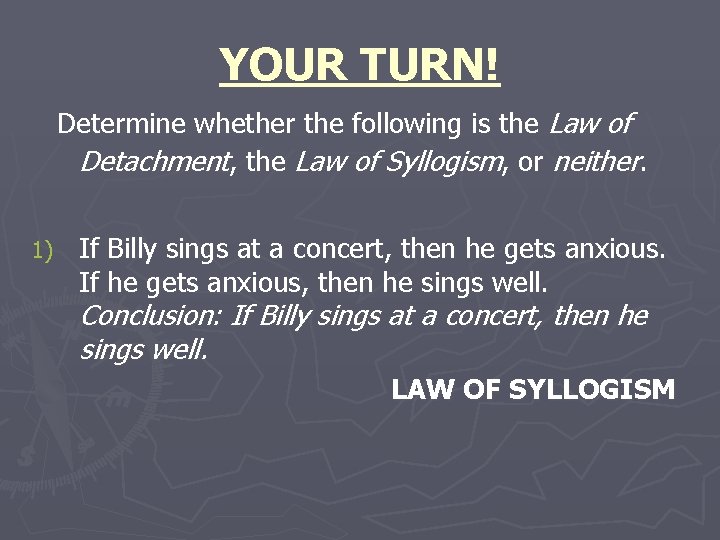
YOUR TURN! Determine whether the following is the Law of Detachment, the Law of Syllogism, or neither. 1) If Billy sings at a concert, then he gets anxious. If he gets anxious, then he sings well. Conclusion: If Billy sings at a concert, then he sings well. LAW OF SYLLOGISM
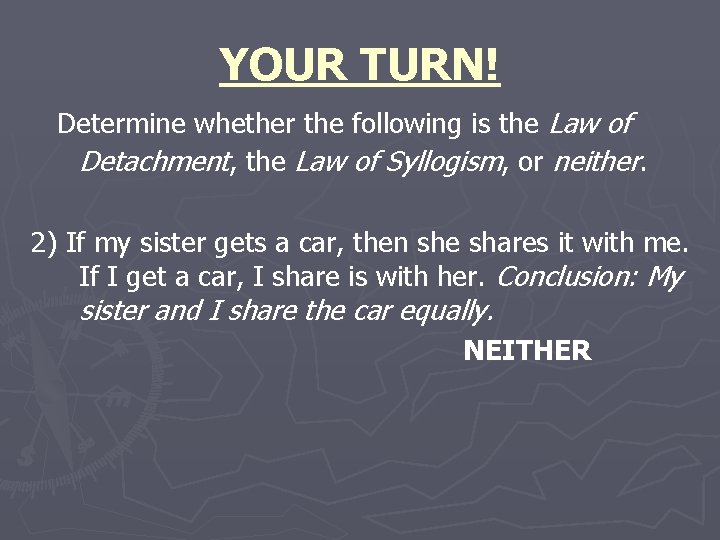
YOUR TURN! Determine whether the following is the Law of Detachment, the Law of Syllogism, or neither. 2) If my sister gets a car, then she shares it with me. If I get a car, I share is with her. Conclusion: My sister and I share the car equally. NEITHER
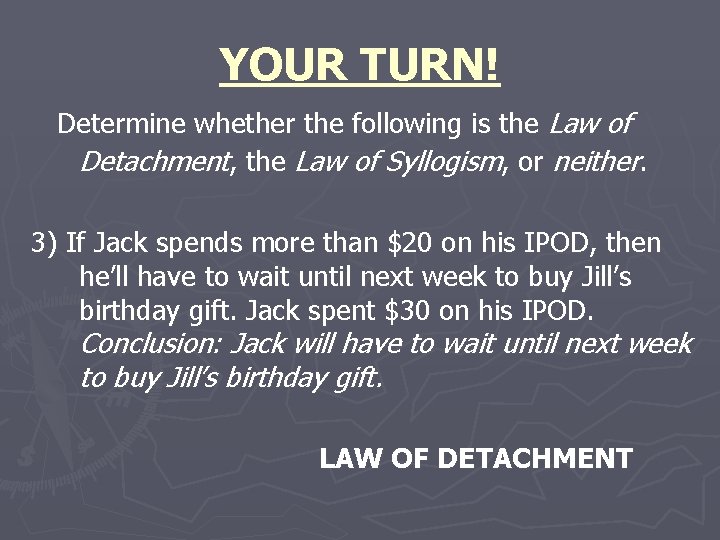
YOUR TURN! Determine whether the following is the Law of Detachment, the Law of Syllogism, or neither. 3) If Jack spends more than $20 on his IPOD, then he’ll have to wait until next week to buy Jill’s birthday gift. Jack spent $30 on his IPOD. Conclusion: Jack will have to wait until next week to buy Jill’s birthday gift. LAW OF DETACHMENT
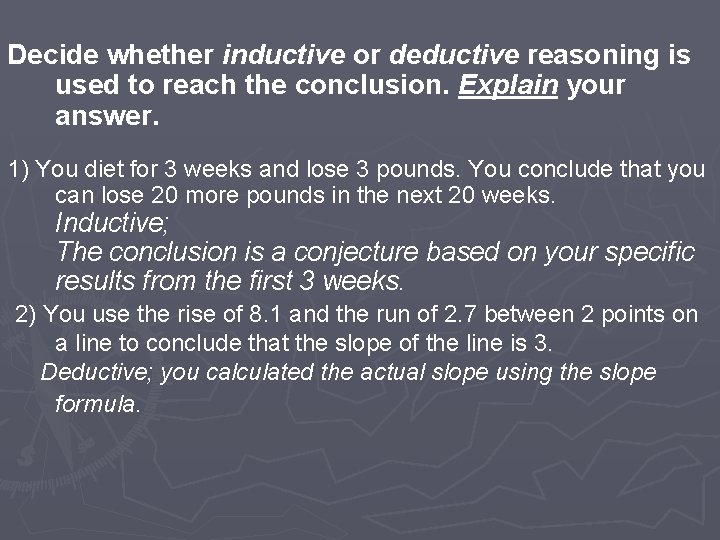
Decide whether inductive or deductive reasoning is used to reach the conclusion. Explain your answer. 1) You diet for 3 weeks and lose 3 pounds. You conclude that you can lose 20 more pounds in the next 20 weeks. Inductive; The conclusion is a conjecture based on your specific results from the first 3 weeks. 2) You use the rise of 8. 1 and the run of 2. 7 between 2 points on a line to conclude that the slope of the line is 3. Deductive; you calculated the actual slope using the slope formula.
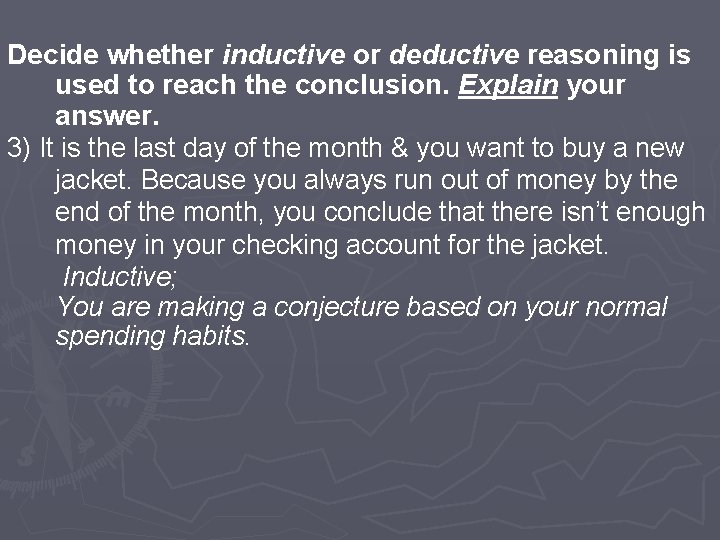
Decide whether inductive or deductive reasoning is used to reach the conclusion. Explain your answer. 3) It is the last day of the month & you want to buy a new jacket. Because you always run out of money by the end of the month, you conclude that there isn’t enough money in your checking account for the jacket. Inductive; You are making a conjecture based on your normal spending habits.
Assignment LESSON 4. 4 PRACTICE WORKSHEET