
4 4 Coordinate systems THEOREM 7 The Unique
- Slides: 22
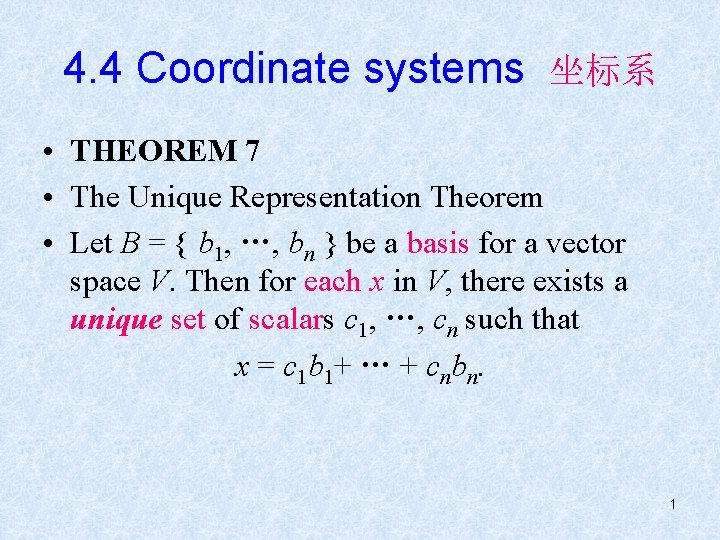
4. 4 Coordinate systems 坐标系 • THEOREM 7 • The Unique Representation Theorem • Let B = { b 1, …, bn } be a basis for a vector space V. Then for each x in V, there exists a unique set of scalars c 1, …, cn such that x = c 1 b 1+ … + cnbn. 1
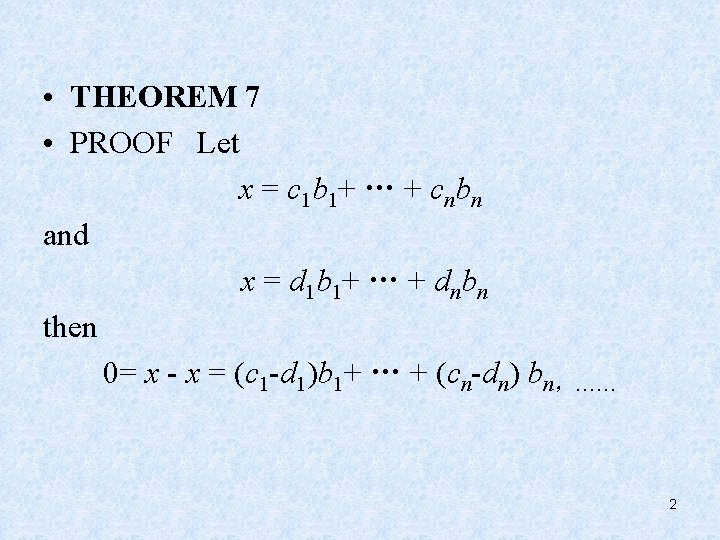
• THEOREM 7 • PROOF Let x = c 1 b 1+ … + cnbn and x = d 1 b 1+ … + dnbn then 0= x - x = (c 1 -d 1)b 1+ … + (cn-dn) bn,…… 2
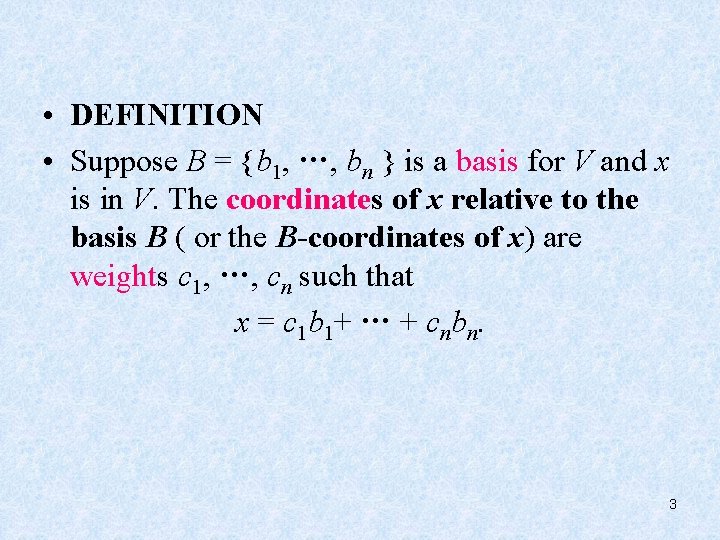
• DEFINITION • Suppose B = {b 1, …, bn } is a basis for V and x is in V. The coordinates of x relative to the basis B ( or the B-coordinates of x) are weights c 1, …, cn such that x = c 1 b 1+ … + cnbn. 3
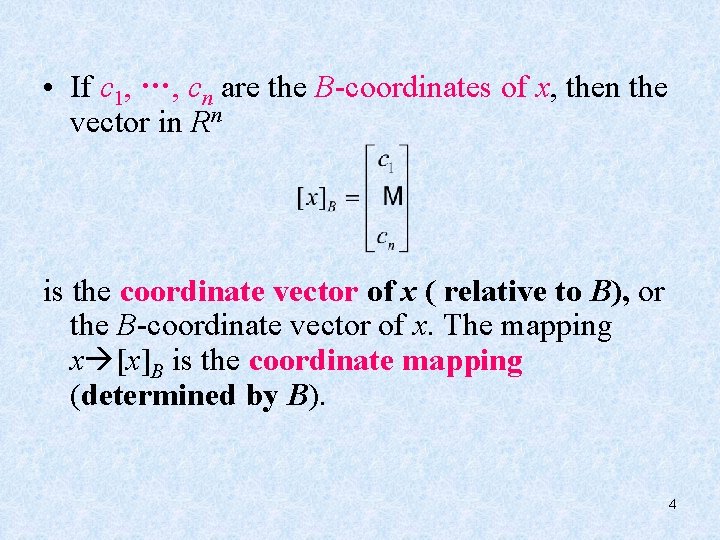
• If c 1, …, cn are the B-coordinates of x, then the vector in Rn is the coordinate vector of x ( relative to B), or the B-coordinate vector of x. The mapping x [x]B is the coordinate mapping (determined by B). 4
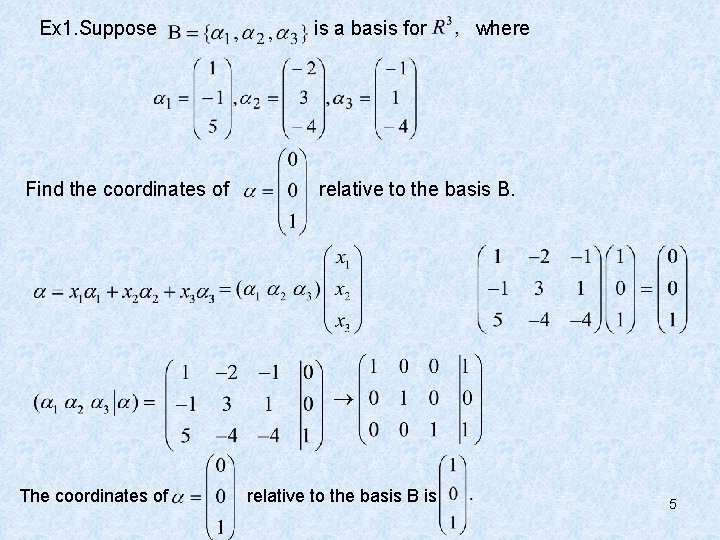
Ex 1. Suppose Find the coordinates of The coordinates of is a basis for where relative to the basis B is 5
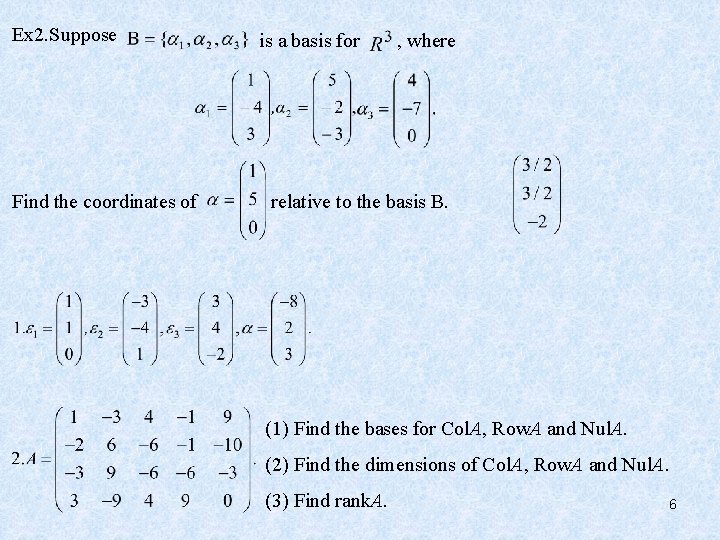
Ex 2. Suppose Find the coordinates of is a basis for , where relative to the basis B. (1) Find the bases for Col. A, Row. A and Nul. A. (2) Find the dimensions of Col. A, Row. A and Nul. A. (3) Find rank. A. 6
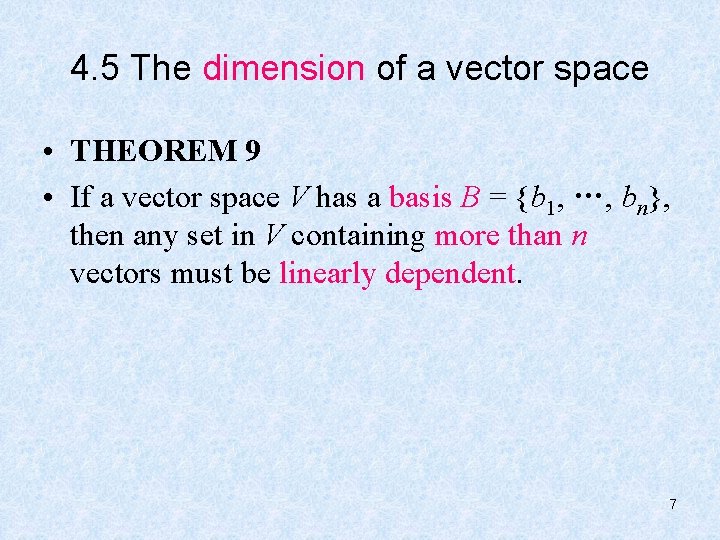
4. 5 The dimension of a vector space • THEOREM 9 • If a vector space V has a basis B = {b 1, …, bn}, then any set in V containing more than n vectors must be linearly dependent. 7
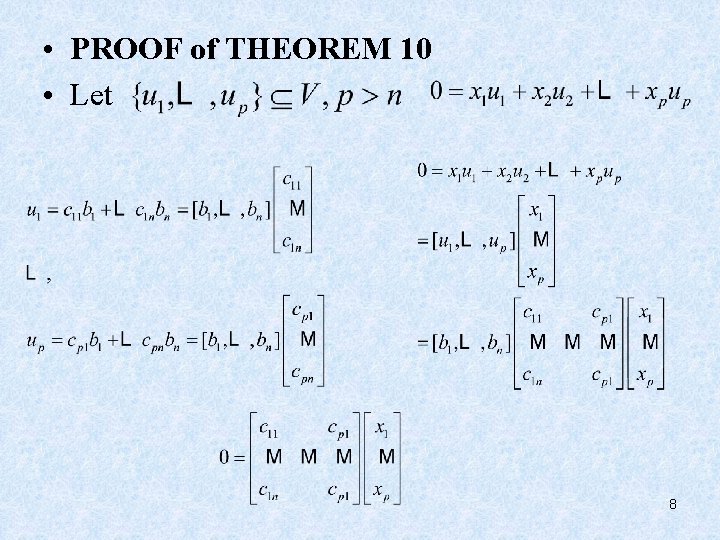
• PROOF of THEOREM 10 • Let 8
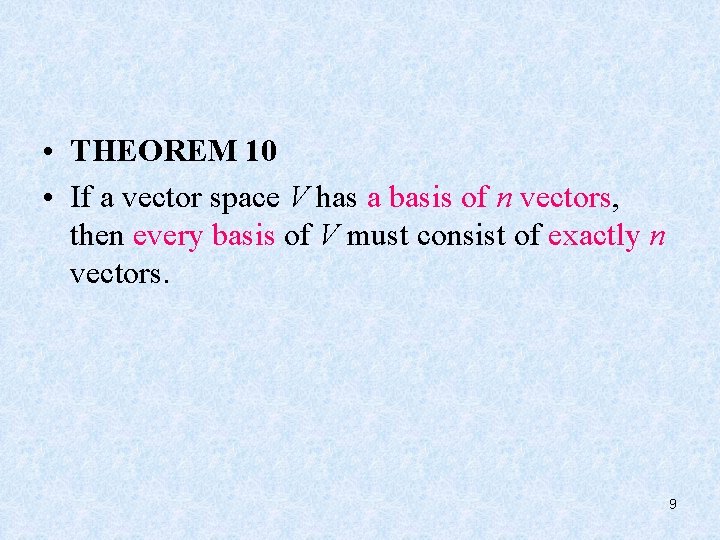
• THEOREM 10 • If a vector space V has a basis of n vectors, then every basis of V must consist of exactly n vectors. 9
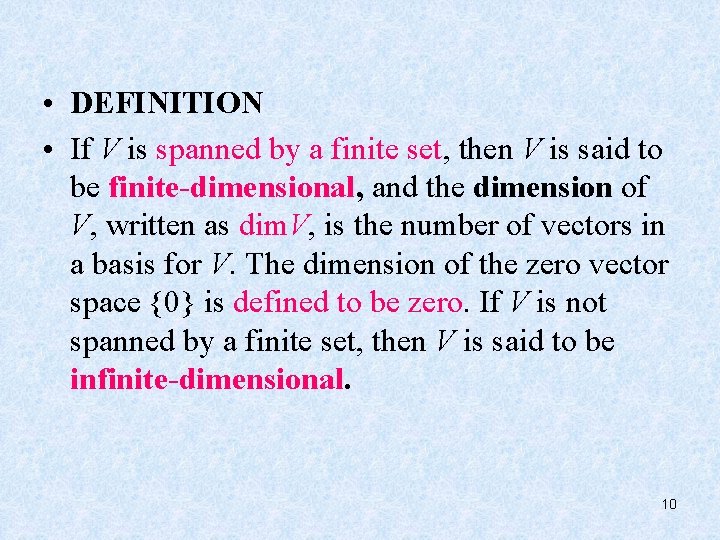
• DEFINITION • If V is spanned by a finite set, then V is said to be finite-dimensional, and the dimension of V, written as dim. V, is the number of vectors in a basis for V. The dimension of the zero vector space {0} is defined to be zero. If V is not spanned by a finite set, then V is said to be infinite-dimensional. 10
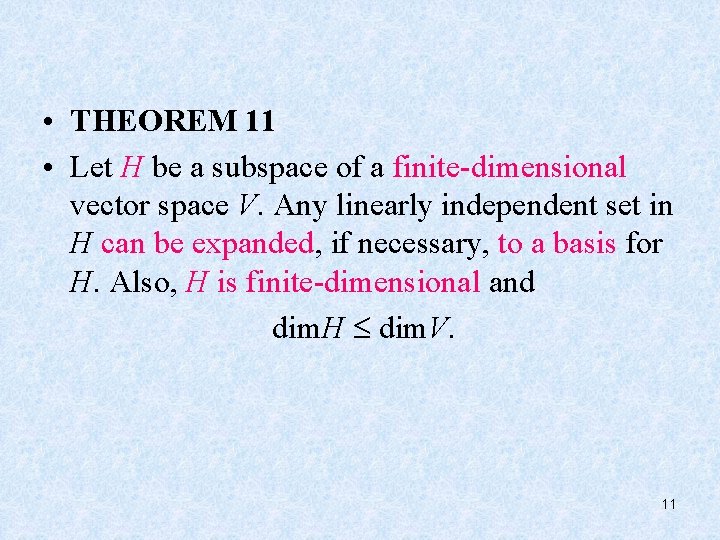
• THEOREM 11 • Let H be a subspace of a finite-dimensional vector space V. Any linearly independent set in H can be expanded, if necessary, to a basis for H. Also, H is finite-dimensional and dim. H dim. V. 11
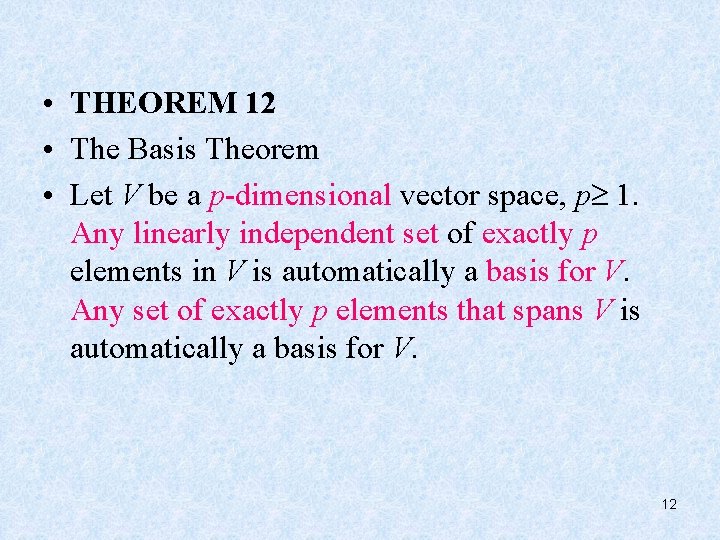
• THEOREM 12 • The Basis Theorem • Let V be a p-dimensional vector space, p 1. Any linearly independent set of exactly p elements in V is automatically a basis for V. Any set of exactly p elements that spans V is automatically a basis for V. 12
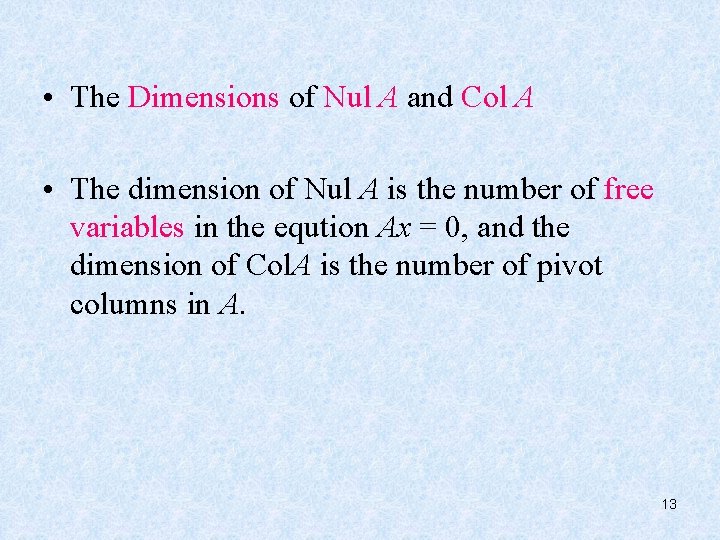
• The Dimensions of Nul A and Col A • The dimension of Nul A is the number of free variables in the eqution Ax = 0, and the dimension of Col. A is the number of pivot columns in A. 13
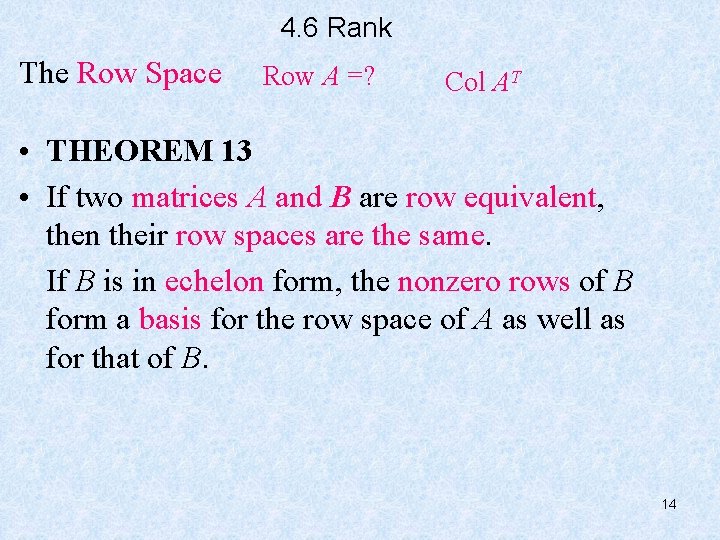
4. 6 Rank The Row Space Row A =? Col AT • THEOREM 13 • If two matrices A and B are row equivalent, then their row spaces are the same. If B is in echelon form, the nonzero rows of B form a basis for the row space of A as well as for that of B. 14
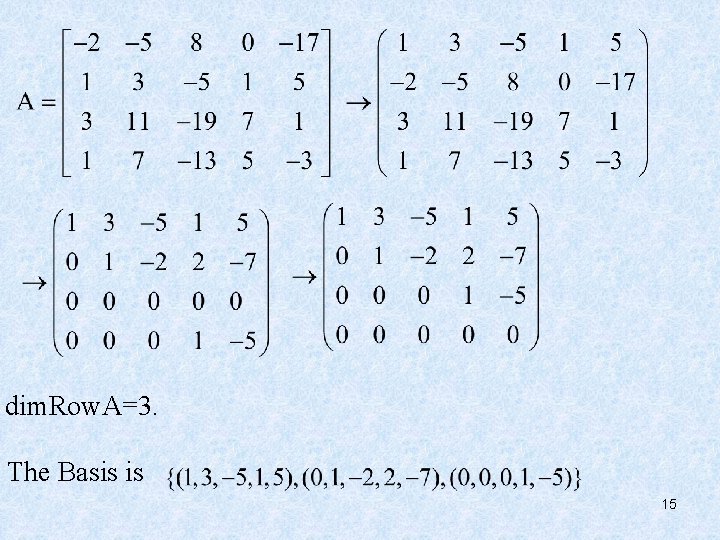
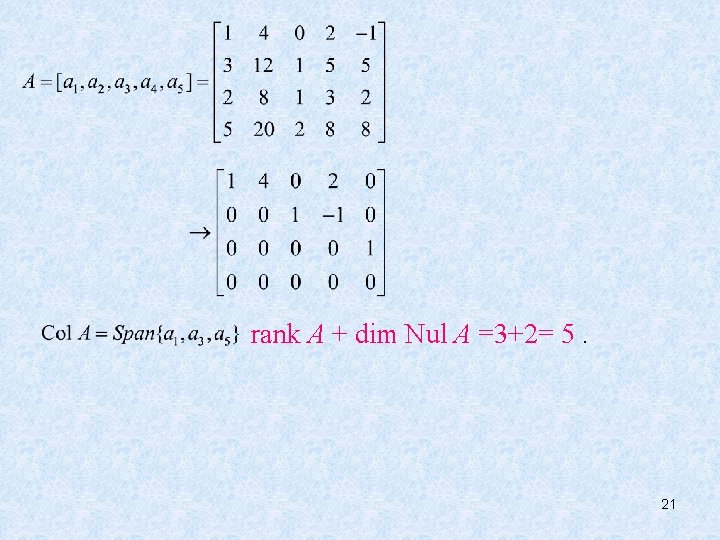
dim. Row. A=3. The Basis is 15
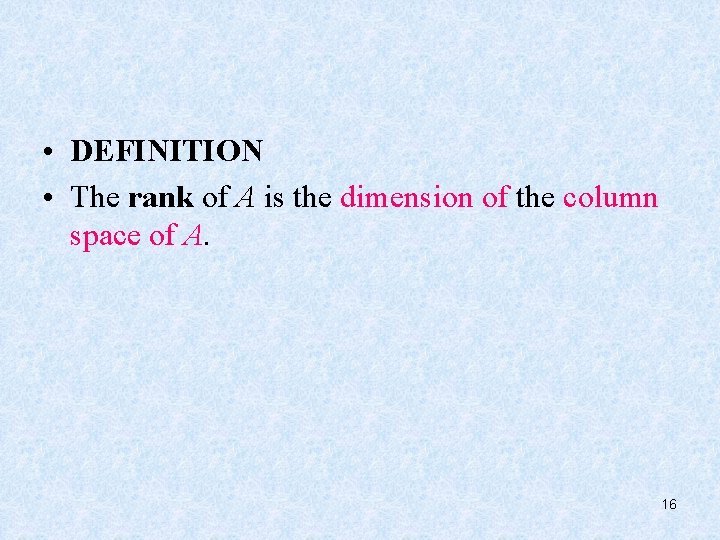
• DEFINITION • The rank of A is the dimension of the column space of A. 16
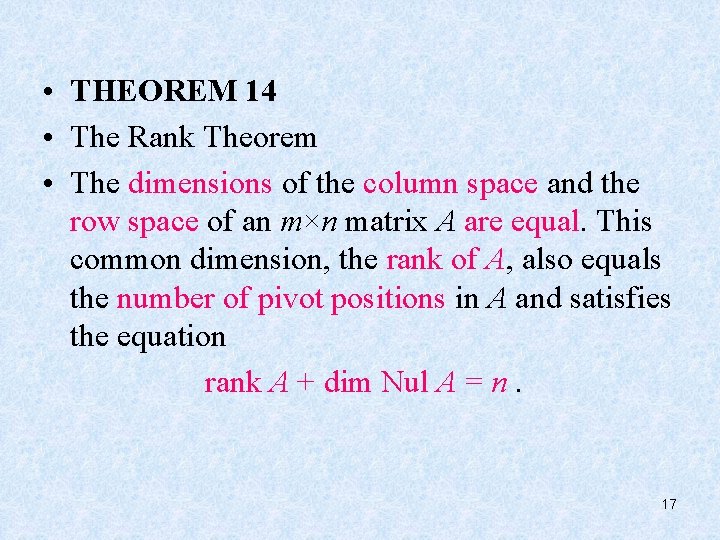
• THEOREM 14 • The Rank Theorem • The dimensions of the column space and the row space of an m×n matrix A are equal. This common dimension, the rank of A, also equals the number of pivot positions in A and satisfies the equation rank A + dim Nul A = n. 17
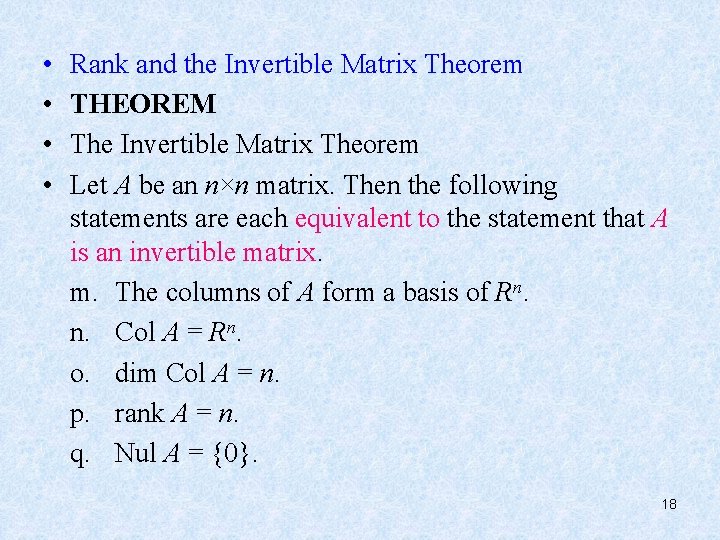
• • Rank and the Invertible Matrix Theorem THEOREM The Invertible Matrix Theorem Let A be an n×n matrix. Then the following statements are each equivalent to the statement that A is an invertible matrix. m. The columns of A form a basis of Rn. n. Col A = Rn. o. dim Col A = n. p. rank A = n. q. Nul A = {0}. 18
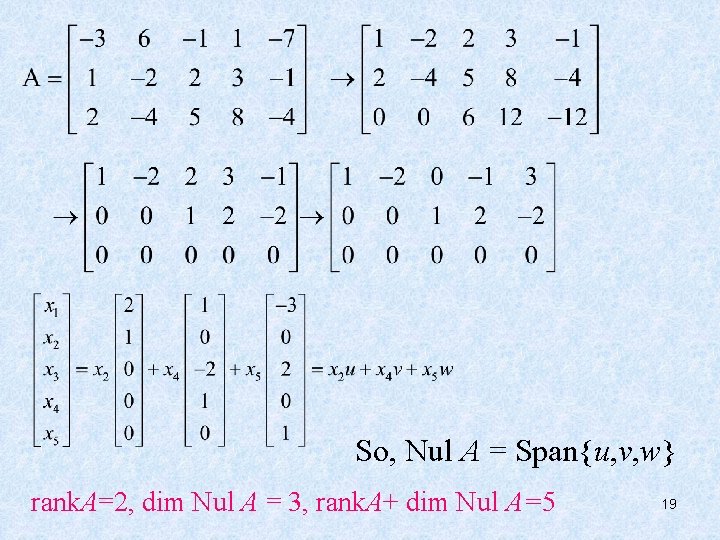
So, Nul A = Span{u, v, w} rank. A=2, dim Nul A = 3, rank. A+ dim Nul A=5 19
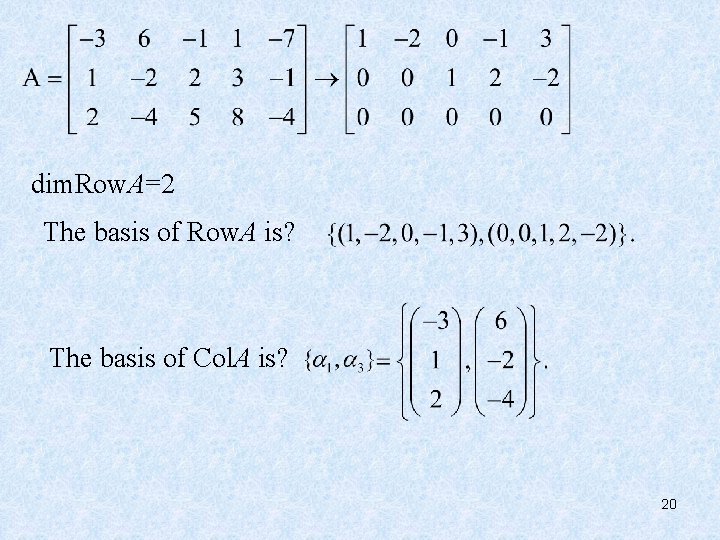
dim. Row. A=2 The basis of Row. A is? The basis of Col. A is? 20
rank A + dim Nul A =3+2= 5. 21
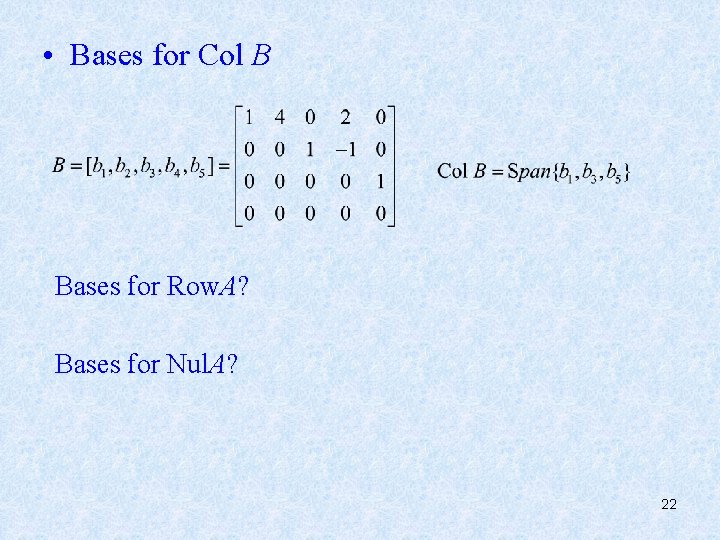
• Bases for Col B Bases for Row. A? Bases for Nul. A? 22