
4 4 Complex Numbers Students will be able
4. 4: Complex Numbers -Students will be able to identify the real and imaginary parts of complex numbers and perform basic operations.
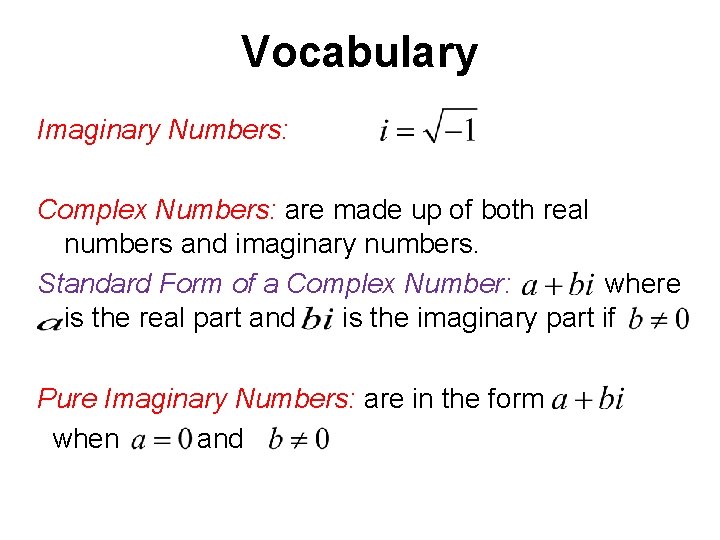
Vocabulary Imaginary Numbers: Complex Numbers: are made up of both real numbers and imaginary numbers. Standard Form of a Complex Number: where is the real part and is the imaginary part if Pure Imaginary Numbers: are in the form when and
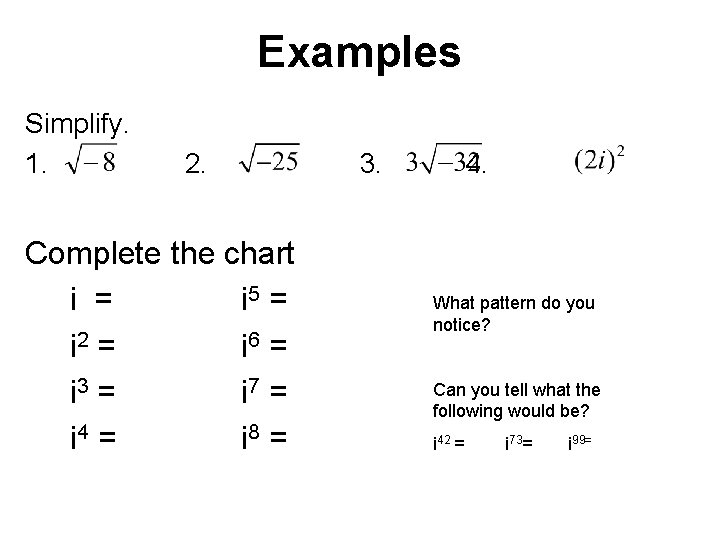
Examples Simplify. 1. 2. Complete the chart i = i 5 = i 2 = i 6 = i 3 = i 7 = i 4 = i 8 = 3. 4. What pattern do you notice? Can you tell what the following would be? i 42 = i 73= i 99=
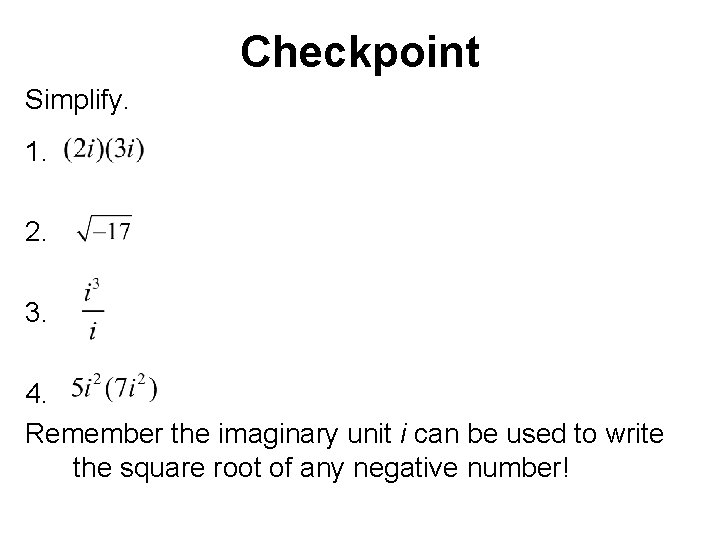
Checkpoint Simplify. 1. 2. 3. 4. Remember the imaginary unit i can be used to write the square root of any negative number!
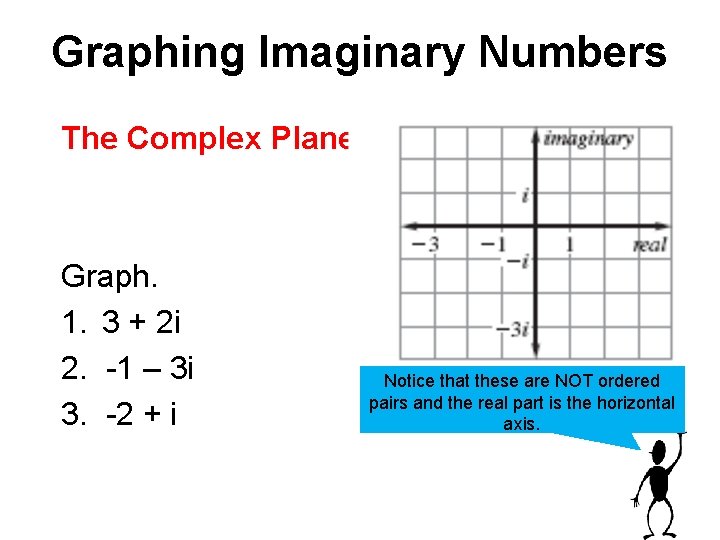
Graphing Imaginary Numbers The Complex Plane Graph. 1. 3 + 2 i 2. -1 – 3 i 3. -2 + i Notice that these are NOT ordered pairs and the real part is the horizontal axis.
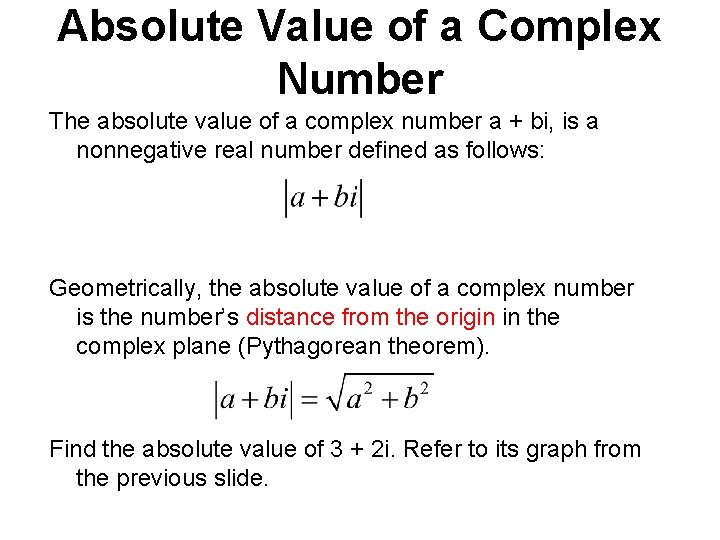
Absolute Value of a Complex Number The absolute value of a complex number a + bi, is a nonnegative real number defined as follows: Geometrically, the absolute value of a complex number is the number’s distance from the origin in the complex plane (Pythagorean theorem). Find the absolute value of 3 + 2 i. Refer to its graph from the previous slide.
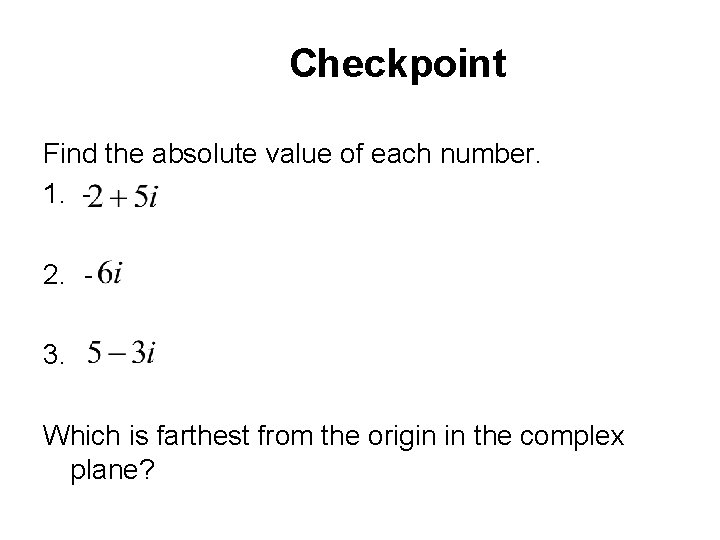
Checkpoint Find the absolute value of each number. 1. - 2. 3. Which is farthest from the origin in the complex plane?
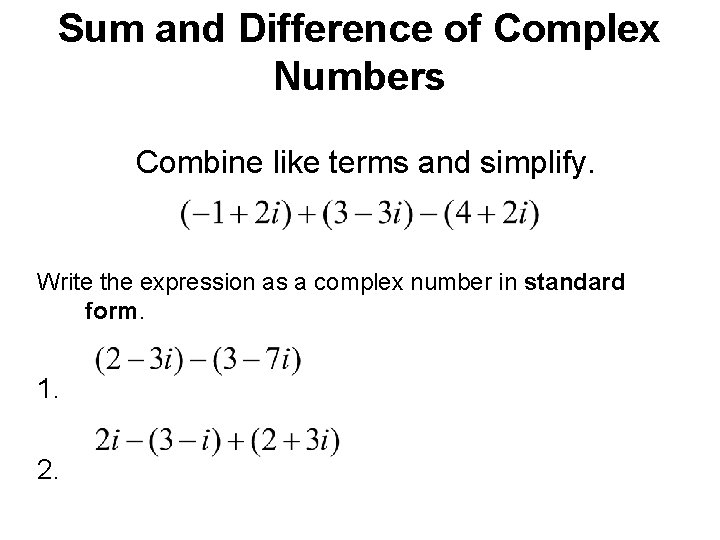
Sum and Difference of Complex Numbers Combine like terms and simplify. Write the expression as a complex number in standard form. 1. 2.
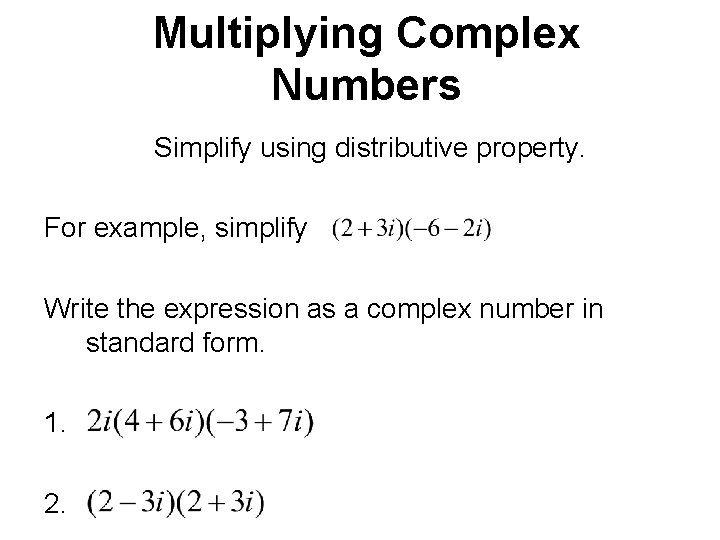
Multiplying Complex Numbers Simplify using distributive property. For example, simplify Write the expression as a complex number in standard form. 1. 2.
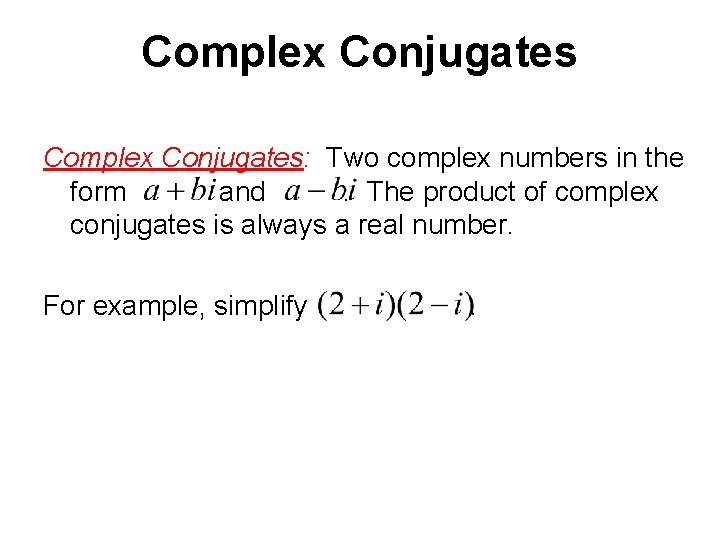
Complex Conjugates: Two complex numbers in the form and. The product of complex conjugates is always a real number. For example, simplify .
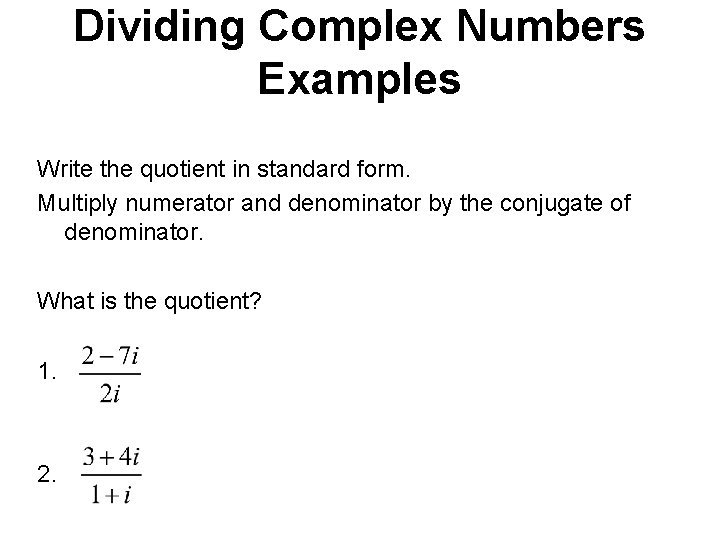
Dividing Complex Numbers Examples Write the quotient in standard form. Multiply numerator and denominator by the conjugate of denominator. What is the quotient? 1. 2.
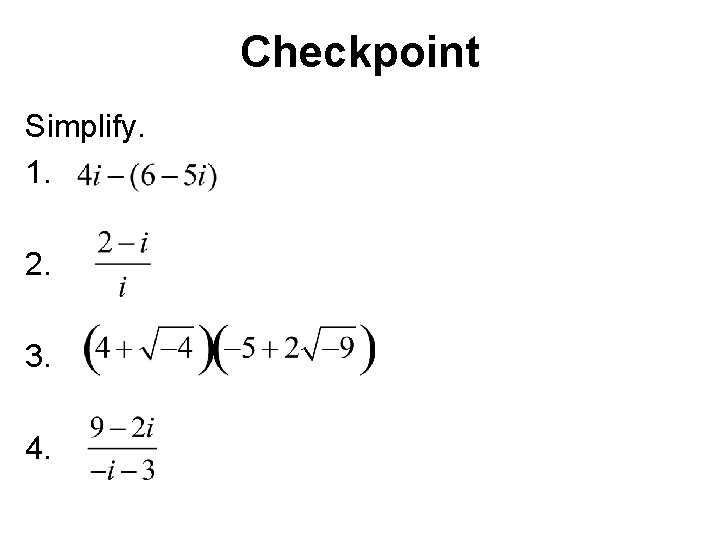
Checkpoint Simplify. 1. 2. 3. 4.
- Slides: 12