
4 4 Biogas a way to solve sanitation
4. 4 Biogas – a way to solve sanitation problems Anaerobic fermentation is a natural and unavoidable process How m u excret ch biogas ca a and bioma n be produc ss? ed from Ho w safe is the proces s and its sludge ? ? Learning objectives: to know about the fundamental processes in biogas production, and get an overview of biogas generation in the world Jam-Olof Drangert, Linköping university, Sweden
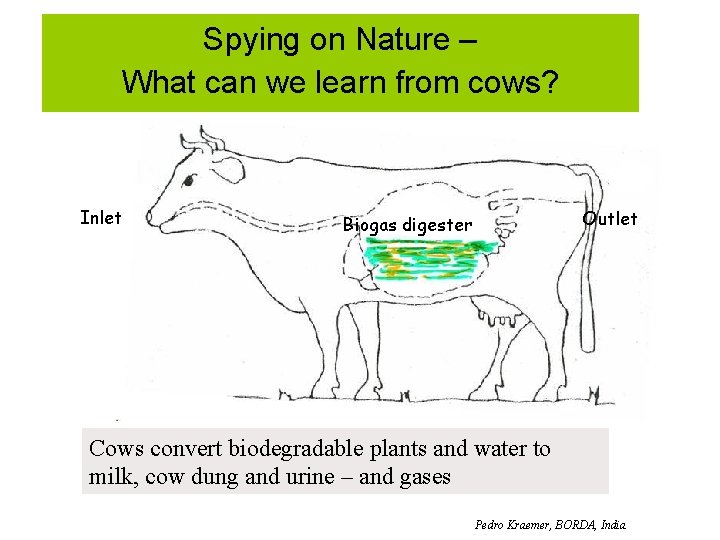
Spying on Nature – What can we learn from cows? Inlet Outlet Biogas digester Cows convert biodegradable plants and water to milk, cow dung and urine – and gases Pedro Kraemer, BORDA, India

A new look at the cow – and bull The Biogas Plant Outlet Inlet Biogas digester Pedro Kraemer, BORDA, India
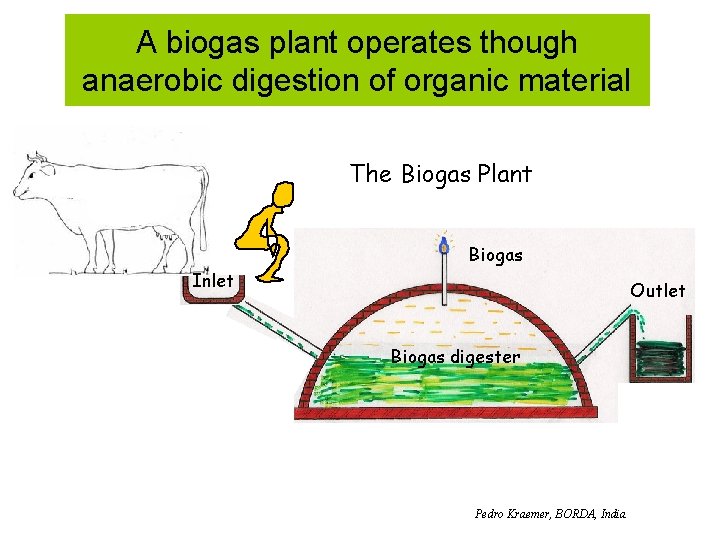
A biogas plant operates though anaerobic digestion of organic material The Biogas Plant Biogas Inlet Outlet Biogas digester Pedro Kraemer, BORDA, India
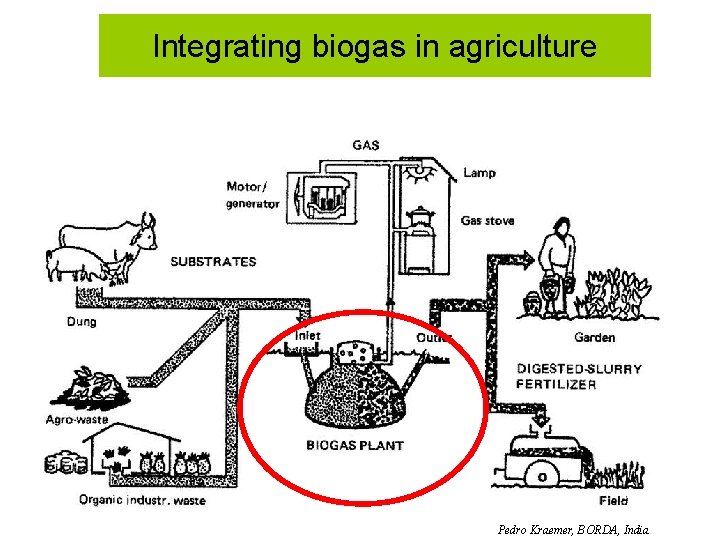
Integrating biogas in agriculture Pedro Kraemer, BORDA, India
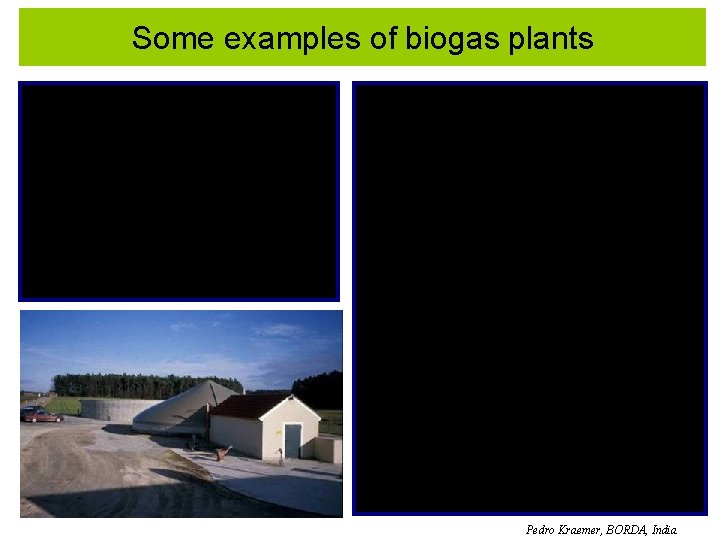
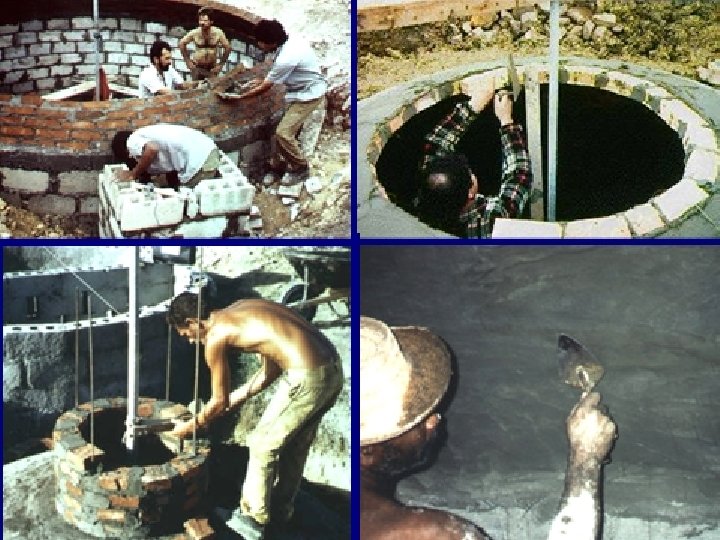
Some examples of biogas plants Pedro Kraemer, BORDA, India
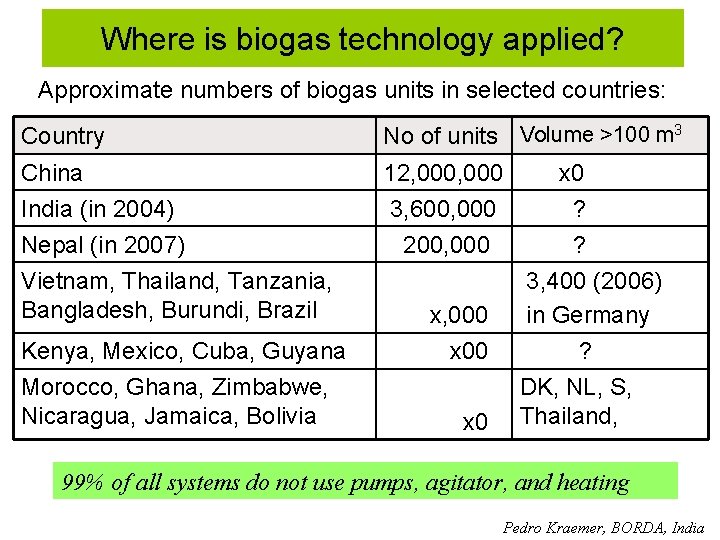
Where is biogas technology applied? Approximate numbers of biogas units in selected countries: Country No of units Volume >100 m 3 China India (in 2004) Nepal (in 2007) 12, 000 3, 600, 000 200, 000 Vietnam, Thailand, Tanzania, Bangladesh, Burundi, Brazil Kenya, Mexico, Cuba, Guyana Morocco, Ghana, Zimbabwe, Nicaragua, Jamaica, Bolivia x, 000 x 0 x 0 ? ? 3, 400 (2006) in Germany ? DK, NL, S, Thailand, 99% of all systems do not use pumps, agitator, and heating Pedro Kraemer, BORDA, India
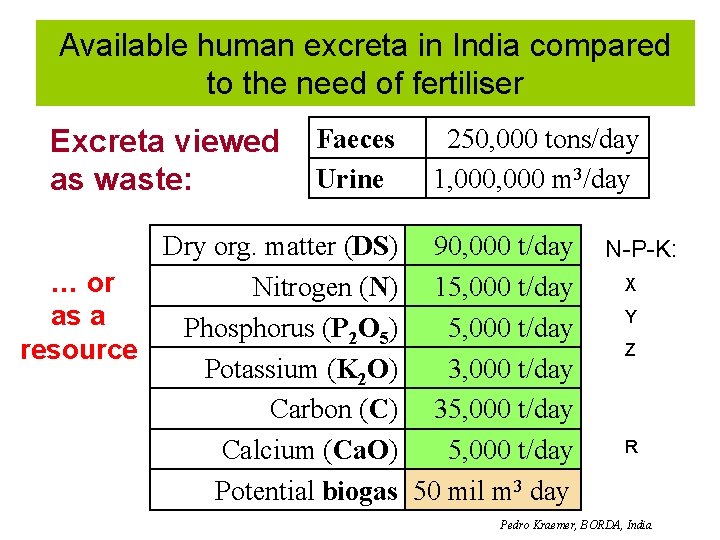
Available human excreta in India compared to the need of fertiliser Excreta viewed as waste: Faeces Urine 250, 000 tons/day 1, 000 m 3/day Dry org. matter (DS) 90, 000 t/day … or Nitrogen (N) 15, 000 t/day as a Phosphorus (P 2 O 5) 5, 000 t/day resource Potassium (K 2 O) 3, 000 t/day Carbon (C) 35, 000 t/day Calcium (Ca. O) 5, 000 t/day Potential biogas 50 mil m 3 day N-P-K: X Y Z R Pedro Kraemer, BORDA, India
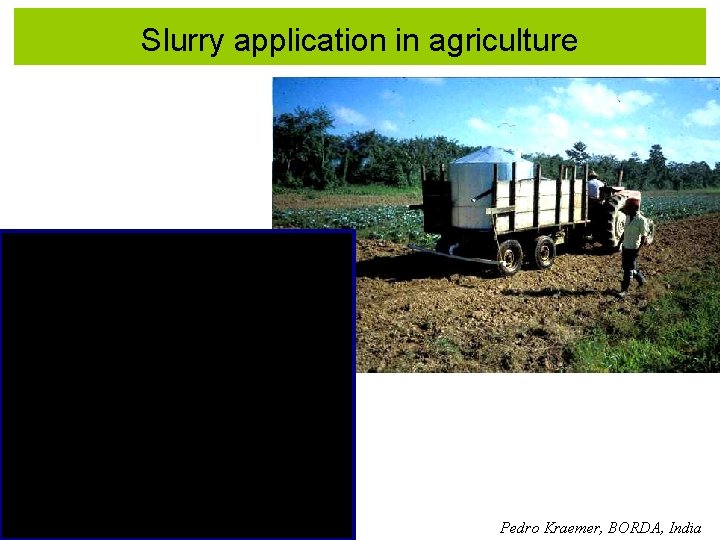
Slurry application in agriculture Pedro Kraemer, BORDA, India
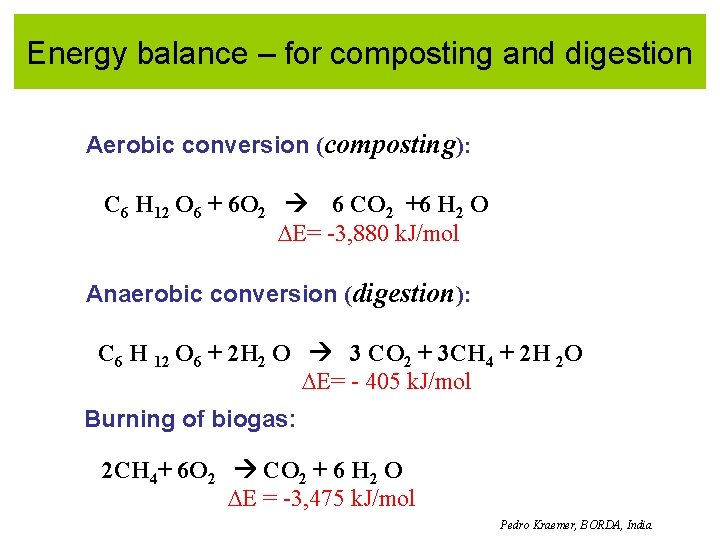
Energy balance – for composting and digestion Aerobic conversion (composting): C 6 H 12 O 6 + 6 O 2 6 CO 2 +6 H 2 O E= -3, 880 k. J/mol Anaerobic conversion (digestion): C 6 H 12 O 6 + 2 H 2 O 3 CO 2 + 3 CH 4 + 2 H 2 O E= - 405 k. J/mol Burning of biogas: 2 CH 4+ 6 O 2 CO 2 + 6 H 2 O E = -3, 475 k. J/mol Pedro Kraemer, BORDA, India
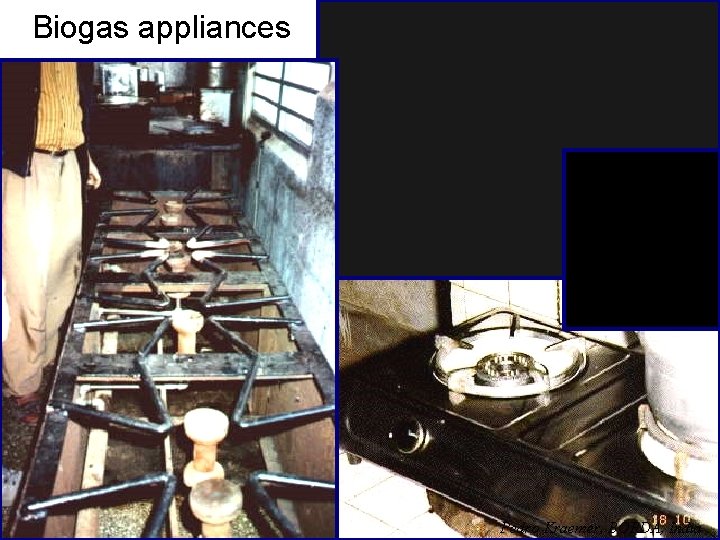
Biogas appliances Pedro Kraemer, BORDA, India
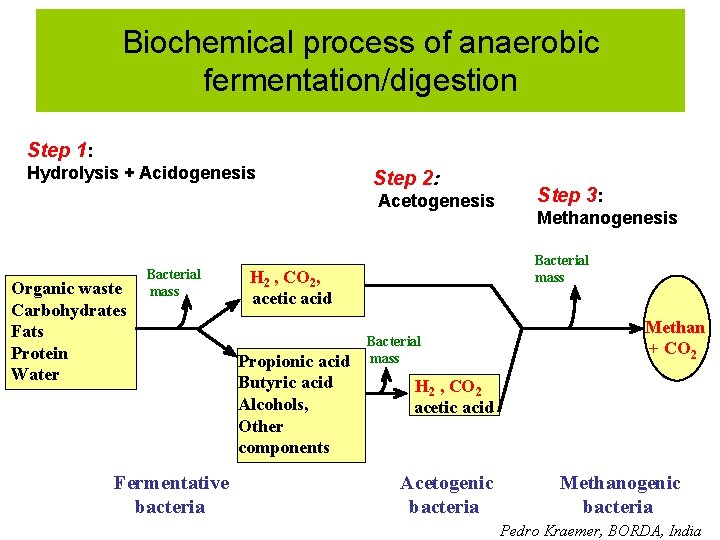
Biochemical process of anaerobic fermentation/digestion Step 1: Hydrolysis + Acidogenesis Step 2: Acetogenesis Organic waste Carbohydrates Fats Protein Water Bacterial mass Fermentative bacteria Methanogenesis Bacterial mass H 2 , CO 2, acetic acid Propionic acid Butyric acid Alcohols, Other components Step 3: Bacterial mass Methan + CO 2 H 2 , CO 2 acetic acid Acetogenic bacteria Methanogenic bacteria Pedro Kraemer, BORDA, India
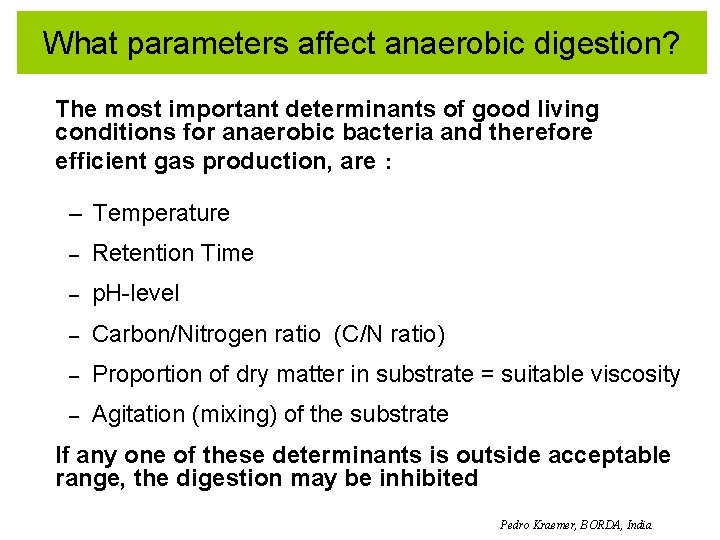
What parameters affect anaerobic digestion? The most important determinants of good living conditions for anaerobic bacteria and therefore efficient gas production, are : – Temperature – Retention Time – p. H-level – Carbon/Nitrogen ratio (C/N ratio) – Proportion of dry matter in substrate = suitable viscosity – Agitation (mixing) of the substrate If any one of these determinants is outside acceptable range, the digestion may be inhibited Pedro Kraemer, BORDA, India
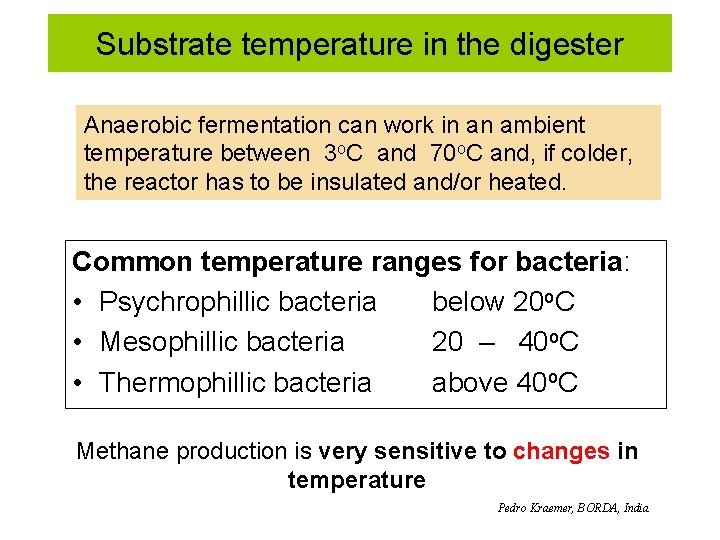
Substrate temperature in the digester Anaerobic fermentation can work in an ambient temperature between 3 o. C and 70 o. C and, if colder, the reactor has to be insulated and/or heated. Common temperature ranges for bacteria: • Psychrophillic bacteria below 20 o. C • Mesophillic bacteria 20 – 40 o. C • Thermophillic bacteria above 40 o. C Methane production is very sensitive to changes in temperature Pedro Kraemer, BORDA, India
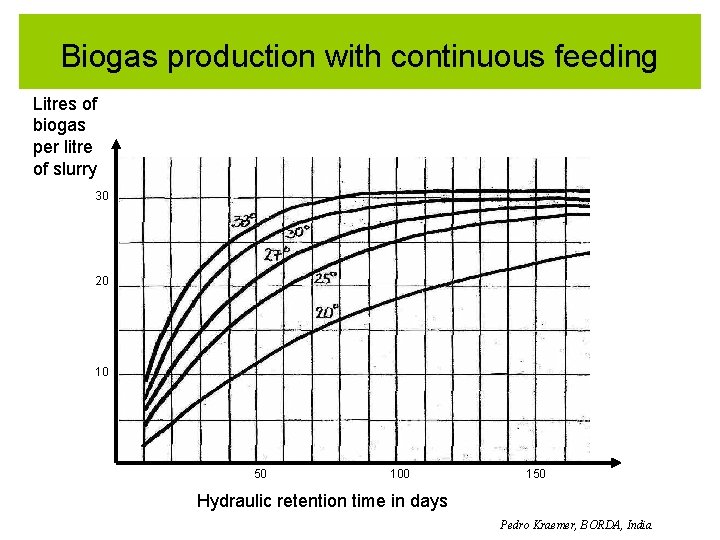
Biogas production with continuous feeding Litres of biogas per litre of slurry 30 20 10 50 100 150 Hydraulic retention time in days Pedro Kraemer, BORDA, India
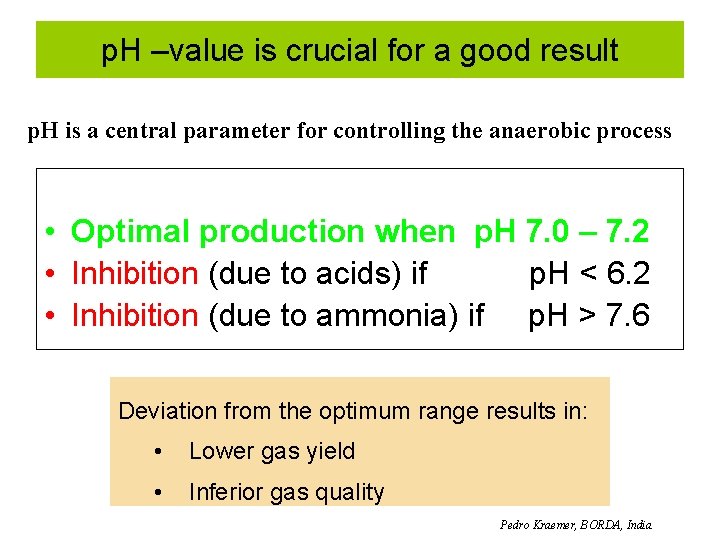
p. H –value is crucial for a good result p. H is a central parameter for controlling the anaerobic process • Optimal production when p. H 7. 0 – 7. 2 • Inhibition (due to acids) if p. H < 6. 2 • Inhibition (due to ammonia) if p. H > 7. 6 Deviation from the optimum range results in: • Lower gas yield • Inferior gas quality Pedro Kraemer, BORDA, India
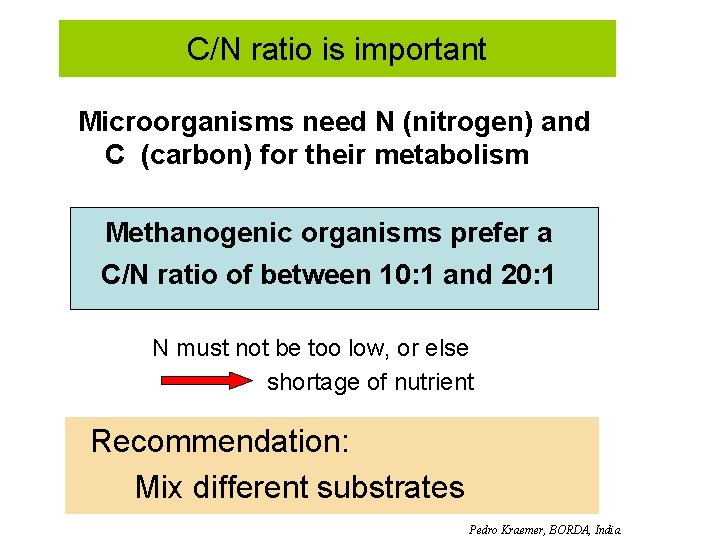
C/N ratio is important Microorganisms need N (nitrogen) and C (carbon) for their metabolism Methanogenic organisms prefer a C/N ratio of between 10: 1 and 20: 1 N must not be too low, or else shortage of nutrient Recommendation: Mix different substrates Pedro Kraemer, BORDA, India
Nitrogen inhibition If N concentration is too high (>1, 700 mg/l of NH 4 -N) and p. H is high, then growth of bacteria is inhibited due to toxicity caused by high levels of (uncharged) ammonia Methanogens, however, are able of adapt to 5, 000 - 7, 000 mg/l of NH 4 -N given the pre-requisite that the uncharged ammonia (NH 3 controlled by p. H) level does not exceed 200 -300 mg/l Pedro Kraemer, BORDA, India
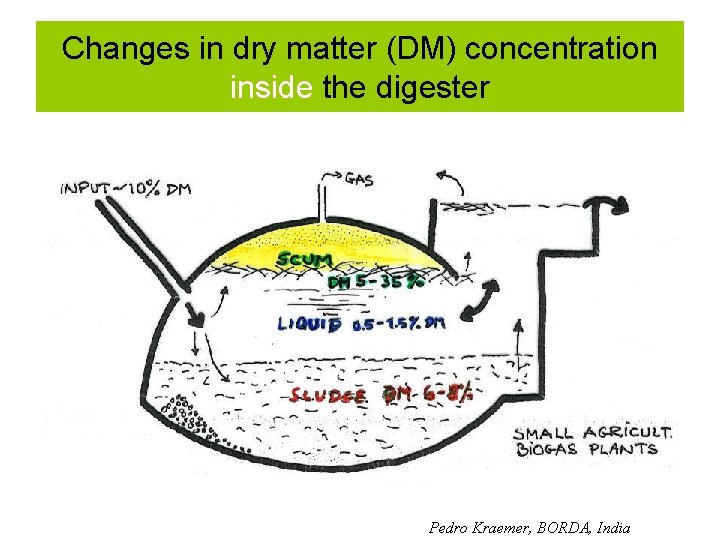
Changes in dry matter (DM) concentration inside the digester Pedro Kraemer, BORDA, India
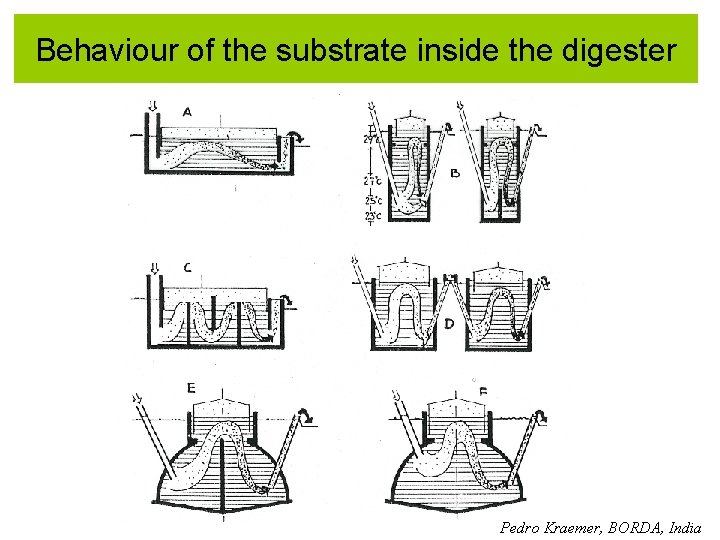
Behaviour of the substrate inside the digester Pedro Kraemer, BORDA, India
Stirring the substrate Stirring improves the efficiency of digestion by: • • • Removing metabolites (gas removal) Bringing fresh material in contact with bacteria Reducing scum formation and sedimentation Preventing temperature gradients in the digester Avoiding the formation of blind spots (short cuts) However, excessive stirring disturbs the symbiotic relationship between the different bacteria species Simple biogas units normally do not have mechanical stirring devises Pedro Kraemer, BORDA, India
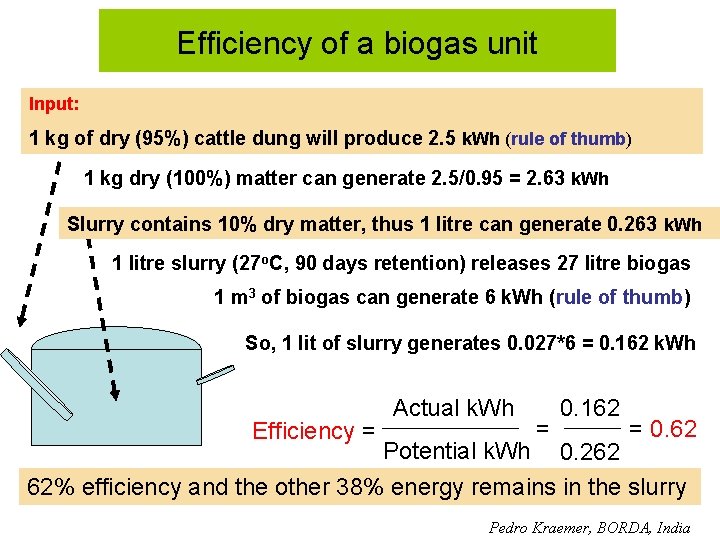
Efficiency of a biogas unit Input: 1 kg of dry (95%) cattle dung will produce 2. 5 k. Wh (rule of thumb) 1 kg dry (100%) matter can generate 2. 5/0. 95 = 2. 63 k. Wh Slurry contains 10% dry matter, thus 1 litre can generate 0. 263 k. Wh 1 litre slurry (27 o. C, 90 days retention) releases 27 litre biogas 1 m 3 of biogas can generate 6 k. Wh (rule of thumb) So, 1 lit of slurry generates 0. 027*6 = 0. 162 k. Wh Efficiency = Actual k. Wh Potential k. Wh = 0. 162 = 0. 62 0. 262 62% efficiency and the other 38% energy remains in the slurry Pedro Kraemer, BORDA, India
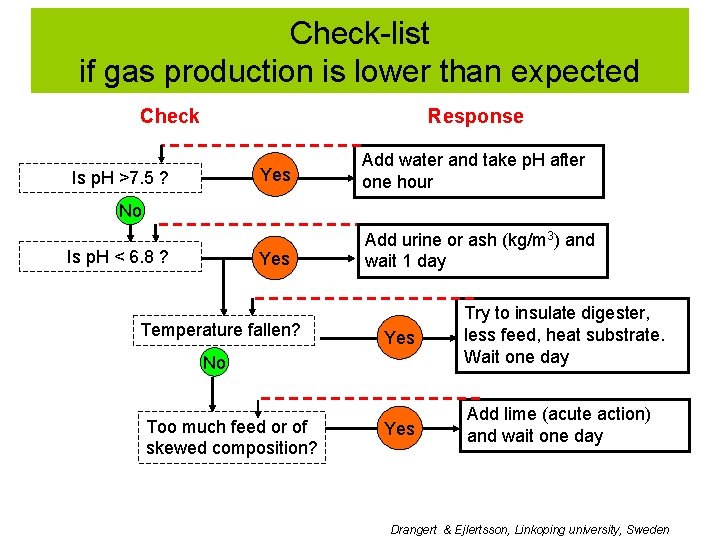
Check-list if gas production is lower than expected Check Response Is p. H >7. 5 ? Yes Add water and take p. H after one hour Yes Add urine or ash (kg/m 3) and wait 1 day No Is p. H < 6. 8 ? Temperature fallen? Yes Try to insulate digester, less feed, heat substrate. Wait one day Yes Add lime (acute action) and wait one day No Too much feed or of skewed composition? Drangert & Ejlertsson, Linkoping university, Sweden
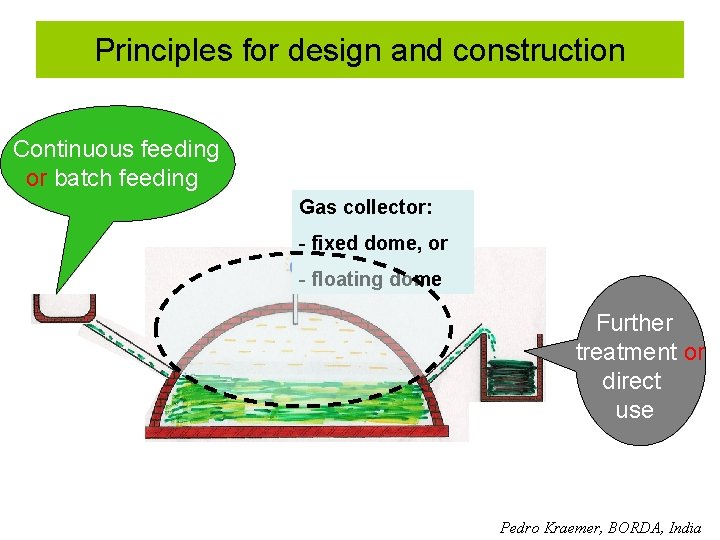
Principles for design and construction Continuous feeding or batch feeding Gas collector: - fixed dome, or - floating dome Further treatment or direct use Pedro Kraemer, BORDA, India
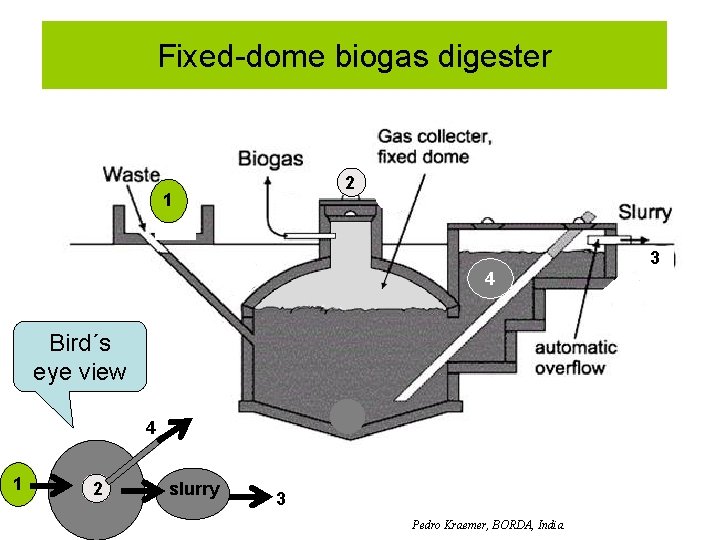
Fixed-dome biogas digester 2 1 3 4 Bird´s eye view 4 1 2 slurry 3 Pedro Kraemer, BORDA, India
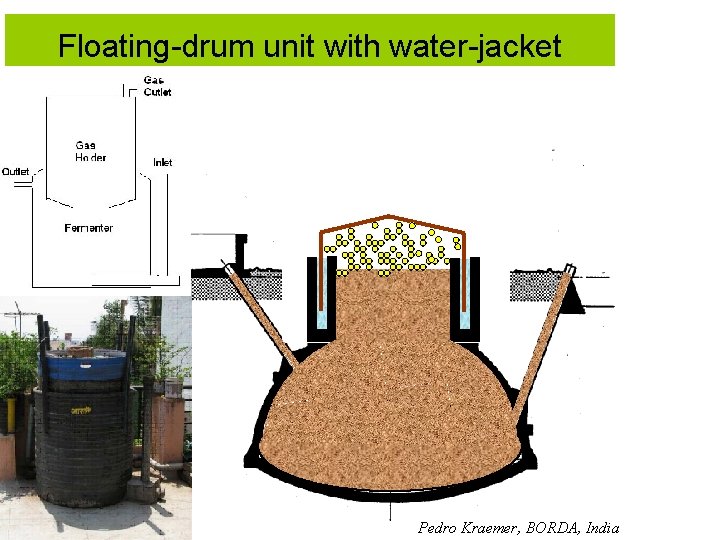
Floating-drum unit with water-jacket Pedro Kraemer, BORDA, India
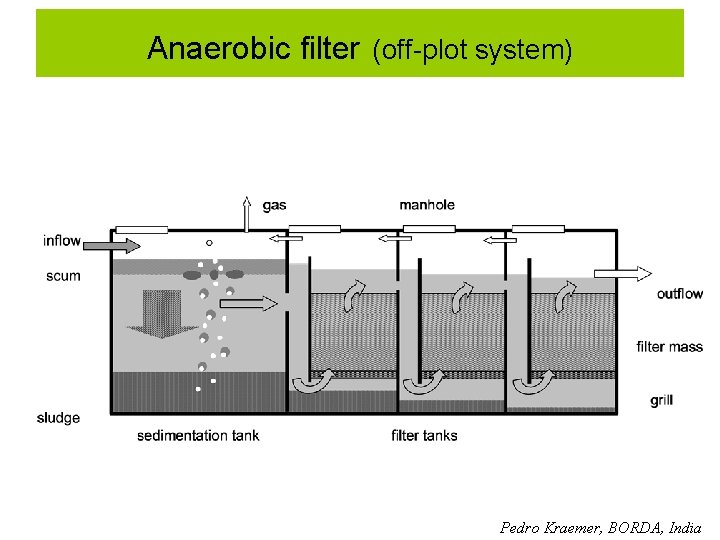
Anaerobic filter (off-plot system) Pedro Kraemer, BORDA, India
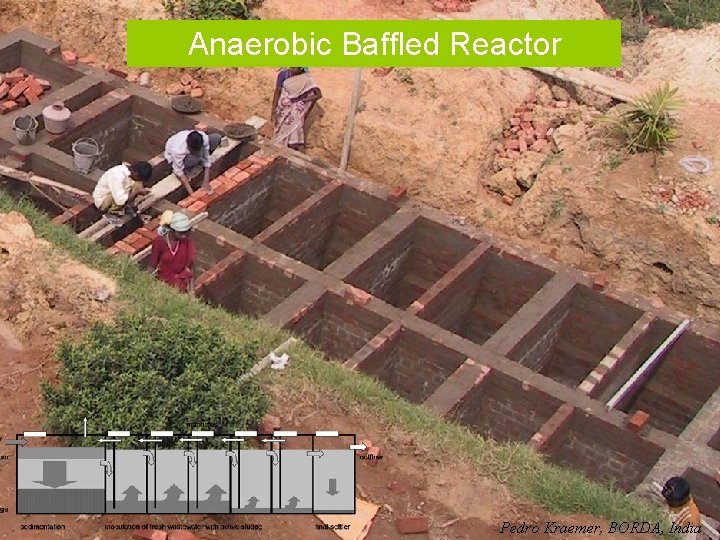
Off-plot system Anaerobic Baffled Reactor Anaerobic baffled reactor Pedro Kraemer, BORDA, India
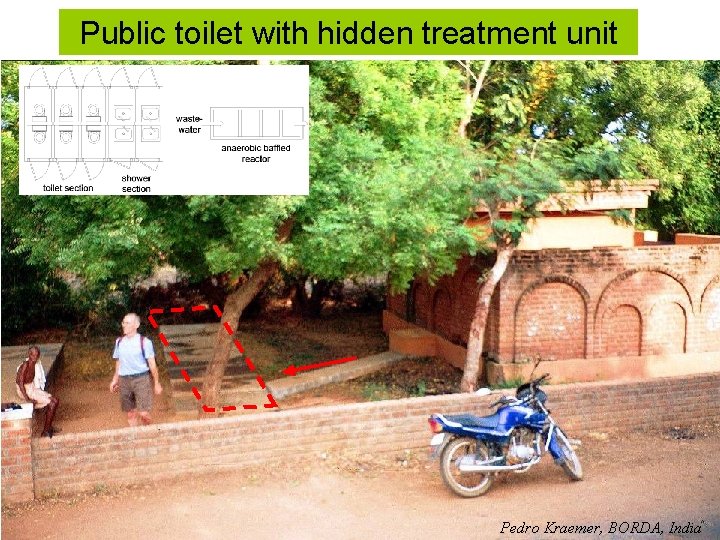
Public toilet with hidden treatment unit Pedro Kraemer, BORDA, India
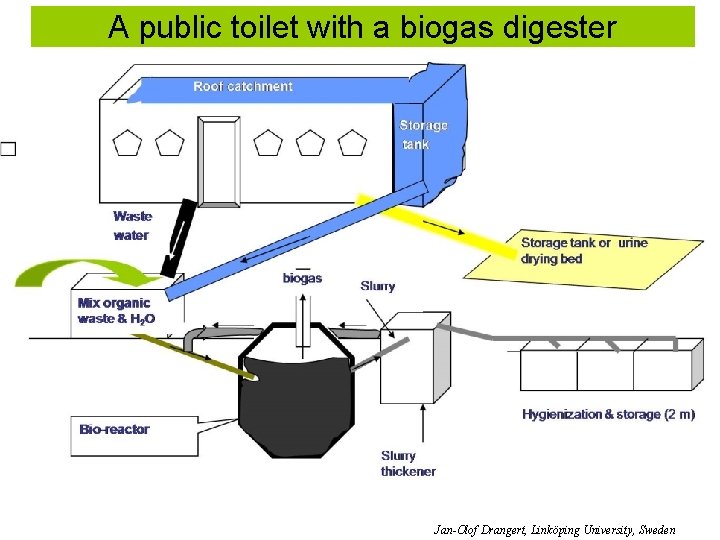
A public toilet with a biogas digester Jan-Olof Drangert, Linköping University, Sweden
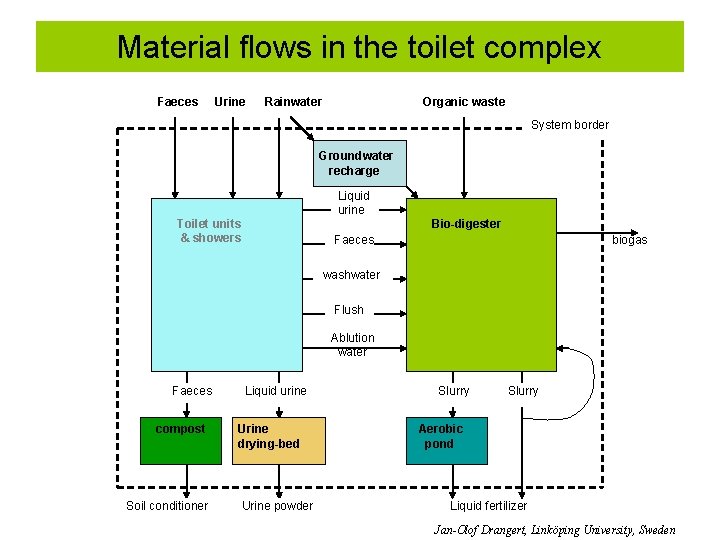
Material flows in the toilet complex Faeces Urine Rainwater Organic waste System border Groundwater recharge Liquid urine Toilet units & showers Bio-digester Faeces biogas washwater Flush Ablution water Faeces compost Soil conditioner Liquid urine Urine drying-bed Urine powder Slurry Aerobic pond Liquid fertilizer Jan-Olof Drangert, Linköping University, Sweden
- Slides: 32