
4 3 Wave characteristics The Doppler Effect is
- Slides: 50
4. 3 Wave characteristics
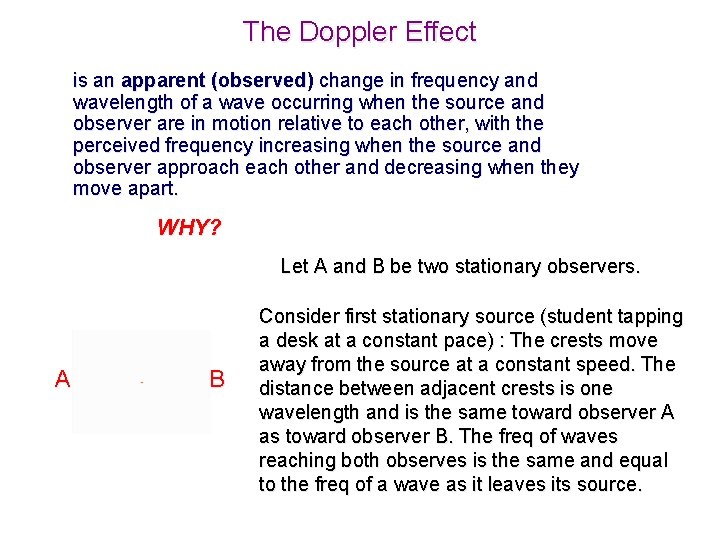
The Doppler Effect is an apparent (observed) change in frequency and wavelength of a wave occurring when the source and observer are in motion relative to each other, with the perceived frequency increasing when the source and observer approach each other and decreasing when they move apart. WHY? Let A and B be two stationary observers. A B Consider first stationary source (student tapping a desk at a constant pace) : The crests move away from the source at a constant speed. The distance between adjacent crests is one wavelength and is the same toward observer A as toward observer B. The freq of waves reaching both observes is the same and equal to the freq of a wave as it leaves its source.
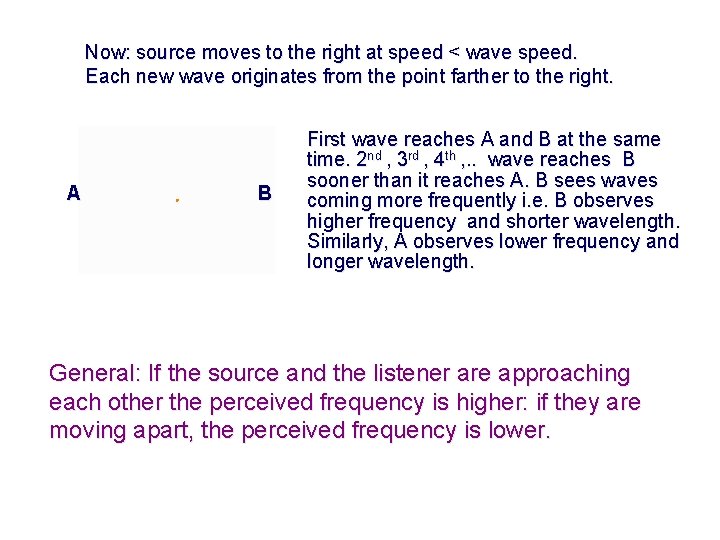
Now: source moves to the right at speed < wave speed. Each new wave originates from the point farther to the right. A B First wave reaches A and B at the same time. 2 nd , 3 rd , 4 th , . . wave reaches B sooner than it reaches A. B sees waves coming more frequently i. e. B observes higher frequency and shorter wavelength. Similarly, A observes lower frequency and longer wavelength. General: If the source and the listener are approaching each other the perceived frequency is higher: if they are moving apart, the perceived frequency is lower.
• If a source of sound is moving toward you at constant speed, you hear a higher freq than when it is at rest • If it is moving at increasing speed you hear higher and higher freq • If a source of sound is moving away from you, you hear a lower freq than when it is at rest • If it is moving at increasing speed you hear lower and lower freq • You can hear this effect with sirens on fire engines of train whistles • A similar effect occurs with light waves and radar waves
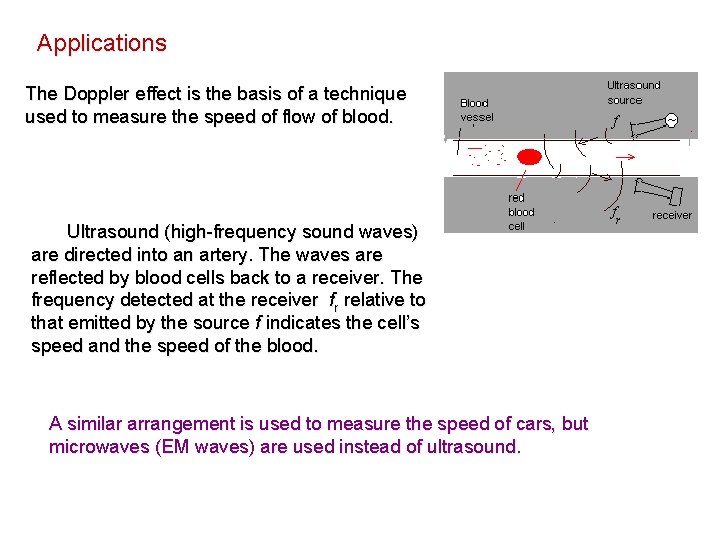
Applications The Doppler effect is the basis of a technique used to measure the speed of flow of blood. Ultrasound (high-frequency sound waves) are directed into an artery. The waves are reflected by blood cells back to a receiver. The frequency detected at the receiver fr relative to that emitted by the source f indicates the cell’s speed and the speed of the blood. A similar arrangement is used to measure the speed of cars, but microwaves (EM waves) are used instead of ultrasound.
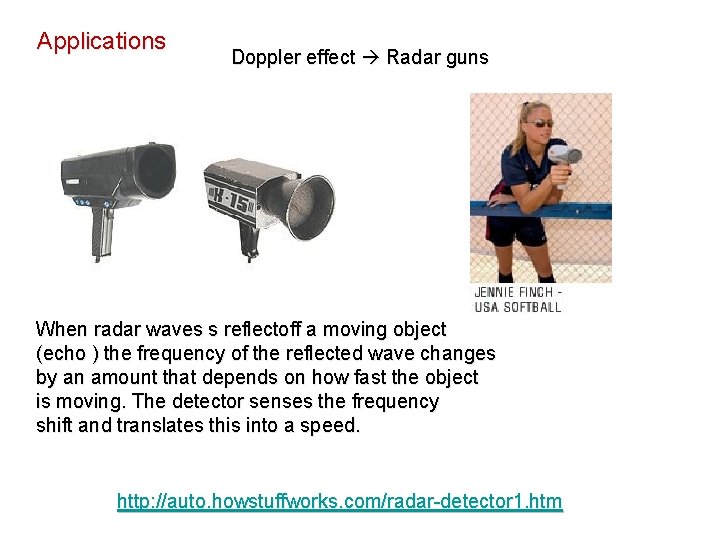
Applications Doppler effect Radar guns When radar waves s reflectoff a moving object (echo ) the frequency of the reflected wave changes by an amount that depends on how fast the object is moving. The detector senses the frequency shift and translates this into a speed. http: //auto. howstuffworks. com/radar-detector 1. htm
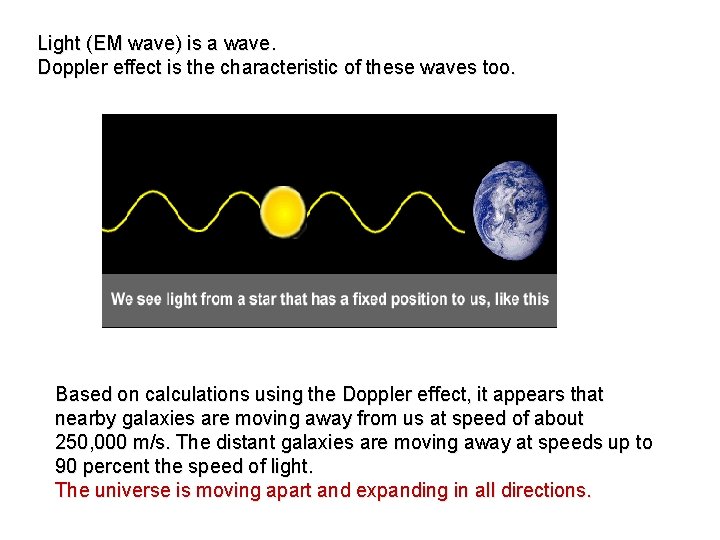
Light (EM wave) is a wave. Doppler effect is the characteristic of these waves too. Based on calculations using the Doppler effect, it appears that nearby galaxies are moving away from us at speed of about 250, 000 m/s. The distant galaxies are moving away at speeds up to 90 percent the speed of light. The universe is moving apart and expanding in all directions.
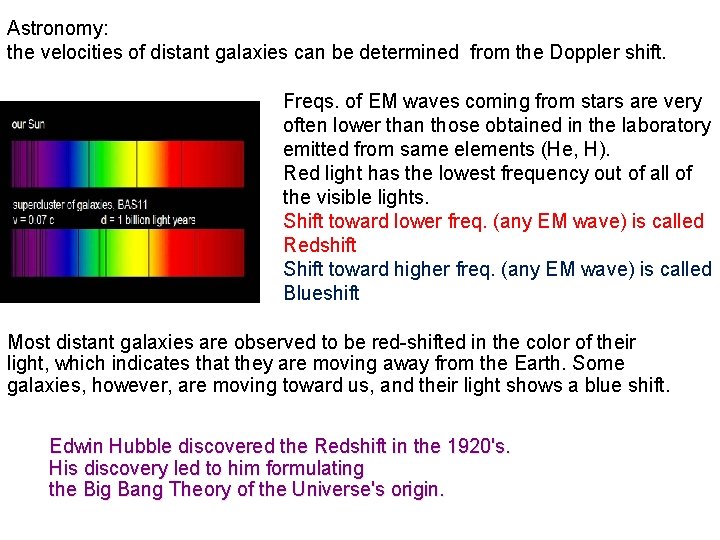
Astronomy: the velocities of distant galaxies can be determined from the Doppler shift. Freqs. of EM waves coming from stars are very often lower than those obtained in the laboratory emitted from same elements (He, H). Red light has the lowest frequency out of all of the visible lights. Shift toward lower freq. (any EM wave) is called Redshift Shift toward higher freq. (any EM wave) is called Blueshift Most distant galaxies are observed to be red-shifted in the color of their light, which indicates that they are moving away from the Earth. Some galaxies, however, are moving toward us, and their light shows a blue shift. Edwin Hubble discovered the Redshift in the 1920's. His discovery led to him formulating the Big Bang Theory of the Universe's origin.
A science teacher demonstrating the Doppler effect
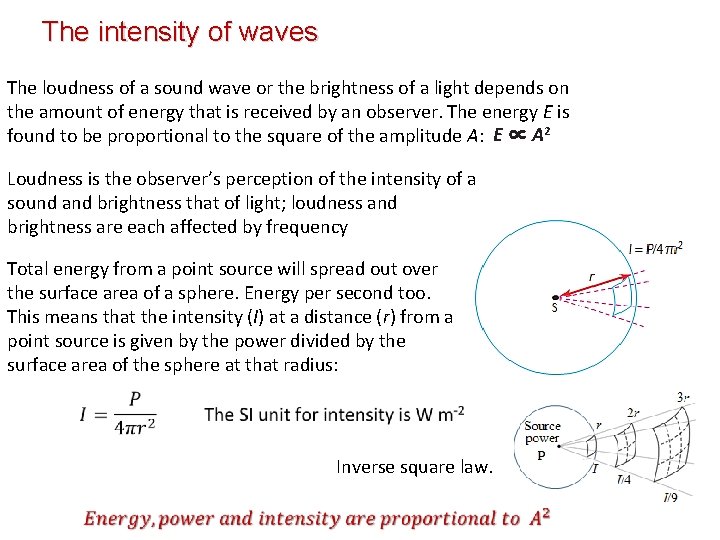
The intensity of waves The loudness of a sound wave or the brightness of a light depends on the amount of energy that is received by an observer. The energy E is found to be proportional to the square of the amplitude A: E ∝ A 2 Loudness is the observer’s perception of the intensity of a sound and brightness that of light; loudness and brightness are each affected by frequency Total energy from a point source will spread out over the surface area of a sphere. Energy per second too. This means that the intensity (I) at a distance (r) from a point source is given by the power divided by the surface area of the sphere at that radius: Inverse square law.
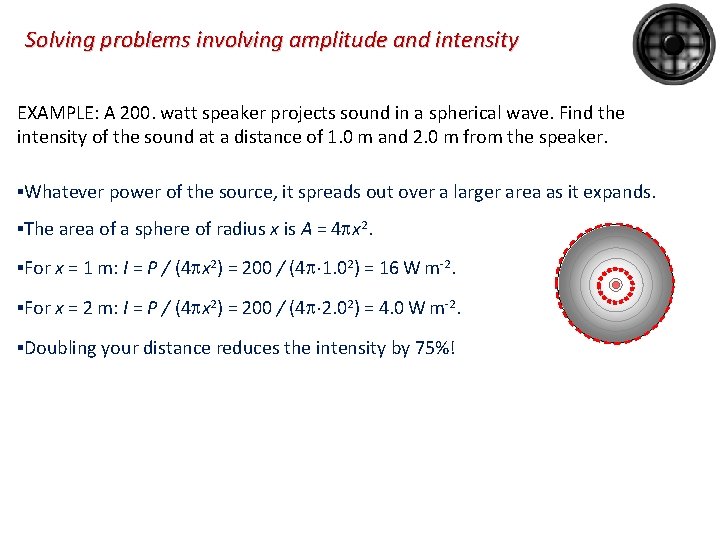
Solving problems involving amplitude and intensity EXAMPLE: A 200. watt speaker projects sound in a spherical wave. Find the intensity of the sound at a distance of 1. 0 m and 2. 0 m from the speaker. ▪Whatever power of the source, it spreads out over a larger area as it expands. ▪The area of a sphere of radius x is A = 4 x 2. ▪For x = 1 m: I = P / (4 x 2) = 200 / (4 1. 02) = 16 W m-2. ▪For x = 2 m: I = P / (4 x 2) = 200 / (4 2. 02) = 4. 0 W m-2. ▪Doubling your distance reduces the intensity by 75%!
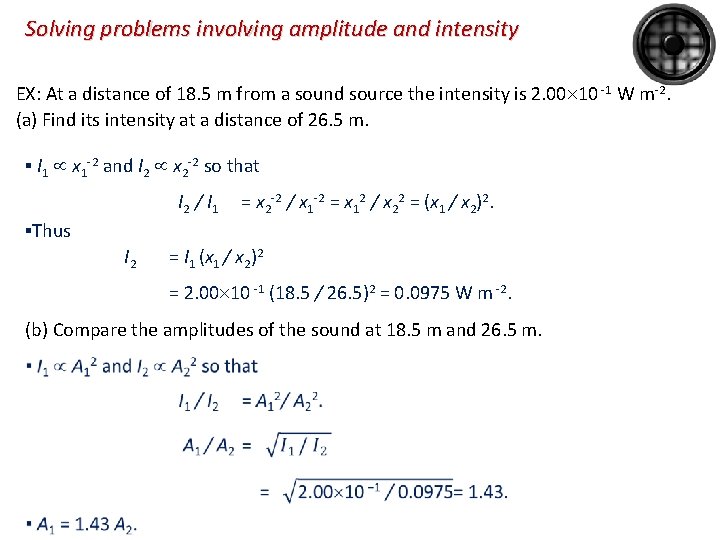
Solving problems involving amplitude and intensity EX: At a distance of 18. 5 m from a sound source the intensity is 2. 00 10 -1 W m-2. (a) Find its intensity at a distance of 26. 5 m. ▪ I 1 x 1 -2 and I 2 x 2 -2 so that I 2 / I 1 = x 2 -2 / x 1 -2 = x 12 / x 22 = (x 1 / x 2)2. ▪Thus I 2 = I 1 (x 1 / x 2)2 = 2. 00 10 -1 (18. 5 / 26. 5)2 = 0. 0975 W m -2. (b) Compare the amplitudes of the sound at 18. 5 m and 26. 5 m.
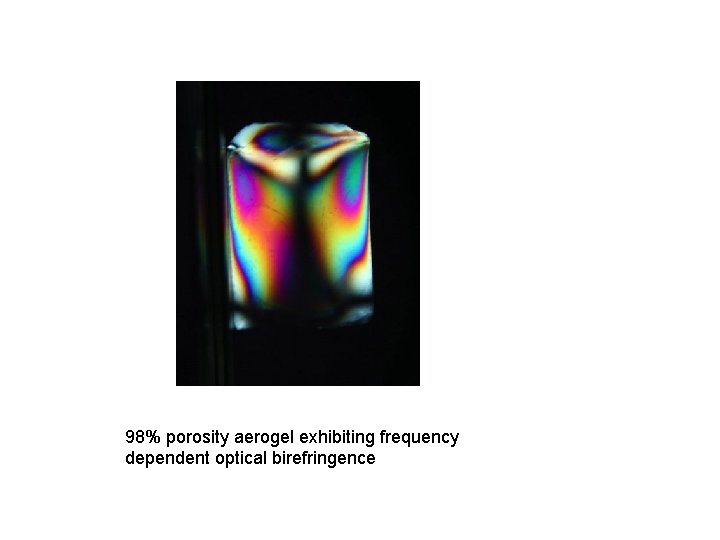
98% porosity aerogel exhibiting frequency dependent optical birefringence
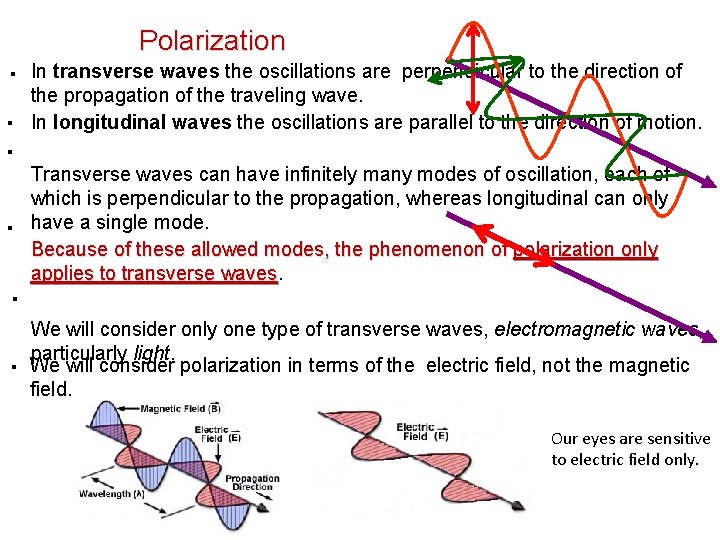
Polarization ▪ In transverse waves the oscillations are perpendicular to the direction of the propagation of the traveling wave. ▪ In longitudinal waves the oscillations are parallel to the direction of motion. ▪ Transverse waves can have infinitely many modes of oscillation, each of which is perpendicular to the propagation, whereas longitudinal can only ▪ have a single mode. Because of these allowed modes, the phenomenon of polarization only applies to transverse waves ▪ We will consider only one type of transverse waves, electromagnetic waves, particularly light. ▪ We will consider polarization in terms of the electric field, not the magnetic field. Our eyes are sensitive to electric field only.
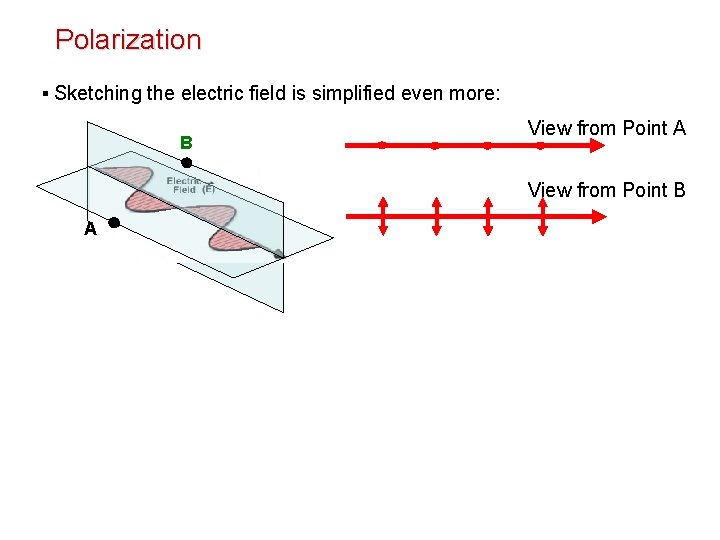
Polarization ▪ Sketching the electric field is simplified even more: B View from Point A View from Point B A
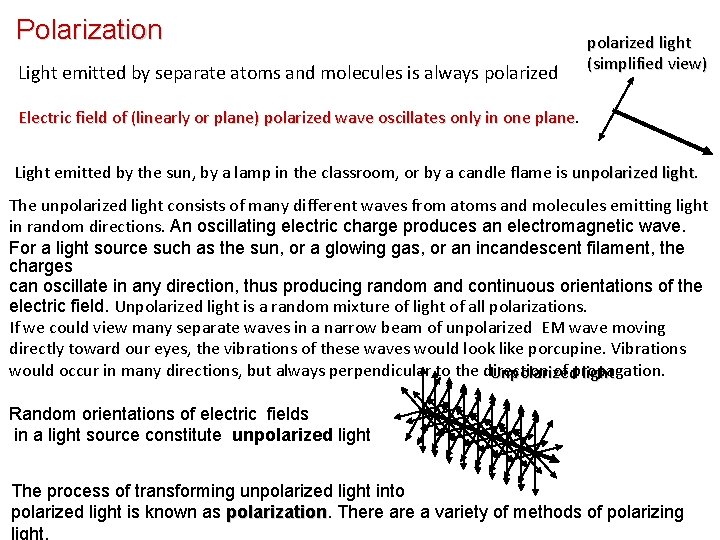
Polarization Light emitted by separate atoms and molecules is always polarized light (simplified view) Electric field of (linearly or plane) polarized wave oscillates only in one plane Light emitted by the sun, by a lamp in the classroom, or by a candle flame is unpolarized light The unpolarized light consists of many different waves from atoms and molecules emitting light in random directions. An oscillating electric charge produces an electromagnetic wave. For a light source such as the sun, or a glowing gas, or an incandescent filament, the charges can oscillate in any direction, thus producing random and continuous orientations of the electric field. Unpolarized light is a random mixture of light of all polarizations. If we could view many separate waves in a narrow beam of unpolarized EM wave moving directly toward our eyes, the vibrations of these waves would look like porcupine. Vibrations would occur in many directions, but always perpendicular to the direction of propagation. Unpolarized light Random orientations of electric fields in a light source constitute unpolarized light The process of transforming unpolarized light into polarized light is known as polarization There a variety of methods of polarizing light.
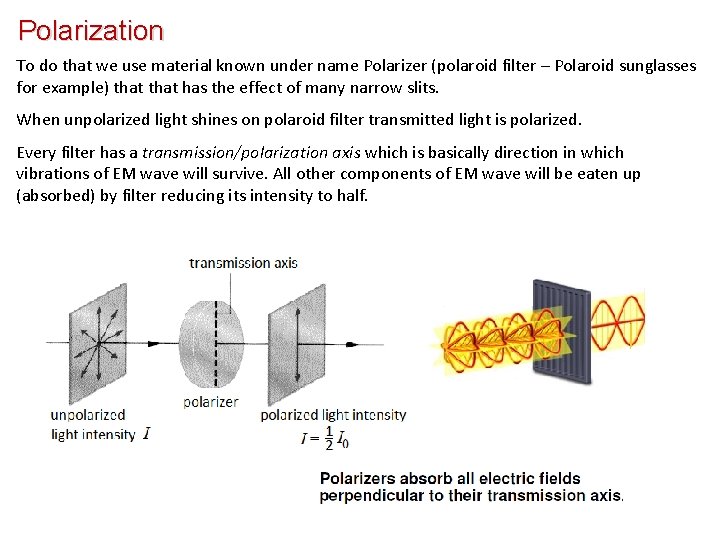
Polarization To do that we use material known under name Polarizer (polaroid filter – Polaroid sunglasses for example) that has the effect of many narrow slits. When unpolarized light shines on polaroid filter transmitted light is polarized. Every filter has a transmission/polarization axis which is basically direction in which vibrations of EM wave will survive. All other components of EM wave will be eaten up (absorbed) by filter reducing its intensity to half.
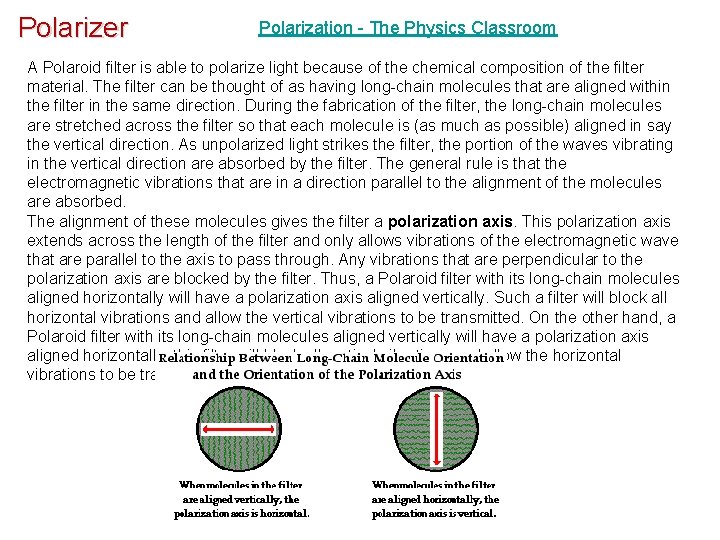
Polarizer Polarization - The Physics Classroom A Polaroid filter is able to polarize light because of the chemical composition of the filter material. The filter can be thought of as having long-chain molecules that are aligned within the filter in the same direction. During the fabrication of the filter, the long-chain molecules are stretched across the filter so that each molecule is (as much as possible) aligned in say the vertical direction. As unpolarized light strikes the filter, the portion of the waves vibrating in the vertical direction are absorbed by the filter. The general rule is that the electromagnetic vibrations that are in a direction parallel to the alignment of the molecules are absorbed. The alignment of these molecules gives the filter a polarization axis. This polarization axis extends across the length of the filter and only allows vibrations of the electromagnetic wave that are parallel to the axis to pass through. Any vibrations that are perpendicular to the polarization axis are blocked by the filter. Thus, a Polaroid filter with its long-chain molecules aligned horizontally will have a polarization axis aligned vertically. Such a filter will block all horizontal vibrations and allow the vertical vibrations to be transmitted. On the other hand, a Polaroid filter with its long-chain molecules aligned vertically will have a polarization axis aligned horizontally; this filter will block all vertical vibrations and allow the horizontal vibrations to be transmitted.
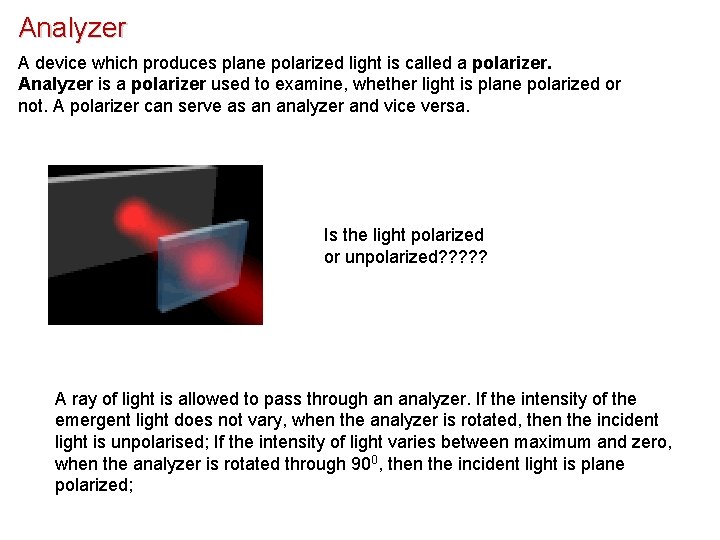
Analyzer A device which produces plane polarized light is called a polarizer. Analyzer is a polarizer used to examine, whether light is plane polarized or not. A polarizer can serve as an analyzer and vice versa. Is the light polarized or unpolarized? ? ? A ray of light is allowed to pass through an analyzer. If the intensity of the emergent light does not vary, when the analyzer is rotated, then the incident light is unpolarised; If the intensity of light varies between maximum and zero, when the analyzer is rotated through 900, then the incident light is plane polarized;
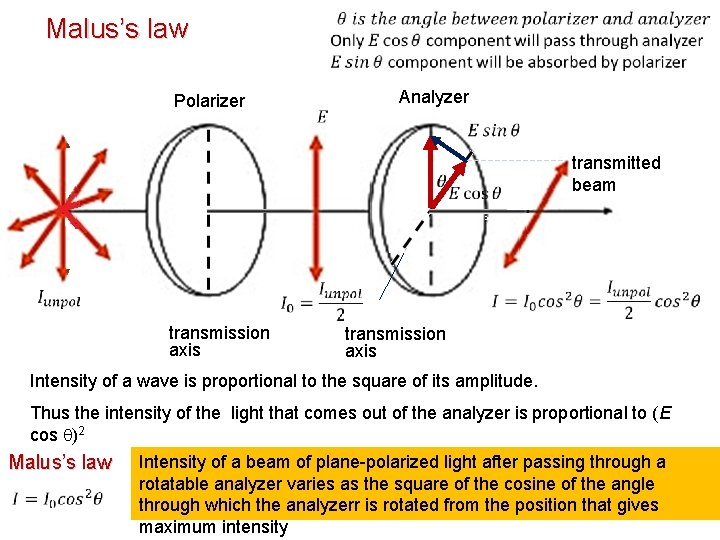
Malus’s law Polarizer Analyzer transmitted beam transmission axis Intensity of a wave is proportional to the square of its amplitude. Thus the intensity of the light that comes out of the analyzer is proportional to (E cos )2 Malus’s law Intensity of a beam of plane-polarized light after passing through a rotatable analyzer varies as the square of the cosine of the angle through which the analyzerr is rotated from the position that gives maximum intensity
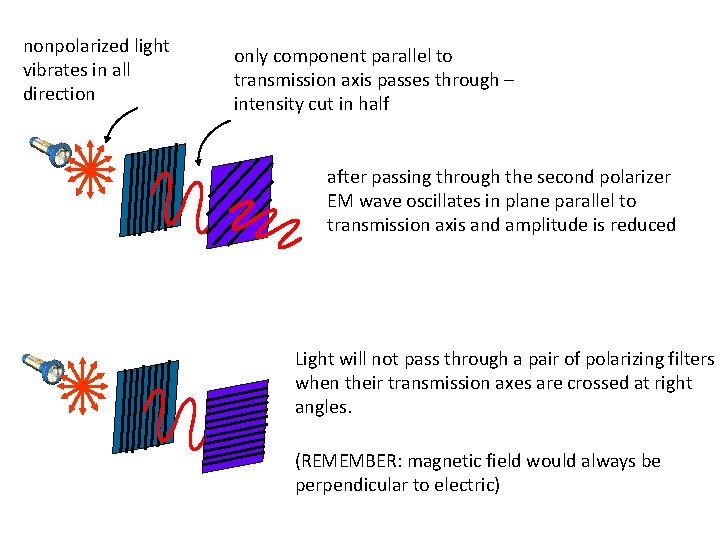
nonpolarized light vibrates in all direction only component parallel to transmission axis passes through – intensity cut in half after passing through the second polarizer EM wave oscillates in plane parallel to transmission axis and amplitude is reduced Light will not pass through a pair of polarizing filters when their transmission axes are crossed at right angles. (REMEMBER: magnetic field would always be perpendicular to electric)
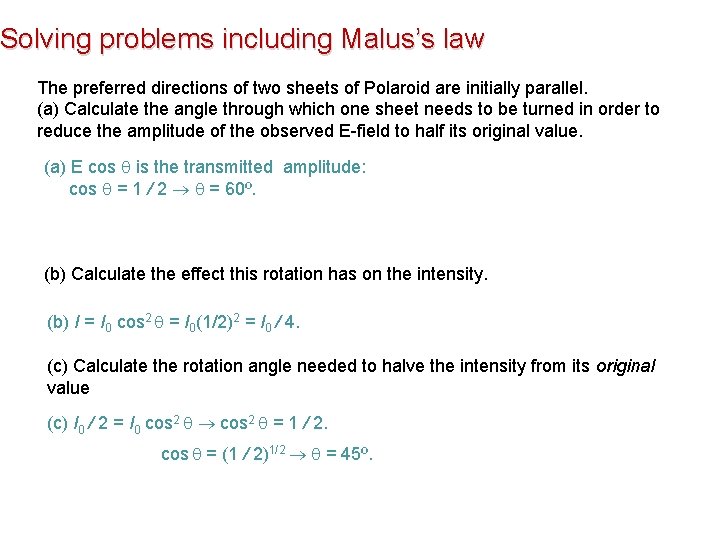
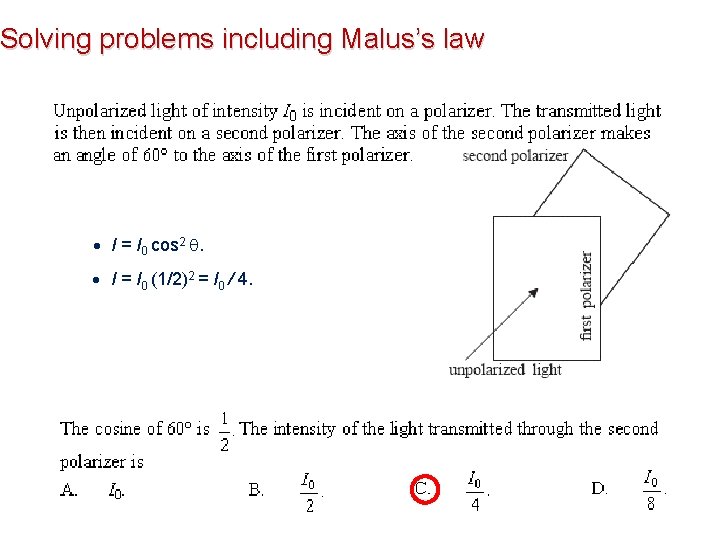
Solving problems including Malus’s law The preferred directions of two sheets of Polaroid are initially parallel. (a) Calculate the angle through which one sheet needs to be turned in order to reduce the amplitude of the observed E-field to half its original value. (a) E cos is the transmitted amplitude: cos = 1 / 2 = 60º. (b) Calculate the effect this rotation has on the intensity. (b) I = I 0 cos 2 = I 0(1/2)2 = I 0 / 4. (c) Calculate the rotation angle needed to halve the intensity from its original value (c) I 0 / 2 = I 0 cos 2 = 1 / 2. cos = (1 / 2)1/2 = 45º.
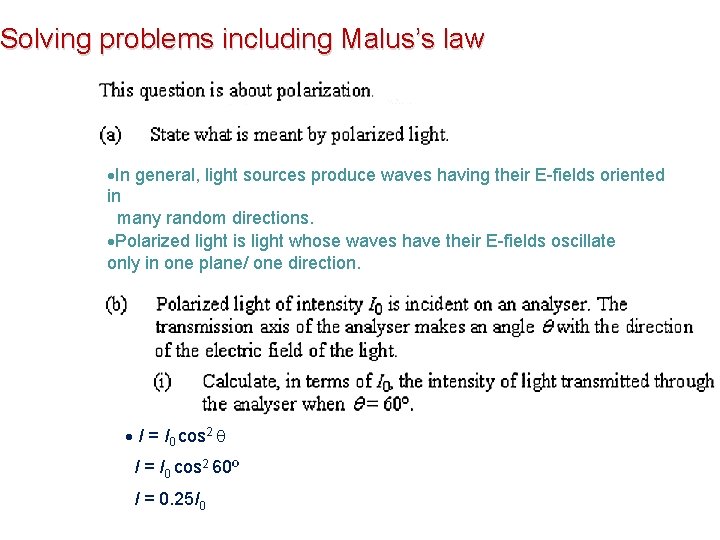
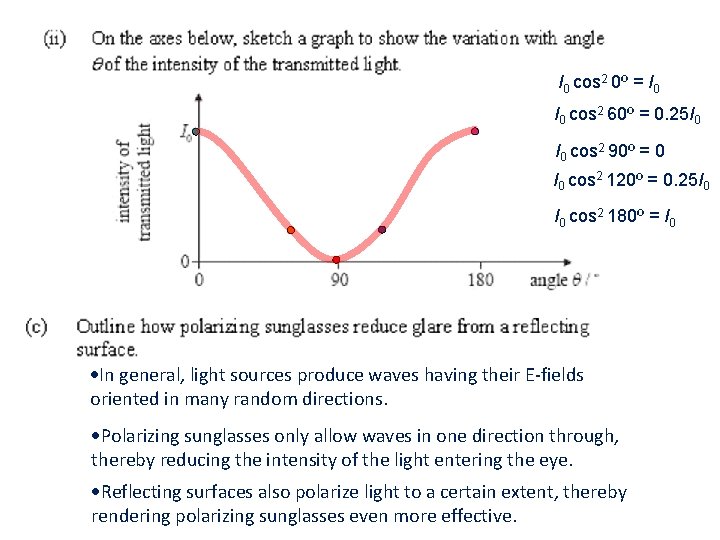
Solving problems including Malus’s law In general, light sources produce waves having their E-fields oriented in many random directions. Polarized light is light whose waves have their E-fields oscillate only in one plane/ one direction. I = I 0 cos 2 60º I = 0. 25 I 0
I 0 cos 2 0º = I 0 cos 2 60º = 0. 25 I 0 cos 2 90º = 0 I 0 cos 2 120º = 0. 25 I 0 cos 2 180º = I 0 In general, light sources produce waves having their E-fields oriented in many random directions. Polarizing sunglasses only allow waves in one direction through, thereby reducing the intensity of the light entering the eye. Reflecting surfaces also polarize light to a certain extent, thereby rendering polarizing sunglasses even more effective.
Solving problems including Malus’s law I = I 0 cos 2 . I = I 0 (1/2)2 = I 0 / 4.
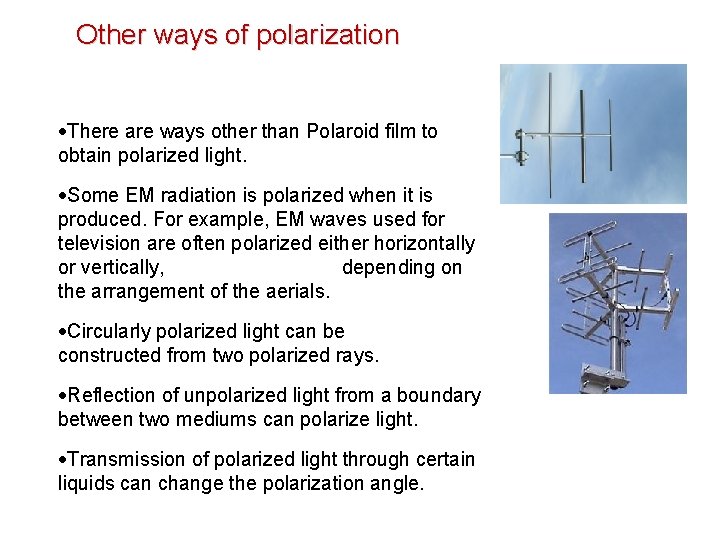
Other ways of polarization There are ways other than Polaroid film to obtain polarized light. Some EM radiation is polarized when it is produced. For example, EM waves used for television are often polarized either horizontally or vertically, depending on the arrangement of the aerials. Circularly polarized light can be constructed from two polarized rays. Reflection of unpolarized light from a boundary between two mediums can polarize light. Transmission of polarized light through certain liquids can change the polarization angle.
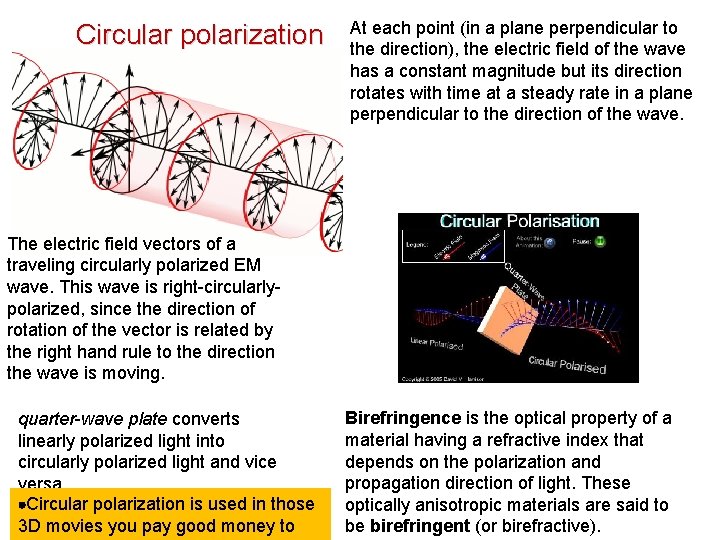
Circular polarization At each point (in a plane perpendicular to the direction), the electric field of the wave has a constant magnitude but its direction rotates with time at a steady rate in a plane perpendicular to the direction of the wave. The electric field vectors of a traveling circularly polarized EM wave. This wave is right-circularlypolarized, since the direction of rotation of the vector is related by the right hand rule to the direction the wave is moving. quarter-wave plate converts linearly polarized light into circularly polarized light and vice versa Circular polarization is used in those 3 D movies you pay good money to Birefringence is the optical property of a material having a refractive index that depends on the polarization and propagation direction of light. These optically anisotropic materials are said to be birefringent (or birefractive).
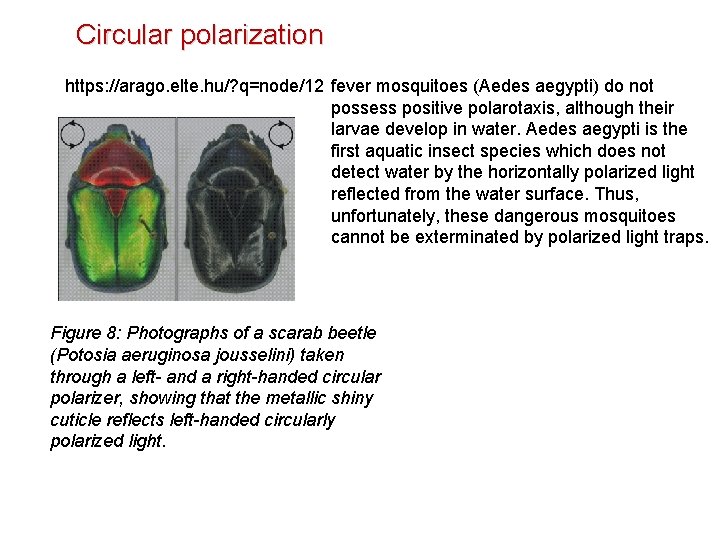
Circular polarization https: //arago. elte. hu/? q=node/12 fever mosquitoes (Aedes aegypti) do not possess positive polarotaxis, although their larvae develop in water. Aedes aegypti is the first aquatic insect species which does not detect water by the horizontally polarized light reflected from the water surface. Thus, unfortunately, these dangerous mosquitoes cannot be exterminated by polarized light traps. Figure 8: Photographs of a scarab beetle (Potosia aeruginosa jousselini) taken through a left- and a right-handed circular polarizer, showing that the metallic shiny cuticle reflects left-handed circularly polarized light.
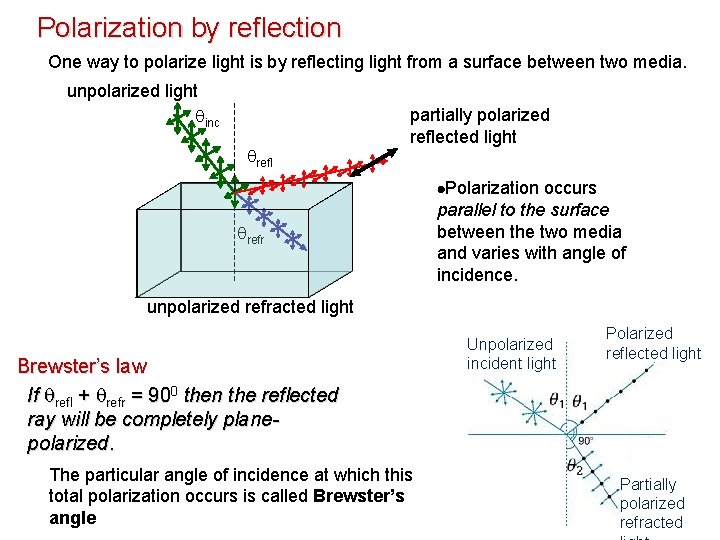
Polarization by reflection One way to polarize light is by reflecting light from a surface between two media. unpolarized light inc refl partially polarized reflected light refr Polarization occurs parallel to the surface between the two media and varies with angle of incidence. unpolarized refracted light Brewster’s law If refl + refr = 900 then the reflected ray will be completely planepolarized. The particular angle of incidence at which this total polarization occurs is called Brewster’s angle Unpolarized incident light Polarized reflected light Partially polarized refracted
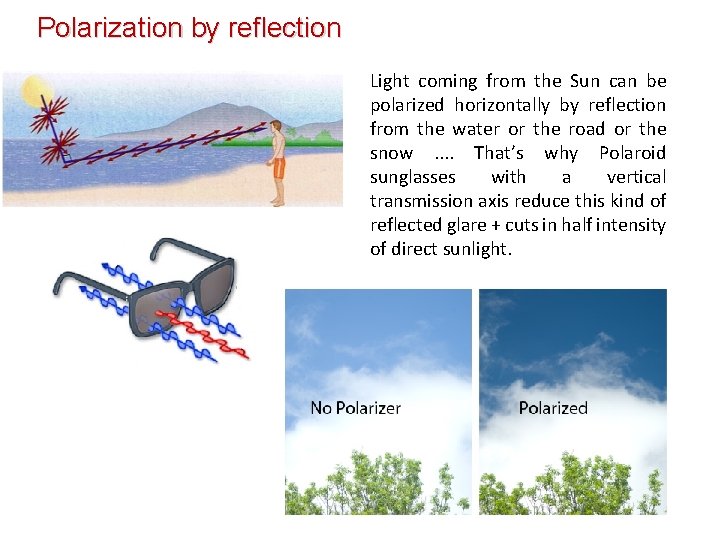
Polarization by reflection Light coming from the Sun can be polarized horizontally by reflection from the water or the road or the snow. . That’s why Polaroid sunglasses with a vertical transmission axis reduce this kind of reflected glare + cuts in half intensity of direct sunlight.
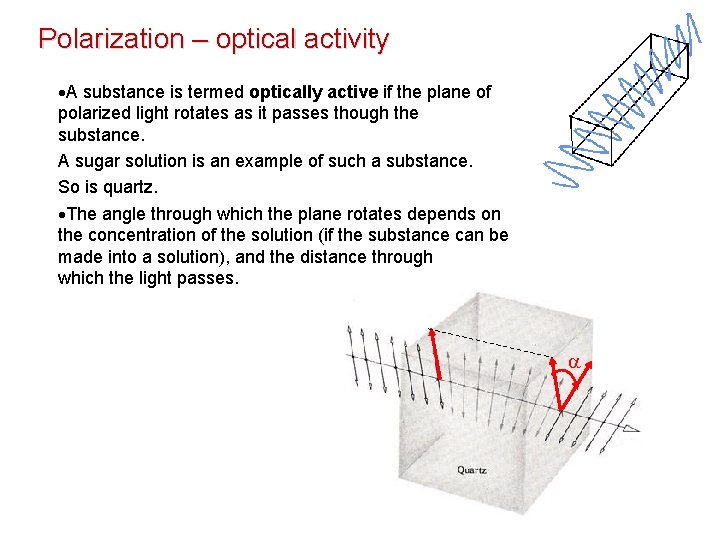
Polarization – optical activity A substance is termed optically active if the plane of polarized light rotates as it passes though the substance. A sugar solution is an example of such a substance. So is quartz. The angle through which the plane rotates depends on the concentration of the solution (if the substance can be made into a solution), and the distance through which the light passes.
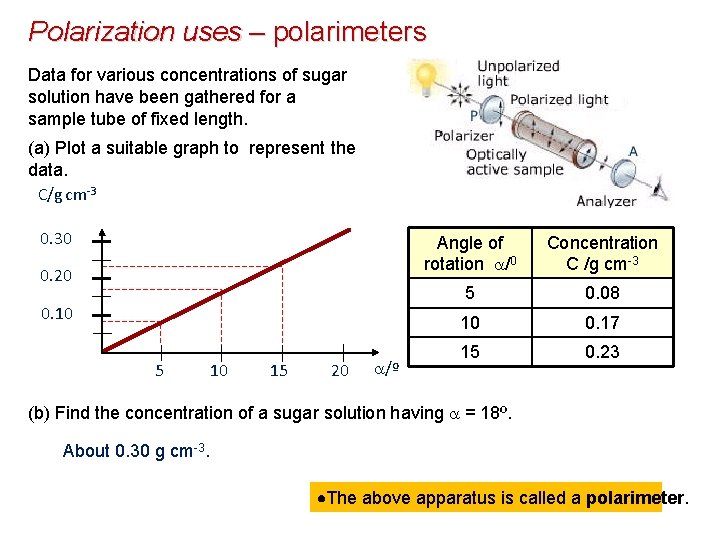
Polarization uses – polarimeters Data for various concentrations of sugar solution have been gathered for a sample tube of fixed length. (a) Plot a suitable graph to represent the data. C/g cm-3 0. 30 0. 20 0. 10 5 10 15 20 /º Angle of rotation /0 Concentration C /g cm-3 5 0. 08 10 0. 17 15 0. 23 (b) Find the concentration of a sugar solution having = 18º. About 0. 30 g cm-3. The above apparatus is called a polarimeter.
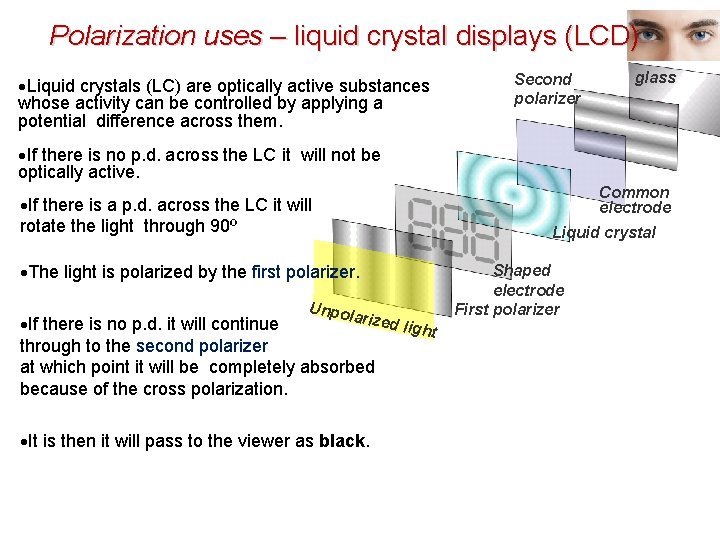
Polarization uses – liquid crystal displays (LCD) Liquid crystals (LC) are optically active substances whose activity can be controlled by applying a potential difference across them. Second polarizer glass If there is no p. d. across the LC it will not be optically active. Common electrode If there is a p. d. across the LC it will rotate the light through 90º Liquid crystal The light is polarized by the first polarizer. Unpo l arized If there is no p. d. it will continue light through to the second polarizer at which point it will be completely absorbed because of the cross polarization. It is then it will pass to the viewer as black. Shaped electrode First polarizer
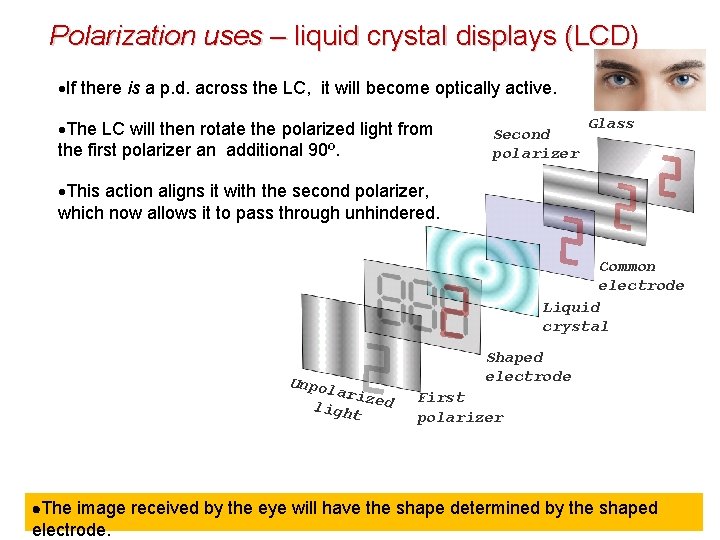
Polarization uses – liquid crystal displays (LCD) If there is a p. d. across the LC, it will become optically active. The LC will then rotate the polarized light from the first polarizer an additional 90º. Second polarizer Glass This action aligns it with the second polarizer, which now allows it to pass through unhindered. Common electrode Liquid crystal Unpol ariz light ed Shaped electrode First polarizer The image received by the eye will have the shape determined by the shaped electrode.
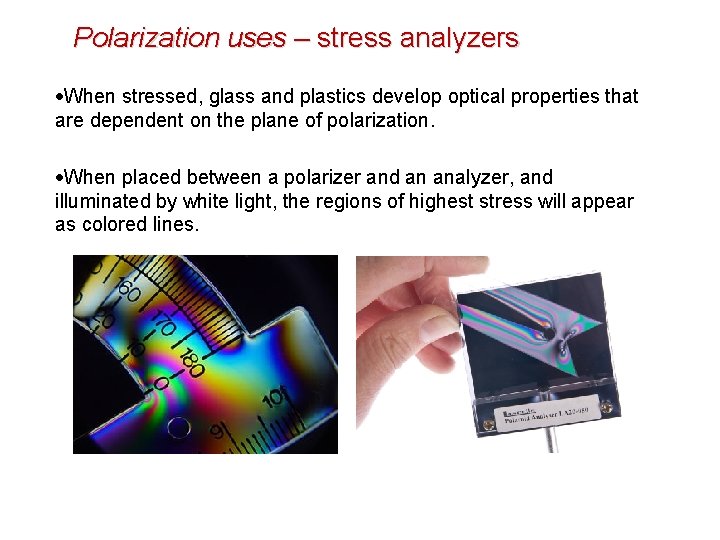
Polarization uses – stress analyzers When stressed, glass and plastics develop optical properties that are dependent on the plane of polarization. When placed between a polarizer and an analyzer, and illuminated by white light, the regions of highest stress will appear as colored lines.
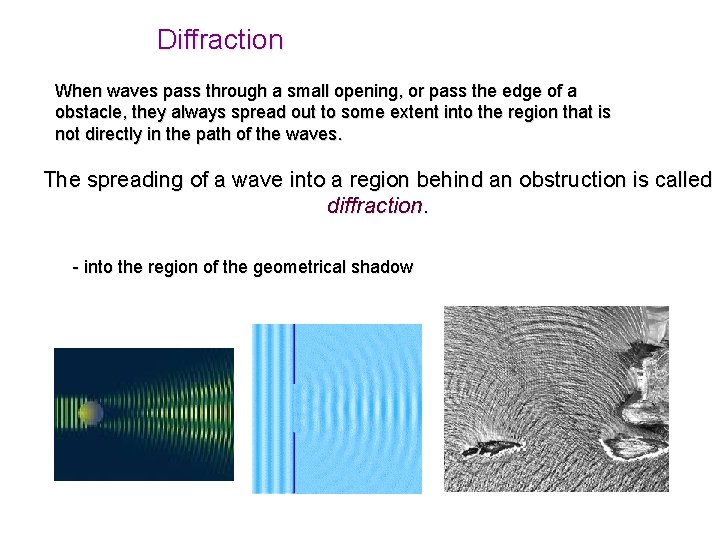
Diffraction When waves pass through a small opening, or pass the edge of a obstacle, they always spread out to some extent into the region that is not directly in the path of the waves. The spreading of a wave into a region behind an obstruction is called diffraction. - into the region of the geometrical shadow
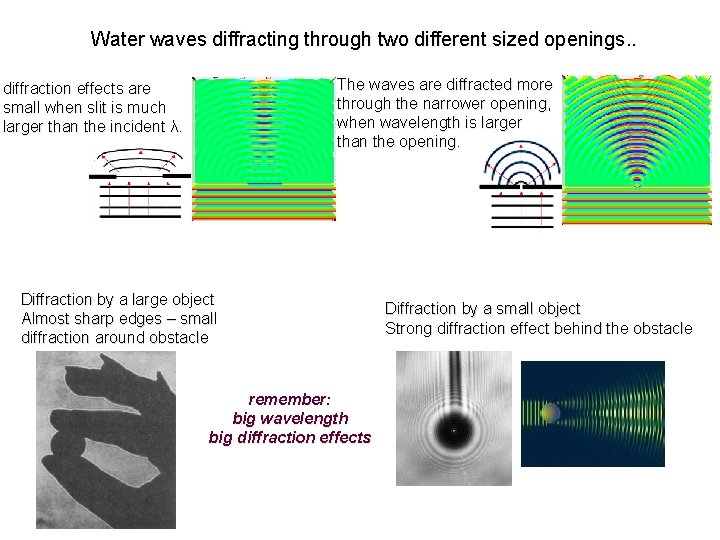
Water waves diffracting through two different sized openings. . The waves are diffracted more through the narrower opening, when wavelength is larger than the opening. diffraction effects are small when slit is much larger than the incident λ. Diffraction by a large object Almost sharp edges – small diffraction around obstacle remember: big wavelength big diffraction effects Diffraction by a small object Strong diffraction effect behind the obstacle
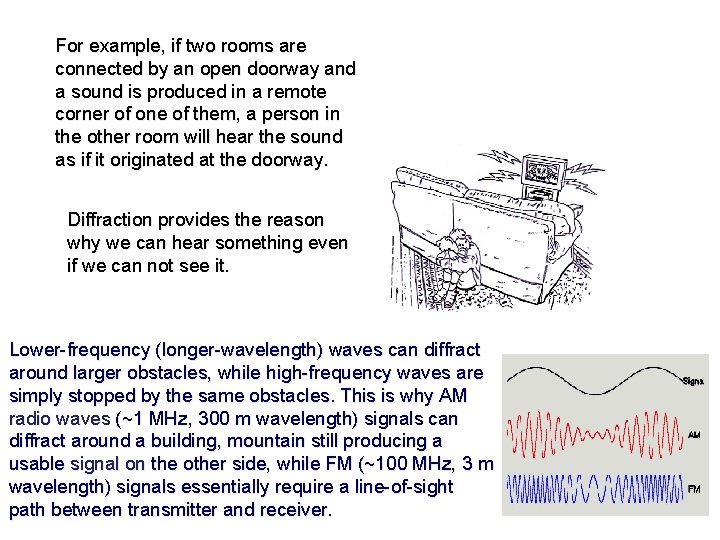
For example, if two rooms are connected by an open doorway and a sound is produced in a remote corner of one of them, a person in the other room will hear the sound as if it originated at the doorway. Diffraction provides the reason why we can hear something even if we can not see it. Lower-frequency (longer-wavelength) waves can diffract around larger obstacles, while high-frequency waves are simply stopped by the same obstacles. This is why AM radio waves (~1 MHz, 300 m wavelength) signals can diffract around a building, mountain still producing a usable signal on the other side, while FM (~100 MHz, 3 m wavelength) signals essentially require a line-of-sight path between transmitter and receiver.
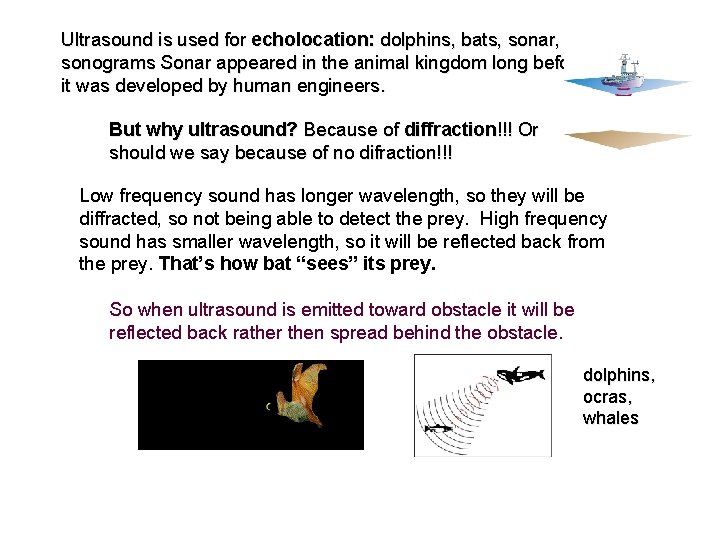
Ultrasound is used for echolocation: dolphins, bats, sonar, sonograms Sonar appeared in the animal kingdom long before it was developed by human engineers. But why ultrasound? Because of diffraction!!! Or should we say because of no difraction!!! Low frequency sound has longer wavelength, so they will be diffracted, so not being able to detect the prey. High frequency sound has smaller wavelength, so it will be reflected back from the prey. That’s how bat “sees” its prey. So when ultrasound is emitted toward obstacle it will be reflected back rather then spread behind the obstacle. dolphins, ocras, whales
Keep in mind that wavelengths of the audible sound are < 1 m, of the visible light ~ 10 -7 m, and water waves you can see for yourself. Now you can understand that diffraction in the case of sound or water can be very obvious, but for light is not so. Light waves (red light: λ ~ 500 nm = 0. 0005 mm) do not diffract very much. Obstacle should be very small. a Shadow!!! (No light behind the obstacle!)
2. Suggest one reason why ships at sea use a very low frequency sound for their foghorn. And low frequency sounds do propagate much further than high-frequency ones – due to diffraction. Another reason and maybe even better explanation is that the method of generating the sound involves the production of a very strong pressure pulse. The fog horn is loud so that it can be heard far away. Elephants also use these deep sounds to communicate over long distance.
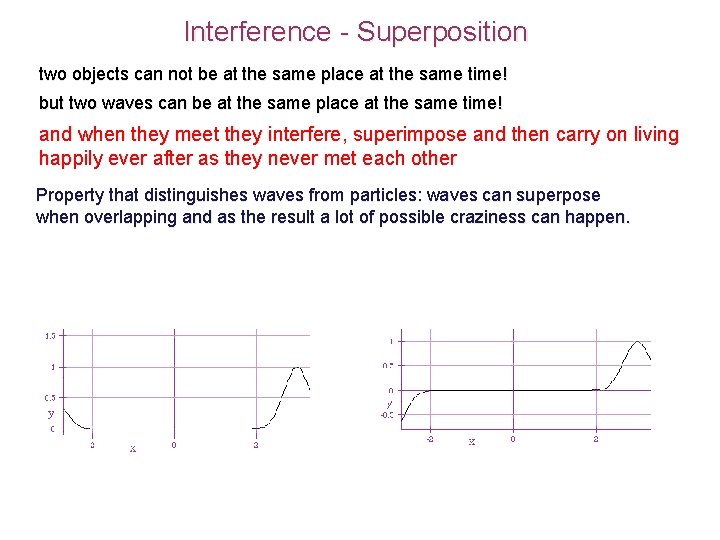
Interference - Superposition two objects can not be at the same place at the same time! but two waves can be at the same place at the same time! and when they meet they interfere, superimpose and then carry on living happily ever after as they never met each other Property that distinguishes waves from particles: waves can superpose when overlapping and as the result a lot of possible craziness can happen.
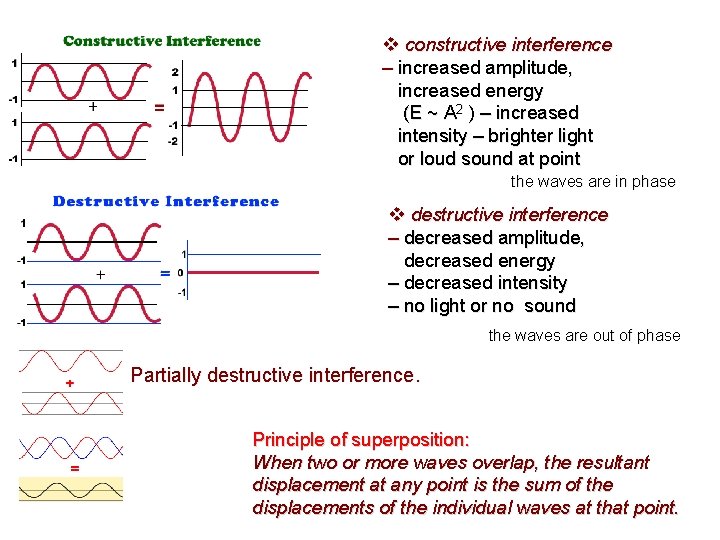
v constructive interference – increased amplitude, increased energy (E ~ A 2 ) – increased intensity – brighter light or loud sound at point the waves are in phase v destructive interference – decreased amplitude, decreased energy – decreased intensity – no light or no sound the waves are out of phase Partially destructive interference. Principle of superposition: When two or more waves overlap, the resultant displacement at any point is the sum of the displacements of the individual waves at that point.
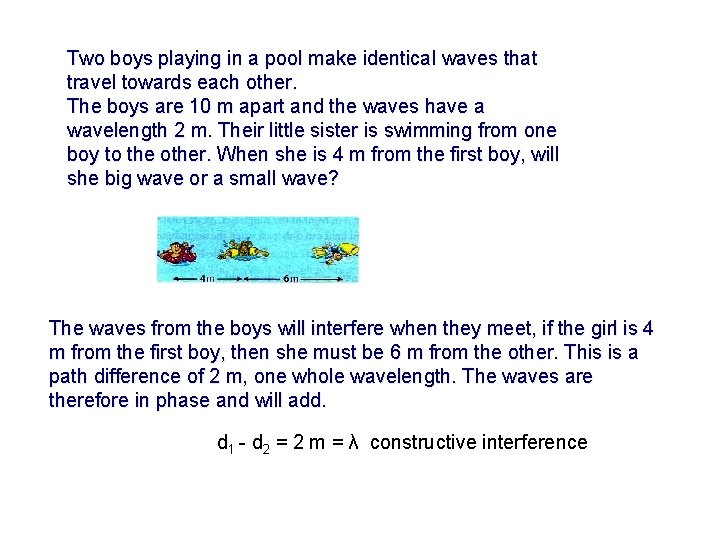
Two boys playing in a pool make identical waves that travel towards each other. The boys are 10 m apart and the waves have a wavelength 2 m. Their little sister is swimming from one boy to the other. When she is 4 m from the first boy, will she big wave or a small wave? The waves from the boys will interfere when they meet, if the girl is 4 m from the first boy, then she must be 6 m from the other. This is a path difference of 2 m, one whole wavelength. The waves are therefore in phase and will add. d 1 - d 2 = 2 m = λ constructive interference
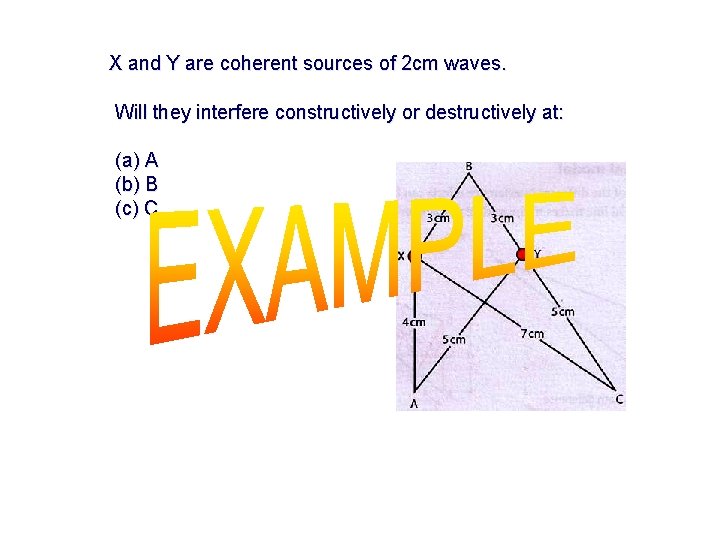
X and Y are coherent sources of 2 cm waves. Will they interfere constructively or destructively at: (a) A (b) B (c) C
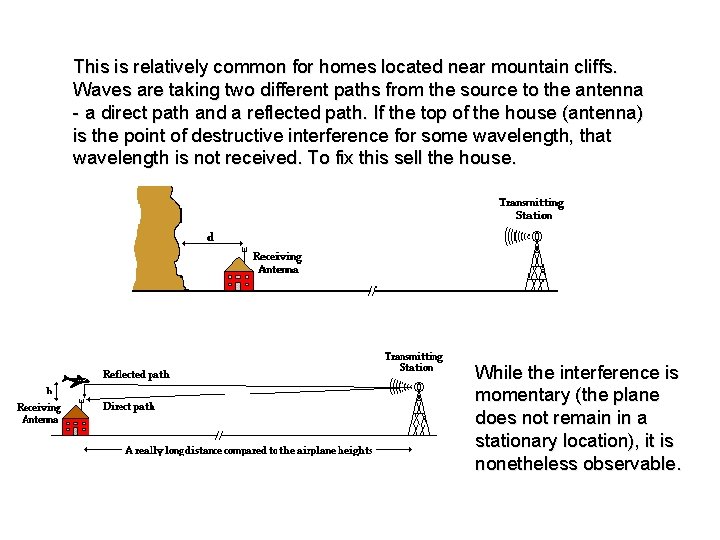
Real-world examples of interference So where in this world do we observe two sources interference? Where can we experience the phenomenon that sound or light taking two paths from two locations to the same point in space can undergo constructive and destructive interference?
This is relatively common for homes located near mountain cliffs. Waves are taking two different paths from the source to the antenna - a direct path and a reflected path. If the top of the house (antenna) is the point of destructive interference for some wavelength, that wavelength is not received. To fix this sell the house. While the interference is momentary (the plane does not remain in a stationary location), it is nonetheless observable.
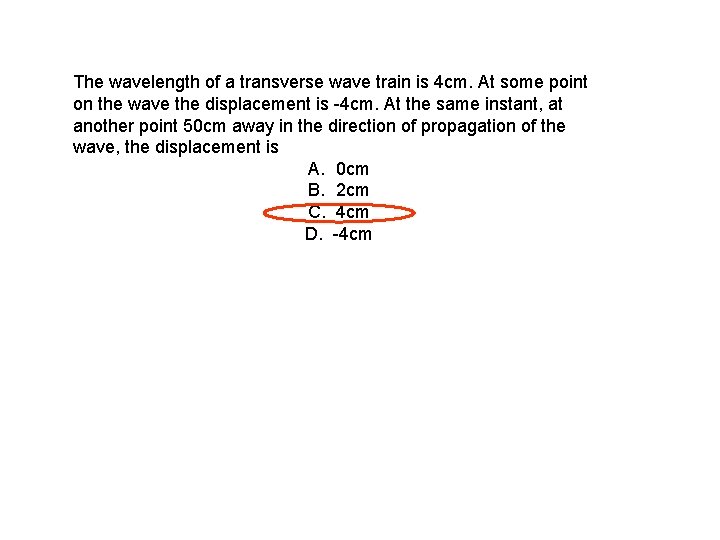
The wavelength of a transverse wave train is 4 cm. At some point on the wave the displacement is -4 cm. At the same instant, at another point 50 cm away in the direction of propagation of the wave, the displacement is A. 0 cm B. 2 cm C. 4 cm D. -4 cm