
4 3 Triumph of Parliament in England Chapter




- Slides: 27
4. 3 Triumph of Parliament in England Chapter 4 Section 3
Vocabulary • Dissenter: Protestant whose views and opinions differed with those of the Church of England • Habeas corpus: principle that a person cannot be held in prison without first being charged with a specific crime • Limited monarchy: government in which a constitution of legislative body limits the monarch’s powers
Important People and Terms • James I: first Stuart monarch, wanted absolute power, clashed with Parliament and dissolved it, created the King James version of the Bible • Charles I: Son of James I, imprisoned enemies without a trial, taxed heavily, forced to sign Petition of Right by Parliament, was defeated by Roundheads in 1647 and executed in 1649 • Petition of Right: law that prohibited the king from increasing taxes without Parliament’s consent and from imprisoning people without just cause • Cavaliers: supporters of Charles I, wealthy nobles who fought for the king • Roundheads: supporters of Parliament, country gentry or manufacturers with short hair cuts who fought against the king • Oliver Cromwell: leader of the Roundheads and leader of the Commonwealth • Levellers: group fighting against the Commonwealth, believed poor men should have as much say in government as noble or rich men • English Bill of Rights: several acts passed by Parliament which ensured the superiority of Parliament and the traditional rights of English citizens, signed by William and Mary in 1689
Setting the Scene • Many people believed that Parliament was the highest power in the 1560 s. • However, in 1603, James I, the monarch of England, took the throne, declaring himself more powerful than Parliament and often colliding it. • It was during the 1600 s that history sees how and why Parliament asserted itself against the power of monarchs.
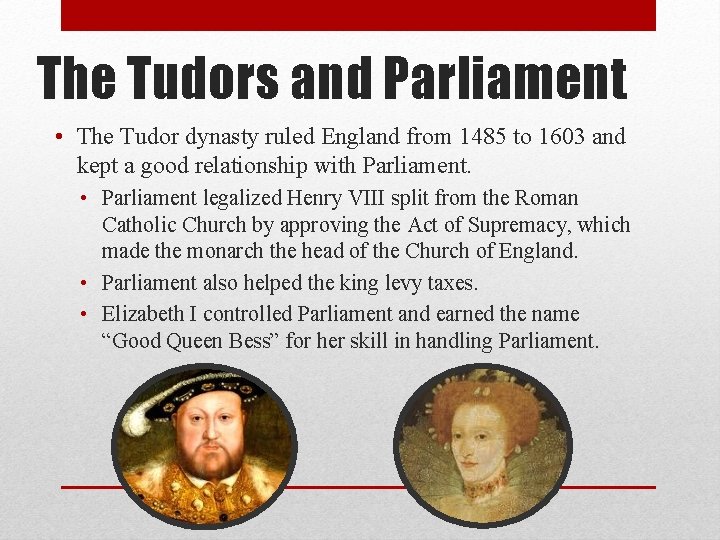
The Tudors and Parliament • The Tudor dynasty ruled England from 1485 to 1603 and kept a good relationship with Parliament. • Parliament legalized Henry VIII split from the Roman Catholic Church by approving the Act of Supremacy, which made the monarch the head of the Church of England. • Parliament also helped the king levy taxes. • Elizabeth I controlled Parliament and earned the name “Good Queen Bess” for her skill in handling Parliament.
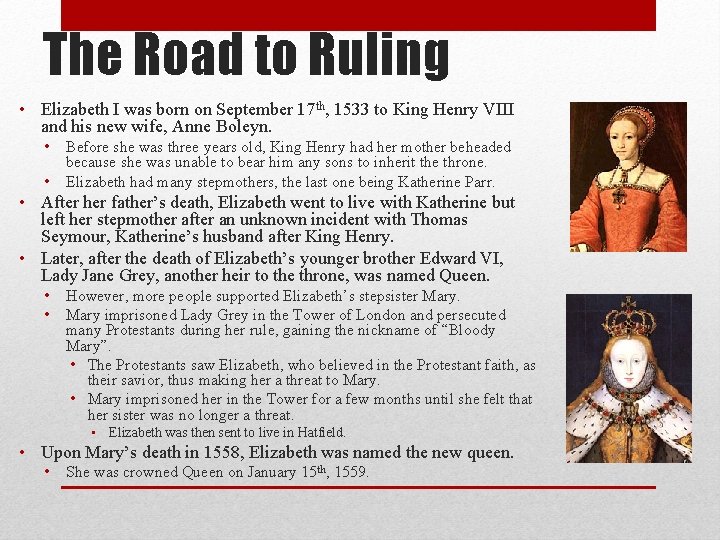
The Road to Ruling • Elizabeth I was born on September 17 th, 1533 to King Henry VIII and his new wife, Anne Boleyn. • Before she was three years old, King Henry had her mother beheaded because she was unable to bear him any sons to inherit the throne. • Elizabeth had many stepmothers, the last one being Katherine Parr. • After her father’s death, Elizabeth went to live with Katherine but left her stepmother after an unknown incident with Thomas Seymour, Katherine’s husband after King Henry. • Later, after the death of Elizabeth’s younger brother Edward VI, Lady Jane Grey, another heir to the throne, was named Queen. • However, more people supported Elizabeth’s stepsister Mary. • Mary imprisoned Lady Grey in the Tower of London and persecuted many Protestants during her rule, gaining the nickname of “Bloody Mary”. • The Protestants saw Elizabeth, who believed in the Protestant faith, as their savior, thus making her a threat to Mary. • Mary imprisoned her in the Tower for a few months until she felt that her sister was no longer a threat. • Elizabeth was then sent to live in Hatfield. • Upon Mary’s death in 1558, Elizabeth was named the new queen. • She was crowned Queen on January 15 th, 1559.
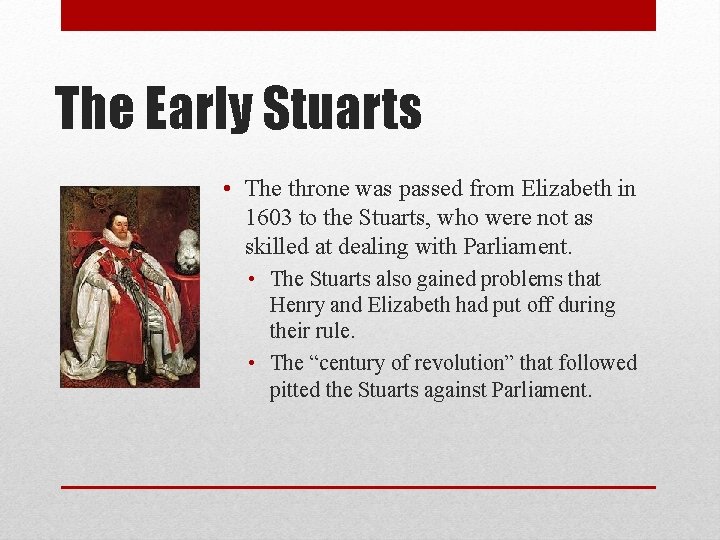
The Early Stuarts • The throne was passed from Elizabeth in 1603 to the Stuarts, who were not as skilled at dealing with Parliament. • The Stuarts also gained problems that Henry and Elizabeth had put off during their rule. • The “century of revolution” that followed pitted the Stuarts against Parliament.
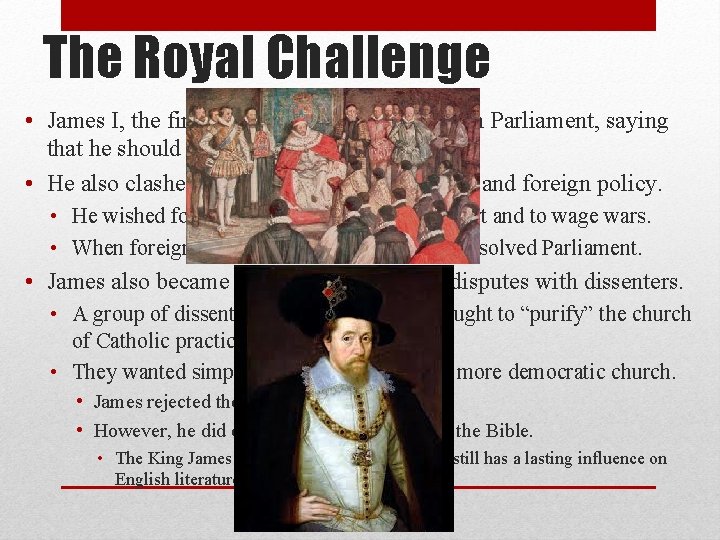
The Royal Challenge • James I, the first Stuart monarch, argued with Parliament, saying that he should have absolute power. • He also clashed with Parliament over money and foreign policy. • He wished for money to satisfy his lavish court and to wage wars. • When foreign policy was discussed, James dissolved Parliament. • James also became involved in numerous disputes with dissenters. • A group of dissenters called the Puritans sought to “purify” the church of Catholic practices. • They wanted simpler church services and a more democratic church. • James rejected their demands. • However, he did call for a new translation of the Bible. • The King James version appeared in 1611 and still has a lasting influence on English literature and language.
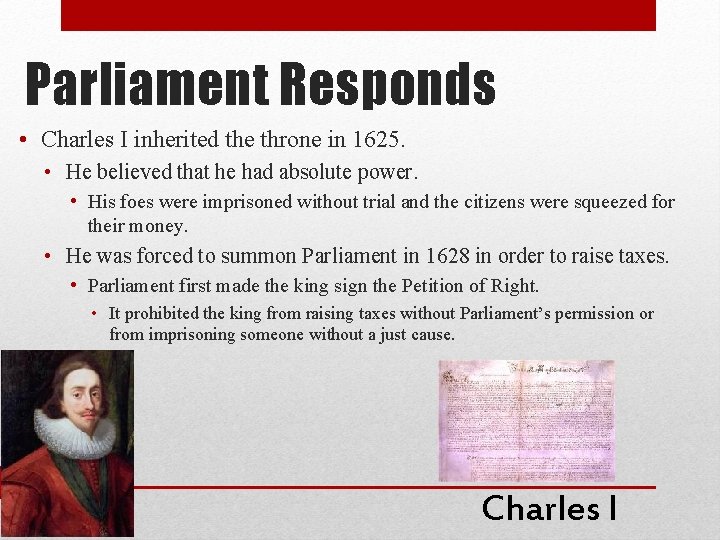
Parliament Responds • Charles I inherited the throne in 1625. • He believed that he had absolute power. • His foes were imprisoned without trial and the citizens were squeezed for their money. • He was forced to summon Parliament in 1628 in order to raise taxes. • Parliament first made the king sign the Petition of Right. • It prohibited the king from raising taxes without Parliament’s permission or from imprisoning someone without a just cause. Charles I
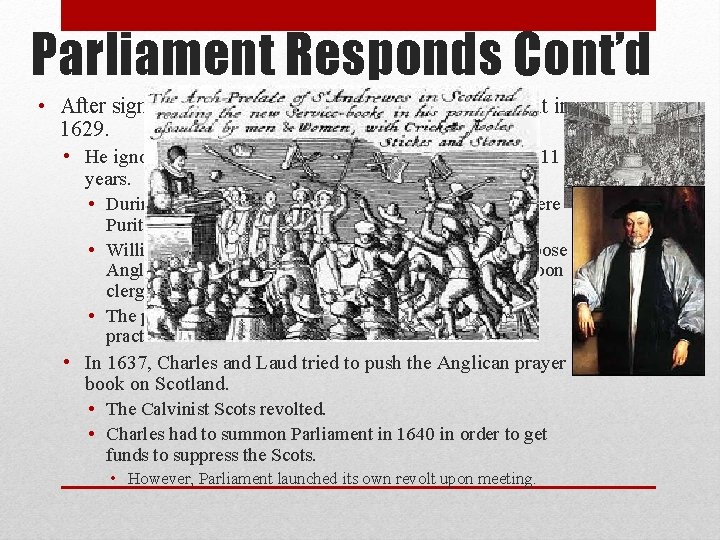
Parliament Responds Cont’d • After signing the petition, Charles dissolved Parliament in 1629. • He ignored the petition and ruled without Parliament for 11 years. • During this time, he acquired enemies, of which many were Puritans. • William Laud, the archbishop of Canterbury, tried to impose Anglican rules of dismissing or imprisoning dissenters upon clergy. • The people thought he was trying to revive Catholic practices. • In 1637, Charles and Laud tried to push the Anglican prayer book on Scotland. • The Calvinist Scots revolted. • Charles had to summon Parliament in 1640 in order to get funds to suppress the Scots. • However, Parliament launched its own revolt upon meeting.
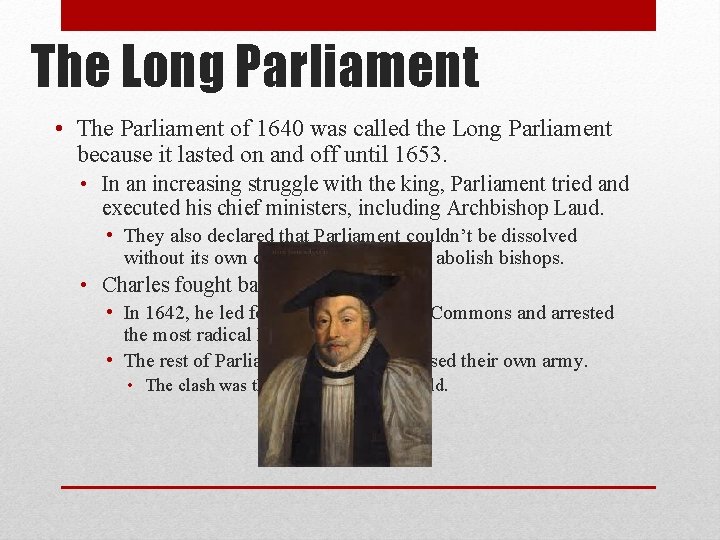
The Long Parliament • The Parliament of 1640 was called the Long Parliament because it lasted on and off until 1653. • In an increasing struggle with the king, Parliament tried and executed his chief ministers, including Archbishop Laud. • They also declared that Parliament couldn’t be dissolved without its own consent and wanted to abolish bishops. • Charles fought back. • In 1642, he led forces to the House of Commons and arrested the most radical leaders. • The rest of Parliament escaped and raised their own army. • The clash was then moved to a battlefield.
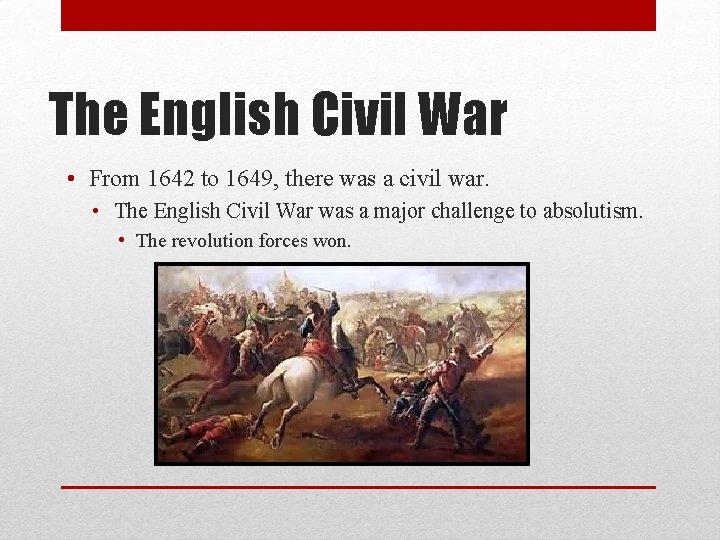
The English Civil War • From 1642 to 1649, there was a civil war. • The English Civil War was a major challenge to absolutism. • The revolution forces won.
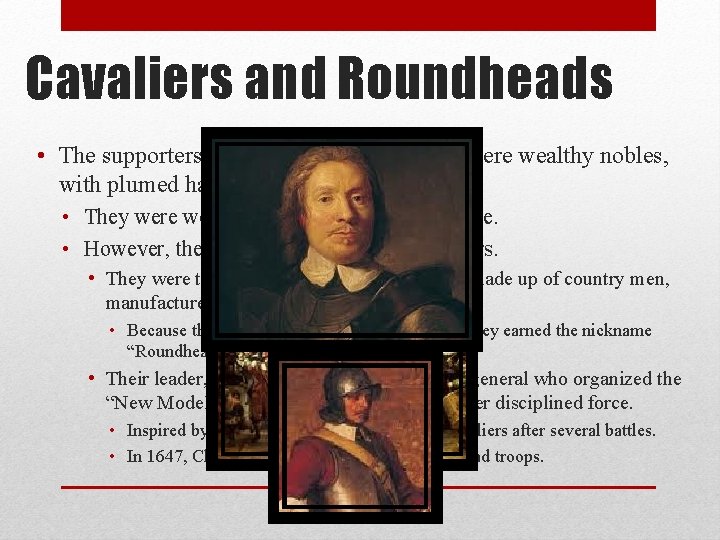
Cavaliers and Roundheads • The supporters of Charles 1, or Cavaliers, were wealthy nobles, with plumed hats and long hair. • They were well-trained in dueling and warfare. • However, the Roundheads were tough fighters. • They were the forces of Parliament and were made up of country men, manufacturers, and Puritan clergy. • Because their hair was cut close to their heads, they earned the nickname “Roundhead”. • Their leader, Oliver Cromwell, was a skillful general who organized the “New Model Army” for Parliament into a better disciplined force. • Inspired by Puritans, his army defeated the Cavaliers after several battles. • In 1647, Charles I was defeated by the Roundhead troops.
English Civil War Video • http: //www. youtube. com/watch? v=Tl 0 LL 6 y. WGRU
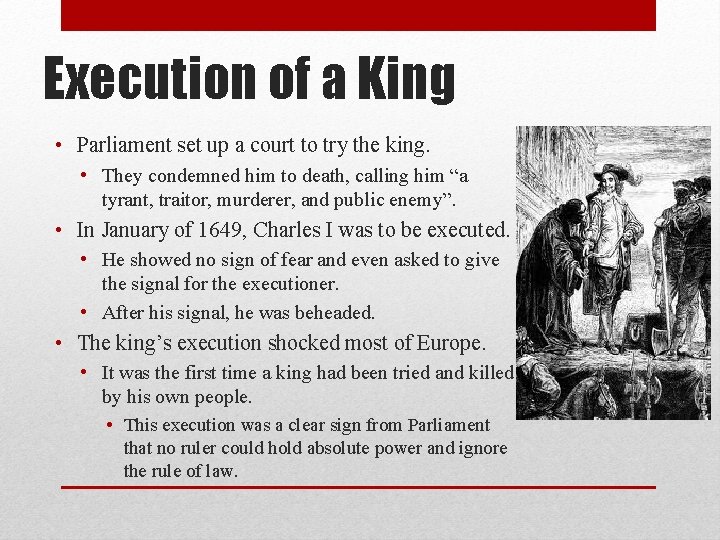
Execution of a King • Parliament set up a court to try the king. • They condemned him to death, calling him “a tyrant, traitor, murderer, and public enemy”. • In January of 1649, Charles I was to be executed. • He showed no sign of fear and even asked to give the signal for the executioner. • After his signal, he was beheaded. • The king’s execution shocked most of Europe. • It was the first time a king had been tried and killed by his own people. • This execution was a clear sign from Parliament that no ruler could hold absolute power and ignore the rule of law.
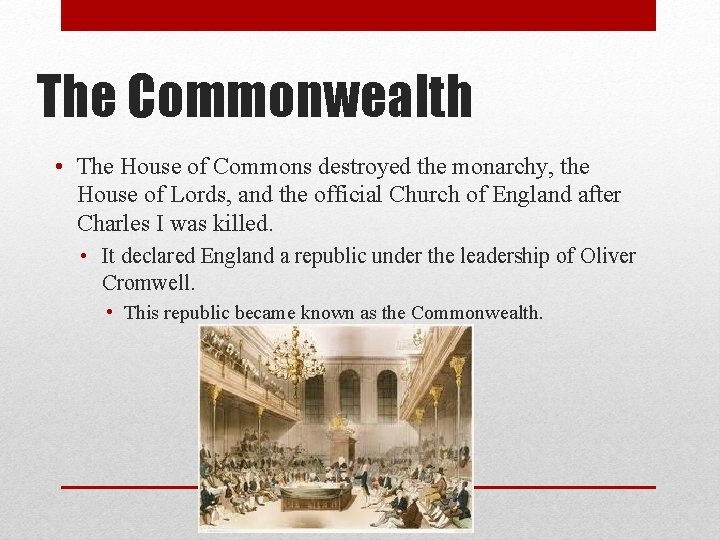
The Commonwealth • The House of Commons destroyed the monarchy, the House of Lords, and the official Church of England after Charles I was killed. • It declared England a republic under the leadership of Oliver Cromwell. • This republic became known as the Commonwealth.
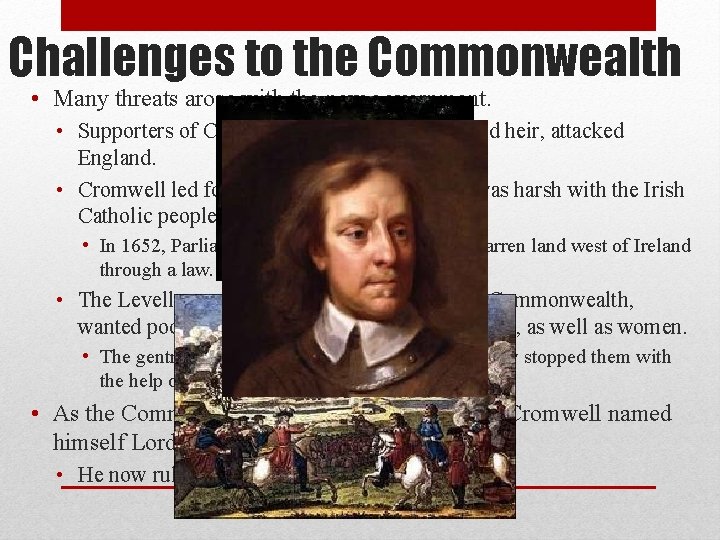
Challenges to the Commonwealth • Many threats arose with the new government. • Supporters of Charles II, Charles I’s uncrowned heir, attacked England. • Cromwell led forces to stop the uprising and was harsh with the Irish Catholic people. • In 1652, Parliament exiled most Catholics to a barren land west of Ireland through a law. • The Levellers, another group that opposed the Commonwealth, wanted poor men to have a say in the government, as well as women. • The gentry of Parliament hated this idea and quickly stopped them with the help of Cromwell. • As the Commonwealth faced more challenges, Cromwell named himself Lord Protector in 1653. • He now ruled the army.
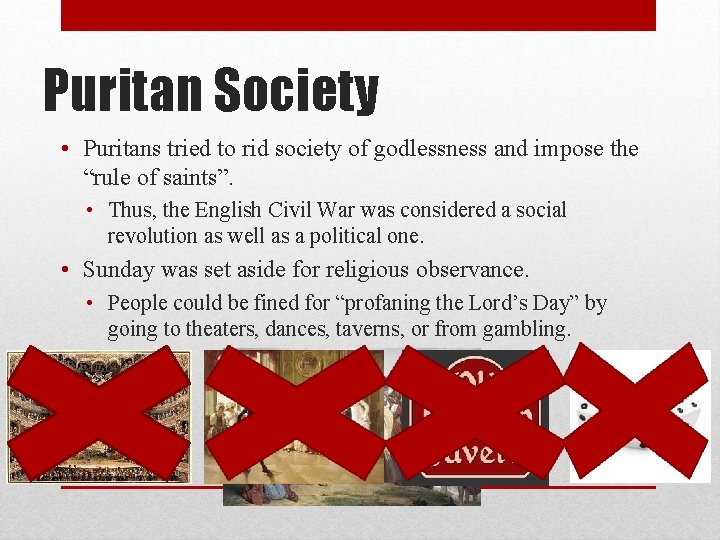
Puritan Society • Puritans tried to rid society of godlessness and impose the “rule of saints”. • Thus, the English Civil War was considered a social revolution as well as a political one. • Sunday was set aside for religious observance. • People could be fined for “profaning the Lord’s Day” by going to theaters, dances, taverns, or from gambling.
Puritan Society Cont’d • Puritans thought that everyone should be able to read the Bible. • They encouraged education for all people and schools became common. • Puritans also wanted to change marriage. • They wanted marriage to be based on love, not business interests. • Women used to be seen as subordinate to men. • However, some Protestant groups allowed women to preach sermons. • Cromwell believed in religious freedom for everyone except Catholics. • After 350 years of exile, he welcomed the Jews back to England.
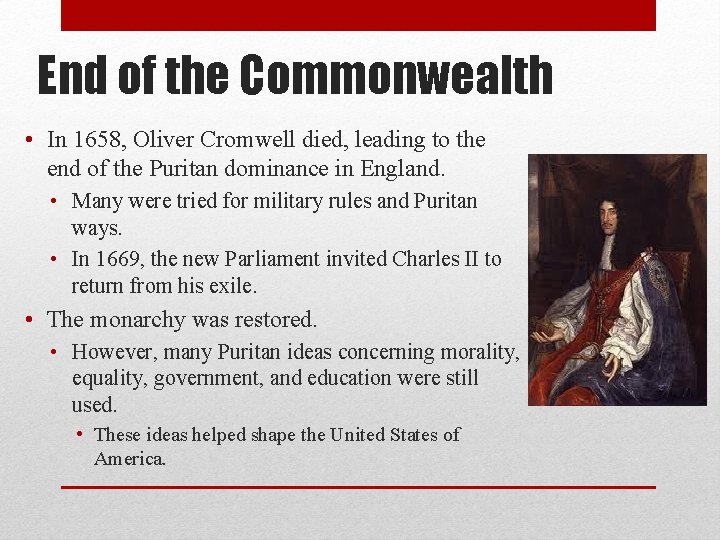
End of the Commonwealth • In 1658, Oliver Cromwell died, leading to the end of the Puritan dominance in England. • Many were tried for military rules and Puritan ways. • In 1669, the new Parliament invited Charles II to return from his exile. • The monarchy was restored. • However, many Puritan ideas concerning morality, equality, government, and education were still used. • These ideas helped shape the United States of America.
From Restoration to Glorious Revolution • Charles II was welcomed back in May of 1660. • He was a popular young ruler who reopened theaters and taverns closed by Cromwell. • He presided over a court and restored the Church of England. • Some Protestant religions were tolerated, though, as well. • Charles accepted the Petition of Rights. • However, he still believed in absolute monarchy and Catholic beliefs.
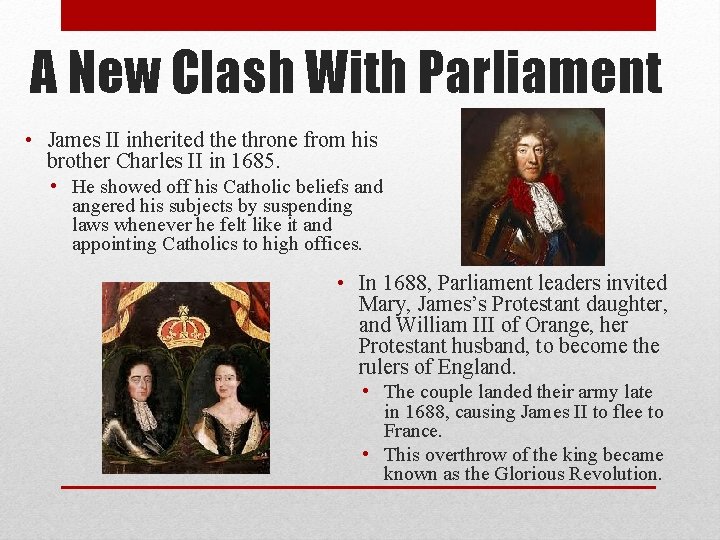
A New Clash With Parliament • James II inherited the throne from his brother Charles II in 1685. • He showed off his Catholic beliefs and angered his subjects by suspending laws whenever he felt like it and appointing Catholics to high offices. • In 1688, Parliament leaders invited Mary, James’s Protestant daughter, and William III of Orange, her Protestant husband, to become the rulers of England. • The couple landed their army late in 1688, causing James II to flee to France. • This overthrow of the king became known as the Glorious Revolution.
English Bill of Rights • William and Mary had to accept certain acts made by Parliament in 1689 before they were crowned. • These acts were known as the English Bill of Rights. • It ensured that Parliament had power over the monarchy. • It also said that the monarch had to summon Parliament regularly and gave the House of Commons the “power of the purse”. • It barred Catholics from ruling and the monarchy from interfering with debates or laws. • The English Bill of Rights also said the rights of English citizens. • It abolished unnecessarily large fines and cruel or unjust punishment. • Habeas corpus was also affirmed. • The Toleration Act of 1689 granted religious freedoms to most religions except Catholics.
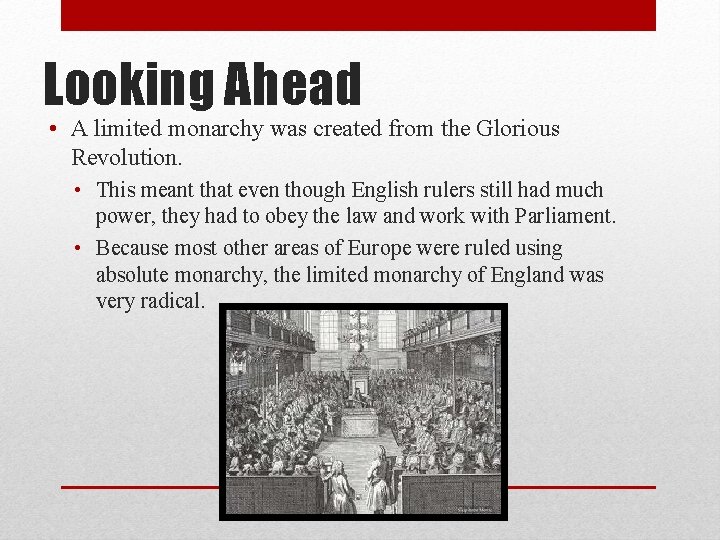
Looking Ahead • A limited monarchy was created from the Glorious Revolution. • This meant that even though English rulers still had much power, they had to obey the law and work with Parliament. • Because most other areas of Europe were ruled using absolute monarchy, the limited monarchy of England was very radical.
Review • Dissenter- Person with different views than the mainstream • Charles I of England- Did not work with Parliament, disbanded them, recalled them, caused English Civil war and was first Monarch to be tried and executed by his people • Roundheads- Supporters of the Crown during the English Civil War • Cavaliers- Supporters of Parliament during the English Civil War • English Bill of Rights- William and Mary signed, limited the power of the Monarch • Habeas Corpus- Cannot be held in jail without being charged with a crime • Limited Monarchy- Monarchy limited by a legislature or a constitution
Review • What was the family name of the rulers of England from 1485 -1603? Tudor • What country does Parliament run, or is the legislative body in? England • After the death of Elizabeth what family too over the throne in England? Stuart, James I • What did James I do to Parliament? Dissolved it, got rid of it • What was the war between the Cavilers and Roundheads called? English Civil War • What was the fate of King Charles I after he was captured by the Roundheads? Head chopped off • Who became leader of England after the war? Oliver Cromwell • What religion did the English leader hold too after the war? Puritanism/Protestantism • After Oliver Cromwell who did the Parliament invite back to be King of England? Charles II
Bibliography • • http: //tudorhistory. org/elizabeth/queen. html History Book Google Images http: //www. youtube. com/watch? v=Tl 0 LL 6 y. WGRU