
4 3 Riemann Sums and Definite Integrals 1
![Definition of Definite Integral If f is defined on the closed interval [a, b]](https://slidetodoc.com/presentation_image_h/d1bad2b623525b2c165e8661a78bbbe7/image-4.jpg "Definition of Definite Integral If f is defined on the closed interval [a, b]")
- Slides: 10
4. 3 Riemann Sums and Definite Integrals 1. Define a Riemann sum. 2. Evaluate a definite integral using limits. 3. Use properties of definite integrals to evaluate a definite integral.
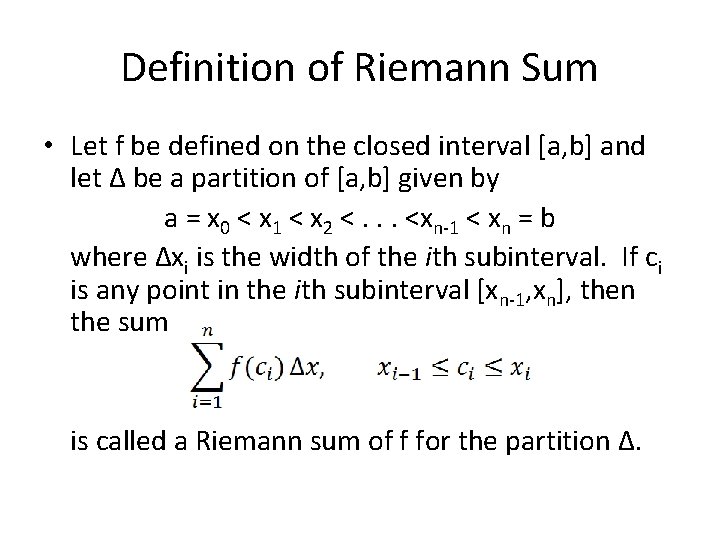
Definition of Riemann Sum • Let f be defined on the closed interval [a, b] and let Δ be a partition of [a, b] given by a = x 0 < x 1 < x 2 <. . . <xn-1 < xn = b where Δxi is the width of the ith subinterval. If ci is any point in the ith subinterval [xn-1, xn], then the sum is called a Riemann sum of f for the partition Δ.
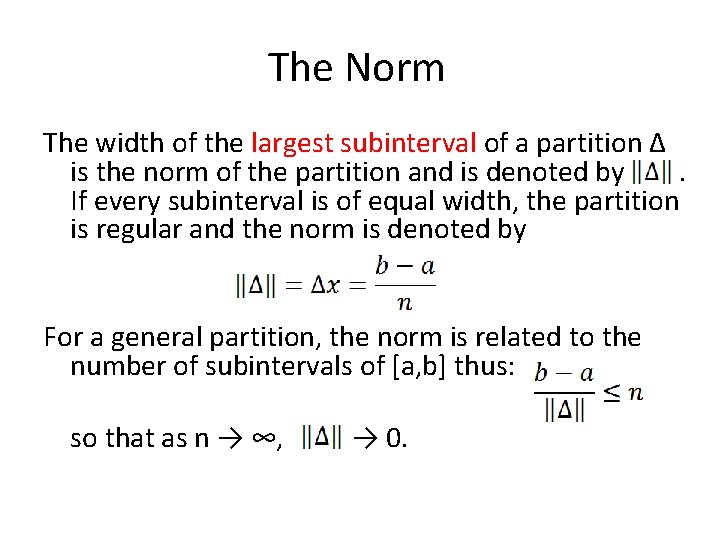
The Norm The width of the largest subinterval of a partition Δ is the norm of the partition and is denoted by. If every subinterval is of equal width, the partition is regular and the norm is denoted by For a general partition, the norm is related to the number of subintervals of [a, b] thus: so that as n → ∞, → 0.
Definition of Definite Integral If f is defined on the closed interval [a, b] and the limit of Riemann sums over partitions Δ exists, then f is integrable on [a, b] and The limit is called the definite integral of f from a to b. The number a is the lower limit of integration and the number b is the upper limit of integration.
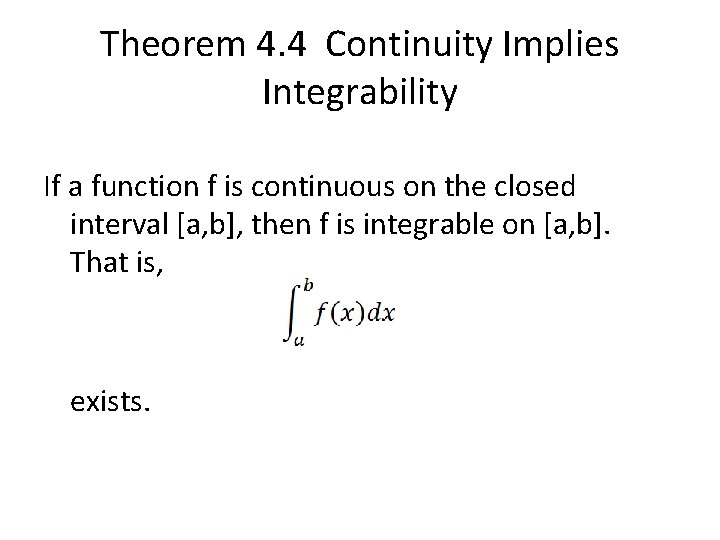
Theorem 4. 4 Continuity Implies Integrability If a function f is continuous on the closed interval [a, b], then f is integrable on [a, b]. That is, exists.
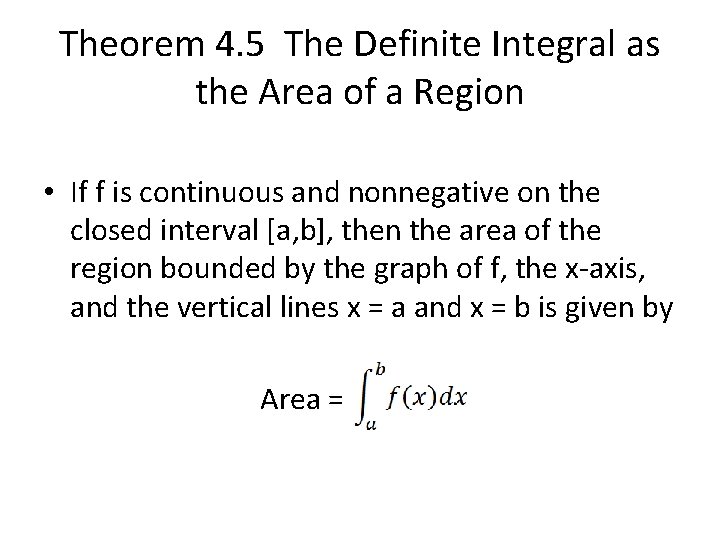
Theorem 4. 5 The Definite Integral as the Area of a Region • If f is continuous and nonnegative on the closed interval [a, b], then the area of the region bounded by the graph of f, the x-axis, and the vertical lines x = a and x = b is given by Area =
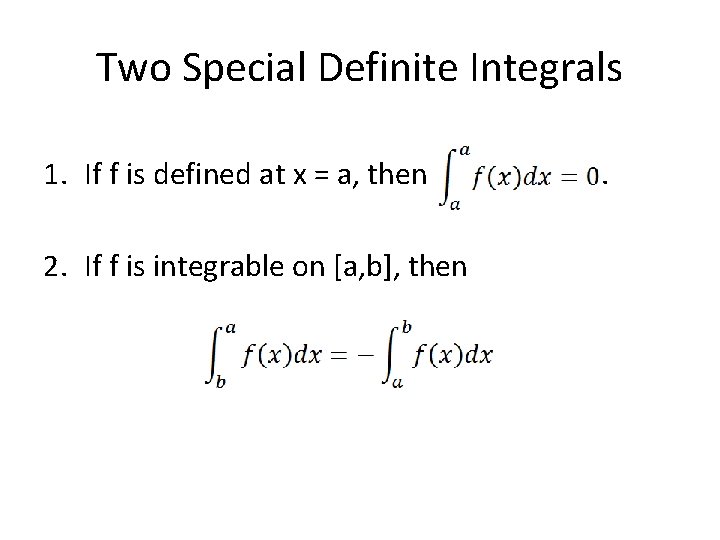
Two Special Definite Integrals 1. If f is defined at x = a, then 2. If f is integrable on [a, b], then .
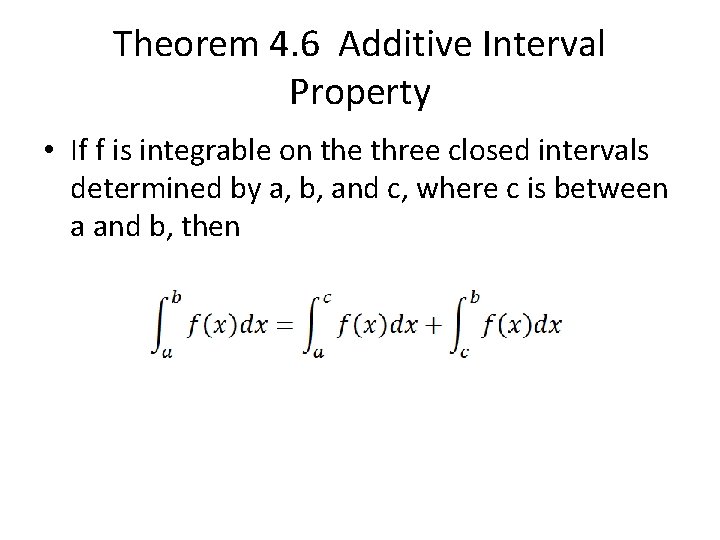
Theorem 4. 6 Additive Interval Property • If f is integrable on the three closed intervals determined by a, b, and c, where c is between a and b, then
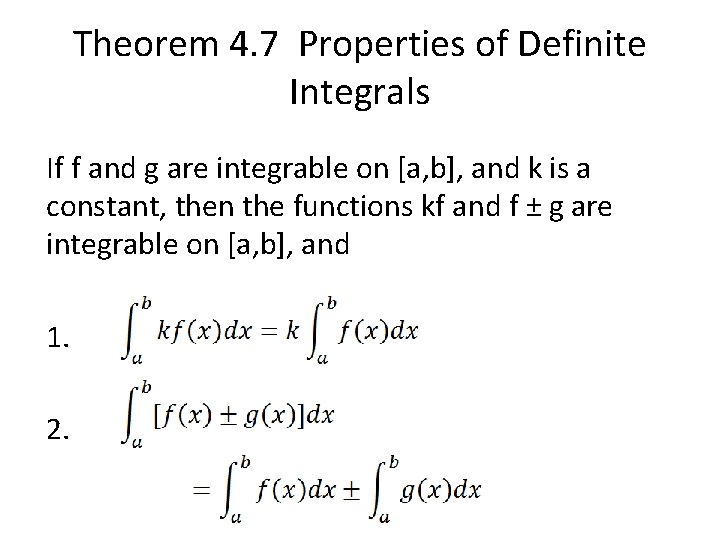
Theorem 4. 7 Properties of Definite Integrals If f and g are integrable on [a, b], and k is a constant, then the functions kf and f ± g are integrable on [a, b], and 1. 2.
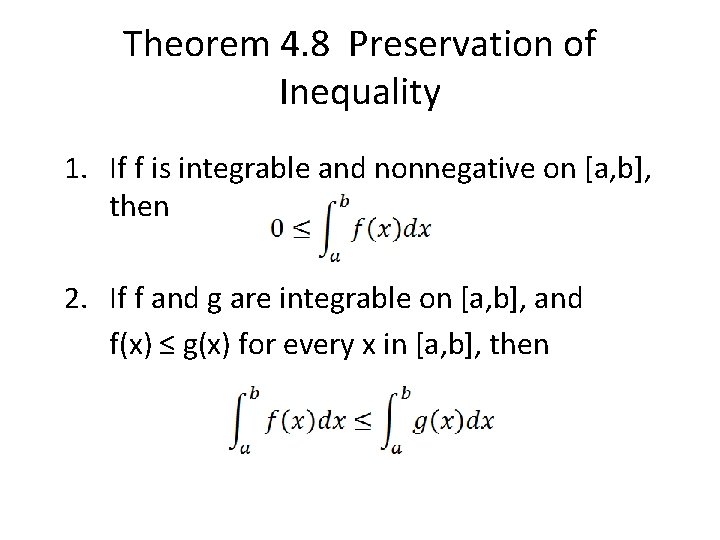
Theorem 4. 8 Preservation of Inequality 1. If f is integrable and nonnegative on [a, b], then 2. If f and g are integrable on [a, b], and f(x) ≤ g(x) for every x in [a, b], then