
4 3 Covalent Bonding Objectives 1 ac hl
4. 3 Covalent Bonding Objectives 1: a-c, h-l, o; 2 Chemistry
Essential Questions n n n What is a covalent bond? How can you tell if two elements can form a covalent bond? How does a covalent bond fulfill the octet rule? What is a molecule? What are the properties of molecular compounds? How are Lewis Structures drawn?
Covalent Bonding n n n A covalent bond is when valence electrons are shared between two nonmetals. By sharing electrons each element in the covalent bond gets a full valence fulfilling the octet rule A covalent bond forms when atoms have a relatively small difference in electronegativity so the electrons spend time with both atoms.
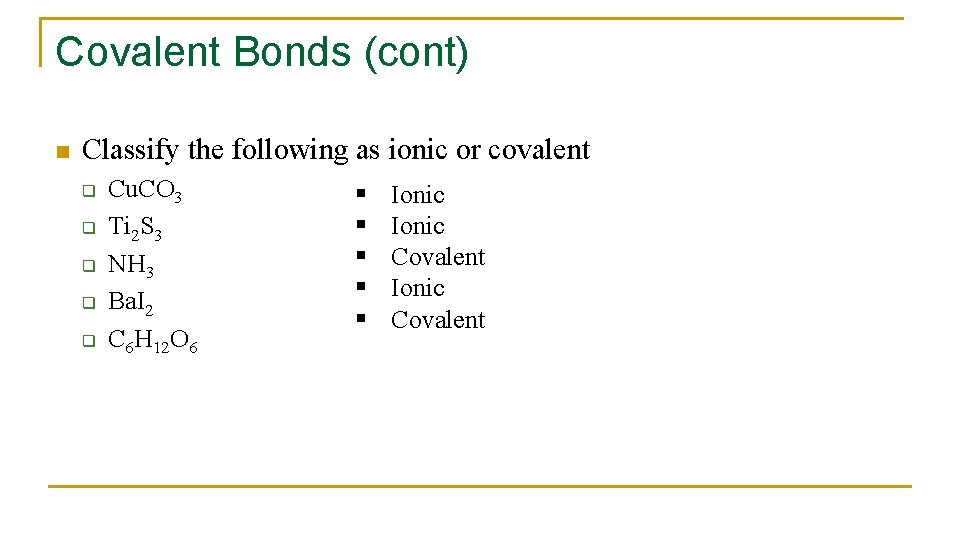
Covalent Bonds (cont) n Classify the following as ionic or covalent q q q Cu. CO 3 Ti 2 S 3 NH 3 Ba. I 2 C 6 H 12 O 6 § § § Ionic Covalent
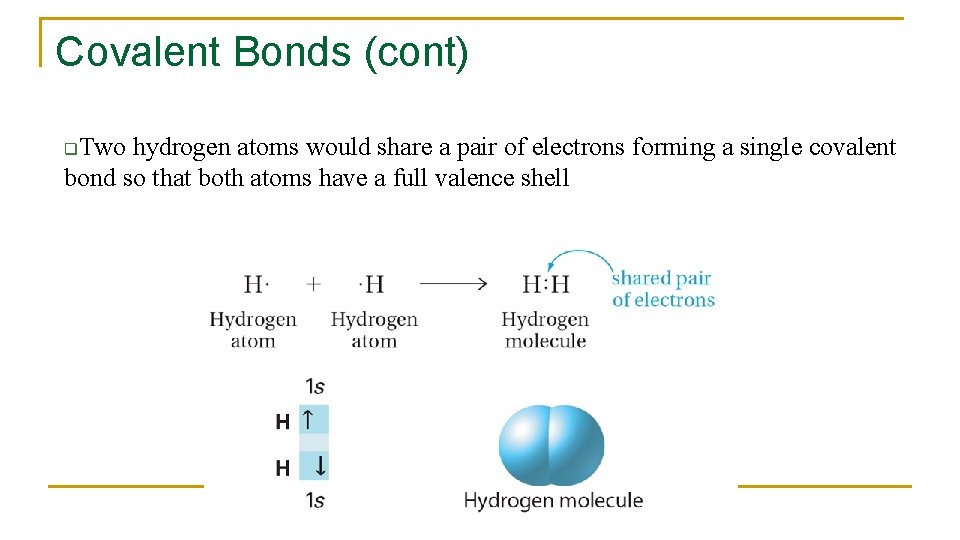
Covalent Bonds (cont) Two hydrogen atoms would share a pair of electrons forming a single covalent bond so that both atoms have a full valence shell q
Covalent Bonds (cont) n n n Single bond: One shared pair of electrons Double bond: Two shared pairs Triple bond: Three shared pairs Double and triple bonds form when an atom needs to share additional electron pairs to become like a noble gas Triple bonds are the strongest and the shortest
Molecular Compounds n n A molecule is a neutral group of atoms held together by covalent bonds. A molecular or covalent compound is a compound made up of molecules.
Molecular Compounds (cont) n n n Properties of molecular compounds: Low melting and boiling points Are not brittle Do not conduct electricity in solution or individually Insoluble or very low solubility in water (doesn’t dissolve well) Some of them smell
Formulas n n n Molecular compounds can have their formula written out two different ways: molecular and structural Molecular formulas are chemical formulas for molecules and show what atoms make up a molecule Structural formulas show the atoms are bonded and are done using Lewis structures
Strategy for Building Molecules n n Step #1: Look up valence e- for each atom and add them up Hydrogen cyanide (HCN) H 1 C 4 N 5 10 Total Electrons n n For anions add the number only from the charge to the e- total For cations subtract number only from the charge from the e- total
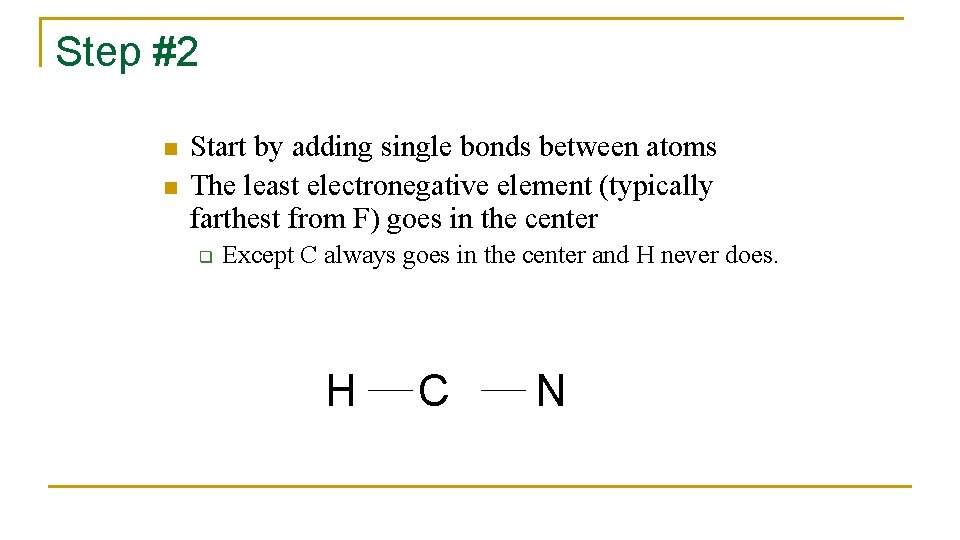
Step #2 n n Start by adding single bonds between atoms The least electronegative element (typically farthest from F) goes in the center q Except C always goes in the center and H never does. H C N
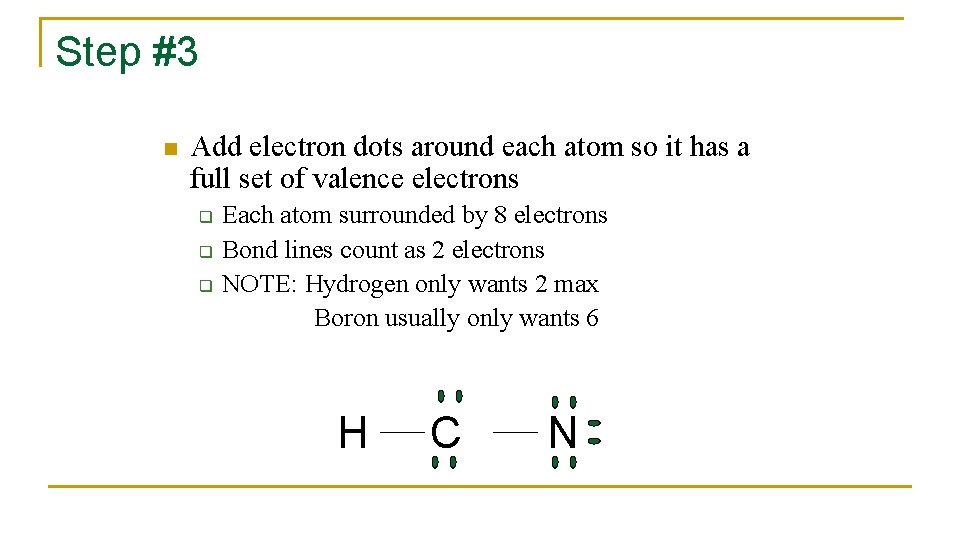
Step #3 n Add electron dots around each atom so it has a full set of valence electrons q q q Each atom surrounded by 8 electrons Bond lines count as 2 electrons NOTE: Hydrogen only wants 2 max Boron usually only wants 6 H C N
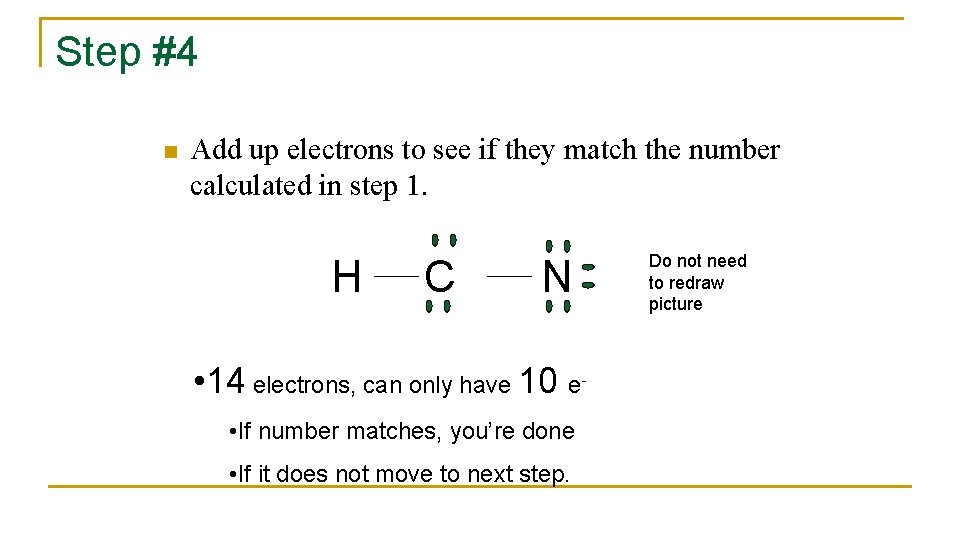
Step #4 n Add up electrons to see if they match the number calculated in step 1. H C N • 14 electrons, can only have 10 e • If number matches, you’re done • If it does not move to next step. Do not need to redraw picture
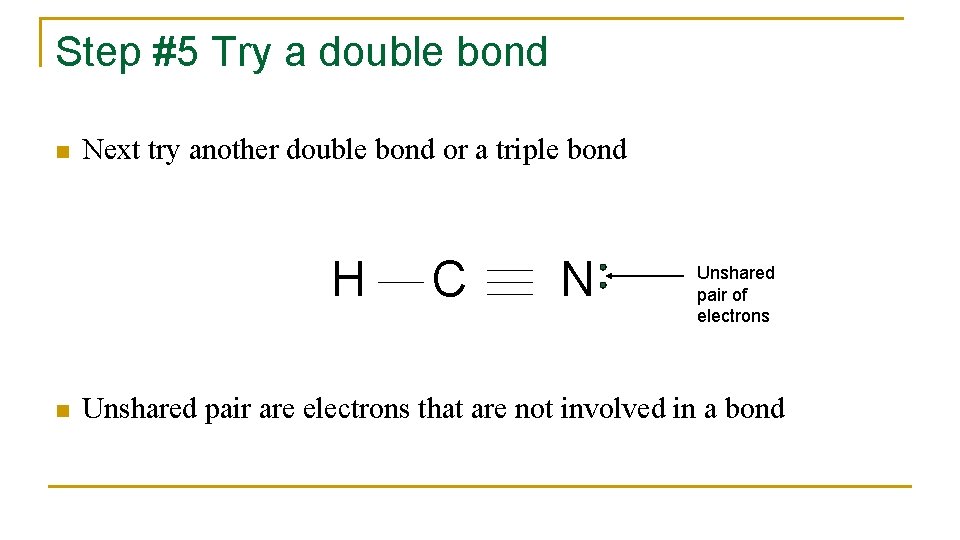
Step #5 Try a double bond n Next try another double bond or a triple bond H n C N Unshared pair of electrons Unshared pair are electrons that are not involved in a bond
HONC rule n HONC is a way to remember how many bonds each type of atoms usually needs based on valence electrons q q n Hydrogen and Halogens– 1 bond Oxygen’s group -2 bonds Nitrogen’s group -3 bonds Carbon’s group - 4 bonds Try CO 2 on your own.
Lewis Structures n n n Draw Lewis structures for the following: H 2 O As. H 3 CCl 2 H 2 NO 2 -
Essential Questions n n n What is a covalent bond? How can you tell if two elements can form a covalent bond? How does a covalent bond fulfill the octet rule? What is a molecule? What are the properties of molecular compounds? How are Lewis Structures drawn?
4. 3 Tracked Assignment n Worksheet
- Slides: 18