
4 2 Pyruvate Oxidation and the Citric Acid
- Slides: 9
4. 2 – Pyruvate Oxidation and the Citric Acid Cycle
Learning Goals • Determine how Pyruvate oxidation works • Understand how Acetyl-Co. A is used in the Citric Acid Cycle • Understand the steps involved in the citric acid cycle • Textbook reading pg. 100 -103
What to do with Pyruvate? • The 2 molecules of Pyruvate that are synthesized by Glycolysis still contain about 75% of the energy stored in Glucose • Pyruvate oxidation and the Citric Acid Cycle help to harvest the remaining available energy
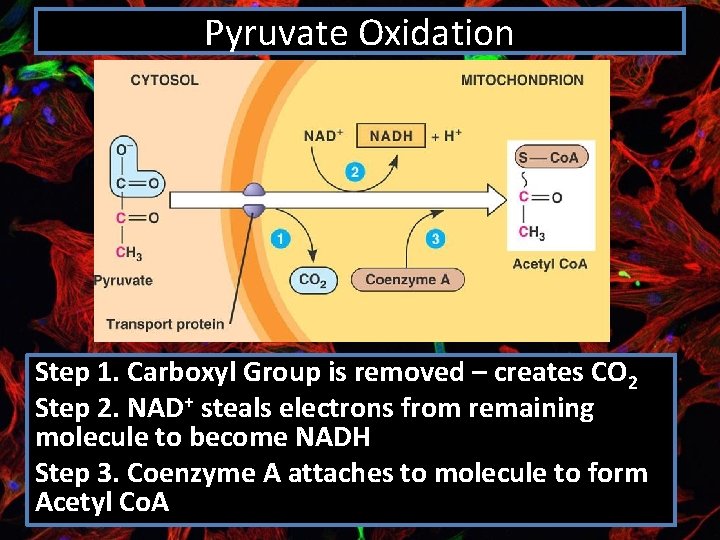
Pyruvate Oxidation Step 1. Carboxyl Group is removed – creates CO 2 Step 2. NAD+ steals electrons from remaining molecule to become NADH Step 3. Coenzyme A attaches to molecule to form Acetyl Co. A
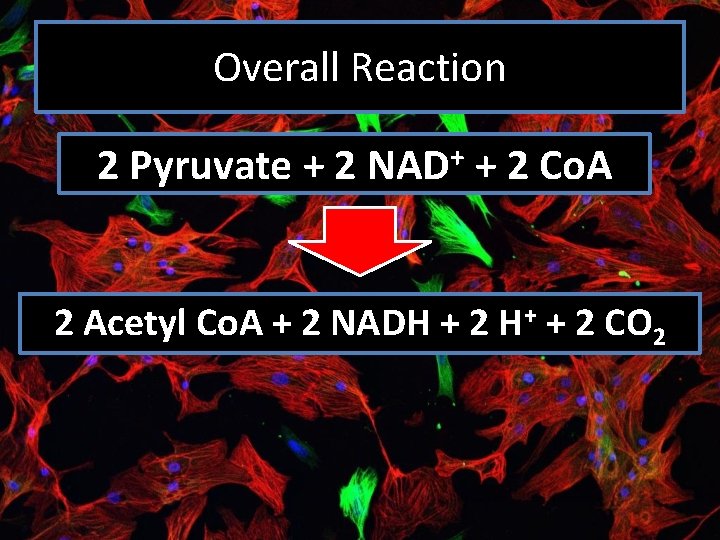
Overall Reaction 2 Pyruvate + 2 NAD+ + 2 Co. A 2 Acetyl Co. A + 2 NADH + 2 H+ + 2 CO 2
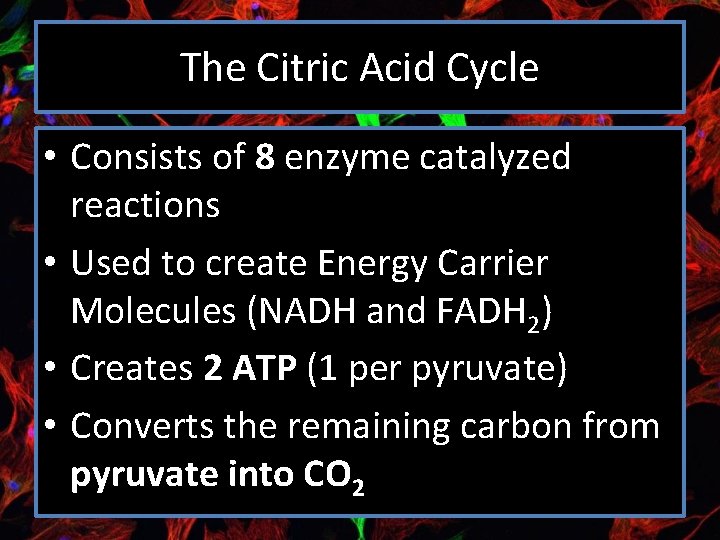
The Citric Acid Cycle • Consists of 8 enzyme catalyzed reactions • Used to create Energy Carrier Molecules (NADH and FADH 2) • Creates 2 ATP (1 per pyruvate) • Converts the remaining carbon from pyruvate into CO 2
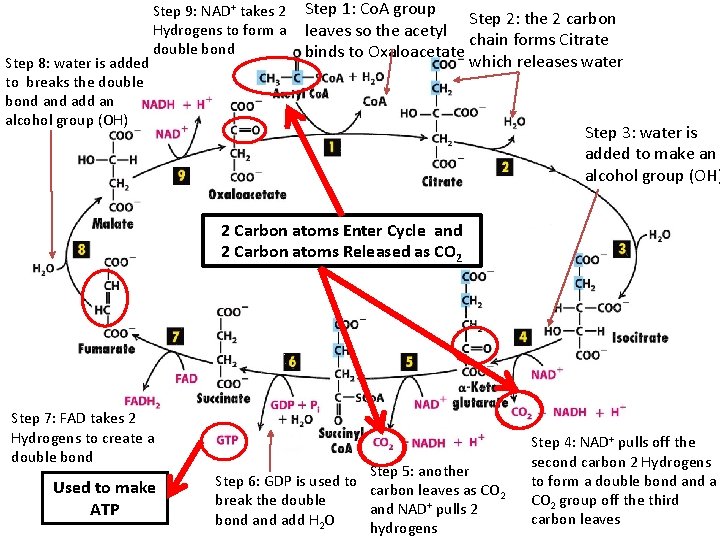
Step 8: water is added to breaks the double bond add an alcohol group (OH) Step 9: NAD+ takes 2 Hydrogens to form a double bond Step 1: Co. A group Step 2: the 2 carbon leaves so the acetyl chain forms Citrate binds to Oxaloacetate which releases water Step 3: water is added to make an alcohol group (OH) 2 Carbon atoms Enter Cycle and 2 Carbon atoms Released as CO 2 Step 7: FAD takes 2 Hydrogens to create a double bond Used to make ATP Step 5: another Step 6: GDP is used to carbon leaves as CO 2 break the double and NAD+ pulls 2 bond add H 2 O hydrogens Step 4: NAD+ pulls off the second carbon 2 Hydrogens to form a double bond a CO 2 group off the third carbon leaves
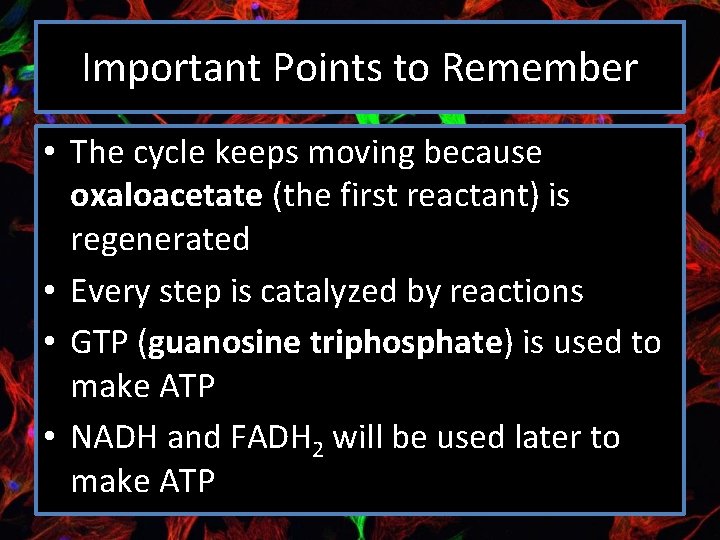
Important Points to Remember • The cycle keeps moving because oxaloacetate (the first reactant) is regenerated • Every step is catalyzed by reactions • GTP (guanosine triphosphate) is used to make ATP • NADH and FADH 2 will be used later to make ATP
Krebs Cycle Animation http: //highered. mheducation. com/sites/0072507470/student_vi ew 0/chapter 25/animation__how_the_krebs_cycle_works__quiz _1_. html