
4 2 Meiosis 1 Submit your karyotype activity
4. 2 Meiosis 1. Submit your karyotype activity sheet. 2. Feedback distributer: Sabrina
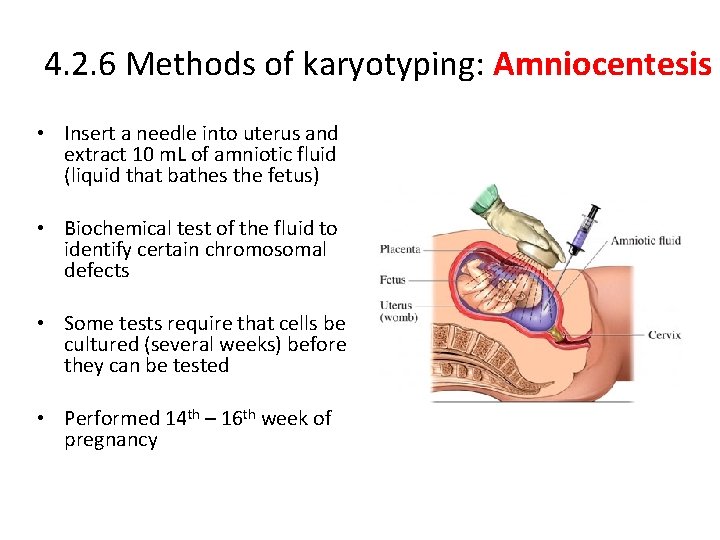
4. 2. 6 Methods of karyotyping: Amniocentesis • Insert a needle into uterus and extract 10 m. L of amniotic fluid (liquid that bathes the fetus) • Biochemical test of the fluid to identify certain chromosomal defects • Some tests require that cells be cultured (several weeks) before they can be tested • Performed 14 th – 16 th week of pregnancy
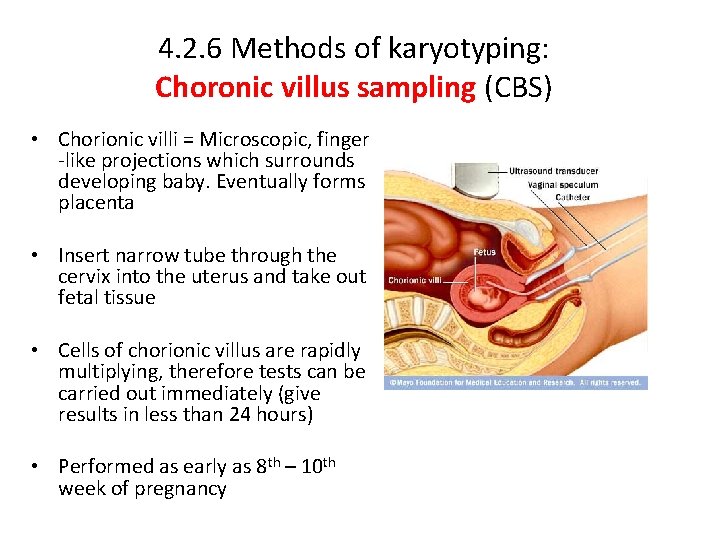
4. 2. 6 Methods of karyotyping: Choronic villus sampling (CBS) • Chorionic villi = Microscopic, finger -like projections which surrounds developing baby. Eventually forms placenta • Insert narrow tube through the cervix into the uterus and take out fetal tissue • Cells of chorionic villus are rapidly multiplying, therefore tests can be carried out immediately (give results in less than 24 hours) • Performed as early as 8 th – 10 th week of pregnancy
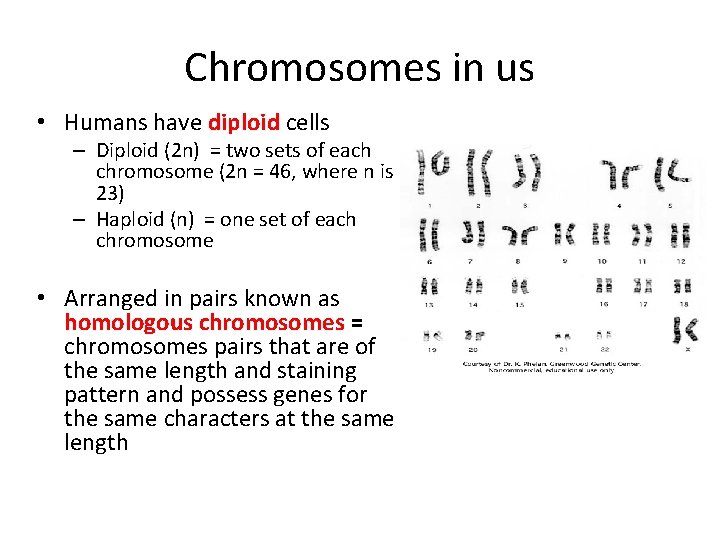
Chromosomes in us • Humans have diploid cells – Diploid (2 n) = two sets of each chromosome (2 n = 46, where n is 23) – Haploid (n) = one set of each chromosome • Arranged in pairs known as homologous chromosomes = chromosomes pairs that are of the same length and staining pattern and possess genes for the same characters at the same length
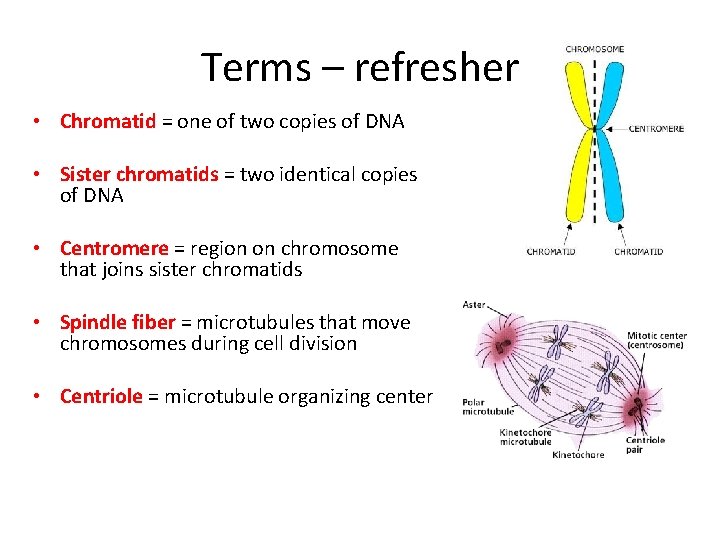
Terms – refresher • Chromatid = one of two copies of DNA • Sister chromatids = two identical copies of DNA • Centromere = region on chromosome that joins sister chromatids • Spindle fiber = microtubules that move chromosomes during cell division • Centriole = microtubule organizing center
The paradox Human beings have 46 chromosomes in each cell. Your mom has 46 chromosomes in each cell. Your dad has 46 chromosomes in each cell. But you do not have 92 chromosomes in your cell. WHY?
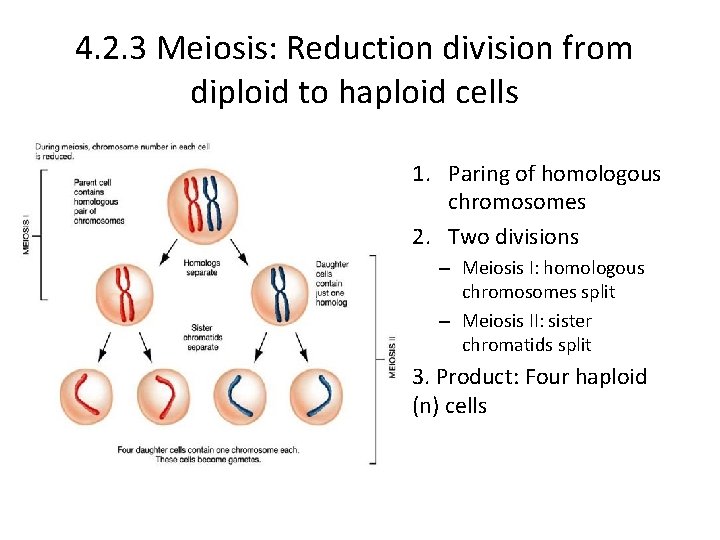
4. 2. 3 Meiosis: Reduction division from diploid to haploid cells 1. Paring of homologous chromosomes 2. Two divisions – Meiosis I: homologous chromosomes split – Meiosis II: sister chromatids split 3. Product: Four haploid (n) cells
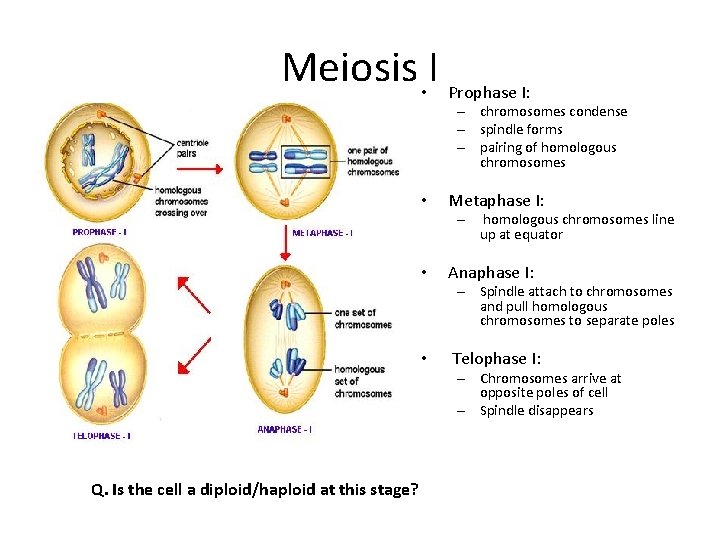
Meiosis • I Prophase I: – chromosomes condense – spindle forms – pairing of homologous chromosomes • Metaphase I: – • homologous chromosomes line up at equator Anaphase I: – Spindle attach to chromosomes and pull homologous chromosomes to separate poles • Telophase I: – Chromosomes arrive at opposite poles of cell – Spindle disappears Q. Is the cell a diploid/haploid at this stage?
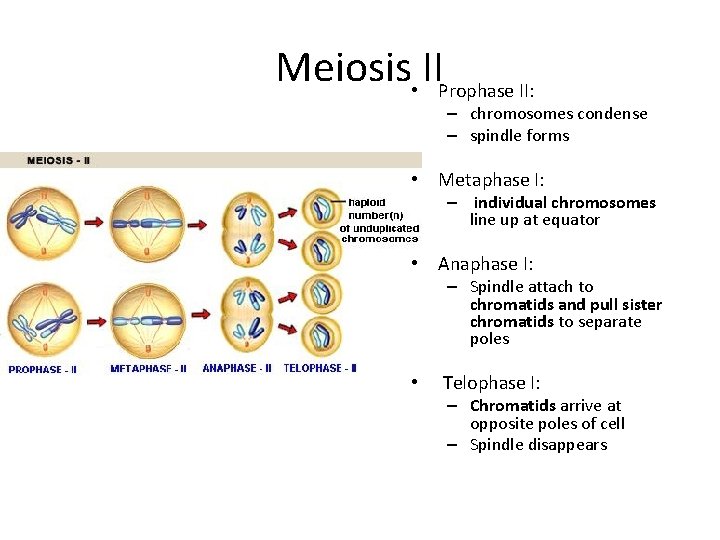
Meiosis • IIProphase II: – chromosomes condense – spindle forms • Metaphase I: – individual chromosomes line up at equator • Anaphase I: – Spindle attach to chromatids and pull sister chromatids to separate poles • Telophase I: – Chromatids arrive at opposite poles of cell – Spindle disappears

Meiosis versus Mitosis
4. 2 Meiosis 1. Feedback distributer: Sabrina
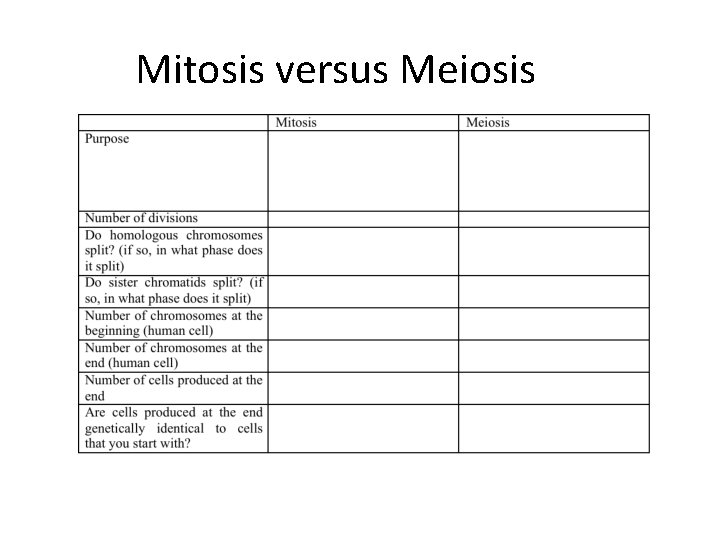
Mitosis versus Meiosis
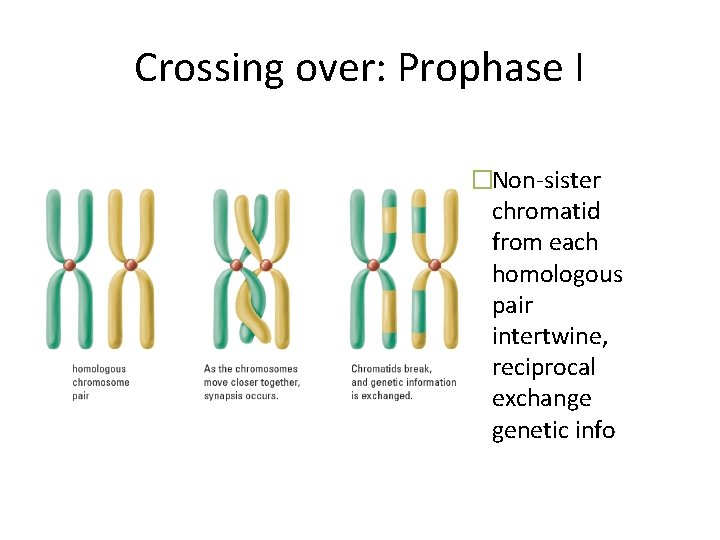
Crossing over: Prophase I �Non-sister chromatid from each homologous pair intertwine, reciprocal exchange genetic info
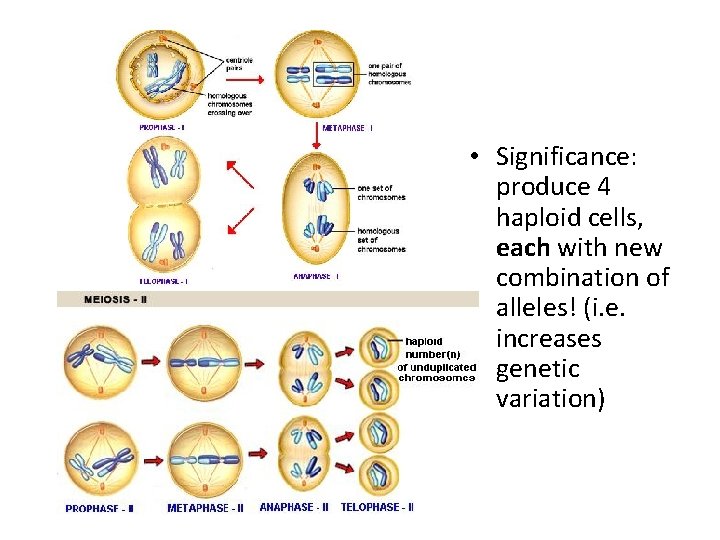
• Significance: produce 4 haploid cells, each with new combination of alleles! (i. e. increases genetic variation)
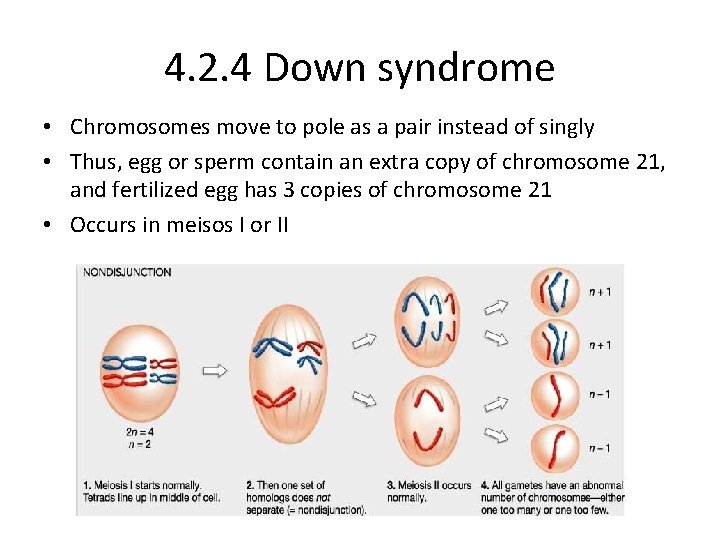
4. 2. 4 Down syndrome • Chromosomes move to pole as a pair instead of singly • Thus, egg or sperm contain an extra copy of chromosome 21, and fertilized egg has 3 copies of chromosome 21 • Occurs in meisos I or II
- Slides: 15