
4 2 kconnected graphs This copyrighted material is

- Slides: 5
4. 2 k-connected graphs This copyrighted material is taken from Introduction to Graph Theory, 2 nd Ed. , by Doug West; and is not for further distribution beyond this course. These slides will be stored in a limited-access location on an IIT server and are not for distribution or use beyond Math 454/553. 1
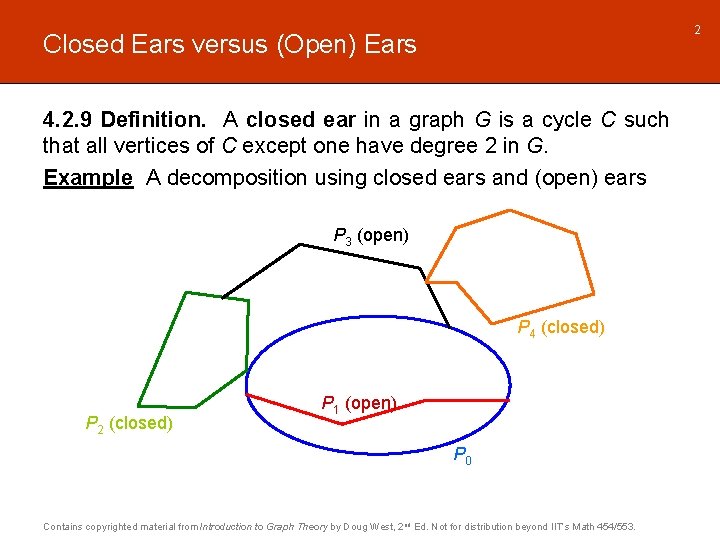
2 Closed Ears versus (Open) Ears 4. 2. 9 Definition. A closed ear in a graph G is a cycle C such that all vertices of C except one have degree 2 in G. Example A decomposition using closed ears and (open) ears P 3 (open) P 4 (closed) P 2 (closed) P 1 (open) P 0 Contains copyrighted material from Introduction to Graph Theory by Doug West, 2 nd Ed. Not for distribution beyond IIT’s Math 454/553.
Closed-Ear Decompositions and 2 -Edge-Connectivity A closed-ear decomposition of a graph G is a decomposition P 0, P 1, …, Pi, …, Pk such that P 0 is a cycle and Pi for i > 0 is either an (open) ear or a closed ear in the union of P 0, P 1, …, Pi. 4. 2. 10 Theorem. A graph is 2 -connected iff it has a closed-ear decomposition, and every cycle in a 2 -edge-connected graph is the initial cycle in some such decomposition. The proof of Theorem 4. 2. 10 is quite similar to that of Theorem 4. 2. 8 (with 2 -connected iff ear decomposition). See p 164. (=>) Show 2 -edge-connectectedness is maintained on addition of each Pi. (<=) Find a cycle P 0 in G. Iteratively find add ears Pi containing an edge with one endpoint in the graph so far. Contains copyrighted material from Introduction to Graph Theory by Doug West, 2 nd Ed. Not for distribution beyond IIT’s Math 454/553. 3
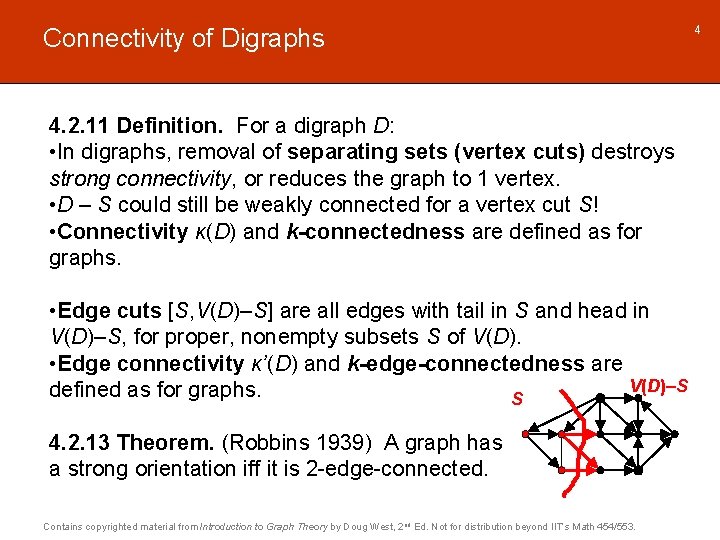
Connectivity of Digraphs 4. 2. 11 Definition. For a digraph D: • In digraphs, removal of separating sets (vertex cuts) destroys strong connectivity, or reduces the graph to 1 vertex. • D – S could still be weakly connected for a vertex cut S! • Connectivity κ(D) and k-connectedness are defined as for graphs. • Edge cuts [S, V(D)–S] are all edges with tail in S and head in V(D)–S, for proper, nonempty subsets S of V(D). • Edge connectivity κ’(D) and k-edge-connectedness are V(D)–S defined as for graphs. S 4. 2. 13 Theorem. (Robbins 1939) A graph has a strong orientation iff it is 2 -edge-connected. Contains copyrighted material from Introduction to Graph Theory by Doug West, 2 nd Ed. Not for distribution beyond IIT’s Math 454/553. 4
Local connectivity and Menger’s Theorem Local connectivity considers the number of alternative paths between a pair of vertices x, y, and the minimum size structure needed to be deleted to disconnect x from y. Global connectivity considers the minimum number of alternative paths between any pair of vertices, and the minimum size structure needed to be deleted to disconnect the graph. We have seen that (for n(G) ¸ 3) 2 -connectedness is equivalent to there existing 2 internally disjoint paths between any pair of vertices. We want to extend this idea: Locally: compare alternative x, y-paths versus minimum x, y-cuts Globally: find vertex pairs optimizing the local values Contains copyrighted material from Introduction to Graph Theory by Doug West, 2 nd Ed. Not for distribution beyond IIT’s Math 454/553. 5