
4 2 Inspection of the Internal Control System
- Slides: 19
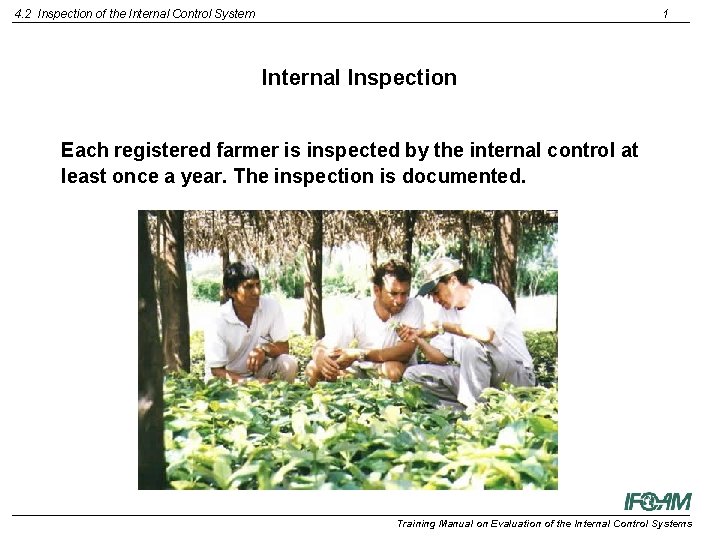
4. 2 Inspection of the Internal Control System 1 Internal Inspection Each registered farmer is inspected by the internal control at least once a year. The inspection is documented. Training Manual on Evaluation of the Internal Control Systems
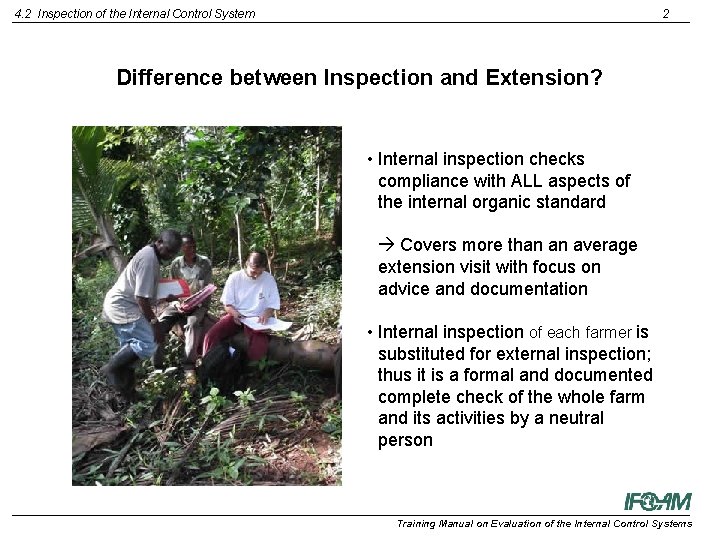
4. 2 Inspection of the Internal Control System 2 Difference between Inspection and Extension? • Internal inspection checks compliance with ALL aspects of the internal organic standard Covers more than an average extension visit with focus on advice and documentation • Internal inspection of each farmer is substituted for external inspection; thus it is a formal and documented complete check of the whole farm and its activities by a neutral person Training Manual on Evaluation of the Internal Control Systems
4. 2 Inspection of the Internal Control System 3 100% Internal Inspection 5. 5. 1: 100% of all growers are inspected annually by the ICS • I. e. , ALL registered farmers: active farmers, conversion farmers, new farmers, passive farmers (remain in the organic program but no purchase planned for respective year) • In case of annual crops (time from planting to harvest is less than 8 months) there has to be one inspection per growing season (if many short seasons twice/yr sufficient) • If the internal inspections are not yet finalized at the time of inspection, will the ICS be able to finalize 100% inspection in time? will need to submit proof on 100% inspection • Check farmers list (should contain inspection details) • Ask ICS Coordinator for current overview of inspections • Understand how the system ensures 100% inspection Training Manual on Evaluation of the Internal Control Systems
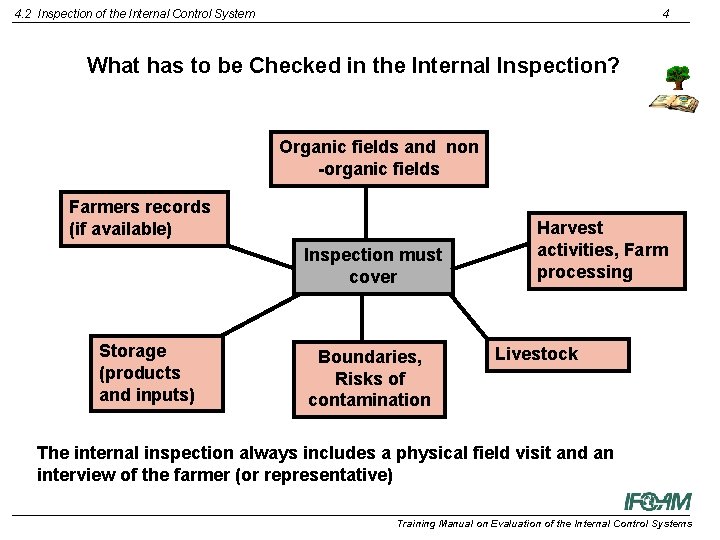
4. 2 Inspection of the Internal Control System 4 What has to be Checked in the Internal Inspection? Organic fields and non -organic fields Farmers records (if available) Inspection must cover Storage (products and inputs) Boundaries, Risks of contamination Harvest activities, Farm processing Livestock The internal inspection always includes a physical field visit and an interview of the farmer (or representative) Training Manual on Evaluation of the Internal Control Systems
4. 2 Inspection of the Internal Control System 5 Critical Control Points of Internal Inspections Have all crops that grow on the organic fields been checked? • e. g. , intercropping conventional cardamom in the organic pepper plot • is production of all crops on the organic plot(s) checked? • incl. seeds of intercrops in organic fields Are all fields that are managed by the farmer registered? • • • no parallel production overall activities of farmer must be known be aware of inputs for conventional fields (where stored? ? ? ) important to know for various private organic standards registration is the very minimum, and usually a spot check of conventional fields is required (if they are close, they shall be checked) Training Manual on Evaluation of the Internal Control Systems
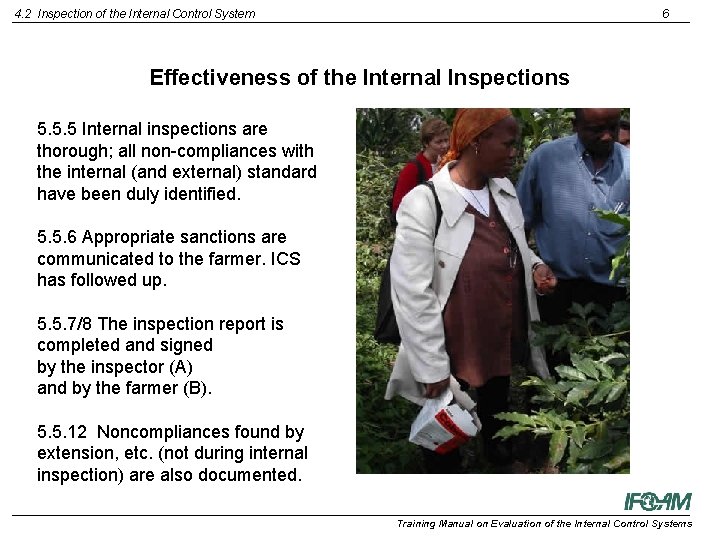
4. 2 Inspection of the Internal Control System 6 Effectiveness of the Internal Inspections 5. 5. 5 Internal inspections are thorough; all non-compliances with the internal (and external) standard have been duly identified. 5. 5. 6 Appropriate sanctions are communicated to the farmer. ICS has followed up. 5. 5. 7/8 The inspection report is completed and signed by the inspector (A) and by the farmer (B). 5. 5. 12 Noncompliances found by extension, etc. (not during internal inspection) are also documented. Training Manual on Evaluation of the Internal Control Systems
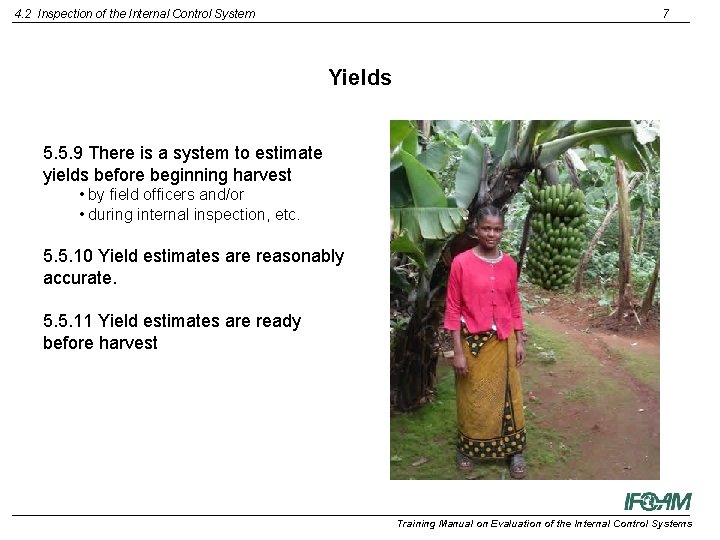
4. 2 Inspection of the Internal Control System 7 Yields 5. 5. 9 There is a system to estimate yields before beginning harvest • by field officers and/or • during internal inspection, etc. 5. 5. 10 Yield estimates are reasonably accurate. 5. 5. 11 Yield estimates are ready before harvest Training Manual on Evaluation of the Internal Control Systems
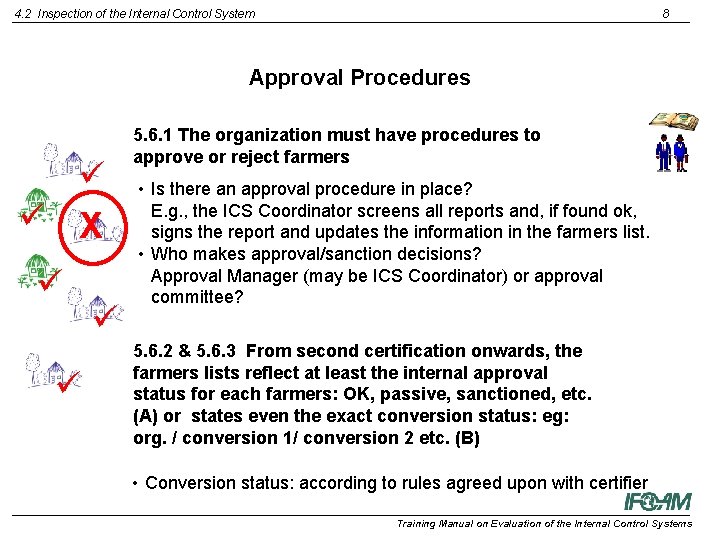
4. 2 Inspection of the Internal Control System 8 Approval Procedures X 5. 6. 1 The organization must have procedures to approve or reject farmers • Is there an approval procedure in place? E. g. , the ICS Coordinator screens all reports and, if found ok, signs the report and updates the information in the farmers list. • Who makes approval/sanction decisions? Approval Manager (may be ICS Coordinator) or approval committee? 5. 6. 2 & 5. 6. 3 From second certification onwards, the farmers lists reflect at least the internal approval status for each farmers: OK, passive, sanctioned, etc. (A) or states even the exact conversion status: eg: org. / conversion 1/ conversion 2 etc. (B) • Conversion status: according to rules agreed upon with certifier Training Manual on Evaluation of the Internal Control Systems
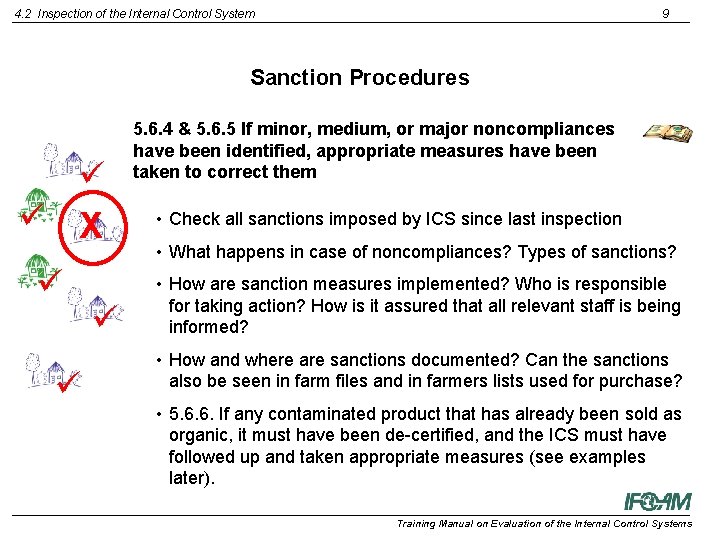
4. 2 Inspection of the Internal Control System 9 Sanction Procedures X 5. 6. 4 & 5. 6. 5 If minor, medium, or major noncompliances have been identified, appropriate measures have been taken to correct them • Check all sanctions imposed by ICS since last inspection • What happens in case of noncompliances? Types of sanctions? • How are sanction measures implemented? Who is responsible for taking action? How is it assured that all relevant staff is being informed? • How and where are sanctions documented? Can the sanctions also be seen in farm files and in farmers lists used for purchase? • 5. 6. 6. If any contaminated product that has already been sold as organic, it must have been de-certified, and the ICS must have followed up and taken appropriate measures (see examples later). Training Manual on Evaluation of the Internal Control Systems
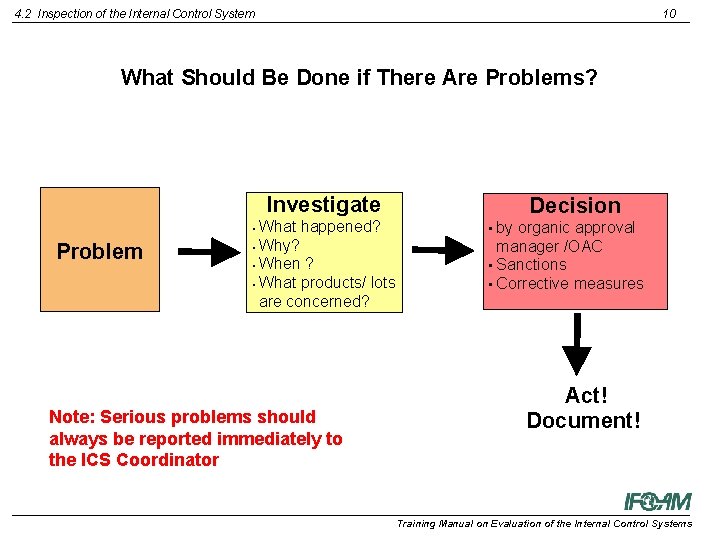
4. 2 Inspection of the Internal Control System 10 What Should Be Done if There Are Problems? Investigate What happened? • Why? • When ? • What products/ lots are concerned? • Problem Note: Serious problems should always be reported immediately to the ICS Coordinator Decision by organic approval manager /OAC • Sanctions • Corrective measures • Act! Document! Training Manual on Evaluation of the Internal Control Systems
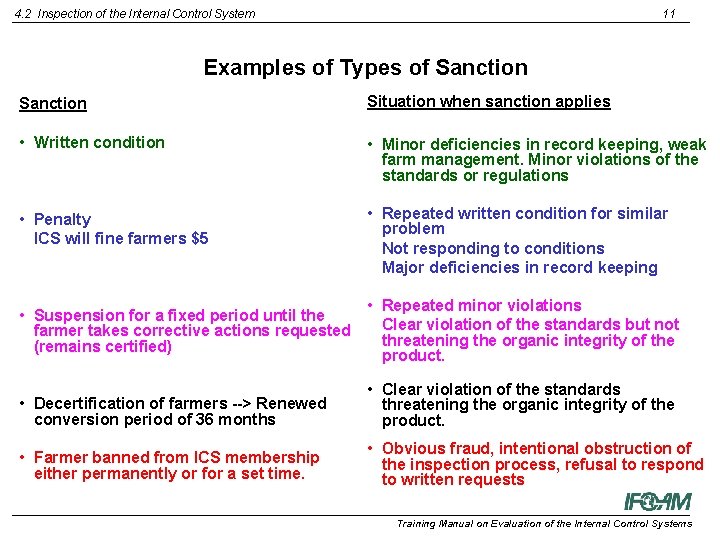
4. 2 Inspection of the Internal Control System 11 Examples of Types of Sanction Situation when sanction applies • Written condition • Minor deficiencies in record keeping, weak farm management. Minor violations of the standards or regulations • Penalty ICS will fine farmers $5 • Repeated written condition for similar problem Not responding to conditions Major deficiencies in record keeping • Suspension for a fixed period until the farmer takes corrective actions requested (remains certified) • Repeated minor violations Clear violation of the standards but not threatening the organic integrity of the product. • Decertification of farmers --> Renewed conversion period of 36 months • Clear violation of the standards threatening the organic integrity of the product. • Farmer banned from ICS membership either permanently or for a set time. • Obvious fraud, intentional obstruction of the inspection process, refusal to respond to written requests Training Manual on Evaluation of the Internal Control Systems
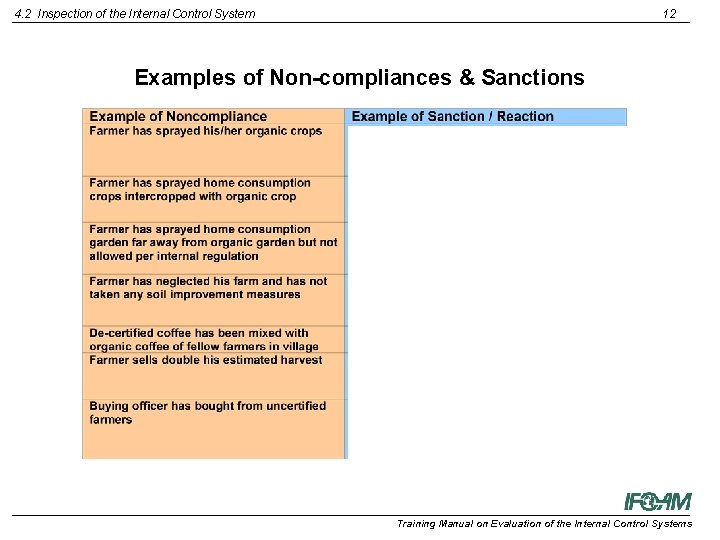
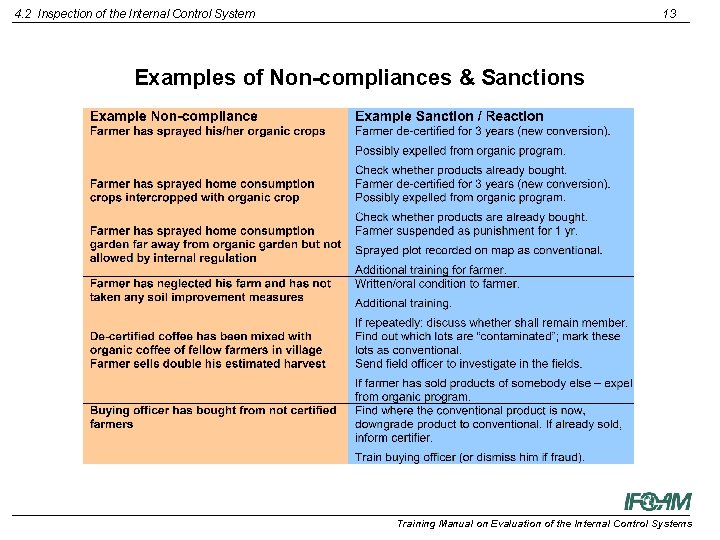
4. 2 Inspection of the Internal Control System 12 Examples of Non-compliances & Sanctions Training Manual on Evaluation of the Internal Control Systems
4. 2 Inspection of the Internal Control System 13 Examples of Non-compliances & Sanctions Training Manual on Evaluation of the Internal Control Systems
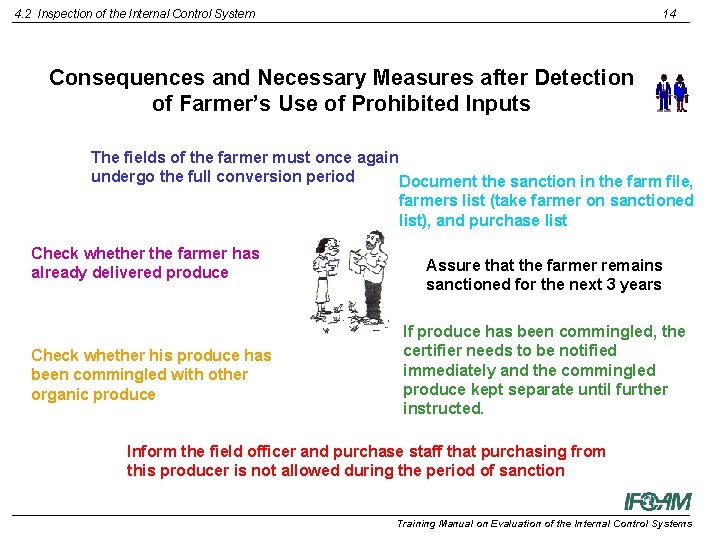
4. 2 Inspection of the Internal Control System 14 Consequences and Necessary Measures after Detection of Farmer’s Use of Prohibited Inputs The fields of the farmer must once again undergo the full conversion period Document the sanction in the farm file, farmers list (take farmer on sanctioned list), and purchase list Check whether the farmer has already delivered produce Check whether his produce has been commingled with other organic produce Assure that the farmer remains sanctioned for the next 3 years If produce has been commingled, the certifier needs to be notified immediately and the commingled produce kept separate until further instructed. Inform the field officer and purchase staff that purchasing from this producer is not allowed during the period of sanction Training Manual on Evaluation of the Internal Control Systems
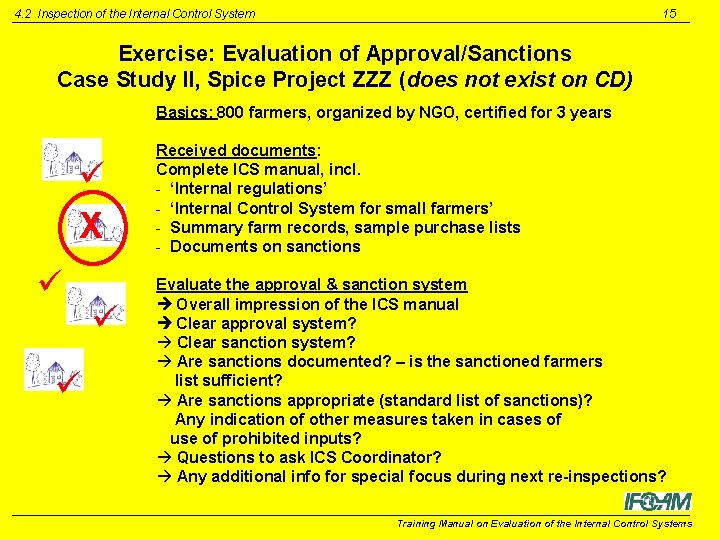
4. 2 Inspection of the Internal Control System 15 Exercise: Evaluation of Approval/Sanctions Case Study II, Spice Project ZZZ (does not exist on CD) Basics: 800 farmers, organized by NGO, certified for 3 years X Received documents: Complete ICS manual, incl. - ‘Internal regulations’ - ‘Internal Control System for small farmers’ - Summary farm records, sample purchase lists - Documents on sanctions Evaluate the approval & sanction system Overall impression of the ICS manual Clear approval system? Clear sanction system? Are sanctions documented? – is the sanctioned farmers list sufficient? Are sanctions appropriate (standard list of sanctions)? Any indication of other measures taken in cases of use of prohibited inputs? Questions to ask ICS Coordinator? Any additional info for special focus during next re-inspections? Training Manual on Evaluation of the Internal Control Systems
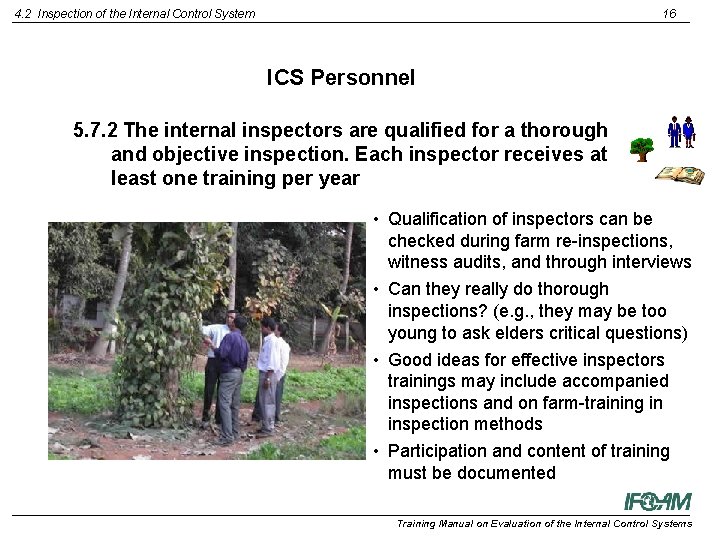
4. 2 Inspection of the Internal Control System 16 ICS Personnel 5. 7. 2 The internal inspectors are qualified for a thorough and objective inspection. Each inspector receives at least one training per year • Qualification of inspectors can be checked during farm re-inspections, witness audits, and through interviews • Can they really do thorough inspections? (e. g. , they may be too young to ask elders critical questions) • Good ideas for effective inspectors trainings may include accompanied inspections and on farm-training in inspection methods • Participation and content of training must be documented Training Manual on Evaluation of the Internal Control Systems
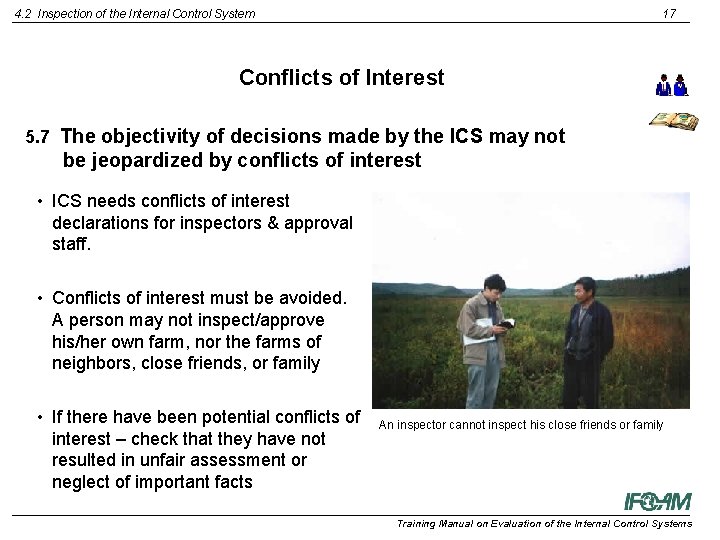
4. 2 Inspection of the Internal Control System 17 Conflicts of Interest 5. 7 The objectivity of decisions made by the ICS may not be jeopardized by conflicts of interest • ICS needs conflicts of interest declarations for inspectors & approval staff. • Conflicts of interest must be avoided. A person may not inspect/approve his/her own farm, nor the farms of neighbors, close friends, or family • If there have been potential conflicts of interest – check that they have not resulted in unfair assessment or neglect of important facts An inspector cannot inspect his close friends or family Training Manual on Evaluation of the Internal Control Systems
4. 2 Inspection of the Internal Control System 18 Inspection vs. Field Advice • Field extension service (farm advice) is an important aspect of an organic project and often field extensionists are at the same time internal inspectors. • However, field extensionists tend to be very close to the farmers; they often live in the same village and therefore are often not “neutral” enough for the actual inspection. • Many ICS Operators solve this problem by exchanging field officers (advisors) among project regions for internal inspections. • However, in certain cases it can also be accepted that one person does both the field extension and the internal inspection, but, at minimum, they should be clearly separate events. This is only possible if the advisor is “distant” enough from farmers to ensure an impartial inspection. • Informing the farmers of the standard requirements and the functioning is not considered consultancy. An internal inspection may also include some advice. Training Manual on Evaluation of the Internal Control Systems
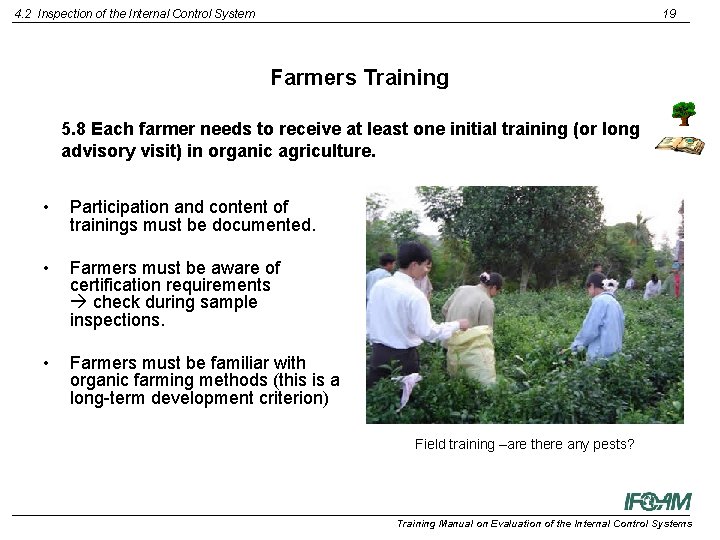
4. 2 Inspection of the Internal Control System 19 Farmers Training 5. 8 Each farmer needs to receive at least one initial training (or long advisory visit) in organic agriculture. • Participation and content of trainings must be documented. • Farmers must be aware of certification requirements check during sample inspections. • Farmers must be familiar with organic farming methods (this is a long-term development criterion) Field training –are there any pests? Training Manual on Evaluation of the Internal Control Systems