
4 1 The Power Rule Theorem The Power
![Differential Notation means “the derivative with respect to x. ” [f (x)] is the](https://slidetodoc.com/presentation_image_h2/5345d8d1c596d51b15f26991f472d88e/image-2.jpg "Differential Notation means “the derivative with respect to x. ” [f (x)] is the")
![The Rules for Sums and Constant Multiples [f (x) ± g(x)] = f (x)](https://slidetodoc.com/presentation_image_h2/5345d8d1c596d51b15f26991f472d88e/image-3.jpg "The Rules for Sums and Constant Multiples [f (x) ± g(x)] = f (x)")
![4. 5 Derivatives of Exponential Functions Derivative of ex Derivative of bx d [eu]](https://slidetodoc.com/presentation_image_h2/5345d8d1c596d51b15f26991f472d88e/image-19.jpg "4. 5 Derivatives of Exponential Functions Derivative of ex Derivative of bx d [eu]")
- Slides: 20
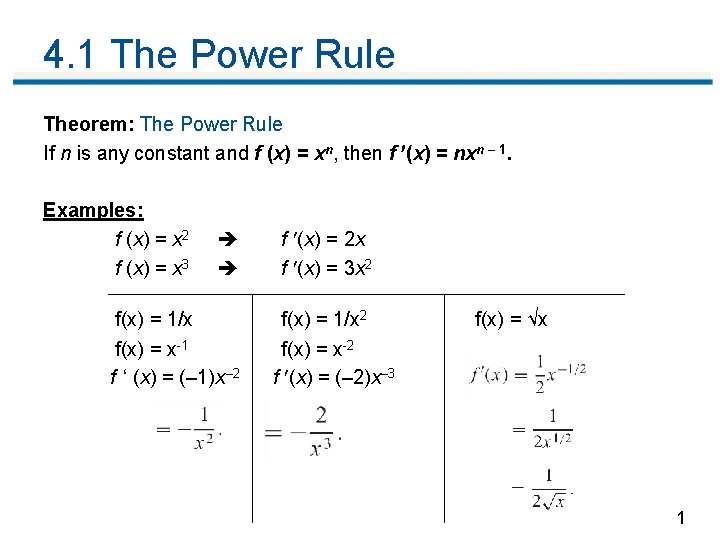
4. 1 The Power Rule Theorem: The Power Rule If n is any constant and f (x) = xn, then f (x) = nxn – 1. Examples: f (x) = x 2 f (x) = x 3 f(x) = 1/x f(x) = x-1 f ‘ (x) = (– 1)x – 2 f (x) = 2 x f (x) = 3 x 2 f(x) = 1/x 2 f(x) = x-2 f (x) = (– 2)x– 3 f(x) = √x 1
Differential Notation means “the derivative with respect to x. ” [f (x)] is the same as f (x), the derivative of f (x) with respect to x. If y is a function of x, then the derivative of y with respect to x is (y) or (x 3) = 3 x 2 2
The Rules for Sums and Constant Multiples [f (x) ± g(x)] = f (x) ± g (x) [cf (x)] = cf (x). Sum Rule Constant Multiple Rule Differentiable Notation Example: Try these: Find f ‘ (x) #1 f (x) = 3 x 2 + 2 x – 4 #2 3
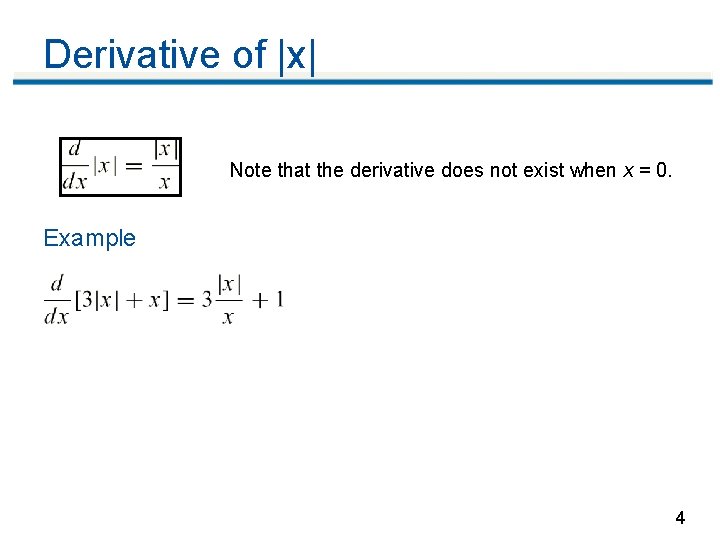
Derivative of |x| Note that the derivative does not exist when x = 0. Example 4
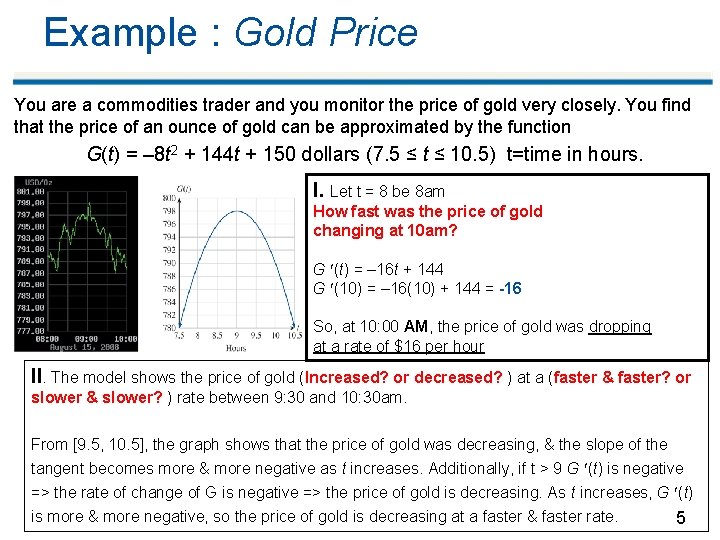
Example : Gold Price You are a commodities trader and you monitor the price of gold very closely. You find that the price of an ounce of gold can be approximated by the function G(t) = – 8 t 2 + 144 t + 150 dollars (7. 5 ≤ t ≤ 10. 5) t=time in hours. I. Let t = 8 be 8 am How fast was the price of gold changing at 10 am? G (t) = – 16 t + 144 G (10) = – 16(10) + 144 = -16 So, at 10: 00 AM, the price of gold was dropping at a rate of $16 per hour II. The model shows the price of gold (Increased? or decreased? ) at a (faster & faster? or slower & slower? ) rate between 9: 30 and 10: 30 am. From [9. 5, 10. 5], the graph shows that the price of gold was decreasing, & the slope of the tangent becomes more & more negative as t increases. Additionally, if t > 9 G (t) is negative => the rate of change of G is negative => the price of gold is decreasing. As t increases, G (t) is more & more negative, so the price of gold is decreasing at a faster & faster rate. 5
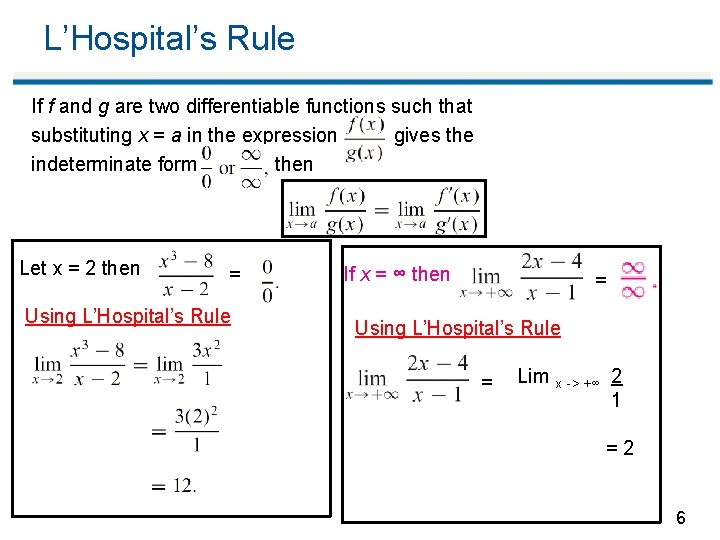
L’Hospital’s Rule If f and g are two differentiable functions such that substituting x = a in the expression gives the indeterminate form then Let x = 2 then = Using L’Hospital’s Rule If x = ∞ then = Using L’Hospital’s Rule = Lim x -> +∞ 2 1 =2 6
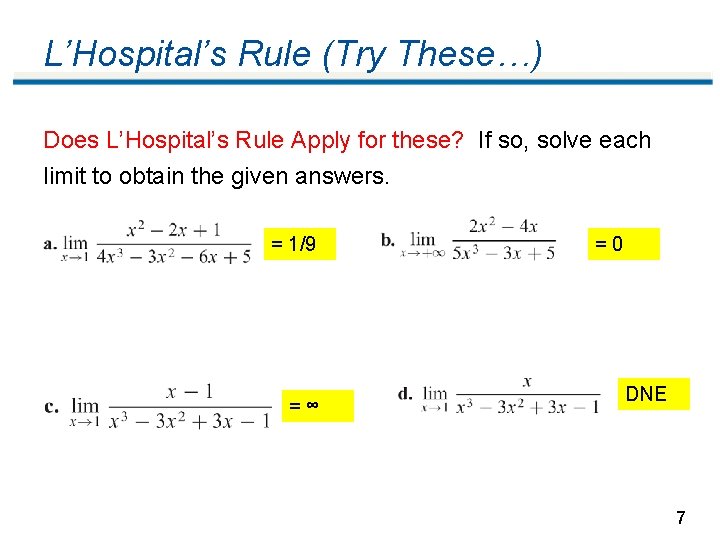
L’Hospital’s Rule (Try These…) Does L’Hospital’s Rule Apply for these? If so, solve each limit to obtain the given answers. = 1/9 =∞ =0 DNE 7
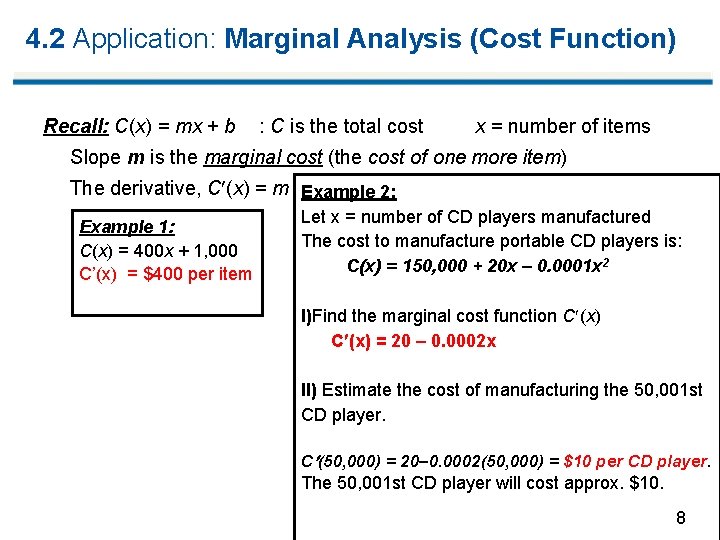
4. 2 Application: Marginal Analysis (Cost Function) Recall: C(x) = mx + b : C is the total cost x = number of items Slope m is the marginal cost (the cost of one more item) The derivative, C (x) = m Example 2: Example 1: C(x) = 400 x + 1, 000 C’(x) = $400 per item Let x = number of CD players manufactured The cost to manufacture portable CD players is: C(x) = 150, 000 + 20 x – 0. 0001 x 2 I)Find the marginal cost function C (x) = 20 – 0. 0002 x II) Estimate the cost of manufacturing the 50, 001 st CD player. C (50, 000) = 20– 0. 0002(50, 000) = $10 per CD player. The 50, 001 st CD player will cost approx. $10. 8
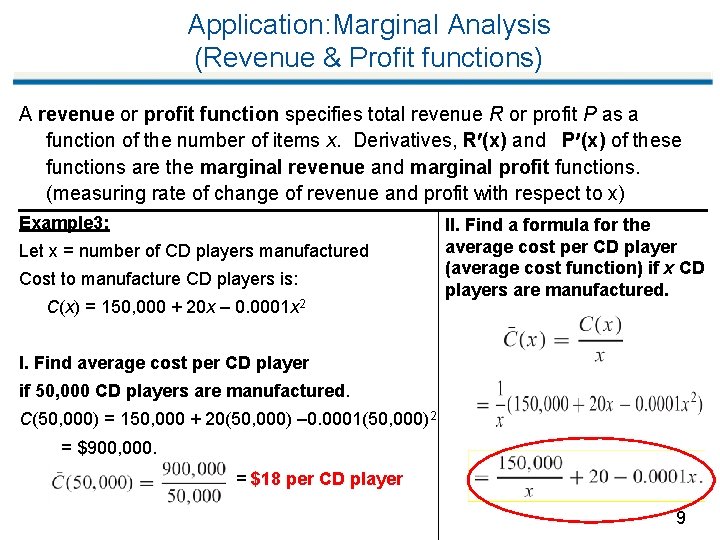
Application: Marginal Analysis (Revenue & Profit functions) A revenue or profit function specifies total revenue R or profit P as a function of the number of items x. Derivatives, R (x) and P (x) of these functions are the marginal revenue and marginal profit functions. (measuring rate of change of revenue and profit with respect to x) Example 3: Let x = number of CD players manufactured Cost to manufacture CD players is: C(x) = 150, 000 + 20 x – 0. 0001 x 2 II. Find a formula for the average cost per CD player (average cost function) if x CD players are manufactured. I. Find average cost per CD player if 50, 000 CD players are manufactured. C(50, 000) = 150, 000 + 20(50, 000) – 0. 0001(50, 000)2 = $900, 000. = $18 per CD player 9
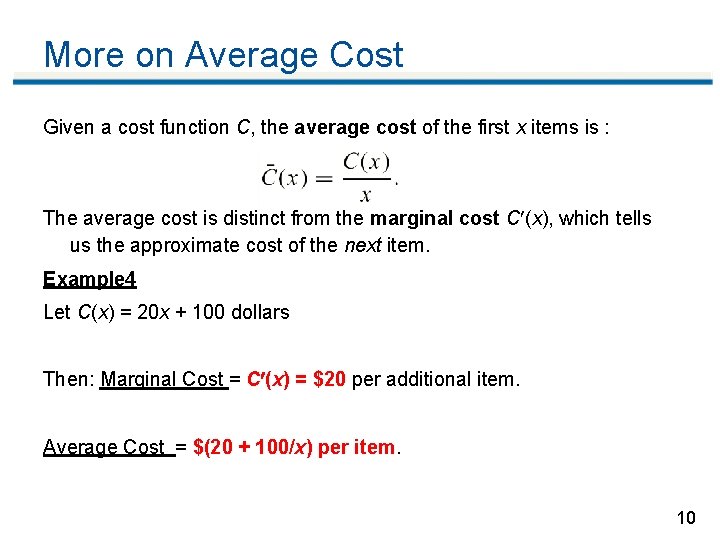
More on Average Cost Given a cost function C, the average cost of the first x items is : The average cost is distinct from the marginal cost C (x), which tells us the approximate cost of the next item. Example 4 Let C(x) = 20 x + 100 dollars Then: Marginal Cost = C (x) = $20 per additional item. Average Cost = $(20 + 100/x) per item. 10
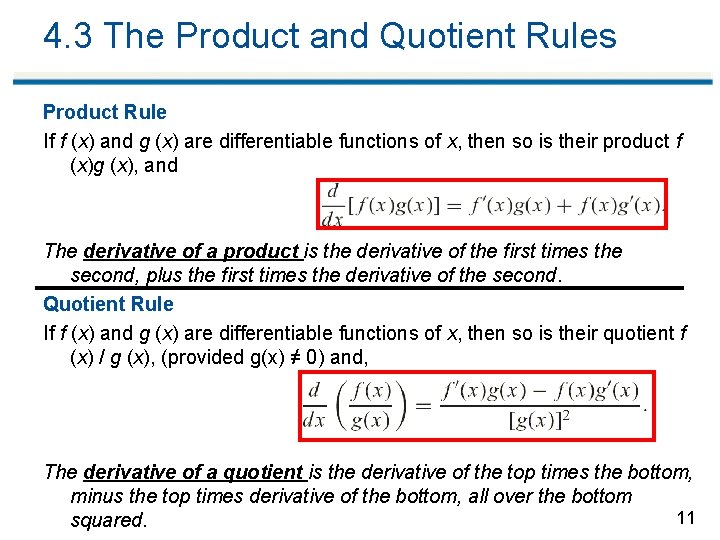
4. 3 The Product and Quotient Rules Product Rule If f (x) and g (x) are differentiable functions of x, then so is their product f (x)g (x), and The derivative of a product is the derivative of the first times the second, plus the first times the derivative of the second. Quotient Rule If f (x) and g (x) are differentiable functions of x, then so is their quotient f (x) / g (x), (provided g(x) ≠ 0) and, The derivative of a quotient is the derivative of the top times the bottom, minus the top times derivative of the bottom, all over the bottom 11 squared.
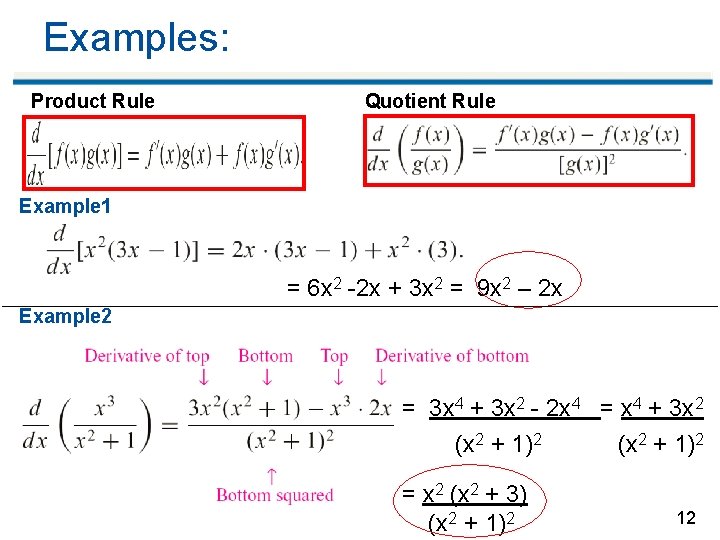
Examples: Product Rule Quotient Rule Example 1 = 6 x 2 -2 x + 3 x 2 = 9 x 2 – 2 x Example 2 = 3 x 4 + 3 x 2 - 2 x 4 = x 4 + 3 x 2 (x 2 + 1)2 = x 2 (x 2 + 3) (x 2 + 1)2 12
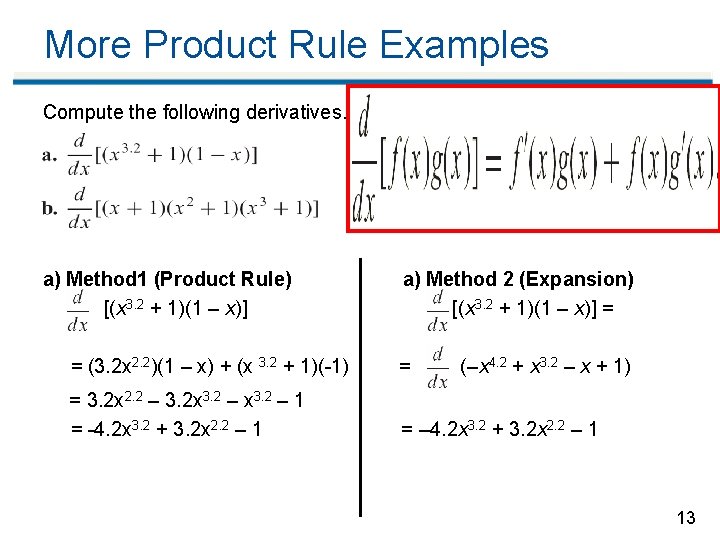
More Product Rule Examples Compute the following derivatives. a) Method 1 (Product Rule) [(x 3. 2 + 1)(1 – x)] a) Method 2 (Expansion) [(x 3. 2 + 1)(1 – x)] = = (3. 2 x 2. 2)(1 – x) + (x 3. 2 + 1)(-1) = (–x 4. 2 + x 3. 2 – x + 1) = 3. 2 x 2. 2 – 3. 2 x 3. 2 – 1 = -4. 2 x 3. 2 + 3. 2 x 2. 2 – 1 = – 4. 2 x 3. 2 + 3. 2 x 2. 2 – 1 13
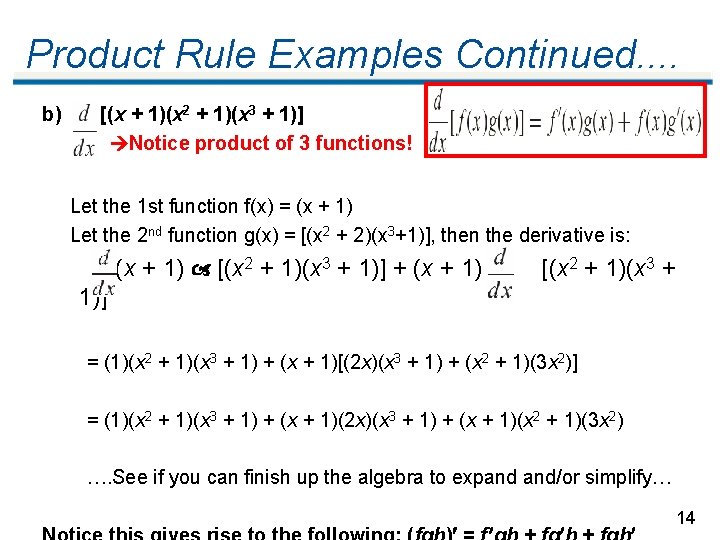
Product Rule Examples Continued. . b) [(x + 1)(x 2 + 1)(x 3 + 1)] Notice product of 3 functions! Let the 1 st function f(x) = (x + 1) Let the 2 nd function g(x) = [(x 2 + 2)(x 3+1)], then the derivative is: (x + 1) [(x 2 + 1)(x 3 + 1)] + (x + 1) [(x 2 + 1)(x 3 + 1)] = (1)(x 2 + 1)(x 3 + 1) + (x + 1)[(2 x)(x 3 + 1) + (x 2 + 1)(3 x 2)] = (1)(x 2 + 1)(x 3 + 1) + (x + 1)(2 x)(x 3 + 1) + (x + 1)(x 2 + 1)(3 x 2) …. See if you can finish up the algebra to expand and/or simplify… 14
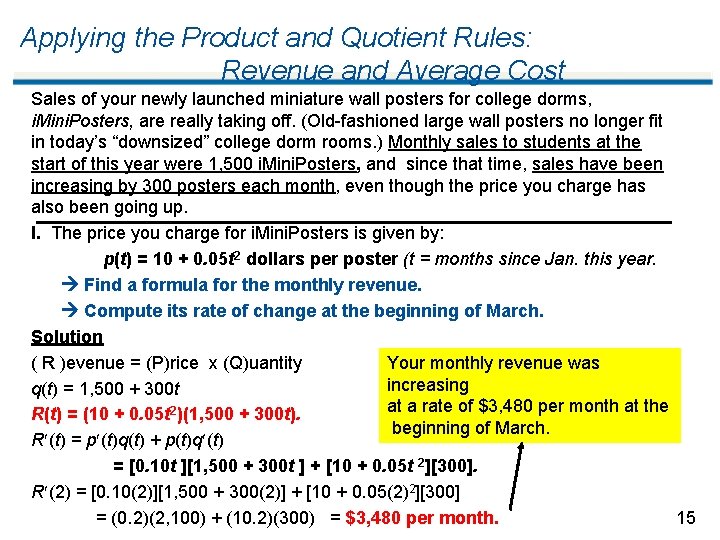
Applying the Product and Quotient Rules: Revenue and Average Cost Sales of your newly launched miniature wall posters for college dorms, i. Mini. Posters, are really taking off. (Old-fashioned large wall posters no longer fit in today’s “downsized” college dorm rooms. ) Monthly sales to students at the start of this year were 1, 500 i. Mini. Posters, and since that time, sales have been increasing by 300 posters each month, even though the price you charge has also been going up. I. The price you charge for i. Mini. Posters is given by: p(t) = 10 + 0. 05 t 2 dollars per poster (t = months since Jan. this year. Find a formula for the monthly revenue. Compute its rate of change at the beginning of March. Solution ( R )evenue = (P)rice x (Q)uantity Your monthly revenue was increasing q(t) = 1, 500 + 300 t at a rate of $3, 480 per month at the R(t) = (10 + 0. 05 t 2)(1, 500 + 300 t). beginning of March. R (t) = p (t)q(t) + p(t)q (t) = [0. 10 t ][1, 500 + 300 t ] + [10 + 0. 05 t 2][300]. R (2) = [0. 10(2)][1, 500 + 300(2)] + [10 + 0. 05(2)2][300] 15 = (0. 2)(2, 100) + (10. 2)(300) = $3, 480 per month.
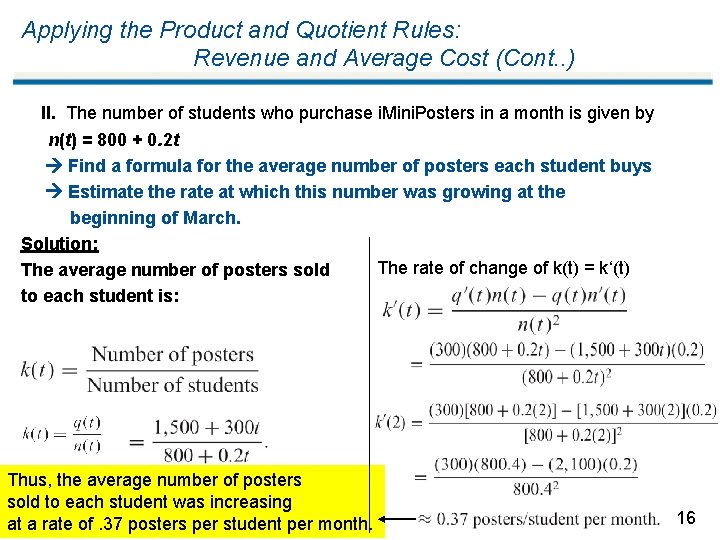
Applying the Product and Quotient Rules: Revenue and Average Cost (Cont. . ) II. The number of students who purchase i. Mini. Posters in a month is given by n(t) = 800 + 0. 2 t Find a formula for the average number of posters each student buys Estimate the rate at which this number was growing at the beginning of March. Solution: The rate of change of k(t) = k‘(t) The average number of posters sold to each student is: Thus, the average number of posters sold to each student was increasing at a rate of. 37 posters per student per month. 16
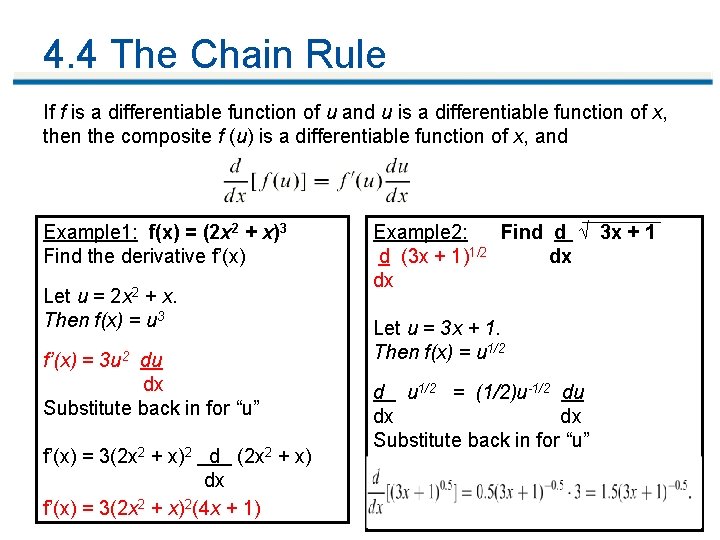
4. 4 The Chain Rule If f is a differentiable function of u and u is a differentiable function of x, then the composite f (u) is a differentiable function of x, and Example 1: f(x) = (2 x 2 + x)3 Find the derivative f’(x) Let u = 2 x 2 + x. Then f(x) = u 3 f’(x) = 3 u 2 du dx Substitute back in for “u” f’(x) = 3(2 x 2 + x)2 d (2 x 2 + x) dx f’(x) = 3(2 x 2 + x)2(4 x + 1) Example 2: Find d √ 3 x + 1 d (3 x + 1)1/2 dx dx Let u = 3 x + 1. Then f(x) = u 1/2 d u 1/2 = (1/2)u-1/2 du dx dx Substitute back in for “u” 17
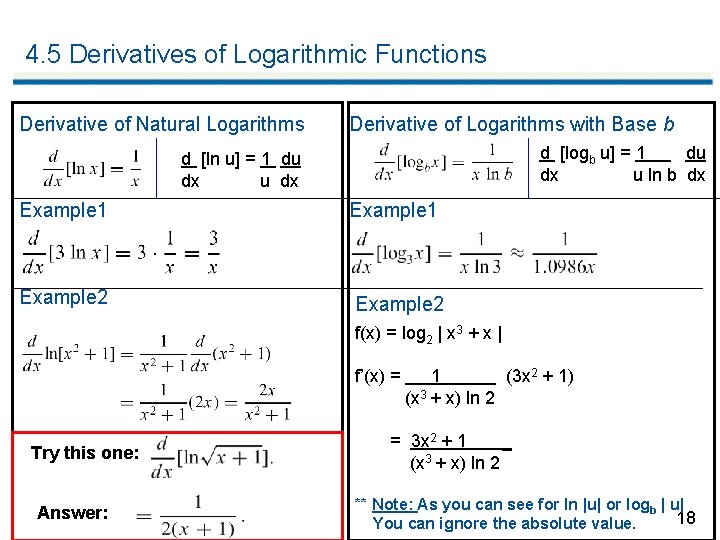
4. 5 Derivatives of Logarithmic Functions Derivative of Natural Logarithms Derivative of Logarithms with Base b d [logb u] = 1 du dx u ln b dx d [ln u] = 1 du dx Example 1 Example 2 f(x) = log 2 | x 3 + x | f’(x) = Try this one: Answer: 1 (3 x 2 + 1) (x 3 + x) ln 2 = 3 x 2 + 1 _ (x 3 + x) ln 2 ** Note: As you can see for ln |u| or logb | u| 18 You can ignore the absolute value.
4. 5 Derivatives of Exponential Functions Derivative of ex Derivative of bx d [eu] = eu du dx dx d [bu] = bu ln b du dx dx Example 1 Example 2 f(x) = 23 x f’(x) = 23 x ln 2 (3) = 3 ln 2 (23 x) 19
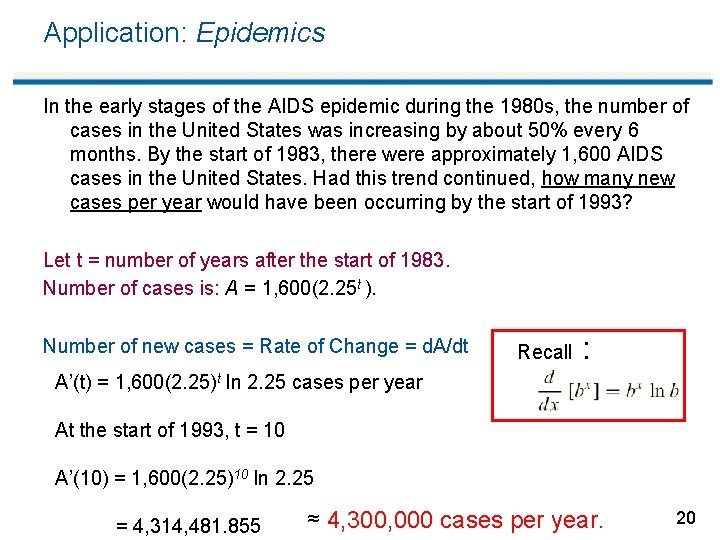
Application: Epidemics In the early stages of the AIDS epidemic during the 1980 s, the number of cases in the United States was increasing by about 50% every 6 months. By the start of 1983, there were approximately 1, 600 AIDS cases in the United States. Had this trend continued, how many new cases per year would have been occurring by the start of 1993? Let t = number of years after the start of 1983. Number of cases is: A = 1, 600(2. 25 t ). Number of new cases = Rate of Change = d. A/dt Recall : A’(t) = 1, 600(2. 25)t ln 2. 25 cases per year At the start of 1993, t = 10 A’(10) = 1, 600(2. 25)10 ln 2. 25 = 4, 314, 481. 855 ≈ 4, 300, 000 cases per year. 20