
4 1 Ratios and Proportions OBJECTIVE You need
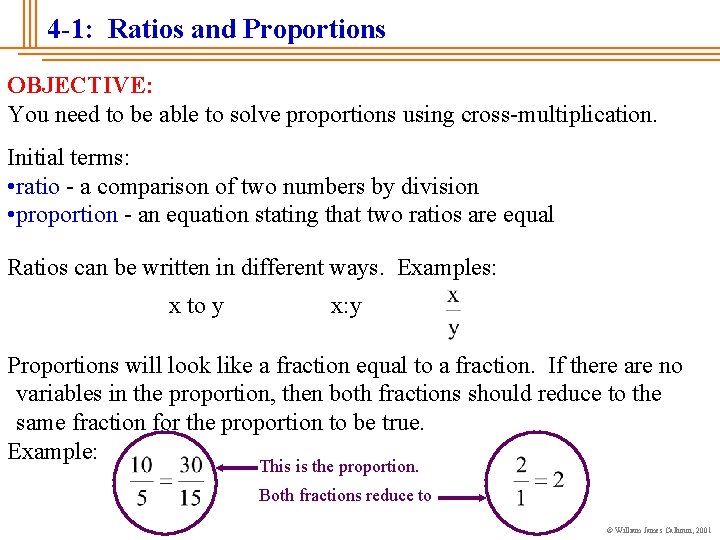
4 -1: Ratios and Proportions OBJECTIVE: You need to be able to solve proportions using cross-multiplication. Initial terms: • ratio - a comparison of two numbers by division • proportion - an equation stating that two ratios are equal Ratios can be written in different ways. Examples: x to y x: y Proportions will look like a fraction equal to a fraction. If there are no variables in the proportion, then both fractions should reduce to the same fraction for the proportion to be true. Example: This is the proportion. Both fractions reduce to © William James Calhoun, 2001
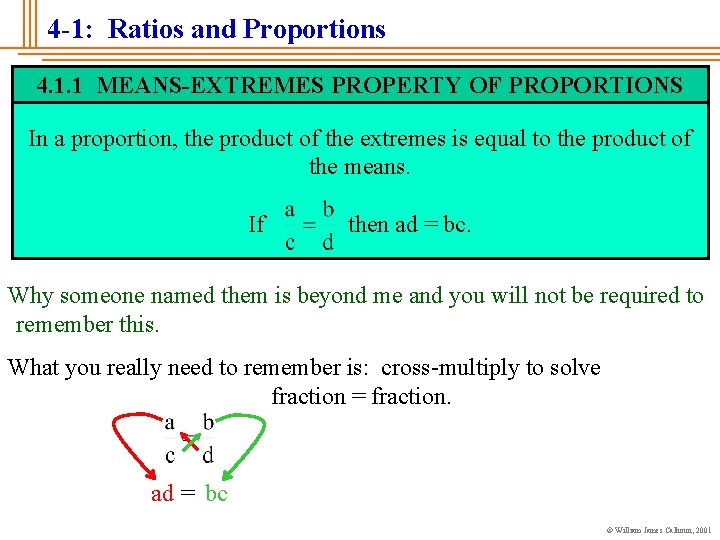
4 -1: Ratios and Proportions 4. 1. 1 MEANS-EXTREMES PROPERTY OF PROPORTIONS In a proportion, the product of the extremes is equal to the product of the means. If then ad = bc. Why someone named them is beyond me and you will not be required to remember this. What you really need to remember is: cross-multiply to solve fraction = fraction. ad = bc © William James Calhoun, 2001
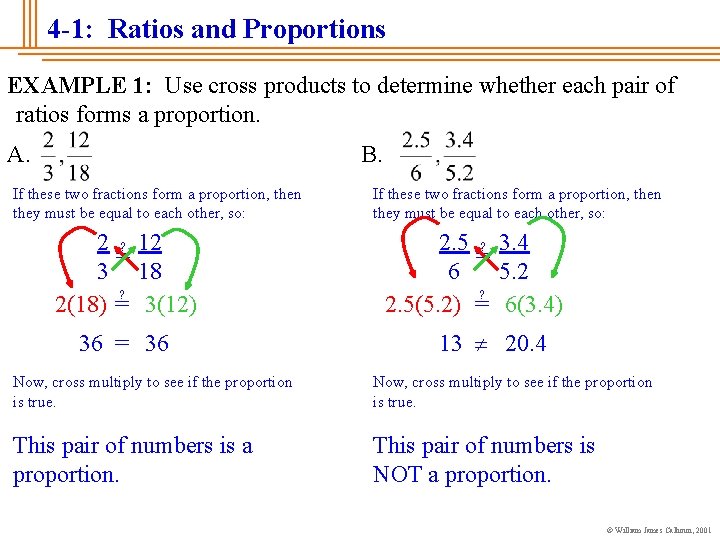
4 -1: Ratios and Proportions EXAMPLE 1: Use cross products to determine whether each pair of ratios forms a proportion. A. B. If these two fractions form a proportion, then they must be equal to each other, so: 2 ? 12 = 3 18 ? 2(18) = 3(12) 36 = 36 If these two fractions form a proportion, then they must be equal to each other, so: 2. 5 ? 3. 4 = 6 5. 2 ? 2. 5(5. 2) = 6(3. 4) 13 20. 4 Now, cross multiply to see if the proportion is true. This pair of numbers is a proportion. This pair of numbers is NOT a proportion. © William James Calhoun, 2001
4 -1: Ratios and Proportions Another term: • scale - a ratio used to make models to represent things that are too large or too small to be conveniently drawn at actual size The scale compares the size of the model to the actual size of the object being modeled. The next example is really BIG With sharp teeth…. No, it is not a vorpal bunnie. © William James Calhoun, 2001
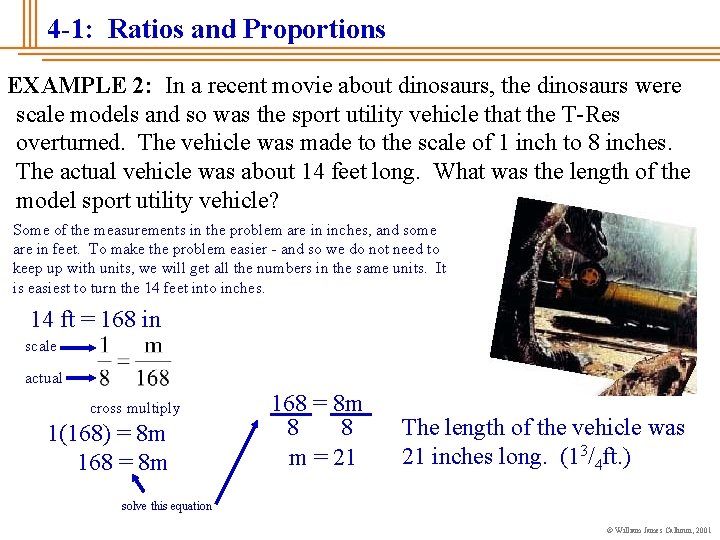
4 -1: Ratios and Proportions EXAMPLE 2: In a recent movie about dinosaurs, the dinosaurs were scale models and so was the sport utility vehicle that the T-Res overturned. The vehicle was made to the scale of 1 inch to 8 inches. The actual vehicle was about 14 feet long. What was the length of the model sport utility vehicle? Some of the measurements in the problem are in inches, and some are in feet. To make the problem easier - and so we do not need to keep up with units, we will get all the numbers in the same units. It is easiest to turn the 14 feet into inches. 14 ft = 168 in scale actual cross multiply 1(168) = 8 m 168 = 8 m 8 8 m = 21 The length of the vehicle was 21 inches long. (13/4 ft. ) solve this equation © William James Calhoun, 2001
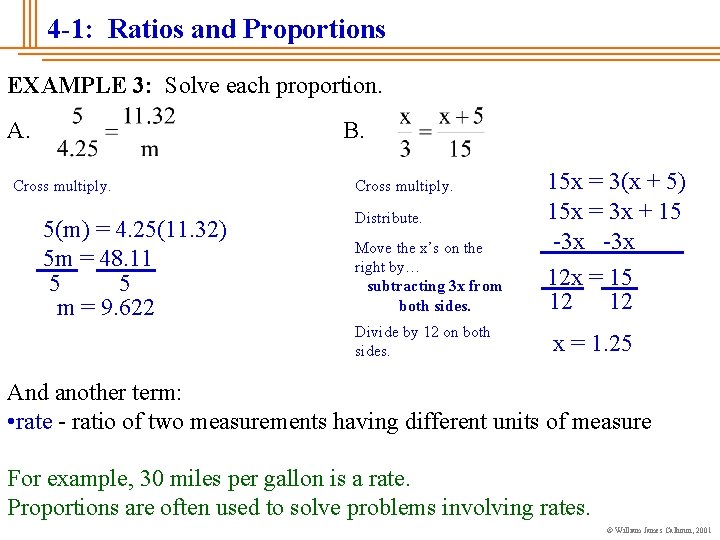
4 -1: Ratios and Proportions EXAMPLE 3: Solve each proportion. A. B. Cross multiply. 5(m) = 4. 25(11. 32) 5 m = 48. 11 5 5 m = 9. 622 Cross multiply. Distribute. Move the x’s on the right by… subtracting 3 x from both sides. Divide by 12 on both sides. 15 x = 3(x + 5) 15 x = 3 x + 15 -3 x 12 x = 15 12 12 x = 1. 25 And another term: • rate - ratio of two measurements having different units of measure For example, 30 miles per gallon is a rate. Proportions are often used to solve problems involving rates. © William James Calhoun, 2001
4 -1: Ratios and Proportions HOMEWORK Page 199 #15 - 33 odd © William James Calhoun, 2001
- Slides: 7