
4 1 Polynomial Functions OBJECTIVES 1 2 3
4. 1 Polynomial Functions OBJECTIVES: 1. 2. 3. 4. DEFINE A POLYNOMIAL. DIVIDE POLYNOMIALS. APPLY THE REMAINDER AND FACTOR THEOREMS, AND THE CONNECTIONS BETWEEN REMAINDERS AND FACTORS. DETERMINE THE MAXIMUM NUMBER OF ZEROS OF A POLYNOMIAL.
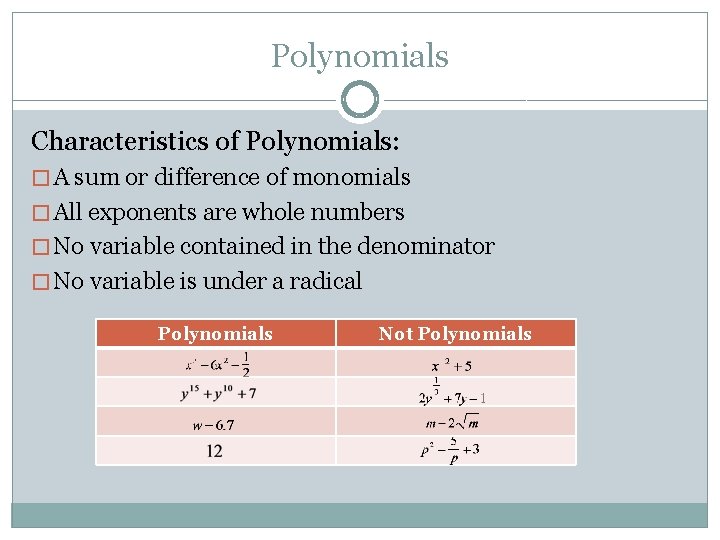
Polynomials Characteristics of Polynomials: � A sum or difference of monomials � All exponents are whole numbers � No variable contained in the denominator � No variable is under a radical Polynomials Not Polynomials
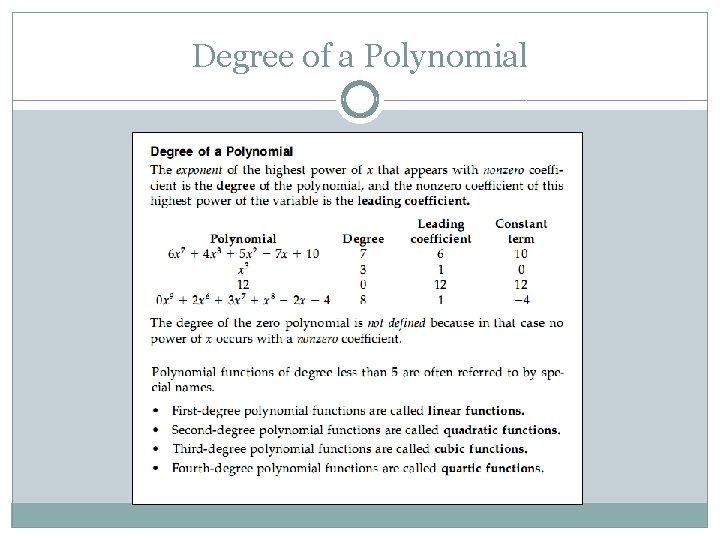
Degree of a Polynomial
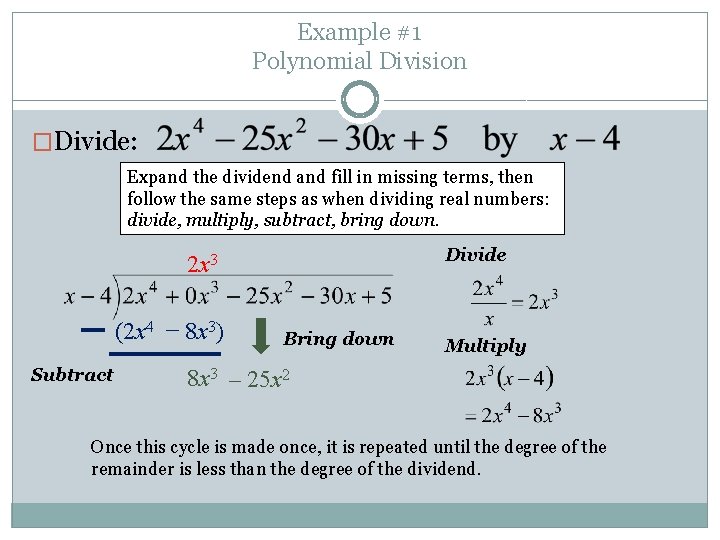
Example #1 Polynomial Division �Divide: Expand the dividend and fill in missing terms, then follow the same steps as when dividing real numbers: divide, multiply, subtract, bring down. Divide 2 x 3 (2 x 4 − 8 x 3) Subtract Bring down Multiply 8 x 3 – 25 x 2 Once this cycle is made once, it is repeated until the degree of the remainder is less than the degree of the dividend.
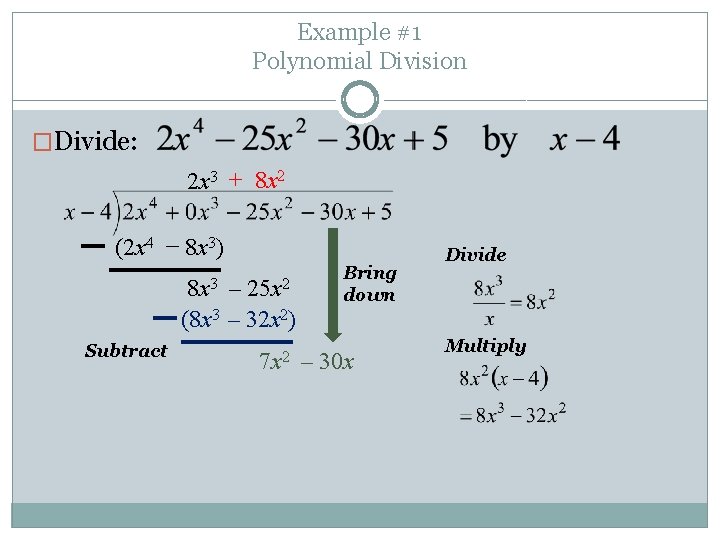
Example #1 Polynomial Division �Divide: 2 x 3 + 8 x 2 (2 x 4 − 8 x 3) 8 x 3 – (8 x 3 – 32 x 2) Subtract 25 x 2 7 x 2 Bring down – 30 x Divide Multiply
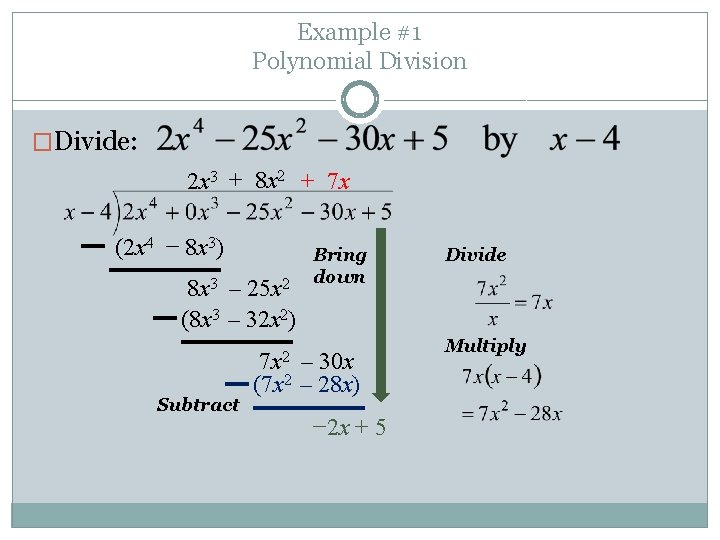
Example #1 Polynomial Division �Divide: 2 x 3 + 8 x 2 + 7 x (2 x 4 − 8 x 3) 8 x 3 – 25 x 2 (8 x 3 – 32 x 2) Subtract 7 x 2 (7 x 2 Bring down – 30 x – 28 x) − 2 x + 5 Divide Multiply
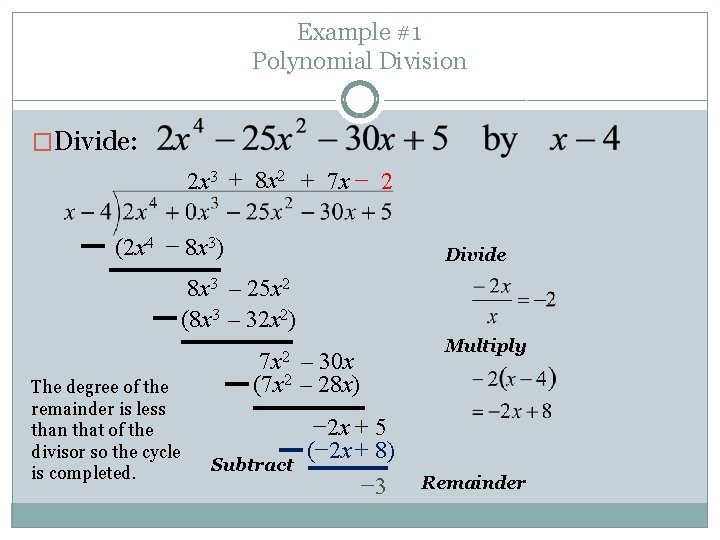
Example #1 Polynomial Division �Divide: 2 x 3 + 8 x 2 + 7 x − 2 (2 x 4 − 8 x 3) Divide 8 x 3 – 25 x 2 (8 x 3 – 32 x 2) The degree of the remainder is less than that of the divisor so the cycle is completed. 7 x 2 (7 x 2 Subtract – 30 x – 28 x) − 2 x + 5 (− 2 x + 8) − 3 Multiply Remainder
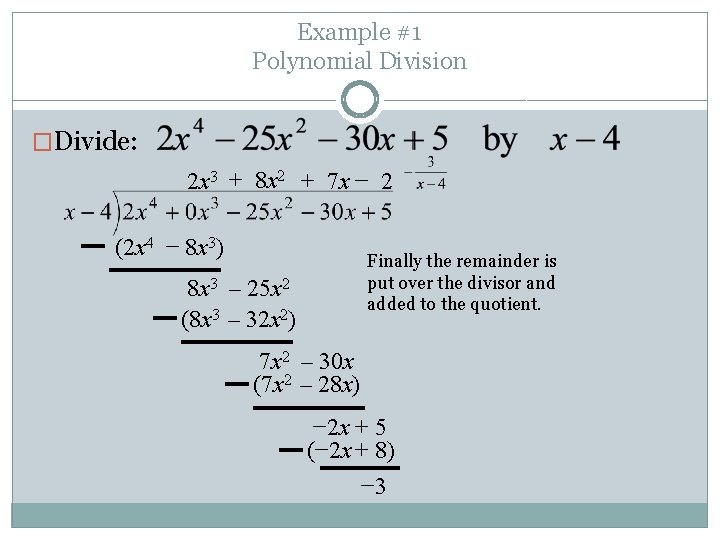
Example #1 Polynomial Division �Divide: 2 x 3 + 8 x 2 + 7 x − 2 (2 x 4 − 8 x 3) Finally the remainder is put over the divisor and added to the quotient. 8 x 3 – 25 x 2 (8 x 3 – 32 x 2) 7 x 2 – 30 x (7 x 2 – 28 x) − 2 x + 5 (− 2 x + 8) − 3
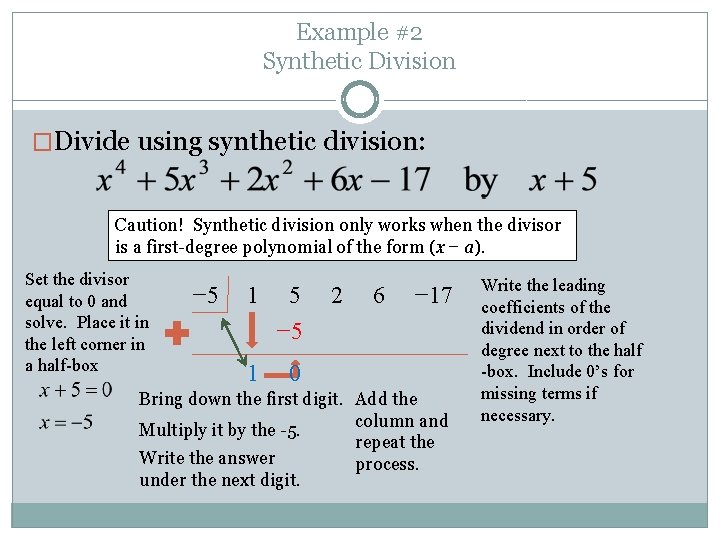
Example #2 Synthetic Division �Divide using synthetic division: Caution! Synthetic division only works when the divisor is a first-degree polynomial of the form (x − a). Set the divisor equal to 0 and solve. Place it in the left corner in a half-box − 5 1 5 − 5 1 0 2 6 − 17 Bring down the first digit. Add the column and Multiply it by the -5. repeat the Write the answer process. under the next digit. Write the leading coefficients of the dividend in order of degree next to the half -box. Include 0’s for missing terms if necessary.

Example #2 Synthetic Division �Divide using synthetic division: − 5 Multiply the sum again by the -5. 1 5 − 5 2 0 1 0 2 6 − 17 Write the answer under the next digit. Add the column and repeat the process.
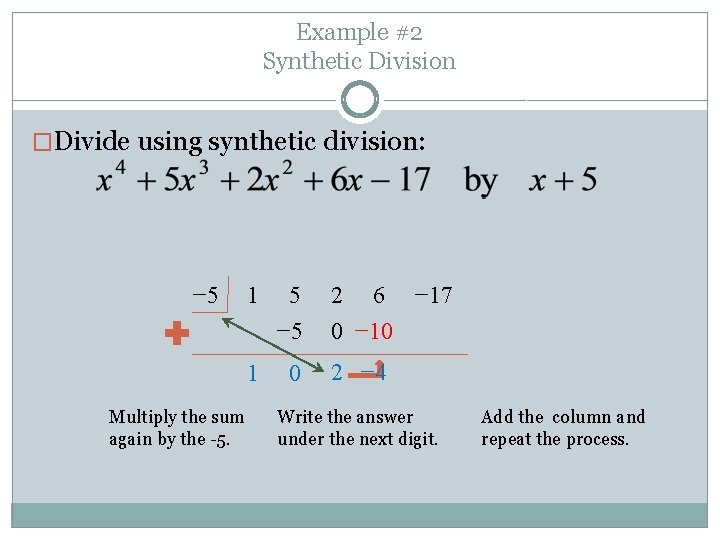
Example #2 Synthetic Division �Divide using synthetic division: − 5 Multiply the sum again by the -5. 1 5 − 5 1 0 2 6 − 17 0 − 10 2 − 4 Write the answer under the next digit. Add the column and repeat the process.
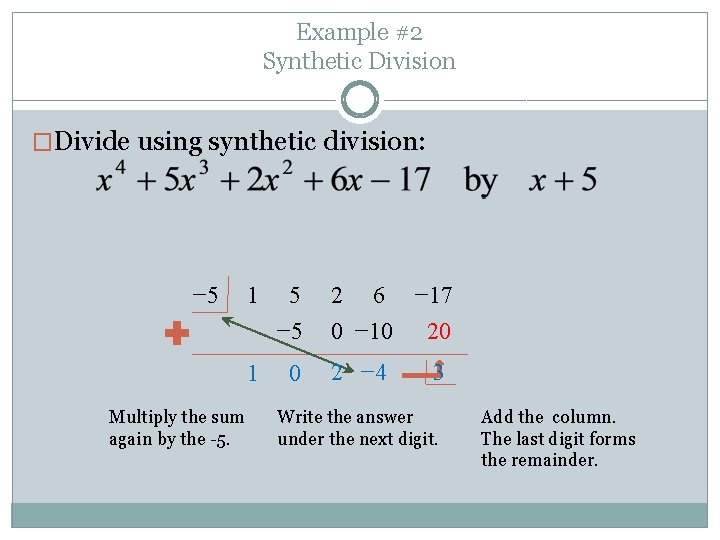
Example #2 Synthetic Division �Divide using synthetic division: − 5 Multiply the sum again by the -5. 1 5 − 5 1 0 2 6 − 17 0 − 10 20 2 − 4 3 Write the answer under the next digit. Add the column. The last digit forms the remainder.
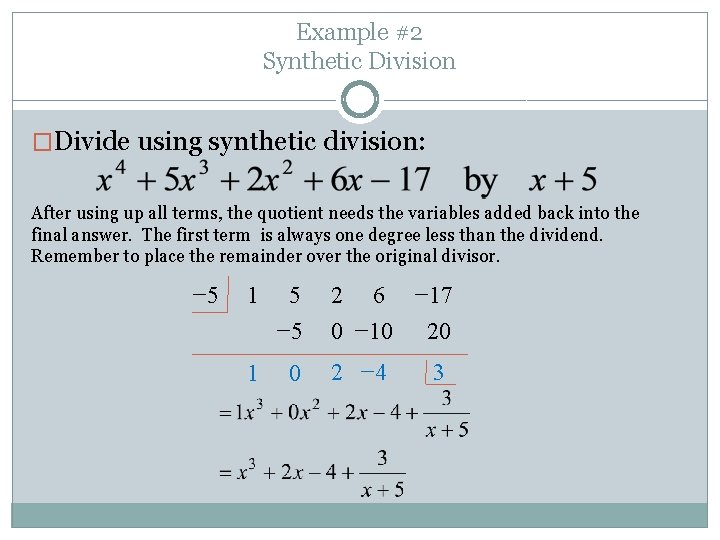
Example #2 Synthetic Division �Divide using synthetic division: After using up all terms, the quotient needs the variables added back into the final answer. The first term is always one degree less than the dividend. Remember to place the remainder over the original divisor. − 5 1 5 − 5 1 0 2 6 − 17 0 − 10 20 2 − 4 3
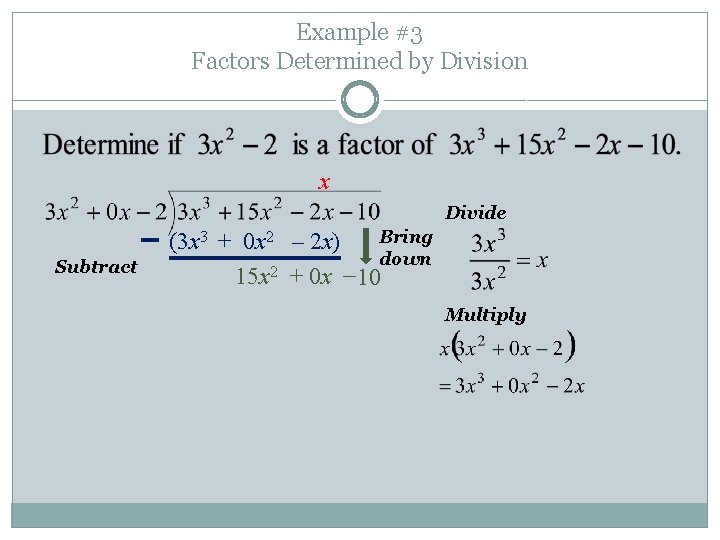
Example #3 Factors Determined by Division x Divide Subtract Bring (3 x 3 + 0 x 2 – 2 x) down 2 15 x + 0 x − 10 Multiply
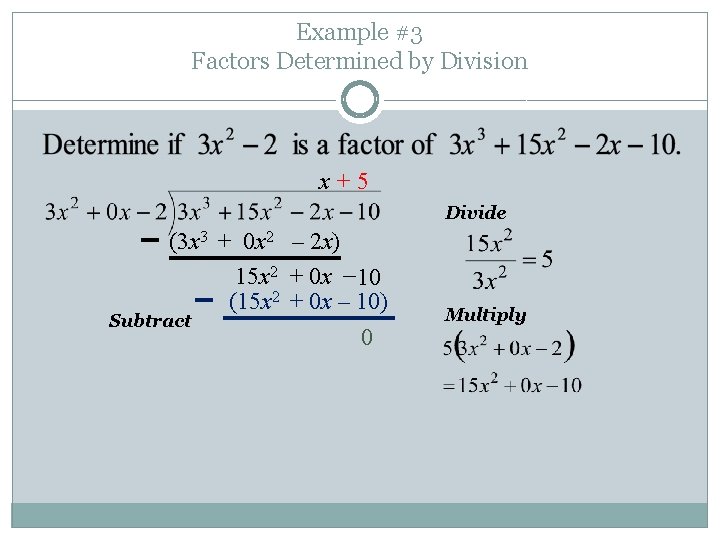
Example #3 Factors Determined by Division x+5 Divide (3 x 3 + 0 x 2 – 2 x) 15 x 2 + 0 x − 10 (15 x 2 + 0 x – 10) Subtract 0 Multiply
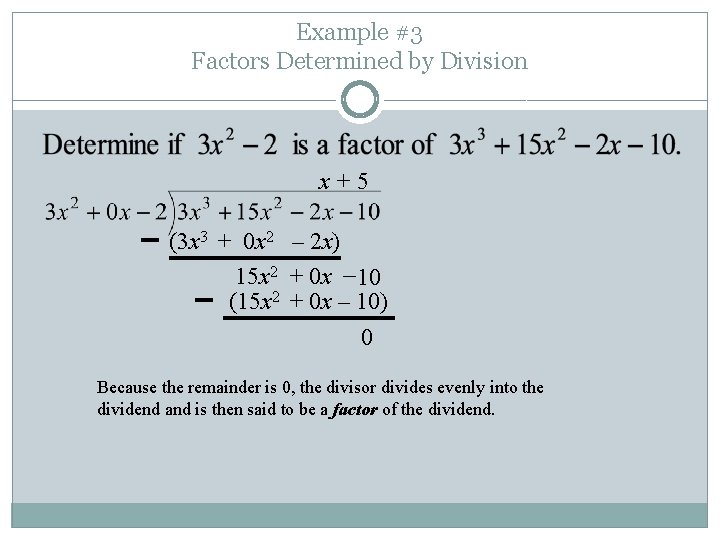
Example #3 Factors Determined by Division x+5 (3 x 3 + 0 x 2 – 2 x) 15 x 2 + 0 x − 10 (15 x 2 + 0 x – 10) 0 Because the remainder is 0, the divisor divides evenly into the dividend and is then said to be a factor of the dividend.
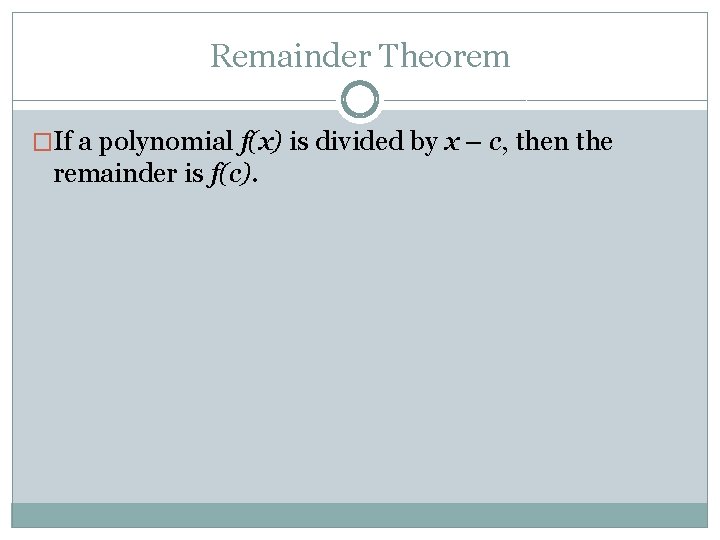
Remainder Theorem �If a polynomial f(x) is divided by x – c, then the remainder is f(c).
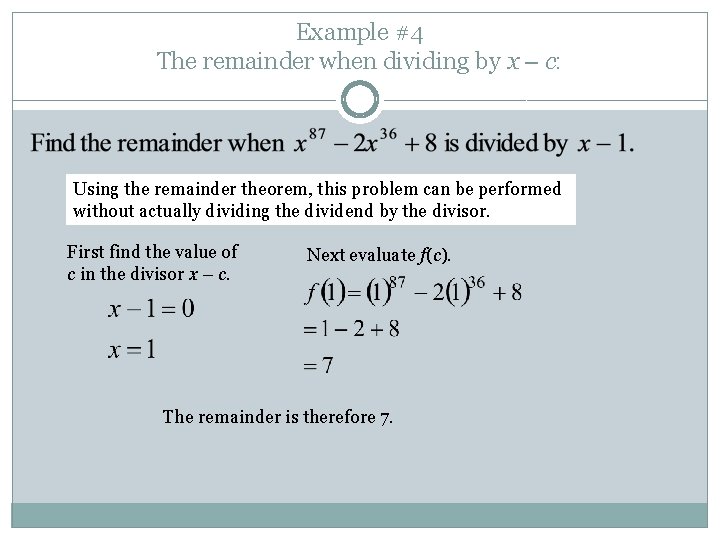
Example #4 The remainder when dividing by x – c: Using the remainder theorem, this problem can be performed without actually dividing the dividend by the divisor. First find the value of c in the divisor x – c. Next evaluate f(c). The remainder is therefore 7.
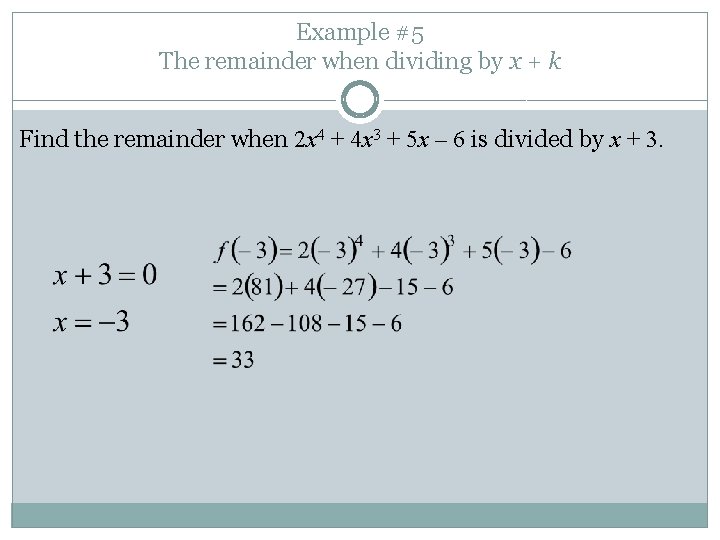
Example #5 The remainder when dividing by x + k Find the remainder when 2 x 4 + 4 x 3 + 5 x – 6 is divided by x + 3.
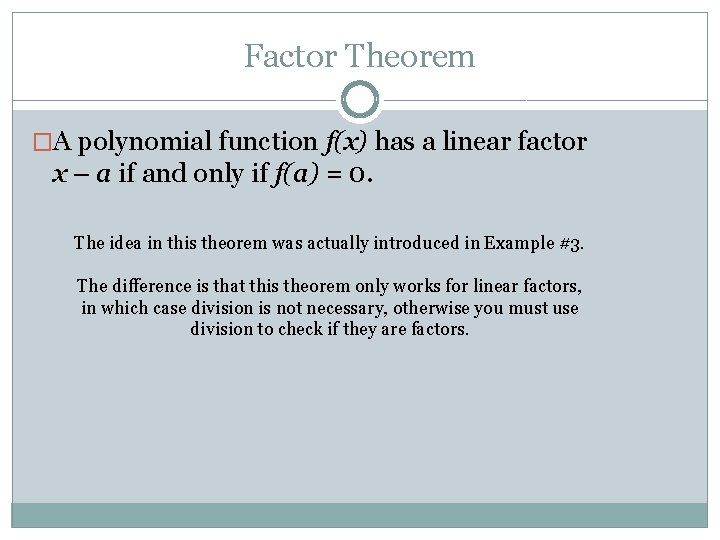
Factor Theorem �A polynomial function f(x) has a linear factor x – a if and only if f(a) = 0. The idea in this theorem was actually introduced in Example #3. The difference is that this theorem only works for linear factors, in which case division is not necessary, otherwise you must use division to check if they are factors.
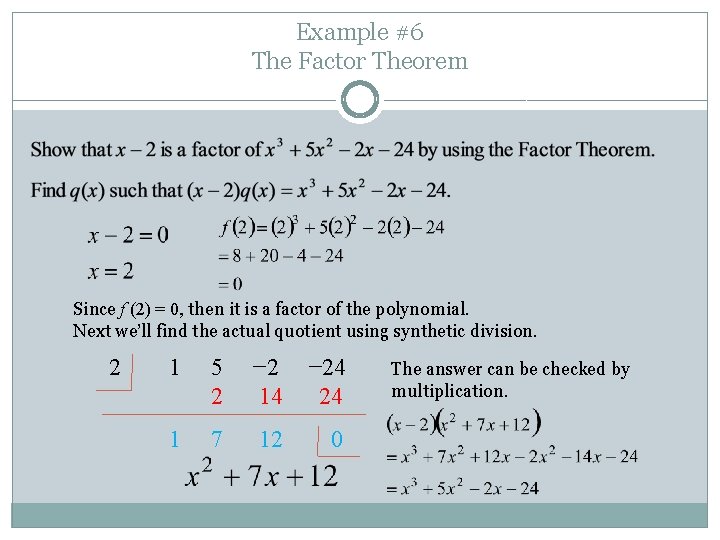
Example #6 The Factor Theorem Since f (2) = 0, then it is a factor of the polynomial. Next we’ll find the actual quotient using synthetic division. 2 1 5 2 − 2 14 − 24 24 1 7 12 0 The answer can be checked by multiplication.
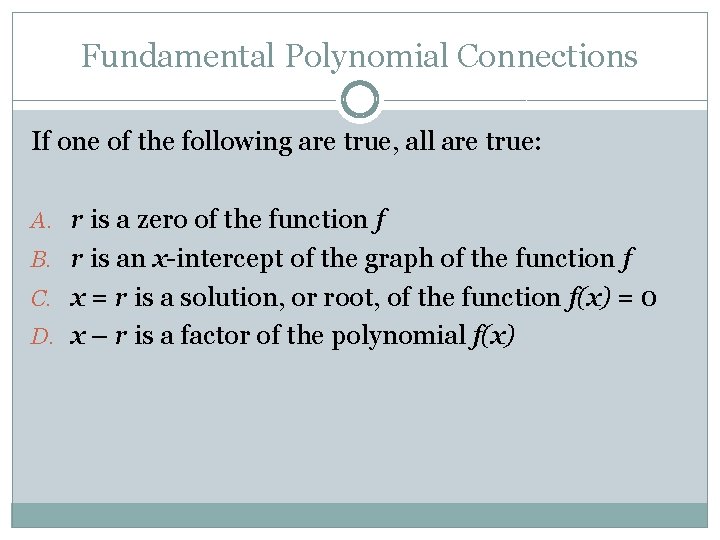
Fundamental Polynomial Connections If one of the following are true, all are true: A. r is a zero of the function f B. r is an x-intercept of the graph of the function f C. x = r is a solution, or root, of the function f(x) = 0 D. x – r is a factor of the polynomial f(x)
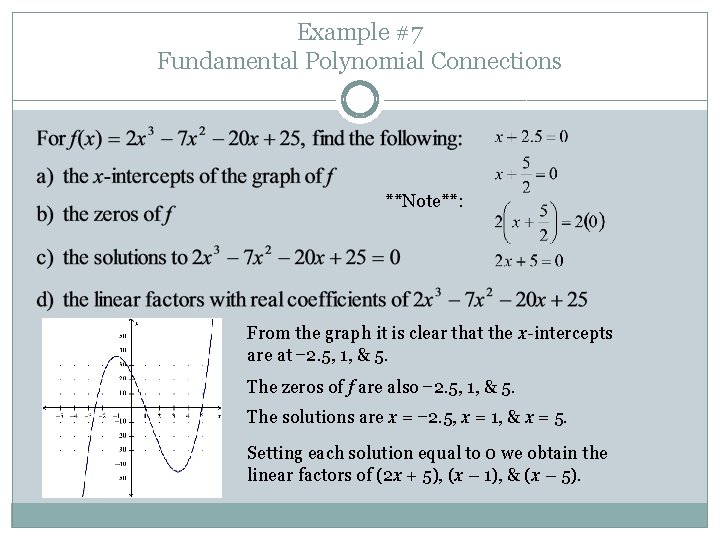
Example #7 Fundamental Polynomial Connections **Note**: From the graph it is clear that the x-intercepts are at − 2. 5, 1, & 5. The zeros of f are also − 2. 5, 1, & 5. The solutions are x = − 2. 5, x = 1, & x = 5. Setting each solution equal to 0 we obtain the linear factors of (2 x + 5), (x – 1), & (x – 5).
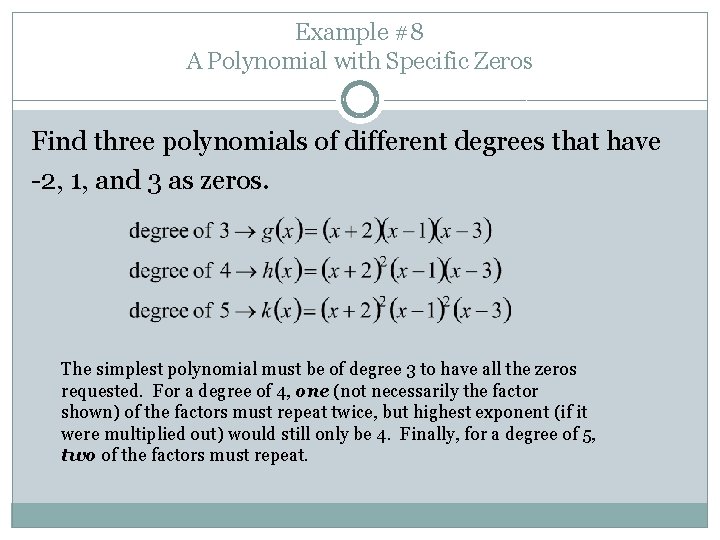
Example #8 A Polynomial with Specific Zeros Find three polynomials of different degrees that have -2, 1, and 3 as zeros. The simplest polynomial must be of degree 3 to have all the zeros requested. For a degree of 4, one (not necessarily the factor shown) of the factors must repeat twice, but highest exponent (if it were multiplied out) would still only be 4. Finally, for a degree of 5, two of the factors must repeat.
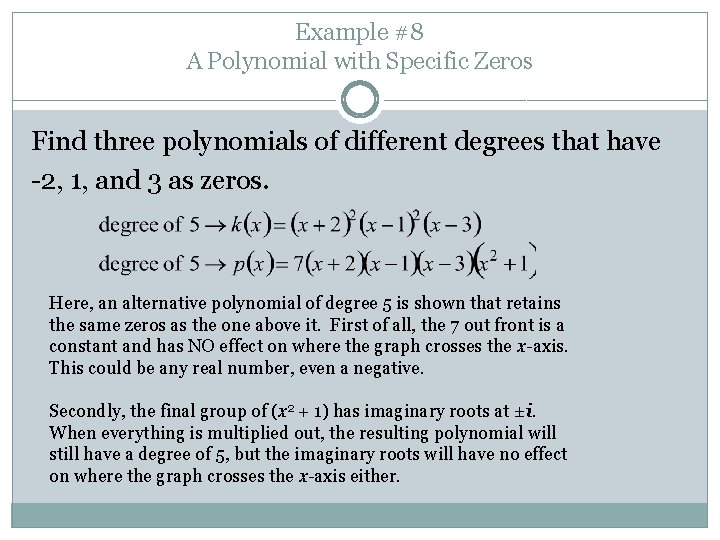
Example #8 A Polynomial with Specific Zeros Find three polynomials of different degrees that have -2, 1, and 3 as zeros. Here, an alternative polynomial of degree 5 is shown that retains the same zeros as the one above it. First of all, the 7 out front is a constant and has NO effect on where the graph crosses the x-axis. This could be any real number, even a negative. Secondly, the final group of (x 2 + 1) has imaginary roots at ±i. When everything is multiplied out, the resulting polynomial will still have a degree of 5, but the imaginary roots will have no effect on where the graph crosses the x-axis either.
Number of Zeros A polynomial of degree n has at most n distinct real zeros.
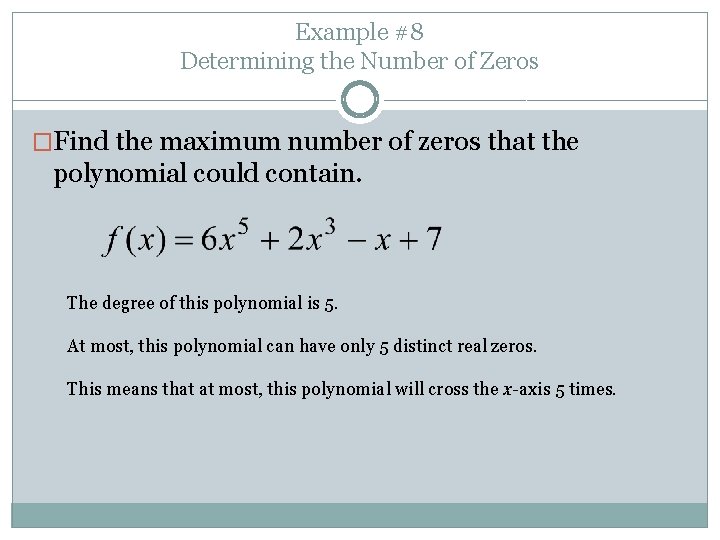
Example #8 Determining the Number of Zeros �Find the maximum number of zeros that the polynomial could contain. The degree of this polynomial is 5. At most, this polynomial can have only 5 distinct real zeros. This means that at most, this polynomial will cross the x-axis 5 times.
- Slides: 27