
4 1 Introduction to Human Factors in Patient
- Slides: 30
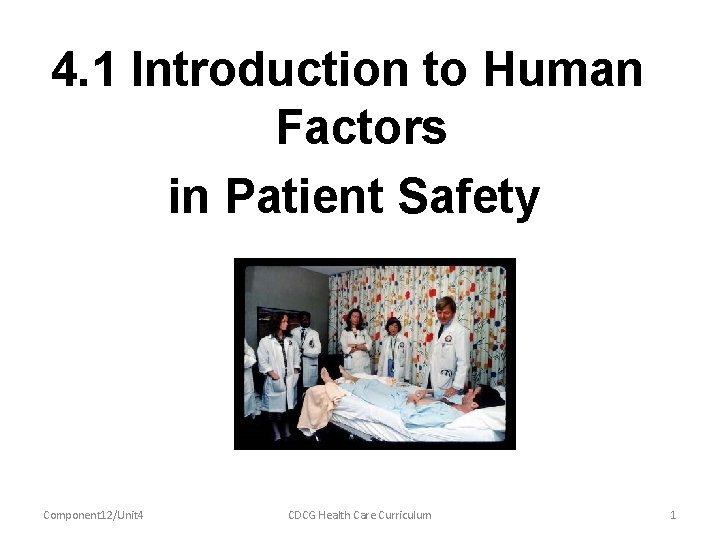
4. 1 Introduction to Human Factors in Patient Safety Component 12/Unit 4 CDCG Health Care Curriculum 1
Objectives • Define human factors and ergonomics (HFE) is and its objectives • Introduce Human Factors Ergonomics (HFE) and discuss the role of HFE in patient safety Component 12/Unit 4 CDCG Health Care Curriculum 2
What is Human Factors Ergonomics? International Ergonomics Association defines human factors (ergonomics) as “the scientific discipline concerned with the understanding of interactions among humans and other elements of a system, and the profession that applies theory, principles, data and methods to design in order to optimize human well-being and overall system performance. ” Component 12/Unit 4 CDCG Health Care Curriculum 3
Goal(s) of HFE Making the human interaction with systems one that – Enhances performance – Increases safety – Increases user satisfaction • Trade-offs between multiple goals Component 12/Unit 4 CDCG Health Care Curriculum 4
HFE is NOT • Common sense • Checklists or guidelines • Limited to correct labeling or design of a device • Designing solutions based on only what users say they need Component 12/Unit 4 CDCG Health Care Curriculum 5
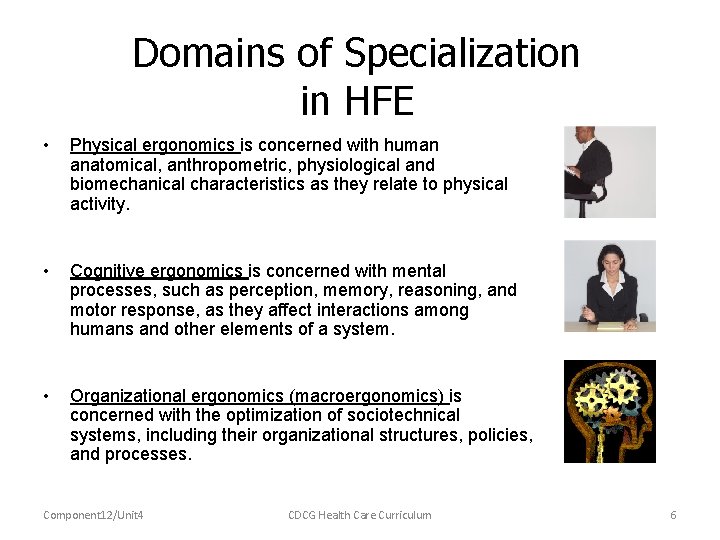
Domains of Specialization in HFE • Physical ergonomics is concerned with human anatomical, anthropometric, physiological and biomechanical characteristics as they relate to physical activity. • Cognitive ergonomics is concerned with mental processes, such as perception, memory, reasoning, and motor response, as they affect interactions among humans and other elements of a system. • Organizational ergonomics (macroergonomics) is concerned with the optimization of sociotechnical systems, including their organizational structures, policies, and processes. Component 12/Unit 4 CDCG Health Care Curriculum 6
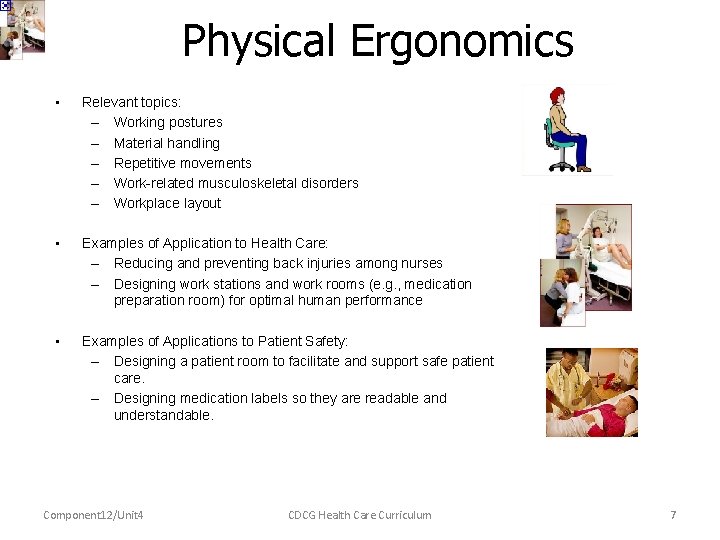
Physical Ergonomics • Relevant topics: – Working postures – Material handling – Repetitive movements – Work-related musculoskeletal disorders – Workplace layout • Examples of Application to Health Care: – Reducing and preventing back injuries among nurses – Designing work stations and work rooms (e. g. , medication preparation room) for optimal human performance • Examples of Applications to Patient Safety: – Designing a patient room to facilitate and support safe patient care. – Designing medication labels so they are readable and understandable. Component 12/Unit 4 CDCG Health Care Curriculum 7
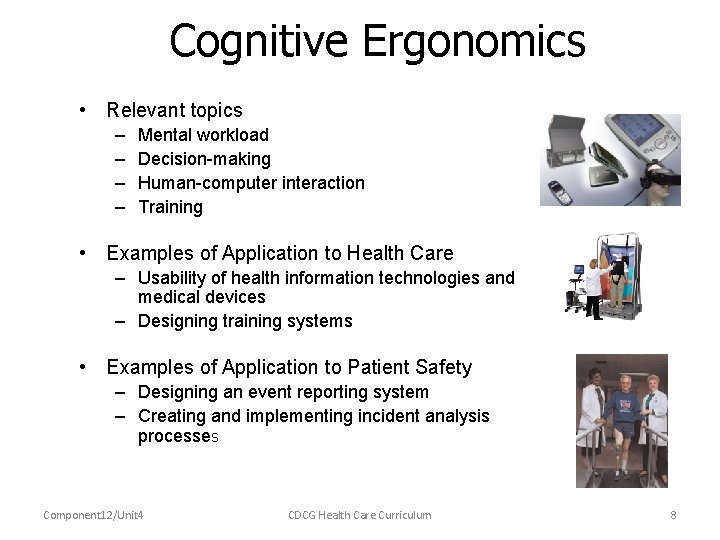
Cognitive Ergonomics • Relevant topics – – Mental workload Decision-making Human-computer interaction Training • Examples of Application to Health Care – Usability of health information technologies and medical devices – Designing training systems • Examples of Application to Patient Safety – Designing an event reporting system – Creating and implementing incident analysis processes Component 12/Unit 4 CDCG Health Care Curriculum 8
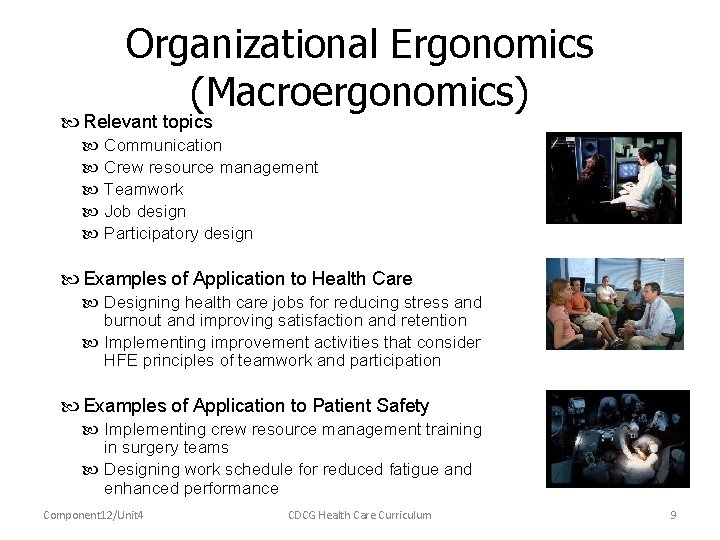
Organizational Ergonomics (Macroergonomics) Relevant topics Communication Crew resource management Teamwork Job design Participatory design Examples of Application to Health Care Designing health care jobs for reducing stress and burnout and improving satisfaction and retention Implementing improvement activities that consider HFE principles of teamwork and participation Examples of Application to Patient Safety Implementing crew resource management training in surgery teams Designing work schedule for reduced fatigue and enhanced performance Component 12/Unit 4 CDCG Health Care Curriculum 9
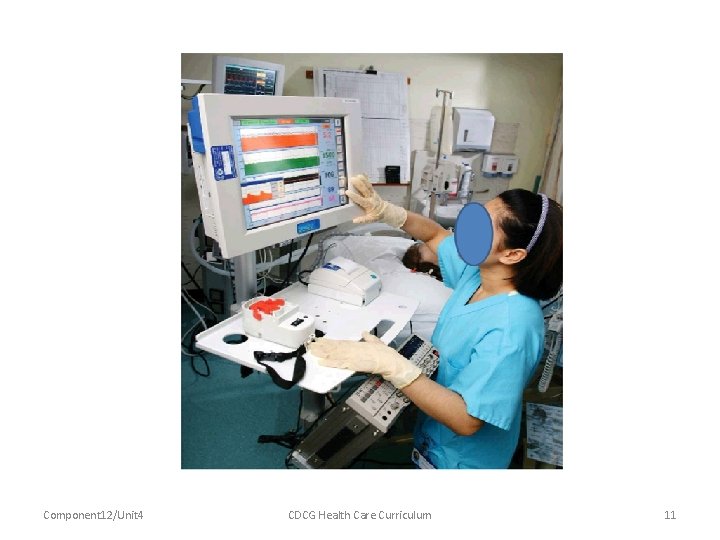
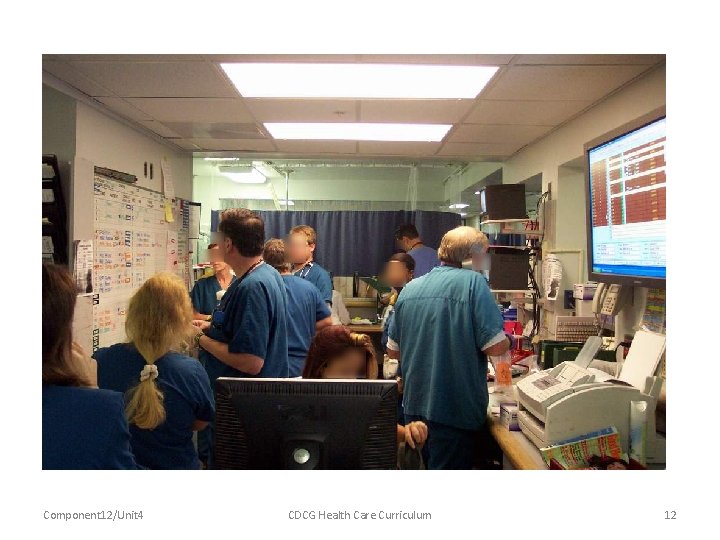
Scope of HFE • Human- Information Display/ Machine interaction • Human – Environment interaction • Human – Job Interaction • Human – Organization Interaction Component 12/Unit 4 CDCG Health Care Curriculum 10
Component 12/Unit 4 CDCG Health Care Curriculum 11
Component 12/Unit 4 CDCG Health Care Curriculum 12
Why do Errors Happen? • Person approach – Blame the individual forgetfulness, inattention, weakness – Countermeasures: writing another procedure, disciplinary measures, threat of litigation, retraining, blaming, and shaming. • System approach – Multiple faults that occur together in an unanticipated interaction, creating a chain of events in which the faults grow and evolve. – Countermeasures: based on the assumption that though we cannot change the human condition, we can change the conditions under which humans work (e. g. , system defenses). - To Err is Human- Building a Safer Health System, Committee on Quality of Health Care in America, Institute of Medicine, 2000. Component 12/Unit 4 CDCG Health Care Curriculum 13
What is a Poorly Designed System? • One that – Does not match the needs of human being or task – Does not take into account human limitations (perception, memory, anthropometrics). Component 12/Unit 4 CDCG Health Care Curriculum 14
System approach Two principles: • Same set of circumstances can provoke similar errors, regardless of the people involved. • Safety is seriously impeded if an organization does not seek out and remove the error provoking properties within the system at large. Component 12/Unit 4 CDCG Health Care Curriculum 15
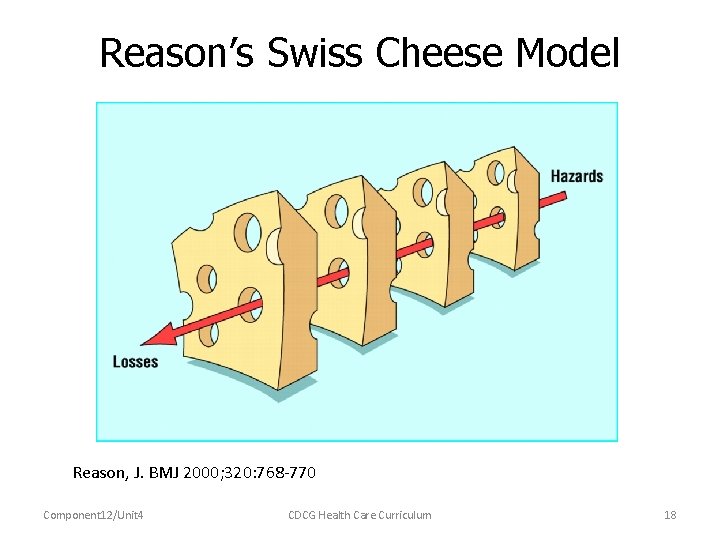
Human error • What is an error? The failure of a planned action to be completed as intended (e. g. , error of execution) or the use of a wrong plan to achieve an aim (e. g. , error of planning). • Active failures (sharp end) – Occur at the level of the frontline operator, and their effects are felt almost immediately. • Latent conditions (blunt end) – Tend to be removed from the direct control of the operator. – Result in two kinds of adverse events: • Translate into error provoking conditions within the local workplace (for example, time pressure, understaffing, inadequate equipment, fatigue, and inexperience) • Or create long-lasting holes or weaknesses in the defenses (untrustworthy alarms and indicators, unworkable procedures, design and construction deficiencies, etc. ). - Reason, J. BMJ 2000; 320: 768 -770 - To Err is Human- Building a Safer Health System, Committee on Quality of Health Care in America, Institute of Medicine, 2000. - Component 12/Unit 4 CDCG Health Care Curriculum 16
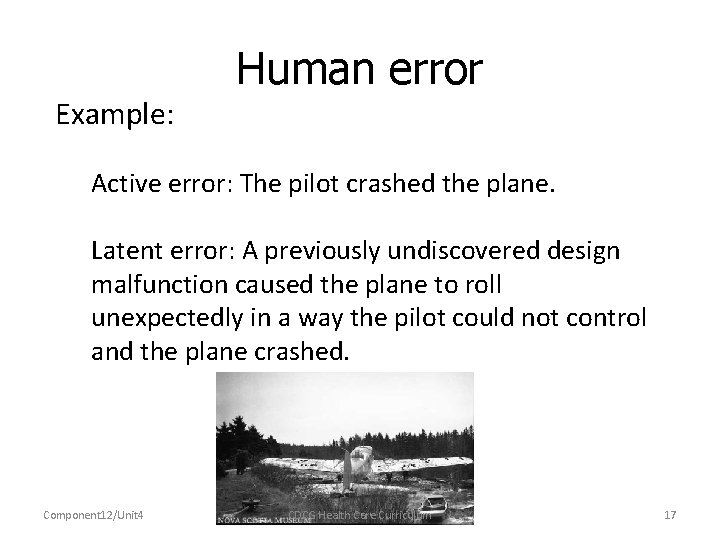
Human error Example: Active error: The pilot crashed the plane. Latent error: A previously undiscovered design malfunction caused the plane to roll unexpectedly in a way the pilot could not control and the plane crashed. Component 12/Unit 4 CDCG Health Care Curriculum 17
Reason’s Swiss Cheese Model Reason, J. BMJ 2000; 320: 768 -770 Component 12/Unit 4 CDCG Health Care Curriculum 18
Error Management • Limiting errors • Creating more error-tolerant • High reliability organizations capable of… – Performing exacting tasks under pressure – Carrying out activities with low incident rates – Good organizational design and management – Organizational commitment to safety – High levels of redundancy – Strong organizational culture – Can convert occasional setbacks into enhanced resilience of the system. * To Err is Human- Building a Safer Health System, Committee on Quality of Health Care in America, Institute of Medicine, 2000. Component 12/Unit 4 CDCG Health Care Curriculum 19
4. 2 Work System Model Component 12/Unit 4 CDCG Health Care Curriculum 20
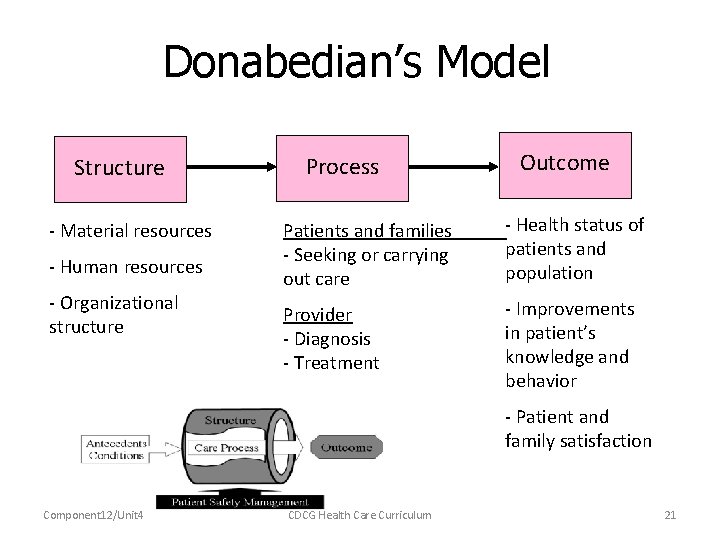
Donabedian’s Model Structure - Material resources - Human resources - Organizational structure Process Outcome Patients and families - Seeking or carrying out care - Health status of patients and population Provider - Diagnosis - Treatment - Improvements in patient’s knowledge and behavior - Patient and family satisfaction Component 12/Unit 4 CDCG Health Care Curriculum 21
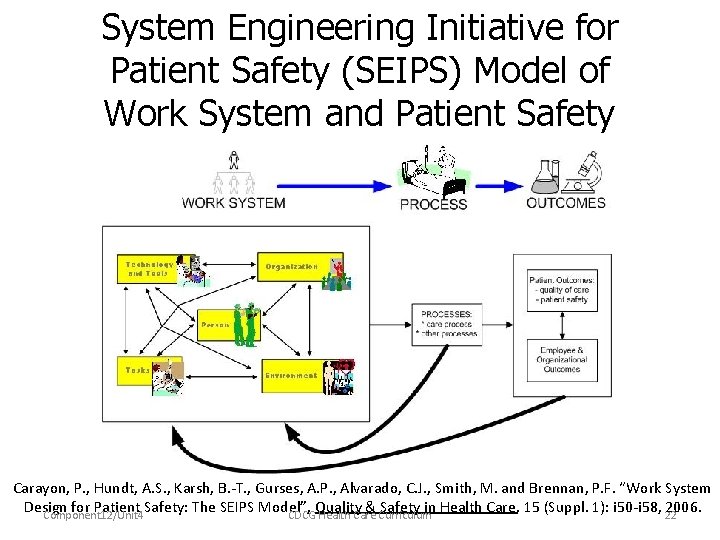
System Engineering Initiative for Patient Safety (SEIPS) Model of Work System and Patient Safety Carayon, P. , Hundt, A. S. , Karsh, B. -T. , Gurses, A. P. , Alvarado, C. J. , Smith, M. and Brennan, P. F. “Work System Design for Patient Safety: The SEIPS Model”, Quality & Safety in Health Care, 15 (Suppl. 1): i 50 -i 58, 22 2006. Component 12/Unit 4 CDCG Health Care Curriculum
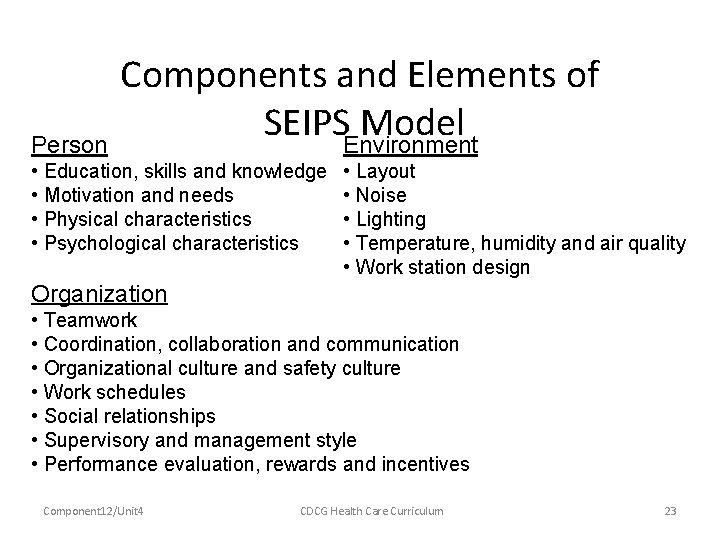
Person Components and Elements of SEIPSEnvironment Model • Education, skills and knowledge • Motivation and needs • Physical characteristics • Psychological characteristics • Layout • Noise • Lighting • Temperature, humidity and air quality • Work station design Organization • Teamwork • Coordination, collaboration and communication • Organizational culture and safety culture • Work schedules • Social relationships • Supervisory and management style • Performance evaluation, rewards and incentives Component 12/Unit 4 CDCG Health Care Curriculum 23
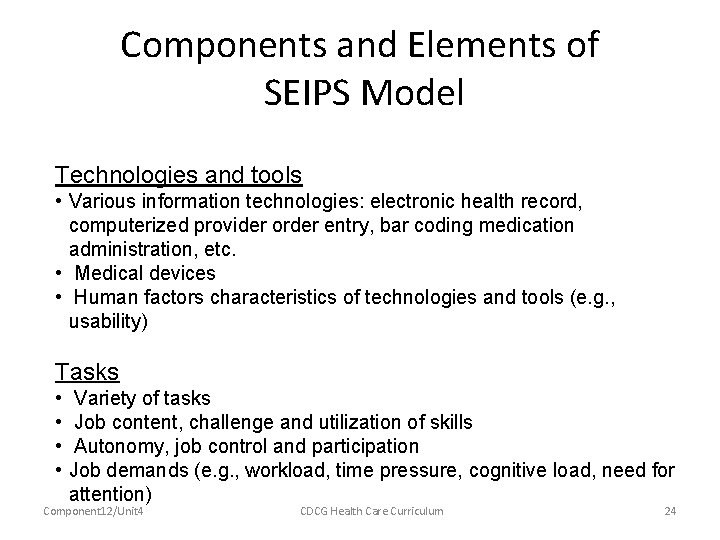
Components and Elements of SEIPS Model Technologies and tools • Various information technologies: electronic health record, computerized provider order entry, bar coding medication administration, etc. • Medical devices • Human factors characteristics of technologies and tools (e. g. , usability) Tasks • • Variety of tasks Job content, challenge and utilization of skills Autonomy, job control and participation Job demands (e. g. , workload, time pressure, cognitive load, need for attention) Component 12/Unit 4 CDCG Health Care Curriculum 24
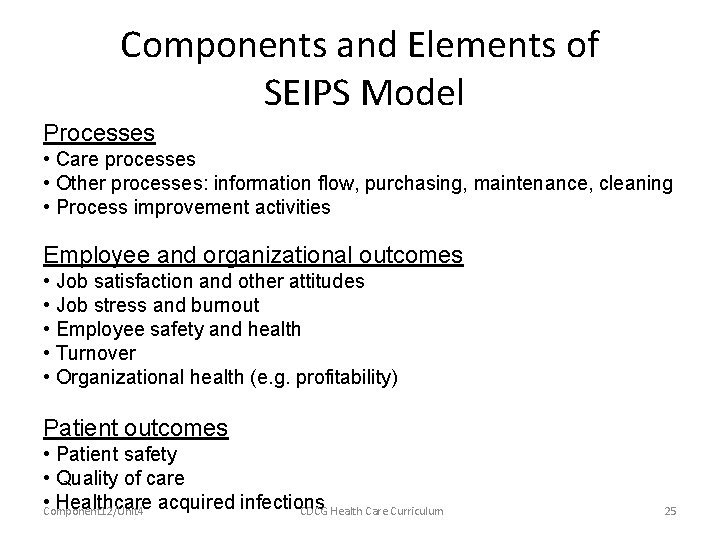
Components and Elements of SEIPS Model Processes • Care processes • Other processes: information flow, purchasing, maintenance, cleaning • Process improvement activities Employee and organizational outcomes • Job satisfaction and other attitudes • Job stress and burnout • Employee safety and health • Turnover • Organizational health (e. g. profitability) Patient outcomes • Patient safety • Quality of care • Healthcare acquired infections CDCG Health Care Curriculum Component 12/Unit 4 25
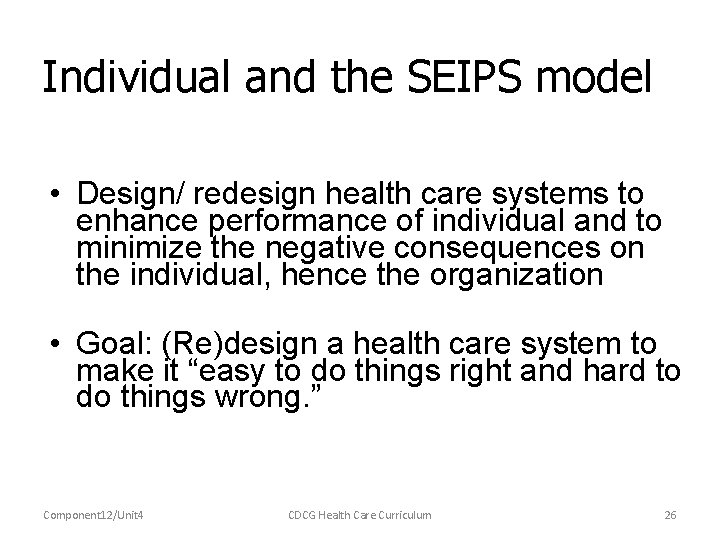
Individual and the SEIPS model • Design/ redesign health care systems to enhance performance of individual and to minimize the negative consequences on the individual, hence the organization • Goal: (Re)design a health care system to make it “easy to do things right and hard to do things wrong. ” Component 12/Unit 4 CDCG Health Care Curriculum 26
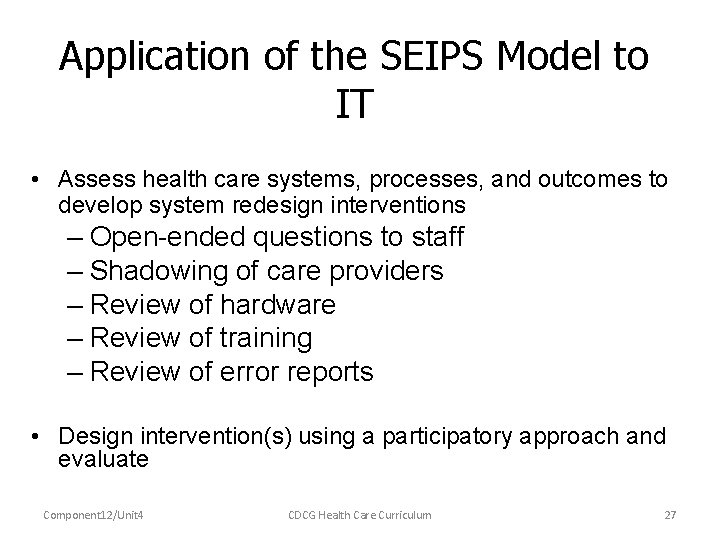
Application of the SEIPS Model to IT • Assess health care systems, processes, and outcomes to develop system redesign interventions – Open-ended questions to staff – Shadowing of care providers – Review of hardware – Review of training – Review of error reports • Design intervention(s) using a participatory approach and evaluate Component 12/Unit 4 CDCG Health Care Curriculum 27
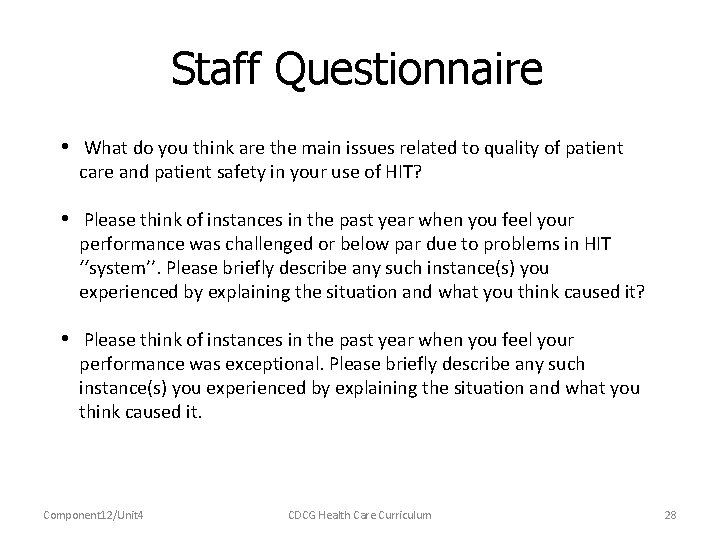
Staff Questionnaire • What do you think are the main issues related to quality of patient care and patient safety in your use of HIT? • Please think of instances in the past year when you feel your performance was challenged or below par due to problems in HIT ‘‘system’’. Please briefly describe any such instance(s) you experienced by explaining the situation and what you think caused it? • Please think of instances in the past year when you feel your performance was exceptional. Please briefly describe any such instance(s) you experienced by explaining the situation and what you think caused it. Component 12/Unit 4 CDCG Health Care Curriculum 28
Patient Shadowing A two dimensional log: • listing the chronological sequence • of steps the clinicians performed recording observations according to the work system component(s). A nurse and physician who are using the HIT system • Task: prescribe medications, document. • Environment: open; noisy and distracting interactions • • between staff in hallway. Tools/technology: drop down menu, confusing screen Organization: production pressures to get patients discharged. Component 12/Unit 4 CDCG Health Care Curriculum 29
Summary • Define human factors and ergonomics (HFE) is and its objectives • Introduce Human Factors Ergonomics (HFE) and discuss the role of HFE in patient safety Component 12/Unit 4 CDCG Health Care Curriculum 30