
4 1 Introduction Chapter Four Data collection The
- Slides: 30
4. 1 Introduction Chapter Four Data collection The task of data collection begins after a research problem has been defined and research design/plan chalked out. While deciding about the method of data collection to be used for the study, the researcher should keep in mind two types of data viz. , primary and secondary. The primary data are those which are collected afresh and for the first time, and thus happen to be original in character. The secondary data, on the other hand, are those which have already been collected by someone else and which have already been passed through the statistical process. 1 10/16/2021
The researcher would have to decide which sort of data he would be using (thus collecting) for his study and accordingly he will have to select one or the other method of data collection. The methods of collecting primary and secondary data differ since primary data are to be originally collected, while in case of secondary data the nature of data collection work is merely that of compilation. 2 10/16/2021
4. 2 Methods of data collection We collect primary data during the course of doing experiments in an experimental research but in case we do research of the descriptive type and perform surveys, whether sample surveys or census surveys, then we can obtain primary data either through observation or through direct communication with respondents in one form or another or through personal interviews. There are several methods of collecting primary data and secondary data, particularly in surveys and descriptive researches. Important ones are: 3 10/16/2021
4. 2. 1 Collection of Primary data 1. Observation method The observation method is the most commonly used method especially in studies relating to behavioral sciences. In a way we all observe things around us, but this sort of observation is not scientific observation. Observation becomes a scientific tool and the method of data collection for the researcher, when it serves a formulated research purpose, is systematically planned and recorded and is subjected to checks and controls on validity and reliability. Under the observation method, the information is sought by way of investigator’s own direct observation without asking from the respondent. 4 10/16/2021
While using this method, the researcher should keep in mind things like: What should be observed? How the observations should be recorded? How the accuracy of observation can be ensured? 5 10/16/2021
In case the observation is characterized by a careful definition of the units to be observed, the style of recording the observed information, standardized conditions of observation and the selection of pertinent data of observation, then the observation is called as structured observation. But when observation is to take place without these characteristics to be thought of in advance, the same is termed as unstructured observation. Structured observation is considered appropriate in descriptive studies, whereas in an exploratory study the observational procedure is most likely to be relatively unstructured. 6 10/16/2021
The main advantage of observation This method is that subjective bias is eliminated, if observation is done accurately. Secondly, the information obtained under this method relates to what is currently happening; it is not complicated by either the past behavior or future intentions or attitudes. Thirdly, this method is independent of respondents’ willingness to respond as such is relatively less demanding of active cooperation on the part of respondents as happens to be the case in the interview or the questionnaire method. This method is particularly suitable in studies which deal with subjects (i. e. , respondents) who are not capable of giving verbal reports of their feelings for one reason or the other 7 10/16/2021
limitations it is an expensive method. the information provided by this method is very limited. sometimes unforeseen factors may interfere with the observational task. At times, the fact that some people are rarely accessible to direct observation creates obstacle for this method to collect data effectively. 8 10/16/2021
2. Interview method The interview method of collecting data involves presentation of oral-verbal stimuli and reply in terms of oral-verbal responses. This method can be used through personal interviews and, if possible, through telephone interviews. (a) Personal interviews: Personal interview method requires a person known as the interviewer asking questions generally in a face-to-face contact to the other person or persons. (At times the interviewee may also ask certain questions and the interviewer responds to these, but usually the interviewer initiates the interview and collects the information. ) 9 10/16/2021
The method of collecting information through personal interviews is usually carried out in a structured way. As such we call the interviews as structured interviews. Such interviews involve the use of a set of predetermined questions and of highly standardized techniques of recording. Thus, the interviewer in a structured interview follows a rigid procedure laid down, asking questions in a form and order prescribed. As against it, the unstructured interviews are characterized by a flexibility of approach to questioning. Unstructured interviews do not follow a system of predetermined questions and standardized techniques of recording information 10 10/16/2021
Advantages of personal interview More information and that too in greater depth can be obtained. Interviewer by his own skill can overcome the resistance, if any, of the respondents; the interview method can be made to yield an almost perfect sample of the general population. There is greater flexibility under this method as the opportunity to restructure questions is always there, specially in case of unstructured interviews. Observation method can as well be applied to recording verbal answers to various questions. 11 10/16/2021
Personal information can as well be obtained easily under this method. Samples can be controlled more effectively as there arises no difficulty of the missing returns; nonresponse generally remains very low. The interviewer can usually control which person(s) will answer the questions. This is not possible in mailed questionnaire approach. If so desired, group discussions may also be held. 12 10/16/2021
The interviewer may catch the informant off-guard and thus may secure the most spontaneous reactions than would be the case if mailed questionnaire is used. The language of the interview can be adopted to the ability or educational level of the person interviewed and as such misinterpretations concerning questions can be avoided. The interviewer can collect supplementary information about the respondent’s personal characteristics and environment which is often of great value in interpreting results. 13 10/16/2021
weaknesses of personal interview It is a very expensive method, specially when large and widely spread geographical sample is taken. There remains the possibility of the bias of interviewer as well as that of the respondent; there also remains the headache of supervision and control of interviewers. Certain types of respondents such as important officials or executives or people in high income groups may not be easily approachable under this method and to that extent the data may prove inadequate. This method is relatively more-time-consuming, specially when the sample is large and recalls upon the respondents are necessary. 14 10/16/2021
The presence of the interviewer on the spot may over- stimulate the respondent, sometimes even to the extent that he may give imaginary information just to make the interview interesting. Under the interview method the organization required for selecting, training and supervising the field-staff is more complex with formidable problems. Interviewing at times may also introduce systematic errors. Effective interview presupposes proper rapport with respondents that would facilitate free and frank responses. This is often a very difficult requirement 15 10/16/2021
(b) Telephone interviews: This method of collecting information consists in contacting respondents on telephone itself. It is not a very widely used method, but plays important part in industrial surveys, particularly in developed regions. 16 10/16/2021
Advantage of telephone interview It is more flexible in comparison to mailing method. It is faster than other methods i. e. , a quick way of obtaining information. It is cheaper than personal interviewing method; here the cost per response is relatively low. Recall is easy; callbacks are simple and economical. There is a higher rate of response than what we have in mailing method; the non-response is generally very low. Replies can be recorded without causing embarrassment to respondents. Interviewer can explain requirements more easily. At times, access can be gained to respondents who otherwise cannot be contacted for one reason or the other. No field staff is required. 17 Representative and wider distribution of sample is possible.
Limitation Little time is given to respondents for considered answers; interview period is not likely to exceed five minutes in most cases. Surveys are restricted to respondents who have telephone facilities. Extensive geographical coverage may get restricted by cost considerations. It is not suitable for intensive surveys where comprehensive answers are required to various questions. Possibility of the bias of the interviewer is relatively more. Questions have to be short and to the point; probes are difficult to handle. 18 10/16/2021
3. Questionnaire This method of data collection is quite popular, particularly in case of big enquiries. It is being adopted by private individuals, research workers, private and public organizations and even by governments In this method a questionnaire is sent (usually by post) to the persons concerned with a request to answer the questions and return the questionnaire. A questionnaire consists of a number of questions printed or typed in a definite order on a form or set of forms. 19 10/16/2021
The questionnaire is mailed to respondents who are expected to read and understand the questions and write down the reply in the space meant for the purpose in the questionnaire itself. The respondents have to answer the questions on their own. The method of collecting data by mailing the questionnaires to respondents is most extensively employed in various economic and business surveys 20 10/16/2021
Advantage There is low cost even when the universe is large and is widely spread geographically. It is free from the bias of the interviewer; answers are in respondents’ own words. Respondents have adequate time to give well thought out answers. Respondents, who are not easily approachable, can also be reached conveniently. Large samples can be made use of and thus the results can be made more dependable and reliable. 21 10/16/2021
Limitation Low rate of return of the duly filled in questionnaires; bias due to no-response is often indeterminate. It can be used only when respondents are educated and cooperating. The control over questionnaire may be lost once it is sent. There is inbuilt inflexibility because of the difficulty of amending the approach once questionnaires have been dispatched. There is also the possibility of ambiguous replies or omission of replies altogether to certain questions; interpretation of omissions is difficult. It is difficult to know whether willing respondents are truly representative. This method is likely to be the slowest of all. 22 10/16/2021
4. 2. 2. Collection of secondary data Secondary data means data that are already available i. e. , they refer to the data which have already been collected analyzed by someone else. When the researcher utilizes secondary data, then he has to look into various sources from where he can obtain them. In this case he is certainly not confronted with the problems that are usually associated with the collection of original data. Secondary data may either be published data or unpublished data. Usually published data are available in: 23 10/16/2021
various publications of the central, state are local governments; various publications of foreign governments or of international bodies and their subsidiary organizations; technical and trade journals; books, magazines and newspapers; reports and publications of various associations connected with business and industry, banks, stock exchanges, etc. ; 24 10/16/2021
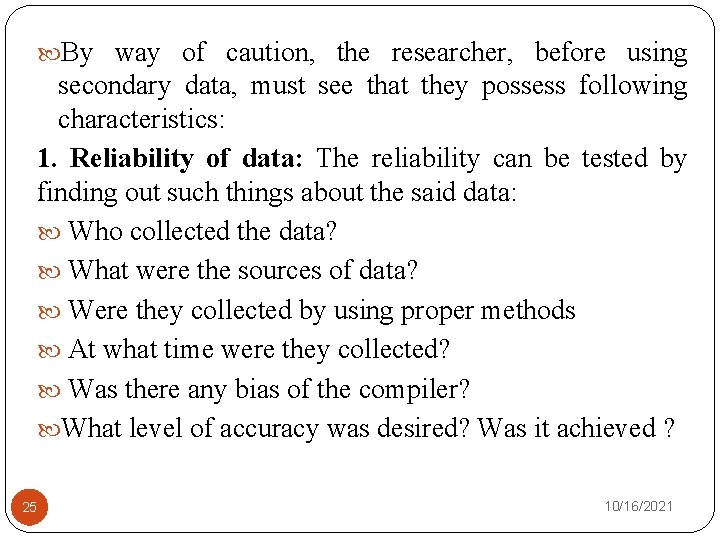
By way of caution, the researcher, before using secondary data, must see that they possess following characteristics: 1. Reliability of data: The reliability can be tested by finding out such things about the said data: Who collected the data? What were the sources of data? Were they collected by using proper methods At what time were they collected? Was there any bias of the compiler? What level of accuracy was desired? Was it achieved ? 25 10/16/2021
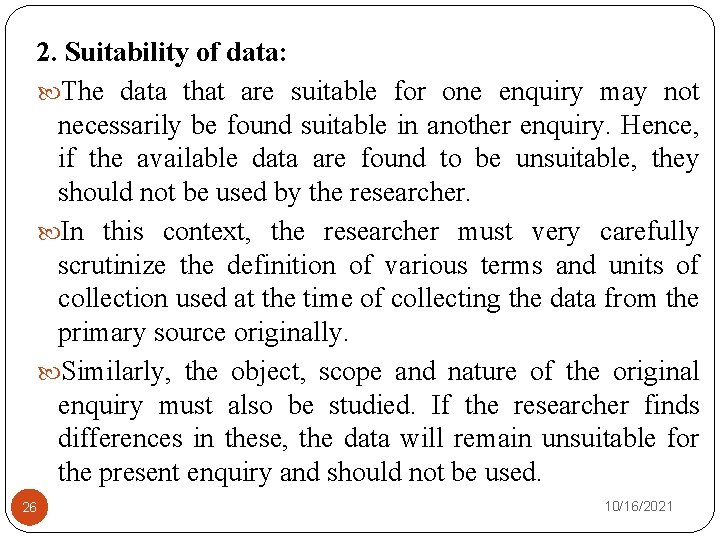
2. Suitability of data: The data that are suitable for one enquiry may not necessarily be found suitable in another enquiry. Hence, if the available data are found to be unsuitable, they should not be used by the researcher. In this context, the researcher must very carefully scrutinize the definition of various terms and units of collection used at the time of collecting the data from the primary source originally. Similarly, the object, scope and nature of the original enquiry must also be studied. If the researcher finds differences in these, the data will remain unsuitable for the present enquiry and should not be used. 26 10/16/2021
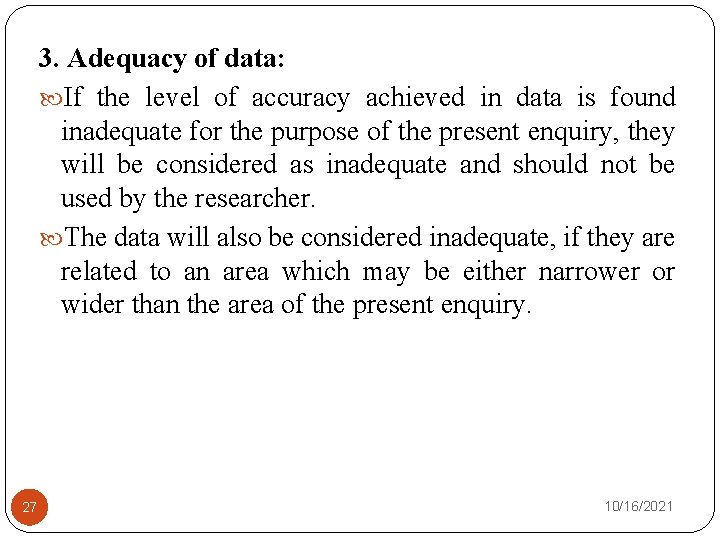
3. Adequacy of data: If the level of accuracy achieved in data is found inadequate for the purpose of the present enquiry, they will be considered as inadequate and should not be used by the researcher. The data will also be considered inadequate, if they are related to an area which may be either narrower or wider than the area of the present enquiry. 27 10/16/2021
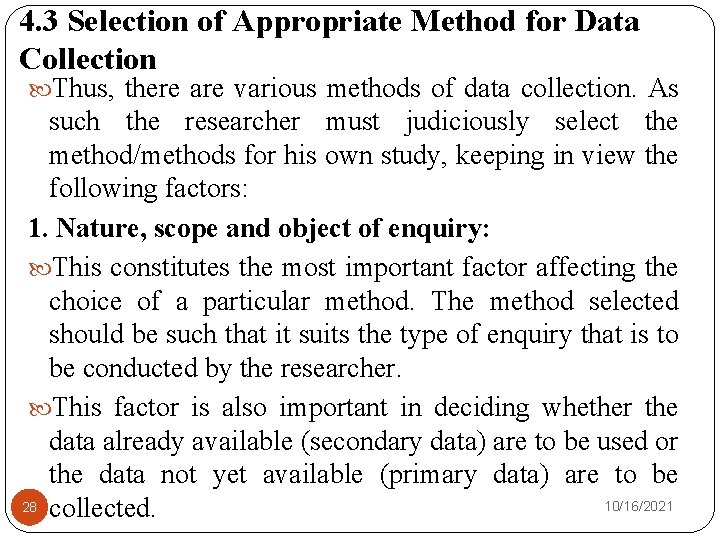
4. 3 Selection of Appropriate Method for Data Collection Thus, there are various methods of data collection. As such the researcher must judiciously select the method/methods for his own study, keeping in view the following factors: 1. Nature, scope and object of enquiry: This constitutes the most important factor affecting the choice of a particular method. The method selected should be such that it suits the type of enquiry that is to be conducted by the researcher. This factor is also important in deciding whether the data already available (secondary data) are to be used or the data not yet available (primary data) are to be 10/16/2021 28 collected.
2. Availability of funds: Availability of funds for the research project determines to a large extent the method to be used for the collection of data. When funds at the disposal of the researcher are very limited, he will have to select a comparatively cheaper method which may not be as efficient and effective as some other costly method. Finance, in fact, is a big constraint in practice and the researcher has to act within this limitation. 29 10/16/2021
3. Time factor: Availability of time has also to be taken into account in deciding a particular method of data collection. Some methods take relatively more time, whereas with others the data can be collected in a comparatively shorter duration. The time at the disposal of the researcher, thus, affects the selection of the method by which the data are to be collected. 4. Precision required: Precision required is yet another important factor to be considered at the time of selecting the method of collection of data. 30 10/16/2021