
4 1 Identifying Texture of soil TEXTURE OF
- Slides: 9
4. 1 Identifying Texture of soil TEXTURE OF SOIL • Chemically, physically and mineralogically soil particles depend on the measure of the particles. • The smaller the measure of the particle, the wider the width of the surface will be. Thus, width of clayey fraction > dusty fraction > sand For example : • Ball typed particle with 1 gram weight and with bulk density 2, 65 g/cm 3 divided into 106 smaller ball typed particles with each particle weighes 10 -6 gram
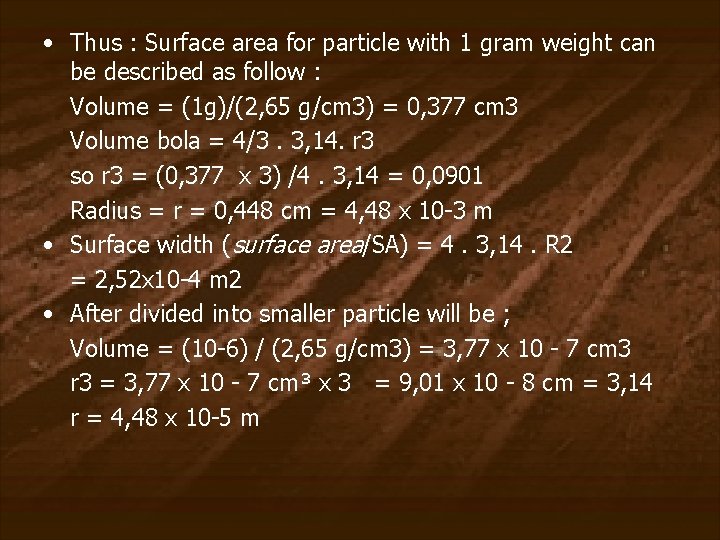
• Thus : Surface area for particle with 1 gram weight can be described as follow : Volume = (1 g)/(2, 65 g/cm 3) = 0, 377 cm 3 Volume bola = 4/3. 3, 14. r 3 so r 3 = (0, 377 x 3) /4. 3, 14 = 0, 0901 Radius = r = 0, 448 cm = 4, 48 x 10 -3 m • Surface width (surface area/SA) = 4. 3, 14. R 2 = 2, 52 x 10 -4 m 2 • After divided into smaller particle will be ; Volume = (10 -6) / (2, 65 g/cm 3) = 3, 77 x 10 - 7 cm 3 r 3 = 3, 77 x 10 - 7 cm³ x 3 = 9, 01 x 10 - 8 cm = 3, 14 r = 4, 48 x 10 -5 m
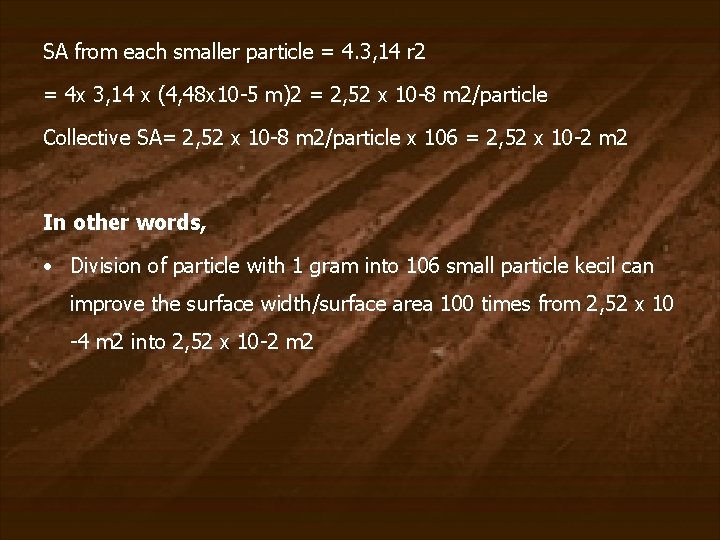
SA from each smaller particle = 4. 3, 14 r 2 = 4 x 3, 14 x (4, 48 x 10 -5 m)2 = 2, 52 x 10 -8 m 2/particle Collective SA= 2, 52 x 10 -8 m 2/particle x 106 = 2, 52 x 10 -2 m 2 In other words, • Division of particle with 1 gram into 106 small particle kecil can improve the surface width/surface area 100 times from 2, 52 x 10 -4 m 2 into 2, 52 x 10 -2 m 2
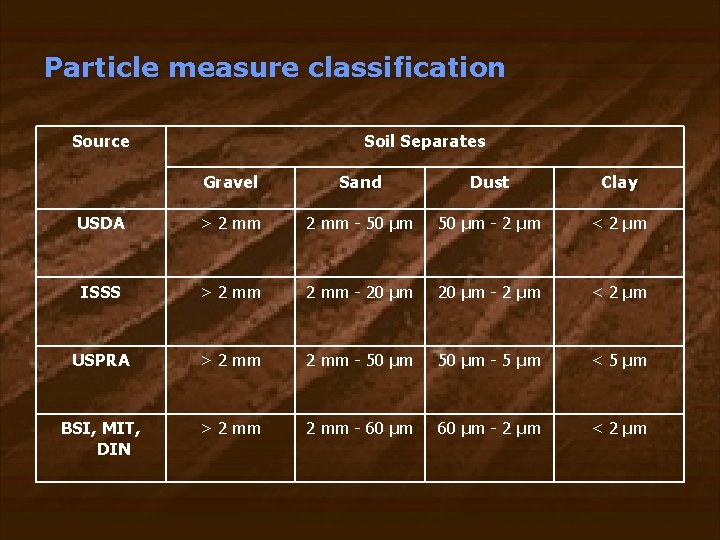
Particle measure classification Source Soil Separates Gravel Sand Dust Clay USDA > 2 mm - 50 μm - 2 μm < 2 μm ISSS > 2 mm - 20 μm - 2 μm < 2 μm USPRA > 2 mm - 50 μm - 5 μm < 5 μm BSI, MIT, DIN > 2 mm - 60 μm - 2 μm < 2 μm
• Soil texture is defined as sand, dust and clay proportion • Measure of particle over 2 mm, the organic substance and sticky agent as carbonate must be removed first before determining the texture • Soil having the same texture such as dusty loam has phisycal and chemical charateristics which are almost similar to prerequisite of clayey minerology
• Soil texture can be recognized in area by knowing consistencial phenomenon and sense of touching according to stream schema and in laboratorium by using pippete and hidrometer methods • Soil texture determines water system, air system and easiness of soil processing and structuring
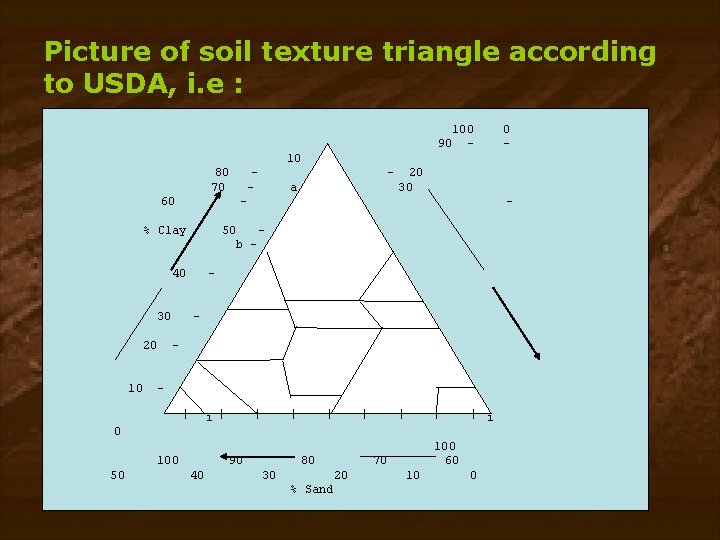
Picture of soil texture triangle according to USDA, i. e : 90 100 - 10 80 70 - 60 a - 20 30 - 40 % Clay 50 b - 50 40 % Debu c - 60 d 30 - f - 20 e 70 - g - 80 h 10 - h j - 90 i i 0 100 50 90 40 80 30 70 20 % Sand 100 60 10 0
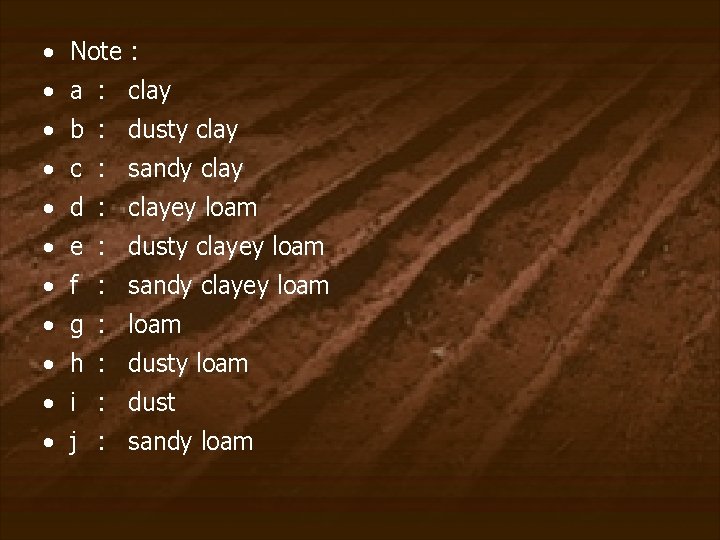
• Note : • a : clay • b : dusty clay • c : sandy clay • d : clayey loam • e : dusty clayey loam • f : sandy clayey loam • g : loam • h : dusty loam • i : dust • j : sandy loam
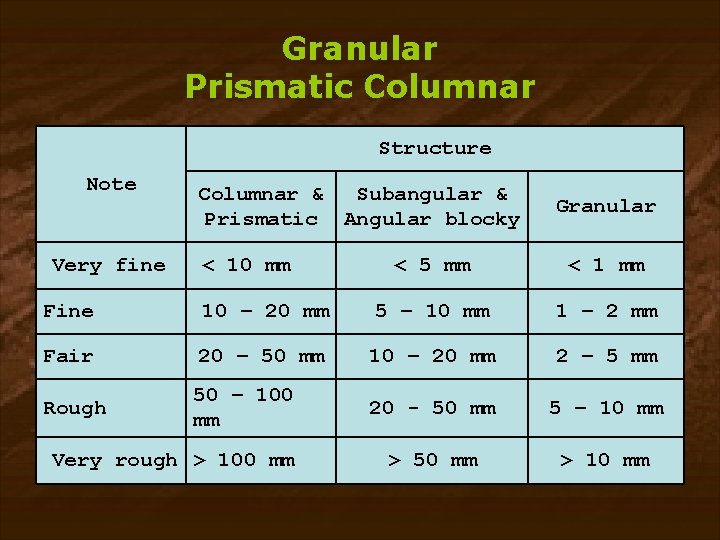
Granular Prismatic Columnar Structure Note Very fine Columnar & Subangular & Prismatic Angular blocky < 10 mm Granular < 5 mm < 1 mm Fine 10 – 20 mm 5 – 10 mm 1 – 2 mm Fair 20 – 50 mm 10 – 20 mm 2 – 5 mm Rough 50 – 100 mm 20 - 50 mm 5 – 10 mm > 50 mm > 10 mm Very rough > 100 mm