
4 1 Chapter Four Audit Evidence and Audit

- Slides: 26
4 -1 Chapter Four Audit Evidence and Audit Documentation Mc. Graw-Hill/Irwin Copyright © 2006 by The Mc. Graw-Hill Companies, Inc. All rights reserved.
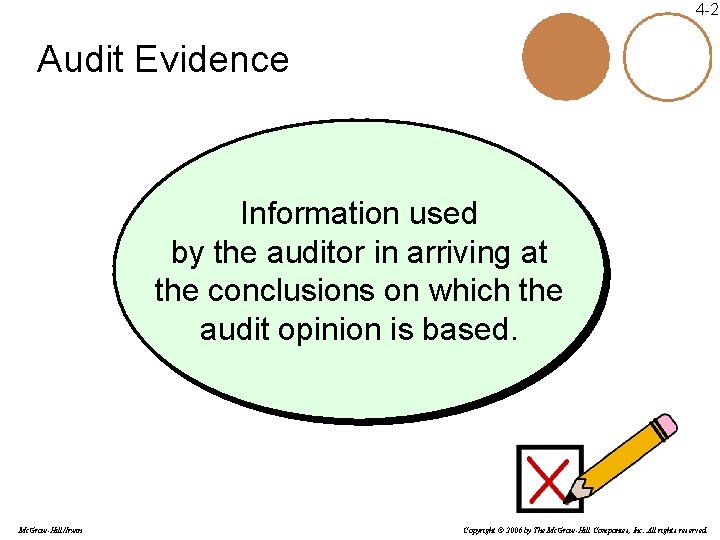
4 -2 Audit Evidence Information used by the auditor in arriving at the conclusions on which the audit opinion is based. Mc. Graw-Hill/Irwin Copyright © 2006 by The Mc. Graw-Hill Companies, Inc. All rights reserved.
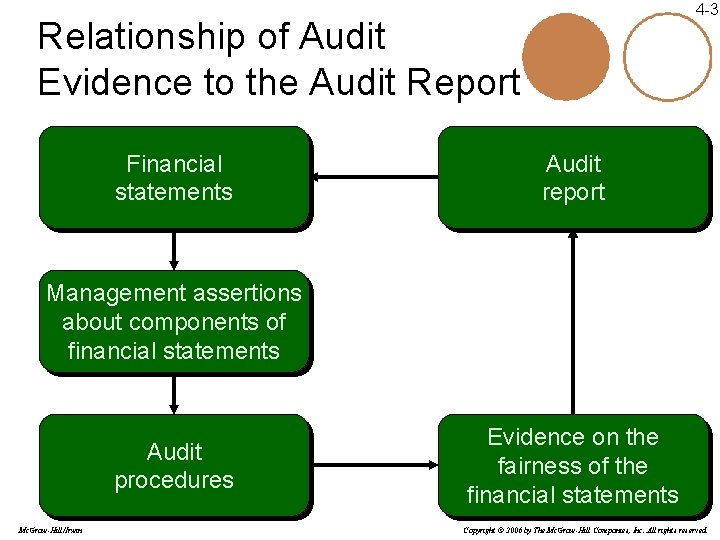
4 -3 Relationship of Audit Evidence to the Audit Report Financial statements Audit report Management assertions about components of financial statements Audit procedures Mc. Graw-Hill/Irwin Evidence on the fairness of the financial statements Copyright © 2006 by The Mc. Graw-Hill Companies, Inc. All rights reserved.
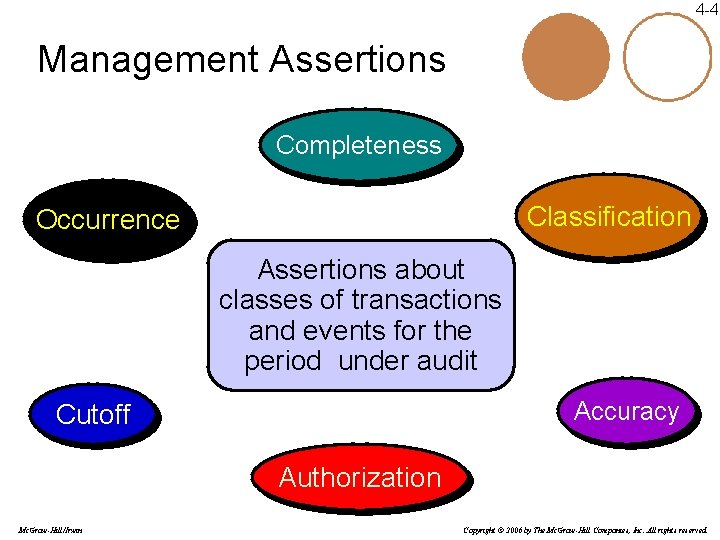
4 -4 Management Assertions Completeness Classification Occurrence Assertions about classes of transactions and events for the period under audit Accuracy Cutoff Authorization Mc. Graw-Hill/Irwin Copyright © 2006 by The Mc. Graw-Hill Companies, Inc. All rights reserved.
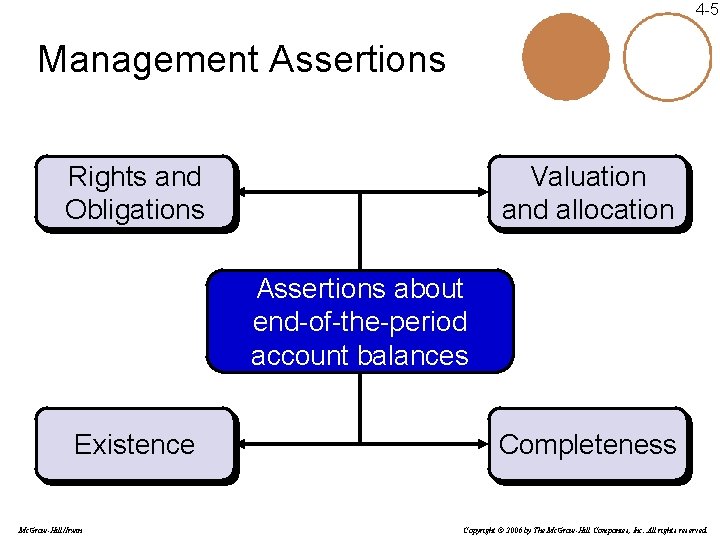
4 -5 Management Assertions Rights and Obligations Valuation and allocation Assertions about end-of-the-period account balances Existence Mc. Graw-Hill/Irwin Completeness Copyright © 2006 by The Mc. Graw-Hill Companies, Inc. All rights reserved.
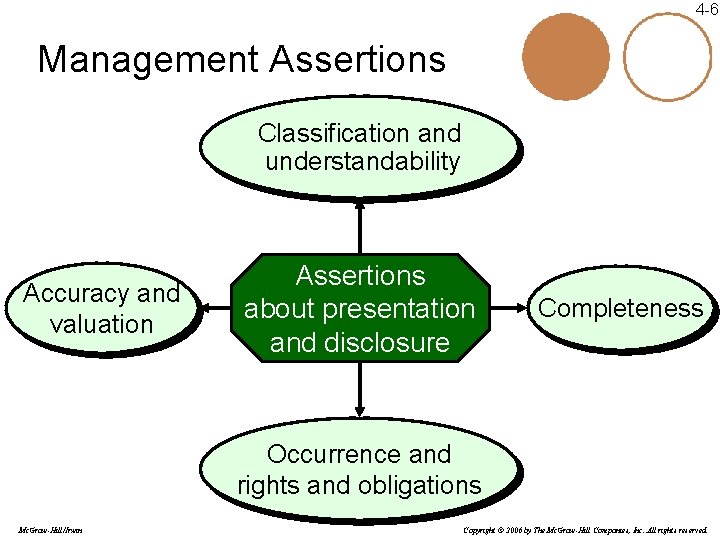
4 -6 Management Assertions Classification and understandability Accuracy and valuation Assertions about presentation and disclosure Completeness Occurrence and rights and obligations Mc. Graw-Hill/Irwin Copyright © 2006 by The Mc. Graw-Hill Companies, Inc. All rights reserved.
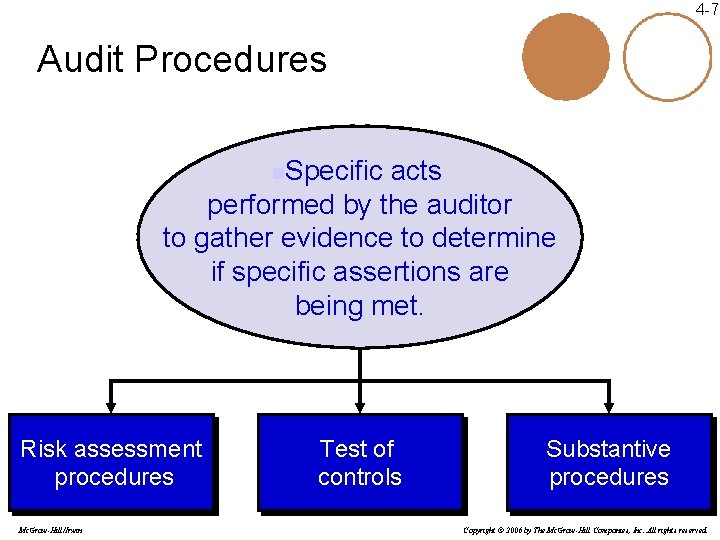
4 -7 Audit Procedures n. Specific acts performed by the auditor to gather evidence to determine if specific assertions are being met. Risk assessment procedures Mc. Graw-Hill/Irwin Test of controls Substantive procedures Copyright © 2006 by The Mc. Graw-Hill Companies, Inc. All rights reserved.
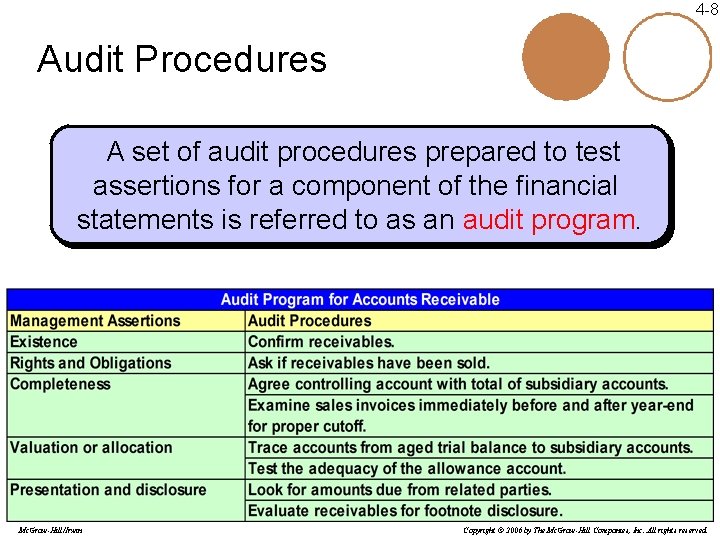
4 -8 Audit Procedures n. A set of audit procedures prepared to test assertions for a component of the financial statements is referred to as an audit program. Mc. Graw-Hill/Irwin Copyright © 2006 by The Mc. Graw-Hill Companies, Inc. All rights reserved.
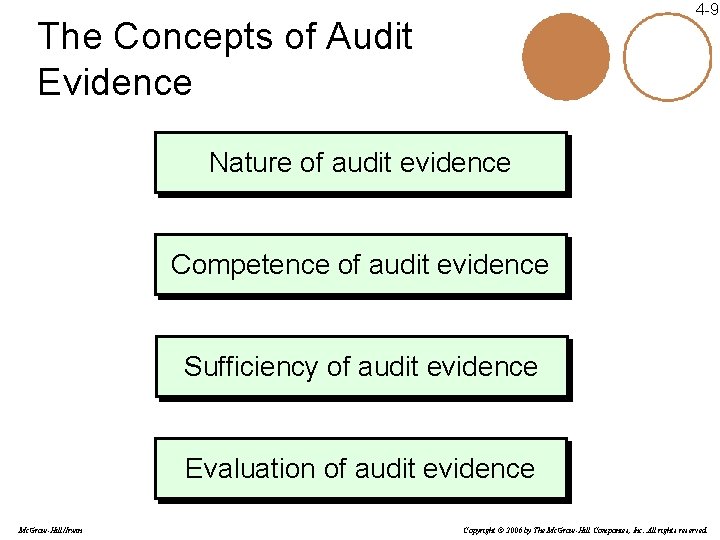
4 -9 The Concepts of Audit Evidence Nature of audit evidence Competence of audit evidence Sufficiency of audit evidence Evaluation of audit evidence Mc. Graw-Hill/Irwin Copyright © 2006 by The Mc. Graw-Hill Companies, Inc. All rights reserved.
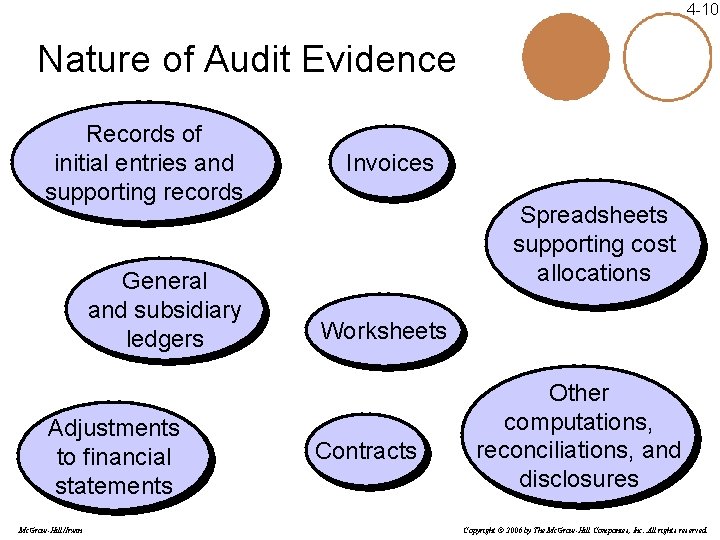
4 -10 Nature of Audit Evidence Records of initial entries and supporting records General and subsidiary ledgers Adjustments to financial statements Mc. Graw-Hill/Irwin Invoices Spreadsheets supporting cost allocations Worksheets Contracts Other computations, reconciliations, and disclosures Copyright © 2006 by The Mc. Graw-Hill Companies, Inc. All rights reserved.
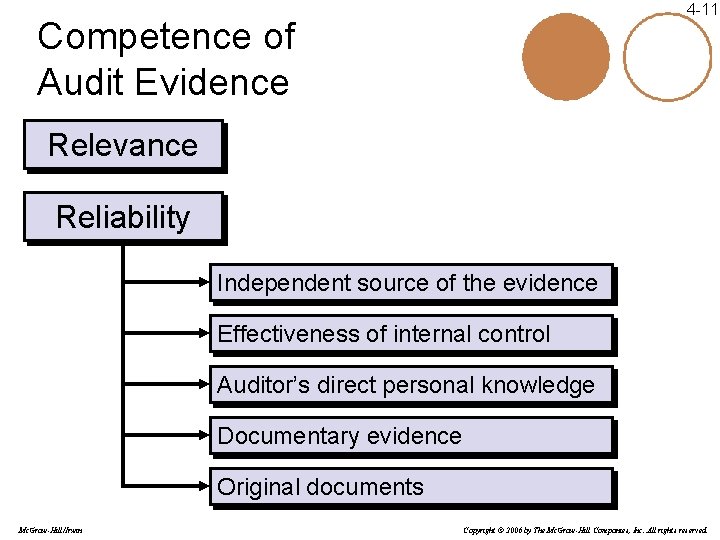
4 -11 Competence of Audit Evidence Relevance Reliability Independent source of the evidence Effectiveness of internal control Auditor’s direct personal knowledge Documentary evidence Original documents Mc. Graw-Hill/Irwin Copyright © 2006 by The Mc. Graw-Hill Companies, Inc. All rights reserved.
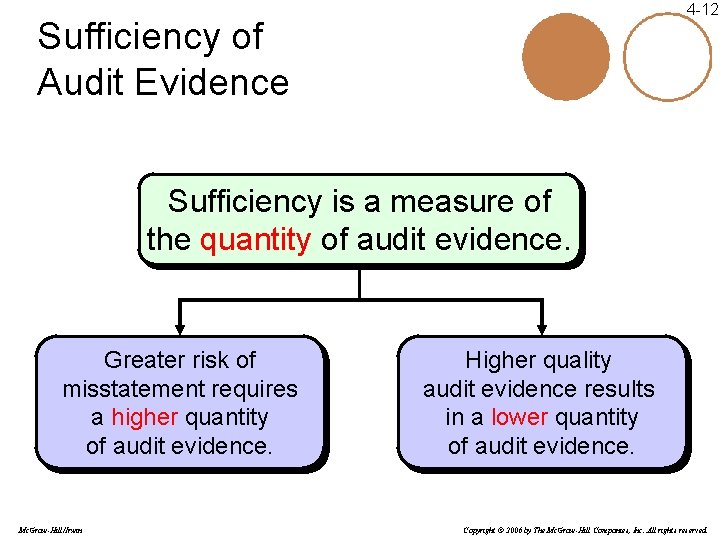
4 -12 Sufficiency of Audit Evidence Sufficiency is a measure of the quantity of audit evidence. Greater risk of misstatement requires a higher quantity of audit evidence. Mc. Graw-Hill/Irwin Higher quality audit evidence results in a lower quantity of audit evidence. Copyright © 2006 by The Mc. Graw-Hill Companies, Inc. All rights reserved.
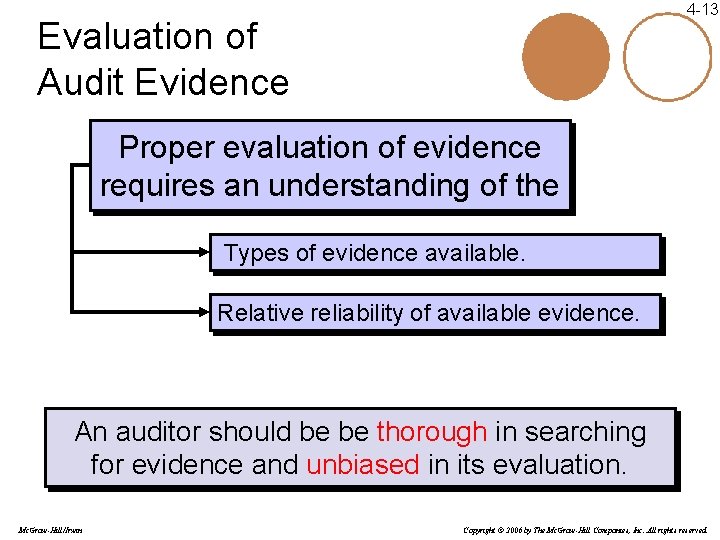
4 -13 Evaluation of Audit Evidence Proper evaluation of evidence requires an understanding of the Types of evidence available. Relative reliability of available evidence. An auditor should be be thorough in searching for evidence and unbiased in its evaluation. Mc. Graw-Hill/Irwin Copyright © 2006 by The Mc. Graw-Hill Companies, Inc. All rights reserved.
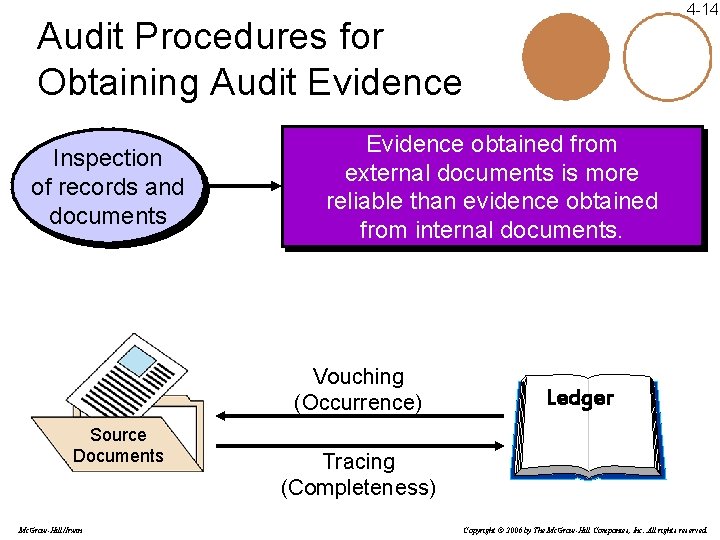
4 -14 Audit Procedures for Obtaining Audit Evidence Inspection of records and documents Evidence obtained from external documents is more reliable than evidence obtained from internal documents. Vouching (Occurrence) Source Documents Mc. Graw-Hill/Irwin Ledger Tracing (Completeness) Copyright © 2006 by The Mc. Graw-Hill Companies, Inc. All rights reserved.
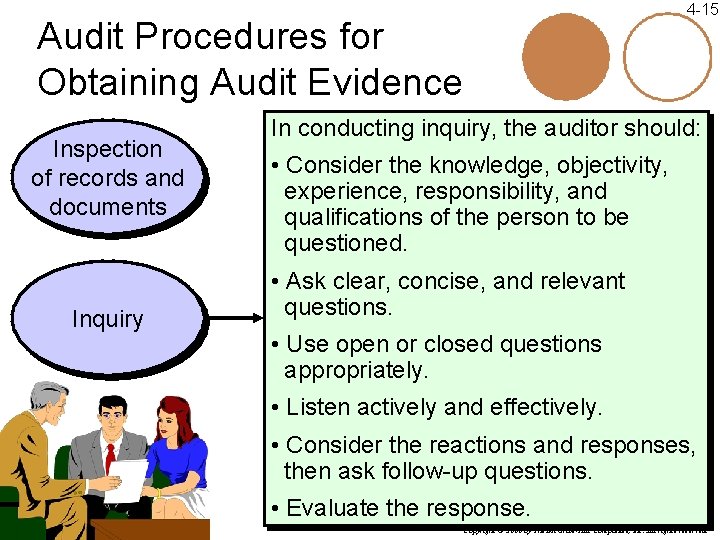
Audit Procedures for Obtaining Audit Evidence Inspection of records and documents Inquiry 4 -15 In conducting inquiry, the auditor should: • Consider the knowledge, objectivity, experience, responsibility, and qualifications of the person to be questioned. • Ask clear, concise, and relevant questions. • Use open or closed questions appropriately. • Listen actively and effectively. • Consider the reactions and responses, then ask follow-up questions. • Evaluate the response. Mc. Graw-Hill/Irwin Copyright © 2006 by The Mc. Graw-Hill Companies, Inc. All rights reserved.
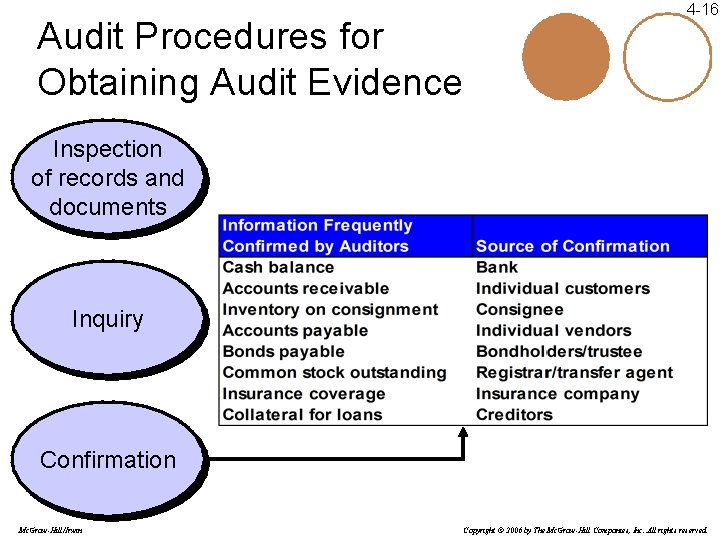
Audit Procedures for Obtaining Audit Evidence 4 -16 Inspection of records and documents Inquiry Confirmation Mc. Graw-Hill/Irwin Copyright © 2006 by The Mc. Graw-Hill Companies, Inc. All rights reserved.
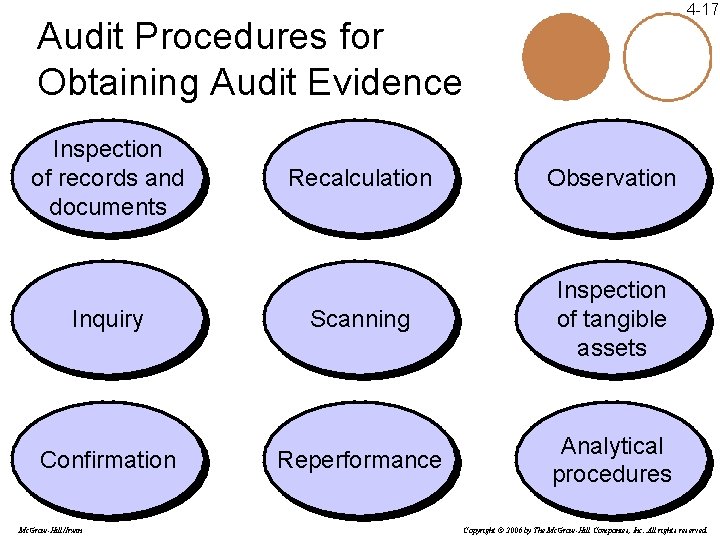
4 -17 Audit Procedures for Obtaining Audit Evidence Inspection of records and documents Recalculation Observation Inquiry Scanning Inspection of tangible assets Confirmation Reperformance Analytical procedures Mc. Graw-Hill/Irwin Copyright © 2006 by The Mc. Graw-Hill Companies, Inc. All rights reserved.
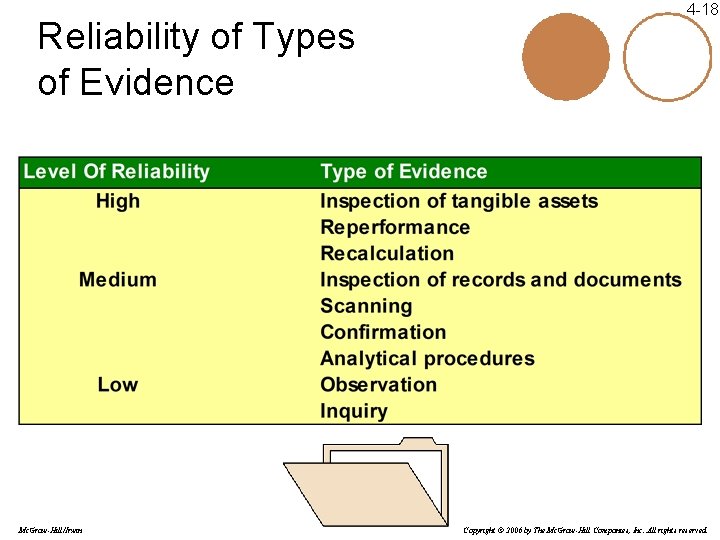
Reliability of Types of Evidence Mc. Graw-Hill/Irwin 4 -18 Copyright © 2006 by The Mc. Graw-Hill Companies, Inc. All rights reserved.
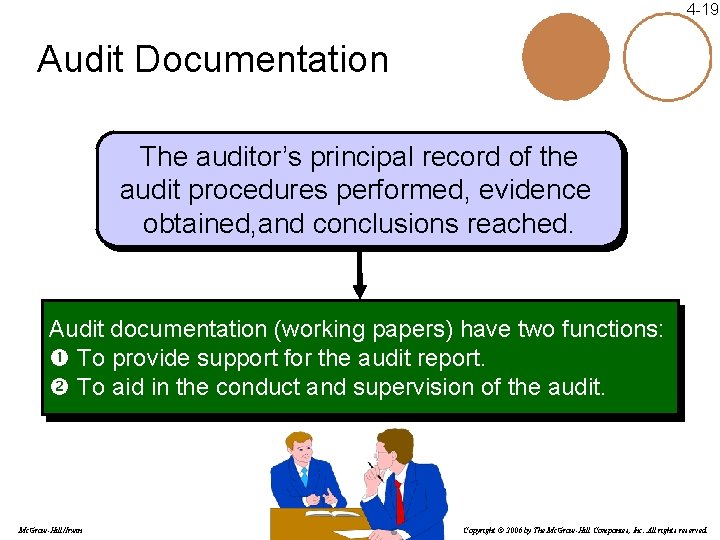
4 -19 Audit Documentation The auditor’s principal record of the audit procedures performed, evidence obtained, and conclusions reached. Audit documentation (working papers) have two functions: To provide support for the audit report. To aid in the conduct and supervision of the audit. Mc. Graw-Hill/Irwin Copyright © 2006 by The Mc. Graw-Hill Companies, Inc. All rights reserved.
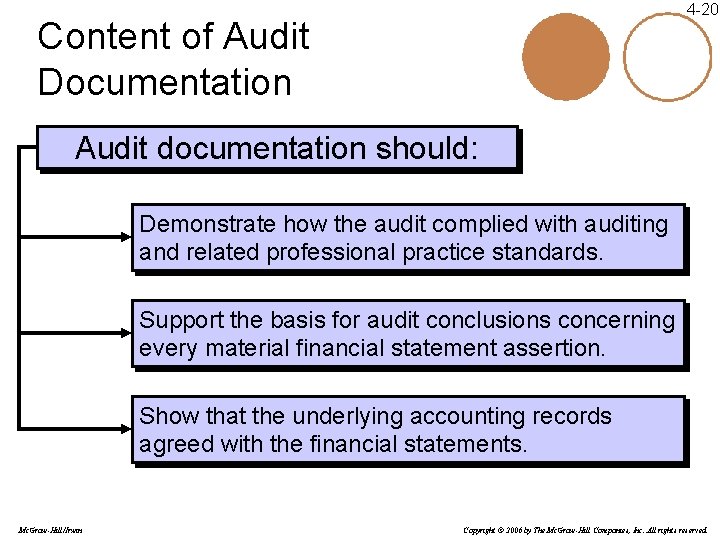
4 -20 Content of Audit Documentation Audit documentation should: Demonstrate how the audit complied with auditing and related professional practice standards. Support the basis for audit conclusions concerning every material financial statement assertion. Show that the underlying accounting records agreed with the financial statements. Mc. Graw-Hill/Irwin Copyright © 2006 by The Mc. Graw-Hill Companies, Inc. All rights reserved.
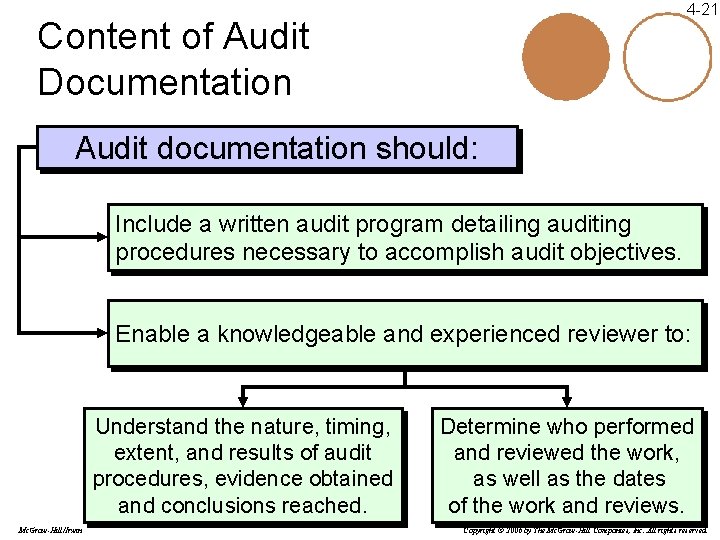
4 -21 Content of Audit Documentation Audit documentation should: Include a written audit program detailing auditing procedures necessary to accomplish audit objectives. Enable a knowledgeable and experienced reviewer to: Understand the nature, timing, extent, and results of audit procedures, evidence obtained and conclusions reached. Mc. Graw-Hill/Irwin Determine who performed and reviewed the work, as well as the dates of the work and reviews. Copyright © 2006 by The Mc. Graw-Hill Companies, Inc. All rights reserved.
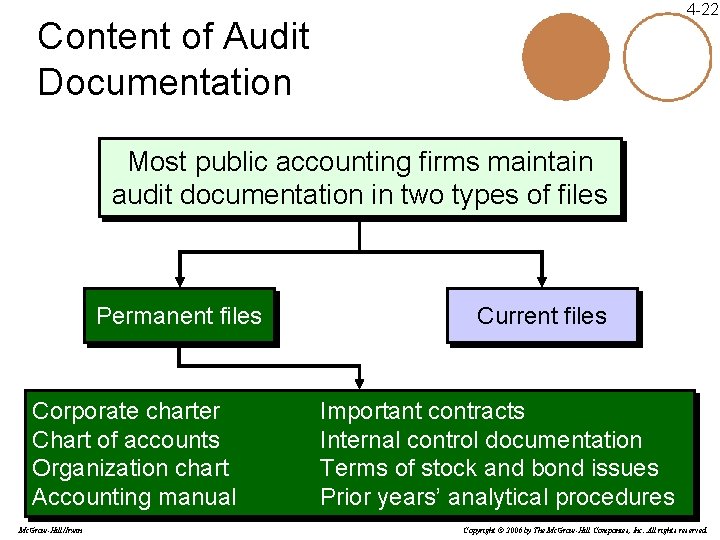
4 -22 Content of Audit Documentation Most public accounting firms maintain audit documentation in two types of files Permanent files Corporate charter Chart of accounts Organization chart Accounting manual Mc. Graw-Hill/Irwin Current files Important contracts Internal control documentation Terms of stock and bond issues Prior years’ analytical procedures Copyright © 2006 by The Mc. Graw-Hill Companies, Inc. All rights reserved.
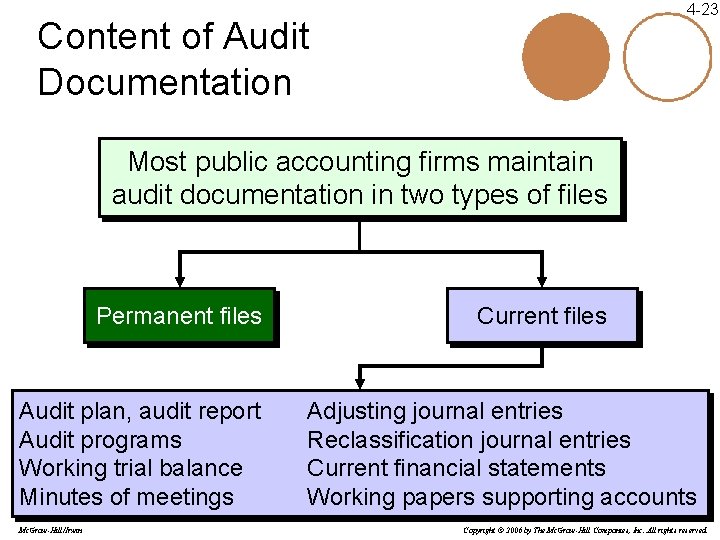
4 -23 Content of Audit Documentation Most public accounting firms maintain audit documentation in two types of files Permanent files Audit plan, audit report Audit programs Working trial balance Minutes of meetings Mc. Graw-Hill/Irwin Current files Adjusting journal entries Reclassification journal entries Current financial statements Working papers supporting accounts Copyright © 2006 by The Mc. Graw-Hill Companies, Inc. All rights reserved.
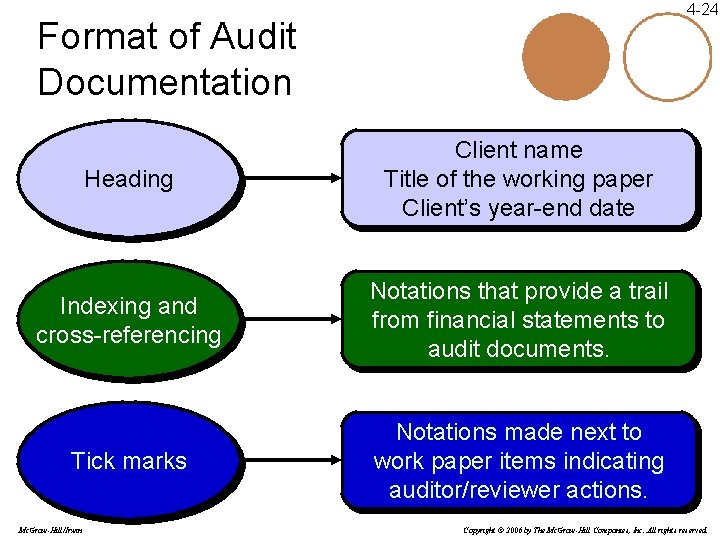
4 -24 Format of Audit Documentation Heading Client name Title of the working paper Client’s year-end date Indexing and cross-referencing Notations that provide a trail from financial statements to audit documents. Tick marks Notations made next to work paper items indicating auditor/reviewer actions. Mc. Graw-Hill/Irwin Copyright © 2006 by The Mc. Graw-Hill Companies, Inc. All rights reserved.
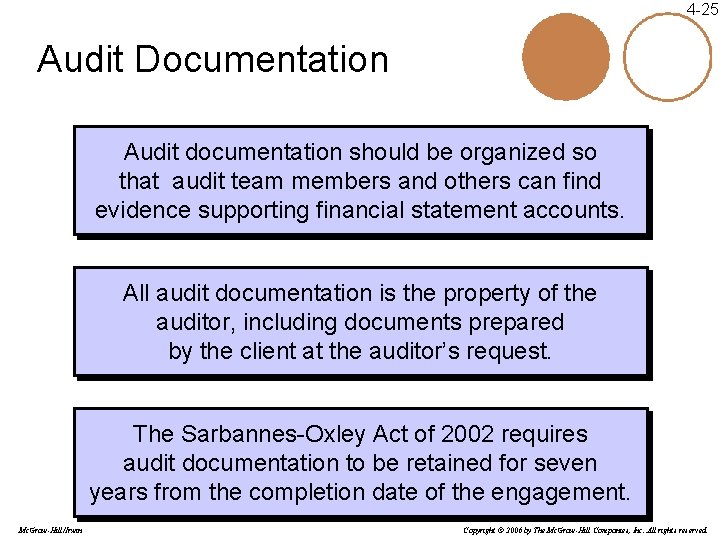
4 -25 Audit Documentation Audit documentation should be organized so that audit team members and others can find evidence supporting financial statement accounts. All audit documentation is the property of the auditor, including documents prepared by the client at the auditor’s request. The Sarbannes-Oxley Act of 2002 requires audit documentation to be retained for seven years from the completion date of the engagement. Mc. Graw-Hill/Irwin Copyright © 2006 by The Mc. Graw-Hill Companies, Inc. All rights reserved.
4 -26 End of Chapter 4 Mc. Graw-Hill/Irwin Copyright © 2006 by The Mc. Graw-Hill Companies, Inc. All rights reserved.