
4 1 Atomic structure and the periodic table
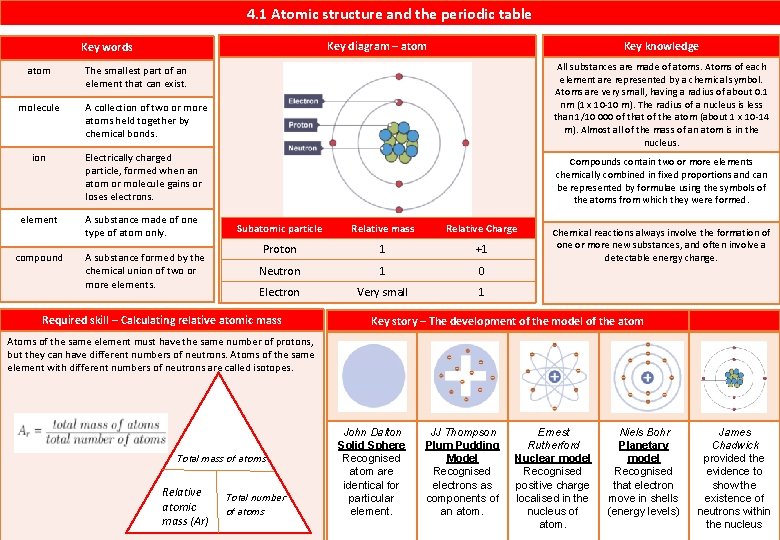
4. 1 Atomic structure and the periodic table atom All substances are made of atoms. Atoms of each element are represented by a chemical symbol. Atoms are very small, having a radius of about 0. 1 nm (1 x 10 -10 m). The radius of a nucleus is less than 1/10 000 of that of the atom (about 1 x 10 -14 m). Almost all of the mass of an atom is in the nucleus. The smallest part of an element that can exist. molecule A collection of two or more atoms held together by chemical bonds. ion Electrically charged particle, formed when an atom or molecule gains or loses electrons. element A substance made of one type of atom only. compound Key knowledge Key diagram – atom Key words A substance formed by the chemical union of two or more elements. Compounds contain two or more elements chemically combined in fixed proportions and can be represented by formulae using the symbols of the atoms from which they were formed. Subatomic particle Relative mass Relative Charge Proton 1 +1 Neutron 1 0 Electron Very small 1 Required skill – Calculating relative atomic mass Chemical reactions always involve the formation of one or more new substances, and often involve a detectable energy change. Key story – The development of the model of the atom Atoms of the same element must have the same number of protons, but they can have different numbers of neutrons. Atoms of the same element with different numbers of neutrons are called isotopes. Total mass of atoms Relative atomic mass (Ar) Total number of atoms John Dalton Solid Sphere Recognised atom are identical for particular element. JJ Thompson Plum Pudding Model Recognised electrons as components of an atom. Ernest Rutherford Nuclear model Recognised positive charge localised in the nucleus of atom. Niels Bohr Planetary model Recognised that electron move in shells (energy levels) James Chadwick provided the evidence to show the existence of neutrons within the nucleus
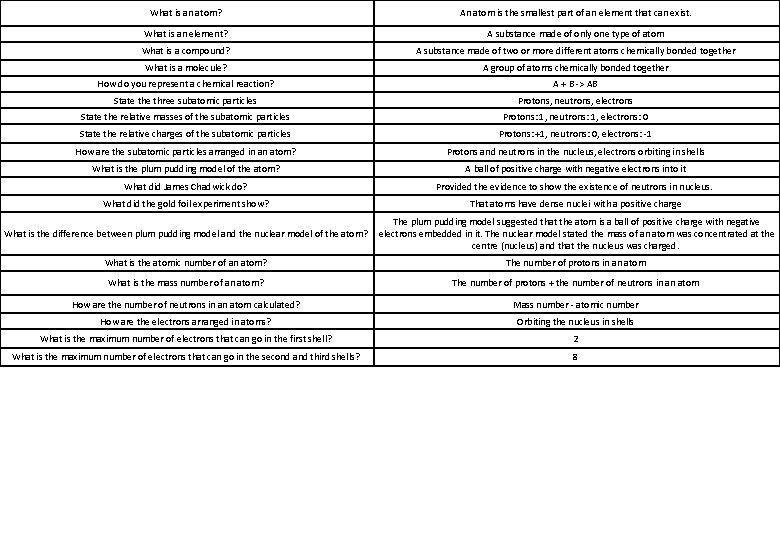
What is an atom? An atom is the smallest part of an element that can exist. What is an element? A substance made of only one type of atom What is a compound? A substance made of two or more different atoms chemically bonded together What is a molecule? A group of atoms chemically bonded together How do you represent a chemical reaction? A + B -> AB State three subatomic particles Protons, neutrons, electrons State the relative masses of the subatomic particles Protons: 1, neutrons: 1, electrons: 0 State the relative charges of the subatomic particles Protons: +1, neutrons: 0, electrons: -1 How are the subatomic particles arranged in an atom? Protons and neutrons in the nucleus, electrons orbiting in shells What is the plum pudding model of the atom? A ball of positive charge with negative electrons into it What did James Chadwick do? Provided the evidence to show the existence of neutrons in nucleus. What did the gold foil experiment show? That atoms have dense nuclei with a positive charge What is the difference between plum pudding model and the nuclear model of the atom? The plum pudding model suggested that the atom is a ball of positive charge with negative electrons embedded in it. The nuclear model stated the mass of an atom was concentrated at the centre (nucleus) and that the nucleus was charged. What is the atomic number of an atom? The number of protons in an atom What is the mass number of an atom? The number of protons + the number of neutrons in an atom How are the number of neutrons in an atom calculated? Mass number - atomic number How are the electrons arranged in atoms? Orbiting the nucleus in shells What is the maximum number of electrons that can go in the first shell? 2 What is the maximum number of electrons that can go in the second and third shells? 8

C 1 Atomic structure and the periodic table Key diagram – Periodic Table period A horizontal row in the periodic table. properties The characteristics of something. In chemistry, chemical properties include the reactions a substance can take part in. Physical properties include colour and boiling point. periodic table non-metal A tabular representation of all known elements in order based on atomic number, eg all the noble gases are found on the right of the periodic table. Element that is a poor conductor of electricity and heat, and which forms negative ion. Shiny element that is a good conductor of electricity and heat, and which forms positive ion. Periods Key words Elements are arranged in rows, called periods, in order of increasing atomic number. Elements with similar properties are placed in vertical columns, called groups. The table is called the periodic table because elements with similar properties occur at regular intervals. Groups 1 2 3 4 5 6 The electronic structure of an element is linked to its position on the periodic table. The zig-zag line in this diagram separates the metals, on the left, from the non-metals, on the right. They are unreactive Physical properties: • The boiling points of the noble gases are low • The boiling points increase going down the group. Group 1 (Alkali metals) Group 7 (Halogens) 7 electrons in the outer shell Placed between groups 2 and 3 in the periodic table The reactivity of the elements increases going down the group. M + water → M hydroxide + hydrogen M + oxygen → M oxide M + chlorine → M chloride The reactivity of the elements decreases down the group. M + chlorine → M chloride M + bromine → M bromide M + iodine → M iodide Halogen can displace each other in chemical reaction. Form ions with different charges and coloured compounds. Used as catalyst. Physical properties: • soft • relatively low melting points • low densities Physical properties: • the melting point increases going down the group. • The boiling point increases going down the group. Physical properties (compared to group 1): • higher melting points • higher densities • greater strength • greater hardness 1 electron in their outer shell. Electronic structure feature Link to the periodic table Number of shells Period number Number of electrons in outermost shell Group number Numbers added together Atomic number Key story - The development of the periodic table Required skills – Identifying trends in data Group 0 (Noble gases) 8 electrons in their outer shell (except for helium) Key knowledge Transition metals M + oxygen → M oxide M + chlorine → M chloride Early periodic tables were incomplete, since many elements were unknown and some elements were placed in groups with elements that were not similar to them based on the relative atomic mass. Dmitri Mendeleev arranged the elements in order of increasing atomic weights. He also took into account the properties of the elements and their compounds. This meant that his table: • had gaps in it ( he predicted the properties of undiscovered elements) • showed elements with similar chemical properties lined up in groups, even if it meant reversing their order.
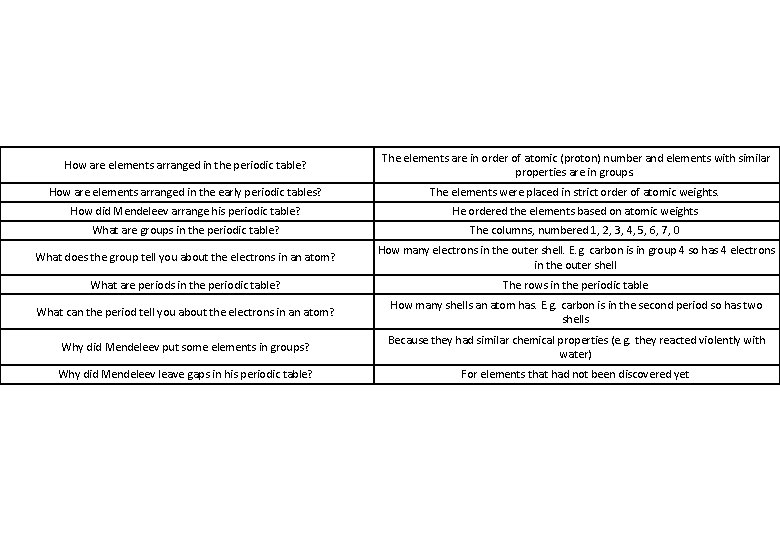
How are elements arranged in the periodic table? The elements are in order of atomic (proton) number and elements with similar properties are in groups. How are elements arranged in the early periodic tables? The elements were placed in strict order of atomic weights. How did Mendeleev arrange his periodic table? He ordered the elements based on atomic weights What are groups in the periodic table? The columns, numbered 1, 2, 3, 4, 5, 6, 7, 0 What does the group tell you about the electrons in an atom? How many electrons in the outer shell. E. g. carbon is in group 4 so has 4 electrons in the outer shell What are periods in the periodic table? The rows in the periodic table What can the period tell you about the electrons in an atom? How many shells an atom has. E. g. carbon is in the second period so has two shells Why did Mendeleev put some elements in groups? Because they had similar chemical properties (e. g. they reacted violently with water) Why did Mendeleev leave gaps in his periodic table? For elements that had not been discovered yet
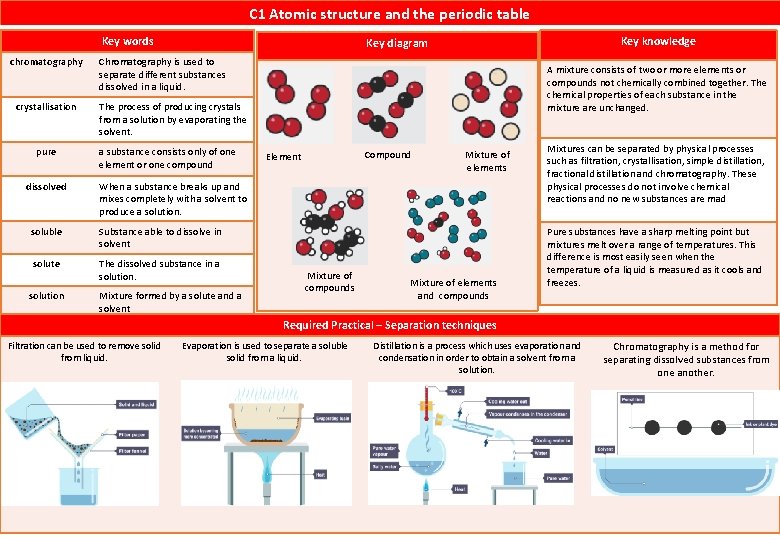
C 1 Atomic structure and the periodic table Key words chromatography crystallisation pure dissolved Chromatography is used to separate different substances dissolved in a liquid. A mixture consists of two or more elements or compounds not chemically combined together. The chemical properties of each substance in the mixture are unchanged. The process of producing crystals from a solution by evaporating the solvent. a substance consists only of one element or one compound Compound Element Mixture of elements When a substance breaks up and mixes completely with a solvent to produce a solution. soluble Substance able to dissolve in solvent solute The dissolved substance in a solution Key knowledge Key diagram Mixture formed by a solute and a solvent Mixture of compounds Mixture of elements and compounds Mixtures can be separated by physical processes such as filtration, crystallisation, simple distillation, fractional distillation and chromatography. These physical processes do not involve chemical reactions and no new substances are mad Pure substances have a sharp melting point but mixtures melt over a range of temperatures. This difference is most easily seen when the temperature of a liquid is measured as it cools and freezes. Required Practical – Separation techniques Filtration can be used to remove solid from liquid. Evaporation is used to separate a soluble solid from a liquid. Distillation is a process which uses evaporation and condensation in order to obtain a solvent from a solution. Chromatography is a method for separating dissolved substances from one another.
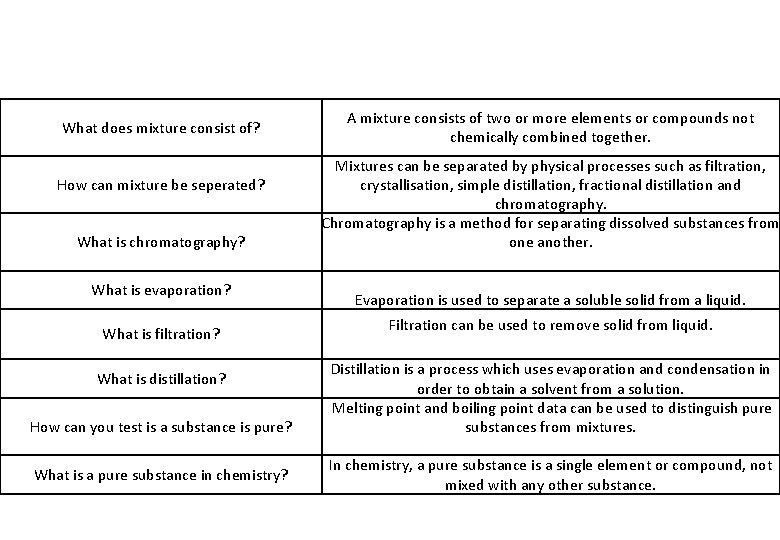
What does mixture consist of? How can mixture be seperated? What is chromatography? What is evaporation? What is filtration? What is distillation? How can you test is a substance is pure? What is a pure substance in chemistry? A mixture consists of two or more elements or compounds not chemically combined together. Mixtures can be separated by physical processes such as filtration, crystallisation, simple distillation, fractional distillation and chromatography. Chromatography is a method for separating dissolved substances from one another. Evaporation is used to separate a soluble solid from a liquid. Filtration can be used to remove solid from liquid. Distillation is a process which uses evaporation and condensation in order to obtain a solvent from a solution. Melting point and boiling point data can be used to distinguish pure substances from mixtures. In chemistry, a pure substance is a single element or compound, not mixed with any other substance.

Ionic bonds Key words lattice A regular grid-like arrangement of atoms in a material. charge Property of matter that causes a force when near another charge. Charge comes in two forms, positive and negative. charged particles Particles, usually ions or electrons, that carry electrical charges. electron Subatomic particle, with a negative charge and a negligible mass relative to protons and neutrons. electrostatic force ion Key diagram Key knowledge Ionic compounds have regular structures (giant ionic lattices) in which there are strong electrostatic forces of attraction in all directions between oppositely charged ions. These compounds have high melting points and high boiling points because of the large amounts of energy needed to break the many strong bonds. When melted or dissolved in water, ionic compounds conduct electricity because the ions are free to move and so charge can flow. Metal atoms lose electrons to become positively charged ions. The ions produced by metals in Groups 1 and 2 have the electronic structure of a noble gas (Group 0) and a positive charge. A force of attraction between particles with opposite charges. Non-metal atoms gain electrons to become negatively charged ions. The ions produced by non-metals in Groups 6 and 7 have the electronic structure of a noble gas (Group 0) and a negative charge. Electrically charged particle, formed when an atom or molecule gains or loses electrons. Key skill – Using models A two-dimensional space-filling model Shows the arrangement of ions in one layer, but it does not show the next layer of ions is arranged A three-dimensional space-filling model Shows the arrangement of ions in a larger section of the crystal, but shows lots of free space between the ions, which there isn't. A three-dimensional ball and stick model Shows the arrangement of ions in a larger section of the crystal, but using sticks for bonds is misleading because the forces of attraction between ions actually act in all directions
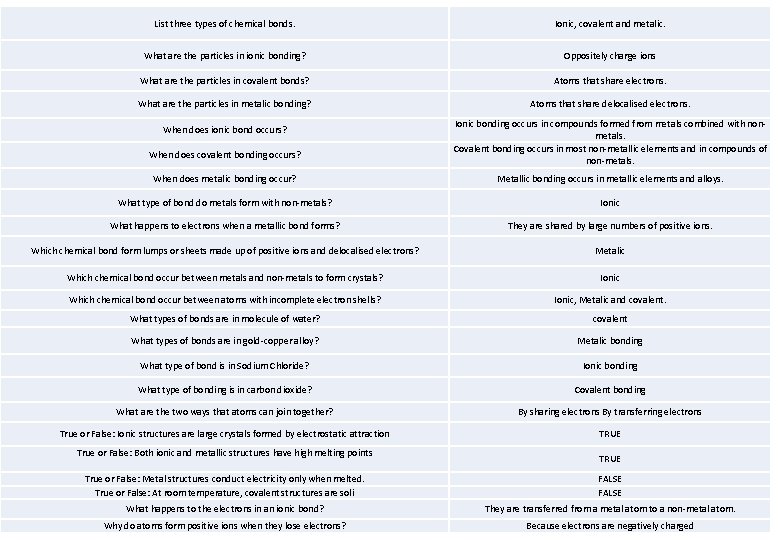
List three types of chemical bonds. Ionic, covalent and metalic. What are the particles in ionic bonding? Oppositely charge ions What are the particles in covalent bonds? Atoms that share electrons. What are the particles in metalic bonding? Atoms that share delocalised electrons. When does ionic bond occurs? When does covalent bonding occurs? Ionic bonding occurs in compounds formed from metals combined with nonmetals. Covalent bonding occurs in most non-metallic elements and in compounds of non-metals. When does metalic bonding occur? Metallic bonding occurs in metallic elements and alloys. What type of bond do metals form with non-metals? Ionic What happens to electrons when a metallic bond forms? They are shared by large numbers of positive ions. Which chemical bond form lumps or sheets made up of positive ions and delocalised electrons? Metalic Which chemical bond occur between metals and non-metals to form crystals? Ionic Which chemical bond occur between atoms with incomplete electron shells? Ionic, Metalic and covalent. What types of bonds are in molecule of water? covalent What types of bonds are in gold-copper alloy? Metalic bonding What type of bond is in Sodium Chloride? Ionic bonding What type of bonding is in carbon dioxide? Covalent bonding What are the two ways that atoms can join together? By sharing electrons By transferring electrons True or False: Ionic structures are large crystals formed by electrostatic attraction TRUE True or False: Both ionic and metallic structures have high melting points TRUE True or False: Metal structures conduct electricity only when melted. True or False: At room temperature, covalent structures are soli FALSE What happens to the electrons in an ionic bond? They are transferred from a metal atom to a non-metal atom. Why do atoms form positive ions when they lose electrons? Because electrons are negatively charged
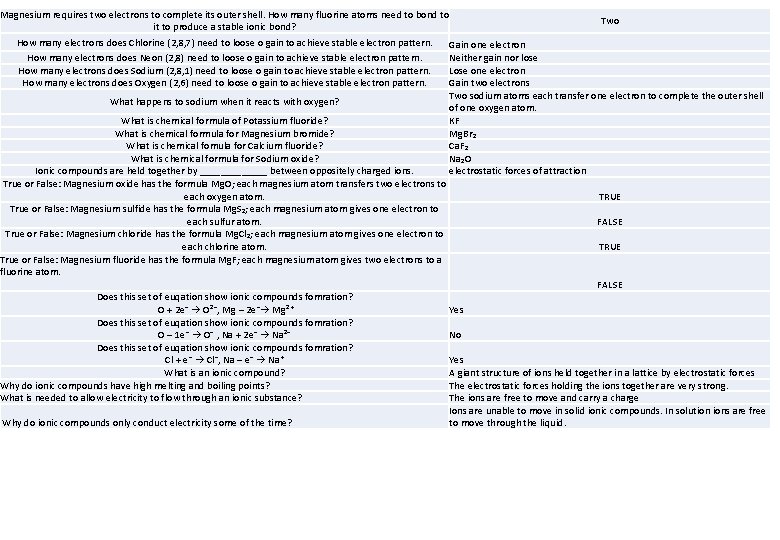
Magnesium requires two electrons to complete its outer shell. How many fluorine atoms need to bond to Two it to produce a stable ionic bond? How many electrons does Chlorine (2, 8, 7) need to loose o gain to achieve stable electron pattern. Gain one electron How many electrons does Neon (2, 8) need to loose o gain to achieve stable electron pattern. Neither gain nor lose How many electrons does Sodium (2, 8, 1) need to loose o gain to achieve stable electron pattern. Lose one electron How many electrons does Oxygen (2, 6) need to loose o gain to achieve stable electron pattern. Gain two electrons Two sodium atoms each transfer one electron to complete the outer shell What happens to sodium when it reacts with oxygen? of one oxygen atom. What is chemical formula of Potassium fluoride? KF What is chemical formula for Magnesium bromide? Mg. Br₂ What is chemical fomula for Calcium fluoride? Ca. F₂ What is chemical formula for Sodium oxide? Na₂O Ionic compounds are held together by _______ between oppositely charged ions. electrostatic forces of attraction True or False: Magnesium oxide has the formula Mg. O; each magnesium atom transfers two electrons to each oxygen atom. TRUE True or False: Magnesium sulfide has the formula Mg. S₂; each magnesium atom gives one electron to each sulfur atom. FALSE True or False: Magnesium chloride has the formula Mg. Cl₂; each magnesium atom gives one electron to each chlorine atom. TRUE True or False: Magnesium fluoride has the formula Mg. F; each magnesium atom gives two electrons to a fluorine atom. FALSE Does this set of euqation show ionic compounds fomration? O + 2 e⁻ → O²⁻, Mg – 2 e⁻→ Mg²⁺ Yes Does this set of euqation show ionic compounds fomration? O – 1 e⁻ → O⁻ , Na + 2 e⁻ → Na²⁻ No Does this set of euqation show ionic compounds fomration? Cl + e⁻ → Cl⁻, Na – e⁻ → Na⁺ Yes What is an ionic compound? A giant structure of ions held together in a lattice by electrostatic forces Why do ionic compounds have high melting and boiling points? The electrostatic forces holding the ions together are very strong. What is needed to allow electricity to flow through an ionic substance? The ions are free to move and carry a charge Ions are unable to move in solid ionic compounds. In solution ions are free Why do ionic compounds only conduct electricity some of the time? to move through the liquid.
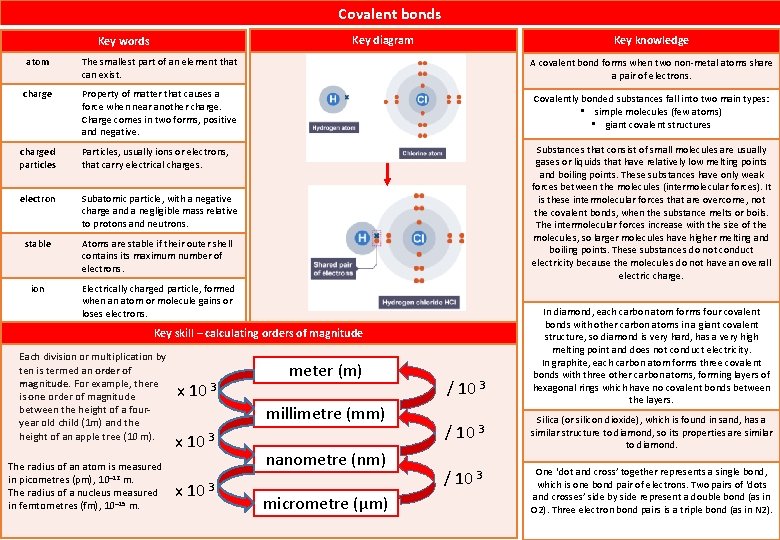
Covalent bonds Key diagram Key words Key knowledge atom The smallest part of an element that can exist. A covalent bond forms when two non-metal atoms share a pair of electrons. charge Property of matter that causes a force when near another charge. Charge comes in two forms, positive and negative. Covalently bonded substances fall into two main types: • simple molecules (few atoms) • giant covalent structures charged particles Particles, usually ions or electrons, that carry electrical charges. electron Subatomic particle, with a negative charge and a negligible mass relative to protons and neutrons. stable Atoms are stable if their outer shell contains its maximum number of electrons. Substances that consist of small molecules are usually gases or liquids that have relatively low melting points and boiling points. These substances have only weak forces between the molecules (intermolecular forces). It is these intermolecular forces that are overcome, not the covalent bonds, when the substance melts or boils. The intermolecular forces increase with the size of the molecules, so larger molecules have higher melting and boiling points. These substances do not conduct electricity because the molecules do not have an overall electric charge. ion Electrically charged particle, formed when an atom or molecule gains or loses electrons. Key skill – calculating orders of magnitude Each division or multiplication by ten is termed an order of magnitude. For example, there is one order of magnitude between the height of a fouryear old child (1 m) and the height of an apple tree (10 m). The radius of an atom is measured in picometres (pm), 10– 12 m. The radius of a nucleus measured in femtometres (fm), 10– 15 m. x 10 3 meter (m) millimetre (mm) x 10 3 nanometre (nm) micrometre (µm) / 10 3 In diamond, each carbon atom forms four covalent bonds with other carbon atoms in a giant covalent structure, so diamond is very hard, has a very high melting point and does not conduct electricity. In graphite, each carbon atom forms three covalent bonds with three other carbon atoms, forming layers of hexagonal rings which have no covalent bonds between the layers. Silica (or silicon dioxide), which is found in sand, has a similar structure to diamond, so its properties are similar to diamond. One ‘dot and cross’ together represents a single bond, which is one bond pair of electrons. Two pairs of ‘dots and crosses’ side by side represent a double bond (as in O 2). Three electron bond pairs is a triple bond (as in N 2).
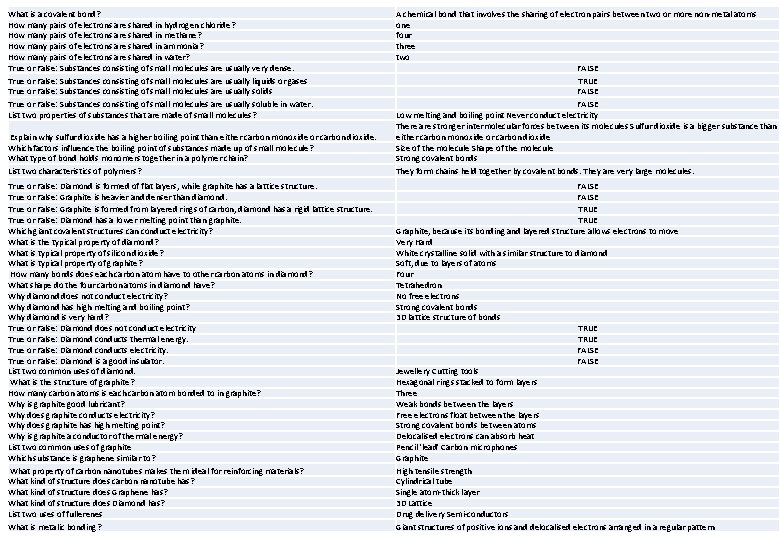
What is a covalent bond? How many pairs of electrons are shared in hydrogen chloride? How many pairs of electrons are shared in methane? How many pairs of electrons are shared in ammonia? How many pairs of electrons are shared in water? True or False: Substances consisting of small molecules are usually very dense. True or False: Substances consisting of small molecules are usually liquids or gases True or False: Substances consisting of small molecules are usually solids True or False: Substances consisting of small molecules are usually soluble in water. List two properties of substances that are made of small molecules? Explain why sulfur dioxide has a higher boiling point than either carbon monoxide or carbon dioxide. Which factors influence the boiling point of substances made up of small molecule? What type of bond holds monomers together in a polymer chain? List two characteristics of polymers? A chemical bond that involves the sharing of electron pairs between two or more non-metal atoms one four three two FALSE TRUE FALSE Low melting and boiling point Never conduct electricity There are stronger intermolecular forces between its molecules Sulfur dioxide is a bigger substance than either carbon monoxide or carbon dioxide Size of the molecule Shape of the molecule Strong covalent bonds They form chains held together by covalent bonds. They are very large molecules. True or False: Diamond is formed of flat layers, while graphite has a lattice structure. True or False: Graphite is heavier and denser than diamond. True or False: Graphite is formed from layered rings of carbon, diamond has a rigid lattice structure. True or False: Diamond has a lower melting point than graphite. Which giant covalent structures can conduct electricity? What is the typical property of diamond? What is typical property of silicon dioxide? What is typical property of graphite? How many bonds does each carbon atom have to other carbon atoms in diamond? What shape do the four carbon atoms in diamond have? Why diamond does not conduct electricity? Why diamond has high melting and boiling point? Why diamond is very hard? True or False: Diamond does not conduct electricity True or False: Diamond conducts thermal energy. True or False: Diamond conducts electricity. True or False: Diamond is a good insulator. List two common uses of diamond. What is the structure of graphite? How many carbon atoms is each carbon atom bonded to in graphite? Why is graphite good lubricant? Why does graphite conducts electricity? Why does graphite has high melting point? Why is graphite a conductor of thermal energy? List two common uses of graphite Which substance is graphene similar to? What property of carbon nanotubes makes them ideal for reinforcing materials? What kind of structure does carbon nanotube has? What kind of structure does Graphene has? What kind of structure does Diamond has? List two uses of fullerenes What is metalic bonding? FALSE TRUE Graphite, because its bonding and layered structure allows electrons to move Very Hard White crystalline solid with a similar structure to diamond Soft, due to layers of atoms Four Tetrahedron No free electrons Strong covalent bonds 3 D lattice structure of bonds TRUE FALSE Jewellery Cutting tools Hexagonal rings stacked to form layers Three Weak bonds between the layers Free electrons float between the layers Strong covalent bonds between atoms Delocalised electrons can absorb heat Pencil 'lead' Carbon microphones Graphite High tensile strength Cylindrical tube Single atom-thick layer 3 D Lattice Drug delivery Semi-conductors Giant structures of positive ions and delocalised electrons arranged in a regular pattern
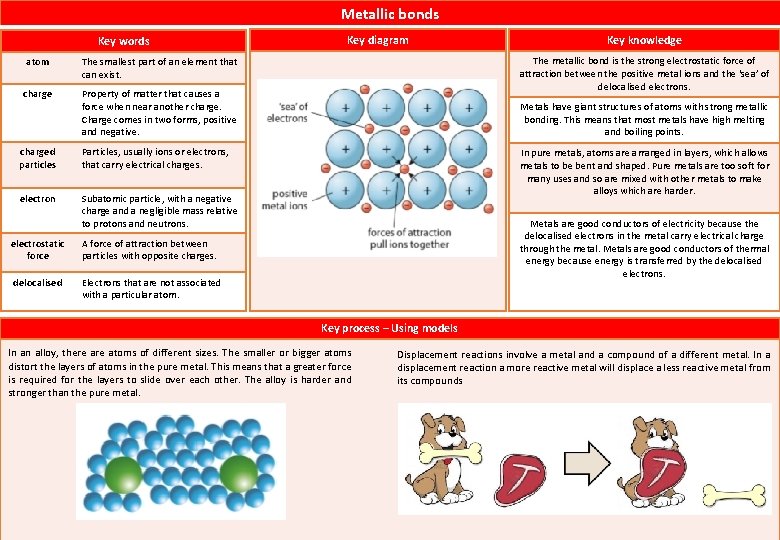
Metallic bonds Key words atom The smallest part of an element that can exist. charge Property of matter that causes a force when near another charge. Charge comes in two forms, positive and negative. charged particles Particles, usually ions or electrons, that carry electrical charges. electron Subatomic particle, with a negative charge and a negligible mass relative to protons and neutrons. electrostatic force A force of attraction between particles with opposite charges. delocalised Electrons that are not associated with a particular atom. Key diagram Key knowledge The metallic bond is the strong electrostatic force of attraction between the positive metal ions and the ‘sea’ of delocalised electrons. Metals have giant structures of atoms with strong metallic bonding. This means that most metals have high melting and boiling points. In pure metals, atoms are arranged in layers, which allows metals to be bent and shaped. Pure metals are too soft for many uses and so are mixed with other metals to make alloys which are harder. Metals are good conductors of electricity because the delocalised electrons in the metal carry electrical charge through the metal. Metals are good conductors of thermal energy because energy is transferred by the delocalised electrons. Key process – Using models In an alloy, there atoms of different sizes. The smaller or bigger atoms distort the layers of atoms in the pure metal. This means that a greater force is required for the layers to slide over each other. The alloy is harder and stronger than the pure metal. Displacement reactions involve a metal and a compound of a different metal. In a displacement reaction a more reactive metal will displace a less reactive metal from its compounds
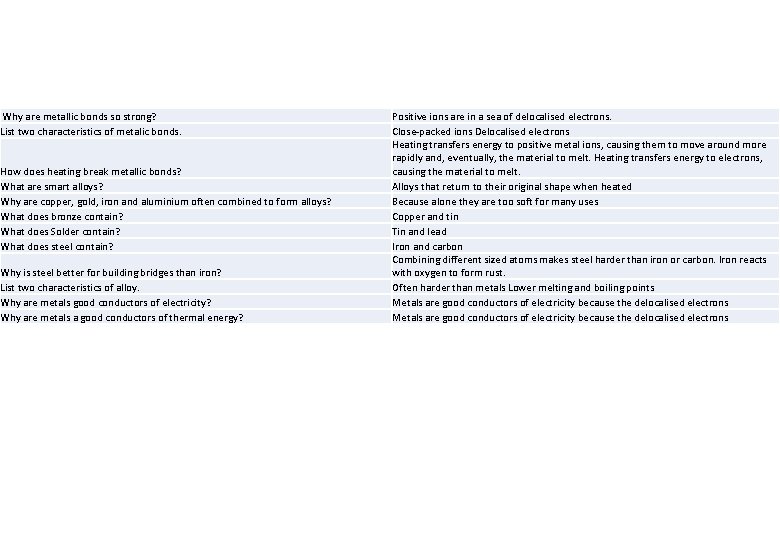
Why are metallic bonds so strong? List two characteristics of metalic bonds. How does heating break metallic bonds? What are smart alloys? Why are copper, gold, iron and aluminium often combined to form alloys? What does bronze contain? What does Solder contain? What does steel contain? Why is steel better for building bridges than iron? List two characteristics of alloy. Why are metals good conductors of electricity? Why are metals a good conductors of thermal energy? Positive ions are in a sea of delocalised electrons. Close-packed ions Delocalised electrons Heating transfers energy to positive metal ions, causing them to move around more rapidly and, eventually, the material to melt. Heating transfers energy to electrons, causing the material to melt. Alloys that return to their original shape when heated Because alone they are too soft for many uses Copper and tin Tin and lead Iron and carbon Combining different sized atoms makes steel harder than iron or carbon. Iron reacts with oxygen to form rust. Often harder than metals Lower melting and boiling points Metals are good conductors of electricity because the delocalised electrons
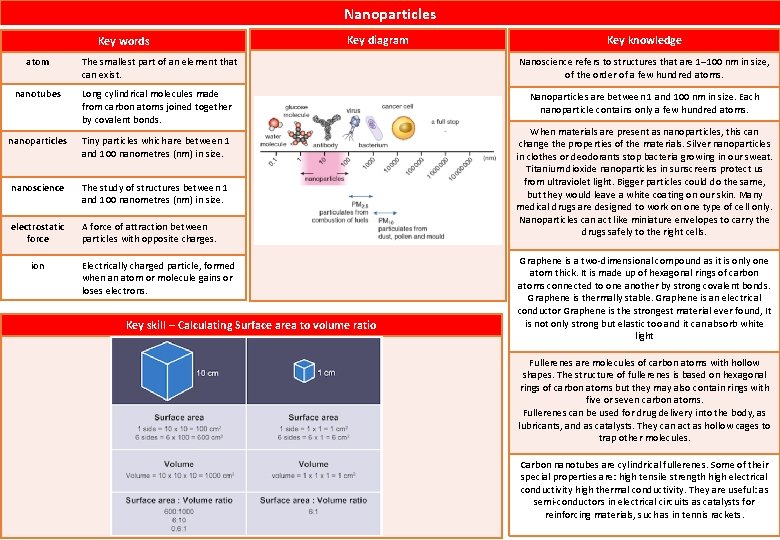
Nanoparticles Key words Key diagram Key knowledge atom The smallest part of an element that can exist. Nanoscience refers to structures that are 1– 100 nm in size, of the order of a few hundred atoms. nanotubes Long cylindrical molecules made from carbon atoms joined together by covalent bonds. Nanoparticles are between 1 and 100 nm in size. Each nanoparticle contains only a few hundred atoms. nanoparticles Tiny particles which are between 1 and 100 nanometres (nm) in size. nanoscience The study of structures between 1 and 100 nanometres (nm) in size. electrostatic force A force of attraction between particles with opposite charges. ion Electrically charged particle, formed when an atom or molecule gains or loses electrons. Key skill – Calculating Surface area to volume ratio When materials are present as nanoparticles, this can change the properties of the materials. Silver nanoparticles in clothes or deodorants stop bacteria growing in our sweat. Titanium dioxide nanoparticles in sunscreens protect us from ultraviolet light. Bigger particles could do the same, but they would leave a white coating on our skin. Many medical drugs are designed to work on one type of cell only. Nanoparticles can act like miniature envelopes to carry the drugs safely to the right cells. Graphene is a two-dimensional compound as it is only one atom thick. It is made up of hexagonal rings of carbon atoms connected to one another by strong covalent bonds. Graphene is thermally stable. Graphene is an electrical conductor Graphene is the strongest material ever found, It is not only strong but elastic too and it can absorb white light Fullerenes are molecules of carbon atoms with hollow shapes. The structure of fullerenes is based on hexagonal rings of carbon atoms but they may also contain rings with five or seven carbon atoms. Fullerenes can be used for drug delivery into the body, as lubricants, and as catalysts. They can act as hollow cages to trap other molecules. Carbon nanotubes are cylindrical fullerenes. Some of their special properties are: high tensile strength high electrical conductivity high thermal conductivity. They are useful: as semi-conductors in electrical circuits as catalysts for reinforcing materials, such as in tennis rackets.
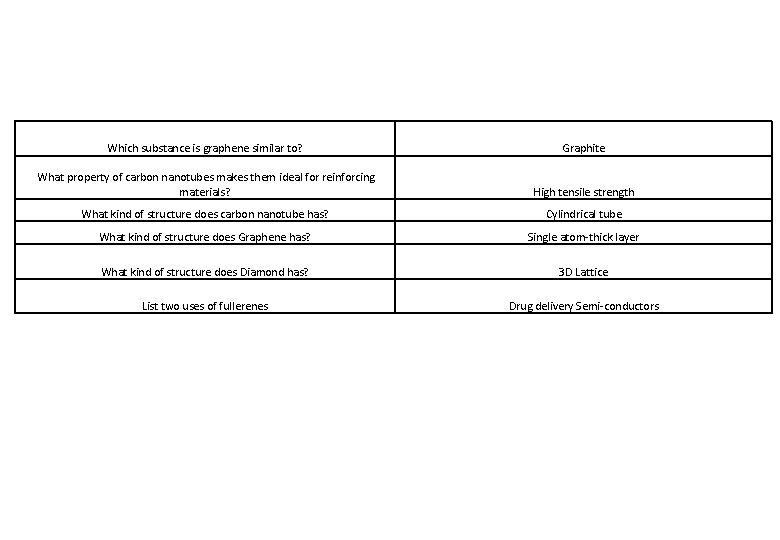
Which substance is graphene similar to? Graphite What property of carbon nanotubes makes them ideal for reinforcing materials? High tensile strength What kind of structure does carbon nanotube has? Cylindrical tube What kind of structure does Graphene has? Single atom-thick layer What kind of structure does Diamond has? 3 D Lattice List two uses of fullerenes Drug delivery Semi-conductors
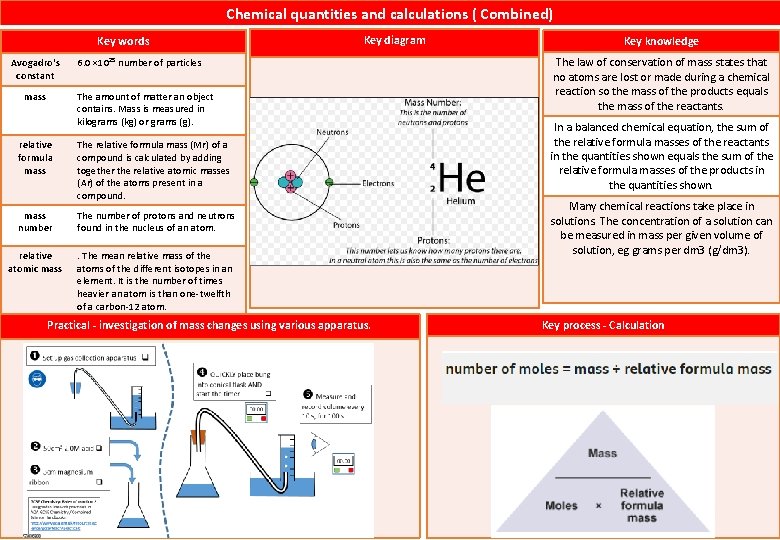
Chemical quantities and calculations ( Combined) Key words Avogadro's constant mass Key diagram 6. 0 × 10²³ number of particles The amount of matter an object contains. Mass is measured in kilograms (kg) or grams (g). relative formula mass The relative formula mass (Mr) of a compound is calculated by adding together the relative atomic masses (Ar) of the atoms present in a compound. mass number The number of protons and neutrons found in the nucleus of an atom. relative atomic mass . The mean relative mass of the atoms of the different isotopes in an element. It is the number of times heavier an atom is than one-twelfth of a carbon-12 atom. Practical - investigation of mass changes using various apparatus. Key knowledge The law of conservation of mass states that no atoms are lost or made during a chemical reaction so the mass of the products equals the mass of the reactants. In a balanced chemical equation, the sum of the relative formula masses of the reactants in the quantities shown equals the sum of the relative formula masses of the products in the quantities shown. Many chemical reactions take place in solutions. The concentration of a solution can be measured in mass per given volume of solution, eg grams per dm 3 (g/dm 3). Key process - Calculation
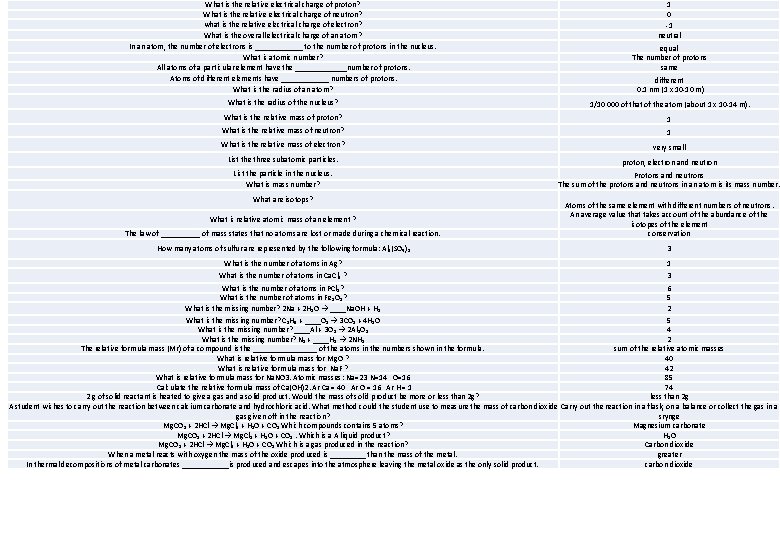
What is the relative electrical charge of proton? What is the relative electrical charge of neutron? what is the relative electrical charge of electron? What is the overall electrical charge of an atom? In an atom, the number of electrons is ______ to the number of protons in the nucleus. What is atomic number? All atoms of a particular element have the _______number of protons. Atoms of different elements have ______ numbers of protons. What is the radius of an atom? 1 0 -1 neutral equal The number of protons same different 0. 1 nm (1 x 10 -10 m) What is the radius of the nucleus? 1/10 000 of that of the atom (about 1 x 10 -14 m). What is the relative mass of proton? 1 What is the relative mass of neutron? 1 What is the relative mass of electron? very small List the three subatomic particles. proton, electron and neutron List the particle in the nucleus. What is mass number? Protons and neutrons The sum of the protons and neutrons in an atom is its mass number. What are isotops? The law of _____ of mass states that no atoms are lost or made during a chemical reaction. Atoms of the same element with different numbers of neutrons. An average value that takes account of the abundance of the isotopes of the element conservation How many atoms of sulfur are represented by the following formula: Al₂(SO₄)₃ 3 What is the number of atoms in Ag? 1 What is the number of atoms in Ca. Cl₂ ? 3 What is relative atomic mass of an element ? What is the number of atoms in PCl₅? 6 What is the number of atoms in Fe₂O₃? 5 What is the missing number? 2 Na + 2 H₂O → ____Na. OH + H₂ 2 What is the missing number? C₃H₈ + ____O₂ → 3 CO₂ + 4 H₂O 5 What is the missing number? ____Al + 3 O₂ → 2 Al₂O₃ 4 What is the missing number? N₂ + ____H₂ → 2 NH₃ 2 The relative formula mass (Mr) of a compound is the ________ of the atoms in the numbers shown in the formula. sum of the relative atomic masses What is relative formula mass for Mg. O ? 40 What is relative formula mass for Na. F ? 42 What is relative formula mass for Na. NO 3. Atomic masses: Na=23 N=14 O=16 85 Calculate the relative formula mass of Ca(OH)2. Ar Ca = 40 Ar O = 16 Ar H = 1 74 2 g of solid reactant is heated to give a gas and a solid product. Would the mass of solid product be more or less than 2 g? less than 2 g A student wishes to carry out the reaction between calcium carbonate and hydrochloric acid. What method could the student use to measure the mass of carbon dioxide Carry out the reaction in a flask, on a balance or collect the gas in a gas given off in the reaction? srynge Mg. CO₃ + 2 HCl → Mg. Cl₂ + H₂O + CO₂ Which compounds contains 5 atoms? Magnesium carbonate Mg. CO₃ + 2 HCl → Mg. Cl₂ + H₂O + CO₂. Which is a A liquid product? H₂O Mg. CO₃ + 2 HCl → Mg. Cl₂ + H₂O + CO₂ Which is a gas produced in the reaction? Carbon dioxide When a metal reacts with oxygen the mass of the oxide produced is _____ than the mass of the metal. greater In thermal decompositions of metal carbonates ______is produced and escapes into the atmosphere leaving the metal oxide as the only solid product. carbon dioxide
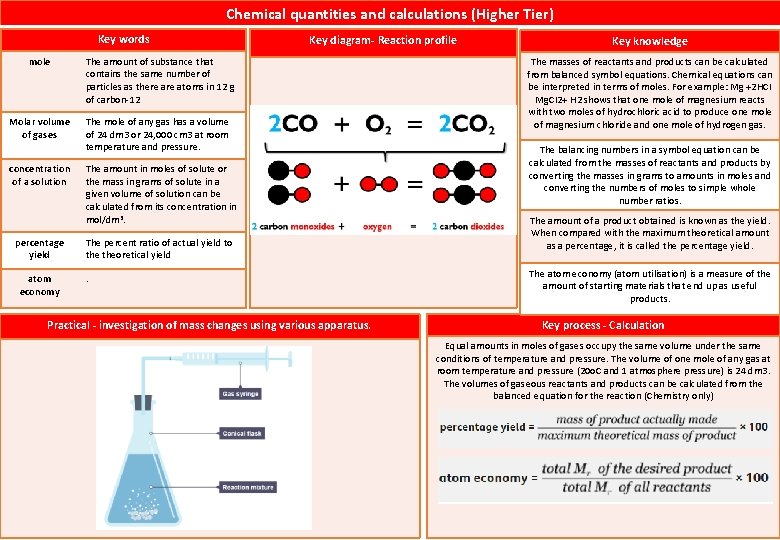
Chemical quantities and calculations (Higher Tier) Key words mole The amount of substance that contains the same number of particles as there atoms in 12 g of carbon-12 Molar volume of gases The mole of any gas has a volume of 24 dm 3 or 24, 000 cm 3 at room temperature and pressure. concentration of a solution percentage yield atom economy Key diagram- Reaction profile The amount in moles of solute or the mass in grams of solute in a given volume of solution can be calculated from its concentration in mol/dm 3. The percent ratio of actual yield to theoretical yield. Practical - investigation of mass changes using various apparatus. Key knowledge The masses of reactants and products can be calculated from balanced symbol equations. Chemical equations can be interpreted in terms of moles. For example: Mg +2 HCI Mg. CI 2+ H 2 shows that one mole of magnesium reacts with two moles of hydrochloric acid to produce one mole of magnesium chloride and one mole of hydrogen gas. The balancing numbers in a symbol equation can be calculated from the masses of reactants and products by converting the masses in grams to amounts in moles and converting the numbers of moles to simple whole number ratios. The amount of a product obtained is known as the yield. When compared with the maximum theoretical amount as a percentage, it is called the percentage yield. The atom economy (atom utilisation) is a measure of the amount of starting materials that end up as useful products. Key process - Calculation Equal amounts in moles of gases occupy the same volume under the same conditions of temperature and pressure. The volume of one mole of any gas at room temperature and pressure (20 o. C and 1 atmosphere pressure) is 24 dm 3. The volumes of gaseous reactants and products can be calculated from the balanced equation for the reaction (Chemistry only)
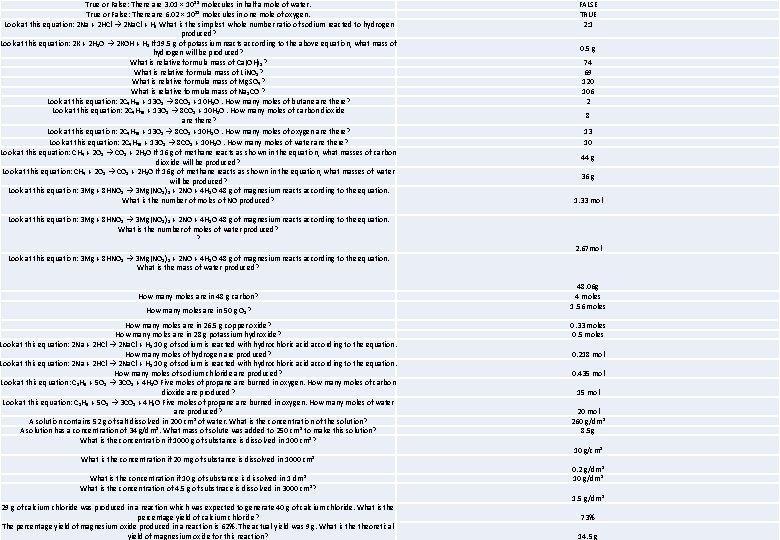
True or False: There are 3. 01 × 10²² molecules in half a mole of water. True or False: There are 6. 02 × 10²³ molecules in one mole of oxygen. Look at this equation: 2 Na + 2 HCl → 2 Na. Cl + H₂ What is the simplest whole number ratio of sodium reacted to hydrogen produced? Look at this equation: 2 K + 2 H₂O → 2 KOH + H₂ If 19. 5 g of potassium reacts according to the above equation, what mass of hydrogen will be produced? What is relative formula mass of Ca(OH)₂? What is relative formula mass of Li. NO₃? What is relative formula mass of Mg. SO₄? What is relative formula mass of Na₂CO ? Look at this equation: 2 C₄H₁₀ + 13 O₂ → 8 CO₂ + 10 H₂O. How many moles of butane are there? Look at this equation: 2 C₄H₁₀ + 13 O₂ → 8 CO₂ + 10 H₂O. How many moles of carbon dioxide are there? Look at this equation: 2 C₄H₁₀ + 13 O₂ → 8 CO₂ + 10 H₂O. How many moles of oxygen are there? Look at this equation: 2 C₄H₁₀ + 13 O₂ → 8 CO₂ + 10 H₂O. How many moles of water are there? Look at this equation: CH₄ + 2 O₂ → CO₂ + 2 H₂O If 16 g of methane reacts as shown in the equation, what masses of carbon dioxide will be produced? Look at this equation: CH₄ + 2 O₂ → CO₂ + 2 H₂O If 16 g of methane reacts as shown in the equation, what masses of water will be produced? Look at this equation: 3 Mg + 8 HNO₃ → 3 Mg(NO₃)₂ + 2 NO + 4 H₂O 48 g of magnesium reacts according to the equation. What is the number of moles of NO produced? Look at this equation: 3 Mg + 8 HNO₃ → 3 Mg(NO₃)₂ + 2 NO + 4 H₂O 48 g of magnesium reacts according to the equation. What is the number of moles of water produced? ? Look at this equation: 3 Mg + 8 HNO₃ → 3 Mg(NO₃)₂ + 2 NO + 4 H₂O 48 g of magnesium reacts according to the equation. What is the mass of water produced? How many moles are in 48 g carbon? How many moles are in 50 g O₂? How many moles are in 26. 5 g copper oxide? How many moles are in 28 g potassium hydroxide? Look at this equation: 2 Na + 2 HCl → 2 Na. Cl + H₂ 10 g of sodium is reacted with hydrochloric acid according to the equation. How many moles of hydrogen are produced? Look at this equation: 2 Na + 2 HCl → 2 Na. Cl + H₂ 10 g of sodium is reacted with hydrochloric acid according to the equation. How many moles of sodium chloride are produced? Look at this equation: C₃H₈ + 5 O₂ → 3 CO₂ + 4 H₂O Five moles of propane are burned in oxygen. How many moles of carbon dioxide are produced? Look at this equation: C₃H₈ + 5 O₂ → 3 CO₂ + 4 H₂O Five moles of propane are burned in oxygen. How many moles of water are produced? A solution contains 52 g of salt dissolved in 200 cm³ of water. What is the concentration of the solution? A solution has a concentration of 34 g/dm³. What mass of solute was added to 250 cm³ to make this solution? What is the concentration if 1000 g of substance is dissolved in 100 cm³? What is the concentration if 20 mg of substance is dissolved in 1000 cm³ What is the concentration if 10 g of substance is dissolved in 1 dm³ What is the concentration of 4. 5 g of substnace is dissolved in 3000 cm³? 29 g of calcium chloride was produced in a reaction which was expected to generate 40 g of calcium chloride. What is the percentage yield of calcium chloride? The percentage yield of magnesium oxide produced in a reaction is 62%. The actual yield was 9 g. What is theoretical yield of magnesium oxide for this reaction? FALSE TRUE 2: 1 0. 5 g 74 69 120 106 2 8 13 10 44 g 36 g 1. 33 mol 2. 67 mol 48. 06 g 4 moles 1. 56 moles 0. 33 moles 0. 5 moles 0. 218 mol 0. 435 mol 15 mol 20 mol 260 g/dm³ 8. 5 g 10 g/cm³ 0. 2 g/dm³ 10 g/dm³ 1. 5 g/dm³ 73% 14. 5 g
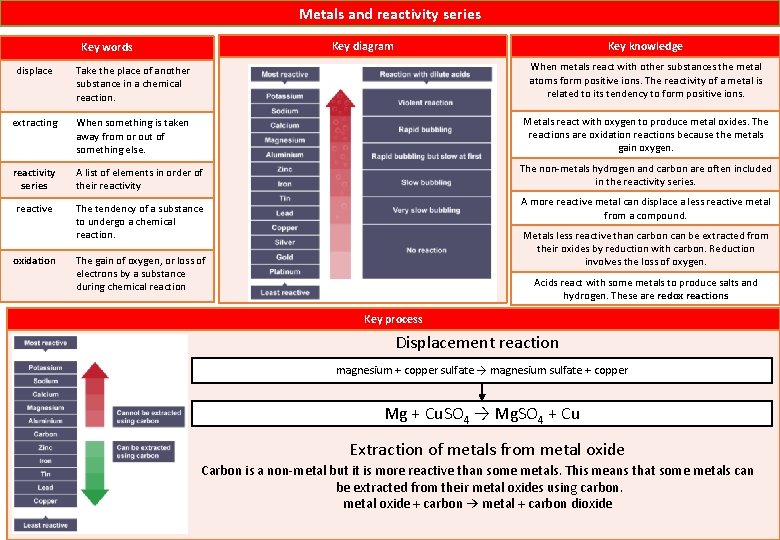
Metals and reactivity series Key knowledge Key diagram Key words displace Take the place of another substance in a chemical reaction. When metals react with other substances the metal atoms form positive ions. The reactivity of a metal is related to its tendency to form positive ions. extracting When something is taken away from or out of something else. Metals react with oxygen to produce metal oxides. The reactions are oxidation reactions because the metals gain oxygen. reactivity series A list of elements in order of their reactivity reactive The tendency of a substance to undergo a chemical reaction. oxidation The non-metals hydrogen and carbon are often included in the reactivity series. A more reactive metal can displace a less reactive metal from a compound. Metals less reactive than carbon can be extracted from their oxides by reduction with carbon. Reduction involves the loss of oxygen. The gain of oxygen, or loss of electrons by a substance during chemical reaction Acids react with some metals to produce salts and hydrogen. These are redox reactions Key process Displacement reaction magnesium + copper sulfate → magnesium sulfate + copper Mg + Cu. SO 4 → Mg. SO 4 + Cu Extraction of metals from metal oxide Carbon is a non-metal but it is more reactive than some metals. This means that some metals can be extracted from their metal oxides using carbon. metal oxide + carbon → metal + carbon dioxide
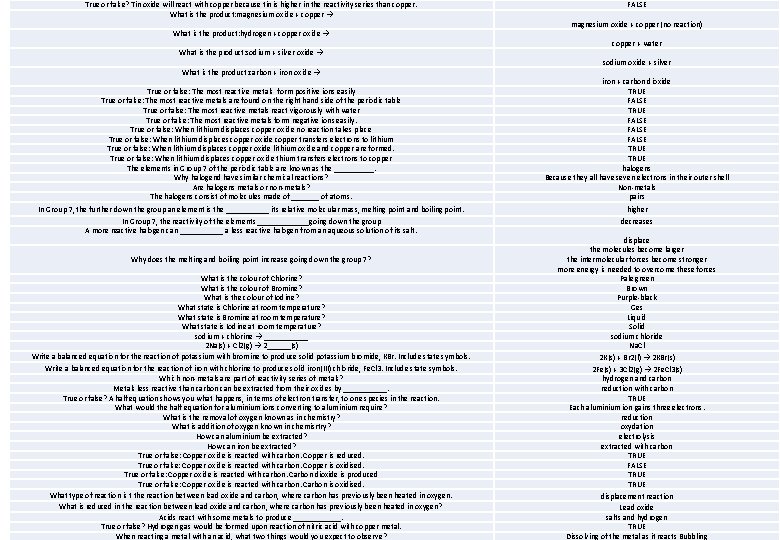
True or false? Tin oxide will react with copper because tin is higher in the reactivity series than copper. What is the product: magnesium oxide + copper → What is the product: hydrogen + copper oxide → What is the product: sodium + silver oxide → What is the product: carbon + iron oxide → True or false: The most reactive metals form positive ions easily True or false: The most reactive metals are found on the right hand side of the periodic table True or false: The most reactive metals react vigorously with water True or false: The most reactive metals form negative ions easily. True or false: When lithium displaces copper oxide no reaction takes place True or false: When lithium displaces copper oxide copper transfers electrons to lithium True or false: When lithium displaces copper oxide lithium oxide and copper are formed. True or false: When lithium displaces copper oxide thium transfers electrons to copper The elements in Group 7 of the periodic table are known as the _____. Why halogend have similar chemical reactions? Are halogens metals or non-metals? The halogens consist of molecules made of _______ of atoms. FALSE magnesium oxide + copper (no reaction) copper + water sodium oxide + silver iron + carbon dioxide TRUE FALSE TRUE halogens Because they all have seven electrons in their outer shell Non-metals pairs In Group 7, the further down the group an element is the ______ its relative molecular mass, melting point and boiling point. higher In Group 7, the reactivity of the elements _______going down the group A more reactive halogen can ______ a less reactive halogen from an aqueous solution of its salt. decreases Why does the melting and boiling point increase going down the group 7? What is the colour of Chlorine? What is the colour of Bromine? What is the colour of Iodine? What state is Chlorine at room temperature? What state is Bromine at room temperature? What state is Iodine at room temperature? sodium + chlorine → ______ 2 Na(s) + Cl 2(g) → 2______(s) Write a balanced equation for the reaction of potassium with bromine to produce solid potassium bromide, KBr. Include state symbols. Write a balanced equation for the reaction of iron with chlorine to produce solid iron(III) chloride, Fe. Cl 3. Include state symbols. Which non-metals are part of reactivity series of metals? Metals less reactive than carbon can be extracted from their oxides by ______. True or false? A half equation shows you what happens, in terms of electron transfer, to one species in the reaction. What would the half equation for aluminium ions converting to aluminium require? What is the removal of oxygen known as in chemistry? What is addition of oxygen known in chemisrtry? How can aluminium be extracted? How can iron be extracted? True or false: Copper oxide is reacted with carbon. Copper is reduced. True or false: Copper oxide is reacted with carbon. Copper is oxidised. True or false: Copper oxide is reacted with carbon. Carbon dioxide is produced True or false: Copper oxide is reacted with carbon. Carbon is oxidised. What type of reaction is t the reaction between lead oxide and carbon, where carbon has previously been heated in oxygen. What is reduced in the reaction between lead oxide and carbon, where carbon has previously been heated in oxygen? Acids react with some metals to produce ______. True or false? Hydrogen gas would be formed upon reaction of nitric acid with copper metal. When reacting a metal with an acid, what two things would you expect to observe? displace the molecules become larger the intermolecular forces become stronger more energy is needed to overcome these forces Pale green Brown Purple-black Ges Liquid Solid sodium chloride Na. Cl 2 K(s) + Br 2(l) → 2 KBr(s) 2 Fe(s) + 3 Cl 2(g) → 2 Fe. Cl 3(s) hydrogen and carbon reduction with carbon TRUE Each aluminium ion gains three electrons. reduction oxydation electrolysis extracted with carbon TRUE FALSE TRUE displacement reaction Lead oxide salts and hydrogen TRUE Dissolving of the metal as it reacts Bubbling
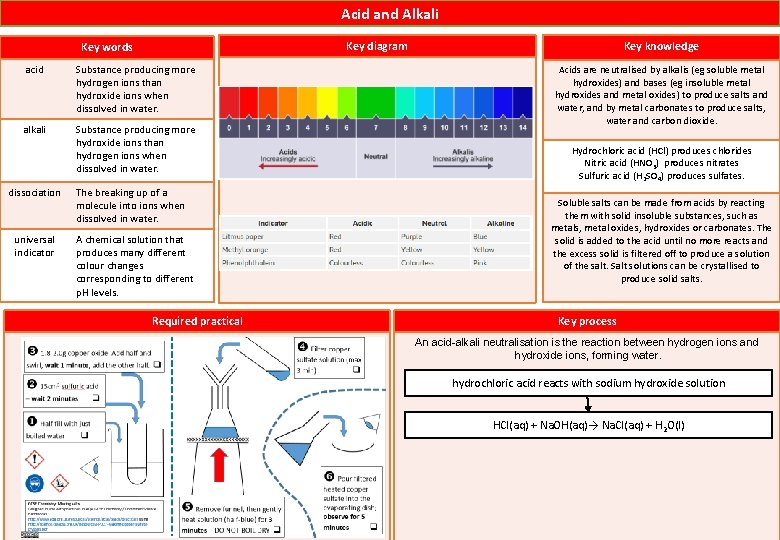
Acid and Alkali acid Substance producing more hydrogen ions than hydroxide ions when dissolved in water. alkali Substance producing more hydroxide ions than hydrogen ions when dissolved in water. dissociation universal indicator Key knowledge Key diagram Key words The breaking up of a molecule into ions when dissolved in water. A chemical solution that produces many different colour changes corresponding to different p. H levels. Required practical Acids are neutralised by alkalis (eg soluble metal hydroxides) and bases (eg insoluble metal hydroxides and metal oxides) to produce salts and water, and by metal carbonates to produce salts, water and carbon dioxide. Hydrochloric acid (HCl) produces chlorides Nitric acid (HNO 3) produces nitrates Sulfuric acid (H 2 SO 4) produces sulfates. Soluble salts can be made from acids by reacting them with solid insoluble substances, such as metals, metal oxides, hydroxides or carbonates. The solid is added to the acid until no more reacts and the excess solid is filtered off to produce a solution of the salt. Salt solutions can be crystallised to produce solid salts. Key process An acid-alkali neutralisation is the reaction between hydrogen ions and hydroxide ions, forming water. hydrochloric acid reacts with sodium hydroxide solution HCl(aq) + Na. OH(aq)→ Na. Cl(aq) + H 2 O(l)
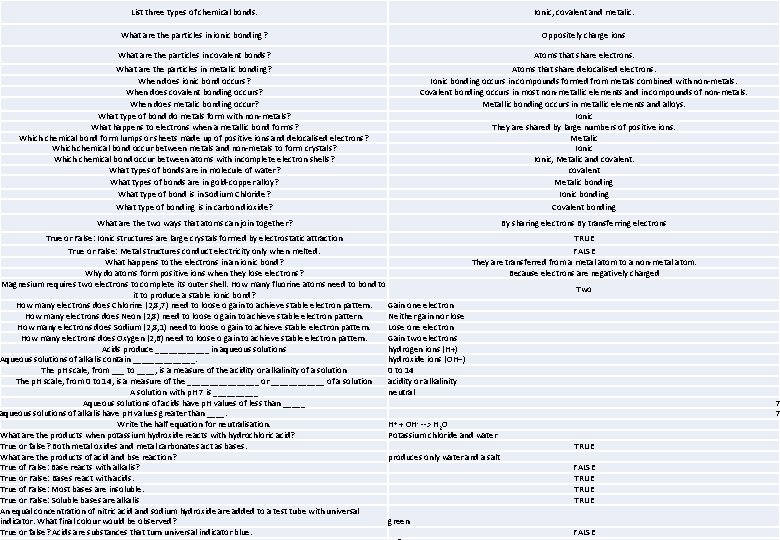
List three types of chemical bonds. Ionic, covalent and metalic. What are the particles in ionic bonding? Oppositely charge ions What are the particles in covalent bonds? Atoms that share electrons. What are the particles in metalic bonding? When does ionic bond occurs? When does covalent bonding occurs? When does metalic bonding occur? What type of bond do metals form with non-metals? What happens to electrons when a metallic bond forms? Which chemical bond form lumps or sheets made up of positive ions and delocalised electrons? Which chemical bond occur between metals and non-metals to form crystals? Which chemical bond occur between atoms with incomplete electron shells? What types of bonds are in molecule of water? What types of bonds are in gold-copper alloy? What type of bond is in Sodium Chloride? What type of bonding is in carbon dioxide? Atoms that share delocalised electrons. Ionic bonding occurs in compounds formed from metals combined with non-metals. Covalent bonding occurs in most non-metallic elements and in compounds of non-metals. Metallic bonding occurs in metallic elements and alloys. Ionic They are shared by large numbers of positive ions. Metalic Ionic, Metalic and covalent Metalic bonding Ionic bonding Covalent bonding What are the two ways that atoms can join together? By sharing electrons By transferring electrons True or False: Ionic structures are large crystals formed by electrostatic attraction TRUE True or False: Metal structures conduct electricity only when melted. FALSE What happens to the electrons in an ionic bond? They are transferred from a metal atom to a non-metal atom. Why do atoms form positive ions when they lose electrons? Because electrons are negatively charged Magnesium requires two electrons to complete its outer shell. How many fluorine atoms need to bond to Two it to produce a stable ionic bond? How many electrons does Chlorine (2, 8, 7) need to loose o gain to achieve stable electron pattern. Gain one electron How many electrons does Neon (2, 8) need to loose o gain to achieve stable electron pattern. Neither gain nor lose How many electrons does Sodium (2, 8, 1) need to loose o gain to achieve stable electron pattern. Lose one electron How many electrons does Oxygen (2, 6) need to loose o gain to achieve stable electron pattern. Gain two electrons Acids produce ______ in aqueous solutions hydrogen ions (H+) Aqueous solutions of alkalis contain _______. hydroxide ions (OH–) The p. H scale, from ___ to ____, is a measure of the acidity or alkalinity of a solution 0 to 14 The p. H scale, from 0 to 14, is a measure of the ________ or ______ of a solution acidity or alkalinity A solution with p. H 7 is _____ neutral Aqueous solutions of acids have p. H values of less than _____ aqueous solutions of alkalis have p. H values greater than ____. Write the half equation for neutralisation. H+ + OH- --> H 2 O What are the products when potassium hydroxide reacts with hydrochloric acid? Potassium chloride and water True or false? Both metal oxides and metal carbonates act as bases. TRUE What are the products of acid and bse reaction? produces only water and a salt True of False: Base reacts with alkalis? FALSE True or False: Bases react with acids. TRUE True of False: Most bases are insoluble. TRUE True or False: Soluble bases are alkalis TRUE An equal concentration of nitric acid and sodium hydroxide are added to a test tube with universal indicator. What final colour would be observed? green True or false? Acids are substances that turn universal indicator blue. FALSE 7 7
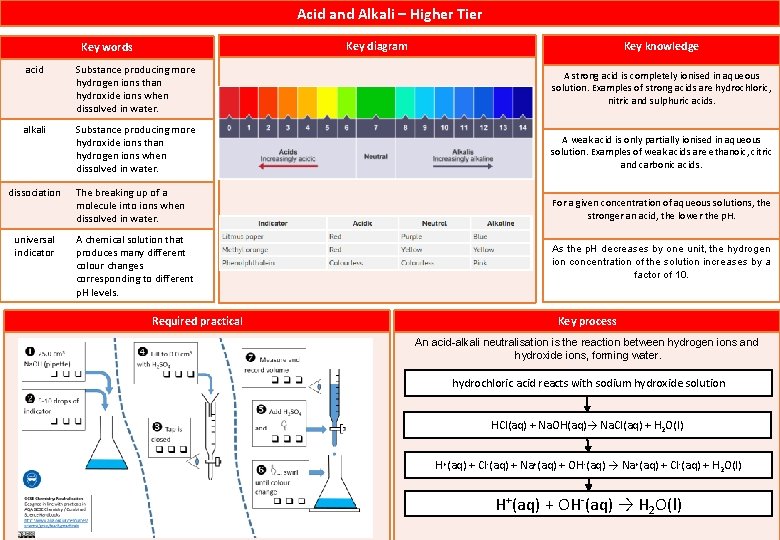
Acid and Alkali – Higher Tier Key knowledge Key diagram Key words acid Substance producing more hydrogen ions than hydroxide ions when dissolved in water. A strong acid is completely ionised in aqueous solution. Examples of strong acids are hydrochloric, nitric and sulphuric acids. alkali Substance producing more hydroxide ions than hydrogen ions when dissolved in water. A weak acid is only partially ionised in aqueous solution. Examples of weak acids are ethanoic, citric and carbonic acids. The breaking up of a molecule into ions when dissolved in water. For a given concentration of aqueous solutions, the stronger an acid, the lower the p. H. A chemical solution that produces many different colour changes corresponding to different p. H levels. As the p. H decreases by one unit, the hydrogen ion concentration of the solution increases by a factor of 10. dissociation universal indicator Required practical Key process An acid-alkali neutralisation is the reaction between hydrogen ions and hydroxide ions, forming water. hydrochloric acid reacts with sodium hydroxide solution HCl(aq) + Na. OH(aq)→ Na. Cl(aq) + H 2 O(l) H+(aq) + Cl-(aq) + Na+(aq) + OH-(aq) → Na+(aq) + Cl-(aq) + H 2 O(l) H+(aq) + OH-(aq) → H 2 O(l)
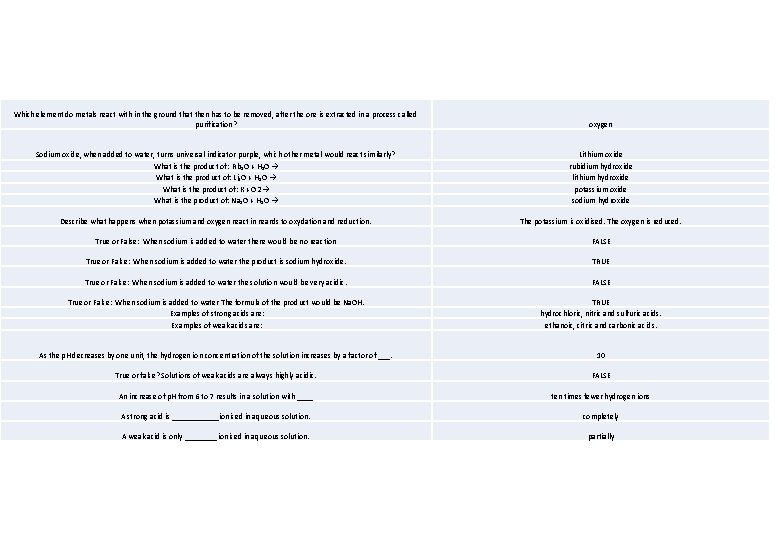
Which element do metals react with in the ground that then has to be removed, after the ore is extracted in a process called purification? oxygen Sodium oxide, when added to water, turns universal indicator purple, which other metal would react similarly? What is the product of: Rb₂O + H₂O → What is the product of: Li₂O + H₂O → What is the product of: K + O 2 → What is the product of: Na₂O + H₂O → Lithium oxide rubidium hydroxide lithium hydroxide potassium oxide sodium hydroxide Describe what happens when potassium and oxygen react in reards to oxydation and reduction. The potassium is oxidised. The oxygen is reduced. True or False: When sodium is added to water there would be no reaction FALSE True or False: When sodium is added to water the product is sodium hydroxide. TRUE True or False: When sodium is added to water the solution would be very acidic. FALSE True or False: When sodium is added to water The formula of the product would be Na. OH. Examples of strong acids are: Examples of weak acids are: TRUE hydrochloric, nitric and sulfuric acids. ethanoic, citric and carbonic acids. As the p. H decreases by one unit, the hydrogen ion concentration of the solution increases by a factor of ___. 10 True or false? Solutions of weak acids are always highly acidic. FALSE An increase of p. H from 6 to 7 results in a solution with ____ ten times fewer hydrogen ions A strong acid is ______ionised in aqueous solution. completely A weak acid is only ____ ionised in aqueous solution. partially
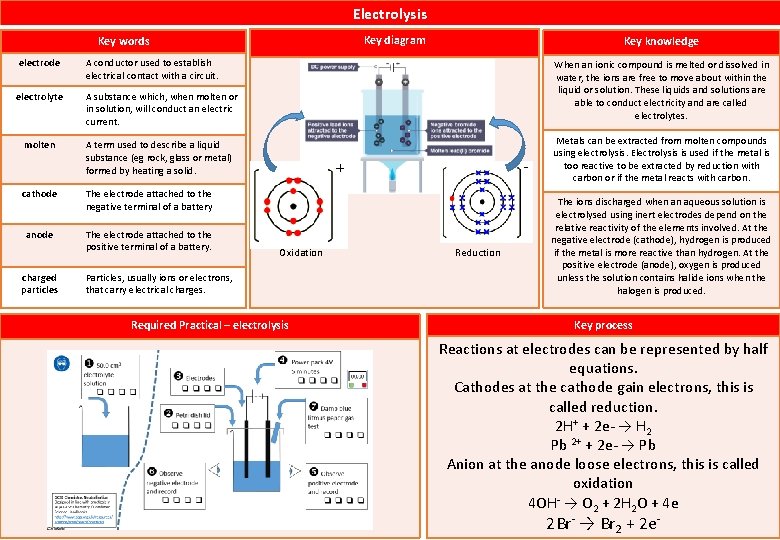
Electrolysis Key diagram Key words electrode A conductor used to establish electrical contact with a circuit. electrolyte A substance which, when molten or in solution, will conduct an electric current. molten A term used to describe a liquid substance (eg rock, glass or metal) formed by heating a solid. cathode The electrode attached to the negative terminal of a battery anode The electrode attached to the positive terminal of a battery. charged particles Key knowledge When an ionic compound is melted or dissolved in water, the ions are free to move about within the liquid or solution. These liquids and solutions are able to conduct electricity and are called electrolytes. Metals can be extracted from molten compounds using electrolysis. Electrolysis is used if the metal is too reactive to be extracted by reduction with carbon or if the metal reacts with carbon. Oxidation Particles, usually ions or electrons, that carry electrical charges. Required Practical – electrolysis Reduction The ions discharged when an aqueous solution is electrolysed using inert electrodes depend on the relative reactivity of the elements involved. At the negative electrode (cathode), hydrogen is produced if the metal is more reactive than hydrogen. At the positive electrode (anode), oxygen is produced unless the solution contains halide ions when the halogen is produced. Key process Reactions at electrodes can be represented by half equations. Cathodes at the cathode gain electrons, this is called reduction. 2 H+ + 2 e- → H 2 Pb 2+ + 2 e- → Pb Anion at the anode loose electrons, this is called oxidation 4 OH → O 2 + 2 H 2 O + 4 e 2 Br- → Br 2 + 2 e-
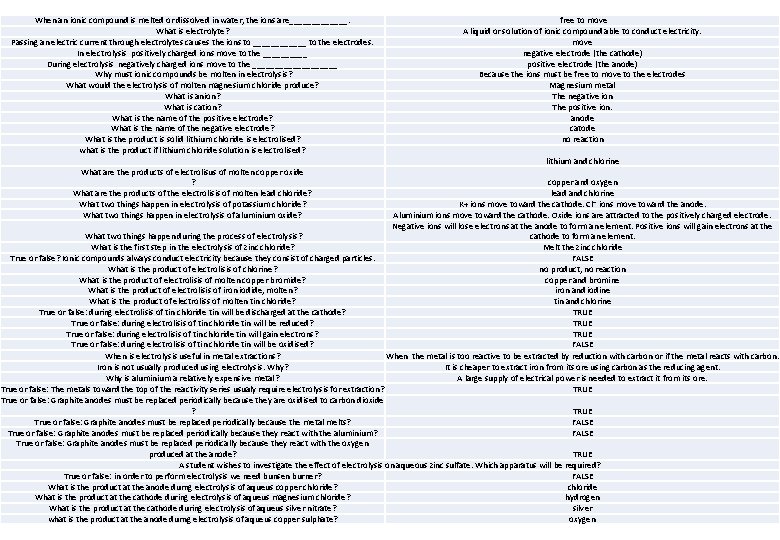
When an ionic compound is melted or dissolved in water, the ions are_______. What is electrolyte? Passing an electric current through electrolytes causes the ions to ______ to the electrodes. In electrolysis positively charged ions move to the _____ During electrolysis negatively charged ions move to the __________ Why must ionic compounds be molten in electrolysis? What would the electrolysis of molten magnesium chloride produce? What is anion? What is cation? What is the name of the positive electrode? What is the name of the negative electrode? What is the product is solid lithium chloride is electrolised? what is the product if lithium chloride solution is electrolised? What are the products of electrolisus of molten copper oxide ? What are the products of the electrolisis of molten lead chloride? What two things happen in electrolysis of potassium chloride? What two things happen in electrolysis of aluminium oxide? free to move A liquid or solution of ionic compound able to conduct electricity. move negative electrode (the cathode) positive electrode (the anode) Because the ions must be free to move to the electrodes Magnesium metal The negative ion The positive ion. anode catode no reaction lithium and chlorine copper and oxygen lead and chlorine K+ ions move toward the cathode. Cl⁻ ions move toward the anode. Aluminium ions move toward the cathode. Oxide ions are attracted to the positively charged electrode. Negative ions will lose electrons at the anode to form an element. Positive ions will gain electrons at the What two things happen during the process of electrolysis? cathode to form an element. What is the first step in the electrolysis of zinc chloride? Melt the zinc chloride True or false? Ionic compounds always conduct electricity because they consist of charged particles. FALSE What is the product of electrolisis of chlorine? no product, no reaction What is the product of electrolisis of molten copper bromide? copper and bromine What is the product of electrolisis of iron iodide, molten? iron and iodine What is the product of electroliss of molten tin chloride? tin and chlorine True or false: during electrolisis of tin chloride tin will be discharged at the cathode? TRUE True or false: during electrolisis of tin chloride tin will be reduced? TRUE True or false: during electrolisis of tin chloride tin will gain electrons? TRUE True or false: during electrolisis of tin chloride tin will be oxidised? FALSE When is electrolysis useful in metal extractions? When the metal is too reactive to be extracted by reduction with carbon or if the metal reacts with carbon. Iron is not usually produced using electrolysis. Why? It is cheaper to extract iron from its ore using carbon as the reducing agent. Why is aluminium a relatively expensive metal? A large supply of electrical power is needed to extract it from its ore. True or false: The metals toward the top of the reactivity series usualy require electrolysis for extraction? TRUE True or false: Graphite anodes must be replaced periodically because they are oxidised to carbon dioxide ? TRUE True or false: Graphite anodes must be replaced periodically because the metal melts? FALSE True or false: Graphite anodes must be replaced periodically because they react with the aluminium? FALSE True or false: Graphite anodes must be replaced periodically because they react with the oxygen produced at the anode? TRUE A student wishes to investigate the effect of electrolysis on aqueous zinc sulfate. Which apparatus will be required? True or false: in order to perform electrolysis we need bunsen burner? FALSE What is the product at the anode durng electrolysis of aqueus copper chloride? chloride What is the product at the cathode during electrolysis of aqueus magnesium chloride? hydrogen What is the product at the cathode during electrolysis of aqueus silver nitrate? silver what is the product at the anode durng electrolysis of aqueus copper sulphate? oxygen
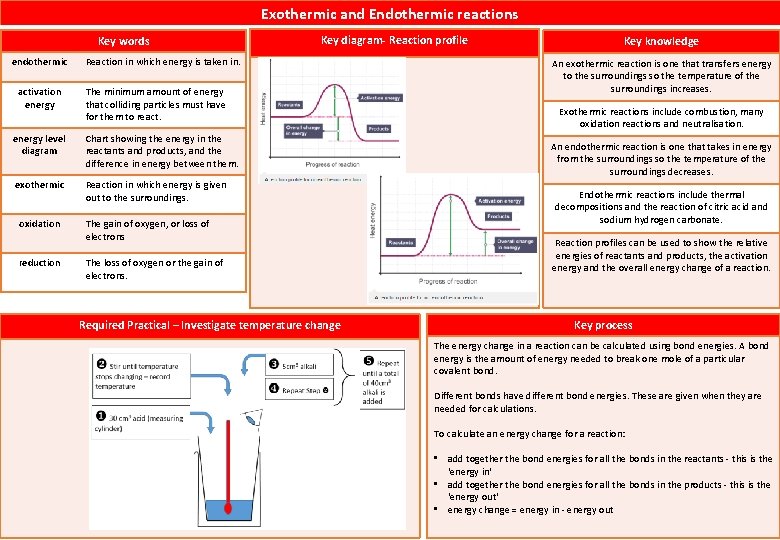
Exothermic and Endothermic reactions Key words endothermic activation energy Reaction in which energy is taken in. The minimum amount of energy that colliding particles must have for them to react. energy level diagram Chart showing the energy in the reactants and products, and the difference in energy between them. exothermic Reaction in which energy is given out to the surroundings. oxidation reduction Key diagram- Reaction profile The gain of oxygen, or loss of electrons The loss of oxygen or the gain of electrons. Required Practical – Investigate temperature change Key knowledge An exothermic reaction is one that transfers energy to the surroundings so the temperature of the surroundings increases. Exothermic reactions include combustion, many oxidation reactions and neutralisation. An endothermic reaction is one that takes in energy from the surroundings so the temperature of the surroundings decreases. Endothermic reactions include thermal decompositions and the reaction of citric acid and sodium hydrogen carbonate. Reaction profiles can be used to show the relative energies of reactants and products, the activation energy and the overall energy change of a reaction. Key process The energy change in a reaction can be calculated using bond energies. A bond energy is the amount of energy needed to break one mole of a particular covalent bond. Different bonds have different bond energies. These are given when they are needed for calculations. To calculate an energy change for a reaction: • add together the bond energies for all the bonds in the reactants - this is the 'energy in' • add together the bond energies for all the bonds in the products - this is the 'energy out' • energy change = energy in - energy out
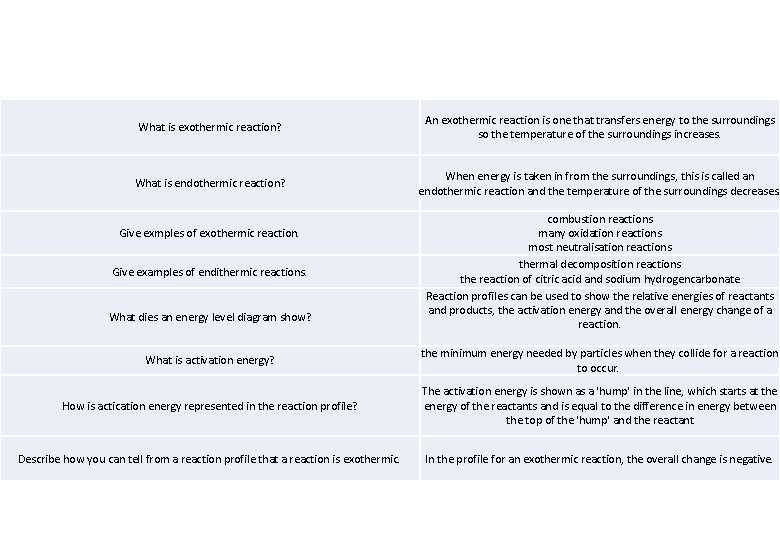
What is exothermic reaction? An exothermic reaction is one that transfers energy to the surroundings so the temperature of the surroundings increases. What is endothermic reaction? When energy is taken in from the surroundings, this is called an endothermic reaction and the temperature of the surroundings decreases. Give exmples of exothermic reaction. Give examples of endithermic reactions. What dies an energy level diagram show? combustion reactions many oxidation reactions most neutralisation reactions thermal decomposition reactions the reaction of citric acid and sodium hydrogencarbonate Reaction profiles can be used to show the relative energies of reactants and products, the activation energy and the overall energy change of a reaction. What is activation energy? the minimum energy needed by particles when they collide for a reaction to occur. How is actication energy represented in the reaction profile? The activation energy is shown as a 'hump' in the line, which starts at the energy of the reactants and is equal to the difference in energy between the top of the 'hump' and the reactant Describe how you can tell from a reaction profile that a reaction is exothermic. In the profile for an exothermic reaction, the overall change is negative.
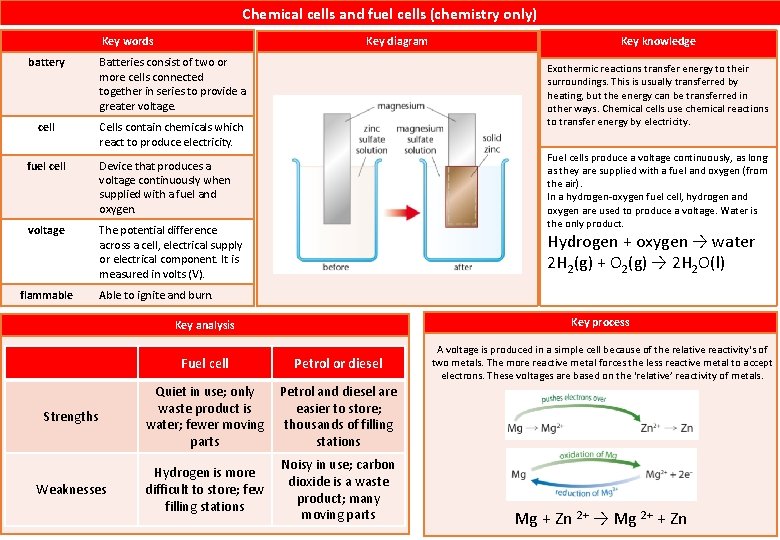
Chemical cells and fuel cells (chemistry only) Key words Key diagram battery Batteries consist of two or more cells connected together in series to provide a greater voltage. cell Cells contain chemicals which react to produce electricity. fuel cell Device that produces a voltage continuously when supplied with a fuel and oxygen. voltage The potential difference across a cell, electrical supply or electrical component. It is measured in volts (V). flammable Key knowledge Exothermic reactions transfer energy to their surroundings. This is usually transferred by heating, but the energy can be transferred in other ways. Chemical cells use chemical reactions to transfer energy by electricity. Fuel cells produce a voltage continuously, as long as they are supplied with a fuel and oxygen (from the air). In a hydrogen-oxygen fuel cell, hydrogen and oxygen are used to produce a voltage. Water is the only product. Hydrogen + oxygen → water 2 H 2(g) + O 2(g) → 2 H 2 O(l) Able to ignite and burn. Key process Key analysis Fuel cell Petrol or diesel Strengths Quiet in use; only waste product is water; fewer moving parts Petrol and diesel are easier to store; thousands of filling stations Weaknesses Hydrogen is more difficult to store; few filling stations Noisy in use; carbon dioxide is a waste product; many moving parts A voltage is produced in a simple cell because of the relative reactivity's of two metals. The more reactive metal forces the less reactive metal to accept electrons. These voltages are based on the ‘relative’ reactivity of metals. Mg + Zn 2+ → Mg 2+ + Zn
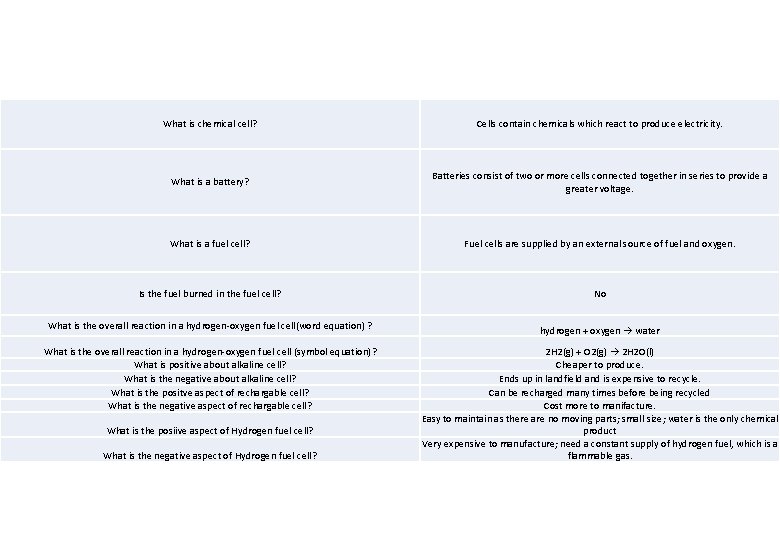
What is chemical cell? Cells contain chemicals which react to produce electricity. What is a battery? Batteries consist of two or more cells connected together in series to provide a greater voltage. What is a fuel cell? Fuel cells are supplied by an external source of fuel and oxygen. Is the fuel burned in the fuel cell? No What is the overall reaction in a hydrogen-oxygen fuel cell(word equation) ? hydrogen + oxygen → water What is the overall reaction in a hydrogen-oxygen fuel cell (symbol equation)? What is positive about alkaline cell? What is the negative about alkaline cell? What is the positve aspect of rechargable cell? What is the negative aspect of rechargable cell? 2 H 2(g) + O 2(g) → 2 H 2 O(l) Cheaper to produce. Ends up in landfield and is expensive to recycle. Can be recharged many times before being recycled Cost more to manifacture. Easy to maintain as there are no moving parts; small size; water is the only chemical product Very expensive to manufacture; need a constant supply of hydrogen fuel, which is a flammable gas. What is the posiive aspect of Hydrogen fuel cell? What is the negative aspect of Hydrogen fuel cell?
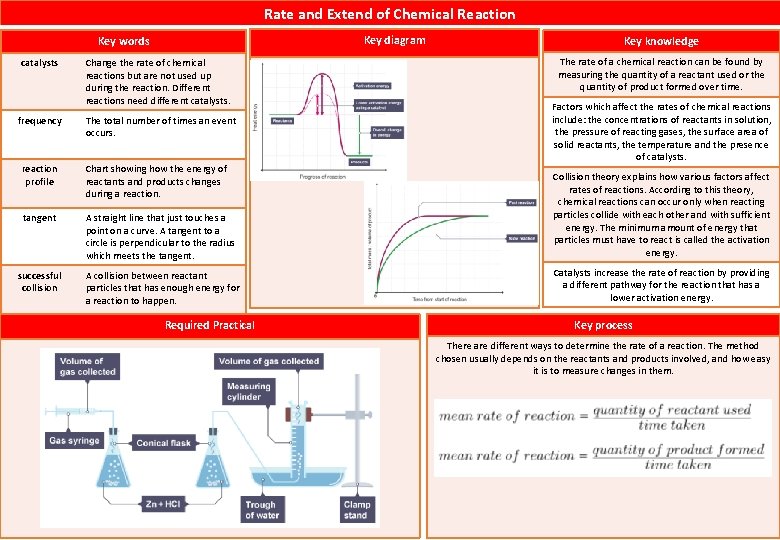
Rate and Extend of Chemical Reaction Key diagram Key words catalysts Change the rate of chemical reactions but are not used up during the reaction. Different reactions need different catalysts. frequency The total number of times an event occurs. Key knowledge The rate of a chemical reaction can be found by measuring the quantity of a reactant used or the quantity of product formed over time. Factors which affect the rates of chemical reactions include: the concentrations of reactants in solution, the pressure of reacting gases, the surface area of solid reactants, the temperature and the presence of catalysts. reaction profile Chart showing how the energy of reactants and products changes during a reaction. tangent A straight line that just touches a point on a curve. A tangent to a circle is perpendicular to the radius which meets the tangent. Collision theory explains how various factors affect rates of reactions. According to this theory, chemical reactions can occur only when reacting particles collide with each other and with sufficient energy. The minimum amount of energy that particles must have to react is called the activation energy. successful collision A collision between reactant particles that has enough energy for a reaction to happen. Catalysts increase the rate of reaction by providing a different pathway for the reaction that has a lower activation energy. Required Practical Key process There are different ways to determine the rate of a reaction. The method chosen usually depends on the reactants and products involved, and how easy it is to measure changes in them.
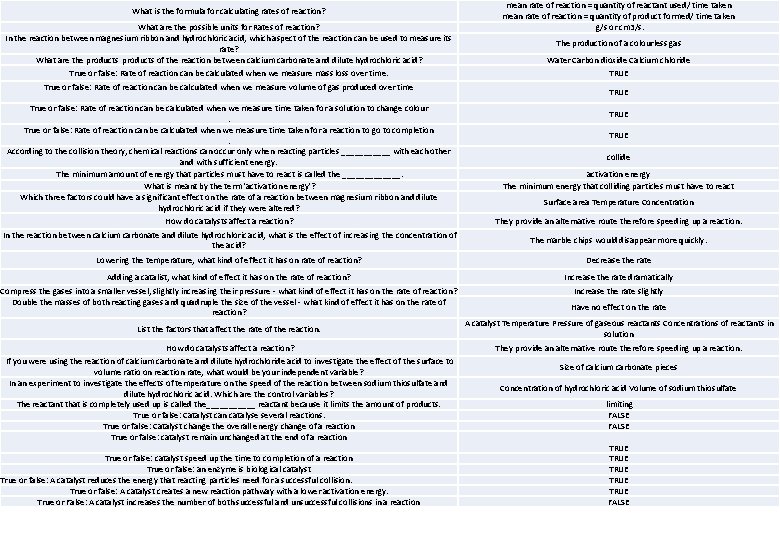
What is the formula for calculating rates of reaction? What are the possible units for Rates of reaction? In the reaction between magnesium ribbon and hydrochloric acid, which aspect of the reaction can be used to measure its rate? What are the products of the reaction between calcium carbonate and dilute hydrochloric acid? True or false: Rate of reaction can be calculated when we measure mass loss over time. True or false: Rate of reaction can be calculated when we measure volume of gas produced over time True or false: Rate of reaction can be calculated when we measure time taken for a solution to change colour. True or false: Rate of reaction can be calculated when we measure time taken for a reaction to go to completion. According to the collision theory, chemical reactions can occur only when reacting particles ______ with each other and with sufficient energy. The minimum amount of energy that particles must have to react is called the _______. What is meant by the term 'activation energy'? Which three factors could have a significant effect on the rate of a reaction between magnesium ribbon and dilute hydrochloric acid if they were altered? mean rate of reaction = quantity of reactant used/ time taken mean rate of reaction = quantity of product formed/ time taken g/s or cm 3/s. The production of a colourless gas Water Carbon dioxide Calcium chloride TRUE collide activation energy The minimum energy that colliding particles must have to react Surface area Temperature Concentration How do catalysts affect a reaction? They provide an alternative route therefore speeding up a reaction. In the reaction between calcium carbonate and dilute hydrochloric acid, what is the effect of increasing the concentration of the acid? The marble chips would disappear more quickly. Lowering the temperature, what kind of effect it has on rate of reaction? Decrease the rate Adding a catalist, what kind of effect it has on the rate of reaction? Increase the rate dramatically Compress the gases into a smaller vessel, slightly increasing their pressure - what kind of effect it has on the rate of reaction? Double the masses of both reacting gases and quadruple the size of the vessel - what kind of effect it has on the rate of reaction? Increase the rate slightly Have no effect on the rate List the factors that affect the rate of the reaction. A catalyst Temperature Pressure of gaseous reactants Concentrations of reactants in solution How do catalysts affect a reaction? They provide an alternative route therefore speeding up a reaction. If you were using the reaction of calcium carbonate and dilute hydrochloride acid to investigate the effect of the surface to volume ratio on reaction rate, what would be your independent variable? In an experiment to investigate the effects of temperature on the speed of the reaction between sodium thiosulfate and dilute hydrochloric acid. Which are the control variables? The reactant that is completely used up is called the______ reactant because it limits the amount of products. True or false: Catalyst can catalyse several reactions. True or false: Catalyst change the overall energy change of a reaction True or false: catalyst remain unchanged at the end of a reaction True or false: catalyst speed up the time to completion of a reaction True or false: an enzyme is biological catalyst True or false: A catalyst reduces the energy that reacting particles need for a successful collision. True or false: A catalyst creates a new reaction pathway with a lower activation energy. True or False: A catalyst increases the number of both successful and unsuccessful collisions in a reaction Size of calcium carbonate pieces Concentration of hydrochloric acid Volume of sodium thiosulfate limiting FALSE TRUE TRUE FALSE
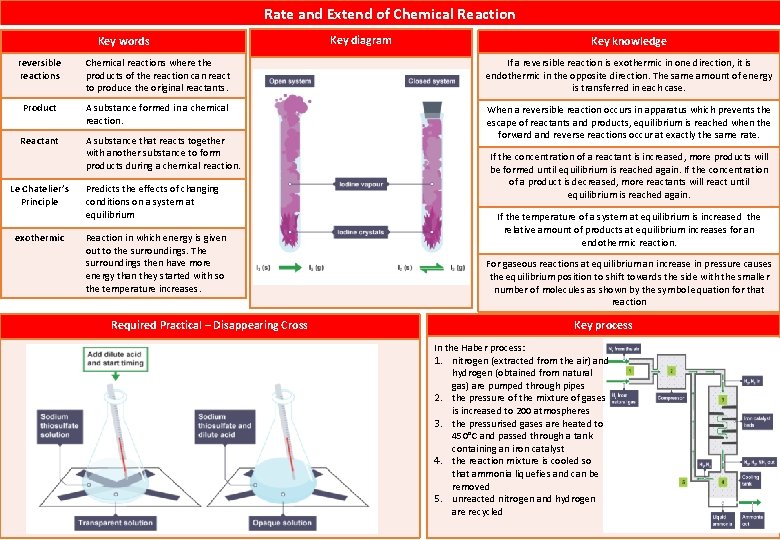
Rate and Extend of Chemical Reaction Key words Key diagram Key knowledge reversible reactions Chemical reactions where the products of the reaction can react to produce the original reactants. If a reversible reaction is exothermic in one direction, it is endothermic in the opposite direction. The same amount of energy is transferred in each case. Product A substance formed in a chemical reaction. Reactant A substance that reacts together with another substance to form products during a chemical reaction. When a reversible reaction occurs in apparatus which prevents the escape of reactants and products, equilibrium is reached when the forward and reverse reactions occur at exactly the same rate. Le Chatelier’s Principle exothermic Predicts the effects of changing conditions on a system at equilibrium Reaction in which energy is given out to the surroundings. The surroundings then have more energy than they started with so the temperature increases. Required Practical – Disappearing Cross If the concentration of a reactant is increased, more products will be formed until equilibrium is reached again. If the concentration of a product is decreased, more reactants will react until equilibrium is reached again. If the temperature of a system at equilibrium is increased the relative amount of products at equilibrium increases for an endothermic reaction. For gaseous reactions at equilibrium an increase in pressure causes the equilibrium position to shift towards the side with the smaller number of molecules as shown by the symbol equation for that reaction Key process In the Haber process: 1. nitrogen (extracted from the air) and hydrogen (obtained from natural gas) are pumped through pipes 2. the pressure of the mixture of gases is increased to 200 atmospheres 3. the pressurised gases are heated to 450°C and passed through a tank containing an iron catalyst 4. the reaction mixture is cooled so that ammonia liquefies and can be removed 5. unreacted nitrogen and hydrogen are recycled
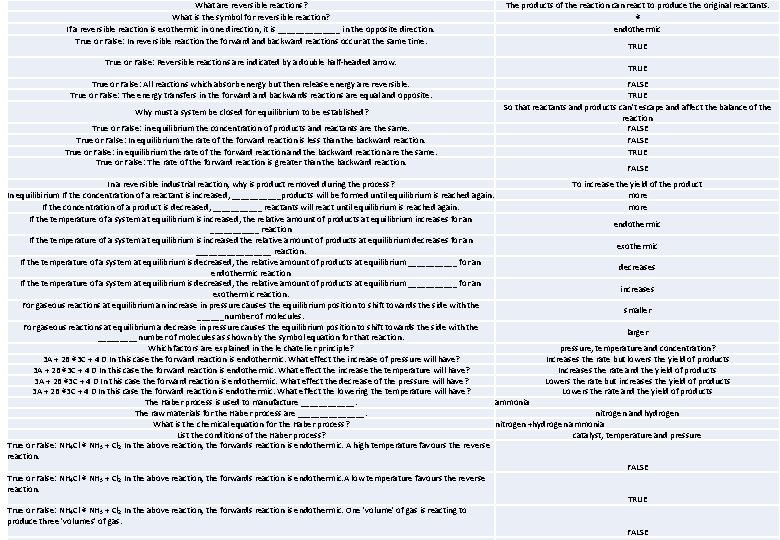
What are reversible reactions? What is the symbol for reversible reaction? If a reversible reaction is exothermic in one direction, it is _______ in the opposite direction. True or False: In reversible reaction the forward and backward reactions occur at the same time. True or False: Reversible reactions are indicated by a double half-headed arrow. True or False: All reactions which absorb energy but then release energy are reversible. True or False: The energy transfers in the forward and backwards reactions are equal and opposite. Why must a system be closed for equilibrium to be established? True or False: in equilibrium the concentration of products and reactants are the same. True or False: In equilibrium the rate of the forward reaction is less than the backward reaction. True or False: in equilibrium the rate of the forward reaction and the backward reaction are the same. True or False: The rate of the forward reaction is greater than the backward reaction. The products of the reaction can react to produce the original reactants. ⇌ endothermic TRUE FALSE TRUE So that reactants and products can't escape and affect the balance of the reaction FALSE TRUE FALSE In a reversible industrial reaction, why is product removed during the process? To increase the yield of the product In equilibirium If the concentration of a reactant is increased, ______products will be formed until equilibrium is reached again. more If the concentration of a product is decreased, ______ reactants will react until equilibrium is reached again. more If the temperature of a system at equilibrium is increased, the relative amount of products at equilibrium increases for an endothermic ______ reaction If the temperature of a system at equilibrium is increased the relative amount of products at equilibrium decreases for an exothermic _________ reaction. If the temperature of a system at equilibrium is decreased, the relative amount of products at equilibrium ______ for an decreases endothermic reaction If the temperature of a system at equilibrium is decreased, the relative amount of products at equilibrium ______ for an increases exothermic reaction. For gaseous reactions at equilibrium an increase in pressure causes the equilibrium position to shift towards the side with the smaller ______number of molecules. For gaseous reactions at equilibrium a decrease in pressure causes the equilibrium position to shift towards the side with the larger _____number of molecules as shown by the symbol equation for that reaction. Which factors are explained in the le chatelier principle? pressure, temperature and concentration? 3 A + 2 B ⇌3 C + 4 D In this case the forward reaction is endothermic. What effect the increase of pressure will have? Increases the rate but lowers the yield of products 3 A + 2 B ⇌3 C + 4 D In this case the forward reaction is endothermic. What effect the increase the temperature will have? Increases the rate and the yield of products 3 A + 2 B ⇌3 C + 4 D In this case the forward reaction is endothermic. What effect the decrease of the pressure will have? Lowers the rate but increases the yield of products 3 A + 2 B ⇌3 C + 4 D In this case the forward reaction is endothermic. What effect the lowering the temperature will have? Lowers the rate and the yield of products The Haber process is used to manufacture ______. ammonia The raw materials for the Haber process are ________. nitrogen and hydrogen What is the chemical equation for the Haber process? nitrogen +hydrogen ammonia List the conditions of the Haber process? catalyst, temperature and pressure True or False: NH₄Cl ⇌ NH₃ + Cl₂ In the above reaction, the forwards reaction is endothermic. A high temperature favours the reverse reaction. FALSE True or False: NH₄Cl ⇌ NH₃ + Cl₂ In the above reaction, the forwards reaction is endothermic. A low temperature favours the reverse reaction. TRUE True or False: NH₄Cl ⇌ NH₃ + Cl₂ In the above reaction, the forwards reaction is endothermic. One 'volume' of gas is reacting to produce three 'volumes' of gas. FALSE
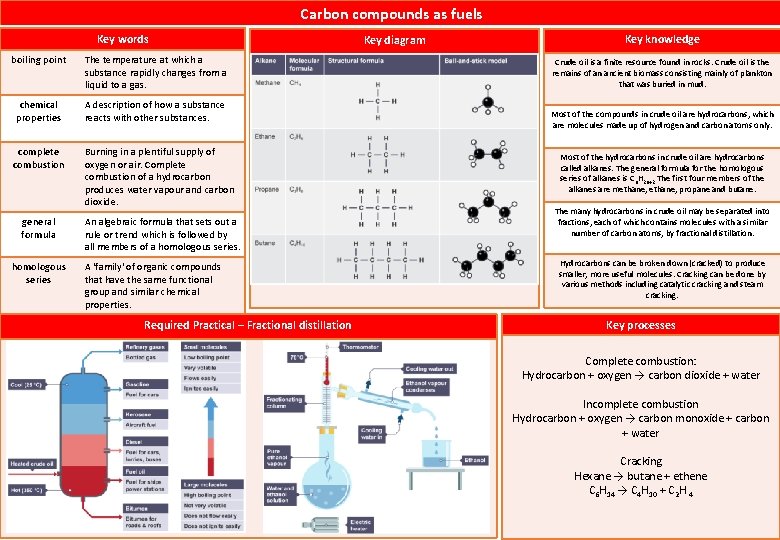
Carbon compounds as fuels Key words boiling point The temperature at which a substance rapidly changes from a liquid to a gas. chemical properties A description of how a substance reacts with other substances. complete combustion Burning in a plentiful supply of oxygen or air. Complete combustion of a hydrocarbon produces water vapour and carbon dioxide. general formula homologous series An algebraic formula that sets out a rule or trend which is followed by all members of a homologous series. A 'family' of organic compounds that have the same functional group and similar chemical properties. Required Practical – Fractional distillation Key diagram Key knowledge Crude oil is a finite resource found in rocks. Crude oil is the remains of an ancient biomass consisting mainly of plankton that was buried in mud. Most of the compounds in crude oil are hydrocarbons, which are molecules made up of hydrogen and carbon atoms only. Most of the hydrocarbons in crude oil are hydrocarbons called alkanes. The general formula for the homologous series of alkanes is Cn. H 2 n+2 The first four members of the alkanes are methane, propane and butane. The many hydrocarbons in crude oil may be separated into fractions, each of which contains molecules with a similar number of carbon atoms, by fractional distillation. Hydrocarbons can be broken down (cracked) to produce smaller, more useful molecules. Cracking can be done by various methods including catalytic cracking and steam cracking. Key processes Complete combustion: Hydrocarbon + oxygen → carbon dioxide + water Incomplete combustion Hydrocarbon + oxygen → carbon monoxide + carbon + water Cracking Hexane → butane + ethene C 6 H 14 → C 4 H 10 + C 2 H 4
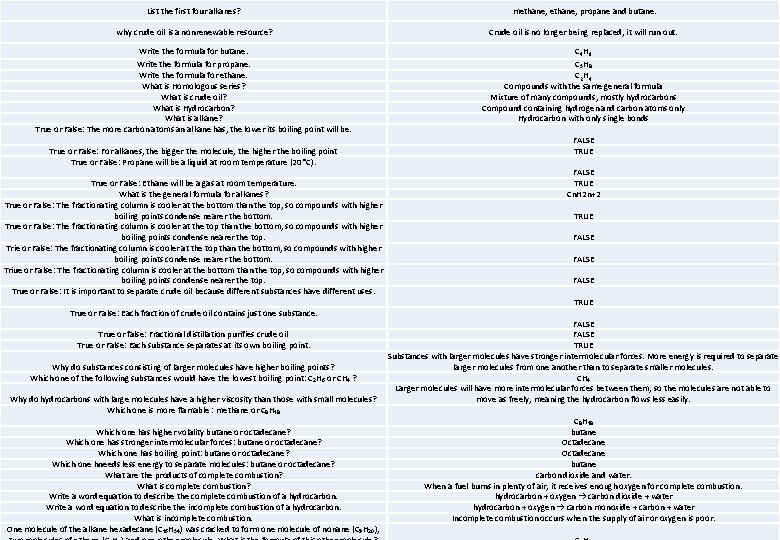
List the first four alkanes? methane, propane and butane. why crude oil is a nonrenewable resource? Crude oil is no longer being replaced, it will run out. Write the formula for butane. Write the formula for propane. Write the formula for ethane. What is Homologous series? What is crude oil? What is Hydrocarbon? What is alkane? True or False: The more carbon atoms an alkane has, the lower its boiling point will be. C 4 H 8 C₃H₈ C 2 H 4 Compounds with the same general formula Mixture of many compounds, mostly hydrocarbons Compound containing hydrogen and carbon atoms only Hydrocarbon with only single bonds True or False: For alkanes, the bigger the molecule, the higher the boiling point True or False: Propane will be a liquid at room temperature (20 °C). True or False: Ethane will be a gas at room temperature. What is the general formula for alkanes? True or False: The fractionating column is cooler at the bottom than the top, so compounds with higher boiling points condense nearer the bottom. True or False: The fractionating column is cooler at the top than the bottom, so compounds with higher boiling points condense nearer the top. Trie or False: The fractionating column is cooler at the top than the bottom, so compounds with higher boiling points condense nearer the bottom. Triue or False: The fractionating column is cooler at the bottom than the top, so compounds with higher boiling points condense nearer the top. True or False: It is important to separate crude oil because different substances have different uses. True or False: Each fraction of crude oil contains just one substance. True or false: Fractional distillation purifies crude oil True or False: Each substance separates at its own boiling point. Why do substances consisting of larger molecules have higher boiling points? Which one of the following substances would have the lowest boiling point: C₂H₆ or CH₄ ? Why do hydrocarbons with large molecules have a higher viscosity than those with small molecules? Which one is more flamable : methane or C₈H₁₈ Which one has higher volality butane or octadecane? Which one has stronger intermolecular forces: butane or octadecane? Which one has boiling point: butane or octadecane? Which one hneeds less energy to separate molecules: butane or octadecane? What are the products of complete combustion? What is complete combustion? Write a word equation to describe the complete combustion of a hydrocarbon. Write a word equation to describe the incomplete combustion of a hydrocarbon. What is incomplete combustion. One molecule of the alkane hexadecane (C₁₆H₃₄) was cracked to form one molecule of nonane (C₉H₂₀), FALSE TRUE Cn. H 2 n+2 TRUE FALSE TRUE FALSE TRUE Substances with larger molecules have stronger intermolecular forces. More energy is required to separate larger molecules from one another than to separate smaller molecules. CH₄ Larger molecules will have more intermolecular forces between them, so the molecules are not able to move as freely, meaning the hydrocarbon flows less easily. C₈H₁₈ butane Octadecane butane carbon dioxide and water. When a fuel burns in plenty of air, it receives enough oxygen for complete combustion. hydrocarbon + oxygen → carbon dioxide + water hydrocarbon + oxygen → carbon monoxide + carbon + water Incomplete combustion occurs when the supply of air or oxygen is poor.
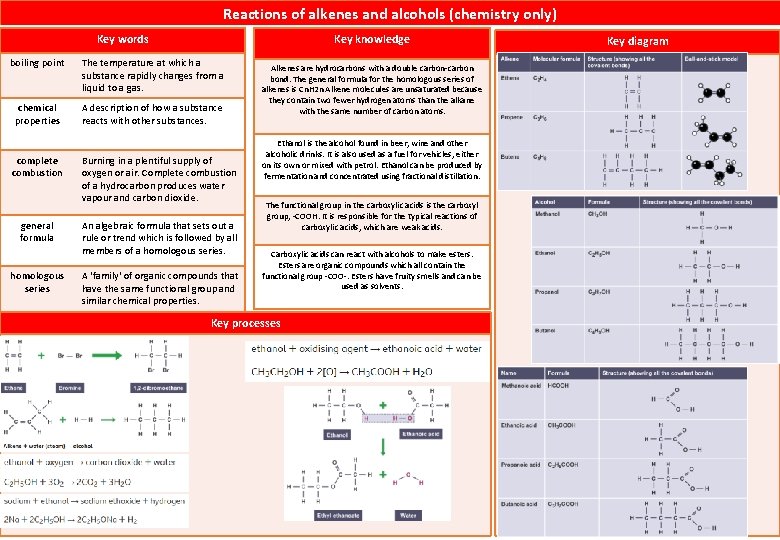
Reactions of alkenes and alcohols (chemistry only) Key knowledge Key words boiling point The temperature at which a substance rapidly changes from a liquid to a gas. chemical properties A description of how a substance reacts with other substances. complete combustion general formula homologous series Burning in a plentiful supply of oxygen or air. Complete combustion of a hydrocarbon produces water vapour and carbon dioxide. An algebraic formula that sets out a rule or trend which is followed by all members of a homologous series. A 'family' of organic compounds that have the same functional group and similar chemical properties. Alkenes are hydrocarbons with a double carbon-carbon bond. The general formula for the homologous series of alkenes is Cn. H 2 n Alkene molecules are unsaturated because they contain two fewer hydrogen atoms than the alkane with the same number of carbon atoms. Ethanol is the alcohol found in beer, wine and other alcoholic drinks. It is also used as a fuel for vehicles, either on its own or mixed with petrol. Ethanol can be produced by fermentation and concentrated using fractional distillation. The functional group in the carboxylic acids is the carboxyl group, -COOH. It is responsible for the typical reactions of carboxylic acids, which are weak acids. Carboxylic acids can react with alcohols to make esters. Esters are organic compounds which all contain the functional group -COO-. Esters have fruity smells and can be used as solvents. Key processes Key diagram
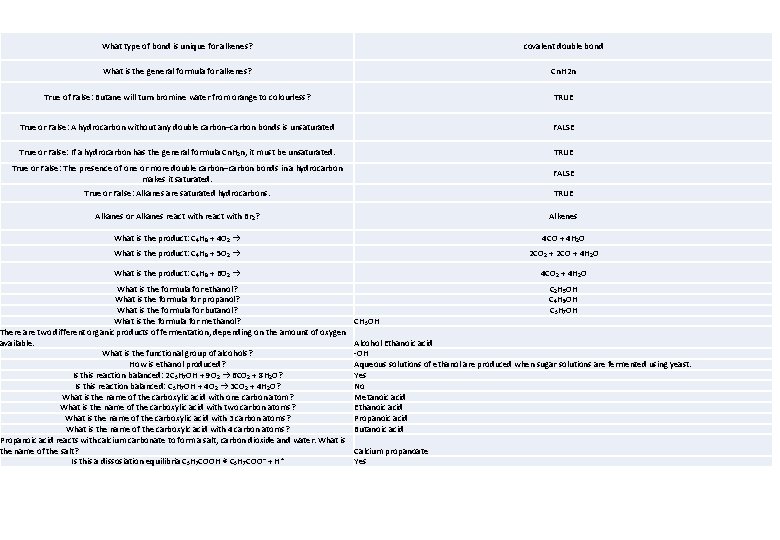
What type of bond is unique for alkenes? covalent double bond What is the general formula for alkenes? Cn. H 2 n True of False: Butane will turn bromine water from orange to colourless? TRUE True or False: A hydrocarbon without any double carbon–carbon bonds is unsaturated FALSE True or False: If a hydrocarbon has the general formula Cn. H₂n, it must be unsaturated. TRUE True or False: The presence of one or more double carbon–carbon bonds in a hydrocarbon makes it saturated. FALSE True or False: Alkanes are saturated hydrocarbons. TRUE Alkanes or Alkanes react with Br₂? Alkenes What is the product: C₄H₈ + 4 O₂ → 4 CO + 4 H₂O What is the product: C₄H₈ + 5 O₂ → 2 CO₂ + 2 CO + 4 H₂O What is the product: C₄H₈ + 6 O₂ → 4 CO₂ + 4 H₂O What is the formula for ethanol? What is the formula for propanol? What is the formula for butanol? What is the formula for methanol? There are two different organic products of fermentation, depending on the amount of oxygen available. What is the functional group of alcohols? How is ethanol produced? Is this reaction balanced: 2 C₃H₇OH + 9 O₂ → 6 CO₂ + 8 H₂O? Is this reaction balanced: C₃H₇OH + 4 O₂ → 3 CO₂ + 4 H₂O? What is the name of the carboxylic acid with one carbon atom? What is the name of the carboxylic acid with two carbon atoms? What is the name of the carboxylic acid with 3 carbon atoms? What is the name of the carboxylc acid with 4 carbon atoms? Propanoic acid reacts with calcium carbonate to form a salt, carbon dioxide and water. What is the name of the salt? Is this a dissosiation equilibria C₃H₇COOH ⇌ C₃H₇COO⁻ + H⁺ CH₃OH C₂H₅OH C₄H₉OH C₃H₇OH Alcohol Ethanoic acid -OH Aqueous solutions of ethanol are produced when sugar solutions are fermented using yeast. Yes No Metanoic acid Ethanoic acid Propanoic acid Butanoic acid Calcium propanoate Yes
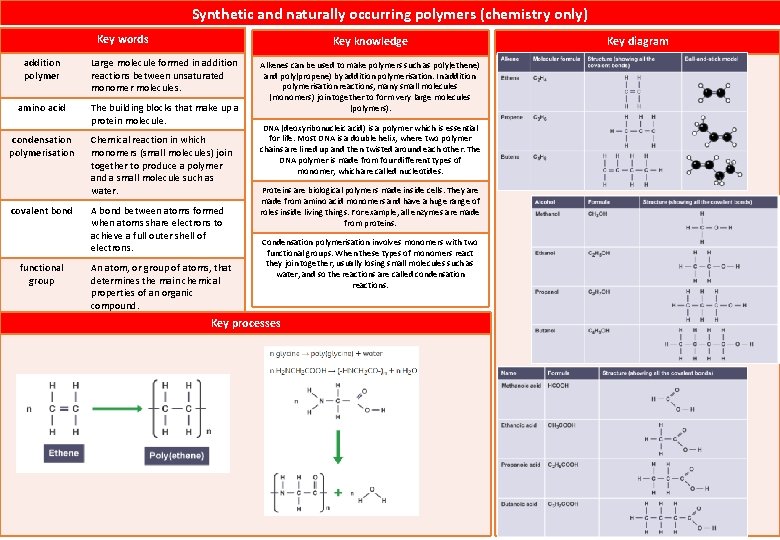
Synthetic and naturally occurring polymers (chemistry only) Key words Key knowledge addition polymer Large molecule formed in addition reactions between unsaturated monomer molecules. amino acid The building blocks that make up a protein molecule. condensation polymerisation covalent bond functional group Chemical reaction in which monomers (small molecules) join together to produce a polymer and a small molecule such as water. A bond between atoms formed when atoms share electrons to achieve a full outer shell of electrons. An atom, or group of atoms, that determines the main chemical properties of an organic compound. Alkenes can be used to make polymers such as poly(ethene) and poly(propene) by addition polymerisation. In addition polymerisation reactions, many small molecules (monomers) join together to form very large molecules (polymers). DNA (deoxyribonucleic acid) is a polymer which is essential for life. Most DNA is a double helix, where two polymer chains are lined up and then twisted around each other. The DNA polymer is made from four different types of monomer, which are called nucleotides. Proteins are biological polymers made inside cells. They are made from amino acid monomers and have a huge range of roles inside living things. For example, all enzymes are made from proteins. Condensation polymerisation involves monomers with two functional groups. When these types of monomers react they join together, usually losing small molecules such as water, and so the reactions are called condensation reactions. Key processes Key diagram
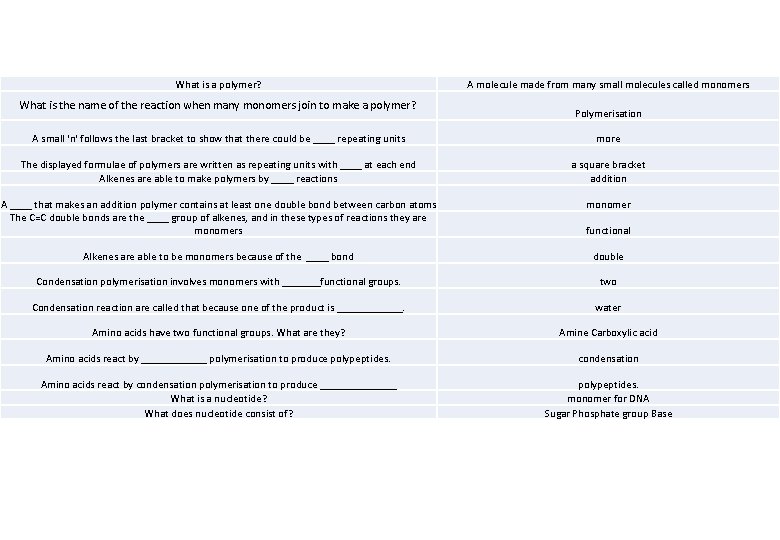
What is a polymer? What is the name of the reaction when many monomers join to make a polymer? A molecule made from many small molecules called monomers Polymerisation A small 'n' follows the last bracket to show that there could be ____ repeating units more The displayed formulae of polymers are written as repeating units with ____ at each end Alkenes are able to make polymers by ____ reactions a square bracket addition A ____ that makes an addition polymer contains at least one double bond between carbon atoms The C=C double bonds are the ____ group of alkenes, and in these types of reactions they are monomers monomer functional Alkenes are able to be monomers because of the ____ bond double Condensation polymerisation involves monomers with _______functional groups. two Condensation reaction are called that because one of the product is ______. water Amino acids have two functional groups. What are they? Amine Carboxylic acid Amino acids react by ______ polymerisation to produce polypeptides. condensation Amino acids react by condensation polymerisation to produce _______ What is a nucleotide? What does nucleotide consist of? polypeptides. monomer for DNA Sugar Phosphate group Base
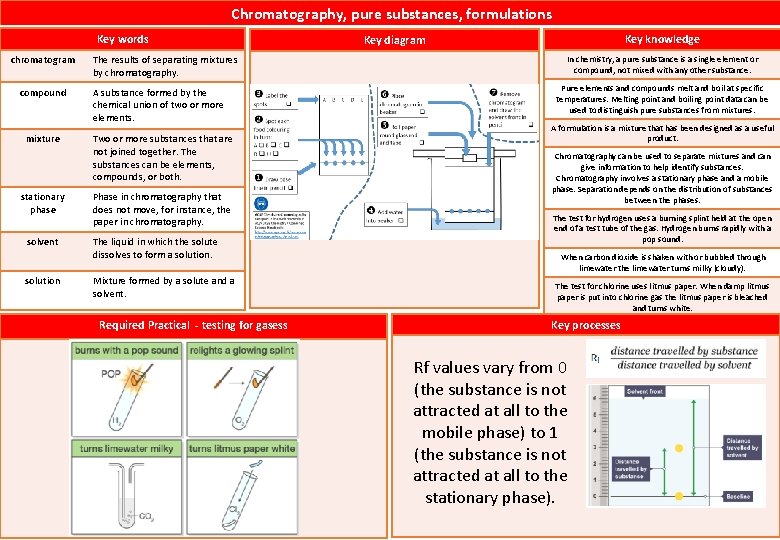
Chromatography, pure substances, formulations Key words chromatogram compound mixture stationary phase solvent solution The results of separating mixtures by chromatography. A substance formed by the chemical union of two or more elements. Two or more substances that are not joined together. The substances can be elements, compounds, or both. Phase in chromatography that does not move, for instance, the paper in chromatography. The liquid in which the solute dissolves to form a solution. Mixture formed by a solute and a solvent. Required Practical - testing for gasess Key knowledge Key diagram In chemistry, a pure substance is a single element or compound, not mixed with any other substance. Pure elements and compounds melt and boil at specific temperatures. Melting point and boiling point data can be used to distinguish pure substances from mixtures. A formulation is a mixture that has been designed as a useful product. Chromatography can be used to separate mixtures and can give information to help identify substances. Chromatography involves a stationary phase and a mobile phase. Separation depends on the distribution of substances between the phases. The test for hydrogen uses a burning splint held at the open end of a test tube of the gas. Hydrogen burns rapidly with a pop sound. When carbon dioxide is shaken with or bubbled through limewater the limewater turns milky (cloudy). The test for chlorine uses litmus paper. When damp litmus paper is put into chlorine gas the litmus paper is bleached and turns white. Key processes Rf values vary from 0 (the substance is not attracted at all to the mobile phase) to 1 (the substance is not attracted at all to the stationary phase).
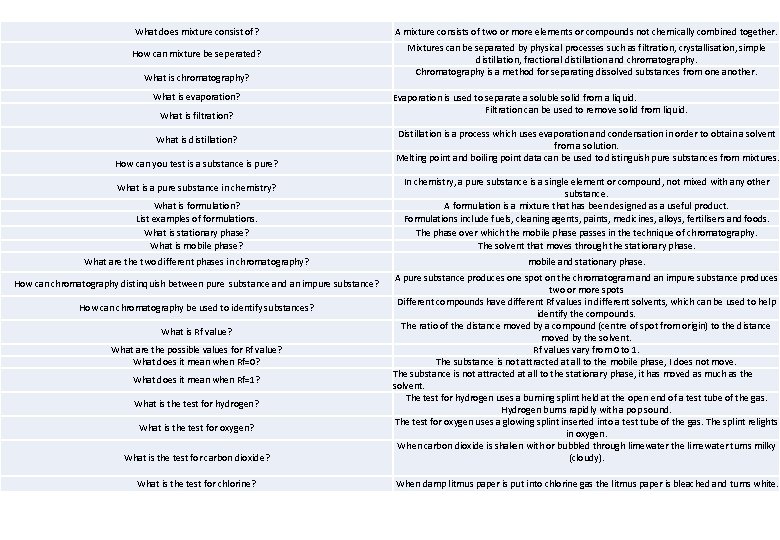
What does mixture consist of? How can mixture be seperated? What is chromatography? What is evaporation? What is filtration? What is distillation? How can you test is a substance is pure? A mixture consists of two or more elements or compounds not chemically combined together. Mixtures can be separated by physical processes such as filtration, crystallisation, simple distillation, fractional distillation and chromatography. Chromatography is a method for separating dissolved substances from one another. Evaporation is used to separate a soluble solid from a liquid. Filtration can be used to remove solid from liquid. Distillation is a process which uses evaporation and condensation in order to obtain a solvent from a solution. Melting point and boiling point data can be used to distinguish pure substances from mixtures. What is formulation? List examples of formulations. What is stationary phase? What is mobile phase? In chemistry, a pure substance is a single element or compound, not mixed with any other substance. A formulation is a mixture that has been designed as a useful product. Formulations include fuels, cleaning agents, paints, medicines, alloys, fertilisers and foods. The phase over which the mobile phase passes in the technique of chromatography. The solvent that moves through the stationary phase. What are the two different phases in chromatography? mobile and stationary phase. What is a pure substance in chemistry? What is the test for carbon dioxide? A pure substance produces one spot on the chromatogram and an impure substance produces two or more spots Different compounds have different Rf values in different solvents, which can be used to help identify the compounds. The ratio of the distance moved by a compound (centre of spot from origin) to the distance moved by the solvent. Rf values vary from 0 to 1. The substance is not attracted at all to the mobile phase, I does not move. The substance is not attracted at all to the stationary phase, it has moved as much as the solvent. The test for hydrogen uses a burning splint held at the open end of a test tube of the gas. Hydrogen burns rapidly with a pop sound. The test for oxygen uses a glowing splint inserted into a test tube of the gas. The splint relights in oxygen. When carbon dioxide is shaken with or bubbled through limewater the limewater turns milky (cloudy). What is the test for chlorine? When damp litmus paper is put into chlorine gas the litmus paper is bleached and turns white. How can chromatography distinquish between pure substance and an impure substance? How can chromatography be used to identify substances? What is Rf value? What are the possible values for Rf value? What does it mean when Rf=0? What does it mean when Rf=1? What is the test for hydrogen? What is the test for oxygen?
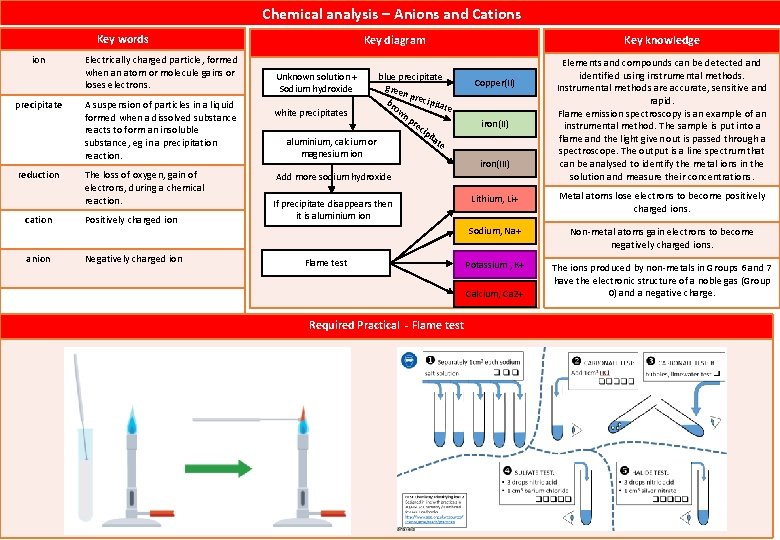
Chemical analysis – Anions and Cations Key words ion precipitate reduction Electrically charged particle, formed when an atom or molecule gains or loses electrons. A suspension of particles in a liquid formed when a dissolved substance reacts to form an insoluble substance, eg in a precipitation reaction. The loss of oxygen, gain of electrons, during a chemical reaction. cation Positively charged ion anion Negatively charged ion Key diagram blue precipitate gree n pr ecip br itate ow white precipitates np re cip ita te aluminium, calcium or magnesium ion Unknown solution + Sodium hydroxide Key knowledge Copper(II) iron(III) Add more sodium hydroxide If precipitate disappears then it is aluminium ion Flame test Lithium, Li+ Metal atoms lose electrons to become positively charged ions. Sodium, Na+ Non-metal atoms gain electrons to become negatively charged ions. Potassium , K+ The ions produced by non-metals in Groups 6 and 7 have the electronic structure of a noble gas (Group 0) and a negative charge. Calcium, Ca 2+ Required Practical - Flame test Elements and compounds can be detected and identified using instrumental methods. Instrumental methods are accurate, sensitive and rapid. Flame emission spectroscopy is an example of an instrumental method. The sample is put into a flame and the light given out is passed through a spectroscope. The output is a line spectrum that can be analysed to identify the metal ions in the solution and measure their concentrations.
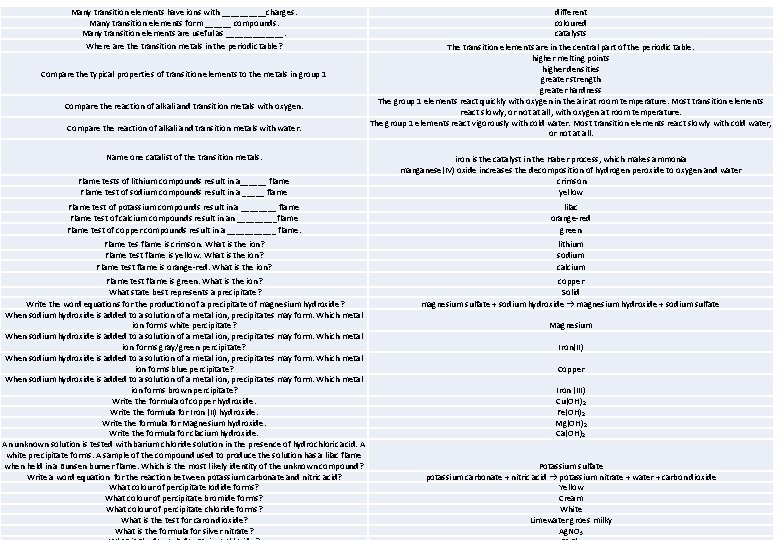
Many transition elements have ions with _____charges. Many transition elements form ______ compounds. Many transition elements are useful as _______. Where are the transition metals in the periodic table? Compare the typical properties of transition elements to the metals in group 1 Compare the reaction of alkali and transition metals with oxygen. Compare the reaction of alkali and transition metals with water. Name one catalist of the transition metals. different coloured catalysts The transition elements are in the central part of the periodic table. higher melting points higher densities greater strength greater hardness The group 1 elements react quickly with oxygen in the air at room temperature. Most transition elements react slowly, or not at all, with oxygen at room temperature. The group 1 elements react vigorously with cold water. Most transition elements react slowly with cold water, or not at all. Flame tests of lithium compounds result in a______ flame Flame test of sodium compounds result in a _____ flame iron is the catalyst in the Haber process, which makes ammonia manganese(IV) oxide increases the decomposition of hydrogen peroxide to oxygen and water crimson yellow Flame test of potassium compounds result in a ____ flame Flame test of calcium compounds result in an _____flame Flame test of copper compounds result in a ______ flame. lilac orange-red green Flame tes flame is crimson. What is the ion? Flame test flame is yellow. What is the ion? Flame test flame is orange-red. What is the ion? lithium sodium calcium Flame test flame is green. What is the ion? What state best represents a precipitate? Write the word equations for the production of a precipitate of magnesium hydroxide? When sodium hydroxide is added to a solution of a metal ion, precipitates may form. Which metal ion forms white percipitate? When sodium hydroxide is added to a solution of a metal ion, precipitates may form. Which metal ion forms gray/green percipitate? When sodium hydroxide is added to a solution of a metal ion, precipitates may form. Which metal ion forms blue percipitate? When sodium hydroxide is added to a solution of a metal ion, precipitates may form. Which metal ion forms brown percipitate? Write the formula of copper hydroxide. Write the formula for Iron (II) hydroxide. Write the formula for Magnesium hydroxide. Write the formula for clacium hydroxide. An unknown solution is tested with barium chloride solution in the presence of hydrochloric acid. A white precipitate forms. A sample of the compound used to produce the solution has a lilac flame when held in a Bunsen burner flame. Which is the most likely identity of the unknown compound? Write a word equation for the reaction between potassium carbonate and nitric acid? What colour of percipitate Iodide forms? What colour of percipitate bromide forms? What colour of percipitate chloride forms? What is the test for caron dioxide? What is the formula for silver nitrate? copper Solid magnesium sulfate + sodium hydroxide → magnesium hydroxide + sodium sulfate Magnesium Iron(II) Copper Iron (III) Cu(OH)₂ Fe(OH)₂ Mg(OH)₂ Ca(OH)₂ Potassium sulfate potassium carbonate + nitric acid → potassium nitrate + water + carbon dioxide Yellow Cream White Limewater groes milky Ag. NO₃
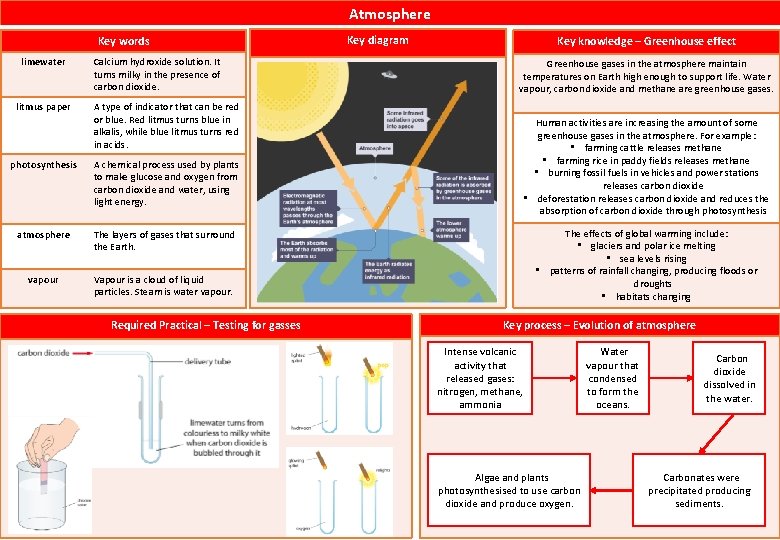
Atmosphere Key words limewater litmus paper Calcium hydroxide solution. It turns milky in the presence of carbon dioxide. Key diagram Key knowledge – Greenhouse effect Greenhouse gases in the atmosphere maintain temperatures on Earth high enough to support life. Water vapour, carbon dioxide and methane are greenhouse gases. A type of indicator that can be red or blue. Red litmus turns blue in alkalis, while blue litmus turns red in acids. photosynthesis A chemical process used by plants to make glucose and oxygen from carbon dioxide and water, using light energy. atmosphere The layers of gases that surround the Earth. vapour Vapour is a cloud of liquid particles. Steam is water vapour. Required Practical – Testing for gasses Human activities are increasing the amount of some greenhouse gases in the atmosphere. For example: • farming cattle releases methane • farming rice in paddy fields releases methane • burning fossil fuels in vehicles and power stations releases carbon dioxide • deforestation releases carbon dioxide and reduces the absorption of carbon dioxide through photosynthesis The effects of global warming include: • glaciers and polar ice melting • sea levels rising • patterns of rainfall changing, producing floods or droughts • habitats changing Key process – Evolution of atmosphere Intense volcanic activity that released gases: nitrogen, methane, ammonia Algae and plants photosynthesised to use carbon dioxide and produce oxygen. Water vapour that condensed to form the oceans. Carbon dioxide dissolved in the water. Carbonates were precipitated producing sediments.
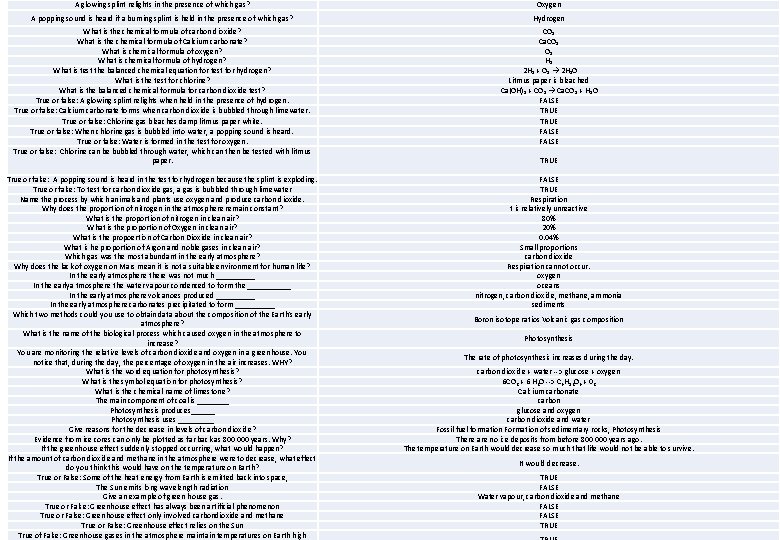
A glowing splint relights in the presence of which gas? Oxygen A popping sound is heard if a burning splint is held in the presence of which gas? Hydrogen What is the chemical formula of carbon dioxide? What is the chemical formula of Calcium carbonate? What is chemical formula of oxygen? What is chemical formula of hydrogen? What is test the balanced chemical equation for test for hydrogen? What is the test for chlorine? What is the balanced chemical formula for carbon dioxide test? True or false: A glowing splint relights when held in the presence of hydrogen. True or false: Calcium carbonate forms when carbon dioxide is bubbled through limewater. True or false: Chlorine gas bleaches damp litmus paper white. True or false: When chlorine gas is bubbled into water, a popping sound is heard. True or false: Water is formed in the test for oxygen. True or false: Chlorine can be bubbled through water, which can then be tested with litmus paper. CO₂ Ca. CO₃ O₂ H₂ 2 H₂ + O₂ → 2 H₂O Litmus paper is bleached Ca(OH)₂ + CO₂ → Ca. CO₃ + H₂O FALSE TRUE FALSE True or false: A popping sound is heard in the test for hydrogen because the splint is exploding. True or false: To test for carbon dioxide gas, a gas is bubbled through limewater Name the process by which animals and plants use oxygen and produce carbon dioxide. Why does the proportion of nitrogen in the atmosphere remain constant? What is the proportion of nitrogen in clean air? What is the proportion of Oxygen in clean air? What is the propoertion of Carbon Dioxide in clean air? What is he proportion of Argon and noble gases in clean air? Which gas was the most abundant in the early atmosphere? Why does the lack of oxygen on Mars mean it is not a suitable environment for human life? In the early atmosphere there was not much _____ In the earlya tmosphere the water vapour condenced to form the ______ In the early atmosphere volcanoes produced _____ In the early atmosphere carbonates precipitated to form _____ Which two methods could you use to obtain data about the composition of the Earth's early atmosphere? What is the name of the biological process which caused oxygen in the atmosphere to increase? You are monitoring the relative levels of carbon dioxide and oxygen in a greenhouse. You notice that, during the day, the percentage of oxygen in the air increases. WHY? What is the word equation for photosynthesis? What is the symbol equation for photosynthesis? What is the chemical name of limestone? The main component of coal is ____ Photosynthesis produces______ Photosynthesis uses _____ Give reasons for the decrease in levels of carbon dioxide? Evidence from ice cores can only be plotted as far back as 800 000 years. Why? If the greenhouse effect suddenly stopped occurring, what would happen? If the amount of carbon dioxide and methane in the atmosphere were to decrease, what effect do you think this would have on the temperature on Earth? True or False: Some of the heat energy from Earth is emitted back into space, The Sun emits long wavelength radiation Give an example of green house gas. True or False: Greenhouse effect has always been artificial phenomenon True or False: Greenhouse effect only involved carbondioxide and methane True or False: Greenhouse effect relies on the Sun True of False: Greenhouse gases in the atmosphere maintain temperatures on Earth high FALSE TRUE Respiration t is relatively unreactive 80% 20% 0. 04% Small proportions carbon dioxide Respiration cannot occur. oxygen oceans nitrogen, carbon dioxide, methane, ammonia sediments TRUE Boron isotope ratios Volcanic gas composition Photosynthesis The rate of photosynthesis increases during the day. carbon dioxide + water --> glucose + oxygen 6 CO 2 + 6 H 2 O --> C 6 H 12 O 6 + 02 Calcium carbonate carbon glucose and oxygen carbon dioxide and water Fossil fuel formation Formation of sedimentary rocks, Photosynthesis There are no ice deposits from before 800 000 years ago. The temperature on Earth would decrease so much that life would not be able to survive. It would decrease. TRUE FALSE Water vapour, carbon dioxide and methane FALSE TRUE
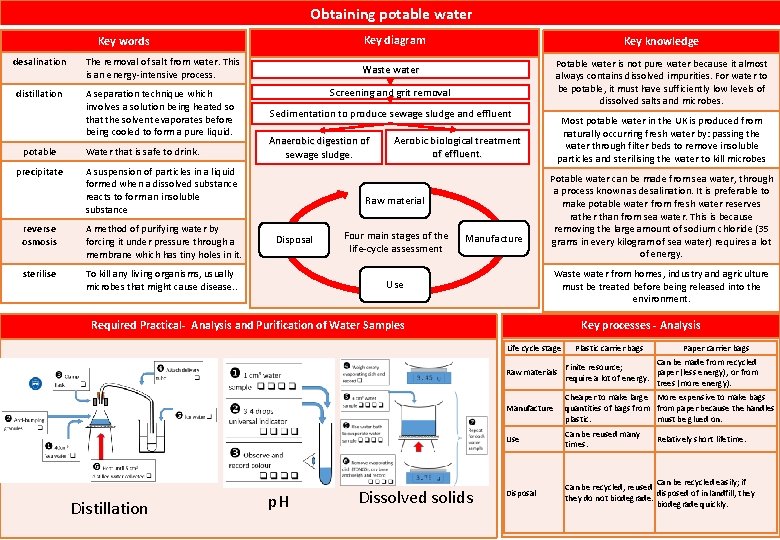
Obtaining potable water Key diagram Key words desalination The removal of salt from water. This is an energy-intensive process. distillation A separation technique which involves a solution being heated so that the solvent evaporates before being cooled to form a pure liquid. potable precipitate Water that is safe to drink. A method of purifying water by forcing it under pressure through a membrane which has tiny holes in it. sterilise To kill any living organisms, usually microbes that might cause disease. . Potable water is not pure water because it almost always contains dissolved impurities. For water to be potable, it must have sufficiently low levels of dissolved salts and microbes. Waste water Screening and grit removal Sedimentation to produce sewage sludge and effluent Anaerobic digestion of sewage sludge. A suspension of particles in a liquid formed when a dissolved substance reacts to form an insoluble substance reverse osmosis Key knowledge Aerobic biological treatment of effluent. Raw material Disposal Most potable water in the UK is produced from naturally occurring fresh water by: passing the water through filter beds to remove insoluble particles and sterilising the water to kill microbes Four main stages of the life-cycle assessment Manufacture Potable water can be made from sea water, through a process known as desalination. It is preferable to make potable water from fresh water reserves rather than from sea water. This is because removing the large amount of sodium chloride (35 grams in every kilogram of sea water) requires a lot of energy. Waste water from homes, industry and agriculture must be treated before being released into the environment. Use Key processes - Analysis Required Practical- Analysis and Purification of Water Samples Life cycle stage Distillation p. H Dissolved solids Plastic carrier bags Paper carrier bags Raw materials Can be made from recycled Finite resource; paper (less energy), or from require a lot of energy. trees (more energy). Manufacture Cheaper to make large More expensive to make bags quantities of bags from paper because the handles plastic. must be glued on. Use Can be reused many times. Disposal Can be recycled easily; if Can be recycled, reused disposed of in landfill, they do not biodegrade quickly. Relatively short lifetime.
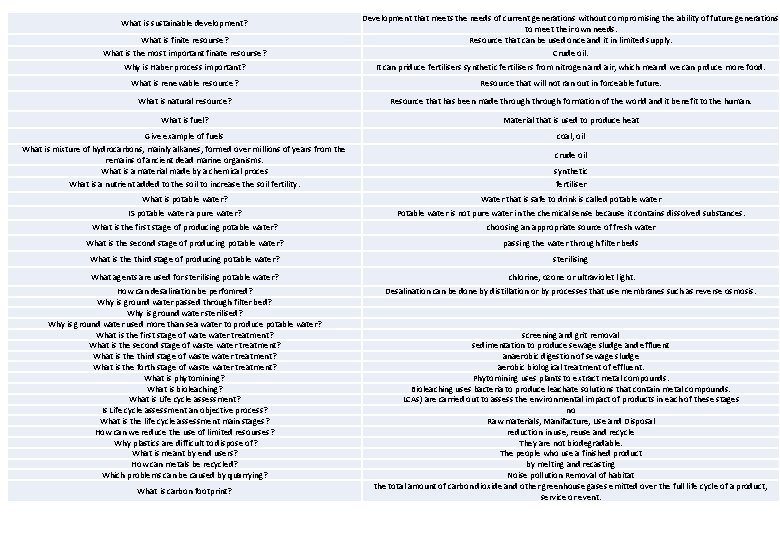
What is finite resourse? What is the most important finate resourse? Development that meets the needs of current generations without compromising the ability of future generations to meet their own needs. Resource that can be used once and it in limited supply. Crude oil. Why is Haber process important? It can priduce fertilisers synthetic fertilisers from nitrogen and air, which meand we can prduce more food. What is renewable resource? Resource that will not ran out in forceable future. What is natural resource? Resource that has been made through formation of the world and it benefit to the human. What is fuel? Material that is used to produce heat Give example of fuels What is mixture of hydrocarbons, mainly alkanes, formed over millions of years from the remains of ancient dead marine organisms. What is a material made by a chemical proces What is a nutrient added to the soil to increase the soil fertility. coal, oil What is sustainable development? crude oil synthetic fertiliser What is potable water? Water that is safe to drink is called potable water IS potable water a pure water? Potable water is not pure water in the chemical sense because it contains dissolved substances. What is the first stage of producing potable water? choosing an appropriate source of fresh water What is the second stage of producing potable water? passing the water through filter beds What is the third stage of producing potable water? sterilising What agents are used for sterilising potable water? chlorine, ozone or ultraviolet light. How can desalination be perfomred? Why is ground water passed through filter bed? Why is ground water sterilised? Why is ground water used more than sea water to produce potable water? What is the first stage of water treatment? What is the second stage of waste water treatment? What is the third stage of waste water treatment? What is the forth stage of waste water treatment? What is phytomining? What is bioleaching? What is Life cycle assessment? Is Life cycle assessment an objective process? What is the life cycle assessment main stages? How can we reduce the use of limited resourses? Why plastics are difficult to dispose of? What is meant by end users? How can metals be recycled? Which problems can be caused by quarrying? Desalination can be done by distillation or by processes that use membranes such as reverse osmosis. What is carbon footprint? screening and grit removal sedimentation to produce sewage sludge and effluent anaerobic digestion of sewage sludge aerobic biological treatment of effluent. Phytomining uses plants to extract metal compounds. Bioleaching uses bacteria to produce leachate solutions that contain metal compounds. LCAs) are carried out to assess the environmental impact of products in each of these stages no Raw materials, Manifacture, Use and Disposal reduction in use, reuse and recycle They are not biodegradable. The people who use a finished product by melting and recasting Noise pollution Removal of habitat the total amount of carbon dioxide and other greenhouse gases emitted over the full life cycle of a product, service or event.
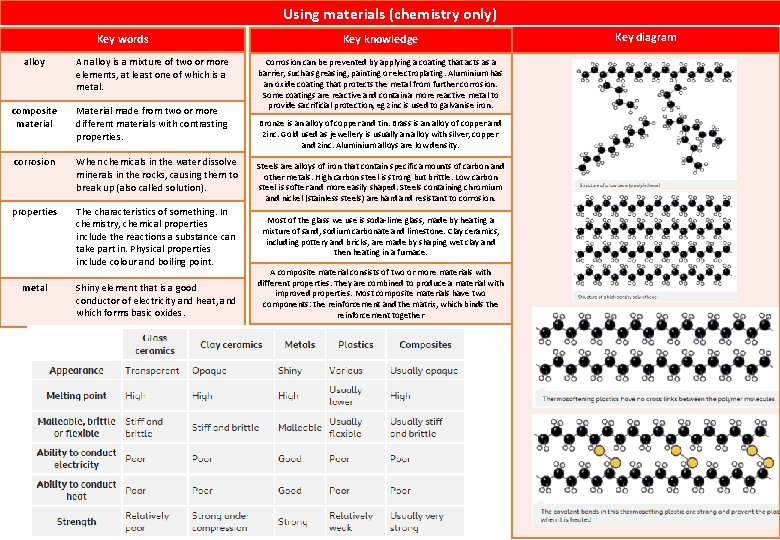
Using materials (chemistry only) Key words alloy An alloy is a mixture of two or more elements, at least one of which is a metal. composite material Material made from two or more different materials with contrasting properties. corrosion When chemicals in the water dissolve minerals in the rocks, causing them to break up (also called solution). properties The characteristics of something. In chemistry, chemical properties include the reactions a substance can take part in. Physical properties include colour and boiling point. metal Shiny element that is a good conductor of electricity and heat, and which forms basic oxides. Key knowledge Corrosion can be prevented by applying a coating that acts as a barrier, such as greasing, painting or electroplating. Aluminium has an oxide coating that protects the metal from further corrosion. Some coatings are reactive and contain a more reactive metal to provide sacrificial protection, eg zinc is used to galvanise iron. Bronze is an alloy of copper and tin. Brass is an alloy of copper and zinc. Gold used as jewellery is usually an alloy with silver, copper and zinc. Aluminium alloys are low density. Steels are alloys of iron that contain specific amounts of carbon and other metals. High carbon steel is strong but brittle. Low carbon steel is softer and more easily shaped. Steels containing chromium and nickel (stainless steels) are hard and resistant to corrosion. Most of the glass we use is soda-lime glass, made by heating a mixture of sand, sodium carbonate and limestone. Clay ceramics, including pottery and bricks, are made by shaping wet clay and then heating in a furnace. A composite material consists of two or more materials with different properties. They are combined to produce a material with improved properties. Most composite materials have two components: the reinforcement and the matrix, which binds the reinforcement together Key diagram
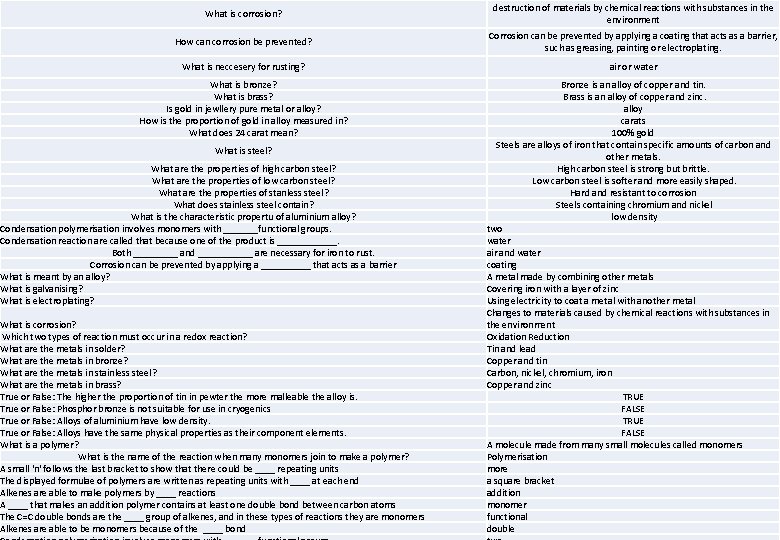
What is corrosion? destruction of materials by chemical reactions with substances in the environment How can corrosion be prevented? Corrosion can be prevented by applying a coating that acts as a barrier, such as greasing, painting or electroplating. What is neccesery for rusting? air or water What is bronze? What is brass? Is gold in jewllery pure metal or alloy? How is the proportion of gold in alloy measured in? What does 24 carat mean? What is steel? What are the properties of high carbon steel? What are the properties of low carbon steel? What are the properties of stanless steel? What does stainless steel contain? What is the characteristic propertu of aluminium alloy? Condensation polymerisation involves monomers with _______functional groups. Condensation reaction are called that because one of the product is ______. Both _____ and ______ are necessary for iron to rust. Corrosion can be prevented by applying a _____ that acts as a barrier What is meant by an alloy? What is galvanising? What is electroplating? What is corrosion? Which two types of reaction must occur in a redox reaction? What are the metals in solder? What are the metals in bronze? What are the metals in stainless steel? What are the metals in brass? True or False: The higher the proportion of tin in pewter the more malleable the alloy is. True or False: Phosphor bronze is not suitable for use in cryogenics True or False: Alloys of aluminium have low density. True or False: Alloys have the same physical properties as their component elements. What is a polymer? What is the name of the reaction when many monomers join to make a polymer? A small 'n' follows the last bracket to show that there could be ____ repeating units The displayed formulae of polymers are written as repeating units with ____ at each end Alkenes are able to make polymers by ____ reactions A ____ that makes an addition polymer contains at least one double bond between carbon atoms The C=C double bonds are the ____ group of alkenes, and in these types of reactions they are monomers Alkenes are able to be monomers because of the ____ bond Bronze is an alloy of copper and tin. Brass is an alloy of copper and zinc. alloy carats 100% gold Steels are alloys of iron that contain specific amounts of carbon and other metals. High carbon steel is strong but brittle. Low carbon steel is softer and more easily shaped. Hard and resistant to corrosion Steels containing chromium and nickel low density two water air and water coating A metal made by combining other metals Covering iron with a layer of zinc Using electricity to coat a metal with another metal Changes to materials caused by chemical reactions with substances in the environment Oxidation Reduction Tin and lead Copper and tin Carbon, nickel, chromium, iron Copper and zinc TRUE FALSE A molecule made from many small molecules called monomers Polymerisation more a square bracket addition monomer functional double
- Slides: 51