
4 0 ROOT LOCUS OBJECTIVE Determination of root
4. 0 ROOT LOCUS OBJECTIVE ~ Determination of root from the characteristic equation by using graphical solution. ~ Rules on sketching the root locus. ~ Analysis of closed-loop using root locus
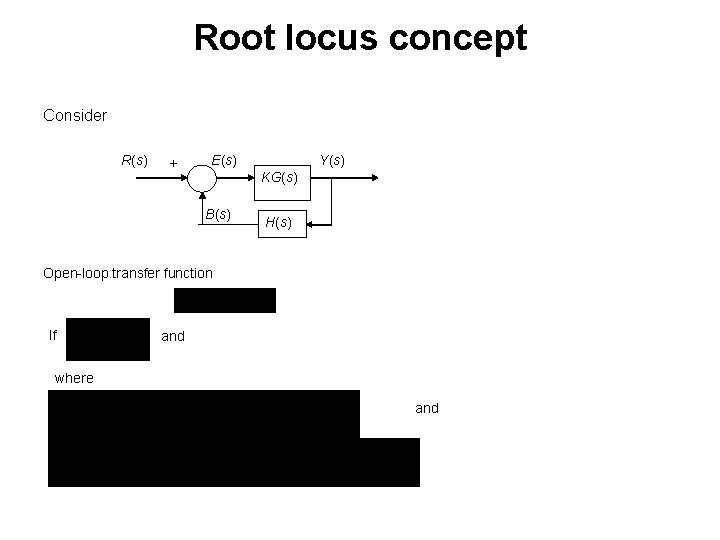
Root locus concept Consider R(s) + E(s) Y(s) KG(s) B(s) H(s) Open-loop transfer function If and where and
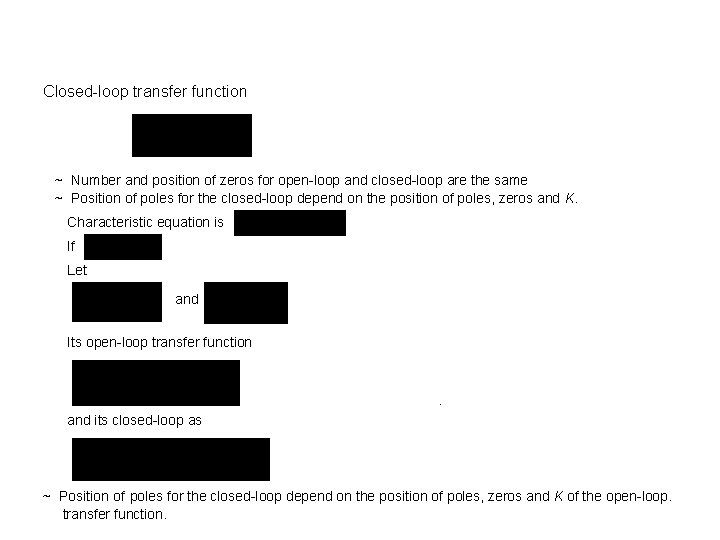
Closed-loop transfer function ~ Number and position of zeros for open-loop and closed-loop are the same ~ Position of poles for the closed-loop depend on the position of poles, zeros and K. Characteristic equation is If . Let and Its open-loop transfer function . and its closed-loop as ~ Position of poles for the closed-loop depend on the position of poles, zeros and K of the open-loop. transfer function.
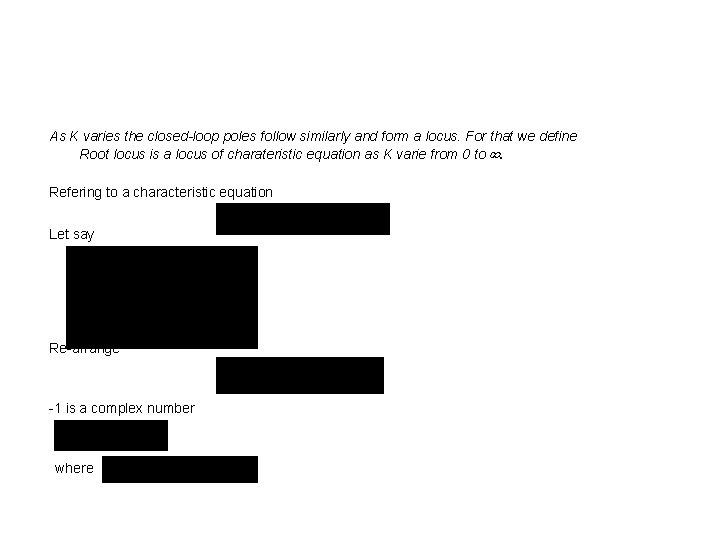
As K varies the closed loop poles follow similarly and form a locus. For that we define Root locus is a locus of charateristic equation as K varie from 0 to . Refering to a characteristic equation Let say Re-arrange -1 is a complex number where
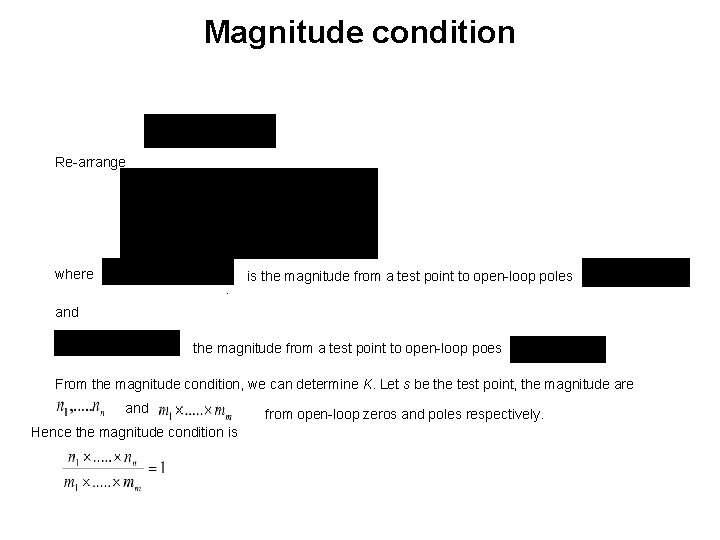
Magnitude condition Re-arrange where. is the magnitude from a test point to open-loop poles and the magnitude from a test point to open-loop poes From the magnitude condition, we can determine K. Let s be the test point, the magnitude are and Hence the magnitude condition is from open-loop zeros and poles respectively.
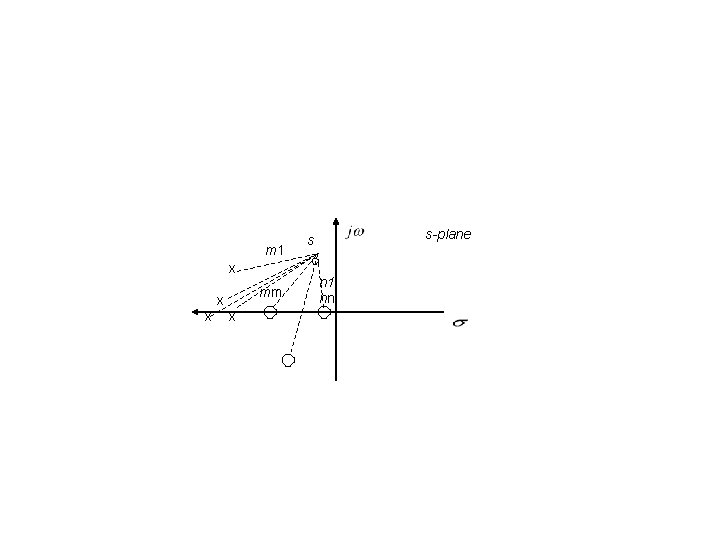
m 1 x mm x x x s plane s n 1 nn
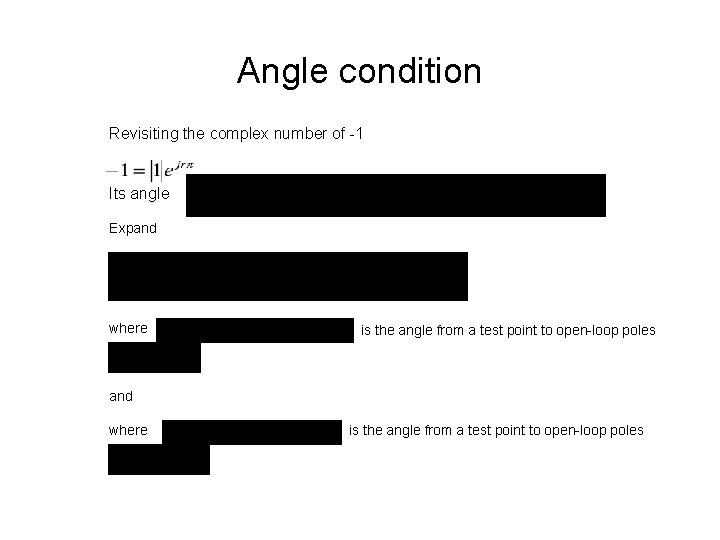
Angle condition Revisiting the complex number of -1 Its angle Expand where is the angle from a test point to open-loop poles
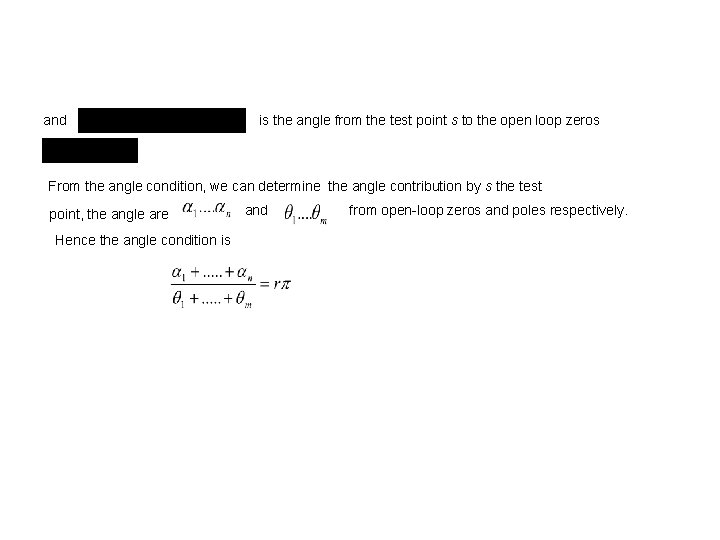
and is the angle from the test point s to the open loop zeros From the angle condition, we can determine the angle contribution by s the test point, the angle are Hence the angle condition is and from open-loop zeros and poles respectively.
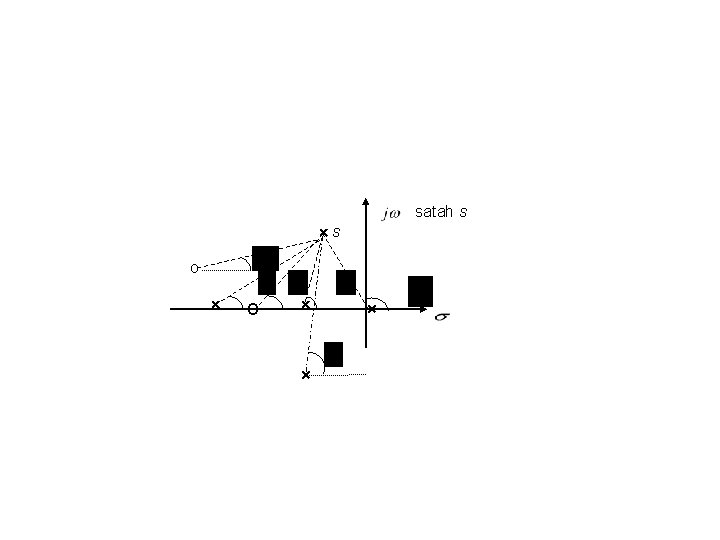
satah s s O O
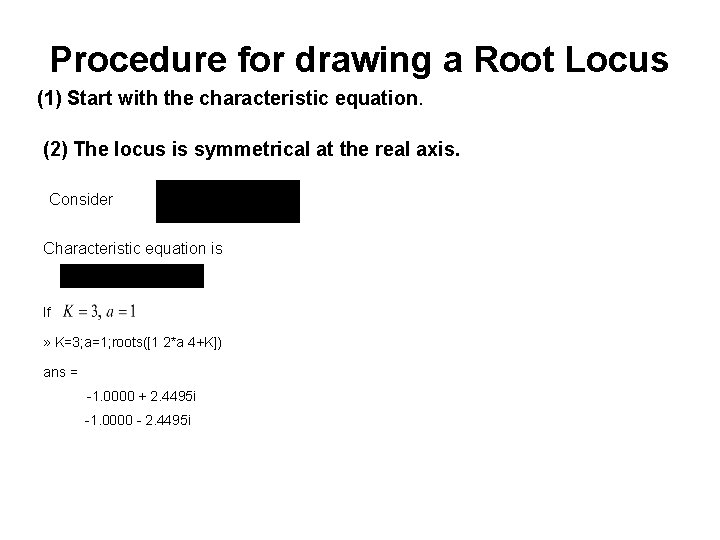
Procedure for drawing a Root Locus (1) Start with the characteristic equation. (2) The locus is symmetrical at the real axis. Consider Characteristic equation is If » K=3; a=1; roots([1 2*a 4+K]) ans = -1. 0000 + 2. 4495 i -1. 0000 - 2. 4495 i
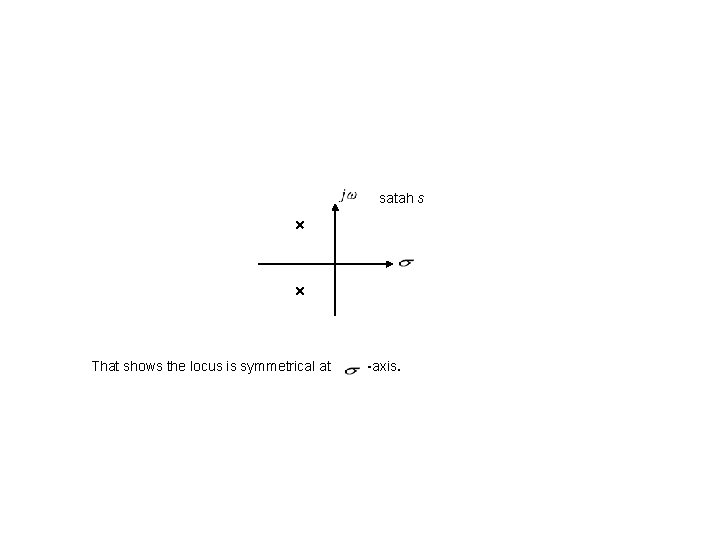
satah s That shows the locus is symmetrical at -axis.
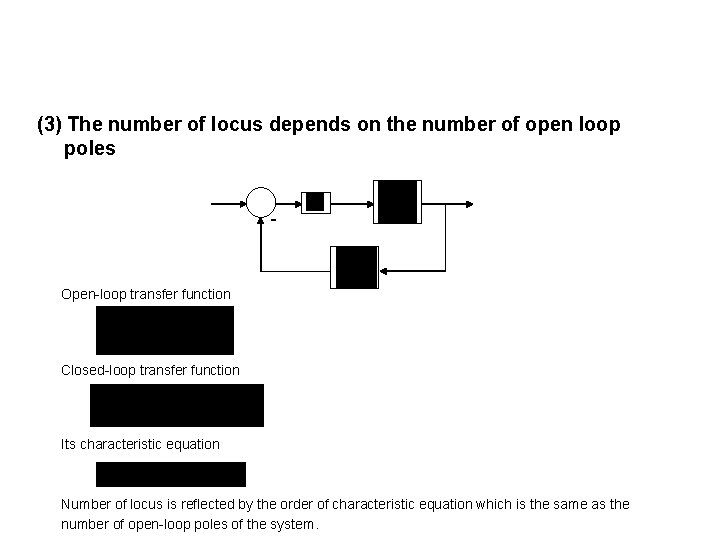
(3) The number of locus depends on the number of open loop poles - Open-loop transfer function Closed-loop transfer function Its characteristic equation Number of locus is reflected by the order of characteristic equation which is the same as the number of open-loop poles of the system.
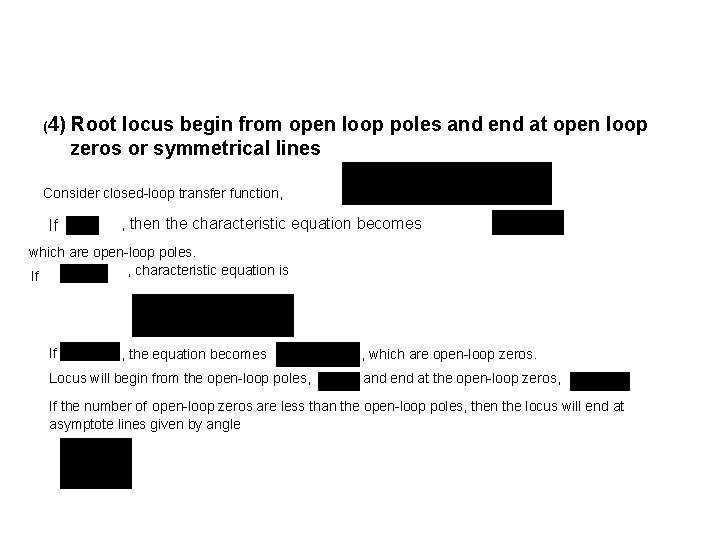
(4) Root locus begin from open loop poles and end at open loop zeros or symmetrical lines Consider closed-loop transfer function, If , then the characteristic equation becomes which are open-loop poles. , characteristic equation is If. If , the equation becomes Locus will begin from the open-loop poles, , which are open-loop zeros. , and end at the open-loop zeros, If the number of open-loop zeros are less than the open-loop poles, then the locus will end at asymptote lines given by angle
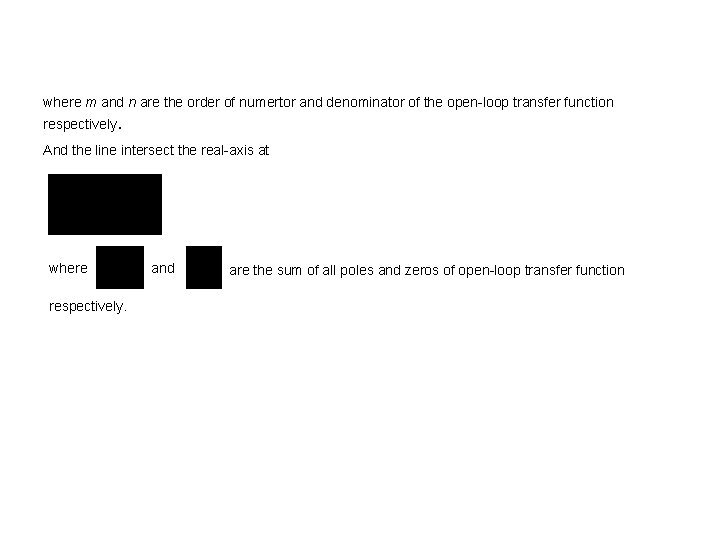
where m and n are the order of numertor and denominator of the open-loop transfer function respectively. And the line intersect the real-axis at where respectively. and are the sum of all poles and zeros of open-loop transfer function
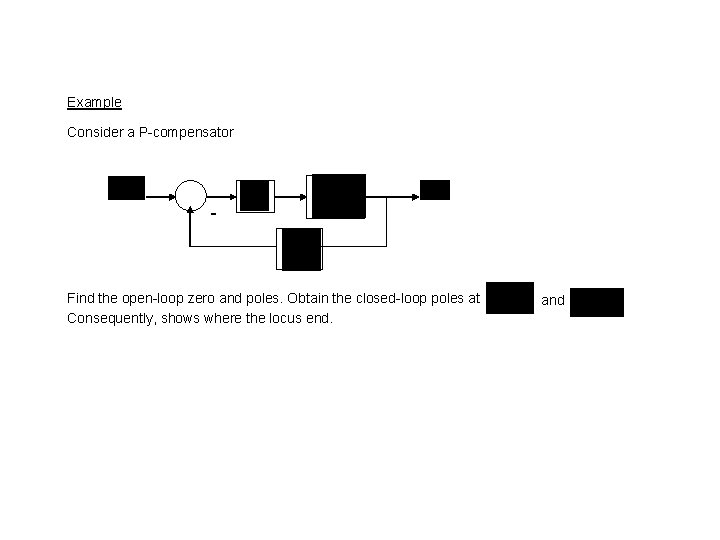
Example Consider a P-compensator - Find the open-loop zero and poles. Obtain the closed-loop poles at Consequently, shows where the locus end. and
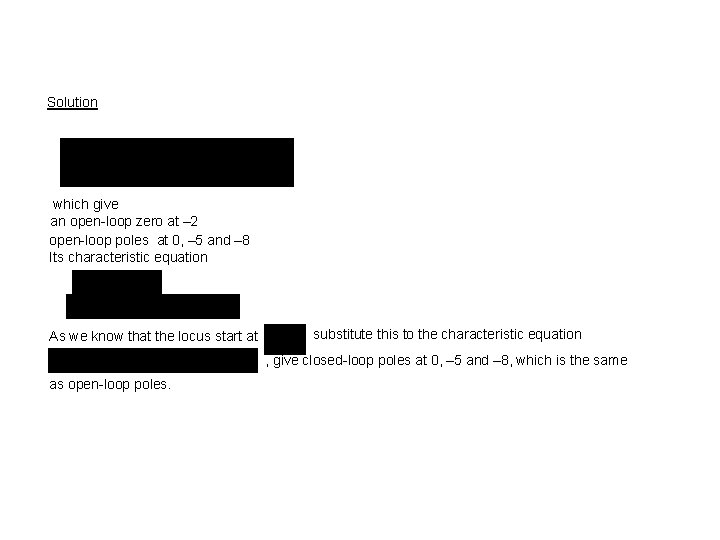
Solution which give an open-loop zero at – 2 open-loop poles at 0, – 5 and – 8 Its characteristic equation As we know that the locus start at substitute this to the characteristic equation , give closed-loop poles at 0, – 5 and – 8, which is the same as open-loop poles.
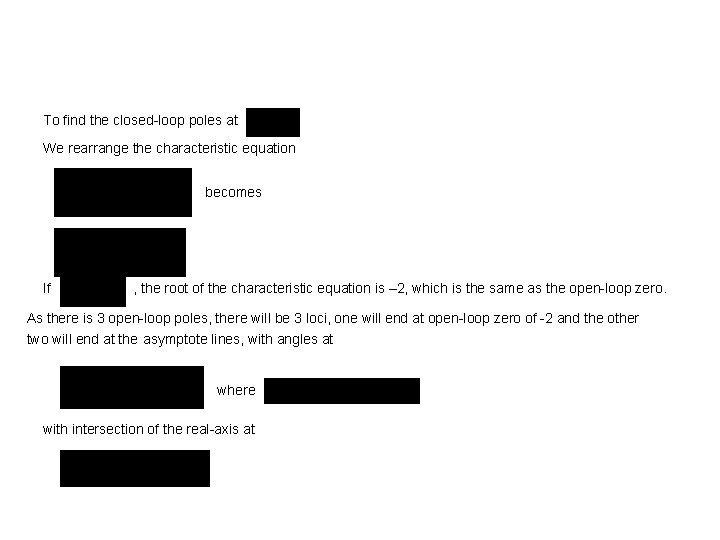
To find the closed-loop poles at We rearrange the characteristic equation becomes If , the root of the characteristic equation is – 2, which is the same as the open-loop zero. As there is 3 open-loop poles, there will be 3 loci, one will end at open-loop zero of -2 and the other two will end at the asymptote lines, with angles at where with intersection of the real-axis at
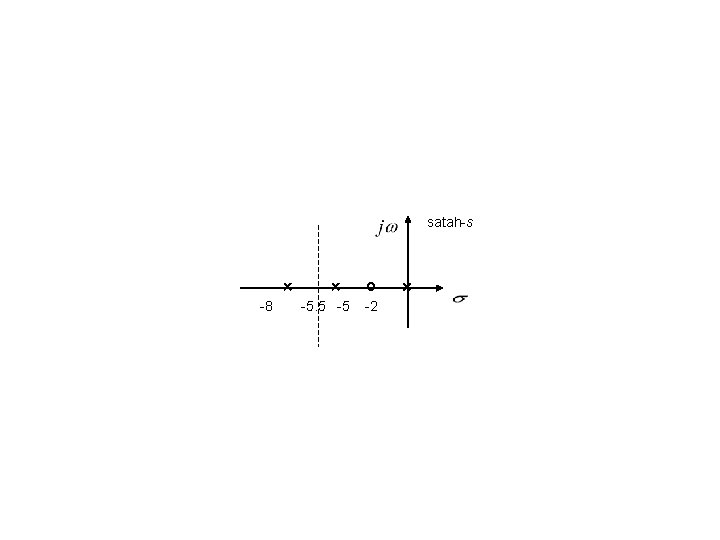
satah-s -8 -5. 5 -5 o -2
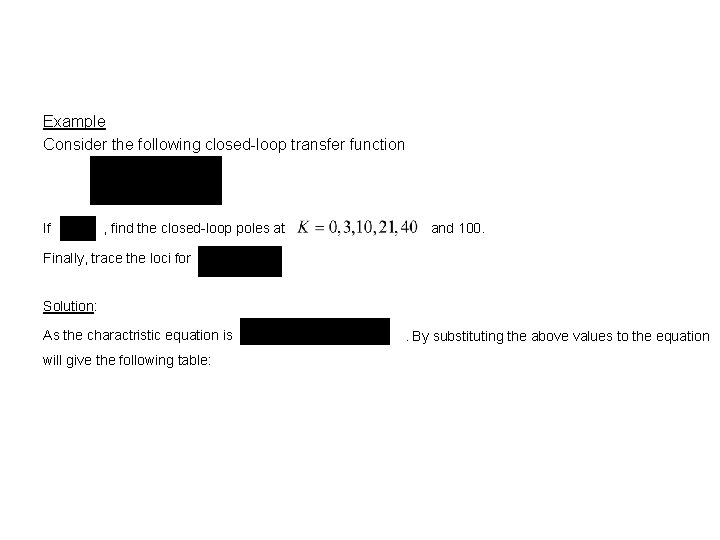
Example Consider the following closed-loop transfer function If , find the closed-loop poles at and 100. Finally, trace the loci for Solution: As the charactristic equation is will give the following table: . By substituting the above values to the equation
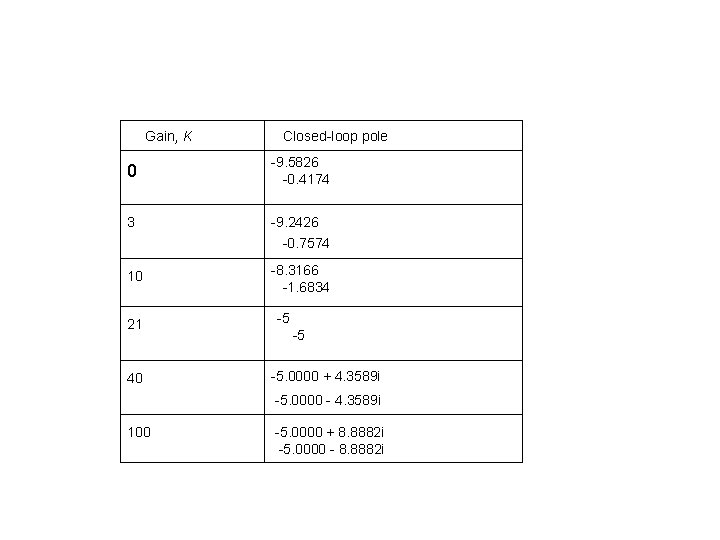
Gain, K Closed-loop pole 0 -9. 5826 -0. 4174 3 -9. 2426 -0. 7574 10 -8. 3166 -1. 6834 21 40 -5 -5 -5. 0000 + 4. 3589 i -5. 0000 - 4. 3589 i 100 -5. 0000 + 8. 8882 i -5. 0000 - 8. 8882 i
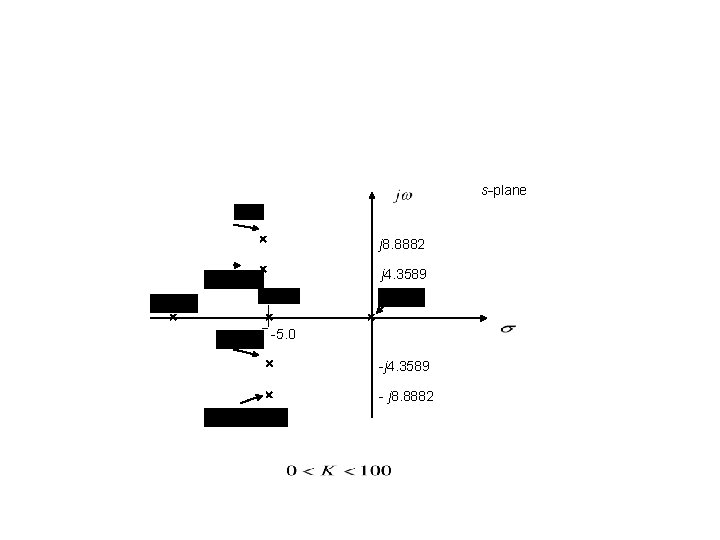
s -plane j 8. 8882 j 4. 3589 -5. 0 -j 4. 3589 - j 8. 8882
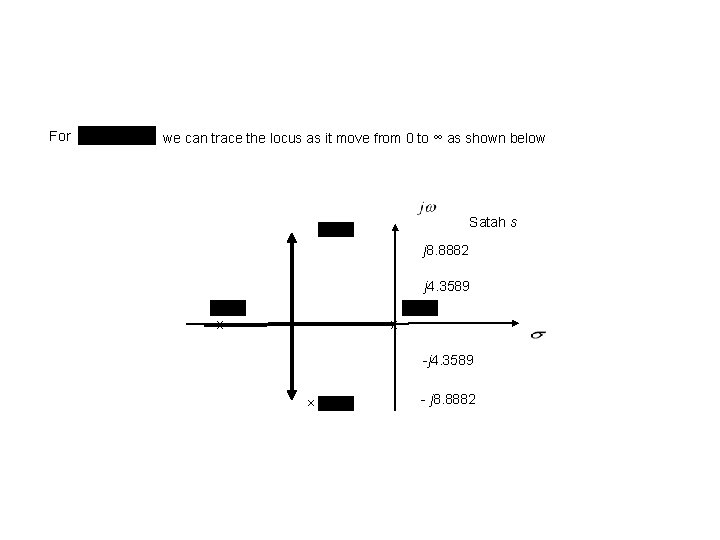
For we can trace the locus as it move from 0 to ∞ as shown below Satah s j 8. 8882 j 4. 3589 x x -j 4. 3589 - j 8. 8882
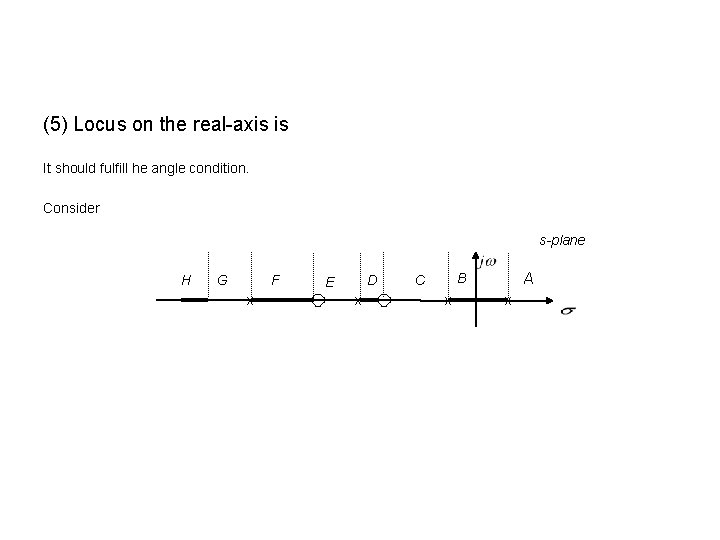
(5) Locus on the real-axis is It should fulfill he angle condition. Consider s plane H G F x D E x A B C x x
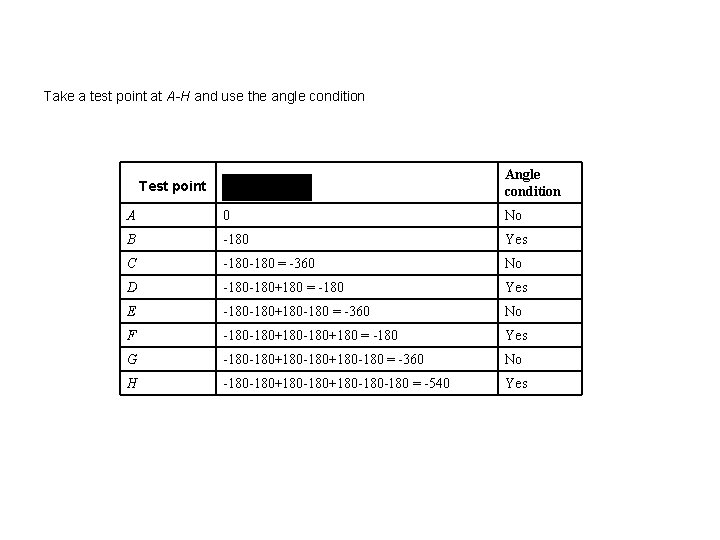
Take a test point at A H and use the angle condition Angle condition Test point A 0 No B -180 Yes C -180 = -360 No D -180+180 = -180 Yes E -180+180 -180 = -360 No F -180+180 -180+180 = -180 Yes G -180+180 -180 = -360 No H -180+180 -180 -180 = -540 Yes
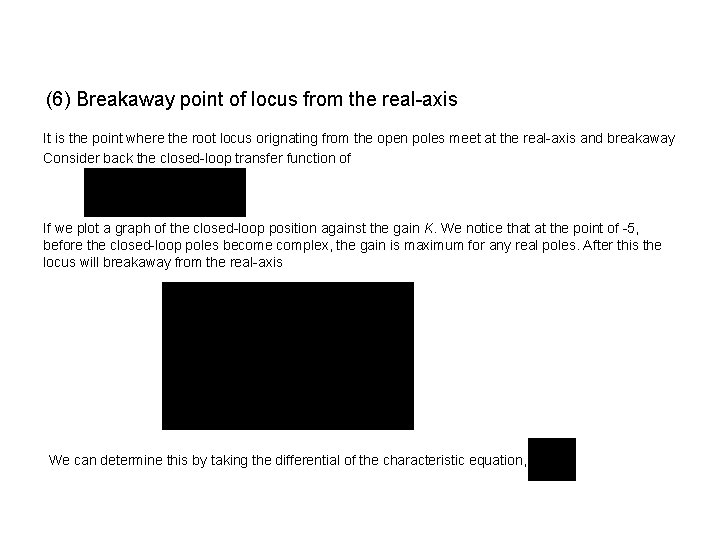
(6) Breakaway point of locus from the real-axis It is the point where the root locus orignating from the open poles meet at the real-axis and breakaway Consider back the closed-loop transfer function of If we plot a graph of the closed-loop position against the gain K. We notice that at the point of -5, before the closed-loop poles become complex, the gain is maximum for any real poles. After this the locus will breakaway from the real-axis We can determine this by taking the differential of the characteristic equation,
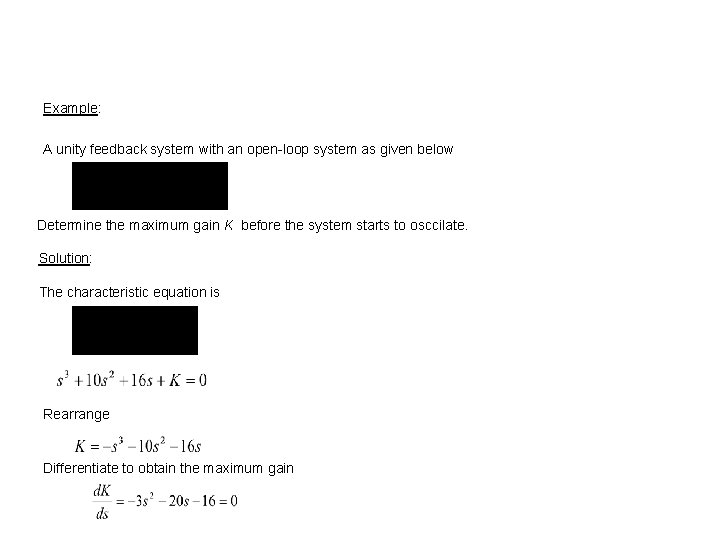
Example: A unity feedback system with an open-loop system as given below Determine the maximum gain K before the system starts to osccilate. Solution: The characteristic equation is Rearrange Differentiate to obtain the maximum gain
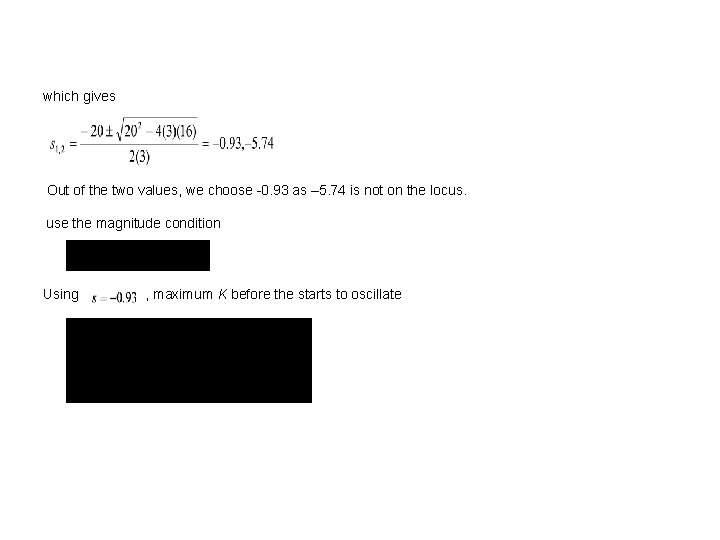
which gives Out of the two values, we choose -0. 93 as – 5. 74 is not on the locus. use the magnitude condition Using , maximum K before the starts to oscillate
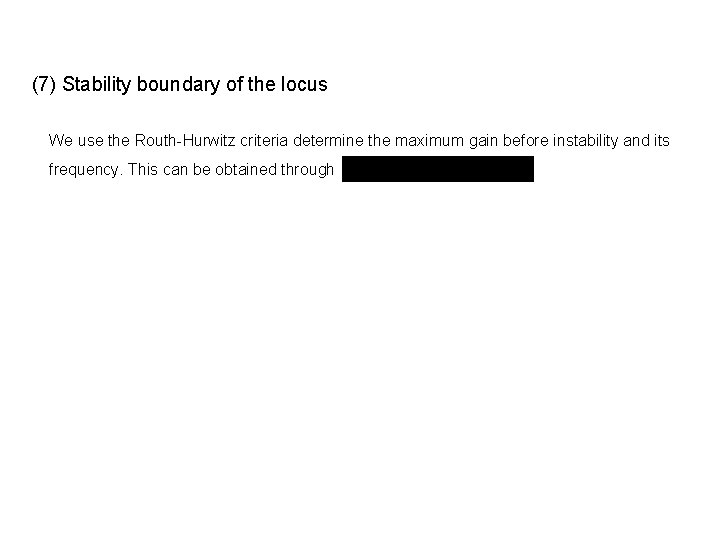
(7) Stability boundary of the locus We use the Routh-Hurwitz criteria determine the maximum gain before instability and its frequency. This can be obtained through
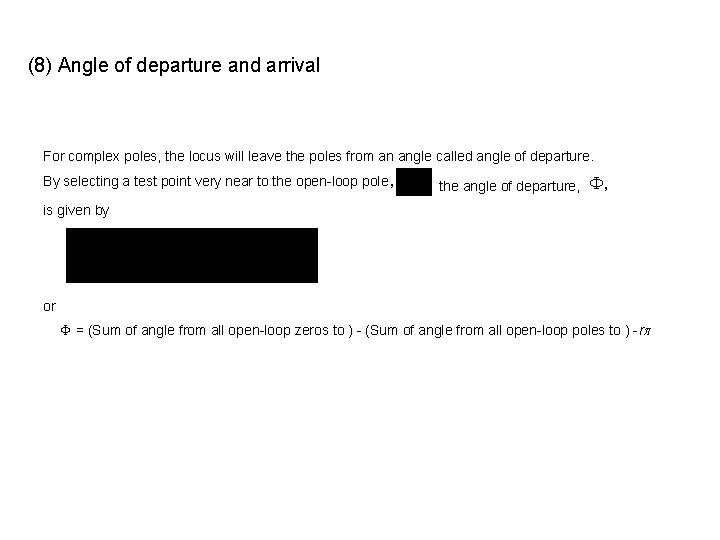
(8) Angle of departure and arrival For complex poles, the locus will leave the poles from an angle called angle of departure. By selecting a test point very near to the open-loop pole, the angle of departure, , is given by or = (Sum of angle from all open-loop zeros to ) - (Sum of angle from all open-loop poles to ) -r
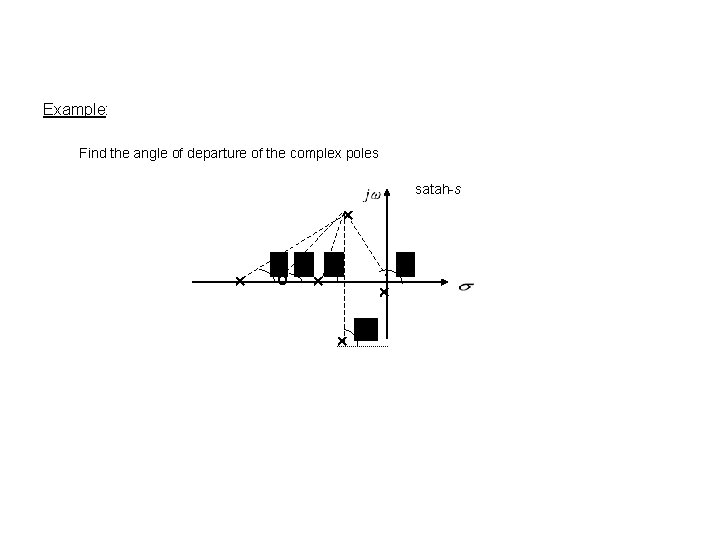
Example: Find the angle of departure of the complex poles satah-s O
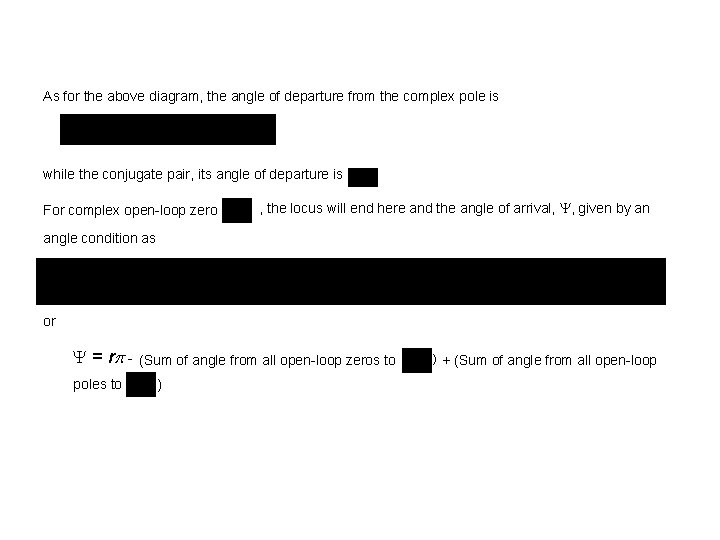
As for the above diagram, the angle of departure from the complex pole is while the conjugate pair, its angle of departure is For complex open-loop zero , the locus will end here and the angle of arrival, , given by an angle condition as or = r poles to (Sum of angle from all open-loop zeros to ) ) + (Sum of angle from all open-loop
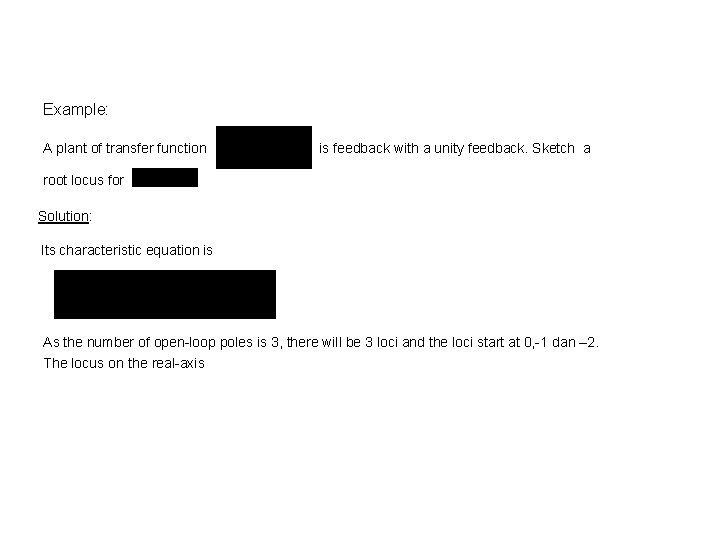
Example: A plant of transfer function is feedback with a unity feedback. Sketch a root locus for Solution: Its characteristic equation is As the number of open-loop poles is 3, there will be 3 loci and the loci start at 0, -1 dan – 2. The locus on the real-axis
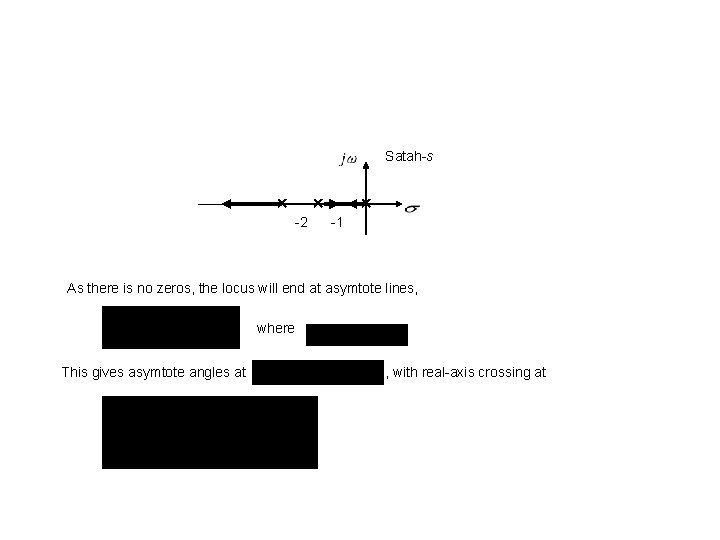
Satah-s -2 -1 As there is no zeros, the locus will end at asymtote lines, where This gives asymtote angles at , with real-axis crossing at
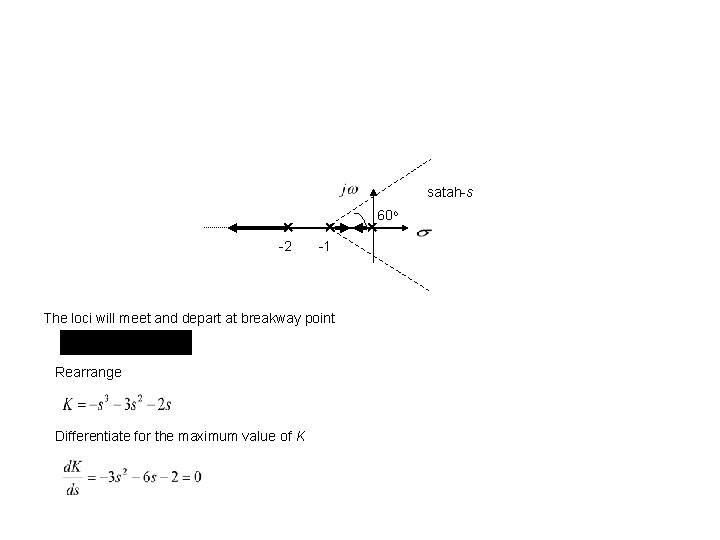
satah-s -2 -1 The loci will meet and depart at breakway point Rearrange Differentiate for the maximum value of K 60 o
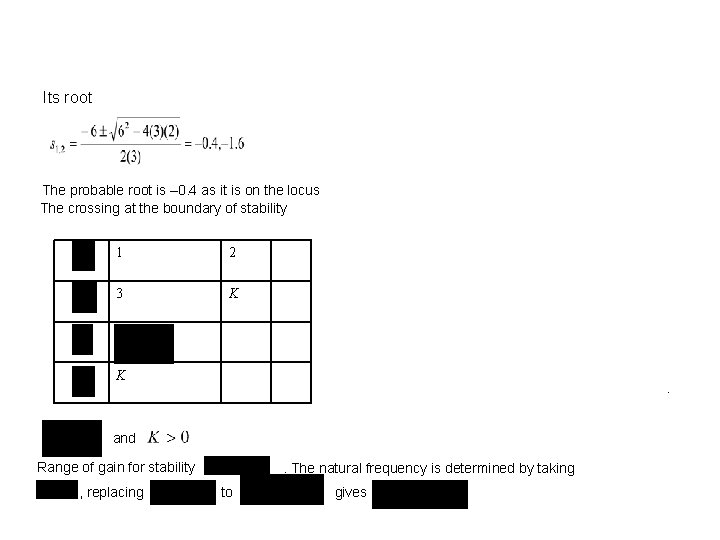
Its root The probable root is – 0. 4 as it is on the locus The crossing at the boundary of stability 1 2 3 K K . and Range of gain for stability , replacing . The natural frequency is determined by taking to gives
![» [k, p]=rlocfind(num, den) » num=[1]; den=[1 3 2 0]; %Takrifkan rangkap pindah gelung](http://slidetodoc.com/presentation_image_h/25d0fb4914be1e5a83007d2ef0e2040b/image-36.jpg "» [k, p]=rlocfind(num, den) » num=[1]; den=[1 3 2 0]; %Takrifkan rangkap pindah gelung")
» [k, p]=rlocfind(num, den) » num=[1]; den=[1 3 2 0]; %Takrifkan rangkap pindah gelung buka » rlocus(num, den); %Kerahan » grid; title('LONDAR PUNCA') We can determine the gain at particular points through » [k, p]=rlocfind(num, den)
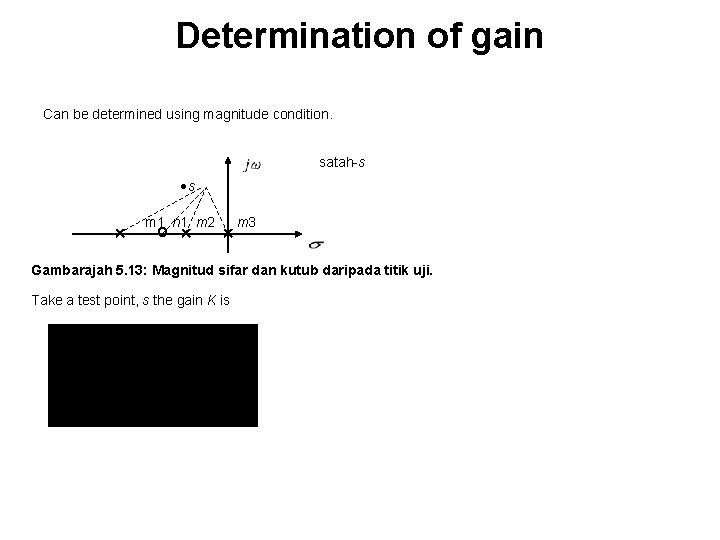
Determination of gain Can be determined using magnitude condition. satah-s s m 1 n 1 m 2 O m 3 Gambarajah 5. 13: Magnitud sifar dan kutub daripada titik uji. Take a test point, s the gain K is
Pole Determination If the order of the charateristic equation is n, there will be n poles. If n-1 poles are known we know the last pole by comparing the coefficient. Consider Which can be factored to. Expanding the factor form Equating the coefficient will give the n pole as where its poles are
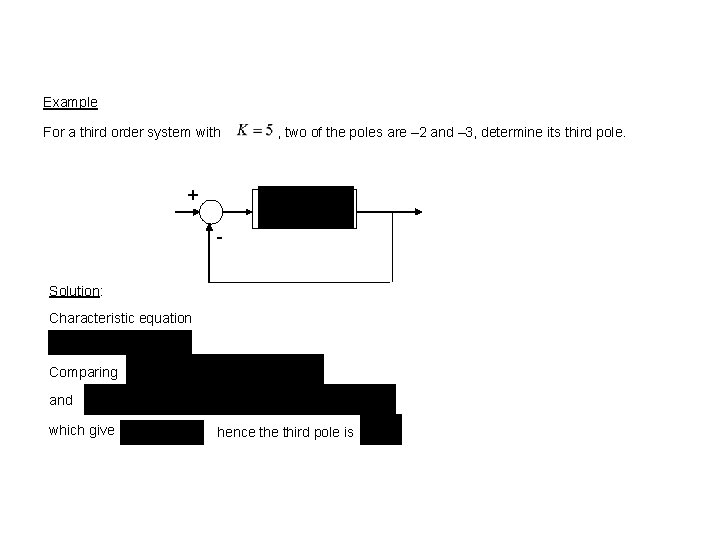
Example For a third order system with , two of the poles are – 2 and – 3, determine its third pole. + Solution: Characteristic equation Comparing and which give hence third pole is
- Slides: 39