
37 Obtaining Vital Signs and Measurements 2009 The
37 - Obtaining Vital Signs and Measurements © 2009 The Mc. Graw-Hill Companies, Inc. All rights reserved
37 -2 Learning Outcomes 37. 1 Recognize common terminology and abbreviations used in documenting and discussing vital signs. 37. 2 Describe the instruments used to measure vital signs and body measurements. 37. 3 Explain the procedure used to measure vital signs and body measurements. © 2009 The Mc. Graw-Hill Companies, Inc. All rights reserved

37 -3 Introduction n Vital signs n n Temperature Pulse Respirations Blood pressure n Body measurements n n n Height Weight Head circumference Vital signs and body measurements are used to evaluate health problems. Accuracy is essential. © 2009 The Mc. Graw-Hill Companies, Inc. All rights reserved

37 -4 Vital Signs n Provide information about patient’s overall condition n Taken at each visit and compared to baseline n Use Standard Precautions n Protected health information – HIPAA © 2009 The Mc. Graw-Hill Companies, Inc. All rights reserved

37 -5 Vital Signs: Temperature n Febrile – body temperature above patient’s normal range n n Fever – sign of inflammation or infection Hyperpyrexia – extremely high temperature Afebrile – normal body temperature Body temperature varies with time of day © 2009 The Mc. Graw-Hill Companies, Inc. All rights reserved
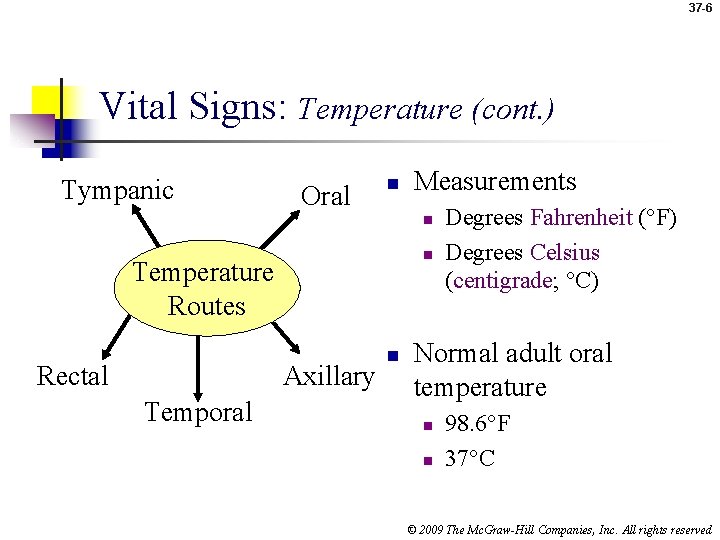
37 -6 Vital Signs: Temperature (cont. ) Tympanic Oral n Measurements n n Temperature Routes Rectal Axillary Temporal n Degrees Fahrenheit (°F) Degrees Celsius (centigrade; °C) Normal adult oral temperature n n 98. 6°F 37°C © 2009 The Mc. Graw-Hill Companies, Inc. All rights reserved
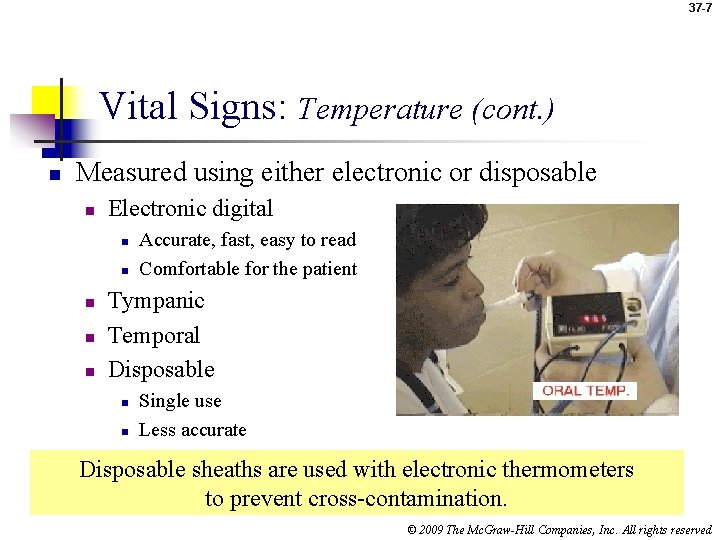
37 -7 Vital Signs: Temperature (cont. ) n Measured using either electronic or disposable n Electronic digital n n n Accurate, fast, easy to read Comfortable for the patient Tympanic Temporal Disposable n n Single use Less accurate Disposable sheaths are used with electronic thermometers to prevent cross-contamination. © 2009 The Mc. Graw-Hill Companies, Inc. All rights reserved

37 -8 Vital Signs: Temperature (cont. ) Route Normal Range ºF / ºC Sites Oral 98. 6 ºF / 37. 0 ºC Mouth Tympanic 99. 6 ºF / 37. 6 ºC Ear Rectal 99. 6 ºF / 37. 6 ºC Rectum Axillary 97. 6 ºF / 36. 6 ºC Axilla (armpit) © 2009 The Mc. Graw-Hill Companies, Inc. All rights reserved

37 -9 Vital Signs: Taking Temperatures n n Measure to nearest tenth of a degree Oral temperatures n Wait at least 15 minutes after eating, drinking, or smoking n Place under tongue in either pocket just off-center in lower jaw © 2009 The Mc. Graw-Hill Companies, Inc. All rights reserved
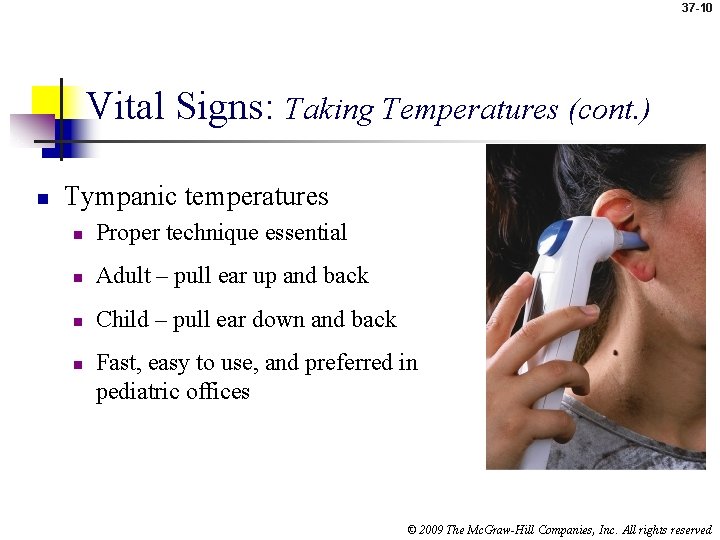
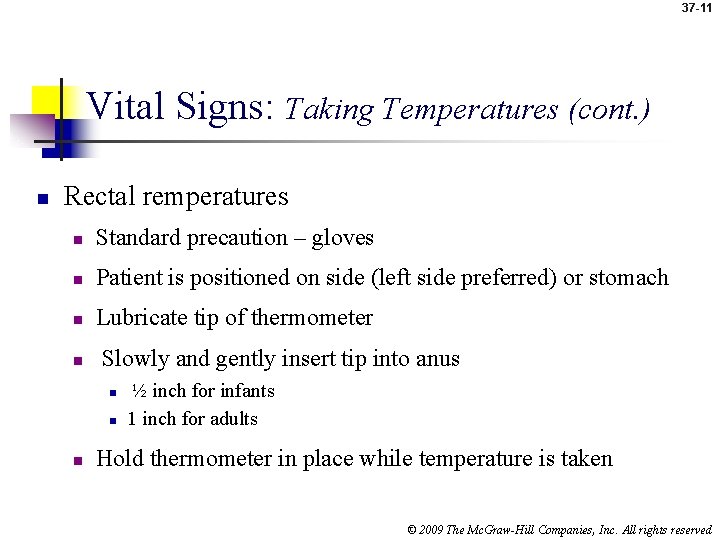
37 -10 Vital Signs: Taking Temperatures (cont. ) n Tympanic temperatures n Proper technique essential n Adult – pull ear up and back n Child – pull ear down and back n Fast, easy to use, and preferred in pediatric offices © 2009 The Mc. Graw-Hill Companies, Inc. All rights reserved
37 -11 Vital Signs: Taking Temperatures (cont. ) n Rectal remperatures n Standard precaution – gloves n Patient is positioned on side (left side preferred) or stomach n Lubricate tip of thermometer n Slowly and gently insert tip into anus n n n ½ inch for infants 1 inch for adults Hold thermometer in place while temperature is taken © 2009 The Mc. Graw-Hill Companies, Inc. All rights reserved
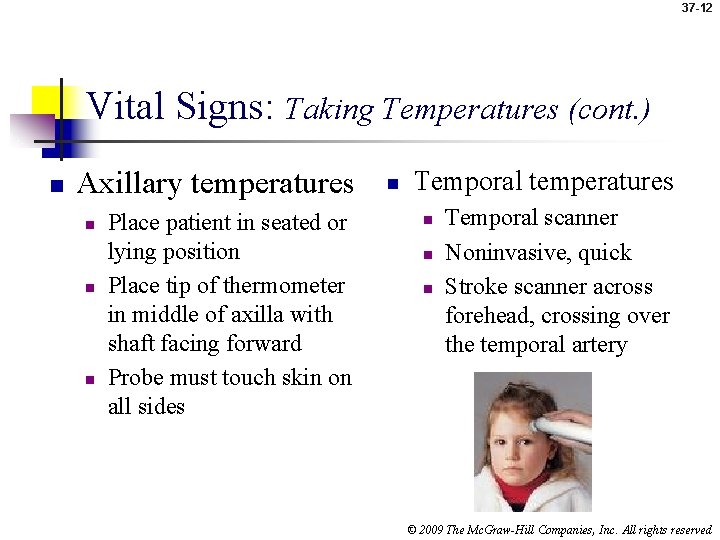
37 -12 Vital Signs: Taking Temperatures (cont. ) n Axillary temperatures n n n Place patient in seated or lying position Place tip of thermometer in middle of axilla with shaft facing forward Probe must touch skin on all sides n Temporal temperatures n n n Temporal scanner Noninvasive, quick Stroke scanner across forehead, crossing over the temporal artery © 2009 The Mc. Graw-Hill Companies, Inc. All rights reserved
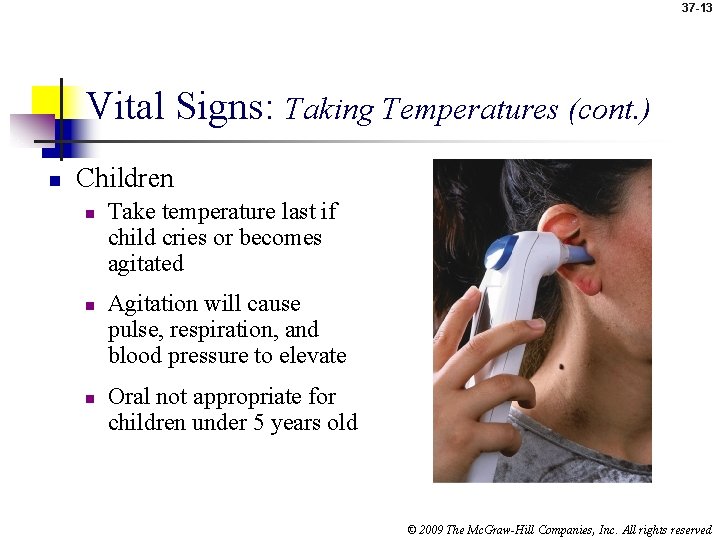
37 -13 Vital Signs: Taking Temperatures (cont. ) n Children n Take temperature last if child cries or becomes agitated Agitation will cause pulse, respiration, and blood pressure to elevate Oral not appropriate for children under 5 years old © 2009 The Mc. Graw-Hill Companies, Inc. All rights reserved
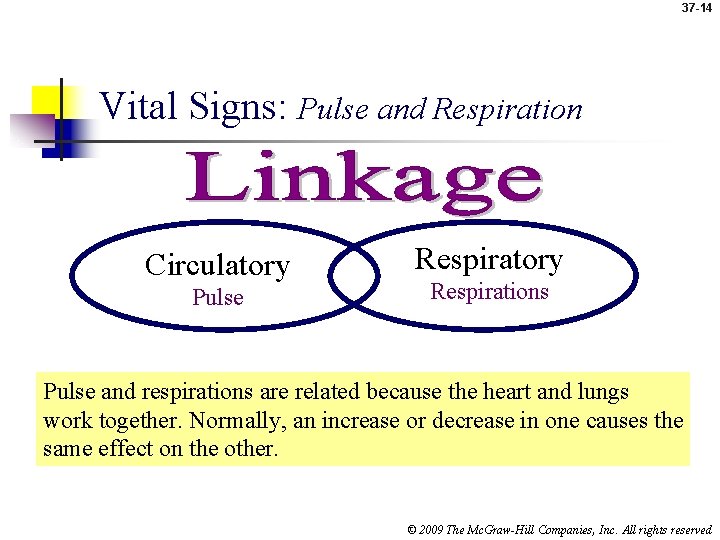
37 -14 Vital Signs: Pulse and Respiration Circulatory Pulse Respiratory Respirations Pulse and respirations are related because the heart and lungs work together. Normally, an increase or decrease in one causes the same effect on the other. © 2009 The Mc. Graw-Hill Companies, Inc. All rights reserved
37 -15 Vital Signs: Pulse n n Pulse – number of times the heart beats in 1 minute Respiration – number of times a patient breaths in 1 minute n n One breath = one inhalation and one exhalation Ratio of pulse to respirations is 4: 1 © 2009 The Mc. Graw-Hill Companies, Inc. All rights reserved
37 -16 Vital Signs: Pulse (cont. ) n n Indirect measurement of cardiac output Problems if n n Tachycardia Bradycardia Weak Irregular n Sites of measurement n n n Adults – radial artery Children – brachial artery (antecubital space) Apex of heart n n 5 th intercostal space directly below center of left clavical Apical pulse taken with a stethoscope © 2009 The Mc. Graw-Hill Companies, Inc. All rights reserved
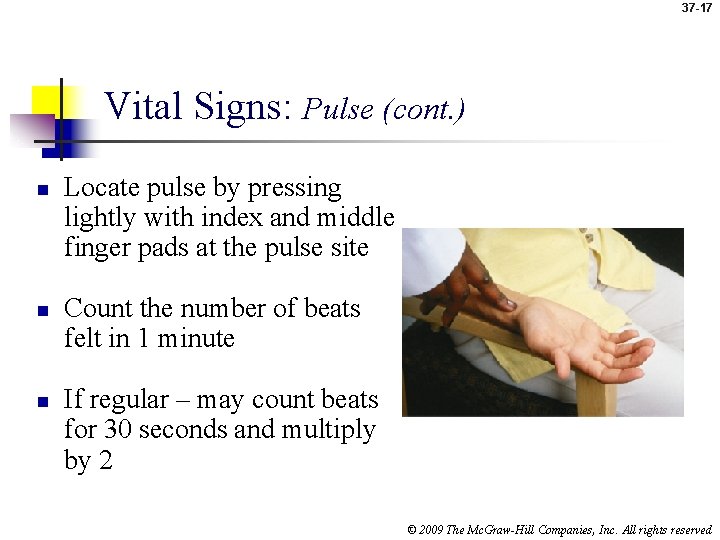
37 -17 Vital Signs: Pulse (cont. ) n n n Locate pulse by pressing lightly with index and middle finger pads at the pulse site Count the number of beats felt in 1 minute If regular – may count beats for 30 seconds and multiply by 2 © 2009 The Mc. Graw-Hill Companies, Inc. All rights reserved
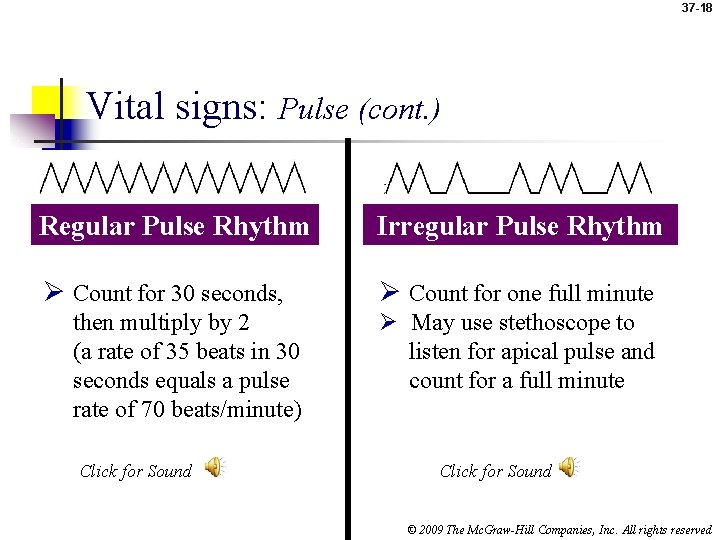
37 -18 Vital signs: Pulse (cont. ) Regular Pulse Rhythm Irregular Pulse Rhythm Ø Count for 30 seconds, Ø Count for one full minute then multiply by 2 (a rate of 35 beats in 30 seconds equals a pulse rate of 70 beats/minute) Click for Sound Ø May use stethoscope to listen for apical pulse and count for a full minute Click for Sound © 2009 The Mc. Graw-Hill Companies, Inc. All rights reserved
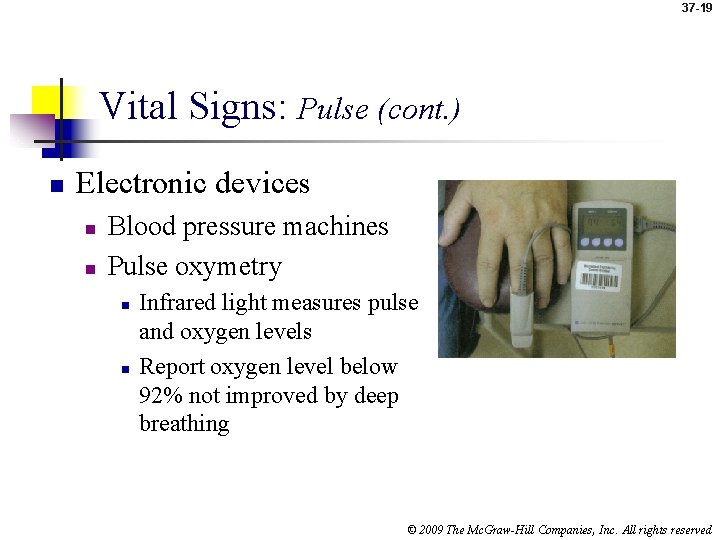
37 -19 Vital Signs: Pulse (cont. ) n Electronic devices n n Blood pressure machines Pulse oxymetry n n Infrared light measures pulse and oxygen levels Report oxygen level below 92% not improved by deep breathing © 2009 The Mc. Graw-Hill Companies, Inc. All rights reserved
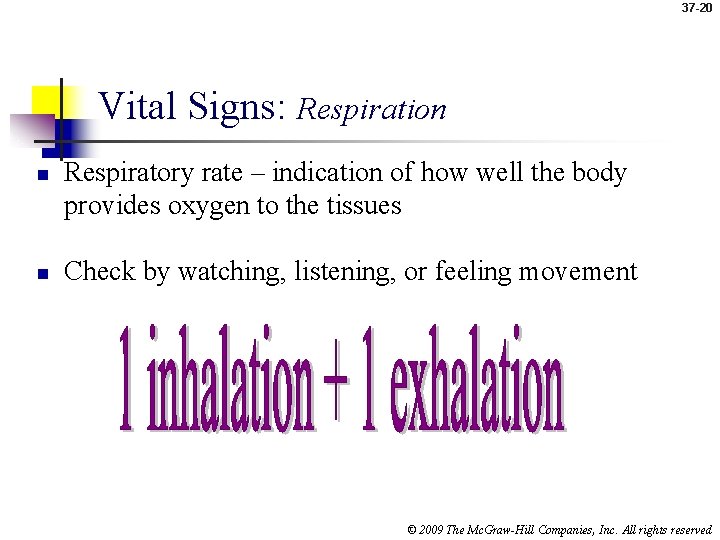
37 -20 Vital Signs: Respiration n n Respiratory rate – indication of how well the body provides oxygen to the tissues Check by watching, listening, or feeling movement © 2009 The Mc. Graw-Hill Companies, Inc. All rights reserved

37 -21 Vital Signs: Respiration (cont. ) Normal Respiratory Rates (26 -40) (20 -30) (18 -24) (16 -24) (12 -20) NOTE: Ranges reflect breaths per minute © 2009 The Mc. Graw-Hill Companies, Inc. All rights reserved
37 -22 Vital Signs: Respiration (cont. ) n Check respirations n n Look, listen, and feel for movement of air Count with a stethoscope n Count for one full minute n n n Rate Rhythm – regular Effort (quality) – normal, shallow, or deep NOTE: If patients are aware that you are counting respirations, they may unintentionally alter their breathing. © 2009 The Mc. Graw-Hill Companies, Inc. All rights reserved
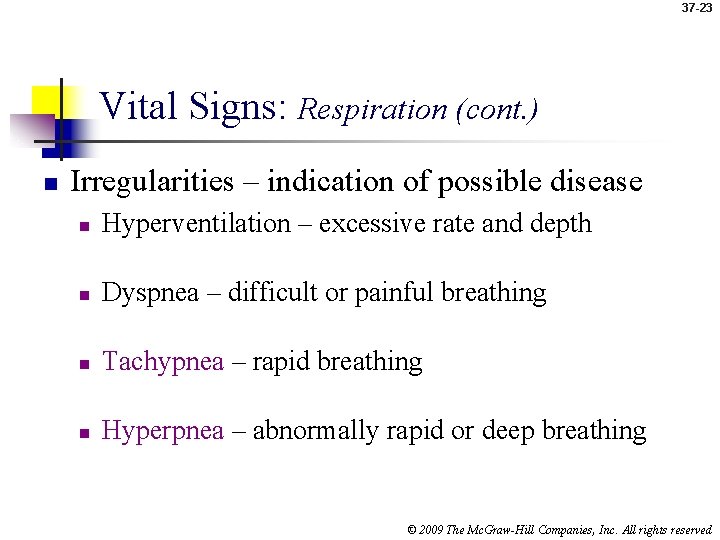
37 -23 Vital Signs: Respiration (cont. ) n Irregularities – indication of possible disease n Hyperventilation – excessive rate and depth n Dyspnea – difficult or painful breathing n Tachypnea – rapid breathing n Hyperpnea – abnormally rapid or deep breathing © 2009 The Mc. Graw-Hill Companies, Inc. All rights reserved
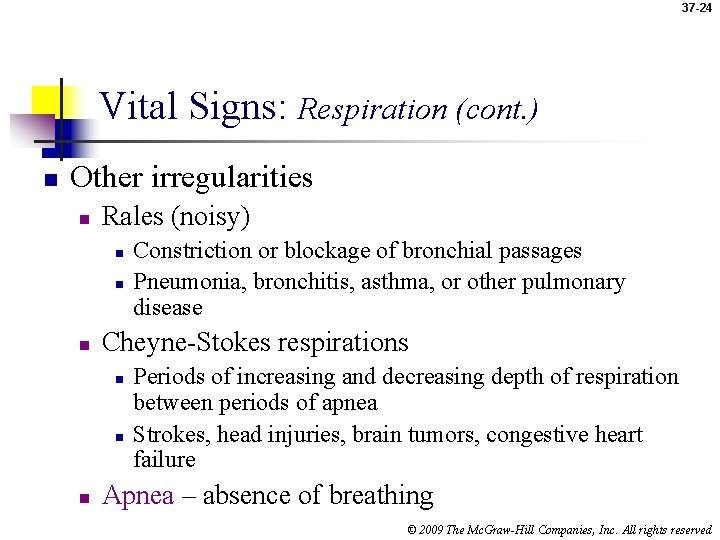
37 -24 Vital Signs: Respiration (cont. ) n Other irregularities n Rales (noisy) n n n Cheyne-Stokes respirations n n n Constriction or blockage of bronchial passages Pneumonia, bronchitis, asthma, or other pulmonary disease Periods of increasing and decreasing depth of respiration between periods of apnea Strokes, head injuries, brain tumors, congestive heart failure Apnea – absence of breathing © 2009 The Mc. Graw-Hill Companies, Inc. All rights reserved
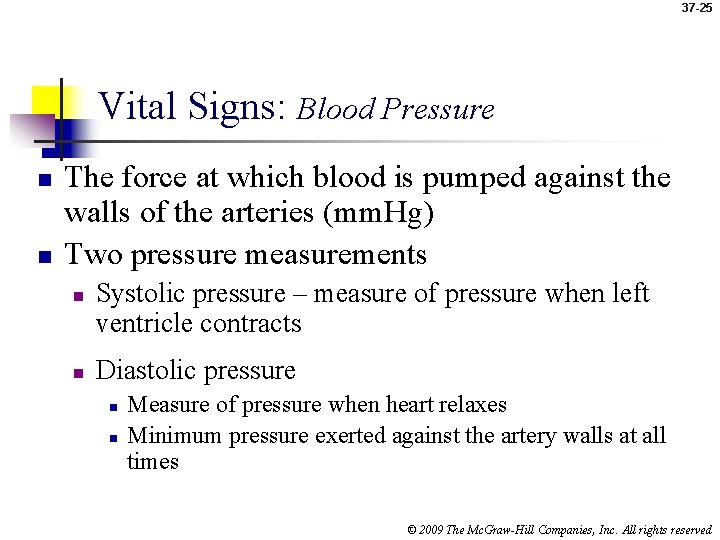
37 -25 Vital Signs: Blood Pressure n n The force at which blood is pumped against the walls of the arteries (mm. Hg) Two pressure measurements n n Systolic pressure – measure of pressure when left ventricle contracts Diastolic pressure n n Measure of pressure when heart relaxes Minimum pressure exerted against the artery walls at all times © 2009 The Mc. Graw-Hill Companies, Inc. All rights reserved
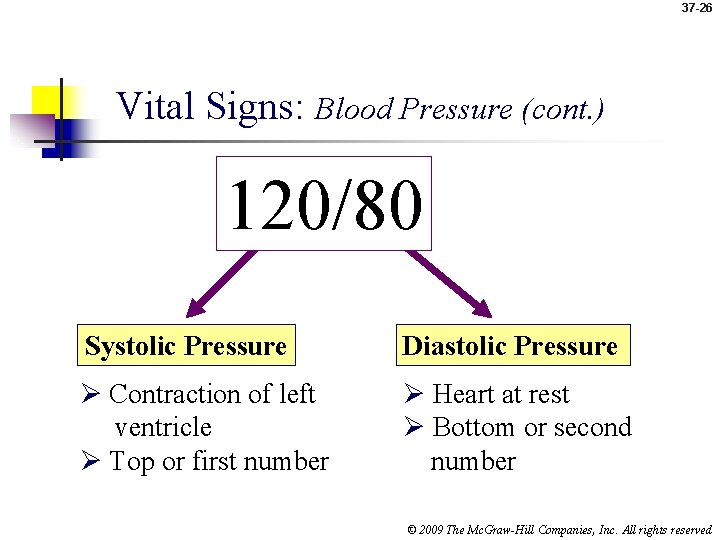
37 -26 Vital Signs: Blood Pressure (cont. ) 120/80 Systolic Pressure Diastolic Pressure Ø Contraction of left ventricle Ø Top or first number Ø Heart at rest Ø Bottom or second number © 2009 The Mc. Graw-Hill Companies, Inc. All rights reserved
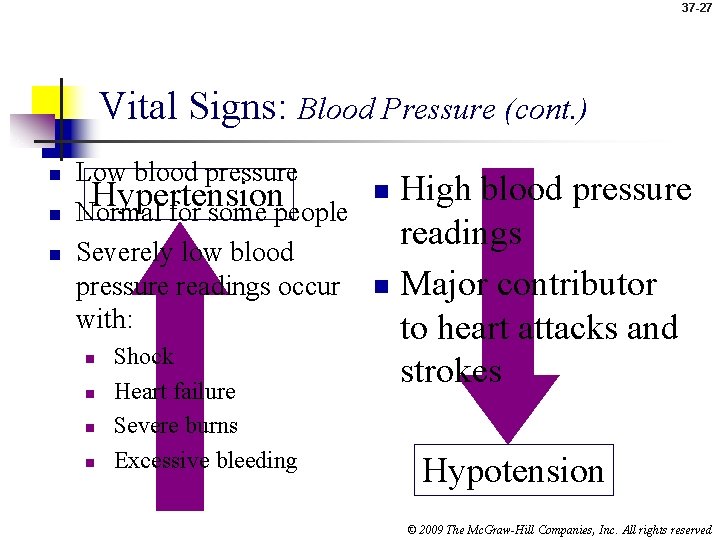
37 -27 Vital Signs: Blood Pressure (cont. ) n n n Low blood pressure Hypertension Normal for some people Severely low blood pressure readings occur with: n n Shock Heart failure Severe burns Excessive bleeding High blood pressure readings n Major contributor to heart attacks and strokes n Hypotension © 2009 The Mc. Graw-Hill Companies, Inc. All rights reserved
37 -28 Vital Signs: Blood Pressure (cont. ) n Equipment n Sphygmomanometer n Inflatable cuff n Pressure bulb or other device for inflating cuff n Manometer n Types of sphygmomanometers n Aneroid n Electronic n Mercury © 2009 The Mc. Graw-Hill Companies, Inc. All rights reserved
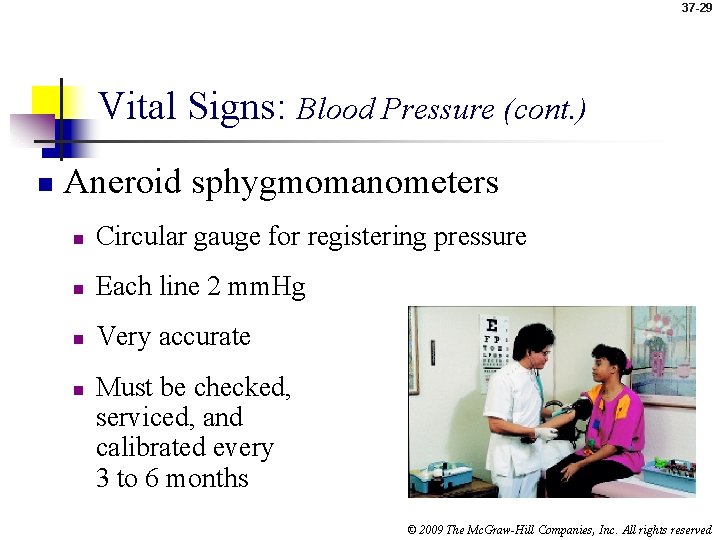
37 -29 Vital Signs: Blood Pressure (cont. ) n Aneroid sphygmomanometers n Circular gauge for registering pressure n Each line 2 mm. Hg n Very accurate n Must be checked, serviced, and calibrated every 3 to 6 months © 2009 The Mc. Graw-Hill Companies, Inc. All rights reserved
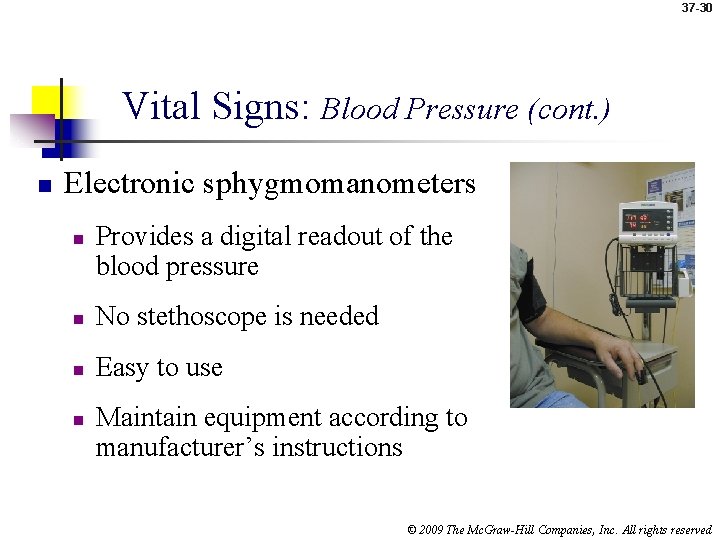
37 -30 Vital Signs: Blood Pressure (cont. ) n Electronic sphygmomanometers n Provides a digital readout of the blood pressure n No stethoscope is needed n Easy to use n Maintain equipment according to manufacturer’s instructions © 2009 The Mc. Graw-Hill Companies, Inc. All rights reserved
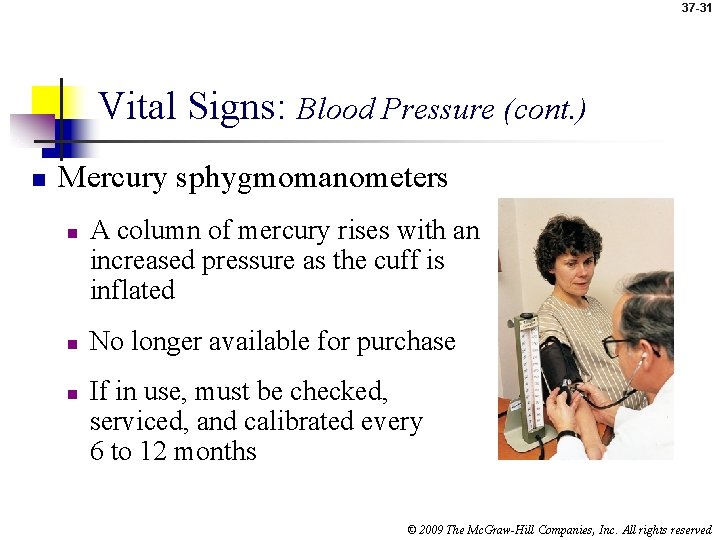
37 -31 Vital Signs: Blood Pressure (cont. ) n Mercury sphygmomanometers n n n A column of mercury rises with an increased pressure as the cuff is inflated No longer available for purchase If in use, must be checked, serviced, and calibrated every 6 to 12 months © 2009 The Mc. Graw-Hill Companies, Inc. All rights reserved
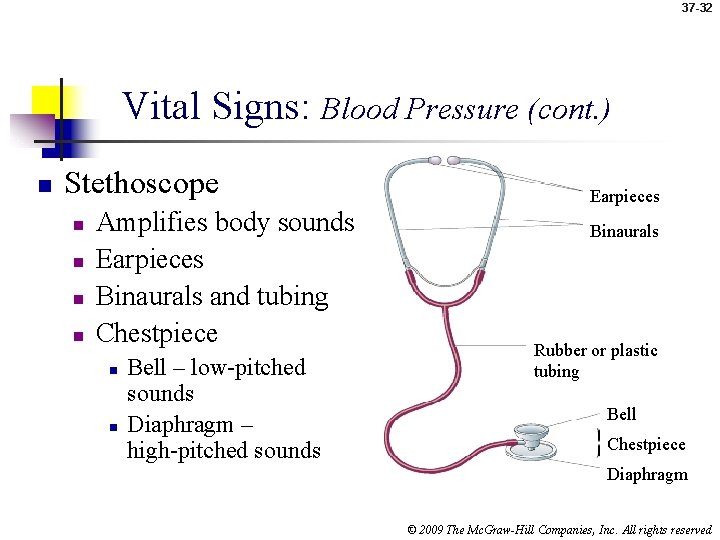
37 -32 Vital Signs: Blood Pressure (cont. ) n Stethoscope n n Amplifies body sounds Earpieces Binaurals and tubing Chestpiece n n Bell – low-pitched sounds Diaphragm – high-pitched sounds Earpieces Binaurals Rubber or plastic tubing Bell Chestpiece Diaphragm © 2009 The Mc. Graw-Hill Companies, Inc. All rights reserved
37 -33 Vital Signs: Blood Pressure (cont. ) n Measuring blood pressure n n Place cuff on the upper arm above the brachial pulse site Inflate cuff about 30 mm. Hg above palpatory result or approximately 180 mm. Hg to 200 mm. Hg Release the air in cuff and listen for the first heartbeat (systolic pressure) and the last heartbeat (diastolic pressure) Record results with systolic as the top number and diastolic as the bottom number (i. e. , 120/76) © 2009 The Mc. Graw-Hill Companies, Inc. All rights reserved
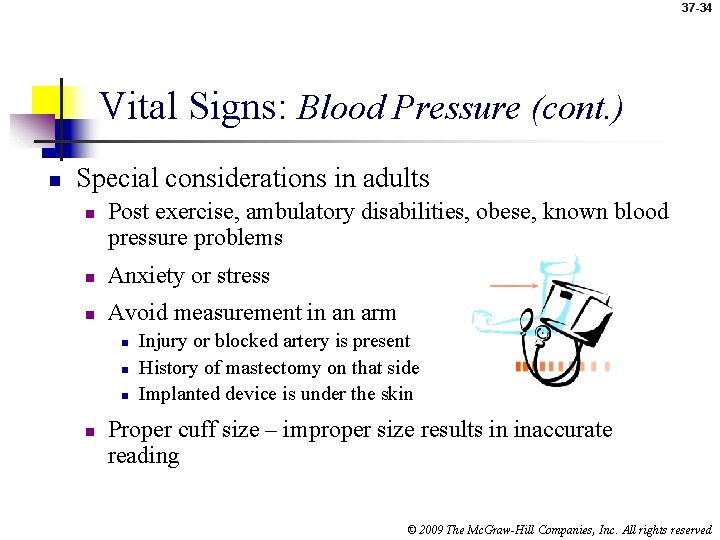
37 -34 Vital Signs: Blood Pressure (cont. ) n Special considerations in adults n Post exercise, ambulatory disabilities, obese, known blood pressure problems n Anxiety or stress n Avoid measurement in an arm n n Injury or blocked artery is present History of mastectomy on that side Implanted device is under the skin Proper cuff size – improper size results in inaccurate reading © 2009 The Mc. Graw-Hill Companies, Inc. All rights reserved
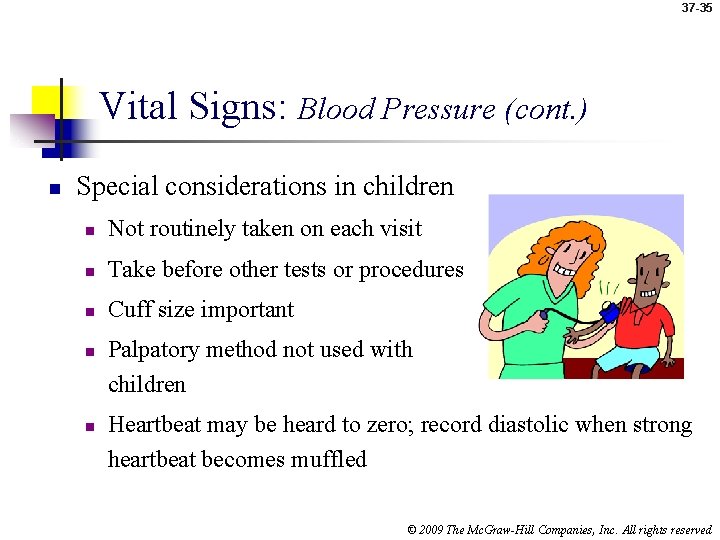
37 -35 Vital Signs: Blood Pressure (cont. ) n Special considerations in children n Not routinely taken on each visit n Take before other tests or procedures n Cuff size important n n Palpatory method not used with children Heartbeat may be heard to zero; record diastolic when strong heartbeat becomes muffled © 2009 The Mc. Graw-Hill Companies, Inc. All rights reserved

37 -36 Vital Signs: Orthostatic or Postural Hypotension n Orthostatic or postural hypotension n n Blood pressure becomes low and pulse increases when the patient moves from lying to standing Indicates fluid loss or malfunction of cardiovascular system Vital signs are taken in different positions Positive tilt test – increase in pulse > 10 bpm and a drop in BP > 20 mm. Hg © 2009 The Mc. Graw-Hill Companies, Inc. All rights reserved
37 -37 Apply Your Knowledge 1. Correct! You are about to take the temperature of a 6 -month-old infant being seen at the pediatrician’s office for vomiting and diarrhea. Which route will you use and why? What special considerations do you need to keep in mind with this specific patient situation and why? Answer: Route would be either tympanic or temporal since a 6 -month-old would not be able to hold thermometer under his/her tongue. Special considerations include: Taking the temperature after the pulse and respirations. For the tympanic thermometer, use proper technique and pull the ear down and back. Use Standard Precautions to prevent the spread of microorganisms. © 2009 The Mc. Graw-Hill Companies, Inc. All rights reserved
37 -38 Correct! Apply Your Knowledge 2. A 26 -year-old athlete visits the medical office for a routine checkup. The medical assistant takes T-P-R and obtains the following: Temperature 98. 8°F, Pulse 52 beats/minute, and Respirations 18/minute. What should the medical assistant do about these results? ANSWER: The temperature and pulse are within the normal range. The pulse of 52 is below the normal range. Check the patient’s previous vital sign results. Some patients, especially athletes, normally have a low pulse rate, so these results may be within normal limits for this patient. © 2009 The Mc. Graw-Hill Companies, Inc. All rights reserved
37 -39 Apply Your Knowledge 3. A 67 -year-old patient is in the medical office complaining of a headache. The blood pressure reading is 212/142. What should the medical assistant do in this situation? ANSWER: This blood pressure reading is very high and should be reported to the physician at once. The complaint of headache should also be reported to the physician. Hypertension is a major contributor to stroke and heart attacks. 3 FOR 3! Very Good! © 2009 The Mc. Graw-Hill Companies, Inc. All rights reserved
37 -40 Body Measurements n Adults and older children n Height n Weight n Infant measurements n Length n Weight n Head circumference Provide baseline values for current condition and enable monitoring of growth and development of children. © 2009 The Mc. Graw-Hill Companies, Inc. All rights reserved
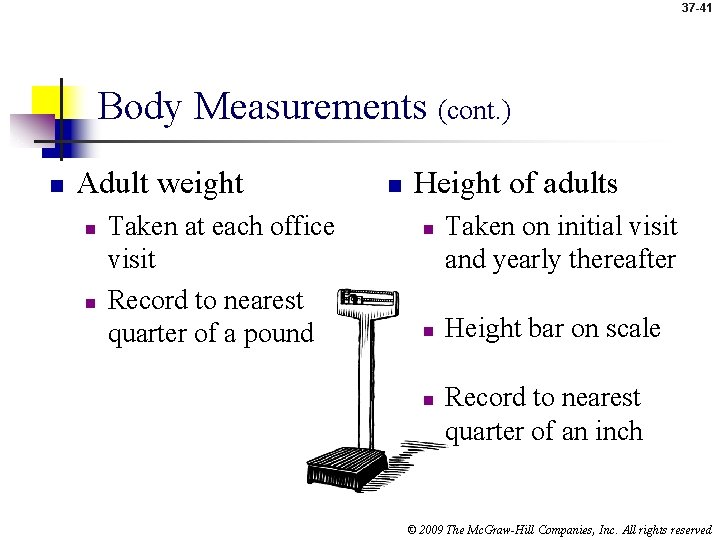
37 -41 Body Measurements (cont. ) n Adult weight n n Taken at each office visit Record to nearest quarter of a pound n Height of adults n n n Taken on initial visit and yearly thereafter Height bar on scale Record to nearest quarter of an inch © 2009 The Mc. Graw-Hill Companies, Inc. All rights reserved
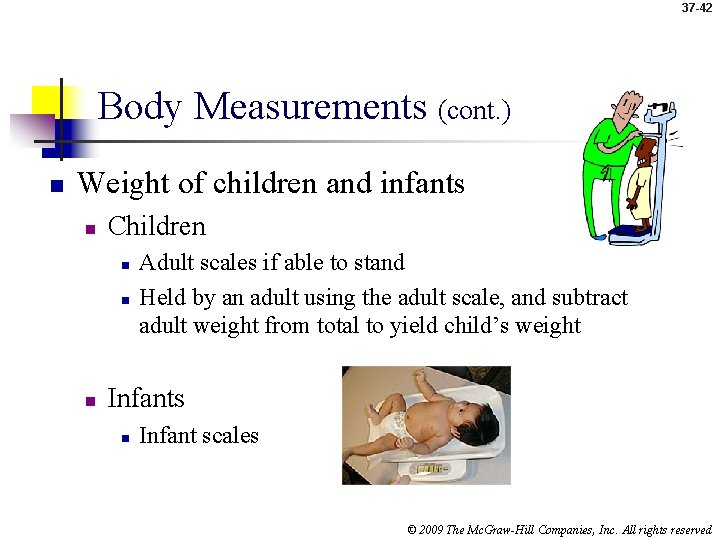
37 -42 Body Measurements (cont. ) n Weight of children and infants n Children n Adult scales if able to stand Held by an adult using the adult scale, and subtract adult weight from total to yield child’s weight Infants n Infant scales © 2009 The Mc. Graw-Hill Companies, Inc. All rights reserved
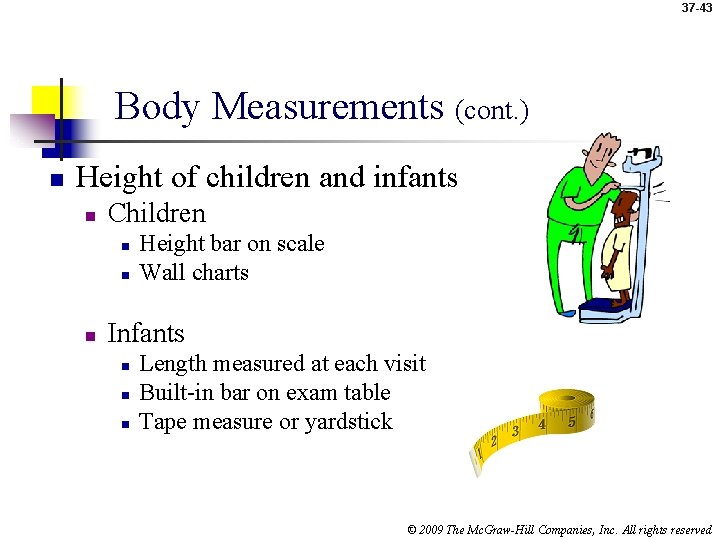
37 -43 Body Measurements (cont. ) n Height of children and infants n Children n Height bar on scale Wall charts Infants n n n Length measured at each visit Built-in bar on exam table Tape measure or yardstick © 2009 The Mc. Graw-Hill Companies, Inc. All rights reserved
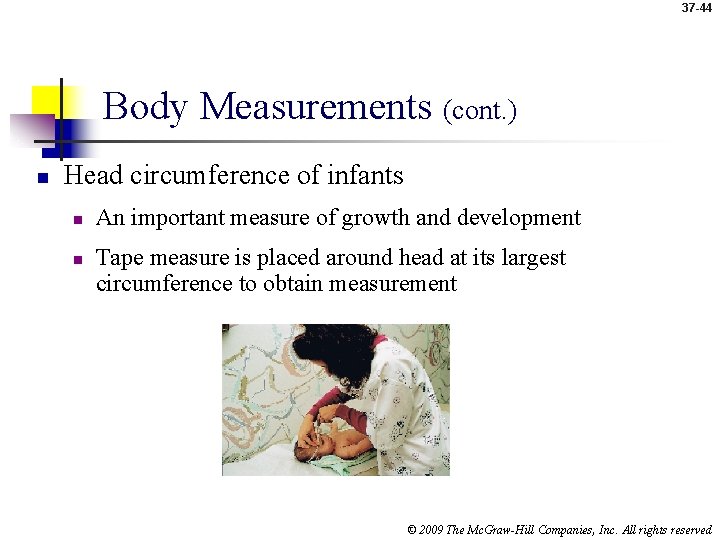
37 -44 Body Measurements (cont. ) n Head circumference of infants n n An important measure of growth and development Tape measure is placed around head at its largest circumference to obtain measurement © 2009 The Mc. Graw-Hill Companies, Inc. All rights reserved
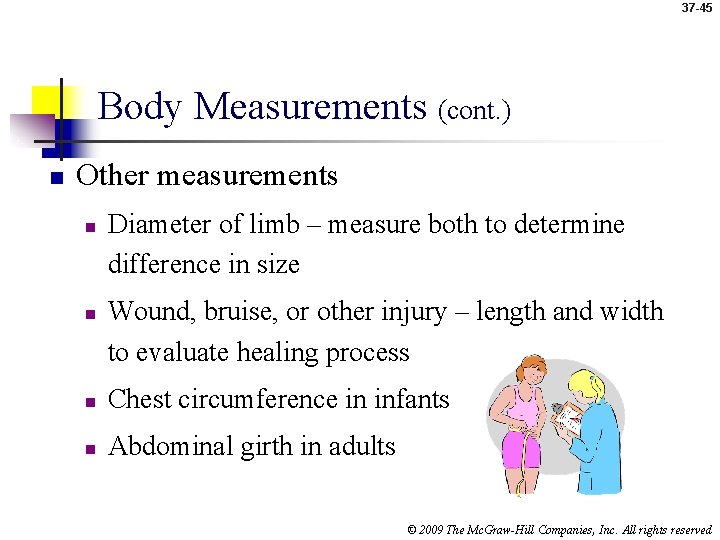
37 -45 Body Measurements (cont. ) n Other measurements n n Diameter of limb – measure both to determine difference in size Wound, bruise, or other injury – length and width to evaluate healing process n Chest circumference in infants n Abdominal girth in adults © 2009 The Mc. Graw-Hill Companies, Inc. All rights reserved
37 -46 Apply Your Knowledge The medical assistant is about to weigh a 6 -month-old infant using the infant scale. When the medical assistant places the infant on the scale she notices the diaper is very soiled. What should the medical assistant do? ANSWER: The diaper could be changed prior to weighing. However, if the infant is weighed with the soiled diaper, the medical assistant should weigh the diaper after weighing the infant and subtract the difference to obtain the infant’s accurate weight. © 2009 The Mc. Graw-Hill Companies, Inc. All rights reserved
37 -47 In Summary n Medical assistant n Measure and record vital signs, weight, and height n Information is important to patient outcomes n Accuracy of data n Proper technique n Same equipment for each measurement © 2009 The Mc. Graw-Hill Companies, Inc. All rights reserved
37 -48 End of Chapter One way to get high blood pressure is to go mountain climbing over molehills. ~ Earl Wilson © 2009 The Mc. Graw-Hill Companies, Inc. All rights reserved
- Slides: 48